
By Francois-Marie Dumas, Jean-Pierre Kreder, Pierre Jobard: with a forward by Paul d’Orléans
The oldest vehicle exhibited at the Guggenheim Museum’s ‘Art of the Motorcycle’ was presented as built in 1871: the Perreaux steam velocipede, built by Louis-Guillaume Perreaux. Well, 1871-ish: the original Perreaux was indeed built in 1871, but the machine loaned for the exhibit (by the Musée de l’Île-de-France at the Château de Sceaux near Paris) was likely a second-generation version, rebuilt c.1874, after the original model exploded the tubing from the boiler, which was not strong enough to withstand the steam pressure. Historians of Perreaux’s remarkable creation suggest this existing machine was revised, using various improvements Perreaux had patented in 1872, ’73, and ’74, finishing its current state. Whether the original chassis was re-used I don’t know: if the original pedal-cycle on which the steam engine is mounted (typically credited to Michaux, but apparently not a Michaux cycle) is the same as the 1871 prototype, then perhaps 1871 is still an appropriate date? In any case, Perreaux then turned to building a tricycle version using the same type of motor, but the only survivor of his motorized inventions is the machine we see today.
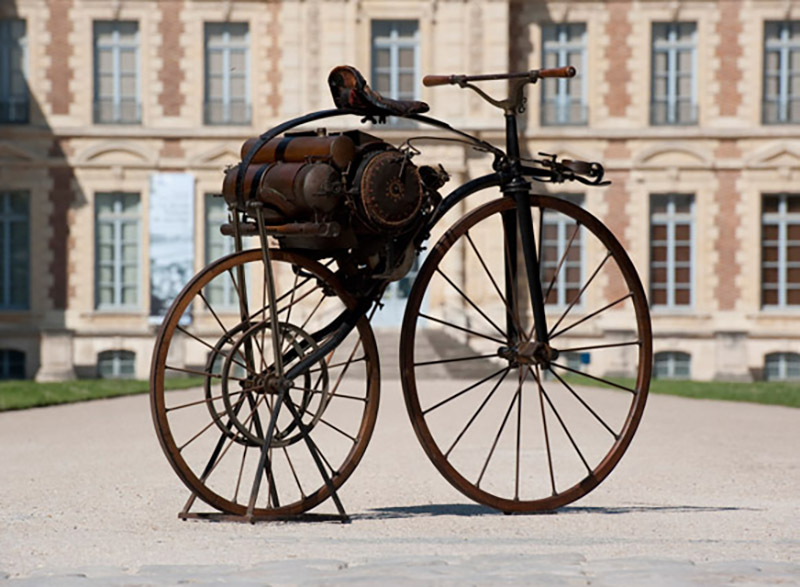
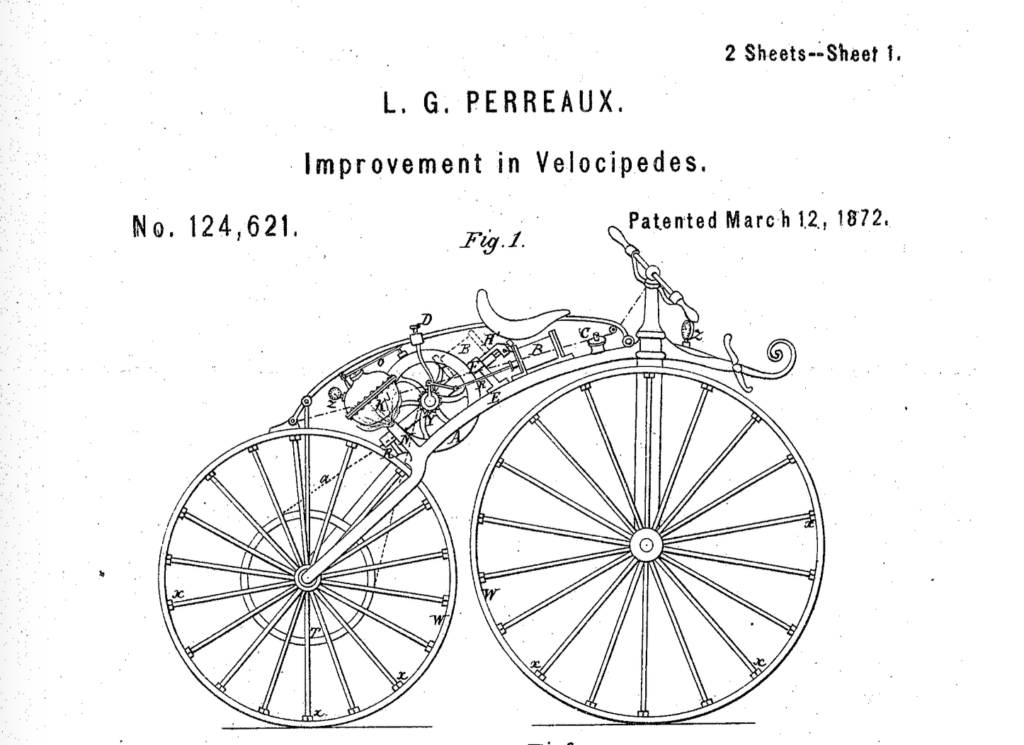
The story of the Perreaux’s explosive history wasn’t told in the Guggenheim catalog, because it wasn’t known: there’s been a lot of research around this motorcycle over the past 28 years, including a whole book published on Perreaux, by Claude Reynaud. So, let’s say the remarkable Perreaux seen at the Guggenheim was built ca.1873, very early indeed in the history of motorcycles. The only extant motorcycle claimed to be older than the Perreaux is Sylvester H. Roper’s steam velocipede, built ca.1867 in Boston, and on display for many years in the Smithsonian Museum. The only reason the Roper wasn’t included in the Guggenheim exhibit was the substantial bond required by the Smithsonian to loan it: $1Million, which was a lot of money for a motorcycle in 1998, and in fact represented a significant percentage of the exhibit’s entire budget. So, the curators said ‘thanks but no thanks, we know of one almost as old, in France…’ There is some disagreement still over what machine is older: while the Roper was indeed built before the Perreaux, Sylvester H. Roper didn’t patent this invention, as he did with his revolving shotgun and other devices, while Louis-Guilllame Perreaux patented many versions of his ‘improved velocipedes’, apparently intending to mass-produce them, though Francois-Marie Dumas notes the Perreaux is unstable to the point of being unrideable, and was likely demonstrated without a rider, using a horse ring with a pivoting rod fixed in the center.

THE PERREAUX STEAM VELOCIPEDE IS NO LONGER UNIQUE!
Text and photos by Jean-Pierre Kreder and Pierre Jobard
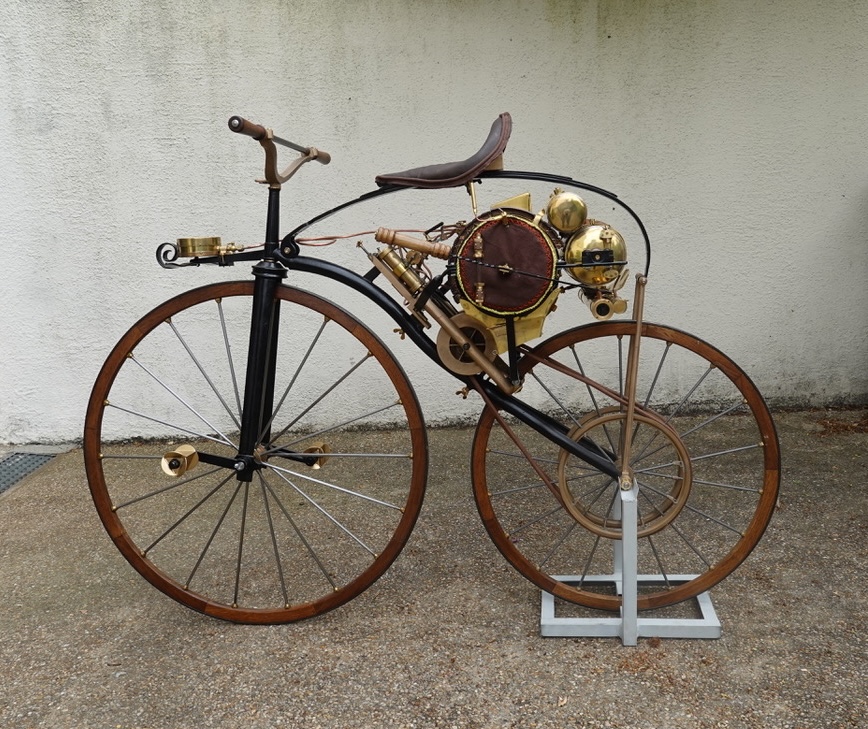
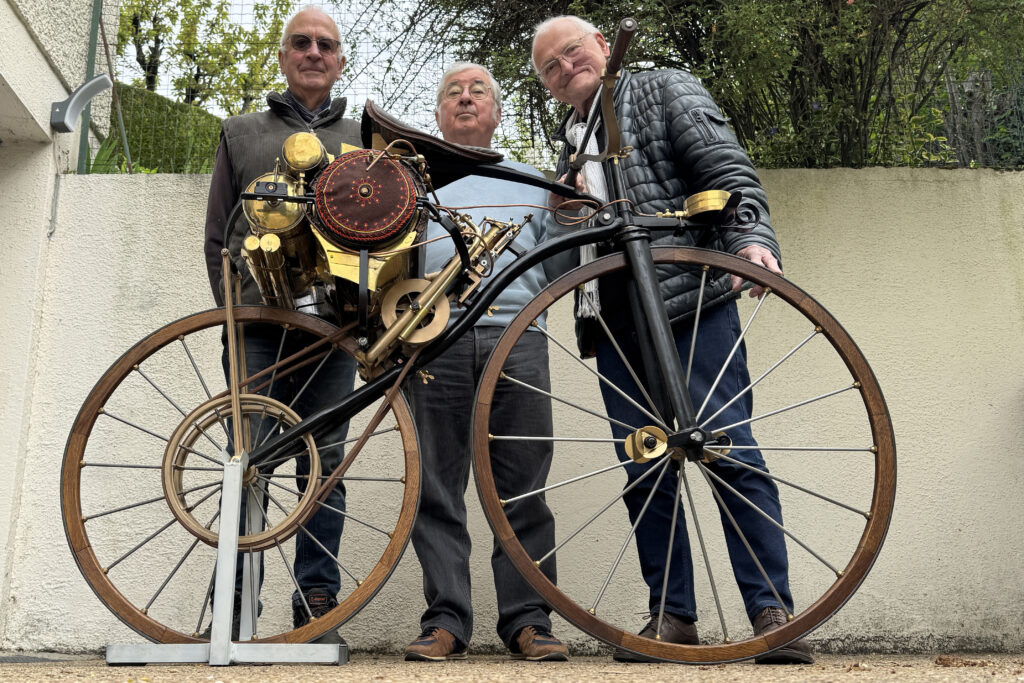
Indeed, a team of enthusiasts gave it a twin brother and here is the story of the construction of the replica of this machine, considered among the first motorized two-wheelers of all time, therefore the ancestor of the motorcycle.
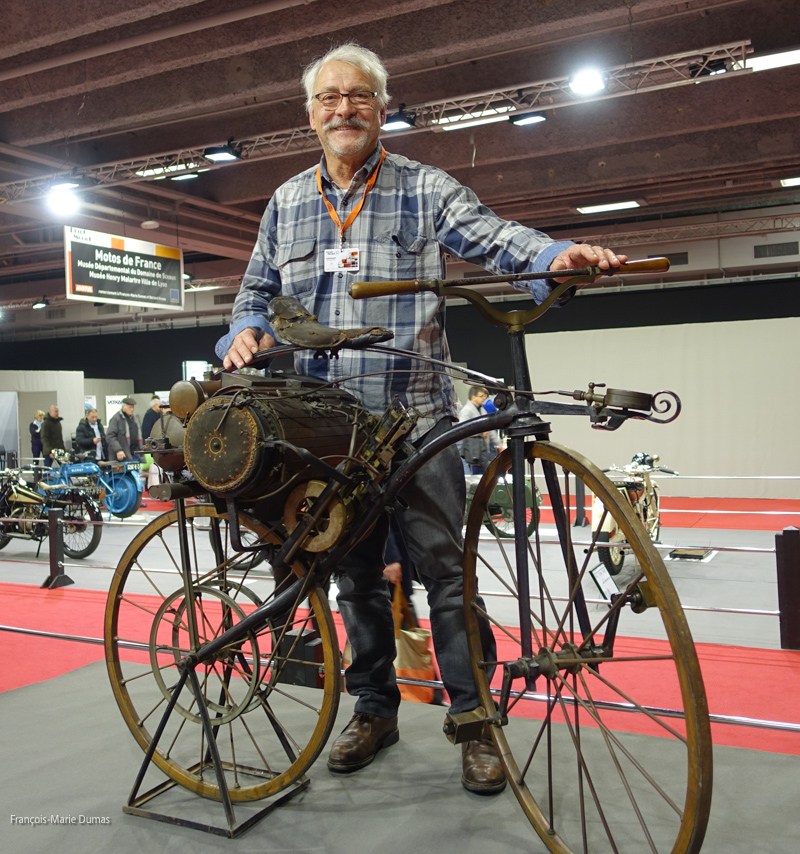
In 1868, Louis-Guillaume Perreaux, a Gadzarts (Arts et Métiers engineering school) graduate, filed a patent for a “high-speed” velocipede. This design was refined six times [several versions were imagined: first with a human-powered inertial drive, then an in-wheel electric motor, and finally a steam – ed], culminating in 1871 with a steam-powered velocipede, the sole surviving example of which has been housed at the Musée du Domaine de Sceaux (Hauts-de-Seine) since 1964. Contemporary accounts attest to the machine’s actual operation. While largely forgotten until the 1990s, Claude Reynaud, a renowned historian of early two-wheeled vehicles, rediscovered the invention and published a book on it. The velocipede was then brought back into the public eye and exhibited on several occasions in increasingly prestigious venues, such as the Guggenheim and Rétromobile exhibits [the Perreaux was part of a remarkable display – curated by Francois-Marie Dumas – at the 2017 Rétromobile in Paris – ed.].
The challenge of creating a replica
Passionate about restoring vintage motorcycles, Jean-Pierre Kreder embarked on an incredible challenge at the end of 2019: building a replica of Louis-Guillaume Perreaux’s steam velocipede. Given the scale of the project, a team effort was essential, and he enlisted the help of two school friends, Philippe Kauffmann and Pierre Jobard (who had already begun exploring the idea), along with Jean-Luc Molle, a friend of Philippe Kauffmann. Other skilled individuals joined the team as they encountered difficulties.
Studying before getting your hands dirty
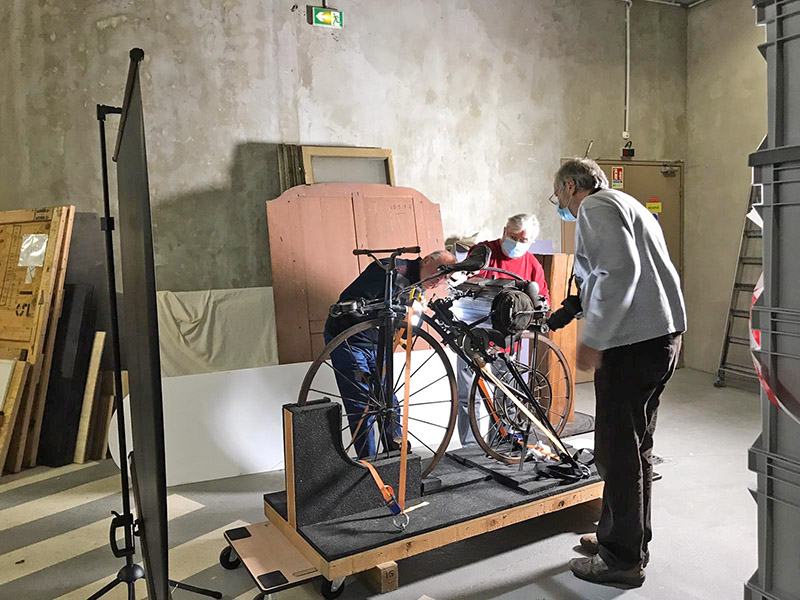
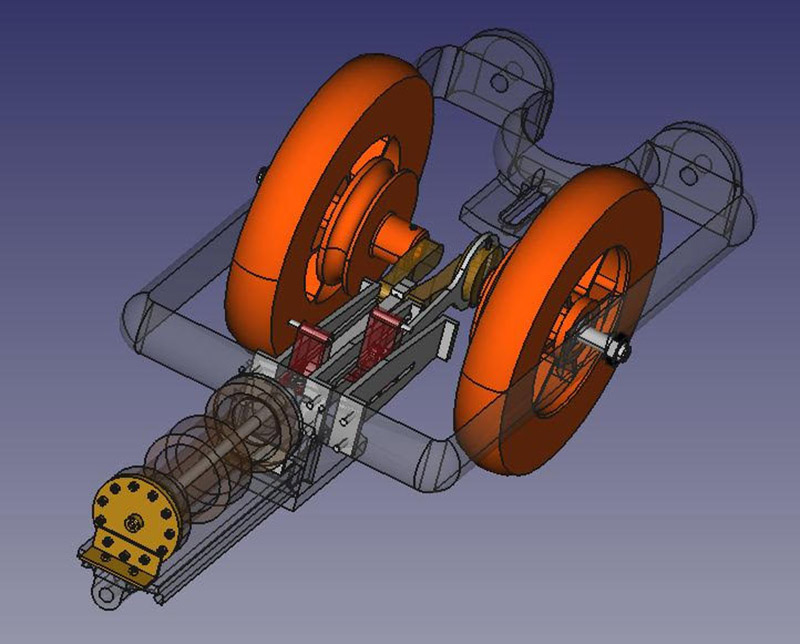
Research conducted online and with specialists in the field (historians, patents, the state of art and techniques in the 19th century, the history of the velocipede, etc.) has created a documentary resource that, incidentally, has allowed us to correct certain historical errors concerning both Pierre Michaux [inventor of the pedal-cycle – ed.] and Louis-Guillaume Perreaux’s invention. Contacts with the Sceaux Museum intensified with the arrival in 2020 of a new curator who was enthusiastic about the project and granted access to the museum’s storage facilities to compile a photographic record and carry out all necessary dimensional measurements. In exchange, plans and operating procedures will be provided to the museum to enrich the velocipede’s historic record. A phase of reverse engineering then began, involving technical exchanges, the development of hypotheses to be substantiated, but also uncertainties, since until now we have only known the visible parts of the machine!
Taking advantage of the COVID-19 lockdown, Philippe Kauffmann created a 3D CAD model of the velocipede and the set of plans necessary for building the replica. Regarding the “invisible” parts, these questions were answered during the dismantling of the original velocipede by museum-certified experts in the summer of 2023, as part of a mechanical restoration, when the Perreaux was to be included in the “Free Wheels” exhibition for the Paris 2024 Olympic Games. Physical participation in the dismantling process by these enthusiast artisans allowed for the accurate creation of plans for all the sub-assemblies comprising the steam generation system.
The achievement
From the outset of this project, it was decided to create two replicas of the velocipede: the first was sponsored by Claude Reynaud, the ‘discoverer’ of the velocipede in the Sceaux Museum, and owner of a fabulous cycling and motorcycle museum (Château de Bosc in the Gard region). Intended to be a static display, this first replica was not built to be functional, and could be finished more quickly. The objective of a second replica is to demonstrate the proper dynamic operation of the entire assembly, and to validate its technical specifications. The design and construction of this first replica required more than six years of work (2020-2026).
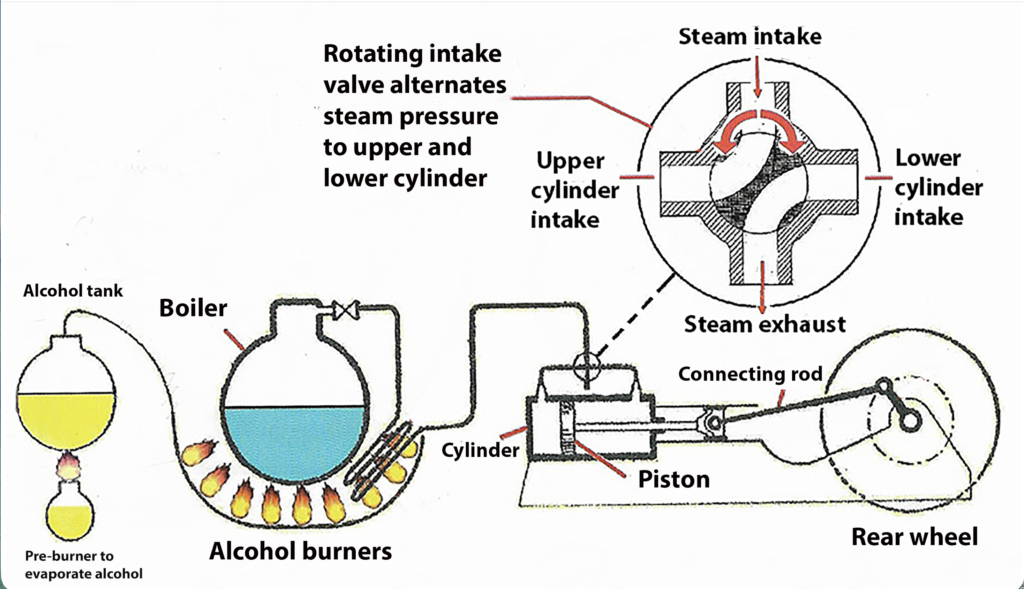
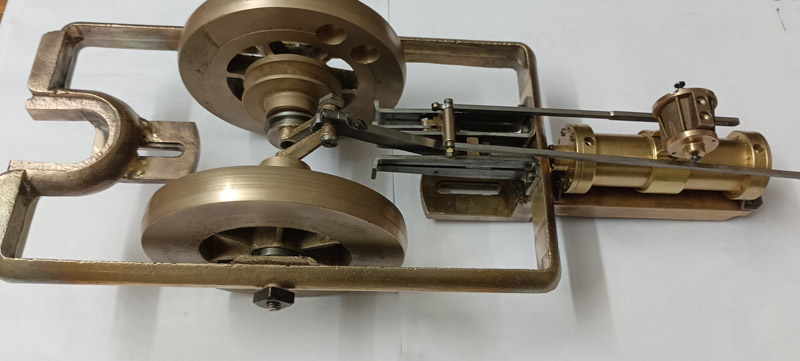
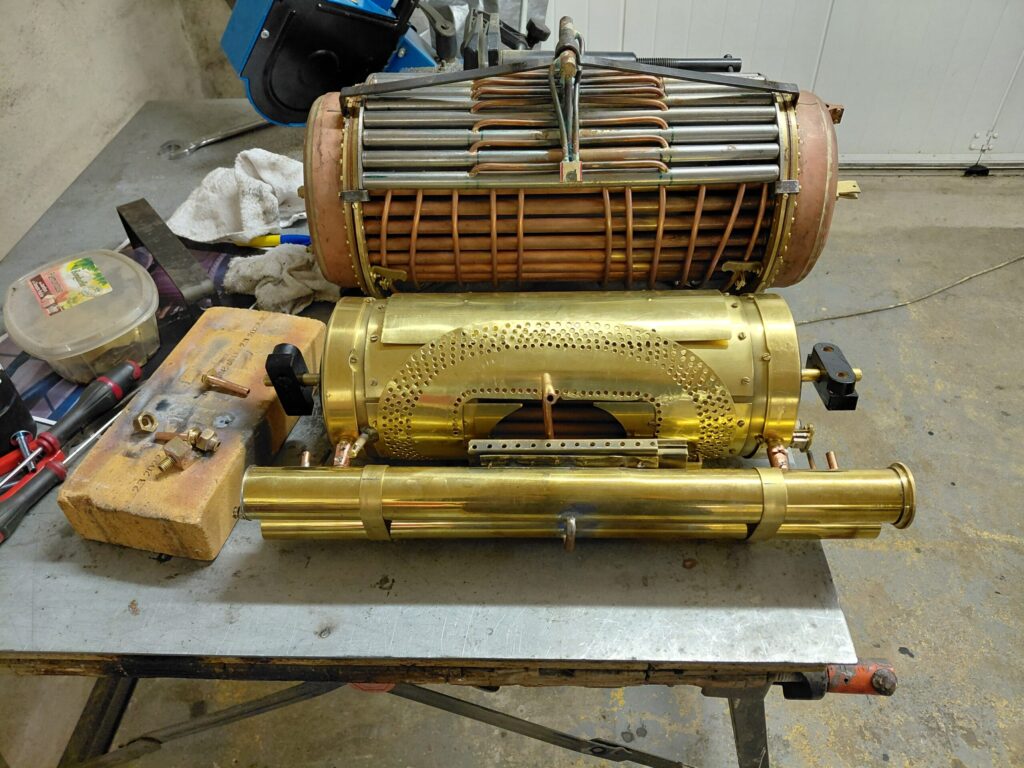
The manufacture of replica velocipedes is broken down into three sub-assemblies: the frame, the engine, and the steam generator. These components require a wide variety of techniques, and here is an overview.
Conventional machining (turning, milling, drilling) of mechanical parts and finishing of cast parts. Carried out in the workshops of Jean-Pierre Kreder (all parts) and Jean-Luc Molle (engines).
Forge and metalwork (various supports, suspension springs, wheel rims). Entrusted to Jean-Pierre Kreder for the supports, suspension springs and wheel rims (determining the optimum tightening).
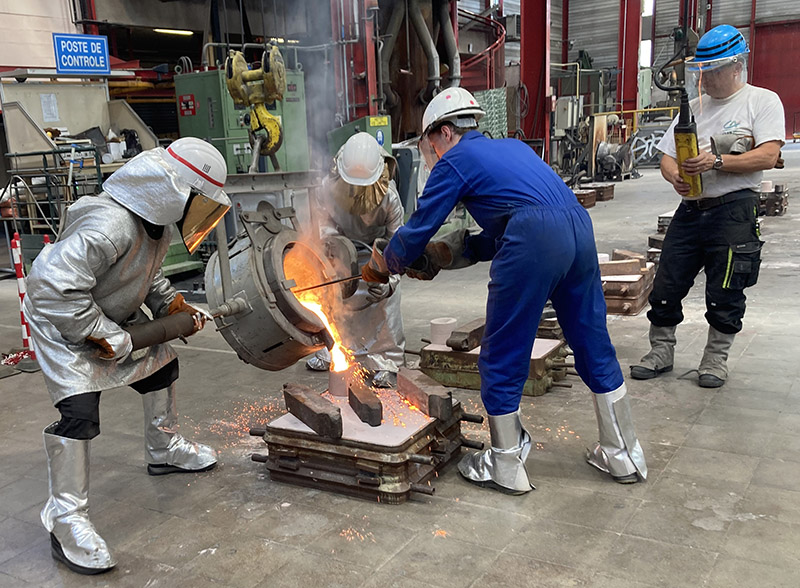
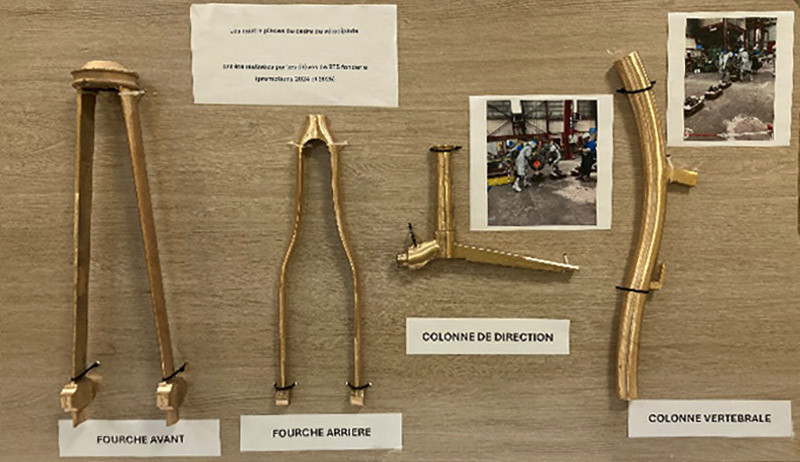
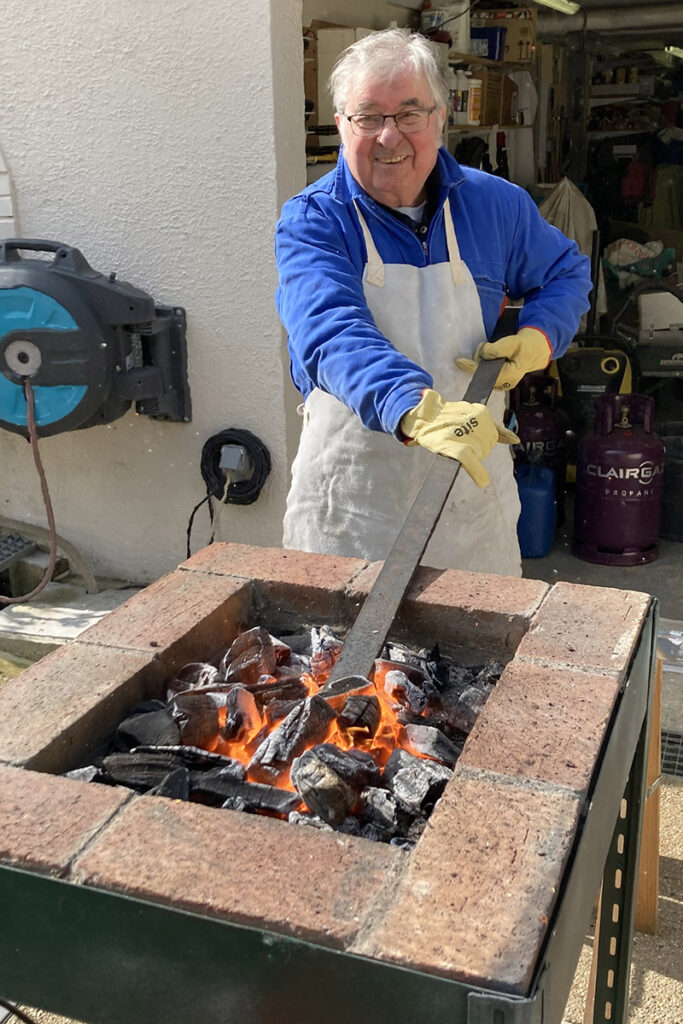
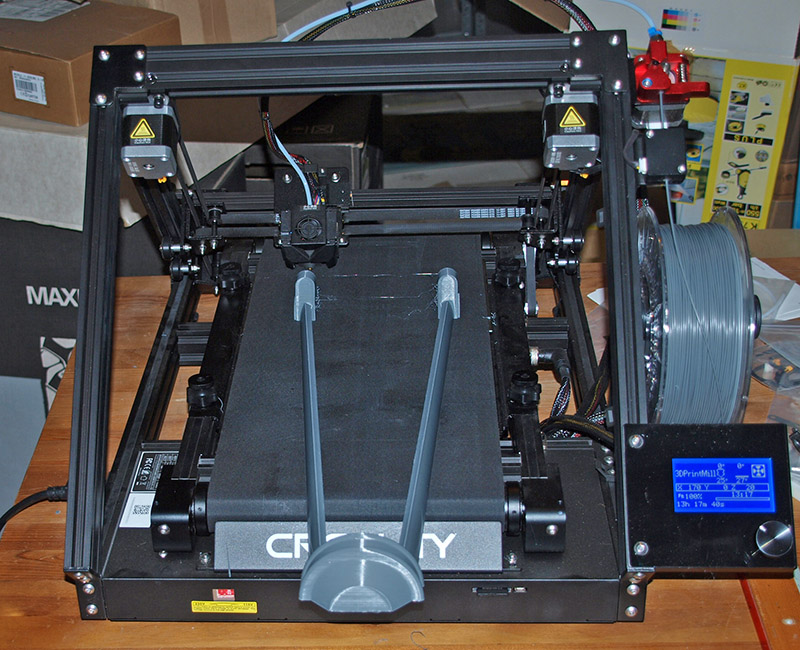
Bronze casting (structural elements, handlebars, and various other parts). The models were 3D printed in PLA resin in the Auvergne region by Philippe Kauffmann. Models with non-standard dimensions required the investment in a specialized 3D printer. Smaller parts were sand-molded and cast in Jean-Pierre Kreder’s workshop, which was equipped with a propane furnace (1100°C) and a crucible. The large and complex frame components of the velocipede were produced in partnership with the Marie Curie vocational high school in Nogent-sur-Oise, which, among other things, offers BTS (Advanced Vocational Training Certificate) programs in foundry work. The constraints of the curriculum meant that the project required two academic years for completion.
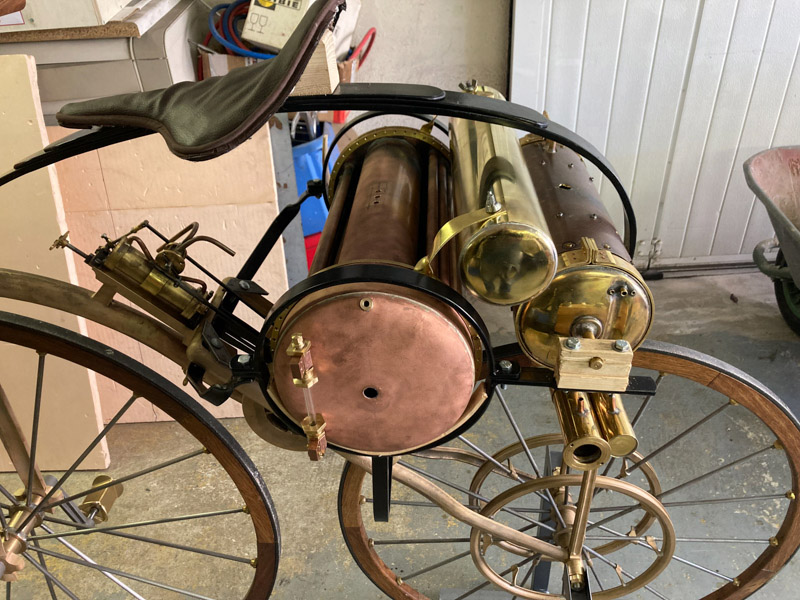
Metalwork, welding and piping of the sub-assemblies of the thermodynamic unit and the saddle were also carried out in the workshop of Jean-Pierre Kreder, assisted by Pierre Jobard, using hand tools and machines such as rolling machines, bending machines, drills, milling machines, and homemade stamping tools. The sub-assemblies were brazed with tin-lead or silver, using an oxyacetylene torch.
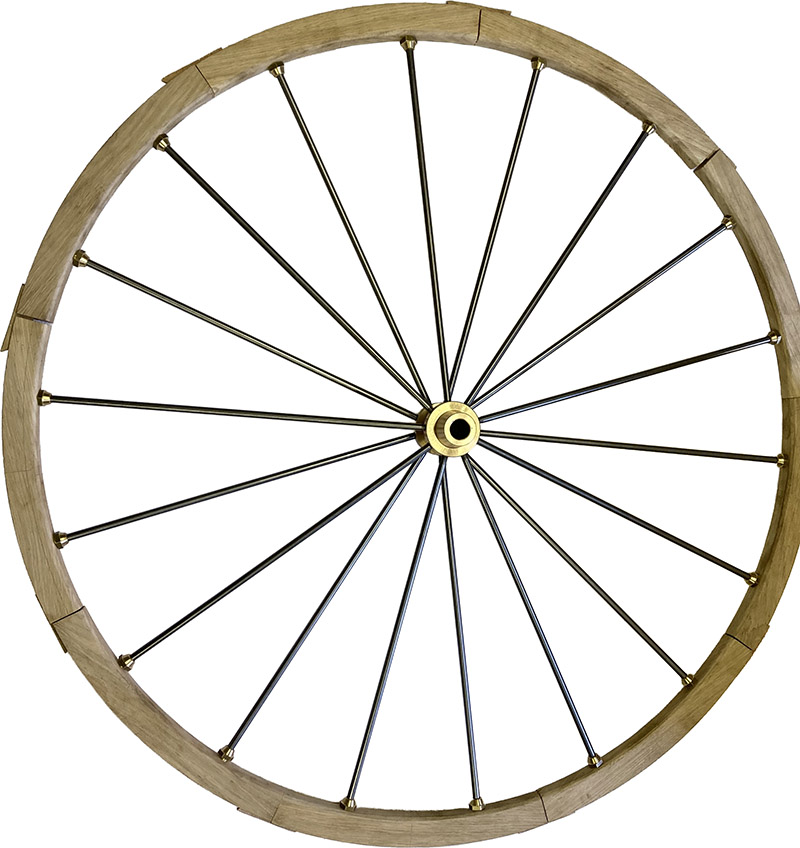
Carpentry (wheel rims, boiler insulation). The wheel rims are made from oak segments assembled and held together by metal spokes and hoops. The boiler insulation consists of a brass sheet and fir slats enclosing a layer of ceramic fabric—admittedly anachronistic, but a significant improvement over the fibrous insulation used in the 19th century.
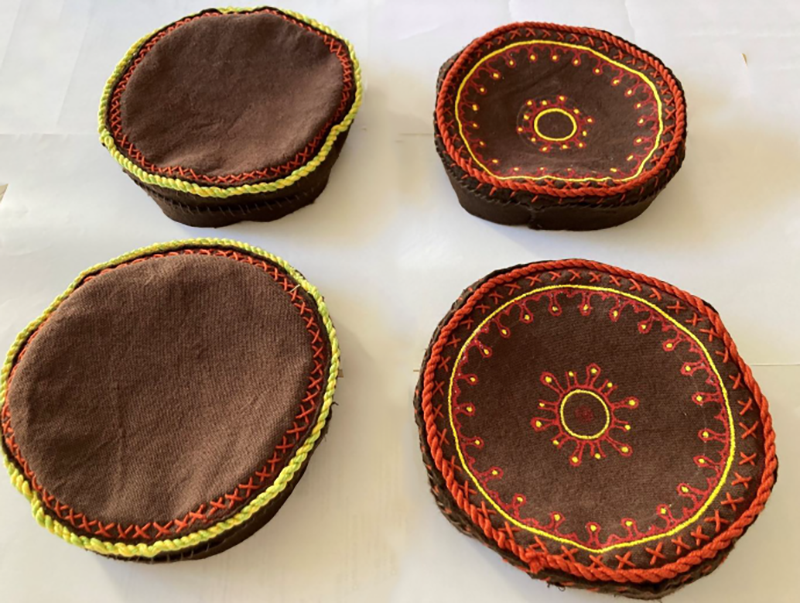
Saddlery and textile work (decorative elements of the boiler) are also noteworthy. The saddle consists of horsehair stuffing and a leather covering, fixed to a formed sheet steel frame. The boiler’s decorative elements are hand-painted on dyed woolen canvas. Twisted cords enhance the assembly of the various panels.
Finally, the surface finishes (polishing, sandblasting, painting).
After all that, what still remained was to assemble all the disparate pieces and build the first replica, a phase that was completed in early 2026. An initial dry run assembly allowed for the correction of inevitable errors, particularly those due to inaccuracies in the photographic measurements, and for the sizing and positioning of certain supports and pipes. The final assembly has just been completed; the velocipede is ready to be delivered to its commissioner, Claude Reynaud, after it is displayed at the Coupes Moto Légende vintage races in Dijon on May 23/24, 2026.
Summary of the operation: approximately 6500 hours of work, plus 1500 hours of 3D printing, 2500 emails and/or phone calls…
And soon, the first test in over 156 years of a Guillaume-Perreaux
Combustion and heating tests on the steam model are continuing with the construction of the functional onboard steam generator. Next will come testing and assembly on the second replica. The presentation of a dynamic, functional replica is planned for 2027, 156 years after the first presentation of the original… This adventure, which remains primarily technical and human, has spanned six years, marked by numerous questions, successes, difficulties, and setbacks, but rich in relationships with many stakeholders. Stay tuned for the running videos!

Related Posts
The Motorcycle Portraits: Dave Roper
He's the king of vintage racing, the…
Sylvester Roper’s Steam Velocipedes
Sylvester H Roper built his first steam…
Steam Cycles and History
How we see history changes with time.…
Hi Paul,
many thanks – the author of the replica will be delighted. I transmit to them your report, as they are more informed than me to suggest eventual corrections. Thanks for your added presentation.
Quite difficult to judge which is the first one between Roper and Perreaux. The « advantage » of the Perreaux is that it was patented and subject of many reports in the press and the concept was, from the start, to create and sell a motorised two-wheeler. That was, we guess, not Roper’s goal.
Apparently, the Perreaux was almost unrideable because of its high centre of gravity and a very flexible frame ! But the team dismantled the engine of the original, and all the parts are quite worn out. It is mostly probable that Perreaux demonstrated his machine in a ‘manege’, with the motorcycle turning around without a rider and fixed with a bar to the centre of the manege.
The Perreaux was exhibited in the international PHILADELPHIA fair, you would be a great support for the team if you can find any report or image.
All the best
François-Marie Dumas
Well … first off … thank you to Mssr. Dumas for finally breaking the silence ‘ round these here parts with a brilliant article on what was a ground breaking machine and its just as brilliant re-creation ! I’d love to see a video or three of that re-creation in action
————————————————–
But ….on The Vintagent and M/C websites in general front . What the hell is ( not ) going on ? The Antipodes have resorted to re-posting years old articles … this’n’s been non existent for days on end … the sites … well … lets just say they’s been crawling up they own posteriors cause they aint got nuthin to say ..
So what is the deal oh great a mighty PdO ?
Yes an extraordinary feat, to accurately re-create such an ancient and important piece of history. There will be videos when the second replica is a runner, and we’ll share them.
Regarding a few days of quiet here, there’s a simple answer: life happens. We’re back on the case now. Can’t answer for our cousin websites.
Oh well … as long as all is well on your side …. I’m good …
I’ll look forward to seeing that beast run when its up and running and videos are available … cause yeah .. from original inception to re-creation …. that is one serious piece of effort !
Toodles … and keep on keeping on !
T
FYI .. one of those ‘ cousins is one you had a serious discussion(s) with in the past about the futility of trying to post each and every day etc … so though not absorbed by them … seems like the lesson you tried to teach is coming home to roost in their backyard . Sad thing is … I could in a 100 words or less tell them exactly how to fix things … all using the legacies of both the long gone print and current online versions of their efforts … but hell .. if they won’t listen to you … they sure as hell won’t listen to me … despite my … errr … lets call it .. ahh … financial well being in the face and despite of global enshittification .
Ahhh .. sigh .. Age & Wisdom … beautiful things until that damnable Cassandra’s Curse ( Greek Mythology ) comes crashing down on the party .
Oh well … you tried yer damnedest PdO … you really did !
😎
Bonjour,
Très bel article, cependant il serait bon de citer vos sources lorsque vous utilisez un schéma soumis à droit d’auteur. En l’occurrence, le schéma décrivant le fonctionnement du moteur à vapeur de cet article est issu du livre de M. ROLLAND Guy (“Perreaux la première moto de l’Histoire” paru aux éditions de l’Ornal ISBN 979-10-91664-04-2).
Merci de préciser vos sources ou bien de retirer le schéma.
Bien cordialement.
Merci pour votre message: cet article ayant été republié avec l’aimable autorisation de François-Marie Dumas, j’ignorais la source du dessin. C’est désormais chose faite, et l’image est créditée comme vous l’avez suggéré.
Thank you for your note: as this article was republished with permission by Francois-Marie Dumas, I did not know the further source of the drawing. Now I do, and the image is credited as you suggest.
Bonjour, M. Jean Rolland,
Mes excuses pour ne pas avoir cité ma source relative au schéma issu du livre de votre parent, le regretté Guy.
Je le connaissais évidemment bien, et il avait été un des déclencheurs de notre aventure de la réplique du vélocipède Perreaux.
Cordialement,
Pierre JOBARD
“My apologies for not citing my source for the diagram, which came from your relative’s book, the late Guy.
I knew him well, of course, and he was one of the driving forces behind our Perreaux velocipede replica project.”
Bonjour Messieurs,
Merci pour vos réponses et bravo à vous pour avoir réussi à mener à terme ce magnifique projet que j’espère bientôt pouvoir admirer de mes propres yeux !
Au plaisir de vous rencontrer.
Jean ROLLAND