“Milwaukee: The Party is Over,” “Harley is Screwed,” “The Painful Downfall of Harley-Davidson.”  These are just a few of the recent headlines about America’s longest-running, historically significant, mythical motorcycle manufacturer.  From traditional news media to motorcycle publications and social media, everyone, it seems, has an opinion about the meaning of Harley-Davidson’s recent transitions in leadership, decisions about where and what to manufacture, and the future of the company. The decline in Harley-Davidson’s motorcycle sales is significant but not completely out of line with motorcycle industry figures generally. The company reported a worldwide sales decrease of 12% between 2024 and 2025, with North America dropping 13%, and Asia-Pacific 15%, with Latin America seeing a 2% increase. Total motorcycle sales in the US dropped 7.6% in 2025, while in Europe, sales declined approximately 13%, with Italy retaining its position as the largest market, down only 7.3%, while Spain saw sales actually increase by 7%.[1]
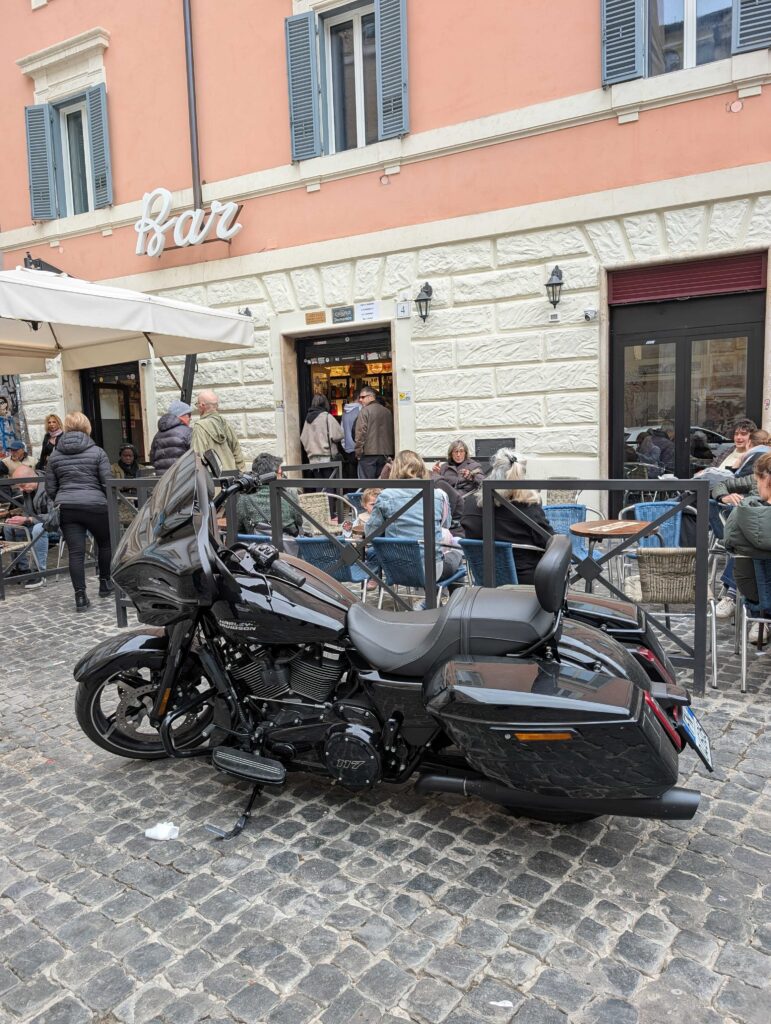
A random Harley-Davidson bagger outside a bar in Piazza San Calisto in Rome. [Wendy Pojmann]
Clearly, the industry is in flux, and manufacturers are clamoring to make sense of what is happening amid a political climate of unpredictable tariffs, a Middle East war affecting oil prices, changing environmental policies, and many other political and economic uncertainties. On my recent trip to Italy, I was interviewed about my new book Connected by the Street: The Myths and Realities of Motorcyclists in the USA and Italy during the Motodays trade fair in Rome.[2] The Italians were interested in my take on all this news about Harley-Davidson. As well, Americans have been asking me about the impact of Trump administration policies on Harley-Davidson sales in Italy. While I don’t want to oversimplify an assessment of the current situation, I can confidently assert that Harley-Davidson has a very different history and culture in Italy than in the United States, which means the two countries are affected by current events in different ways. The company’s story dates back to 1903, when William S. Harley and Arthur Davidson combined forces to build a motorized bicycle. The Harley-Davidson Motor Company was founded in 1907 and, in 1909, produced its first V-Twin engine, which came to characterize the brand.  Alongside many other early motorcycle makers, such as Indian, Curtiss, and Excelsior-Henderson, Harley-Davidson was interested in innovation, speed, and growing its sales and distribution networks in the US. A similar process was underway in Italy, with brands such as Frera, Gilera, and Bianchi advancing technology and engineering.

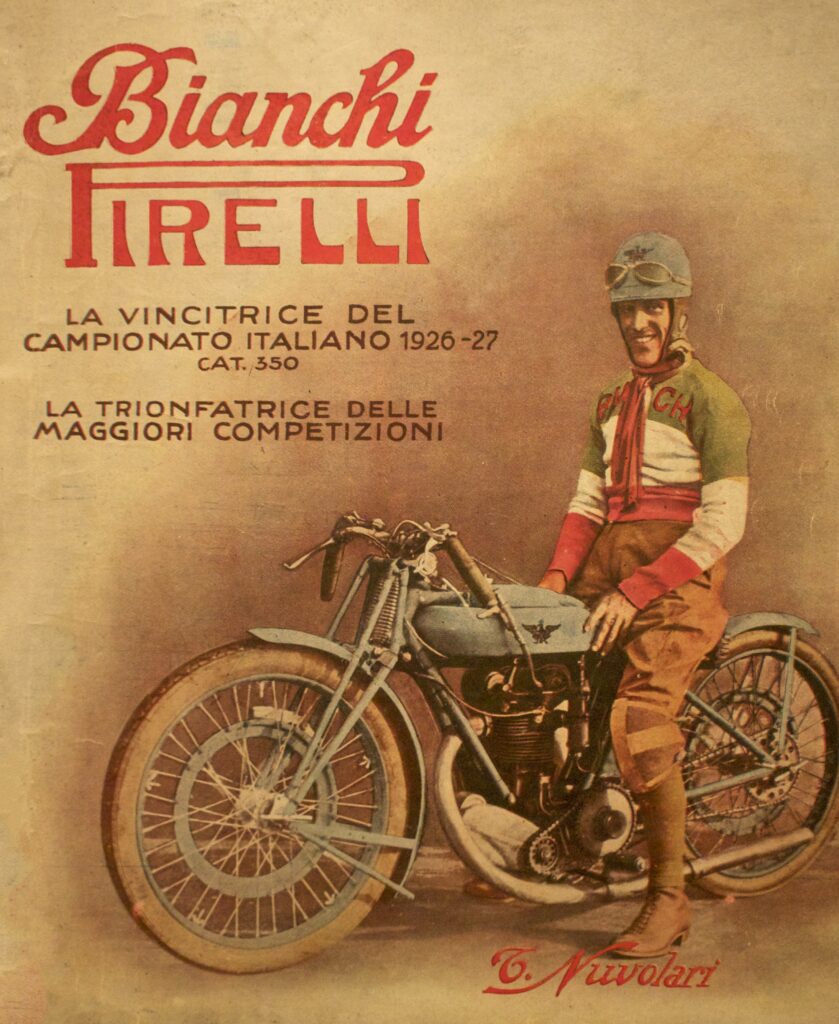
A 1927 Bianchi poster featuring Tazio Nuvolari as the new Italian Champion, who would later become a legendary World Champion on 4 wheels. The Bianchi Freccia Celeste (blue arrow) was a sophisticated DOHC single-cylinder machine with minimal suspension and dummy rim brakes! Note hte hand oiling pump mounted on the tank, pushing lube directly to the camshafts. [Aldo Carrer Archive]
During World War I, Italy imported American motorcycles to support its war effort, including Harley-Davidsons. Although the iconic photograph of American GI Roy Holtz entering Germany on a Harley at the armistice in November 1918 became emblematic, that image was not widely circulated until the closing years of World War II. Harley-Davidson lacked a comprehensive European sales network in the interwar period [there was also a tariff war between the US and Europe starting in the mid-1920s that effectively killed sales of Harley-Davidson, Indian, et al. in Europe – ed].

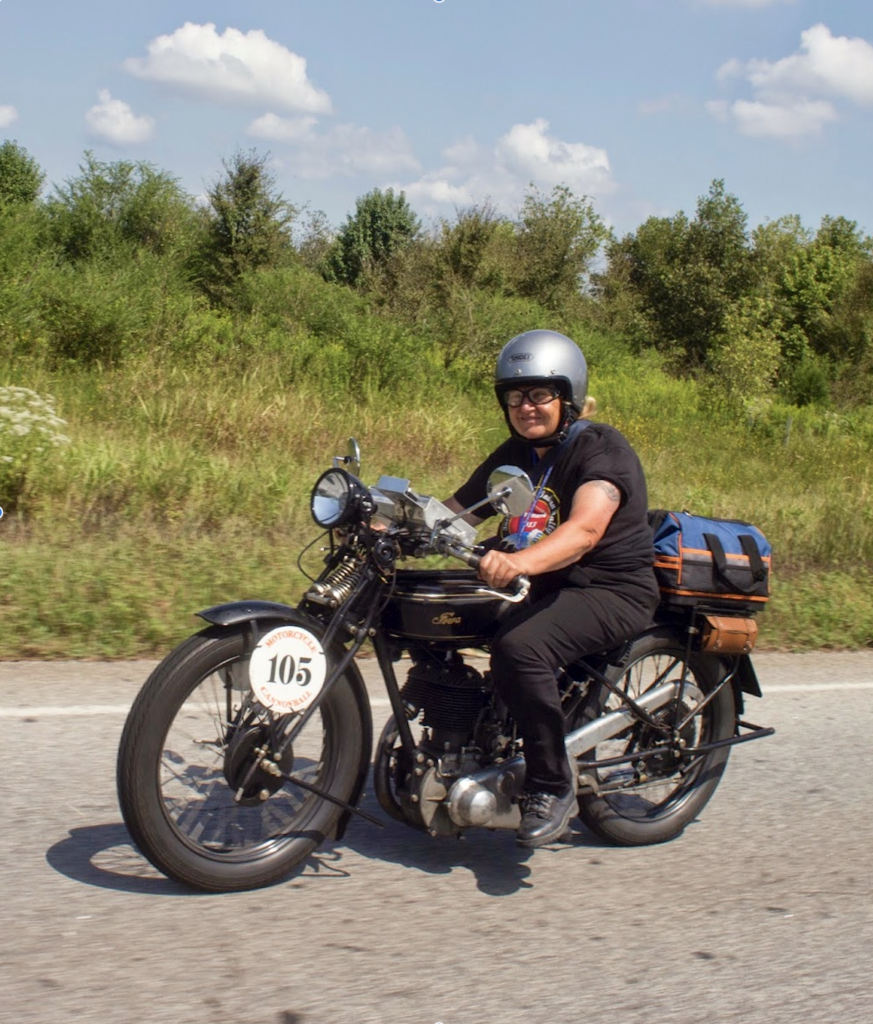
Claudia Ganzaroli of Rimini Italy, rode her 1928 Frera 500SR F-head single in the 2014 Cannonball: one of many dozens of Italians brands with a significant local history, but are little known abroad. [Paul d’Orléans]
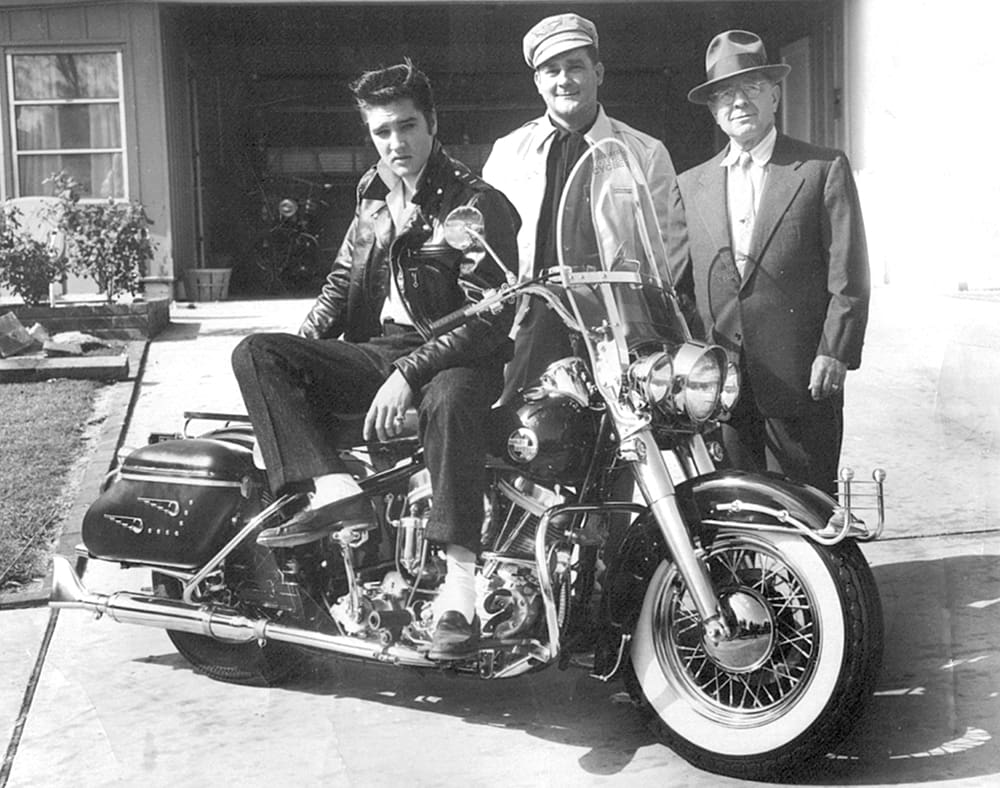
However, several significant Italian manufacturers emerged in the period, most notably Moto Guzzi in 1923, which rose to become Italy’s leading motorcycle company and whose models were important during World War II.  After World War II, the two countries underwent recovery periods that further shaped their motorcycle industries: Indian foundered and ceased production in 1953. Harley-Davidson, successfully introduced new models, such as the Panhead, and got them into the garages of postwar superstars like Elvis Presley. H-D excelled at marketing an image of rugged, war-proven machines that were comfortable and perfectly suited for cruising along America’s new interstate system, with the romance of the open road a balm for returning veterans. Harleys became a symbol of freedom, masculinity, and American might as the Cold War emerged.

While US riders got large chrome motorcycles in the 1950s, Italians had to settle for high performance small-displacment machines. But the image of Elvis Presley on a new 1959 Harley-Davidson Panhead burned in the minds of Italians. [Wikipedia]
If there is one point of convergence between the United States and Italy, it lies in the enduring myth of Harley-Davidson, rooted in a shared ideal of personal freedom. Yet Italy’s postwar economic trajectory was significantly different than the US: rather than experiencing an immediate economic boom, the country recovered slowly, so small-displacement, economical motorcycles were the rule in the 1940s and ’50s, with 50-125cc models the most popular, and 175cc+ machines aspirational. and thus the most-watched class in road racing for brands like Gilera, Ducati, Morini, Benelli, Moto Morini, and FB Mondial. At the same time, practical but stylish vehicles such as Piaggio’s Vespa and Moto Guzzi’s Galletto provided commuter mobility for those in everyday attire. By the time the Fiat 500 entered the market in 1957, Italians had become accustomed to life on two wheels, and kept the habit forevermore [unlike in the USA with the Model T, and the UK with the Austin 7, that liberated motorcycles from practical duties – ed.]
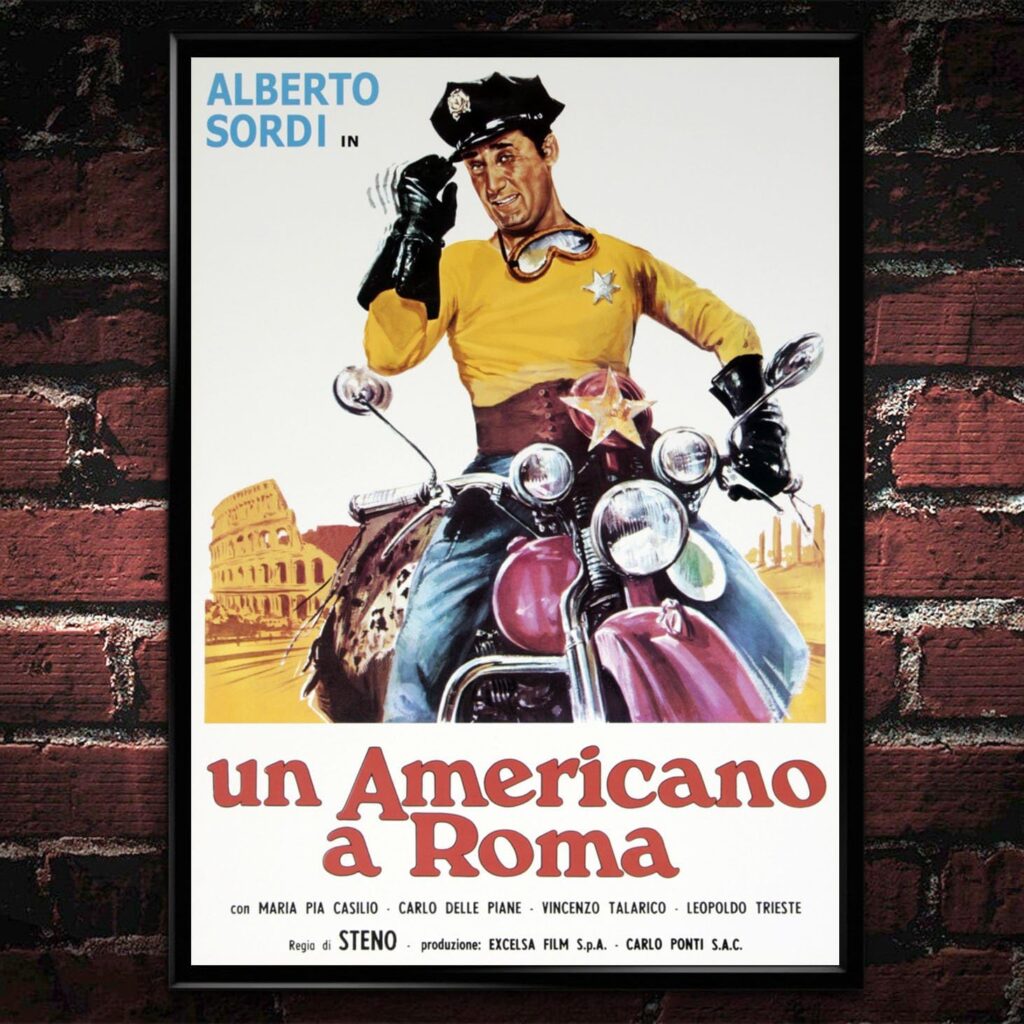
An American in Rome, a 1954 Italian comedy film. In 2008, the film was included on the Italian Ministry of Cultural Heritage’s 100 Italian films to be saved, a list of 100 films that “have changed the collective memory of the country between 1942 and 1978.” [Wikipedia]
The 1954 film Un Americano a Roma captures a moment of cultural connection between the two countries, even as the United States and Italy followed divergent paths, both literally and figuratively. Many Italians developed a fascination with all things American, including Harley-Davidson, which was famously rendered as “Harley-Davinson” by the film’s main character. This mispronunciation has lingered, even among some owners.

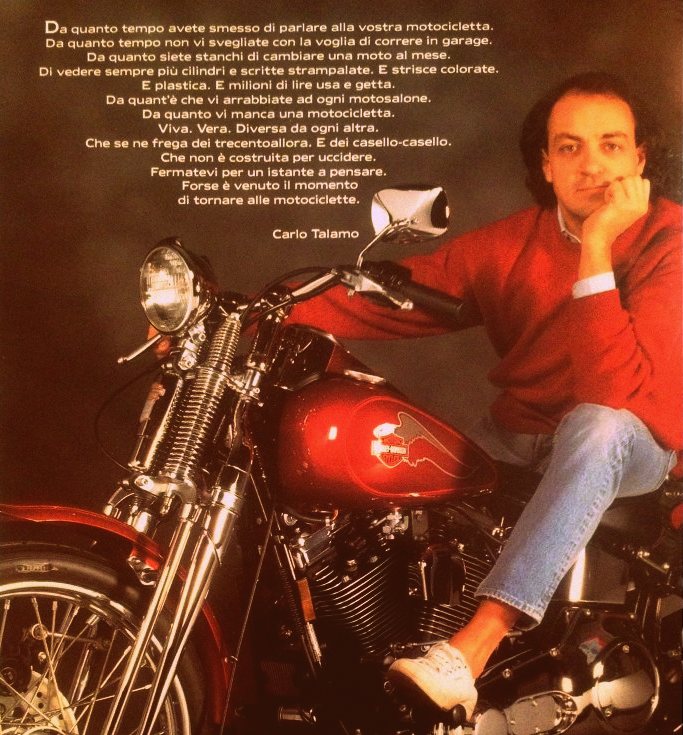
Carlo Talamo ran the first licensed Harley-Davidson dealer in Italy, and ran philosophical ads about his love for the big V-twins. [Wendy Pojmann]
While a few ex-military Harley-Davidsons remained in Italy after WW2, it was not until the early 1980s that the first official Harley-Davidson dealership was established in Italy. Under the leadership of Carlo Talamo, this new venture, based in Milan and also importing Triumph motorcycles, operated under the name Numero Uno. Talamo’s shop initially sold very few motorcycles. His entrepreneurial vision, however, was shaped by the lasting impression of a leftover Harley-Davidson he recalled seeing in Rome in 1959. Drawing on his own perceptions and experiences, Talamo crafted a distinctly personal approach to marketing the brand to Italian consumers. The advertising campaigns he developed frequently featured his own image alongside a Harley and a reflective statement. In one such ad, he writes, “I want a motorcycle that can grow with me, always itself, always new, always different. I don’t want a one-week fling; I am looking for stability.” Talamo’s messaging consistently emphasized Harley-Davidson’s history, authenticity, and timeless appeal. His prose evoked expansive, almost mythic landscapes as he described journeys that stretch “days and days from one ocean to another along wide, abandoned roads.” At the same time, he acknowledged the motorcycles’ high cost, framing it as justified by their enduring value. The result was a carefully constructed image that was rooted in American cultural mythology yet distinctly reframed through an Italian sensibility.

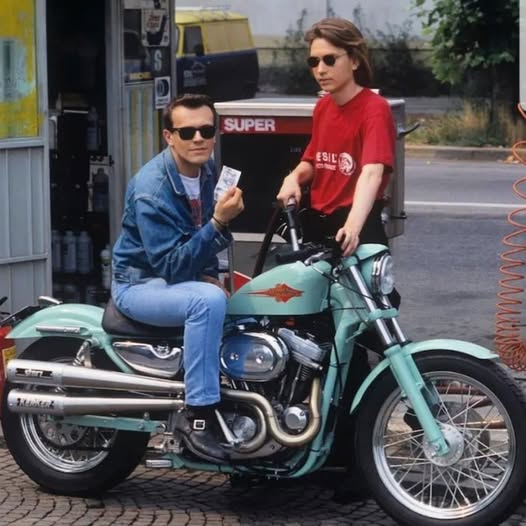
Harley-Davidson 883 Sportsters were so popular in Italy, in 1988 Max Pezzali and Mauro Repetto formed a band with the name 883, and were a big hit. [Wikipedia]
Today, Harley-Davidson ranks 21st among motorcycle sales in Italy, with the Sportster 883 its leading model and the Pan America 1250 in second place.[3] In the US, the Street Glide and Road Glide are the best-selling H-D models. Keep in mind that sales figures for Italy in 2025 include only two Italian motorcycles in the top 15: the Ducati Multistrada V4 and the Benelli TRK 702X. BMW, Yamaha, and Honda lead the sales charts. In the US, Kawasaki is currently the industry leader, while Harley and Indian are joined by Honda and Yamaha in the top spots.

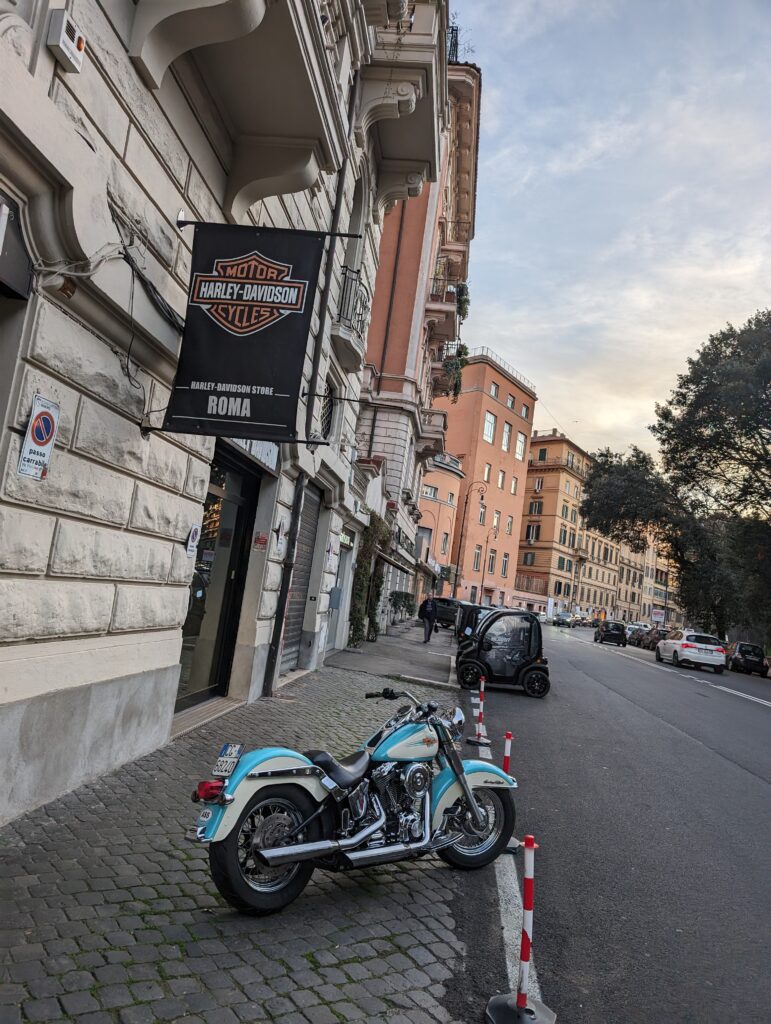
Wendy’s friend Gianluca’s Harley-Davidson on the streets of Rome. [Wendy Pojmann]
So what does the myth of Harley-Davidson hold? In both Italy and the United States, the brand promises a return to freedom, a reckless abandon paired with the reassuring continuity of a company more than 120 years old. Yet for Americans, something more is at stake: a connection to America itself. Many Harley enthusiasts want a big, noisy machine made in America for Americans. Italians, by contrast, are often drawn to the way the motorcycle captures something they admire about the United States.

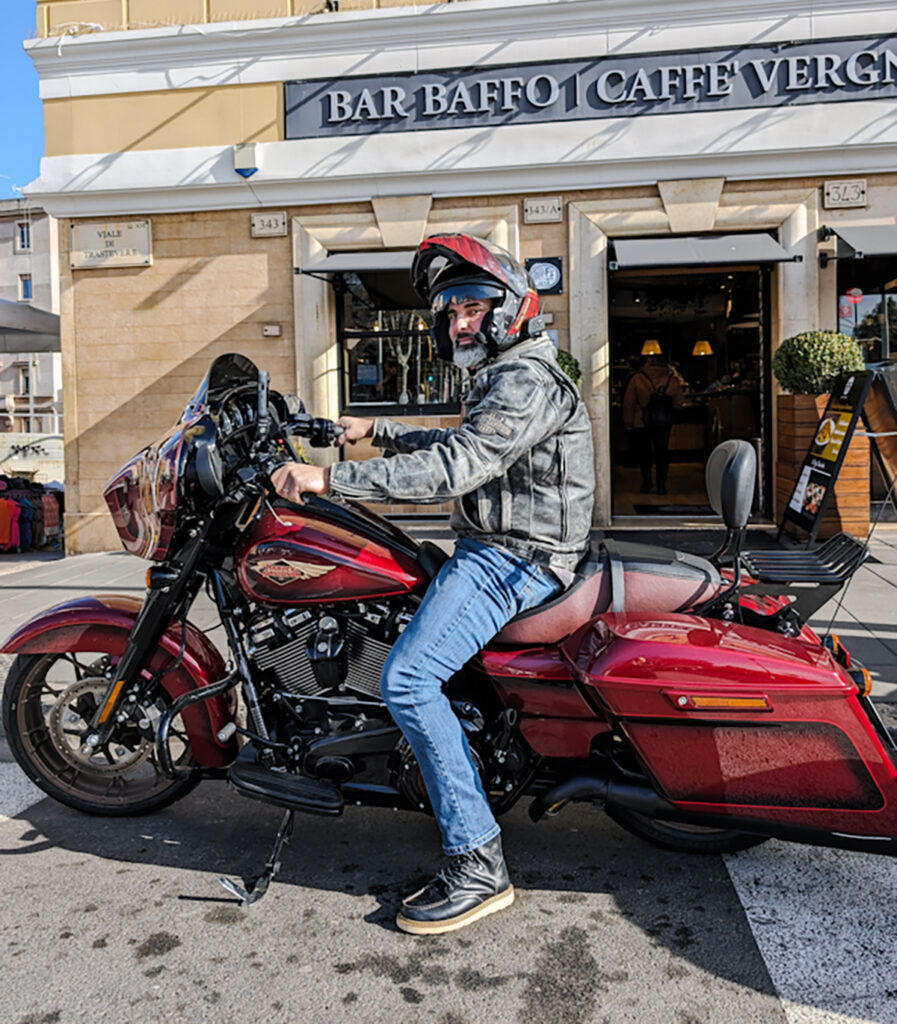
American excess on the streets of the Eternal City. Wendy’s pal Simone on his customized Street Glide. [Wendy Pojmann]
Some of my Italian interviewees for Connected by the Street described riding a Harley as a way to slow down and enjoy the scenery. Others admitted they enjoy the attention that comes from pulling up to a stoplight on a Harley.[4] All of them, however, emphasized that Harley is “the original.” That idea, the sense of authenticity tied to origins, continues to shape the brand’s appeal regardless of global economic pressures or shifting US administrations. As Gianluca Elisei of Harley-Davidson Rome put it, “There’s nothing like it. The vibrations enter your brain, unlike other motorcycles. It’s an emotion, not just freedom.” That emotional connection may be precisely what Harley-Davidson is counting on.

[1] See data from Harley-Davidson Investor and in The Gazzetta

[2] See my latest book Wendy Pojmann, Connected by the Street: The Myths and Realities of Motorcyclists in the USA and Italy (Schenectady: Parigi Press, 2025) at www.parigibooks.com. Motodays is Italy’s second largest motorcycle trade fair after EICMA https://www.motodays.it/.

[3] Note that the 883 has a huge following and an Italian rock band called 883 formed in 1988.

[4] See especially Chapter Three of Connected by the Street for more on American motorcycles in Italy.
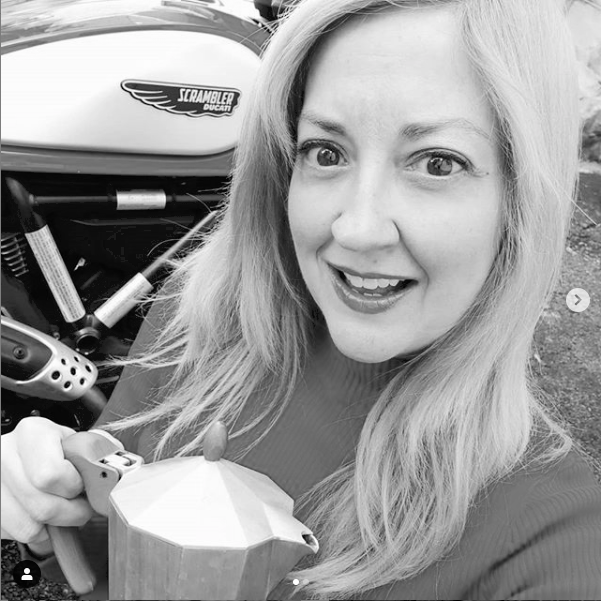
Dr. Wendy Pojmann, Ph.D., is Professor of History at Siena University in Albany, New York. Her latest book is Connected by the Street: The Myths and Realities of Motorcyclists in the USA and Italy, available at www.parigibooks.com. She splits her time between Rome, Italy, and upstate New York. Follow her on Instagram @wendysespressolife. See her other articles for The Vintagent here.