Brian Darwas has established a solid, world-wide reputation for his hot rods. He and his brother Jason build strict, 1950s period-correct machines from a garage in New York City’s the Bronx[1] where they have groomed deep connections to the local hot rod community. His website atomichotrods.com is legendary, and he has an active social media presence. He is a senior member of the Rumblers CC and has made many award-winning films that document hot rod culture that include: Three Mile (2015), This is Long Beach (2013), White Knuckle (2012), A Sweet Sickness: The Flathead Movie (2011) The Devil At Your Feet (2009) and The Road to Bonneville (2008). All the films combine hardcore music soundtracks with images of noteworthy people, cars and locations.  [Brian was also a judge at the original Motorcycle Film Festival, founded by our Film Curator Corinna Mantlo – ed.]
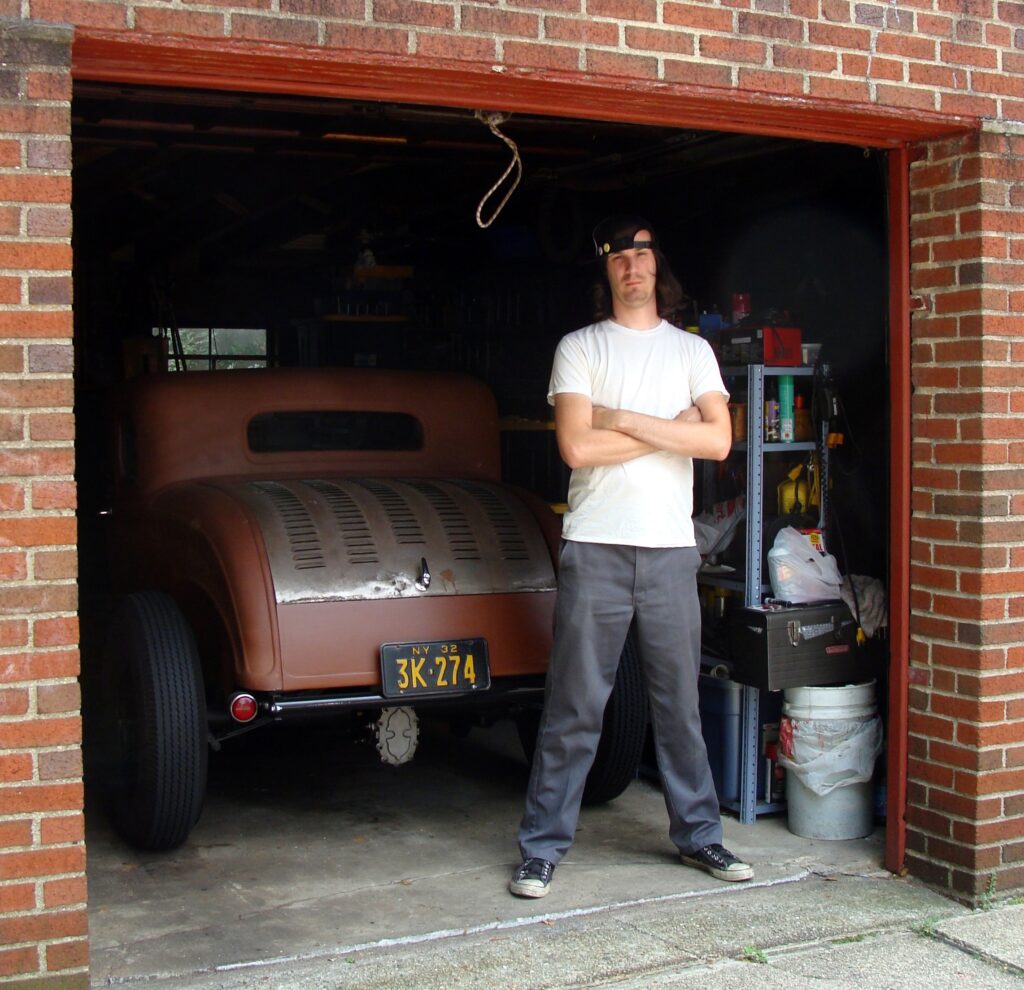
In recent years Brian has broadened his filmmaking interests beyond motoring, into the horror genre with: Mail Order Murder: the Story Of W.A.V.E. Productions (2019), Early Days and Night of Vengeance (2018), The Road Leads to Terror: The Locations of Last House (2018), Elmer’s Turf: The NYC Locations of ‘Brain Damage’ (2017) and Get My Gun (2017). He is also a self-taught musician who plays bass guitar in notorious and legendary NYHC (New York Hard Core) bands like Roger Miret and the Disasters and Agnostic Front .. you must watch this 2015 YouTube video of Agnostic Front’s “Old New York” that Brian shot illegally on the elevated subway train.
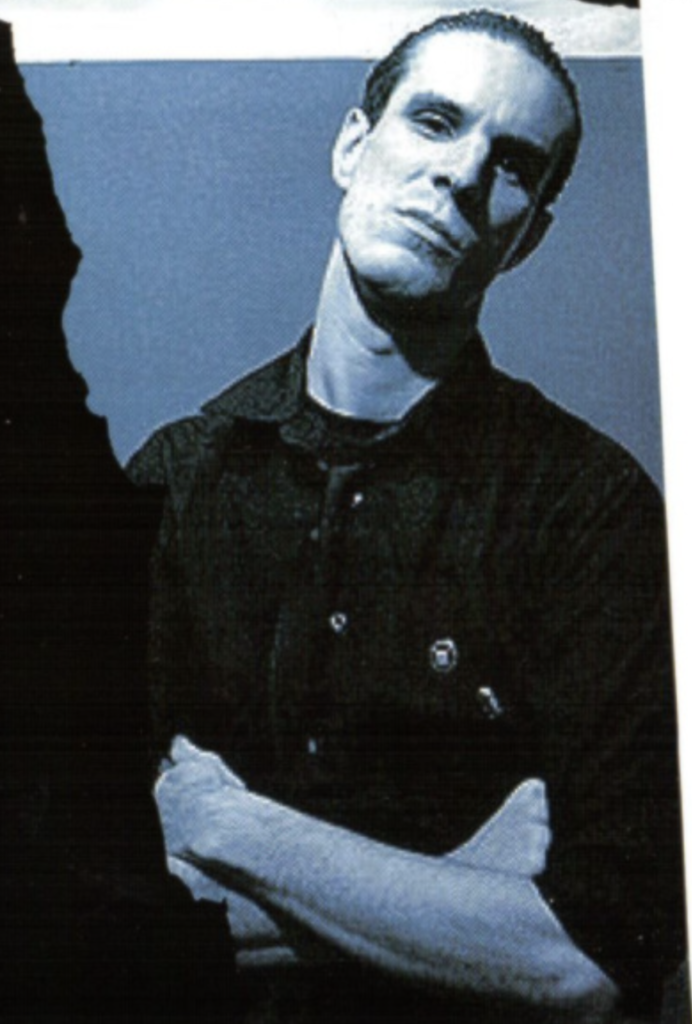
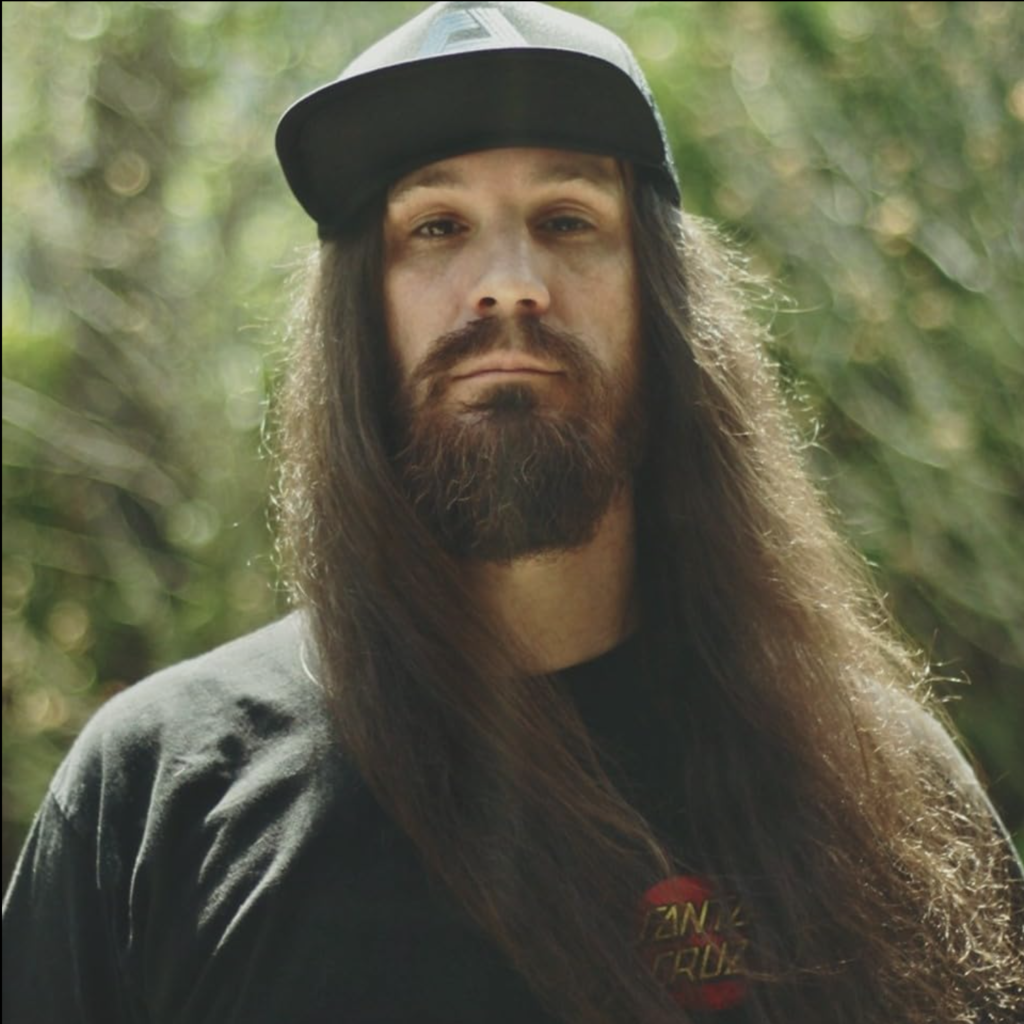
Brian Darwas in his punk rock bass playing era, in this photo with Roger Miret and the Disasters. [Discog]
Brian’s rep in the hot rod community reveals a hard-working, no bullshit guy who values the pre high-tech working habits and hard materials of yesteryear, used to build period correct pre-1955 parts cars that preserve 1940s and ‘50s hot rod building culture. He specializes in ‘recycling old steel’ – finding and rehabilitating discarded and unused materials into functioning parts. His methods emphasize a hands on DIY approach that he first learned as a young boy when his father refused to throw away broken appliances until an effort was made to repair them. Today, Brian and his brother build hot rods that are meant to be driven and raced, not checkbook, ‘trailer queens’. They don’t cut corners with time, effort and materials and the process of maintaining a historical connection between the materials and the methods is critical.

Brian when he filmed ‘White Knuckle’, about the first Motorcycle Cannonball in 2010, which we screened in the first Motorcycle Film Festival. [Brian Darwas]
Over the years, finding and keeping a garage work space has been increasingly difficult in New York, where real estate development is ruthless. Recently, the garage on 165th street near Yankee Stadium where Brian and several Rumblers members wrenched on their cars was sold and a luxury condominium tower now stands in the original property footprint. “Several of my friends had a garage space up by 165th street and Jerome Avenue in the Bronx near Yankee Stadium where we worked on cars,” Brian recalled. “It has always been a rough area in the city with a reputation. I am born and raised in the Bronx and I still live and wrench there. The garage is gone now and it’s a luxury condo tower. Ya, this is how it goes all around the city. Working spaces and garages are being knocked down.

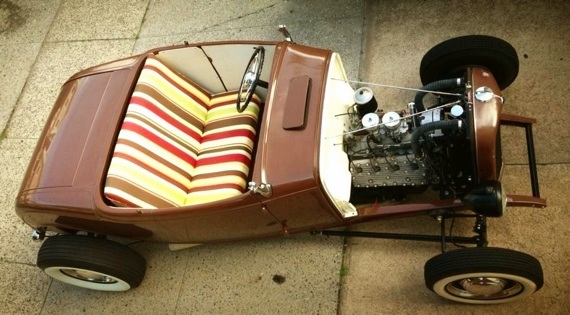
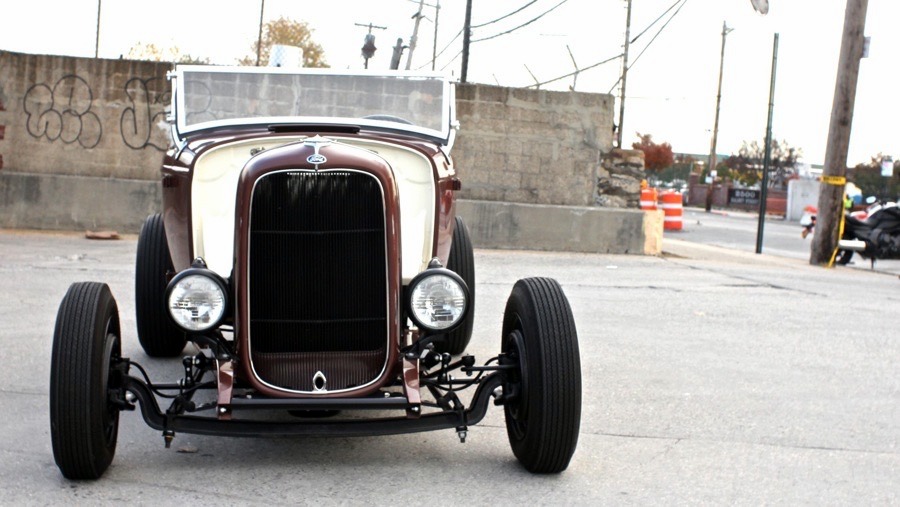
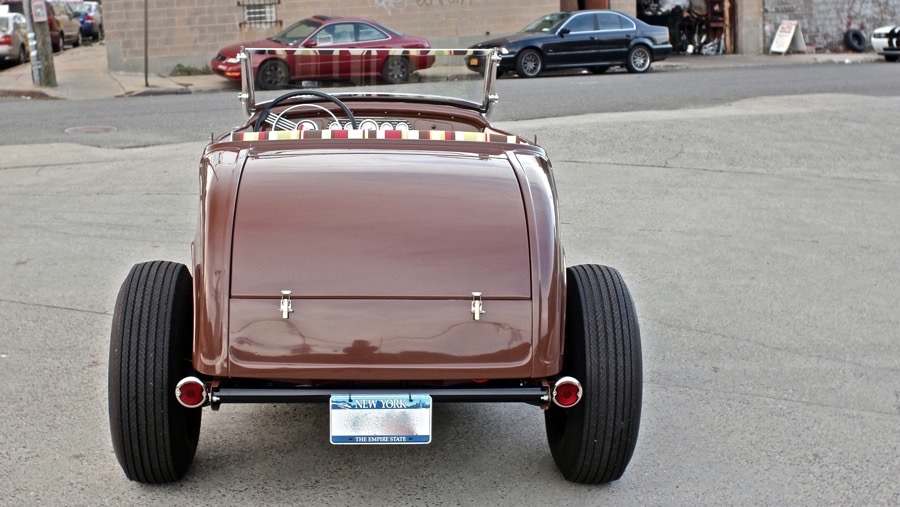
Brian Darwas’ 1932 Ford roadster hotrod. [Mike McCabe]
“I was born February 14, 1977. My family lived next to the Hutch (Hutchinson Parkway). When I was a kid my brother and his friends would go to the Howard Johnsons restaurant near the Whitestone movie theater and they would have a weekly cruise night. All the guys would talk shit to each other and challenge each other. They’d make their bets and then go onto the Hutch a little past the Orchard Beach exit. Three cars would stop on the highway, stop all the traffic and then two cars would set up and race.  As a kid I would go with him and watch the races. As a younger guy I had a ’77 Chevelle, and a ’66 Pontiac LeMans. The motor from that LeMans is in my current ’32 Ford. I had a ’52 Willy’s, it kinda looked like a small Shoebox Ford. The first hot rod I built was a ’29 roadster pick-up.

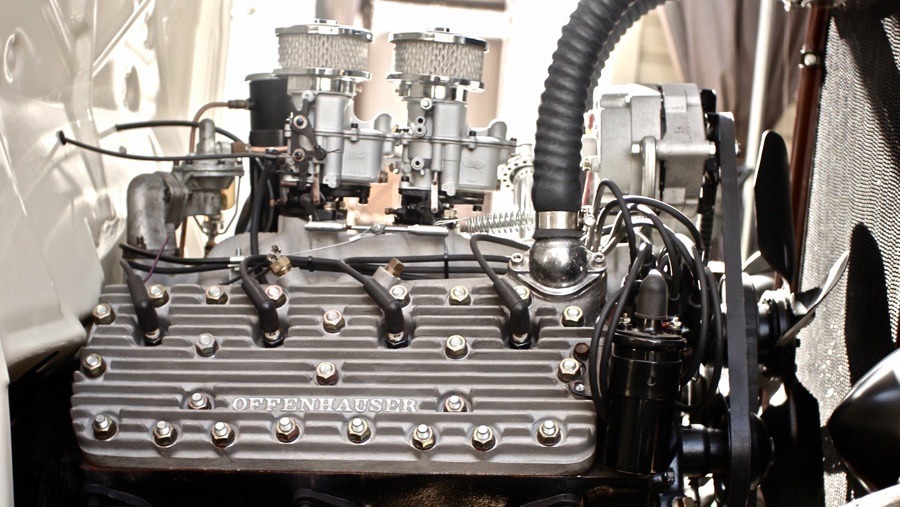
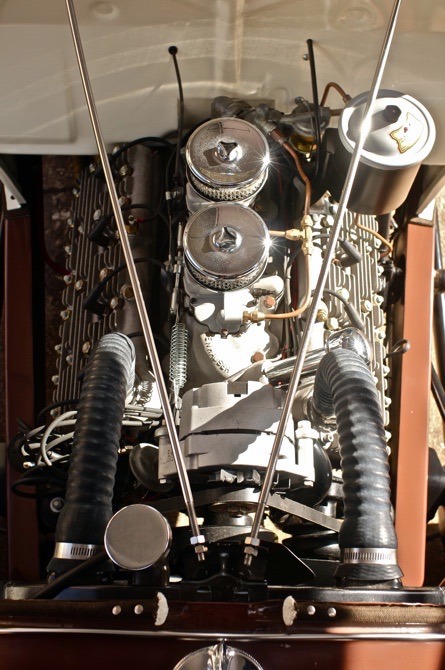
1949- ’53 Ford Flathead motor (8BA) capped with high compression Offenhauser heads (8.6:1). The engine is fed by an Offenhauser 2×2 intake (with two 94s). [Mike McCabe]
“My parents moved out of that apartment and we moved into a house in the Bronx. We didn’t have enough garage space to work on a car so I built that roadster in the basement of the house. When I disassembled it to paint it I brought the pieces into the back yard, painted them and put the car back together. It was a roadster pick-up. I carried the chassis, the body and the bed outside one piece at a time. My parents were cool with it. It took me a little over six months. It was the first one I ever did.  It was kind of a learning experience and I registered it and drove it.

Dropped axle up front with lengthened and split Model A wishbone (to match the length of ’32 wishbones). Ford nine inch out back held in place by 1937 Ford (rear) wishbones (with gusseted top links for added strength). [Mike McCabe]
“I have an interest in older machines. I like knowing how stuff works. For me, I can’t just know that it works, I need to know how it works and why it works… so that’s where that interest in stuff like that comes from. And also, older machines and cars. To open them up and see how they work and why they work. Which components drive what other components… I like knowing how stuff works. With older cars you can open it up and pinpoint the problem. You can look at the parts and connect the dots. Now you can’t do that. Now the distributor cap and computer tells the cylinders when to fire. I appreciate the ingenuity of building a mechanical object. Like a shot gun… When you rack a shotgun, it works itself… all the pieces move. It’s the simplest design… It’s been the same for 200 years… You know… I am very interested in that. These old cars are around because over the years someone has maintained them. I am only able to get an old car because somebody maintained it. So now I feel I am maintaining it for the next generation to get it at some point. I like a lot of cool old stuff and if no one else cared for it, maintained it, I wouldn’t be able to own it. It wouldn’t exist for me.  Hopefully the next generation will be into this stuff.

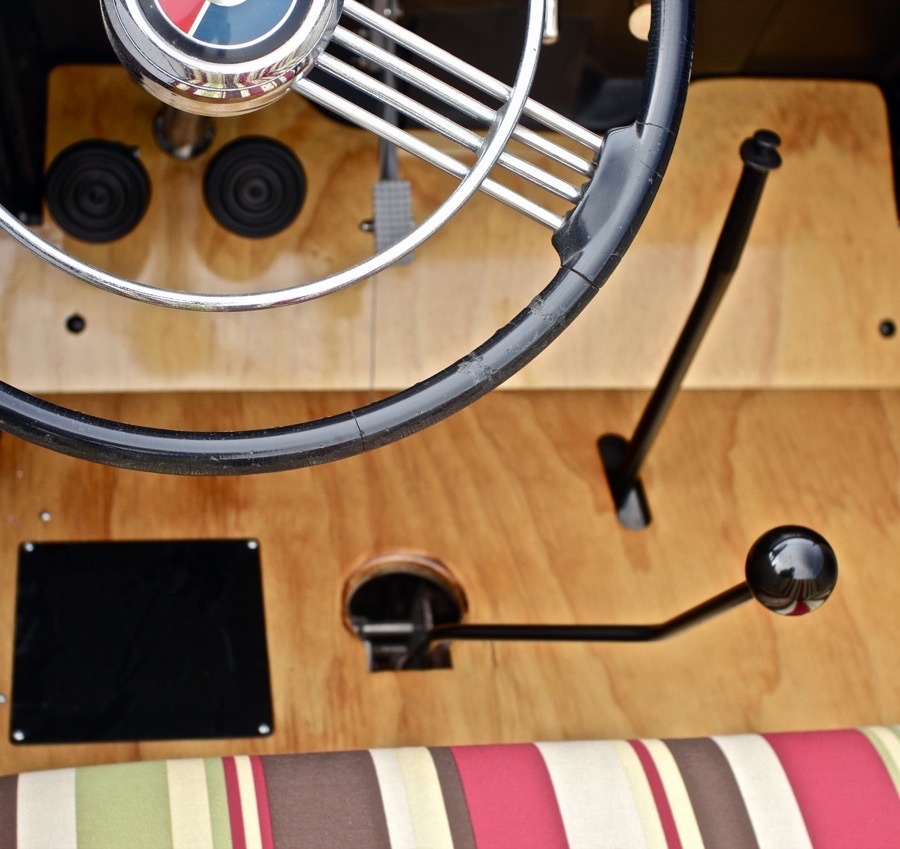
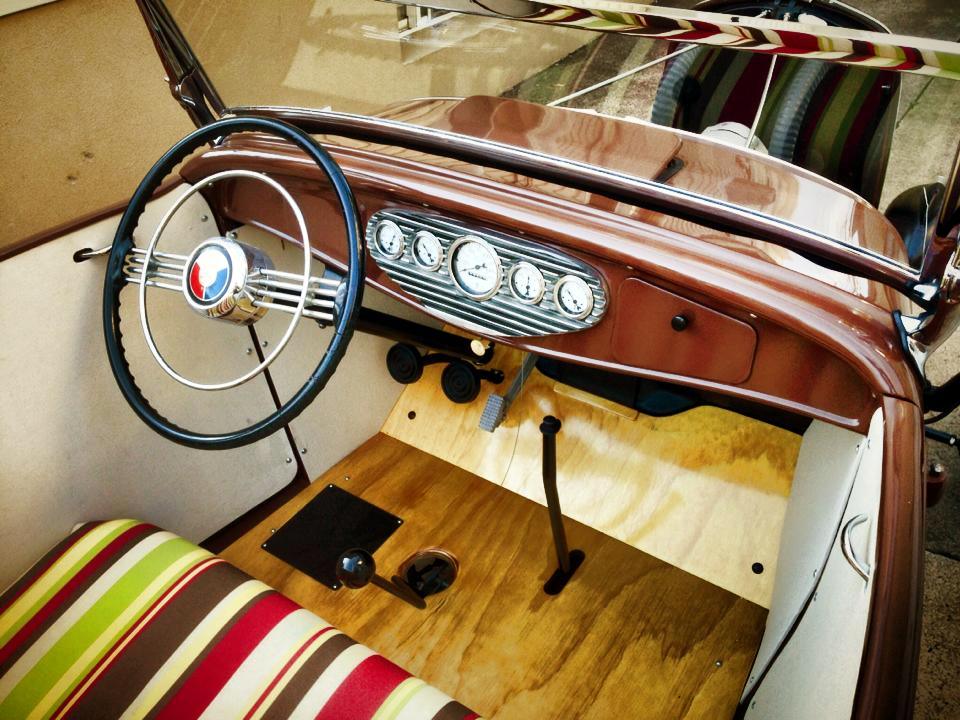
1953 Buick steering wheel. ’32 dash with a finned aluminum gauge cluster and glove box. [Mike McCabe]
“I understand the drama of nostalgic things. This is one reason people honk at me and my car. I wasn’t alive when my car was built the first time. My Ford is from a time when people were more hands-on about things. Today, eight out of ten guys can’t change a flat tire. My car and cars like it are from a time when a high school kid wanted a race car so he bought a junked car from the ‘30s and he worked on it himself and he made a hot rod. The main passion in his life was his car. I am attracted to that aspect of it. It’s my car and I built it. I’m driving it and if anything goes wrong I can fix it. It is more personal to me. I like stuff from before my time. Stuff from the ‘20s, ‘30s, ‘40s, ’50s. I am not sure young people are like this now. Everything is replaceable now. When I was a kid, anything broken in the house my father fixed it. There was a value in knowing how to maintain stuff.  I don’t think this process is very common these days. Maybe 40 years ago, people would have fixed it.

“The car was built by us a few years back and has been on the road. It does have a couple marks here and there in the paint, it’s a driver.” [Mike McCabe]
“With my ’32 Ford I have changed things with the car but it’s subtle. I want the car to look like it was built that way. I might see something and I don’t like the way it was originally done, so when I change it, I want it to look like it was built that way originally. I want to integrate it into the original design. Like with my ‘32 Ford, I pinched down the nose of the frame, to change the look of the car, the stance, but it’s not obvious. You can’t see it unless you know the ins and outs of the car. I didn’t go to an automotive high school or a tech school. I figured this out on my own from talking with people and studying on my own.

Sweet Ford flathead from above. [Mike McCabe]
“It’s amazing that old cars have survived in a place like New York. The streets are really bad, the drivers are really bad, the congestion…  New York City is interesting because it’s an interconnected series of islands. A lot of bridges and tunnels… It’s interesting. I dive my ’32 Five Window Coup most of the year. Not in the winter and not in the rain but most of the time this is what I drive in the city. I get some looks but this is what I drive.”

Ultra-smooth rear end. [Mike McCabe]
Brian and his brother Jason recently completed a ground up build ’32 Ford Roadster. Every aspect of the car reflects the values and aesthetic reasoning that both brothers live by[2].

[1] New York City has five boroughs, Manhattan, Brooklyn, Queens and the Bronx… known for its consistent highest crime statistics.

[2] 1932 Roadster, all steel Brookville Body. The car sits on a ’32 Frame with stock front and rear cross members (the rear cross member has been flattened to bring the back of the car down for a better stance).
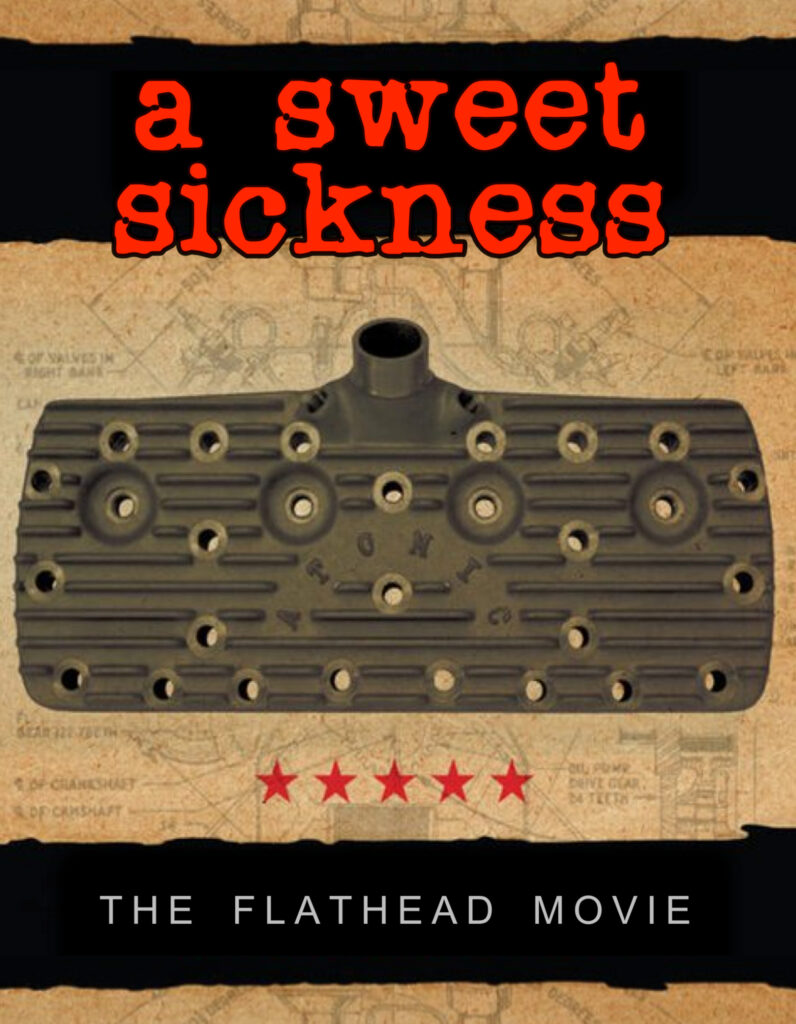
 

Darwas’ film ‘A Sweet Sickness’ is one of many available on his website. [AtomicHotrods.com]
Michael McCabe is a New York City tattoo artist and cultural anthropologist. He is the author of New York City Horsepower, Kustom Japan, New York City Tattoo, Japanese Tattooing Now, Tattoos of Indochina, and Tattooing New York City. For New York City Horsepower, Mr. McCabe spent two years discovering and documenting underground custom motorcycle and car garages in the City, as rapid gentrification put their culture under tremendous pressure. He interviewed and photographed New York City customizers about their personal histories and creative sensibilities. More of Mike’s articles for The Vintagent can be found here.