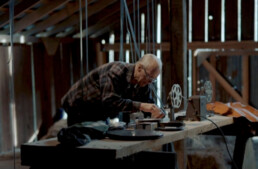
How Taylor Swift’s ‘Life of a Showgirl’ tracks with Springfield Mile bike stories.

Baby that’s show business for ya

Who celebrates the mystical and magical loop of their past Eras with more searing honesty than vintage bike lovers?  When the barn door swings open, our precious two-wheeled icons are a testament to spiritual renewal and purposeful intent, echoing the stories of of America’s Fearless siren and poet laureate, Taylor Swift.   Listen closely to words of the vintage-bike obsessed as they peruse the overwhelming vendor booths of parts, pieces and possibilities at the Springfield Mile vintage bike show and swap meet. You’ll hear unexpected parallels between the “life of a show bike” and the “Life of a Showgirl:” neither the passionate riders/collectors/sellers, nor America’s brash pop sweetheart are apologizing when they confess, “You know I can’t help myself.”  She even sings of the quietly subversive act of reassembling the fragmented remains of a ‘basket case’ to create something new and cool.

Taylor Swift’s songs about life and love are surprisingly relevant to the world of motorcycle restoration, or at least that’s how Catherine OConnor sees it. [Taylor Swift]
The Antique Motorcycle Club of America (AMCA) held a vintage show and swap meet over Labor Day weekend on the infield of the 2025 Springfield Mile.  It was a first time / test run for the bike show and vendor event, and offered front row seats to “the world’s fastest mile.”  Held in coordination with race promoter Mees Productions, the expo was conceived as a way to refresh and amp up interest in one of the country’s oldest American Flat Track races, at the storied Illinois State Fair oval dirt track. With its rich history dating back to 1937, and evolving with the AMA Grand National Championship points system introduced in 1954, the Springfield Mile survived a near two-decade hiatus in the 1960s due to gang activity and safety concerns. The Illinois Motorcycle Dealers Association revived the event in the 1980’s, giving rise to a generation of legendary victors, including Chris Carr, Ricky Graham, Scott Parker, Bubba Shobert, and Jay Springsteen.  Fast forward to the 21st Century, when National #1 Jared Mees and his Indian 750 FTR crew mopped the floor with a record-setting 10 career championships.  A suggestion by Mees for a collaboration with AMCA to stage a bike show and sale was a no-brainer.

Jared Mees with his usual #1 plate, with his wife Nicole and their daughter taking a victory lap. [Mike Lawless]
Was Taylor thinking of Jared Mees when she wrote “History is written by the victors?”  Her recent album Life of a Showgirl sounds like she’s coaching an eager field of dirt track starters with her lyrics, ”keep it one hundred on the land, thе sea, the sky / pledge allegiance to your hands, your team, your vibes.”   And she sure sounds like Mees when she declares, “when I touch down / call the amateurs and cut ‘em from the team / get the crown / baby, I’m the one to beat.” According to Keith Kizer, AMCA’s Executive Director, the first-year Springfield Mile bike show was a gamble, as it ran in a competing time slot with one of the country’s longest running swap meet and vintage races in Davenport, Iowa.  But with far fewer vendors yet equally enthusiastic collectors, sellers and buyers, Springfield was an opportunity to become a large fish in a small pond, and as soon as vendors opened on the steamy Saturday morning, there were lines of collectors waiting to explore the treasures and swap life stories.

Ready For It

Fans gathered for a look behind the curtain in the August heat, where Devon Pritchard of Pontiac, Illinois showed off a blue-ribbon winning 1912 Harley-Davidson X8A with more than a facelift. “The motor and the seat frame are original parts, and everything else has been handcrafted.”  According to Pritchard, at sanctioned AMCA events bikes are not judged against other motorcycles on display, but on how that motorcycle left the dealership when it was new. A machinist by trade, Pritchard didn’t paint or pinstripe, but meticulously focused on the frame and mechanics. With a top speed of about 45 MPH, the glorified bicycle drinks about 8-10 drops of oil per minute. Given the nickname “The Silent Grey Fellow” by early aughts horse owners who appreciated that it was as quiet as today’s electric bicycles, it’s a reminder that everything old is new again.

Devon Pritchard and his rare 1912 Harley-Davidson X8A single. [Sam Evans]
Show bikes like Pritchard’s are a century-old mechanics’ history lesson, with details like a tiny sight glass for the motor oil pump. “This was the first year they had a rear wheel clutch. There’s no transmission, but you can change the spark advance with your left-hand grip. This is also the last year for what they call an atmospheric intake valve. The vacuum of the piston going up and down is what makes that valve actuate. The next year they had an external push rod with a rocker on it.”  No muffler, no air cleaner, the throttle is turned backwards to lift the exhaust valve. Harley even offered a custom padlock for an onboard toolbox in their parts catalog. Pritchard pointed out the spring-loaded seat post, noting 1912 was the first year Harley came out with that feature, which survived on H-Ds until 1984, even after they had rear suspension. Mechanical evolution sped along in 1913, when they enclosed the magneto so it didn’t get full of crud. “So in a way, we’re kind of going backwards now with bicycles that are motorized. It’s like they’ve almost stolen a few of these little features. Compared to other manufacturers, this bike wasn’t as advanced as their competition at that time. Like Indians had advanced some things even before Harley did.”

Wildest Dreams

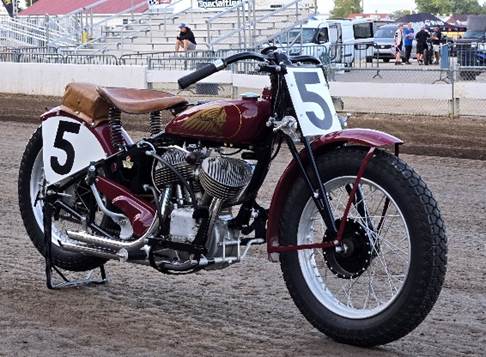
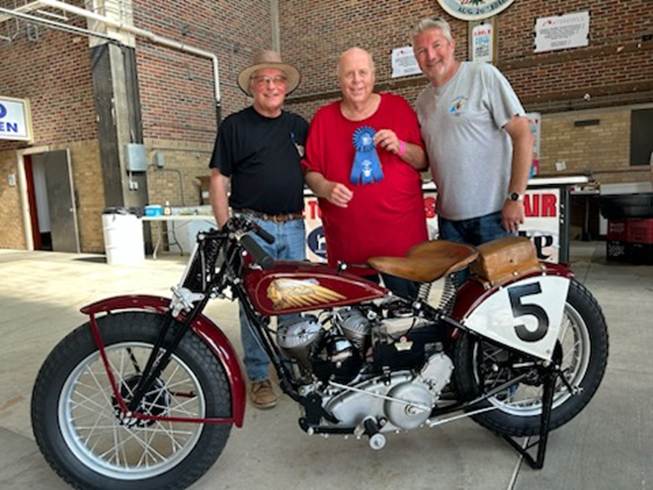
Fearless longform storytelling  is Taylor Swift’s stock and trade, with vulnerable, relatable lyrics that reflect well the ‘agony & ecstasy’ story of Rick Giles’ 1936 Indian Sport Scout. A passionate AMCA member, Giles traveled from Springfield, Ohio to display his Big Base racer, which started out as a regular mid-1930’s street bike for dirt track racing. As he explained, the AMA adopted Class C rules so that racers could walk into a dealership, buy a motorcycle, strip it down and race on tracks across the USA. Indians quickly developed their Sport Scouts for racing, with the factory offering special parts and modifications like the  big base engine by the late 1930s. But according to Giles, only the top riders got them.
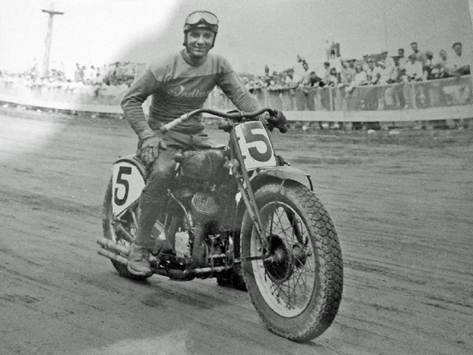
Andy Drobek #5, aboard his 1936 Indian Big Base Sport Scout racer. [Rick Giles]
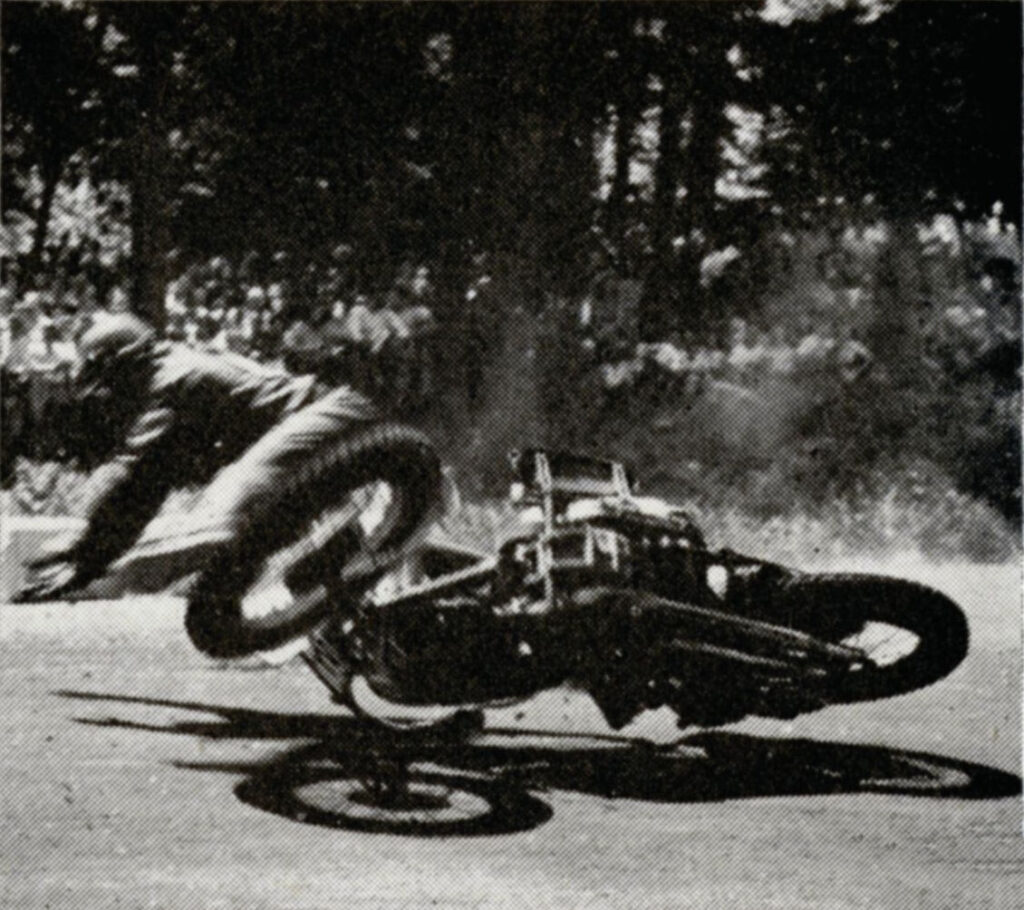
In August, 1946, #5 Andy Drobek was an aspiring 34-year-old from Reading, PA who rode the bike to a 3rd place finish in the Springfield Mile. Research on the provenance of Giles’ Indian revealed that Drobek fell off the bike a few weeks later at the prestigious Langhorne raceway, was struck by another rider and succumbed to his injuries, according to published reports in The New York Times on Sept  2, 1946, as well as in contemporary  Associated Press outlets from Gettysburg to Galveston “So, as I learned, my Indian had a bit of a tragic history to it — with a twist-of-fate return.” Giles said. In 1980, Giles, an Ohio native, was living in L.A. and had just become interested in motorcycles, specifically Indian Sport Scout race bikes.  Through a friend (Dick Barth in Marietta, OH), who owned two special factory production race bikes that he bought back in the 1940s, Giles first learned of Drobek’s #5  unrestored big base, a bike that he would eventually own. “But there’s a whole big story between the time when I acquired the bike in 2011, that sounds like a real ‘meant to be’ odyssey of sorts,” he said.

Still running #5, the restored Indian Big Base Scout racer. [Sam Evans]
At some point in the 1980’s, the owner had taken the bike, which was in fairly decent shape, stripped it down and did a “re-imagined RestoMod.”  According to Giles, “He put a disc brake on it, changed all the sheet metal, the paint job and basically changed the entire look of the bike. And to me, he kind of stripped the history off of it.”  It eventually was sold off to a guy in upstate New York who had moved to the United States from Switzerland.  A few years went by, before Giles discovered the bike again for sale in the pre-Internet era, Motorcycle Trader magazine.  “After that, I lost track of it — until 2003, when I met a guy named Stan Witinsky Jr, who showed me actual  pictures of his dad riding this same bike.  I thought, wow ! That’s pretty cool because the senior Witinski was one of only handful of experts who had the first amped up, late 1940’s Indians.” Giles didn’t know where to re-start his search for the bike but had a phone number from the old magazine. Unfortunately, it turned out to be disconnected, but he traced the address listed in the old magazine ad using the Intelius website and sent a certified letter. “When that came back unopened, I thought, ‘Oh this guy’s moved back to Switzerland and taken the bike with him. I’ll never find this thing again’.”

Rick Giles with Keith Kizer (L) and his gorgeous 1936 Indian Big Base racer. [Rick Giles]
But Giles had a picture of the Big Base and in a last-ditch effort, he posted it on Flickr, an early photo sharing website. “I get an e-mail from this guy named Gus who lived, as I found out, in upstate New York. He goes, ‘what can you tell me about that race bike with the # 5 on it? I have one that looks exactly like it.’  And I thought this can’t be happening. This is impossible. I’ve looked all over the place for this thing, and nobody had ever seen it. I told him the story. He said, ‘well, I have that bike’.” Giles struck up a pen-pal/email relationship with Gus and learned that the bike had changed hands from the original buyer, to a picker, to the front window of an upstate antique store. Still living in L.A. at the time, Giles struck a deal with the antique shop owner and rented a box van to haul the bike back from Albany.  As they loaded the bike in the van, one more story was revealed.  The seller explained that several years ago, the bike was in his garage, with an Airstream trailer sitting next to it, full of antiques, including boxes full of celluloid film of a rodeo cowboy that toured with Houdini. Well, one hot August day, the celluloid film spontaneously combusted and set the trailer and garage on fire. With a 4:30 a.m. panic call, the fire department rescued the bike out of the garage just before the roof collapsed. “I just thought, Oh my God. I can’t believe this was almost destroyed. So, I took it back to Los Angeles with me to someone who could start to restore it back to the time when it was raced.”

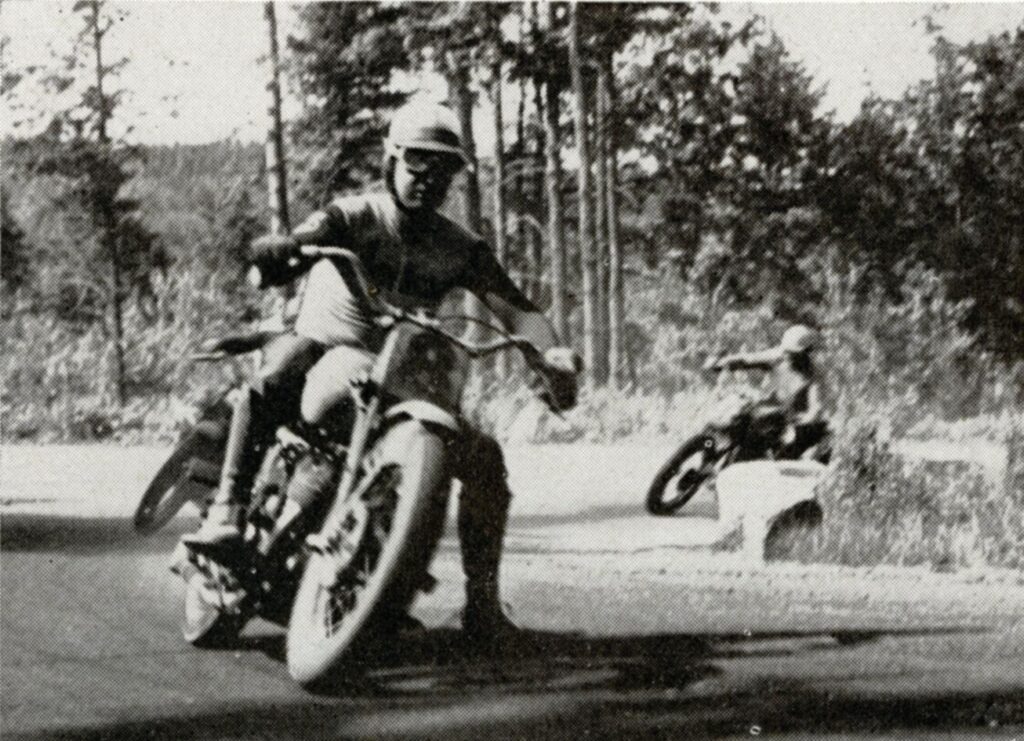
Laconia, 1946. Bill Anderson (Indian) leads, with Bill Drobeck behind, followed by Al Chrisler. [MotoCyclist]
Giles’ friend Dick, who was still alive at the time, had given him a set of original wheels and a rear fender, but now came the struggle to source the special oil tank, a set of gas tanks and a period-correct front fender.  Traveling back to L.A., Giles stopped in Marietta, but found his friend was ailing, and couldn’t get back to his apartment to recover the parts he needed. Then on a subsequent trip back to GA, Giles learned the original parts were now on the auction block for a premium price. “He had a lot of Indian parts, and it was a lot of money. There was a guy from Australia that was interested in this stuff and another guy who was a friend of mine, from Indianapolis, who was interested.”  Fortunately, the friend in Indianapolis bought much of the collection, allowing Giles to get the parts needed, except for the gas tanks and oil tank. When Giles learned that the original gas tanks were in Australia, he offered to trade two sets of salvaged tanks for the original tank that had been on the bike at the 1946 Springfield Mile.  As he recalled, the Australian said, “That’s fine — under one condition. If you ever sell the bike, I wanna get the first chance of buying it.” Giles agreed but is now reluctant because he feels that the bike shouldn’t leave America to become just a component of a collection in Australia.

How Drobek’s career ended: an unlucky crash at the Langhorne race. Racing is dangerous! [MotorCyclist]
In 2017, with the rebuild still underway, Giles relocated from California back to Ohio. When the restoration was finally complete in 2021, he retrieved the bike and took it to an antique motorcycle meet in the tiny town of Oley, Pennsylvania. With only one main street and a couple of cross streets, it is the home of the Reading Motorcycle Club. Giles learned by coincidence that Andy Drobek had been a member of the club when he was riding the #5 bike. He was stunned to find a photo of the bike, posed in front of the Reading clubhouse, just a quarter mile from the meet. At that moment, Giles was convinced that his Sport Scout detective journey was meant to be. He said, “Everything kind of fell in place. I felt like I finally brought the bike back home. I was able to put the bike back just like it was when Andy rode it in Springfield in 1946.”

Cruel Summer

At a nearby trailer were Scott Bair and his son Kyle, of New Castle, Pennsylvania. With a blue ribbon fluttering on an expertly restored 1975 Bultaco that he’s owned for a couple of years, he told a different, heart-rending, yet familiar show bike story. “I bought two brand new bikes and raced them back in 1975 and ’76. And of course, I later sold them. Then probably 20-25 years ago I started looking for them again, and unfortunately, I was unable to find either one of them. I almost gave up hope of finding one, but when I least expected it, a friend of mine gave me a tip.”

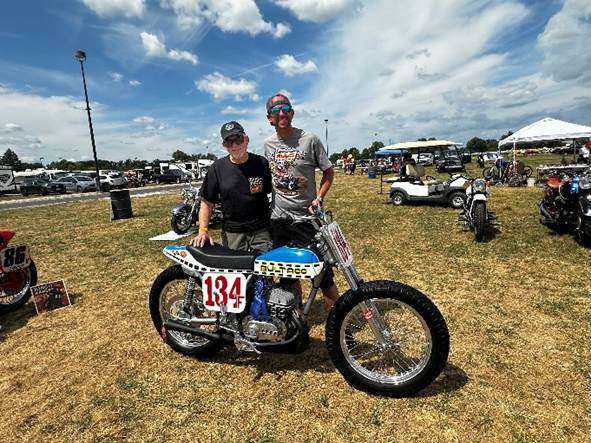
Scott Bair kept his original leathers and boots, but not his Bultaco racers.  It took decades to be reunited with his motorcycles. [Sam Evans]
Bair proudly displayed his original leathers, helmet and boots with Ken Maley signed steel shoe that were over 50 years old. “Maley always put his trademark with your initials on. They were the best and they’re very sought after.”  Like many other racers, Bair has found “the shoes and helmet still fit but the leathers seem to have shrunk, over time.”  With a sigh Bair said that he has given up racing. “The risks are greater than the rewards at this age, in my mind. Since being completely rebuilt, the motor has not been re-started, and the pristine bike is kept in the house — because that’s show business for ya.

Scott Bair with his Bultaco Astro flat track racer. [Sam Evans]
Noticeably absent from this year’s AMCA Springfield Mile show was colorful personality Paul Lasko of Henderson TN, who is the proud owner of a 1972 first-year XR750  show bike with a Carl Patrick engine, its #1 plate signed by riders Corky Keener and 1970’s champ Jay Springsteen.  Check this space for Part 2 of the Springfield Mile Life of a Show Bike story, coming soon to The Vintagent, highlighting Lasko’s adventures working for Metro Detroit Harley, when he hooked up with Gary Nixon, Keener, Kevin Atherton, Tom Cummings and Davey Watts, to put together an XR750 racing team that sailed through American dirt track in the 1990’s sponsored by Benson Ford Jr…the grandson of those Fords.

Thanks to Sam Evans @Abroadslideview for the bike show photography, and to Taylor Swift: am I the only one who thought about motorcycles when listening to her songs?
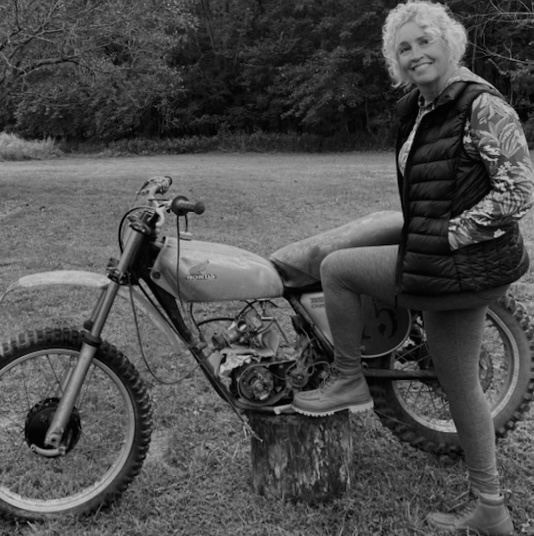
 

Historian and Journalist, Catherine OConnor looks at the past, present and future of motorsports with an eye for the human experience that brings us all closer. She has reported on women in supporting roles, the roots of the Springfield Mile, the DuQuoin Magic Mile, and a story in images of the Hogroast: When Honda Smoked Harley in the 1980s.


Related Posts

The Vintagent Trailers: Dirt Track Dickie

I think it's time I finish that film.

What’s Mees Got?

Jared Mees has 6 AMA Flat Track…
The Universal Racing Motorcycle

Dimitri Coste attempts the impossible:…


Subscribe to Our Weekly Newsletter