Collecting Motorcycles in the Shadow of the Acropolis

The Hellenic Motorcycle Museum of Athens, Greece

Motorcycle collections are often built as the result of one person’s dedication to preserving memory and time. People are drawn to specific brands and styles for aesthetic and technical reasons, but also intangible reasons that might be hard to explain. One bike leads to another and a logic between the machines develops. Having a large, safe, space to keep those bikes facilitates the process exponentially.
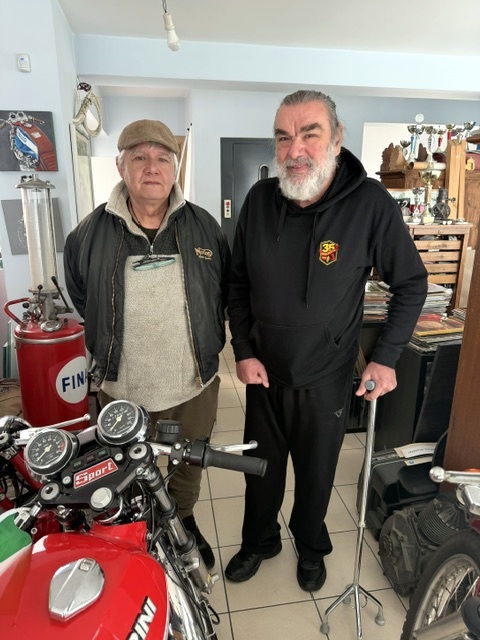
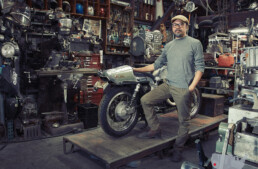
Master mechanic Athanasios Papoutis and the Owner of the Hellenic Motorcycle Museum Takis Mariolopoulous [Mike McCabe]
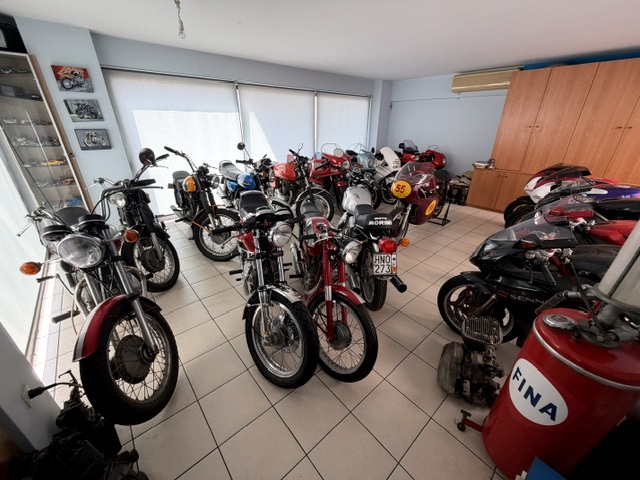
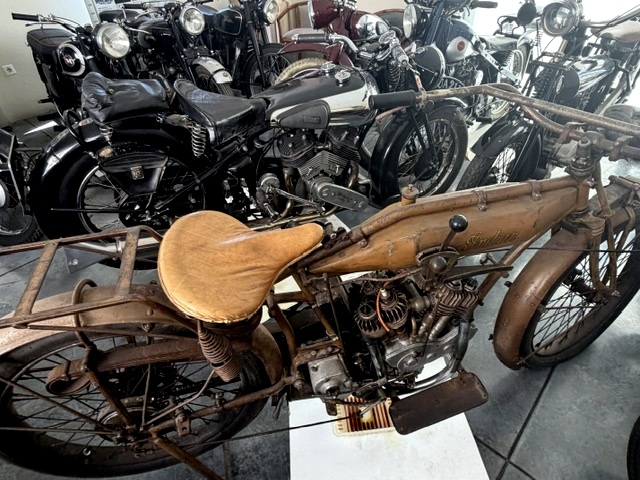
Panagiotis (Takis) Mariolopoulos lives with his wife in a contemporary, midsized five-story building in the Mets neighborhood of Athens, in the shadow of the historic Acropolis. The building has a central freight elevator and a contemporary spiral staircase that Takis designed and installed, connecting the floors of the building that are crammed with more than one-hundred impressive, historic motorcycles. The dizzying collection spans time and styles from vintage to track bikes and motocross two-stroke enduros manufactured in different countries. He’s paid attention to grouping brands together, and each bike represents a memorable example of a particular class. The selections cut across mostly British and European marques: Brough Superior, Ariel, Matchless, Norton, Ducati, Moto Guzzi, Velocette, BMW, Douglas, Aspes, Ariel, Pesaro Motobi, Triumph, Moto Morini, Universal, Condor and Laverda.  There is also an Army green Harley Davidson WLA from around 1939-40 and a few Japanese track bikes from the ‘80s-90s. The air around these bikes is heavy with aging tire rubber and gasoline -every available square inch has a bike somehow parked in it. The whole situation is completely mind blowing.

A c.1916 Indian Power Plus in an unusual color with a Brough Superior SS80 with Matchless motor. [Mike McCabe]
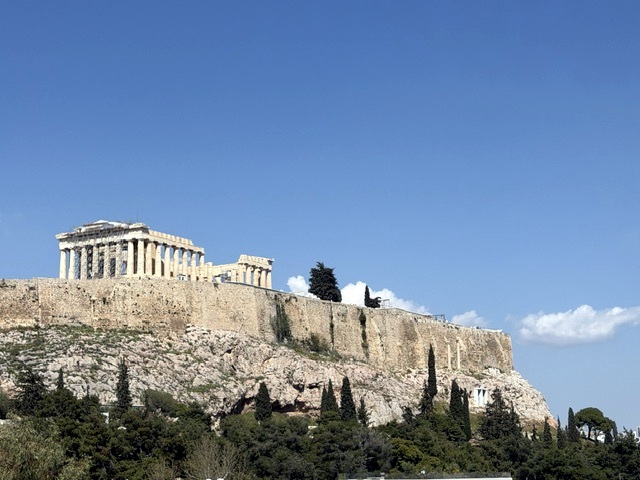
Upstairs, standing on the building’s roof terrace, Takis gestures towards the impressive 5th century BC Acropolis where the Parthenon stands: there are connections between the Acropolis and all the motorcycles sitting downstairs. Ideas about democracy were first talked about in Athens; the remaking of a society to be more inclusive. Motorcycles share these same kinds of ideas in history. During the 20th century, the development of lower cost, two-wheeled vehicles insured more people could take part in the transportation revolution.

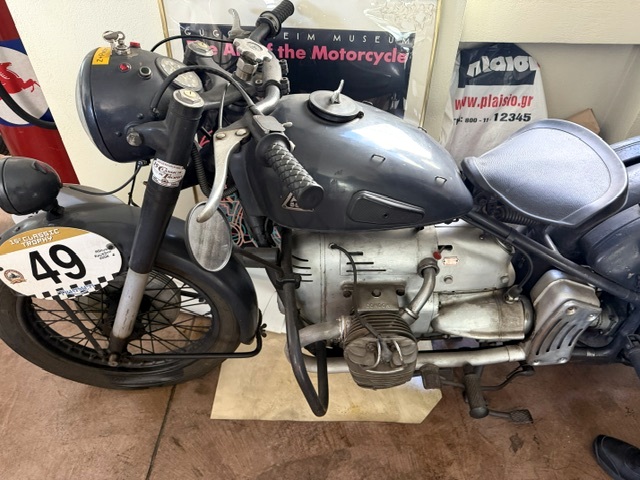
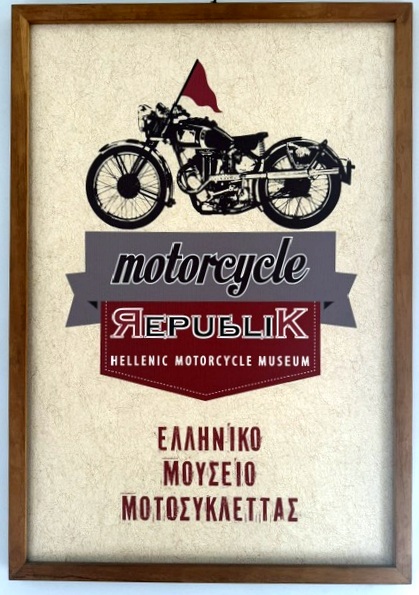
A poster for the Hellenic Motorcycle Museum in Athens. [Mike McCabe]
Greek civilization has existed in some way for 3,400 years, and Athens has been an established power base since 1400 BC. But today, looking across the Athens skyline, there are few if any large, modern buildings blocking the sun. Greece is not known for an industrial footprint and instead has a booming tourist industry, and exports agricultural products. During the 1950s-60s there were a few Greek companies like MEBEA that made small motorcycles and three-wheel utility vehicles; Mego that was a partner of MEBEA; Alta, that made bikes from 1962 to 1972; and Leftas that made bikes from 1982 to 2005. All these brands lost out to international competition and slipped into obscurity. Today, Greece’s two-wheel industry focusses on distribution, retail, and servicing of foreign brands rather than domestic manufacturing. Major global brands have official distributors and subsidiaries in the country, like the Saracakis Group that represents Honda in Greece and Triumph Motorcycles Greece.

A selection of machines from the 1970s and 80s: Triumph, Ducatis, Motobi, Kawasaki – a real mix. [Mike McCabe]
Takis lives a calm day-to-day life overseeing his impressive Hellenic Motorcycle Museum collection. “I started collecting motorcycles around the 1980,” Takis said. “I was in my early 30s. My parents were Peloponnesian but I was born in Athens. First of all, when I was young I liked vintage cars, so I sold them. But when I sold the last one, I lost my identity. … I wanted something to do…  I found a 1951-52 Horex 400cc single cylinder (German motorcycle)… Good bikes but like English bikes, always a problem… I still have this Horex bike. Horex had different models, the Regina 350 in the 1950s, the Imperator 400 and 500 in the 1950s and the Columbus 500 that was released in 1988 as a tribute to the earlier models.”

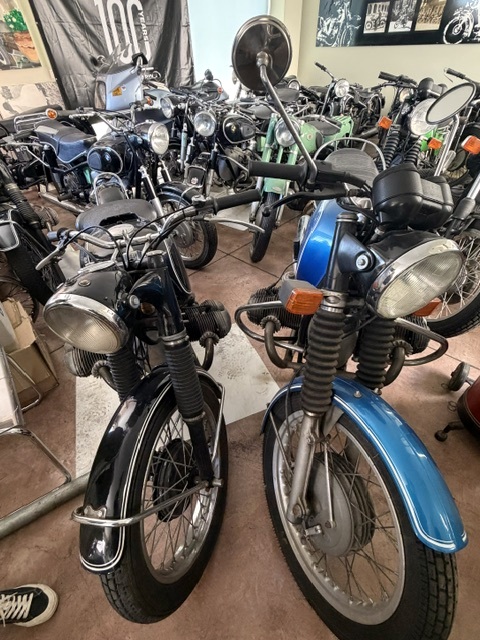
Two BMWs, from the 1950s and 70s, guard a larger group of German machines, including a Zundapp two-stroke. [Mike McCabe]
“I wasn’t so young when I started collecting bikes. I started when I came back from my studies in Rome- 1985. I studied residential design. It was a good experience. I love Italian people. I lived with them for more than six years. Now through the bikes I have kept contact with these people. I speak Italian of course. Back in the 1980s it was easy to find motorcycles… I would go to the petrol station and they would tell me, “Look, there’s another guy who wants to sell his bike.” I was making enough money from my architecture work, so I would buy bikes. I did not have skill to work on motorcycles and learned only from experience.”

The view of the Acropolis from the Hellenic Motorcycle Museum. [Mike McCabe]
“I lived in this building so I kept the motorcycles here. After architecture school I made spiral stairs, and after 1990, I started my own company to make stairs. I was the only architect in this area, and had good business. So, I was making good business and I thought…more motorcycles. I thought at the time, motorcycles are like the ocean, they never stop. I renovated this building to fit the motorcycles. I designed the living space in the building to be as minimal as possible. My wife and I live in a small apartment on the third floor: everything else is motorcycles. Every time I buy one, I push everything over and make room for one more. I have more than one-hundred motorcycles here and I have more in other buildings. I lost count, maybe I have one-hundred and two (laughter).”

Condor is a Swiss manufacturer that’s as old as Indian, dating back to 1901. [Mike McCabe]
“I have different bikes here, and it’s impossible to estimate the value of the collection. So there is a Brough Superior, Vincent, Douglas, HRD, Velocette – my favorite bike – and other English bikes. There are a lot of BMWs, some French bikes… Bikes from everywhere. A collection of spare parts. I cannot know everything I have. For this collection, we have more than just classic motorcycles, I believe in a museum we have to present all the history of motorcycles. We have many recent Ducati; I believe we must have modern bikes. All of these bikes are a part of history.”

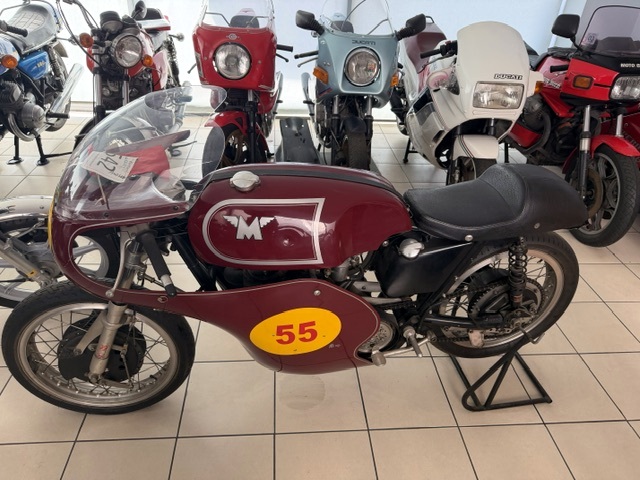
A 1960s Matchless G50 fronts a selection of 1980s sports bikes. [Mike McCabe]
“When I studied architecture in Italy, I saw many Italian motorcycles there. Now I have many Italian bikes in my collection. I don’t really have a feeling of completeness about this. Never. Every time I look at my collection, I feel something is missing. I look at magazines and I dream about the next bike. I am getting older. I know, it will not be possible to ride all my bikes so I dream about being able to ride all these motorcycles. My wife tells me sometimes she dreams of me riding the motorcycles up the spiral staircases inside the building. That would be nice.”

www.motorcyclerepublik.org


Michael McCabe is a New York City tattoo artist and cultural anthropologist. He is the author of New York City Horsepower, Kustom Japan, New York City Tattoo, Japanese Tattooing Now, Tattoos of Indochina, and Tattooing New York City. For New York City Horsepower, Mr. McCabe spent two years discovering and documenting underground custom motorcycle and car garages in the City, as rapid gentrification put their culture under tremendous pressure. He interviewed and photographed New York City customizers about their personal histories and creative sensibilities. More of Mike’s articles for The Vintagent can be found here.