“Everything is Permitted” – Carlo Mollino

Getting a handle on Carlo Mollino’s life and work defies easy summary, as he did so much, so well, in so many diverse fields, with the only Venn overlap being Mollino himself at the center of it all. His only nod towards having a proper business was a small brass plaque outside his father’s engineering firm, where he kept a desk most of his life.  I’ve come to think of Carlo Mollino as an aristocratic genius vampire, or maybe just Italian Batman, with a public life of a wealthy bon vivant who saw art in speed and machinery (naturally, growing up in the heyday of Futurism), excelled in every field he chose, yet kept enormous secrets, especially his ‘Batcave’ garconnieres, where no-one was admitted but a string of Cat Women whom he photographed seminude, in costumes he collected; bridal dresses, sexy lingerie, and even a Paco Rabanne metal-disc shift.
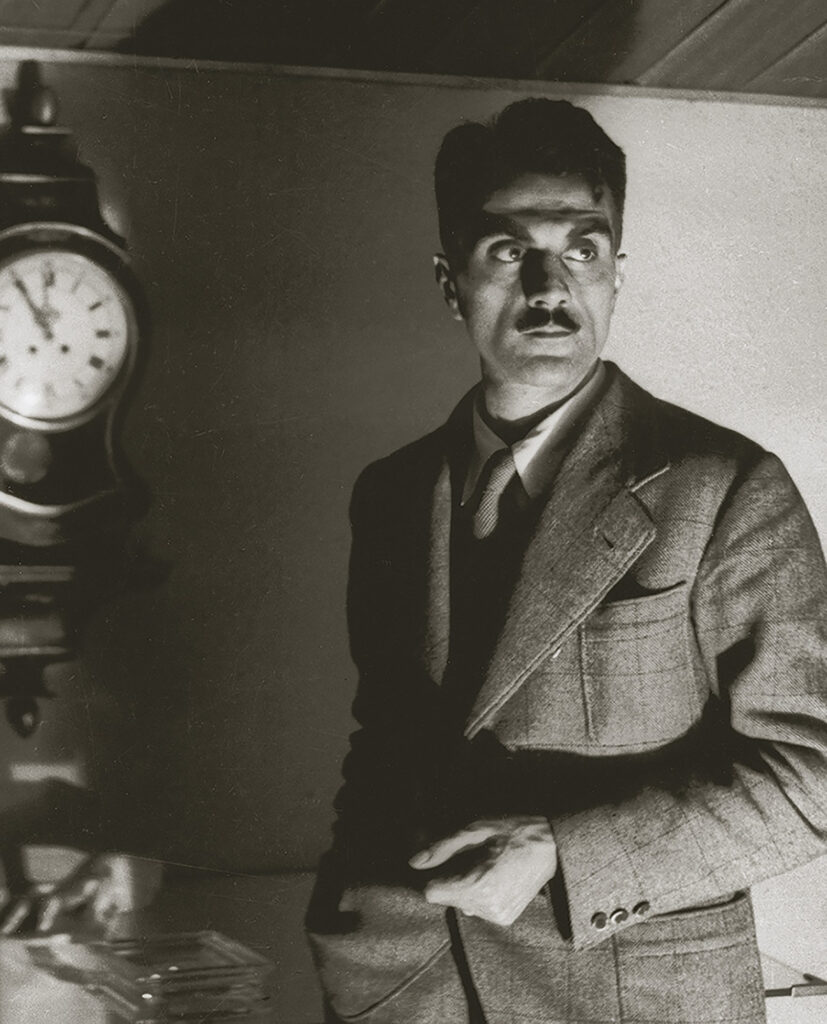
The ‘Turinese superhero’ – an artist as beyond comprehension, yet utterly brilliant. Carlo Mollino was truly a man of many facets, some of which were not discovered until after his death. [Wikipedia]
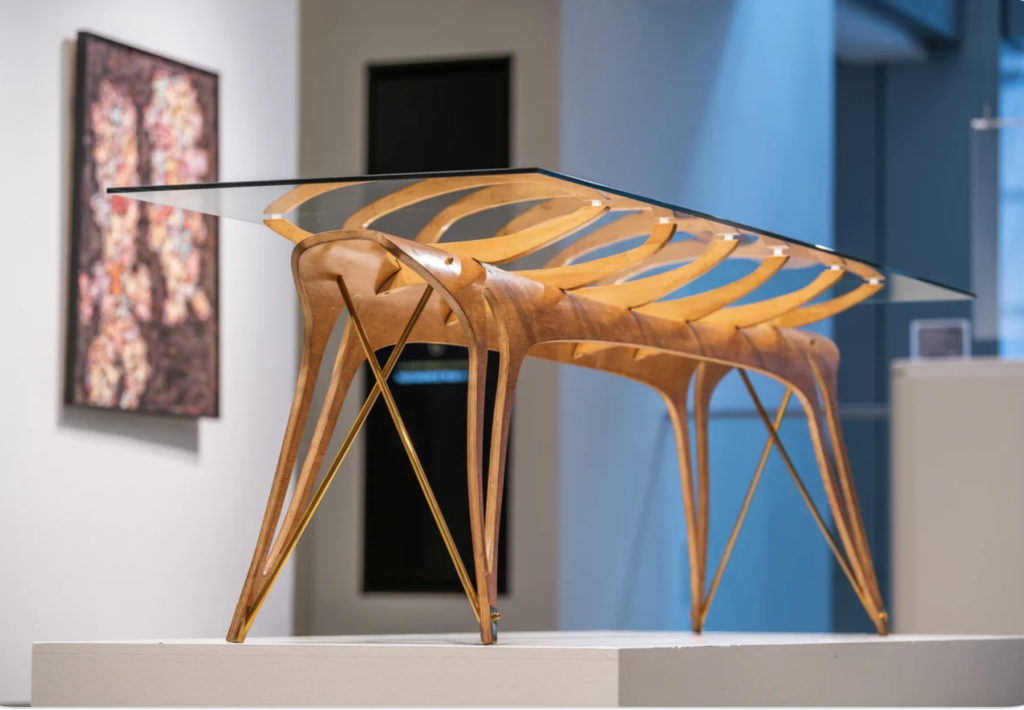
The complicated life and work of Carlo Mollino demands metaphors. Paola Antonelli, Design Curator at MoMA, called him “a Turinese superhero, dark and irresistible.”  His friend Bruno Zevi called him “a man surely in league with the Devil.”  Modern artists and architects are frequently called names – for good reason – but only Mollino is so described for his genius, not for his behavior.  He is widely acknowledged as a monstrous and eccentric talent, the breadth of whose career cannot be easily summarized, and his rare output – a baker’s dozen buildings, a couple of vehicles, two books, a few hundred pieces of furniture, and a few thousand photographs – commands the highest prices at auction today.  His furniture sells for huge sums: in 2020 the Brooklyn Museum de-accessioned a unique Mollino glass-topped plywood dining table built in 1949, gaining them $6.2M at auction, and dealing ‘a nasty crack to the overdraft’, as Harold Willis quipped about his 1928 TT prize money.

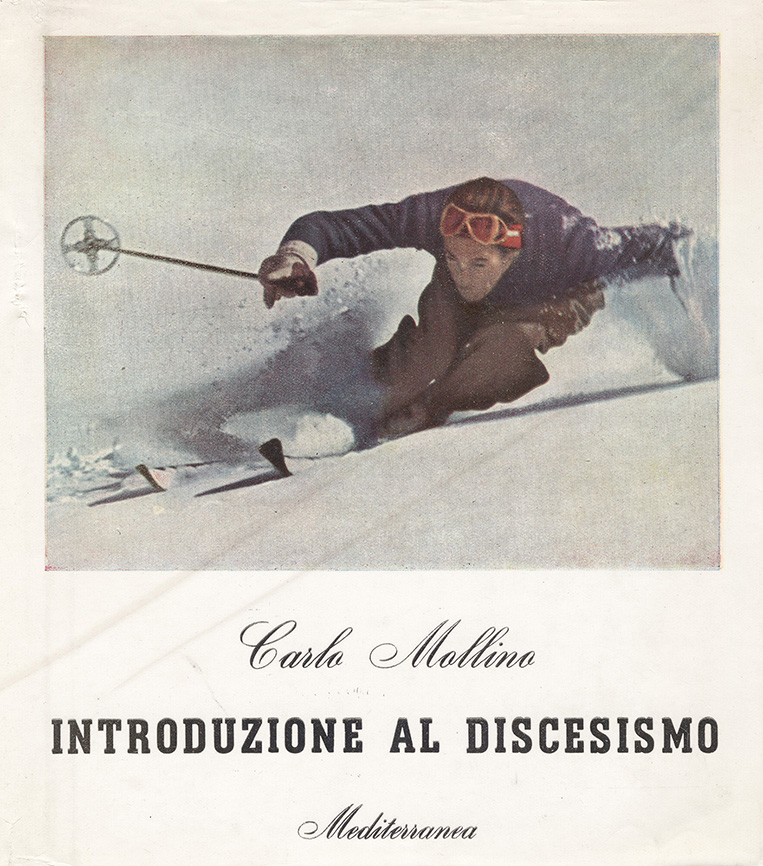
During WW2, Mollino spent time trekking into the Alps to photograph his instruction manual on skiing. The photography is, as one would expect, superb, especially considering there were no ski lifts: every hill had to be climbed before skiing, and taking multiple shots for the book must have been an ordeal. Mollino also published a wonderful book on photography – ‘Message from the Darkroom’.  Who else would use such a spooky title?[Wikipedia]
Carlo Mollino was born 6 May 1905, the only son of Jolanda Testa and Eugenio Mollino, and grew up in an 1860 neo-Gothic villa surrounded by extensive parkland, a bourgeois paradise in Rivoli, just outside Turin.  Young ‘Carluccio’ was surrounded by indulgent women, including three aunts who shared the grand manse: it seemed a happy childhood. Carlo loved their home, grounds, and library, which he later immortalized in his 1936 Surrealist novel ‘L’amante del Duca’ (the Duke’s lover): “The sumptuous library left to its own devices had become a fossilized landscape and fief of an intelligent though barbaric, but not vandalistic, corsair…”  If one’s first novel is always autobiographical, here is Mollino’s self-image.  He definitely curated how others saw him, cultivating his image through carefully lit self-portraits and photographs within his unique interior designs, especially in his own garconniers.

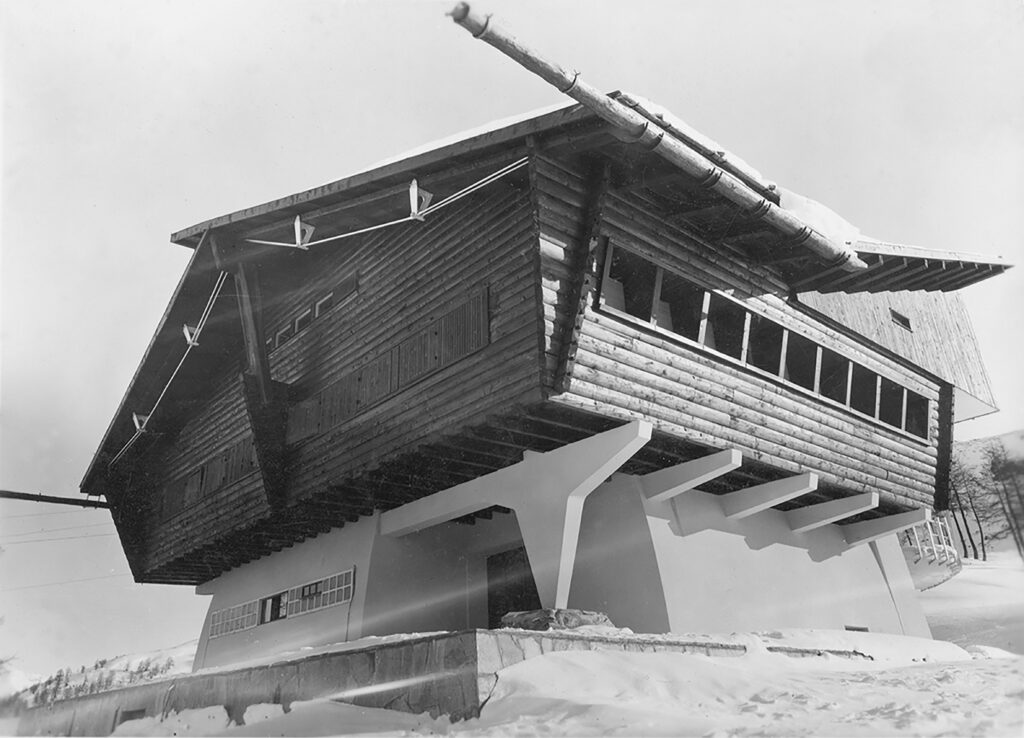
Architecture and furniture were Mollino’s claim to fame. His Lago Nero ‘Sled Station’ in Sauze d’Oulx is a meditation on folk construction techniques, filtered through a modern lens, but totally idiosyncratic. [Wikipedia]
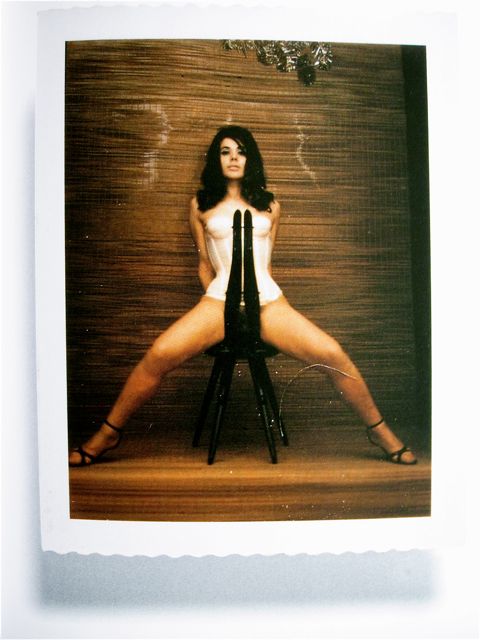
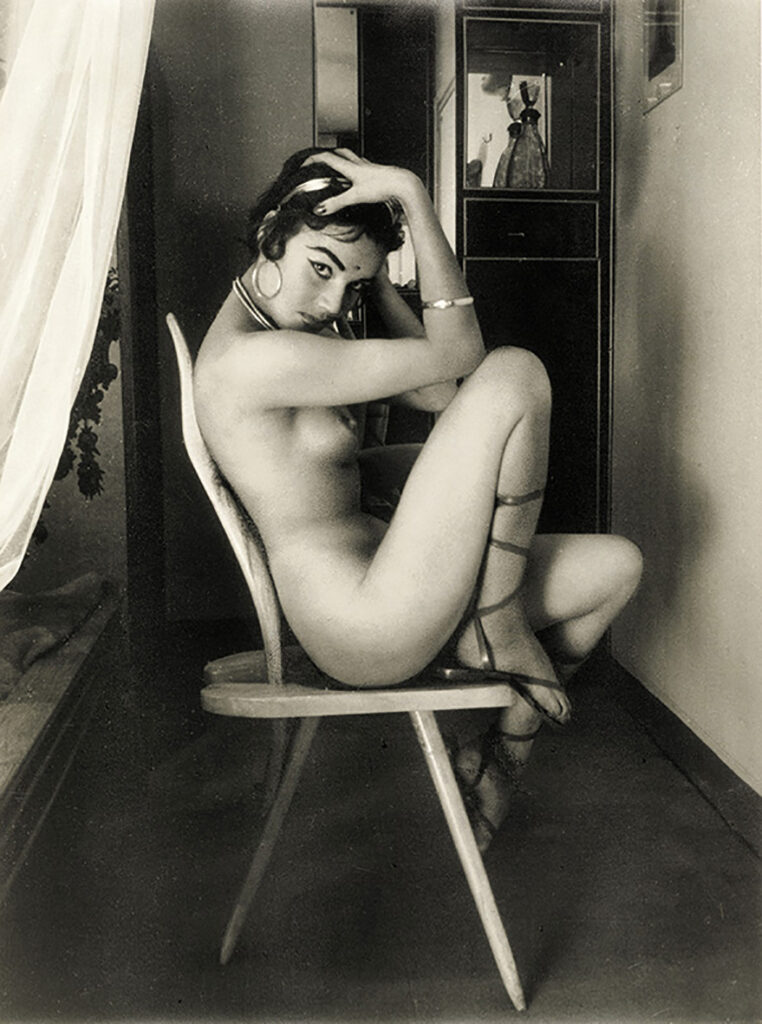
Mollino graduated from Regio Scuola Superiore di Architettura in 1931 while working at his father’s busy civil engineering firm. He interned for Erich Mendelsohn in Berlin, and studied art history for six months in Ghent. By this time his virtuosity as a draftsman was recognized, as well as his uncanny ability to draw simultaneously with both hands – on different drawings.  A man in league with the Devil.  During the war years, Mollino, who never expressed a political opinion nor participated in the war effort, spent his time developing the first modern book on skiing technique (Introduzione al Discesismo, finally published 1950) which he wrote, illustrated, and photographed in the days before ski lifts.  He also finished a book on photography he’d begun in 1934, called ‘Il Messaggio Della Camera Oscuro’; a message from the dark room. Mollino photographed intensively all his life, at first his architecture and interiors, in Surrealist setups with friends, and of skiers.  After 1950, he turned exclusively to photographing women, and from 1962 until his death in 1973, shot only Polaroids of Turinese streetwalkers in his final apartment, which he never slept in. These 1500 unique works are pure Carlo; erotic of course, but strangely majestic, and distinctively staged within his peculiar interior design.  If published in Vogue, these photos would have been the equal of Helmut Newton or Stephen Miesel, but Mollino showed them to no-one, and was decades ahead of that curve.

Mollino on Mollino: one of his never-discovered Polaroids of Turinese streetwalkers posing in his garconniere, here with his own ‘Fenis’ chair, which is currently back in production. ‘Is that your Fenis, or are you happy to see me?’ [Salon 94]
Because of Carlo’s disinterest in money, his father Eugenio, proud of the 300 structures he’d built around Turin, called his only son a ‘feckless good-for-nothing’.  Yet who remembers a single building from the upstanding Eugenio?  The memorable ones are usually burned at the stake. Carlo was not sacrificed, but did upset a few people, and certainly caused head scratching.  It’s no wonder his greatest oeuvre, the one discipline he pursued consistently his whole adult life – his photography – he kept hidden until his death, for others to discover, and be scandalized by.  Today Mollino is remembered for his photos as much as for his magnificent furniture and architecture.  He is barely remembered for his car, and not at all for his bus.

Furniture

The record-setting ‘Vertebra’ table that sold for $6.2M in 2020. [Sotheby’s]
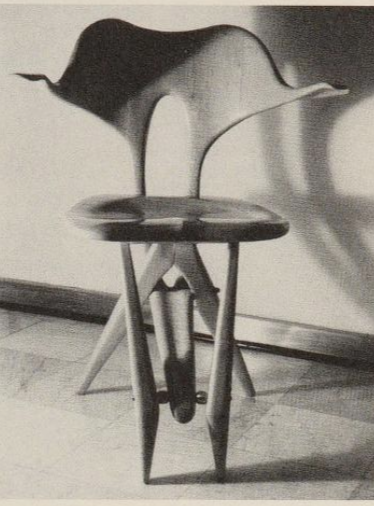
Mollino’s furniture is universally acclaimed as his most radical and successful work.  His designs look like nothing else, with strong Surrealist influences built with a mid-Century toolkit: glass, steel, tension rods, and ply/ bent/ carved wood. While completely functional and surprisingly comfortable, their design was far more uncompromising than more celebrated contemporaries like Prouvé or Eames, icons lashed to the mast of industrial production.  Mollino’s chairs especially are slim and possibly dangerous, always erotic, and from certain angles even cunnilingual.  If that seems outrageous, imagine the obnoxious trucker from ‘Thelma & Louise’ waving a photo of a Mollino chair at the heroines, instead of his crude gestures; they would have got the message.

An example of Carlo Mollino’s furniture: a chair so utterly, viscerally cunnilingual as to elicit reactions of revulsion, fascination, and awe. [Museo Carlo Mollino]
There are good reasons that collectors (mostly wealthy males) go crazy for Mollino’s furniture, and spend fortunes to acquire the few extant pieces: there is simply nothing else like them, they are very beautiful, and they are extremely rare.  Mollino’s designs were hand-built for a specific location; to make more than 8 chairs for a bespoke dining set was pointless.  Only his designs for theaters and offices were built in series, with as many as 200 chairs for the RAI auditorium (1952) or the Lutrario Ballroom (1960).  All else was made in handfuls.  Mollino’s secrecy included his relationship with the Turinese workshop Appeli & Varesio: he insisted his furniture was built only on Sundays, when the shop was supposedly closed, to ensure no one could spy his concepts.  For the rest of the week, they were hidden under blankets, off-limits.  With his modest furniture production, and his meticulous notes, it is possible to trace each piece to a specific date and commission: no fakes are possible. That, combined with his masterful, uncompromising design, contributes to their astronomical prices.

Nube d’Argento (1954)

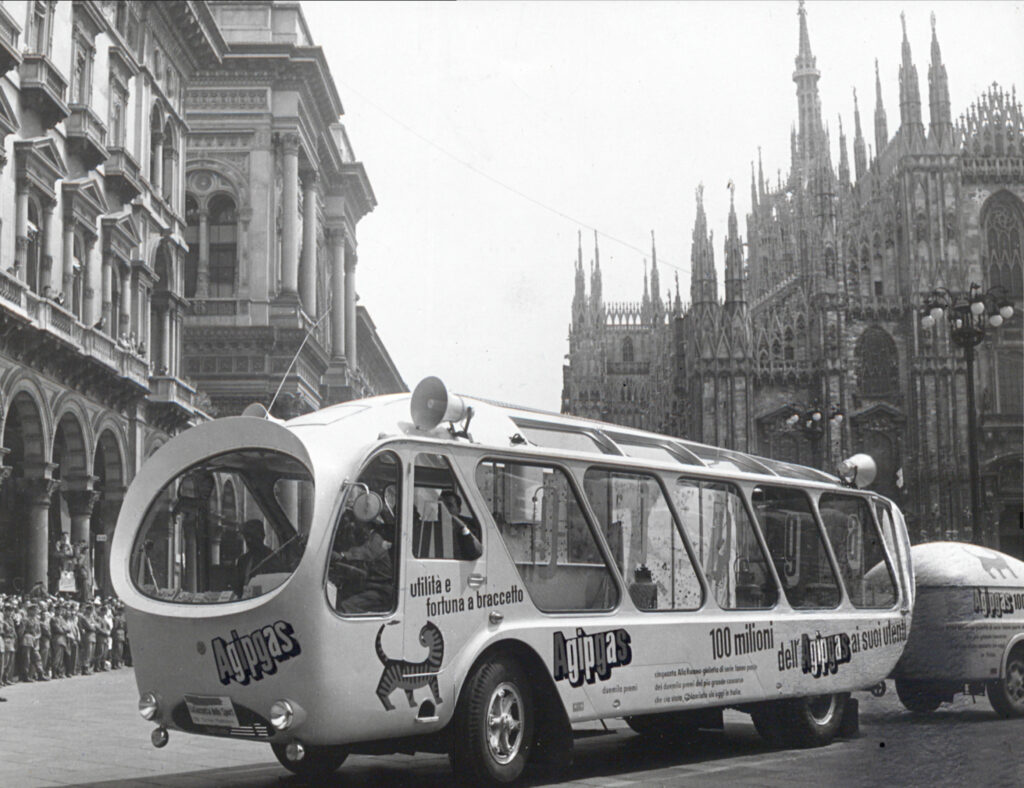
The Nube d’Argento promotional bus commissioned by AGIP gas, through which passed over 1 Million visitors. [Museo Carlo Mollino]
Mollino completed only two automotive designs, each wildly different from the other: an advertising bus, and a Le Mans racer.  The bus was a commission from AGIP, in a push to move Italians away from wood or coal-fired cooking, in favor of natural gas. By the late 1950s, Italy was sufficiently prosperous to afford home improvements; gas was the future, and AGIP envisioned a mobile showroom to demonstrate gas-fired home appliances.  Such advertising vehicles were popular enough by 1951 that the Levante trade fair in Bari held a concours d’commmerce: the winner was a mobile showroom commissioned by Societa del Liquigas, designed by architects Franco Camp and Carlo Graffi.

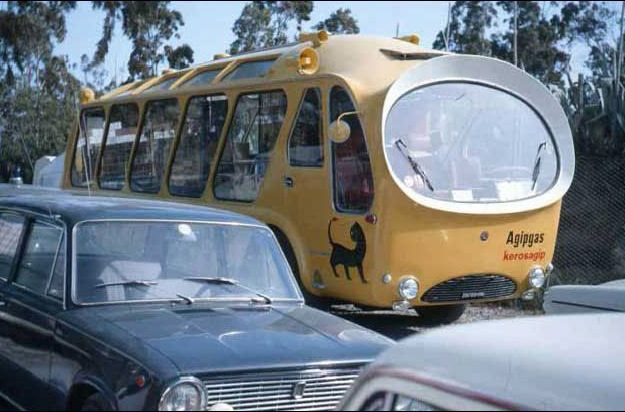
The lurid yellow of the ‘silver cloud’ Nube d’Argento, and its scuba mask driver’s window are clearly seen here. [Gianluca Brescia]
In 1953 AGIP turned to Campo and Graffi to design a mobile display bus, and they in turn roped in their friend Carlo Mollino.  A Macchi bus chassis was chosen as the perfect clean slate atop which they could build anything: what they built was striking, innovative, and odd, a 1950s schoolbus with slanted windows fronted by an off-kilter scuba mask.  The windows and roof were a special VIS safety glass, used for the first time on a vehicle, but the interior is recognizable today as a high-end caravan conversion. The driving area was a lounge that doubled as a radio station, with two seats for drivers, plus three armchairs bolted to the floor, as was a Masonite-topped mini desk with a screwed-down typewriter.  A radio and two record players (the first mobile DJ booth?) connected to four PA speakers mounted atop the bus.

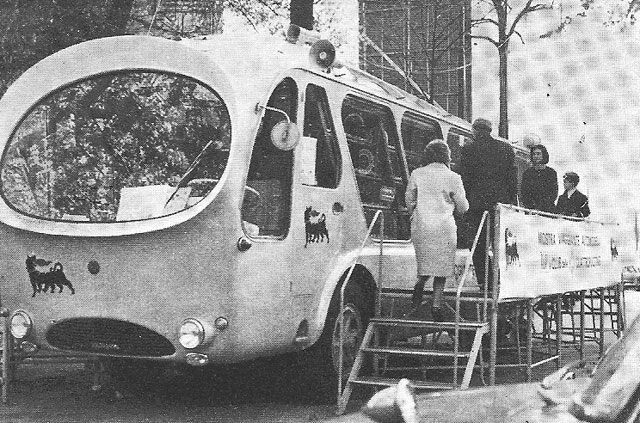
A few of the estimated 1 Million people who toured the mobile promotional bus all across Italy. [Gianluca Brescia]
Covered in bilious paint and green stickers, the bus was dubbed ‘Nube d’Argento’ (silver cloud). It looked more like a Futurist lizard, with its framed driver’s window a giant mouth eternally shouting propaganda; Filippo Marinetti would have approved. The Nube d’Argento traveled all over Italy, even into regions of Africa where AGIP had a footprint, and it is reckoned the van reached over a million people through the early 1960s.  It was then stripped out, repainted, and loaned to Editoriale Domus, who used it for a mobile exhibit of 800 model cars organized by Ruotoclassische magazine.  That, too, reached about a million visitors in 1965 and ’66.  That’s humans walking through physical displays: whatever was spent building the Nube d’Argento, it was clearly worth it, twice.

Sports Car Fever

The lovely Mimi Schiagno in her Nardi 750 Barchetta sports racer, circa 1954. [Museo Carlo Mollino[
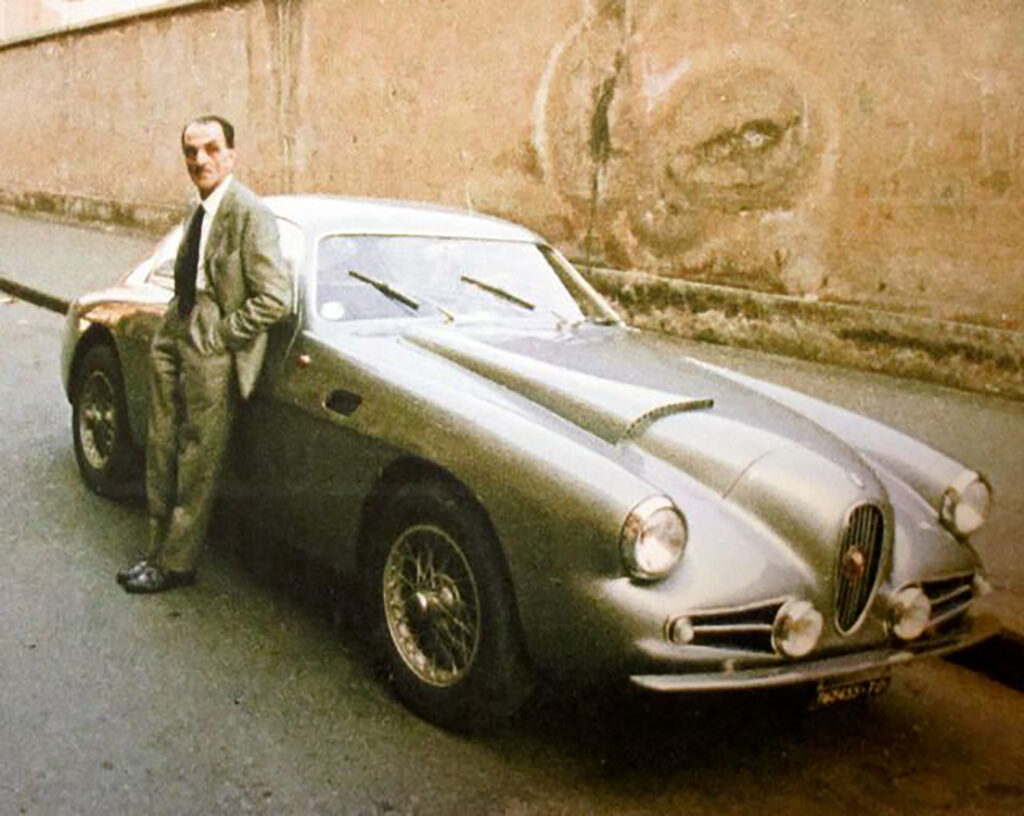
At age 49, in a classic mid-life crisis, Carlo Mollino grew obsessed with sports cars.  He dated the beautiful Mimi Schiagno, who was stylish, game, and raced sports cars. Carlo photographed her extensively, in her twin-seater sports racer (possibly a Nardi 750 Barchetta), and also her Lancia Appia and B20.  Mollino’s friends expressed surprise that he’d gone car-crazy, including the engineer Aldo Celli, who wrote to him in 1954; “I don’t know what to think about your new passion for engines and racing cars.”  As with everything Mollino, he went deep, and ordered a bespoke version of the newest and sexiest Alfa Romeo, a 1954 1900SS Zagato.  The only extant photo with the car shows a slightly more ovoid grille than the standard Zagato, and only a single asymmetric air scoop on the hood.

Ladies First: Carlo Mollino was apparently inspired by Mimi Schiagno to commission a custom Alfa Romeo 1900SS Zagato built in 1954, a unique vehicle worthy of his stylish presence. [Museo Carlo Mollino]
His confidant Aldo Celli moved to the USA in 1954 to work for Carl Kiekhaefer and his all-conquering NASCAR Chryslers, but felt compelled to (elegantly) warn Mollino about any racing aspirations; “Firstly, driving racing cars is like handling skis when racing; 80% depends on what you have learned and knowing how to do it, and 20% depends on innate skills. The difference is that if you make a mistake on skis, you fall, whereas if you make a mistake while you are driving you kill yourself.”  But knowing Mollino, he added, “Having said all this, live your life the way you want to, this is the most important thing.”  Mollino did go racing, entering his Zagato for the 6th edition of the Sestiere Rally in February 1955. With Celli’s warning in his ear, he hired Gino Valenzano to pilot the car, sitting beside him as copilot for a wild ride: they won their class, of course.

DaMolNar Bisiluro (1955)

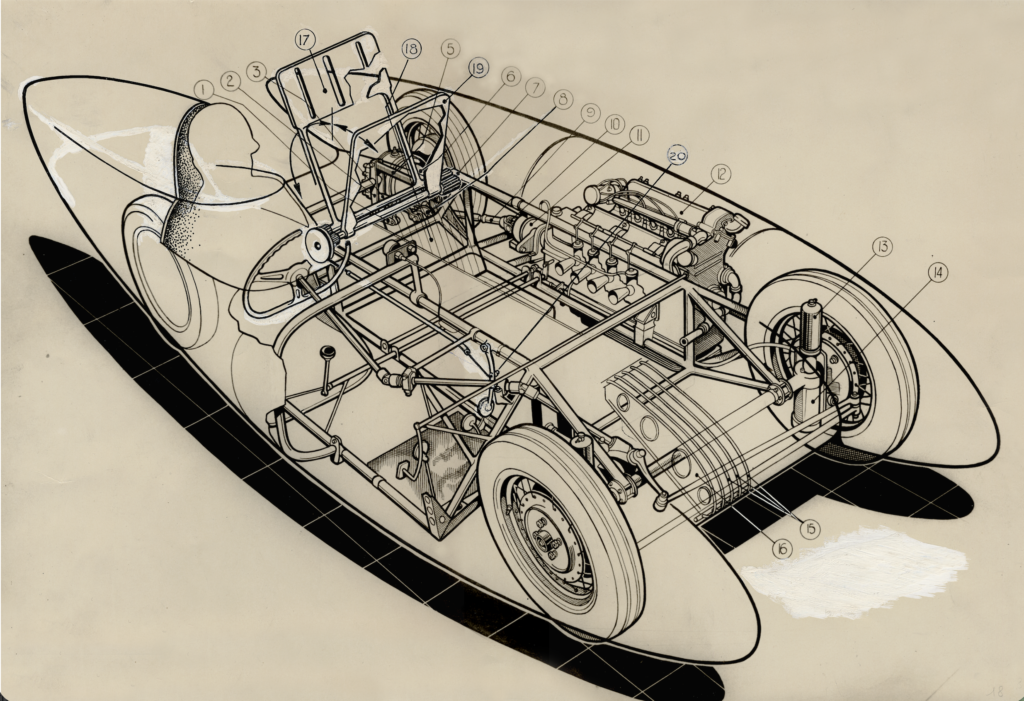
A lovely technical drawing of the Bisiluro, showing the assymetric layout of the engine and gearbox, and driver’s seat. [DaVinci Museum]
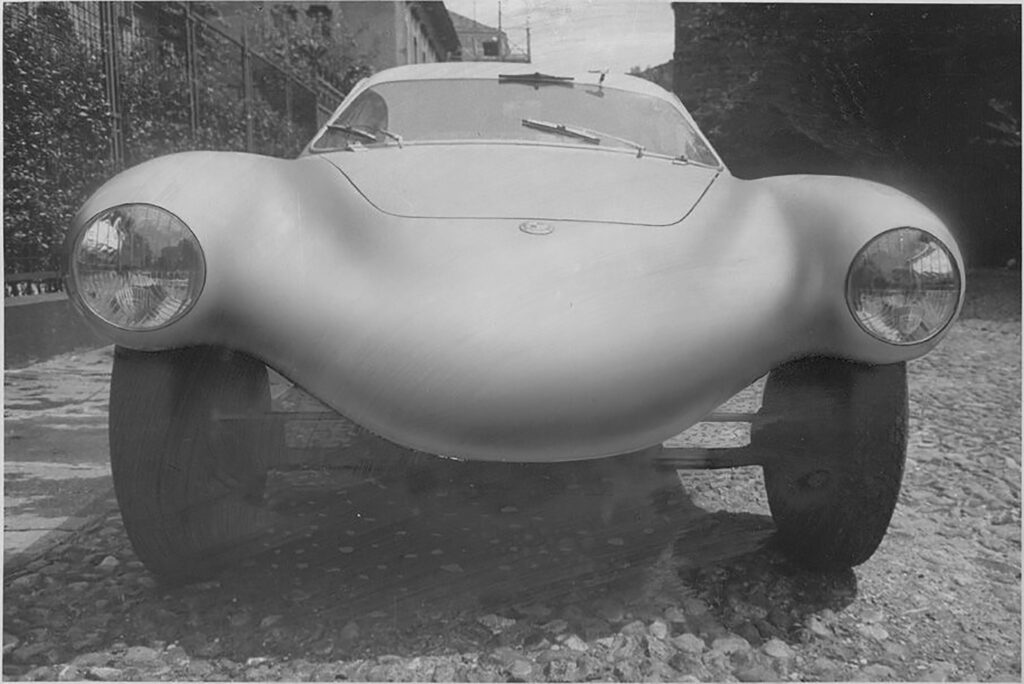
Mollino began hanging around a chemist’s shop in central Turin, owned by gentleman driver Mario Damonte, who had entered LeMans twice, winning his class in 1953 with an OSCA 1100 MT4 Vignale Berlinetta.  The shop was a hub for Turinese motorheads, and a cauldron of cutting-edge racing ideas, where Mollino met Enrico Nardi and his pilots Gino Valenzano and Geno Munaron.  Mario Damonte shared the 1954 Le Mans with Nardi in his ND 750LM Crossley, but they retired after 7 laps. But Mollino found inspiration in a photo of Damonte’s curvaceous OSCA 1100, over which he used an airbrush to modify the body shape, exploring new aerodynamics.  The OSCA grew progressively more curvaceous until he finally divided the body into two elongated breasts floating in space – the ultimate Surrealist automobile.  Thus was born the original layout for a Bisiluro, or twin torpedo, an asymmetric car with the driver in one torpedo, the engine in the other, and not much in the middle.

Carlo Mollino’s re-imagining of Mario Damonte’s OSCA 1100 racer. [Salon 94]
Mollino shared these studies with Nardi and Damonte, exciting them sufficiently to mount a plan.  Nardi’s ND workshop had the facilities to make such a car, and Damonte had both the money and the history with the LeMans organizers to gain entry to the world’s premier race.  Objectively, it was rash to have an architect design a sports racer, regardless his qualifications as an engineer, but this was Italy in the 1950s, where anything was possible with cars.   Mollino refined his ideas with more drawings that eventually became plans. He successfully minimized the car’s frontal area by turning the middle of the car into a down-force wing, and placing the weight of the driver and engine in opposite sides of the car.  They called it DaMolNar for its triad of creators, but Mollino preferred simply ‘Bisiluro’.

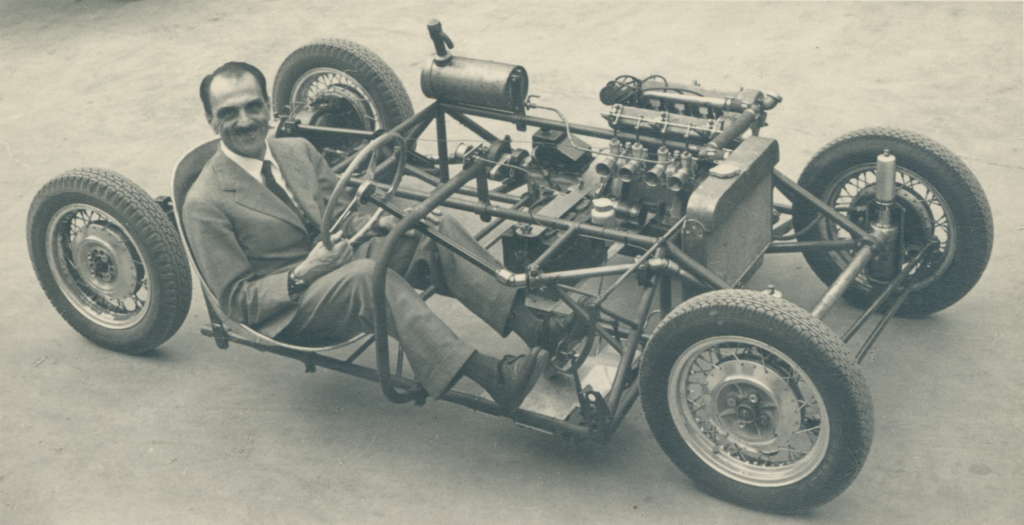
Carlo Mollino trying out the first-gen chassis of the Bisiluro, before the two halves were more radically divided into twin torpedos. [DaVinci Museum]
Mollino’s Bisiluro was not the first of its type; drawings for a twin-boom racing car were patented in the 1940s by Reinhard von Koenig-Fachsenfeld at the FKFS aerodynamics research center – the Kamm Institute of ‘Kamm tail’ fame.  The first bisiluro actually constructed Piero Taruffi’s 1948 Tarf and Tarf II record breakers.  The first Tarf weighed only 300kg, and was powered by a 350cc Gilera 4-cylinder motor; it’s wind-cheating body exceeded 130mph.  The Tarf II used a supercharged 1720cc Maserati engine and did 187mph. The Tarf racers proved (as if it needed proving) that taking aerodynamics seriously was rewarded with speed.

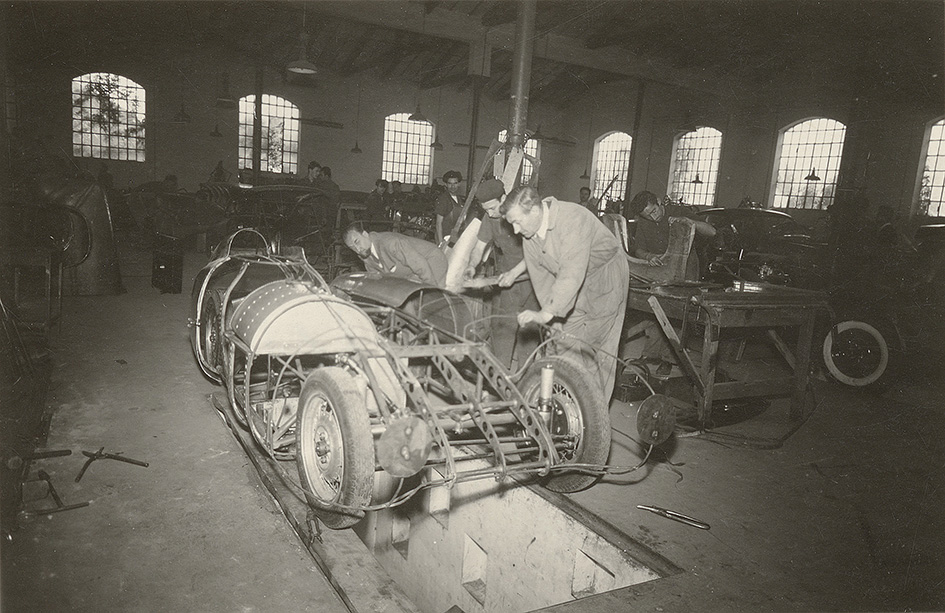
The Bisiluro under construction at the workshop of Enrico Nardi, with Mario Damonte examining progress. [DaVinci Museum]
The Bisiluro’s design process was backwards compared to traditional coachbuilding, with the body taking priority, as with aircraft and record-breaking streamliners.  Enrico Nardi had many years’ experience building trellis-tube chassis for his racing cars, so an understructure for Mollino’s streamlined form was straightforward. The body itself was entrusted to Turinese specialist Rocco Molto, whose CaMo (Carrozeria Molto) built aluminum racing bodies for Ferrari, Maserati, and Nardi.  These were hammered from aluminum sheet less than a millimeter thick, then gas-welded on U-shaped lapped seams using borax to prevent brittleness: his shells were extraordinarily light.  For the motor, a 4-cylinder DOHC Giannini G2 engine of 747cc was used, that breathed through four Dell’Orto carburetors to give 55hp. Front steering and suspension was courtesy a Lancia Appia, with the rear end from a Fiat 1100. Integrating a radiator into the curved body shape required Mollino’s guidance at a Turinese radiator shop, using bent square copper tubing to flow seamlessly with the central wing.

The Giannini G2 747cc DOHC four-cylinder motor used four Dell’Orto carburetors, producing 55hp, but with the streamlining the car was tested at 220kph (132mph). The Bisiluro is now restored, and can be seen in the Meseo Nazionale Scienza e Tecnologia Leonardo DaVinci (better known as the DaVinci Museum) in Turin. [DaVinci Museum]
Nardi’s pilot Geno Munaron test drove the Bisiluro, and his reports are telling.  First, the car was too fast for its drum brakes. ‘‘We had no brakes, and our tires were 17 to 18 centimeters wide. We needed an elephant’s weight to press on the pedal to brake.”  Mollino’s solution came from aircraft, with a pair of flat ailerons activated by a foot pedal acting as air brakes.  The system worked a treat, just as it did for the Mercedes-Benz 300SLRs that year.  The rearview mirror was retractable to maintain the slipperiest profile, although the airflow was slightly marred for Le Mans by the addition of three flat scoops directing air over the radiator.

The Bisiluro was so light at 450kg that it could be manhandled to turn around within its own length. [DaVinci Museum]
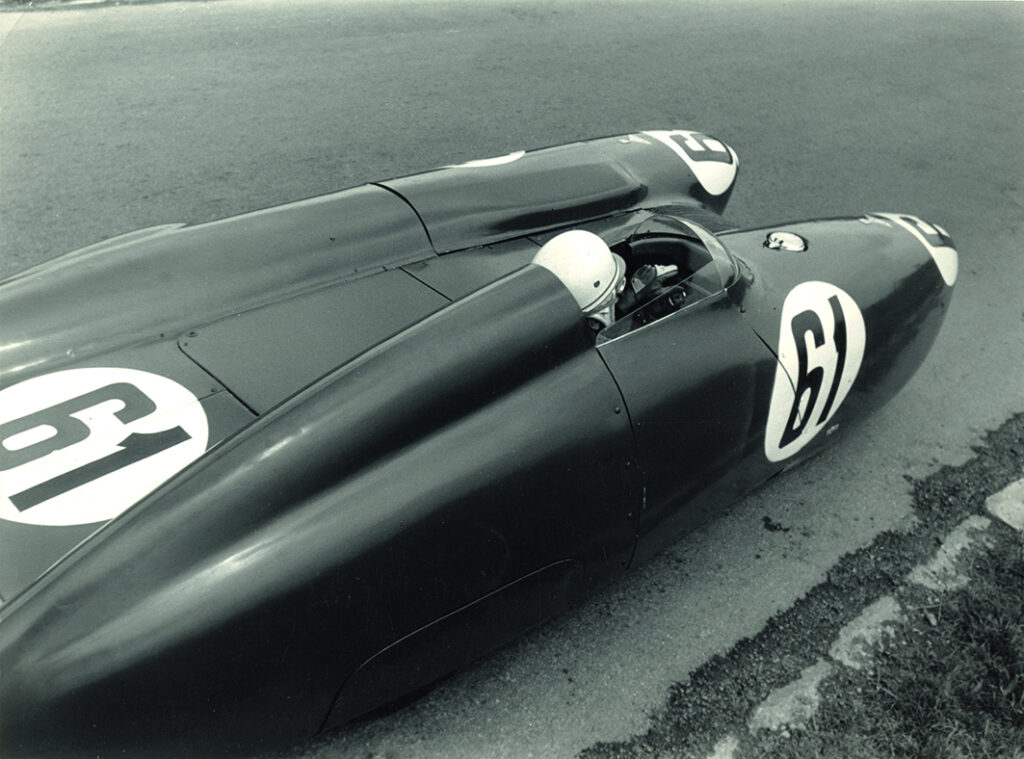
The competed Bisiluro weighed only 450kg, and was by far the fastest car in its class, with a top speed recorded testing at Monza of 220kph. But the handling was peculiar; Munaron explained how the driver feel either at the center or at the edge of a pivot, turning left or right.  Munaron had clearly never driven a sidecar, which gives exactly these sensations!  His net assessment: the Bisiluro was twitchy, requiring a calm hand while cornering: “Damonte will not have a quiet country walk on Saturday” at Le Mans.

Carlo Mollino testing the Bisiluro. [Elirio Inverizzi]
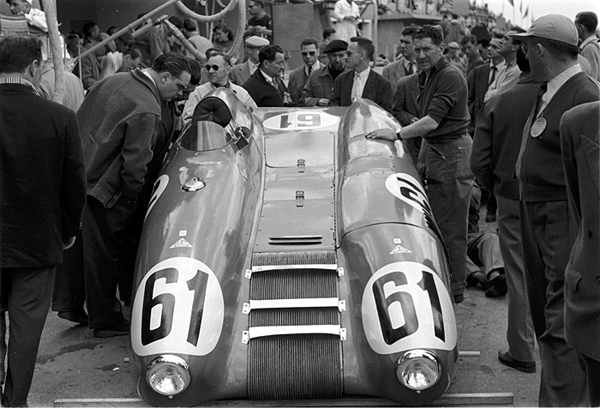
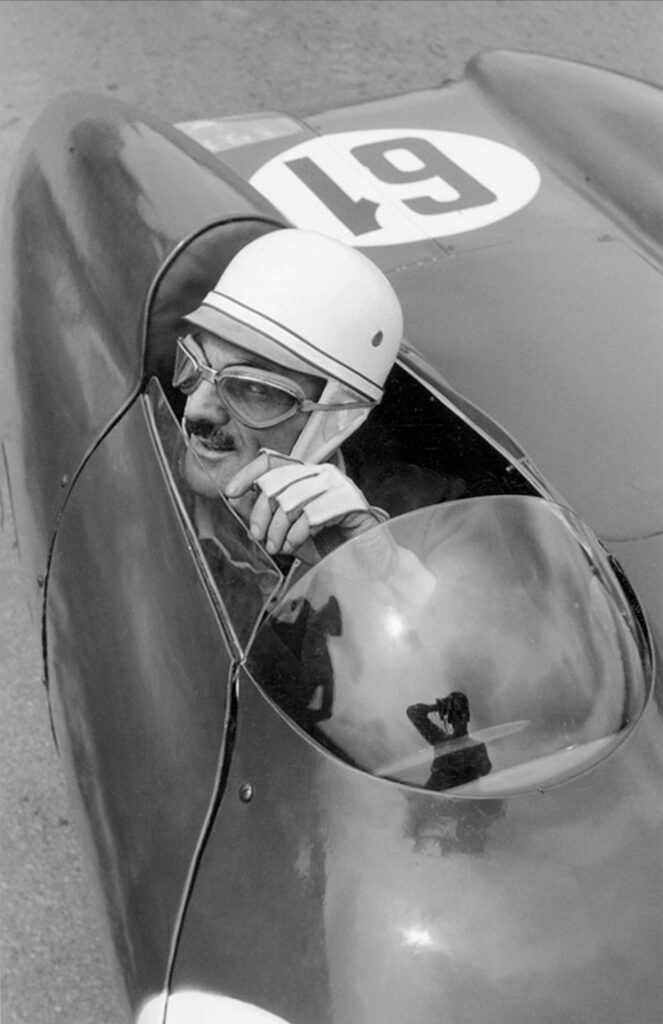
Damonte towed the Bisiluro to France atop a tiny trailer behind his Fiat 1100; it looked like a shiny red spacecraft, and drew considerable attention.  Entering the race was a trick; Le Mans was only open for production cars, so Nardi claimed the ‘ND 750LM’ as his next model, advertising it in his 1955 catalog for 1.4M Lire.  Scrutineering was another matter, and the rules required a passenger seat, if not a ‘mechanic’ as in the old days: it was necessary to remove one of the air brakes and install a folded stool in the void.  That satisfied the officials, but cost the car part of its braking system, and some of its chassis integrity, as a tube had to be removed.

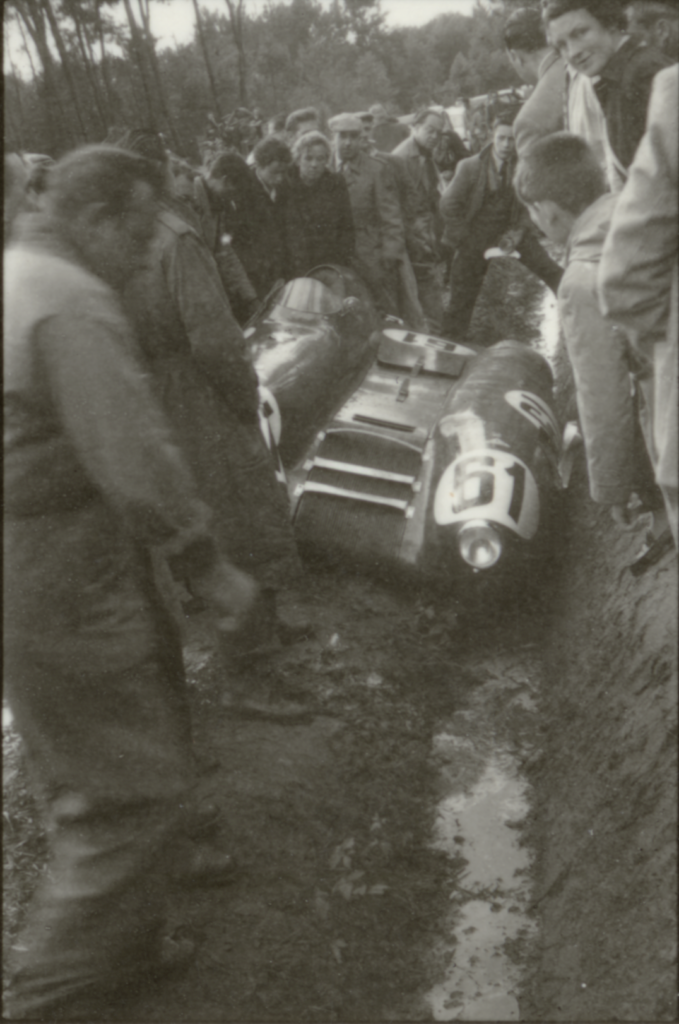
The Bisiluro in a ditch at LeMans. Nobody was hurt, but the race would end catastrophically, overshadowing the magical appearance of this unique racer. [DaVinci Museum]
Munaron’s prediction proved accurate.  Damonte was the pilot when, 7 laps into the race, Mike Hawthorne passed him at speed in his Jaguar D-Type: either his wind blast unsettled the very light Bisiluro, or Damonte over-corrected, or both, and after a few spins, he ended up in a ditch, without injury.  The retirement was a blessing in disguise; Google ‘1955 Le Mans disaster’.  The Bisiluro needed further development, but never got it, as a mighty row between Damonte and Mollino after the crash spelled the end of their relationship.  It was also the end of Mollino’s obsession with cars. He had achieved his goal of designing, building, and racing a vehicle that remains unique, and still demands amazement.  A last word from Munaron; ‘Molino was with us drivers constantly, then he quit the automobile world completely.’

The Record Breaker

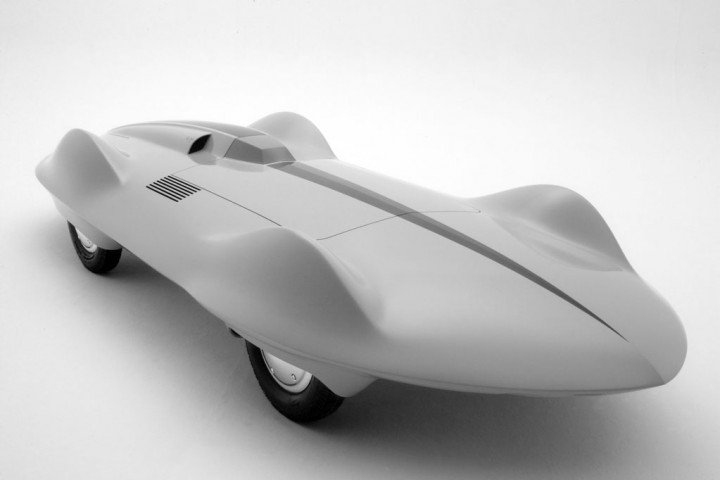
Carlo Mollino’s final car design: a record-breaking streamliner which only built as a 1:1 model by Stola in 2006. [Turin Modern Art Gallery]
The final piece of Carlo Mollino’s automotive story is a series of drawings for an unbuilt record-breaking streamliner, featuring a flat chassis punctuated by a central cockpit bubble and raised wheel arches. The design predated Donald Campbell’s similar Bluebird-Proteus CN7 by 5 years, and by 60 years the near-identical bodies of solar-powered racecars, demonstrating that Mollino was less an eccentric than an original thinker, far ahead of his time.  His record-breaker was never built for cost reasons – it’s interesting to note that Campbell’s Bluebird CN7 cost over £1M in 1950s money.  But Mollino’s streamliner was constructed as a full-scale model by Stola SpA for a 2007 museum retrospective, and is simply exquisite.

How we must remember Mollino: the man of the future, rocketing onward in his personal spacecraft. [Museo Carlo Mollino]
By then, Carlo Mollino was long gone, having died in 1973 not by driving too fast, nor in the throes of love with an escort in what has been preserved as his Pharaonic tomb, the secret apartment on Via Napione that is now the Museo Casa Mollino.  He died at his desk, a fitting end for such an enigmatic and protean figure; it was always about the work.  The difficulty of summing up his remarkable life’s output can be explained in his own words: “Only when a work of art is not explicable other than in terms of itself can we say that we are in the presence of art.  This ineffable quality is the hallmark of an authentic work.”  We still struggle to understand Carlo Mollino, comparing and contextualizing his cars, architecture, furniture, photography, and writings, but in the end they are only understandable via the man, inexplicable except as himself.

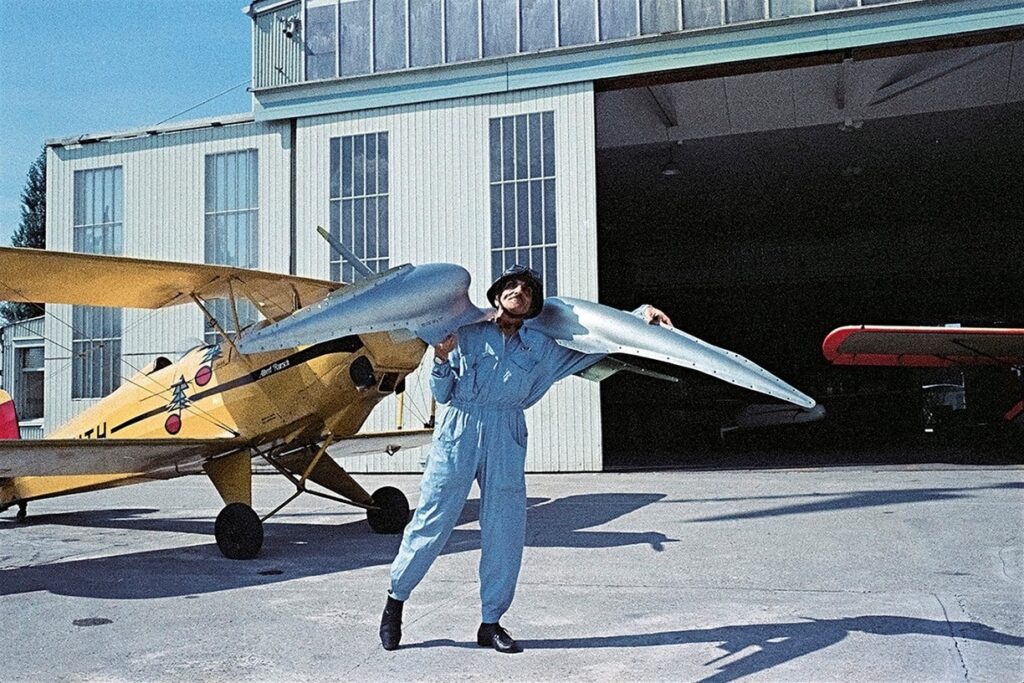
And then there is Carlo Mollino the stunt pilot…a story for another time. Here he’s having a bit of fun with a pair of aluminum cowls as wings…the man is a design angel now, reminding us to be exactly ourselves at all times. [Museo Carlo Mollino]
This article originally appeared in the March 2025 issue of The Automobile magazine.
For Carlo Mollino’s fascinating engagement with a Wall of Death, read here.

Paul d’Orléans is the founder of TheVintagent.com. He is an author, photographer, filmmaker, museum curator, event organizer, and public speaker. Check out his Author Page, Instagram, and Facebook.