Mecum’s annual motorcycle auction in Las Vegas is coming up January 27-31: have a look on their website, and bid baby bid!  It’s a great time to buy motorcycles. Here’s what I want for Christmas, in no particular order:
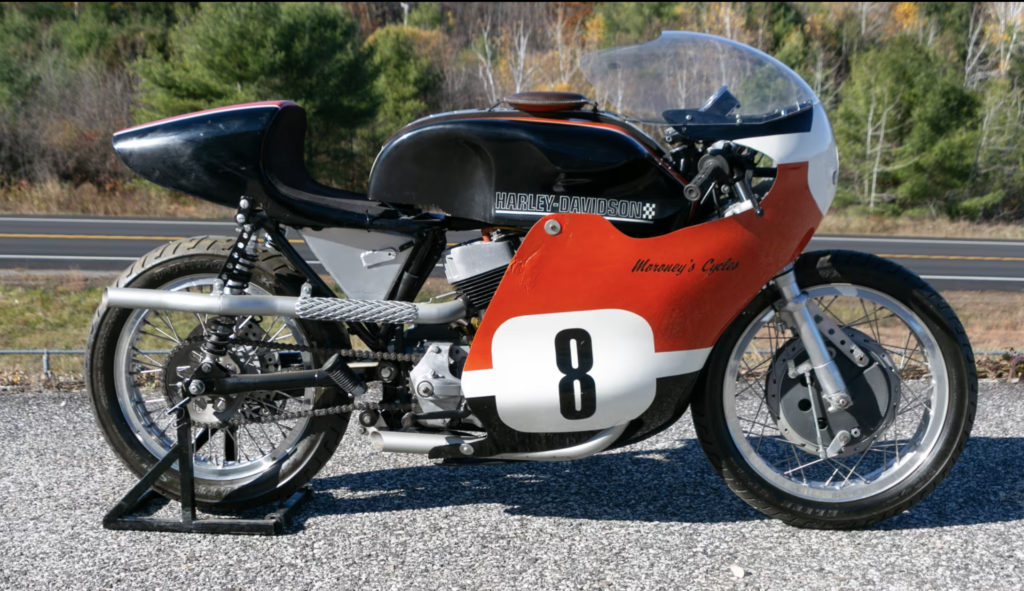
1968 Harley-Davidson KRTT

Sometimes Harley-Davidson does the absolute right thing, and wins. [Mecum]
Truly, the last of the flathead racers.  So far past its sell-by date that decades of tuning ingenuity came full circle to build a winner.  This is a sidevalve 45ci 750cc racer that clocked 150mph at Daytona…that’s on a banked oval race track, not a salt flat.  To prove it wasn’t a fluke, Cycle World tested a production KRTT in 1963, and did a timed run at 142mph.  Five years later, the KRTT was nothing of not faster, and in the hands of specialist tuners, could clock wild speeds.  This is a motor suitable for a tractor that wizards cast a spell on to create a rocket.   World class.  One of less than 20 built that year.  Probably a few more in the last year of production in 1969.  This bike is superbly correct, with all the right details.  Yes they had big magnesium drum brakes up front riding in Ceriani road race forks, with a disc brake out back.  The bodywork alone is worth the price of admission.  Do I like this bike?  Yes, I do.

1934 Matchless Silver Hawk V-4

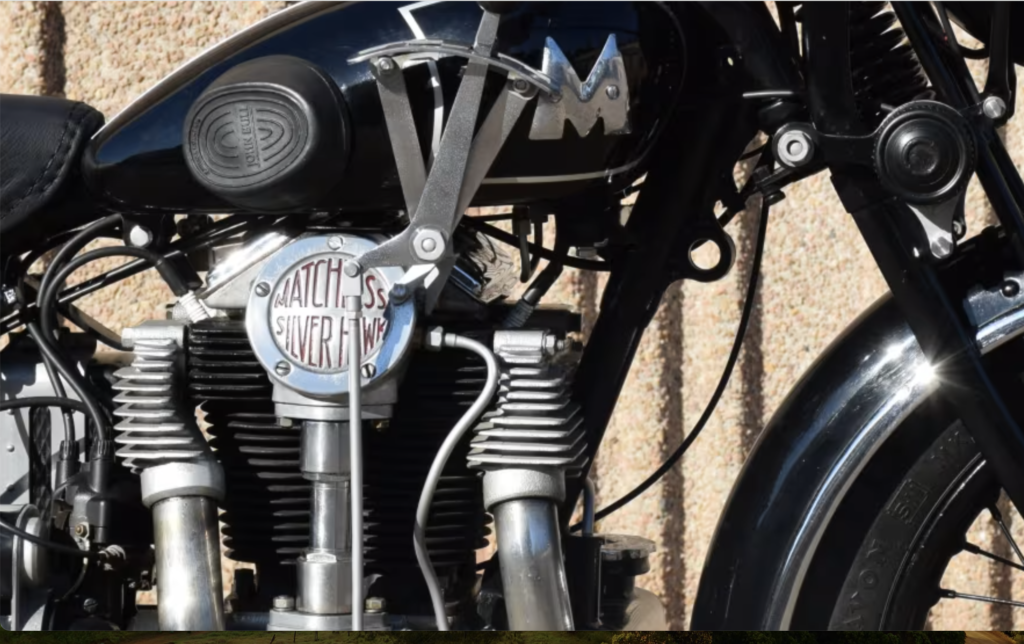
The best cam drive cover in motorcycle history. [Mecum]
You think Honda invented the OHC V-4 motorcycle with the VFR?  Nah.  It was Matchless, with this superb Art Deco masterpiece, the Silver Hawk.  The best bevel drive cover in motorcycle history (sorry Fabio). Technology so far ahead of the times it was doomed to fail.  But it didn’t completely, and remains one of the handful of amazing British 4-cylinder motorcycles that deserve respect for their innovation and design brilliance.  And, it can be ridden anywhere you like, just don’t thrash it, and stay out of the heat: the narrow-angle v-4 configuration worked well for Lancia cars, but they’re watercooled, while our Silver Hawk relies on air flow.  Also, ok, only a single carb, so while tuning is a snap, you won’t be passing Broughs on your elegant Deco space ship. Buy it anyway, it’s cool AF.

1926 Indian Altoona A-45 OHV

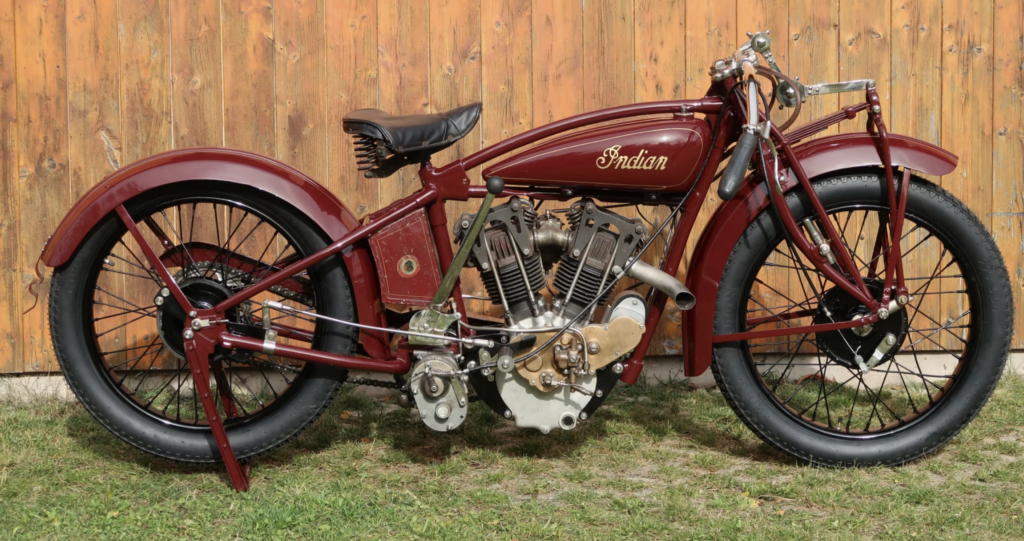
Now this is a motorcycle I’d like to get to know. And blow off everything else on the road during an AMCA road run. [Mecum]
OK, let’s call a spade a spade: I don’t believe the fluff about this being an ex-Gerhard Schaukal machine.  I knew Gerhard, I visited Gerhard at his home in Austria, Gerhard showed me around all the motorcycle museums in Austria, and I had a good hard look at what was in his collection.  Didn’t see this, and he would have been proud of it, even amongst his superb World Record Zeniths and 8V Harley-Davidsons. So, I have to assume this is a nicely created replica of the baddest ass motorcycle Indian ever built.  At Muroc Dry Lake in 1928, Jim Davis was timed at over 126mph on a factory A45, making this the fastest motorcycle in the world at that date. Indian built a few (3 or 4) A45s for road racing in Europe, with the first front brake they ever offered on a motorcycle, because road racing. The rest of the 26 examples built had longer frames for hillclimbing.

1926 Moto Guzzi C2V 

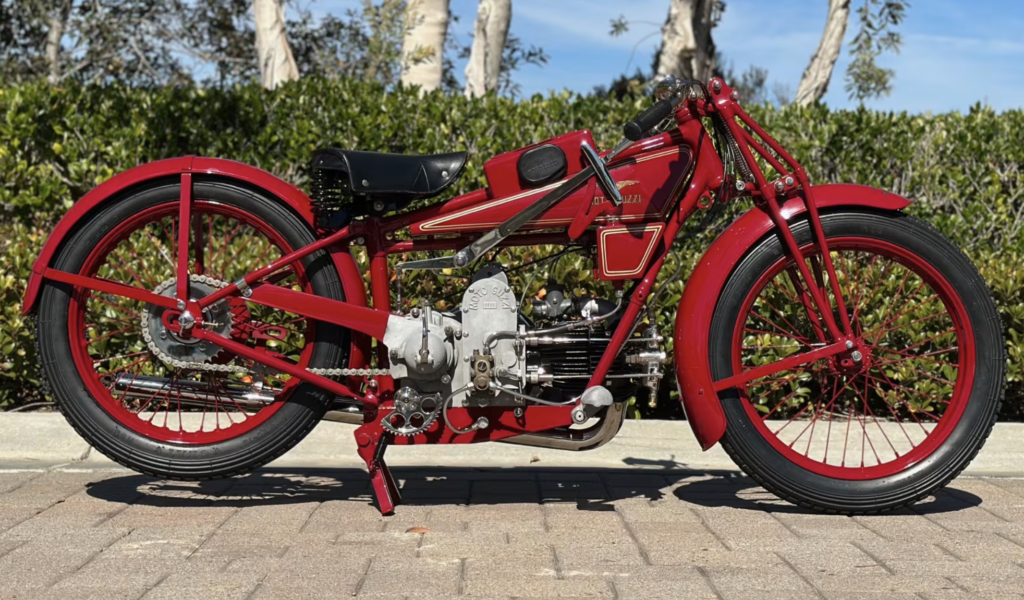
Low and sleek as a ferret, the Moto Guzzi C2V is all racer. [Mecum]
I’m a sucker for Moto Guzzis.  I have a Falcone Sport, but this is the factory’s granddaddy OHV machine, the corsa (racing) 2 Valve. Carlo Guzzi’s first design of 1921 was an OHC single with four valves, but that was too good for the world.  We can’t have nice things.  So we got F-heads in production from 1923. But Carlo soon revisited the idea of an actual performance motorcycle, so modified his flat single with a simple OHV cylinder and head in 1925, which bumped up performance to 75mph or so.  Very shortly afterwards he said ‘che si fottano’, and built the thing he really wanted, which was an OHC 4-valve single, the C4V.  Rare as hen’s teeth and routinely faked up (caveat emptor always), the earlier C2V is actually even rarer, and almost as cool.  I saw this one at the Quail Motorcycle Gathering (come back, Quail!) in 2024, but in truth I met it back in 2000, after Allesandro Altinier offered it to me.  Very tempting!  What a beautiful machine.

1978 Honda CB125SNew in Box PAIR

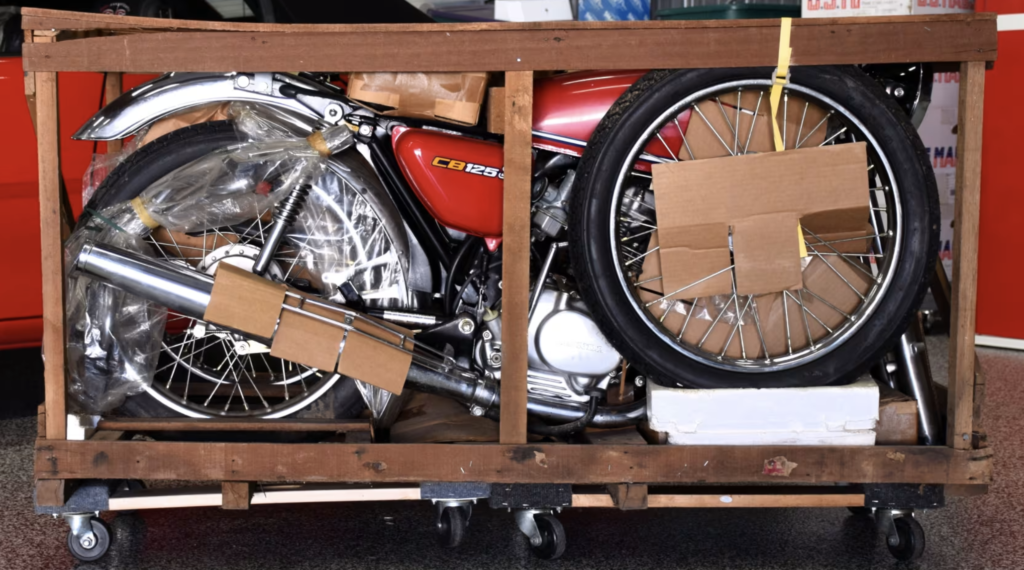
New in Box, not one but two! What you gonna do!? [Mecum]
These are probably the last new-in-a-box 1978 Honda CB125s in existence.  Here’s my plan: buy them, put one safely in storage, then invite 100 of my best friends out to the desert for an unhinged ayahuasca-fueled 36 hour party, where each guest is given a hammer in exchange for their clothing and enough hallucinogens for the next day and a half (they can keep their shoes – you need shoes in the desert).  Light a big bonfire, put a crated Honda single on a low platform, and let everyone work out their daddy issues from this life or the previous, until the little Honda-that-could-have-been is scattered unrecognizably over the sand like a disintegrated space shuttle.  I mean, what else can a motorcycle in a box represent but a childhood repressed and a dream deferred?  Kill it with fire.  And keep the other one as the now-absolutely last boxed CB125 on the planet.

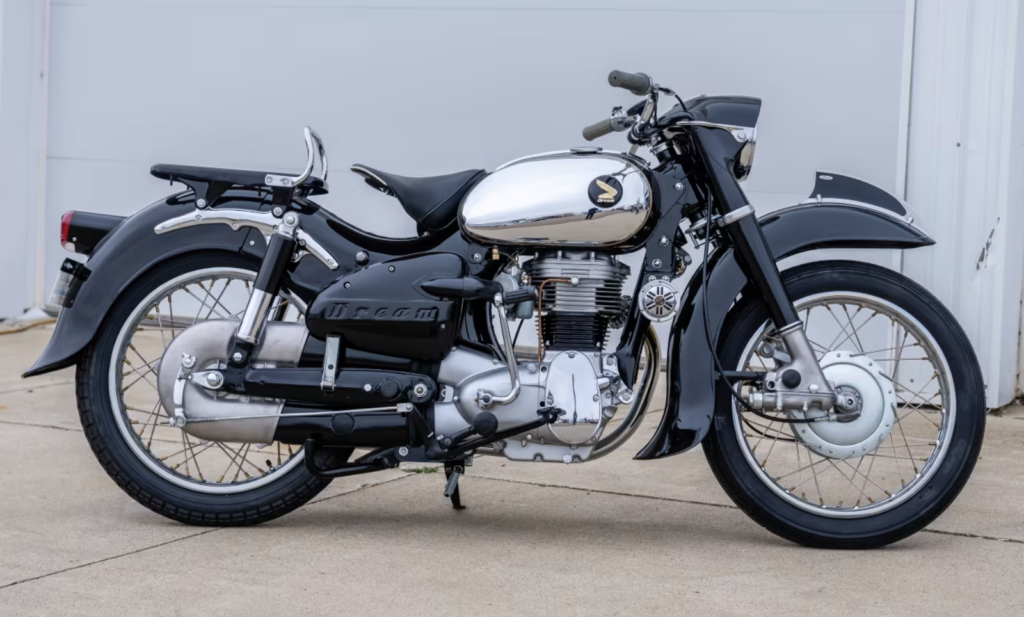
1957 Honda ME250 Dream

A machine built to fight the post-radiation monsters emerging from the sea. [Mecum]
See, part of my issue with crated motorcycles is…motorcycles are a dream.  Of freedom, power, aesthetic bliss, exploration, all the things. Soichiro Honda understood this, so he called many of his first models Dream.  As with this magnificent and elegant little beastie, a pre-US import ME250 Dream.  Yes, the styling is clearly inspired by NSU, but I’ve always been charmed by the purely Japanese twist on all those influences they absorbed.  It’s Dieter Rams designing for the set of Ultra Man, and I just adore 1950s Japanese sci-fi.  This looks to be a superb restoration of a technically very interesting machine, with an OHC single-cylinder motor of 246cc that gave 14hp.  A little faster than my old BMW R26 of the same year, in other words, and a lot lighter and more stylish. I reckon the stylist on this machine had fun making those sweeping lines.  Swoop!

1975 Norton VR880 Sprint Special Kenny Dreer
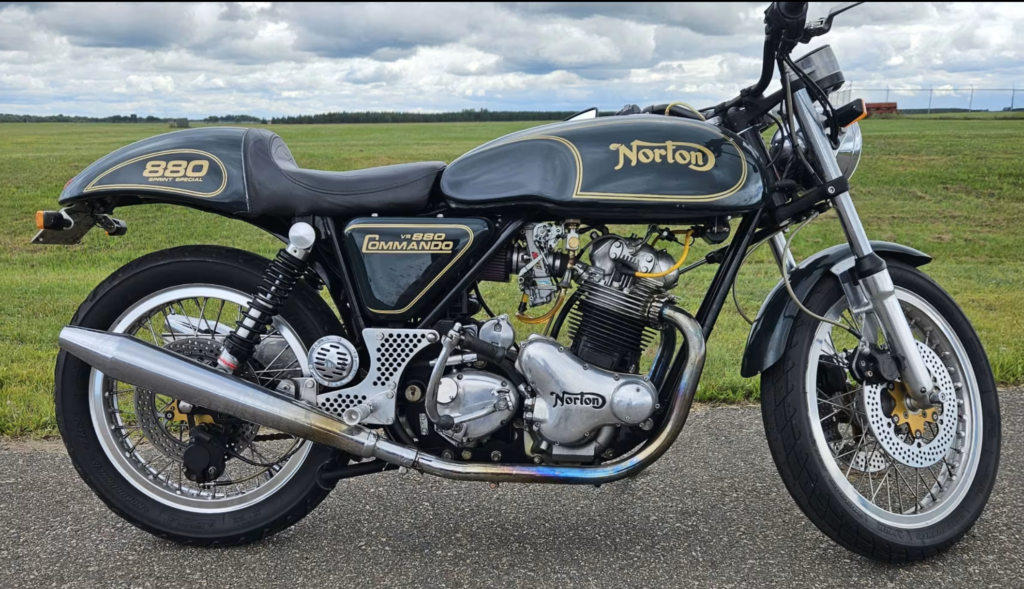
Take a great thing and make it perfect: the Kenny Dreer Norton VR880. [Mecum]
Norton Commandos are the ultimate expression of a 1940s design, which sounds like a bad idea until you actually ride one.  In a manner not totally dissimilar to the Harley-Davidson KRTT racer above, the British motorcycle industry had some kind of magic up its sleeve, taking objectively ancient designs and creating masterpieces that far exceeded the imagination of their original designers.  I’d include the Velocette Thruxton in that camp too: a fast and lithe production racer built from the bones of a 1933 250cc MOV, using the clutch from a 1921 two-stroke with 4hp.  How can this work?  But it does.  And so does the Norton Commando.  Especially when an arch-fan and technically brilliant enthusiast decides to make the ultimate Commando, and 49 more for his friends.  Thank you, Kenny Dreer: I know it probably broke your bank account, but the world needed your VR880 interpretation of what a Commando could be.

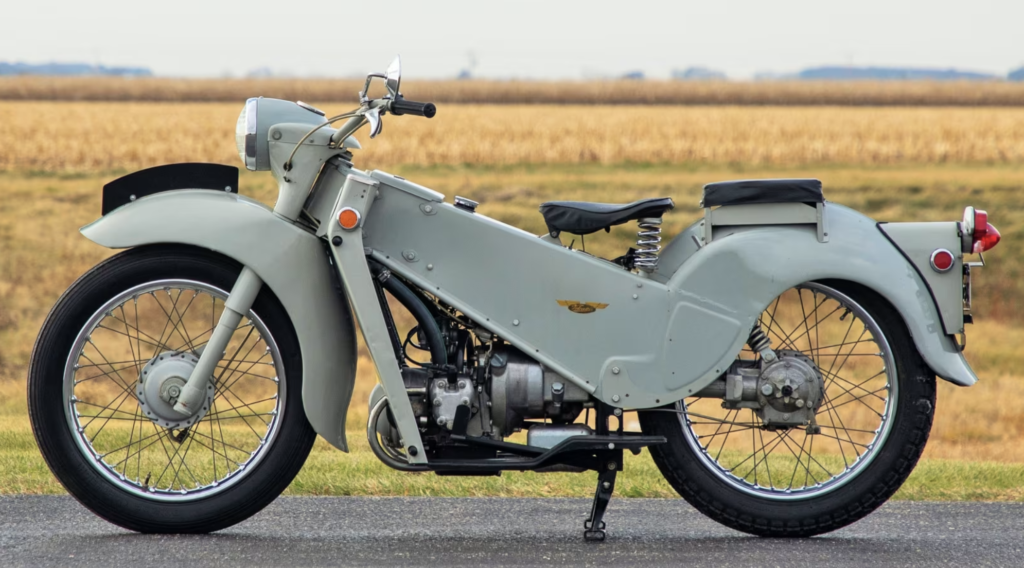
1970 Velocette LE MKIII

The Velocette LE: silent and smooth as silk. [Mecum]
Mostly, I like fast motorcycles.  But sometimes a small bike’s charms win me over, and I become a forever fan.  The Velocette LE (for ‘little engine’) is a radical motorcycle with a bizarre mix of antediluvian technological choices (it’s a fricken sidevalve, the only one Veloce ever built in series), with far out ideas.  For example, the body is monocoque, stamped from pressings and welded up for maximum rigidity with minimal weight.  The body can be lifted right over the engine/gearbox/rear wheel assembly, kinda like a VW bug.  The engine is watercooled, with a tidy radiator up front.  The styling is a mix of industrial angle iron with feminine fenders, and it works.  The LE is almost completely silent while tooling down the road, which is why the British police forces loved them…slowly catchee monkey was the idea. Veloce built a few thousand of them over a long period, with minor changes between the three iterations, which all looked the same and performed about the same, too.  Despite their popularity with the cops, this is the design that sank a great company.  They knew a people’s motorcycle would someday conquer the world, but that was the Honda C100, not a strange little watercooled flat twin.  But ride one, and be charmed.

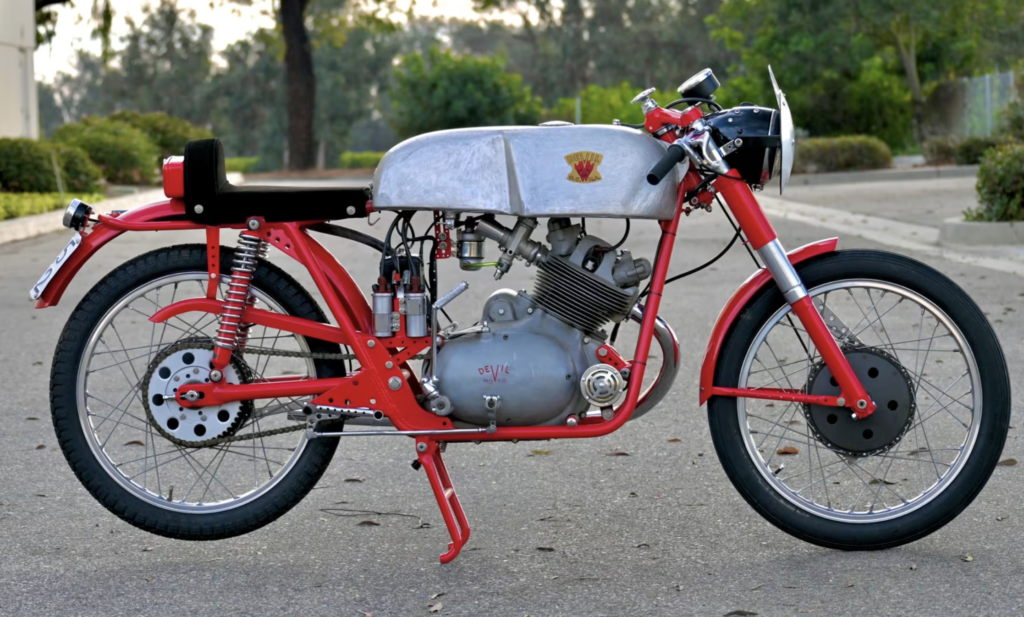
1956 Moto Devil Factory Racer 

Oh, you cheeky little Moto Devil. [Mecum]
You had me at Moto Devil, but the closer I looked, the more I liked.  I’ve seen this bike in person down at Classic Avenue, and before that at Robb Talbott’s much lamented Moto Talbott Museum.  This is one of the coolest etceterini I’ve ever seen, and is clearly built by hand at a small factory during Italy’s heyday as the champions of the world of motorcycles.  The castings are just rough enough to sing the song of speed, and the layout of the motor is fascinating: while it looks like an OHC bike, it’s actually got pushrods acting on cams high in the crankcase just fore and aft of the cylinders, just like a Triumph, but it’s a single. The chassis is typical Italian of the period, with the engine sat in a full-cradle double loop frame, which I’m sure handles like a razor.  The brakes are proper magnesium race bits, and the rest of the details are as seen on every other Italian racer: Dell’Orto carb with a remote float, a Veglia tach, alloy clip-ons and rearsets.  The gas tank gets special mention though, as it’s rough as a bear’s ass, and perfectly imperfect.  If I bought this bike, I’d have to get a tattoo of that Moto Devil logo, right?  Last word: please use this to win the Moto Giro.

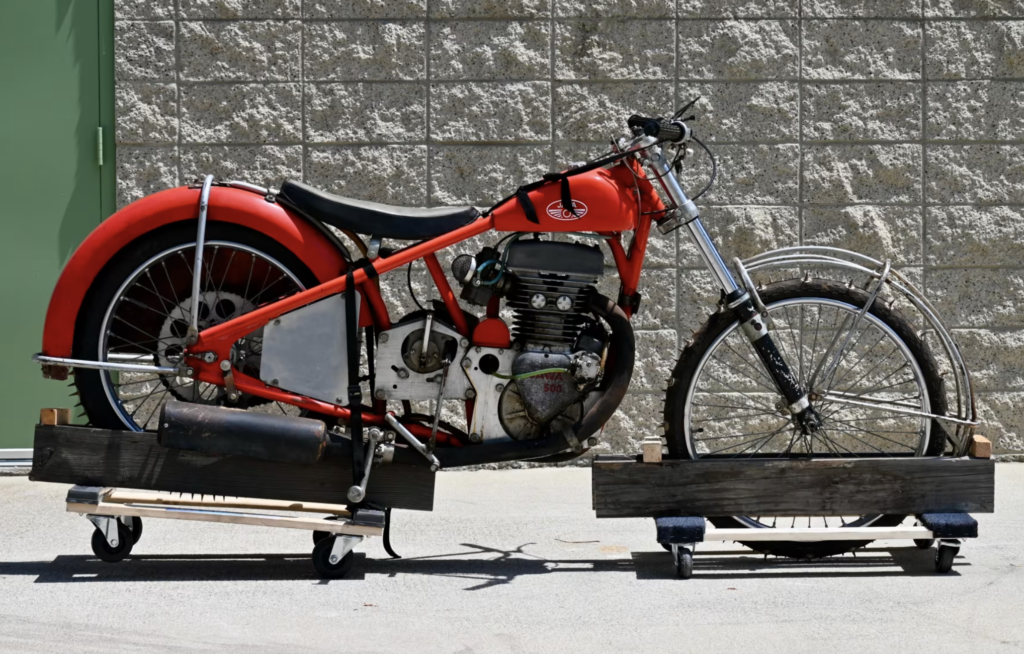
1970 JAWA Ice Racer

Potent 4V alcohol burning motor in a chassis designed to tenderize meat. [Mecum]
Sweet baby Jesus, this IS the coolest bike coming over the auction block this year.  Not safe for children.  Maybe I’ve been living too long in the land of cactus, but the insane 2″ spikes on this JAWA are awesome.  If you live near Lake Baikal, or anywhere in the northern Midwest, can you imagine having more fun than ruining the glass-perfect surface of your local frozen lake with this thing?  60hp + 188lbs + spikes = big yeehaw!  But seriously, this bike was actually built to compete on Lake Baikal, the largest body of fresh water on the planet, deep in Russia.  It freezes deeply every winter, and nobody’s going to tell you not to race on the ice there, because there are hardly any people there in the winter.  It’s colder than cold.  You probably know JAWA, when they set their mind to it, built insanely competitive racers on dirt, asphalt, and ice.  To that end, they purchased ESO in 1968 to absorb their killer MX engine tech, and as a sidebar, dominate speedway racing for quite a while.  Ice racing is frozen speedway, with wild angles of lean made possible by those big spikes.  Note: don’t fall off, or let anyone falling off anywhere near you, or you’ll look like a colander straining borscht, which is not pretty.