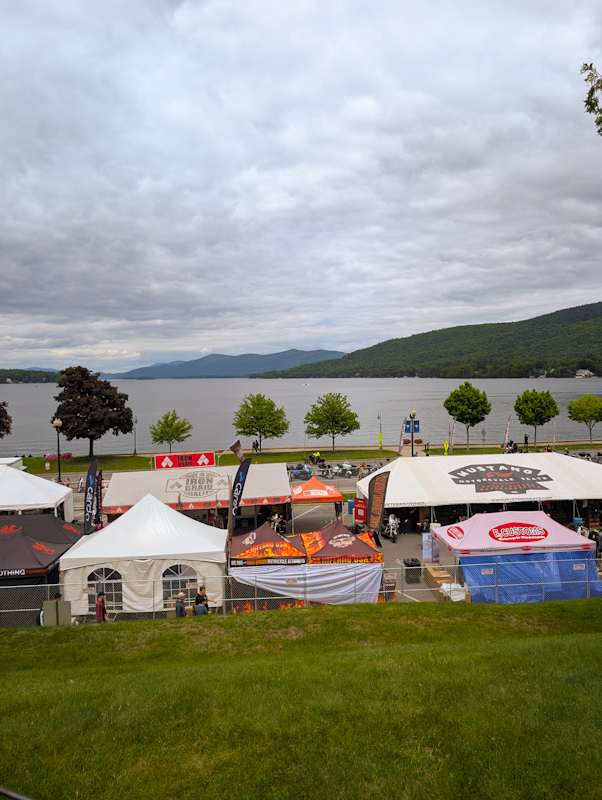
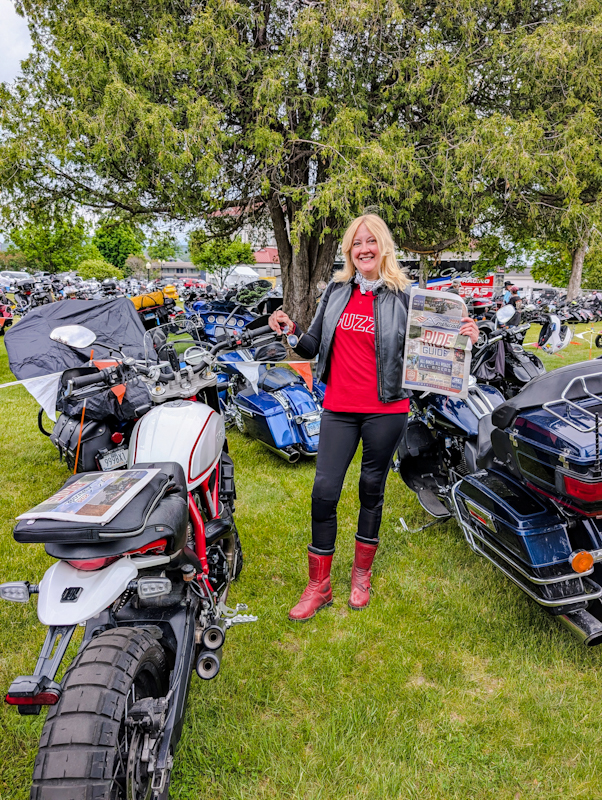
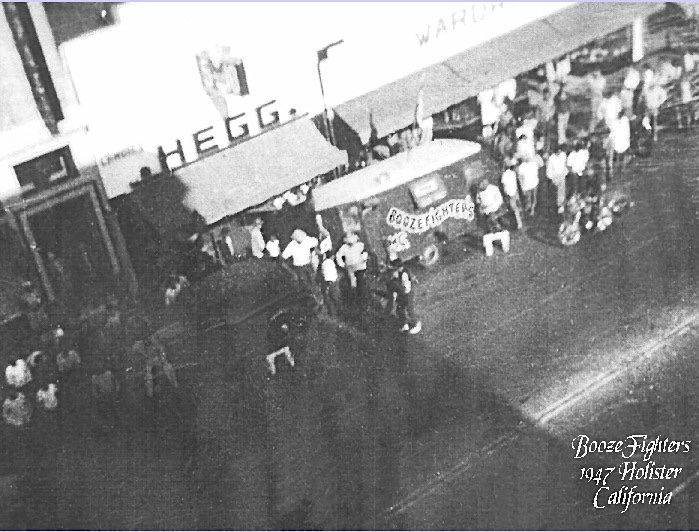
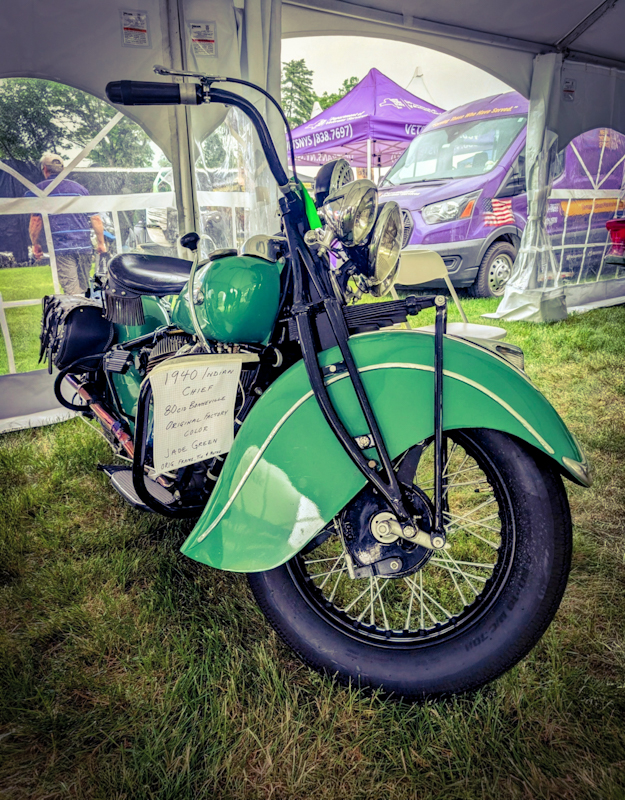
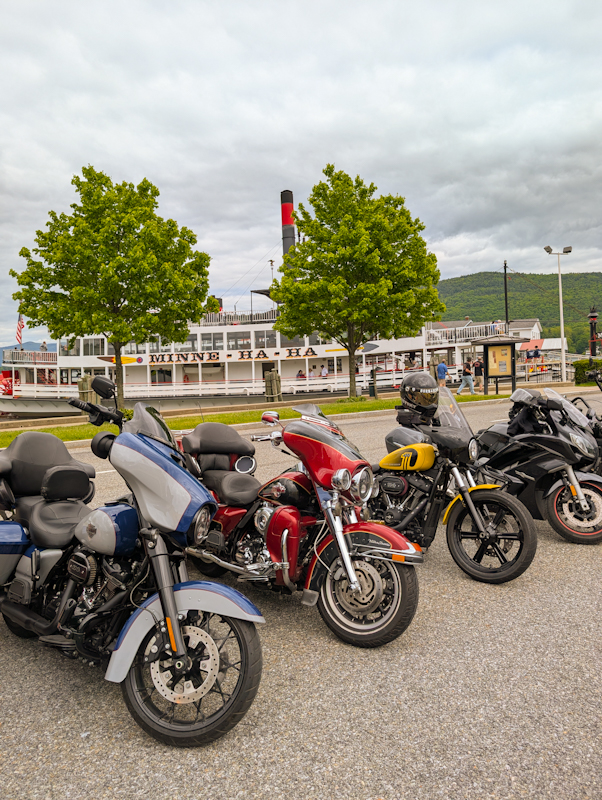
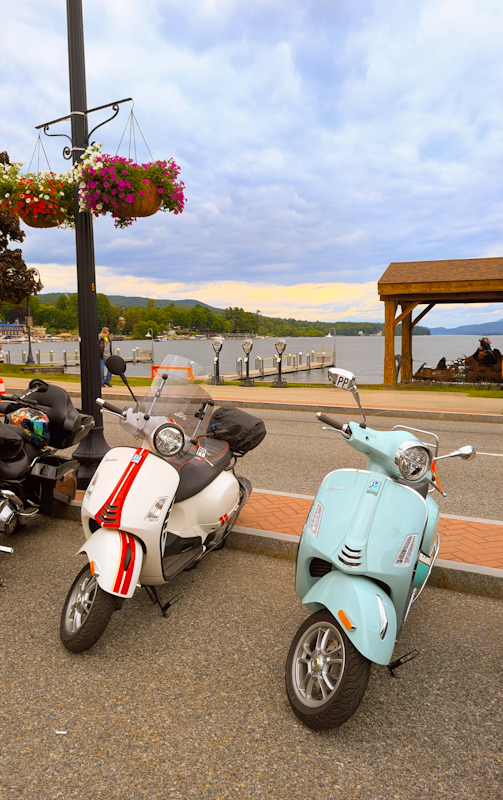
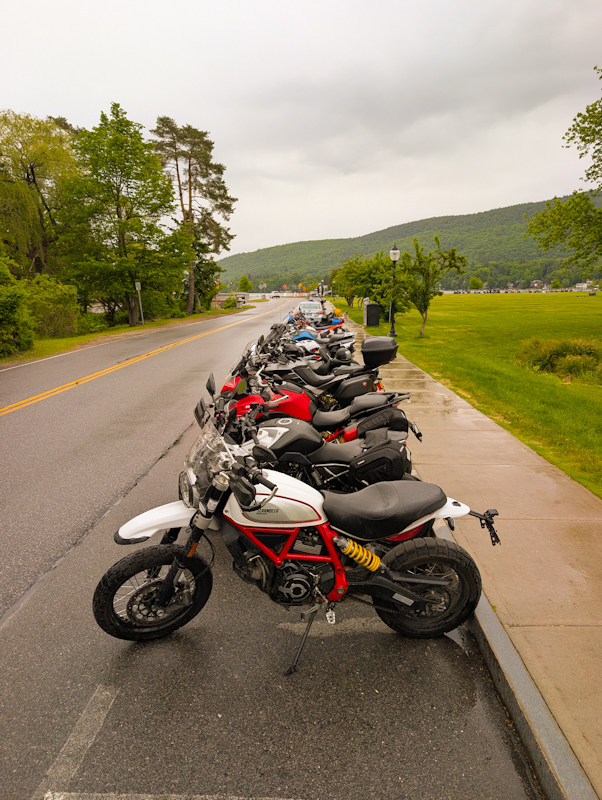
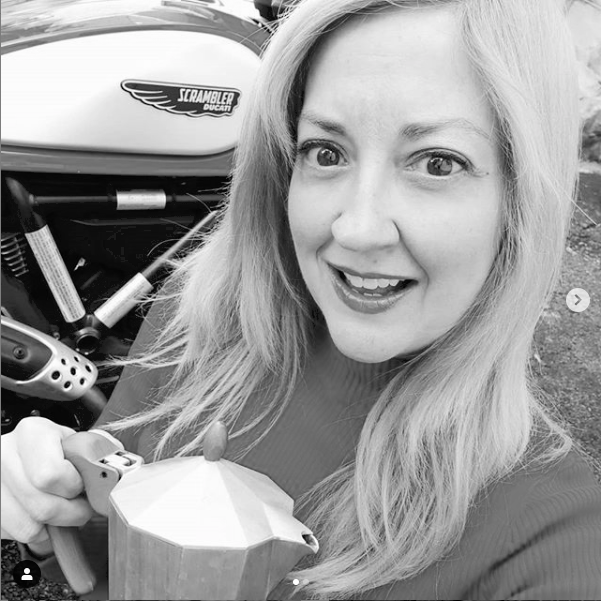
As thousands of motorcycles rolled out of Lake George on May 31, ending another Americade, they left behind a familiar image. For many Americans, motorcycle rallies still evoke visions of leather-clad outlaws, roaring engines, public drunkenness, and occasional violence. It is an image reinforced for decades by newspaper headlines, Hollywood films, and television coverage that tends to focus on arrests, accidents, and conflict. Yet, walking through Americade this year, it was difficult to reconcile that stereotype with the reality. Most attendees were focused on rides, seminars, new motorcycles, and catching up with friends. And that disconnect is hardly new. For more than a century, motorcycle organizations have sought to promote a positive image of riders while confronting stereotypes reinforced by the media and popular culture.The Americade expo on Lake George NY, near Adirondack Park National Monument, and the Green Mountains of Vermont. [Wendy Pojmann]Americade was founded in 1983, partly to offer an alternative experience to anti-motorcycle media hype. Unlike rallies such as Daytona and Sturgis, both founded in the late 1930s and consistently attracting headlines for disorder, Americade sought to emphasize touring, safety, and hospitality. The Dutcher family wanted to showcase a different side of motorcycling, one centered on recreation and travel rather than chaos. In many ways, however, they were attempting to solve a problem that had existed for decades. Originally conceived as an eastern counterpart to the Golden Aspen Rally (formerly Aspencade), which dates to 1971 in Ruidoso, New Mexico, Americade has grown into a major regional event. From roughly 2,000 participants in its early years, Americade drew 10,000 riders by 1986, when it relocated from Glens Falls to Lake George NY. Within a few years, annual attendance approached 50,000.Wendy Pojmann in her happy place, at the Americade Rally with her Ducati. [Wendy Pojmann]Its mission was not entirely new. Laconia Bike Week, which generally takes place in mid-June, claims to be America’s oldest rally. Laconia traces its origins to a 1916 Gypsy Tour stop at Weirs Beach, New Hampshire, where riders enjoyed, among other events, the immensely popular hill climbs of the early years of motorcycling. By 1924, organizers and the American Motorcycle Association were already trying to improve public perceptions of riders, suggesting that concerns about motorcycling’s image predated the postwar outlaw stereotype often associated with films such as The Wild One. The rally was now held under the auspices of the AMA, with the goal “to create a more favorable public opinion of the motorcycle and motorcycle riders.”The actual July 4, 1947 Hollister gathering, with the Boozefighters MC support truck (full of booze of course) in the center of the image. [Bill Brownell archive]The infamous and mis-remembered Hollister Rally of 1947, and its afterlife in popular culture, helped cement the outlaw biker in the American imagination. In response, the AMA emphasized that most riders were law-abiding citizens and launched the idea of the “99 percent” of motorcyclists being good people. The challenge was to prevent a small minority from defining the image of all motorcyclists. Today, both Americade and Laconia market themselves as family-friendly and have built relationships with local townships. In the Northeast, where the riding season is relatively short, the rallies help kick off the summer tourism season. Most local businesses put up their figurative and literal “welcome bikers” signs. Americade, which usually takes place over four and a half days during the first week of June, claims that as many as 60,000 people come to Lake George and generate $45 million for the local economy. The larger Laconia rally reports upwards of 300,000 visitors and $140 million in revenue during the nine-day event.Gorgeous green 1940 Indian Chief on display. [Wendy Pojmann]Historically, mainstream media coverage of motorcycle rallies has reflected the tension between economic benefits and public concern, especially regarding the image of unruly bikers. A 1957 New York Times article on Laconia recalled the event’s “gypsy tour” origins, when riders congregated in unofficial camping areas and often spent the night wherever they could find space. Local officials in a town of just 15,000 residents struggled to accommodate the growing crowds in motels and campgrounds. More than sixty years later, some of the concerns had changed. In a 2023 Boston Globe article, one longtime Loudon resident remembered the trash and disorder that once followed the rally but noted that local communities had become much more effective at managing those problems. Safety and security, rather than litter, had become the primary concerns.The lineup at Americade is a mix of baggers, sports bikes, tourers, and vintage machines. Note the Mine Ha Ha II paddlewheel steamboat on Lake George, on which one can take tours. [Wendy Pojmann]The public looked to law enforcement to manage the crowds. During the 1950s, authorities at Laconia routinely impounded motorcycles belonging to riders who committed serious traffic violations. As one official remarked, “You’ve never seen anything sadder than a motorcyclist with no motorcycle.” Yet even then, the number of offenders represented only a small fraction of attendees; in 1956, just eighteen of the estimated 6,500 motorcycles at the rally were impounded.Even scooters are welcome at Americade, and are surprisingly fun for touring. [Wendy Pojmann]The same tensions persist today. During Americade 2026, an off-duty police officer attending the rally was arrested for riding while intoxicated, and his brother, who had been riding in the same group, died in a crash that evening. In 2022, a motorcyclist in Lake George lost control of his machine and hit six pedestrians on a walking/bike path, killing two. Americade spokespersons distanced the rally from the tragic crash, saying it occurred after the official event had ended and that the motorcyclist involved had not been registered. Incidents such as these attract media attention and reinforce negative stereotypes about motorcyclists, even when they involve only a tiny percentage of rally participants.Northeast weather; yes the riding season is short, so riders take full advantage when the weather is good enough. [Wendy Pojmann]These stories receive attention in part because they reinforce an image Americans already recognize. For decades, films, television shows, and news reports have portrayed motorcyclists as rebels and outsiders. Rally organizers, manufacturers, and tourism officials have worked just as hard to present motorcycling as a safe and welcoming recreational activity. The two images have existed side by side for generations. Americade has largely succeeded in creating a different kind of rally. Yet a single arrest, crash, or disturbance still generates more attention than thousands of uneventful rides through the Adirondacks. Motorcycle organizations have been confronting that imbalance since the earliest Gypsy Tours. More than a century later, the challenge that inspired Americade’s founders remains unresolved.
Dr. Wendy Pojmann, Ph.D., is Professor of History at Siena University in Albany, New York. Her latest book is Connected by the Street: The Myths and Realities of Motorcyclists in the USA and Italy, available at www.parigibooks.com. She splits her time between Rome, Italy, and upstate New York. Follow her on Instagram @wendysespressolife. See her other articles for The Vintagent here.

I agree completely … in principle … problem is …. reality and the addled mindset of the general US public .
Simple reality is …. especially in THIS current era ( you know that I know that you know too damn well exactly what I’m referring to ) ..
Being …. hmm …. how shall we say this …. nice ? Aint cool … garners ZERO attention ….. and even less publicity … all of which like it or not ( I DO NOT ) ……that IS what forms the majority of overall ‘ Mericun …. opinion … ( stupidity plays its part as well … but thats another subject for another day )
Whereas bad ,.. gets all the headlines … even when its fake bad !
Truth ? Facts ? Genuine reality ? All play no part in this 15 minutes of fame .. OTT … violence and guns are a good thing … MMA … etc etc BS . And then there’s all the rubes , wanna be’s and hipster BS artists trying desperately in a Halloween moment to dress and act like real 1%ers .. promotion the s*** out of something they have ZERO understanding of !
Which is to say ….. great idea .kiddo … but in todays world … it jes aint gonna fly …
Sooooo …. my suggestion …. until a certain someone and his minions fade into the past ….. until the Hipster Wanna be rubes and copycats are no longer considered ‘ hip’ … until the Net finally loses its ‘ influence’ on general culture … just ride …. and ***K the attitudes and opinions .. on both sides ..
Or … as we Joisey Boyz say …….. ***k Em If they can’t take a joke !
Sounds a bit mean spirted you say … well .. to quote the bard ;
” You’ve got to be cruel to be kind … in the right measure ” – Nick Lowe
Rock On – Ride On – Remain Calm ( despite it all ) and do … Carry On 😎
Couple case in points ?
1) The current ultimate BS RAM / JEEP commercials . American my @$& … owned lock stock and tire valves by the Italians … with decades old Mercedes Benz motors under the hood ( V8’s … the rest are Korean ) Manufactured everywhere but the US … and POS to boot
2) The whole Indian M/C MAGA debacle …. CDN owned from 2011 – 2026 … assembled in the US with parts and motors from India China Mexico etc …. sold in 2026 cause even the might of Polaris could not make a profit from the POS .. yet here they are trying to pretend they’ve been on top all along … on top of what is the question …. the $h!tplie ?
3) Oh …. and the I’m a Badass Dodge commercials … all of #1 applies …. and yeah bubba … yer a badass alright .. as long as ya don’t gotta turn or stop !
Hell … even the Japanese/ Koreans now promote themselves as the badass brand !
And don’t even get ma started on Rap/HipHop …. what pretends to be Country these days …. and pop culture in general
Sigh … so yeah kiddo … I agree whole heartedly with the concept … but todays culture ? Just aint gonna allow it
Sigh …. off em all … we’s enjoying life .. without all the stupidity
As I remember, wasn’t Americade called Hondacade when it started? Maybe I’m mis-remembering. In any case, I used to go up to the event and there were mostly serious touring motorcyclist riding gold wings, “metric cruisers” as well as all the other makes of motorcycles.. Now, it’s morphed into mostly a Harley rally. I like to see a variety of bikes and not just Harleys no matter how they are adorned. To me, a Harley has become an accessary like a chain neckless, a watch or a pair of sun glasses. If variety is the spice of life, then Americade has become really bland.