
[This essay was delivered at the 2026 IJMS Conference in Shelton WA]
I had the realization just last week that I think of my motorcycle in the same way I think of a lover. Not as a sex partner, though we’ll get to that later, but as someone or something I yearn for and fantasize about; an object of desire. It was one of those 4am wide awake moments when that thought appeared, and I had to write it down, because I needed a keynote speech, and after 20 years of writing about the world of motorcycles, the scope of possible subjects was overwhelming. But there it was, handed to me in a dream.
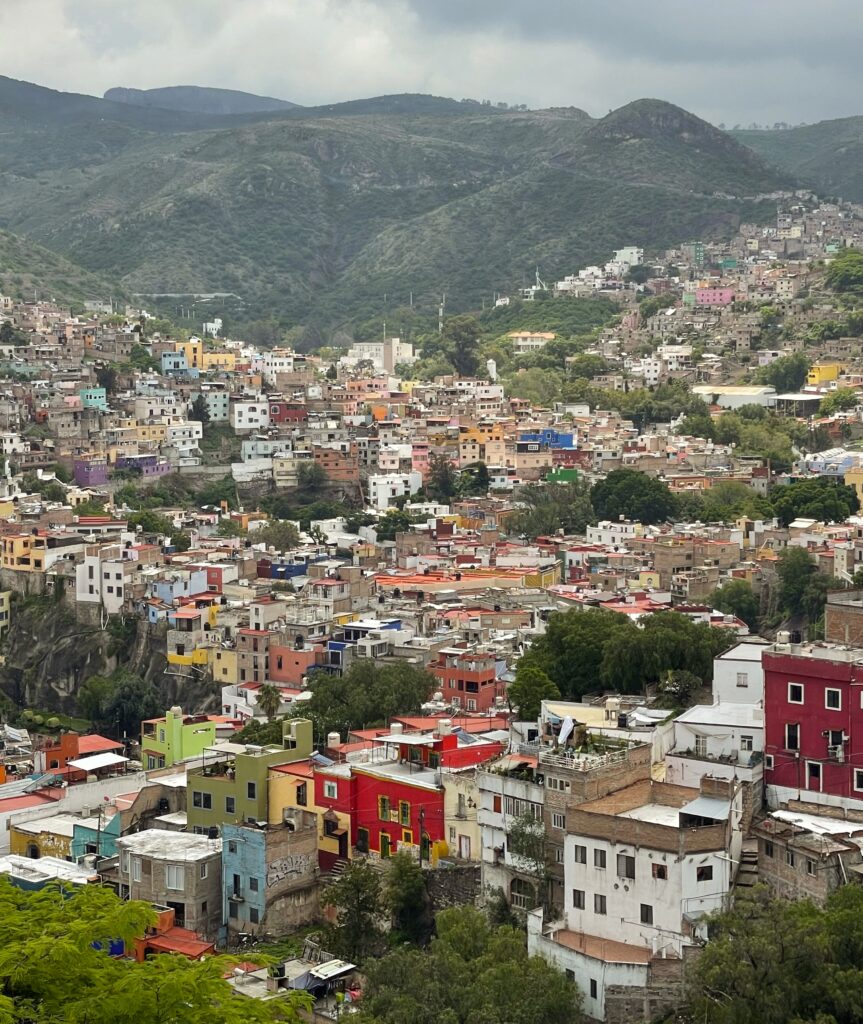
You know the feeling: I wanted nothing more than to be on a motorcycle, to experience that landscape in the way that’s only possible on a bike. And I reflected in that moment that, just as with a best friend or lover, your motorcycle is the one you want to do things with. It’s your ideal companion for adventure. I wanted that adventure, and was jonesing for a bike, and observed myself acting like I was missing my sweetheart. Which is an absurd thing to say in an academic conference, yet here we all are, and I know every one of you knows exactly what I’m talking about.
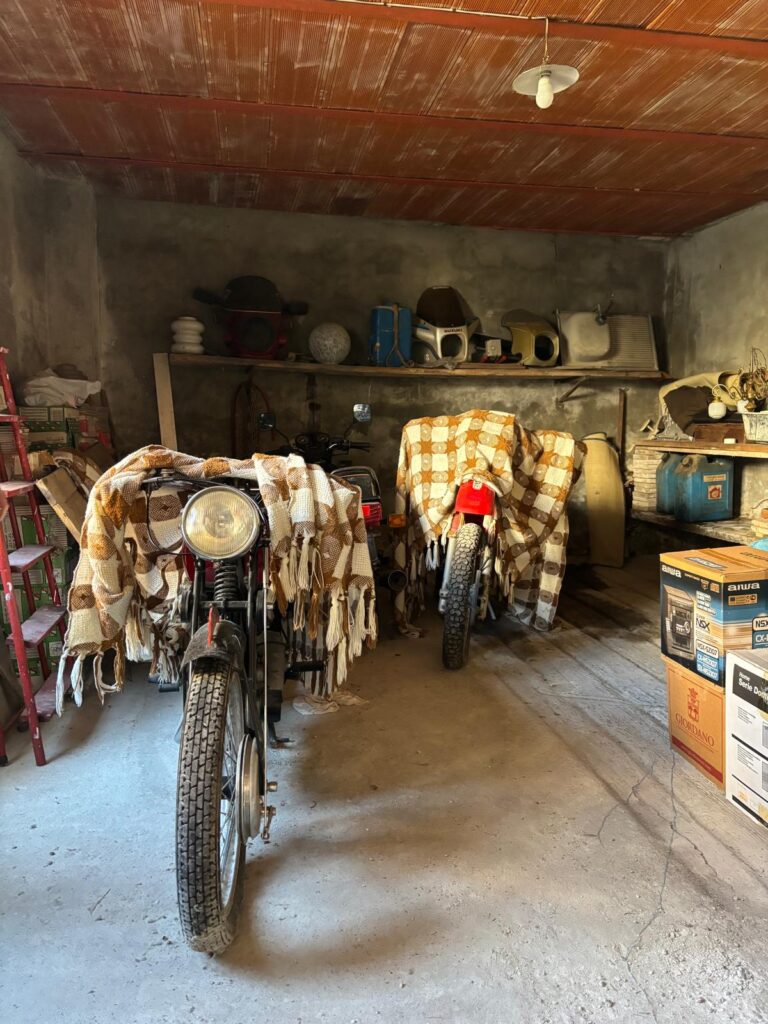
Sadly, Bill betrayed me. I believe the academic term is “cock-blocked”. I think he’s buying it for himself! Motherfucker stole my Italian beauty. But I forgive him; it would have been a geographically inconvenient affair.
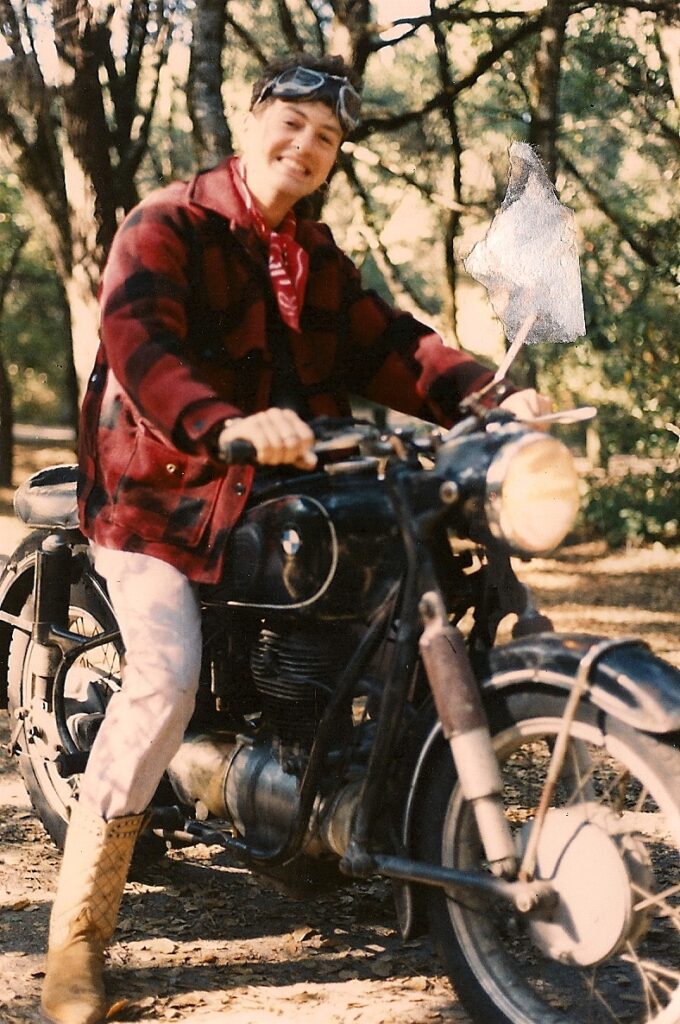
The man who got me into motorbikes, the one who infected me with the bug and really made me fall in love with everything two wheels, was Jim Gilman, who in one generous afternoon laid the foundation for the rest of my life, and led to me being here. I met Jim in the 1980s anarchist punk scene in San Francisco, at Bound Together Books, which is still there by the way. There were a lot of motorcyclists in that scene, like Lee the speedfreak, who put hardtails on a string of 1960s Triumphs, claiming he could outrun and out-handle any cop, sliding around corners with panache like a flat tracker.
In my youthful naiveté I thought anarchism was the natural habit of bikers, that every motorcyclist must hate cops and stupid laws like I did. That was before I read Hunter S. Thompson‘s Hells Angels, and before I went to Sturgis. Anyway, Jim Gilman was a journeyman printer, and hauled a surplus Multilith 2000 into my mother’s garage in the Sunset District. We printed political posters and band flyers and books of poetry by Peter Plate, the original slam poet, who liked to perform his readings while naked. He had terrific delivery, a great body and an impressive penis, so why not? Peter Plate didn’t ride, but Jim Gilman did: he’d unearthed an old Earles fork BMW R50 from under a staircase, with its original paint turned matte and the pinstripes all gone, and the big Denfield dualseat ripped. In other words, the perfect anarchist motorbike. I’d only ever ridden my little Honda Express before University, but Jim was kind enough to let me try his BMW one afternoon. I rode through Golden Gate Park out to the Great Highway and Ocean Beach, loving the smell of the sea and the rockle-tockle feel of the old Beemer, and was gone for over 30 minutes, while he stood in the street worrying. But I had the time of my life, and it changed my life forever. Two things to remember there: letting a newbie try your cool motorcycle will probably change their life. And if you let me try your bike, I’ll be gone a while. I mean, if you had the hots for someone else’s lover and they let you have a go, would you rush it? No you would not.

Or even, given the soundtrack to our interior movie, we are living a song, continuously creating as we ride, a song moving through a landscape. And while I’m recalling my own song right now, you are invariably picturing yours. The sound of your particular motor, with its own mix of cylinders and revs, accompanied by your exhaust note, perhaps mixed with intake noise if you ride vintage, like me. You may have an aftermarket exhaust, which reminds us that the motorcycle can be tuned. And if it’s tuneable, it must be an instrument, ergo it makes a song.
And while others hear snatches of your tune, the only person who hears it all is you, and maybe your pillion. (Did you see Pillion the movie? Whooeee). Perhaps that’s why I enjoy carrying a passenger so much, to share that magic experience, that song, and the seduction of moving through a landscape on a fair day, the way the whole scene washes past and through you, the way we digest it with our eyes and ears and breath and skin, absorbing the whole of it, all that air and vision and sound. That’s what I miss when I’m not on a bike, even when I was a young tearaway possessed by going faster; it was always the landscape, the vista, and swallowing the world whole like a hungry whale, a filter feeder, taking it all in, wide fucking open.
Most of what we swallow passes through but the best of it sticks and becomes memory, and that feeds us, and heals us. Feeds our souls. Experience that a few times and it leads to years of habit, and obsession, because there is no experience like it available to us humans. It is the most connected we can feel to a machine.
We don’t talk much about intimacy with machines, unless we’re selling lifesize dolls, but we probably should; they occupy such a huge part of our lives. Most machines – despite sophisticated user interface design – are utter failures as regards intimacy. I’ve often said the motorcycle is the second most intimate machine humanity has invented. The first is the vibrator. But, do we fall in love with our vibrators? Do we collect vibrators to the point of exasperation of our partners, and peril to our bank accounts? Do we change our leisure time orientation and our housing choices for our love of vibrators? Do we build museums, and write books about vibrator subcultures? No, we do not (ok, there are a few). But we do all of those things for motorcycles. And that’s profound.
[As an aside, in 2017 we published the first-ever study of women’s orgasms on motorcycles, called The Sex Machine. Someone please follow up on this research.]So digging in a on (to quote Melissa Holbrook Pierson) ‘what it is about motorcycles’, and why I think motorcycles feel like lovers. We know the answer, and like love, it’s complicated. Partly it’s that motorcycles are the only machines in general use that become an extension of our bodies. That creates an amazing bond over time, and is why the French call motorcyclists Centaurs: when we ride we become half-person, half-bike. The emotional component is harder to define, but I think it is fundamentally connected with vulnerability. For example, when new writers want to submit an article for The Vintagent, I ask them for two things: take chances, and be vulnerable. Why? Because what’s expected is boring, and because a writer’s vulnerability is the exact point of connection with a reader. I think the same applies to motorcycles, because they are the most vulnerable of experiences: a vehicle inherently unstable unless in motion, offering no protection for a rider, who is totally exposed to the elements and to other kinds of vehicles that will kill you without remorse. Cars are designed to reduce sensation, so you don’t hear noise, don’t smell the trees, don’t feel the weather, and require ever less effort. Motorcycles are the opposite; as they make you so vulnerable, they force you to amplify your senses, and feel the world as a matter of survival that is conversely extremely pleasurable. Danger is an inherent part of the experience, and that’s OK.
That vulnerability is what leads to intimacy. And intimacy leads naturally to love. And for the geekiest among us, love leads to scholarship.
My particular kink is really old motorcycles. Because they add whole other layers to the experience, like a sense of responsibility for the machine, pride when it all works as it should, and an inexplicable feeling that I am riding the one of the most beautiful industrial design objects ever made. When vintage motorcycles got really expensive after the Guggenheim’s Art of the Motorcycle exhibit in 1998, I used to defend the price of a Brough Superior SS100 saying, ‘well, you can’t ride a Rembrandt.’ But apparently you can. Except in our case the artist is Edward Turner, or Fabio Taglioni, or Massimo Tamburini, who should also be celebrated for their genius. It’s for all that, the mix of emotion and vulnerability and excitement and responsibility and focus and beauty, that makes motorcycles change where we live, and empty our bank accounts, and find new friends, and sometimes break our hearts. Just like a lover.
Related Posts
Sturgis 2020: $12.2 Billion Health Cost
The impact of the Sturgis Rally this…
The Vintagent Selects: Hunter S. Thompson on Outlaws
I keep my mouth shut now. I’ve turned…
Legend of the Motorcycle Attire
It was an event that changed the…
Hmmmm … well … lets call this somewhat ‘ interesting’ ……albeit from an academic and intellectual perspective more than a bit disparate in content , conclusions etc .. leading one to deduce that thy affliction is more ‘ obsession ‘ than love . And to be clear … in psychological parlance …. ONE IS NOT THE OTHER .
Now to be blunt .. if one choses to continue on in a state of obsession … thats his or her’s business … but to play obsession off as some kind of norm about ‘ why motorcycles ‘ is … well ….. an unfounded irrelevant and erroneous conclusion to say the least .
Suffice it to say there are a multitude of reasons to ride none of which have anything to do with obsession or love .
So my friend … though I thoroughly enjoy the majority of your writing etc …. this ? Suffice it to say I’m glad I wasn’t there … cause had I been … lets just say my inability to hold back any challenges and criticisms might of been such that any respect between us might of gone the way of the’ ghost ‘
Which would of been a damn shame . Oh well ………
I’m curious though ..beyond professional politeness ( academic bs at its finest … saying this as a former academic … both the wife and I ) what was the IJMS’ attendees reaction to this bit of …. well … lets call it what it is … agenda biased psycho babble .
Sigh …… oh well … &$!#% reigns supreme in the 21st century ….
😎
I’ll add in addendum in order to assuage any accusations of intended or implied insult ( of which there is neither ) ;
Epistemology 101 – Personal experience is NEVER , EVER .. an accurate , reasonable nor reliable test for truth
A bit cruel perhaps in this digitally addled social media consumed everybody’s opinion matters zeitgeist we find ourselves in
But truth be know … the sooner this insane wold we’re existing in relearns that simple truth … the better off we’ll ALL be
Oh … and on the issue of women and orgasms on motorcycles …. all bets are should one dig that deeply into such an inane statistic,… that women on horses have that experience far more often than those on motorcycles … assuming the whole M/C thing isn’t pure myth !
Southern Oregon hosted the SOTT the weekend before last in Ashland Oregon. My friend Mike DeSalvo decided about 7 years ago that we needed a rally and ride for the betweeners–greater than Moto Giro and less than Moto Mele bikes and riders. Hence the 350cc and European preference. I joined in but my Honda 350 wasn’t ready for the task and I rode my ’73 Bonnie instead. We traversed 670 miles of some of the most technical roads in the west over 3 days. The little Italian bikes were fun to see out handling the bigger “cheater” bikes like mine. You talk about the intimate relationship between rider and machine. This was in grand display as the 50 or so riders negotiated twists, turns, mountains, and obstacles in a symphony of transportation. I began to dream of repurposing my ’51 Velocette MAC by upgrading to a spring frame and joining the fray of 350’s next year. Meanwhile, the ’26 Indian Scout beckons.