[Written and researched by Riley Ward, edited by Paul d’Orléans]

Clarifying Historical Misconceptions

There are plenty of brands that would love to be known as the originators of the biker jacket.  Some have famously claimed as much, as well as for famous jackets made iconic in the movies, but turning up actual evidence for such claims has proved problematic.   Leather fans and amateur historians have formed different opinions on the matter, which typically contradict what has become the ‘official’ narrative (ie, ‘Schott invented the biker jacket, and provided Marlon Brando’s jacket in The Wild One’).  With what is essentially crowdsourced research, we seem to be closer to an accurate picture of the history of leather motorcycle gear, and who provided what to whom, though the actual cross-connections between brands has caused considerable confusion.
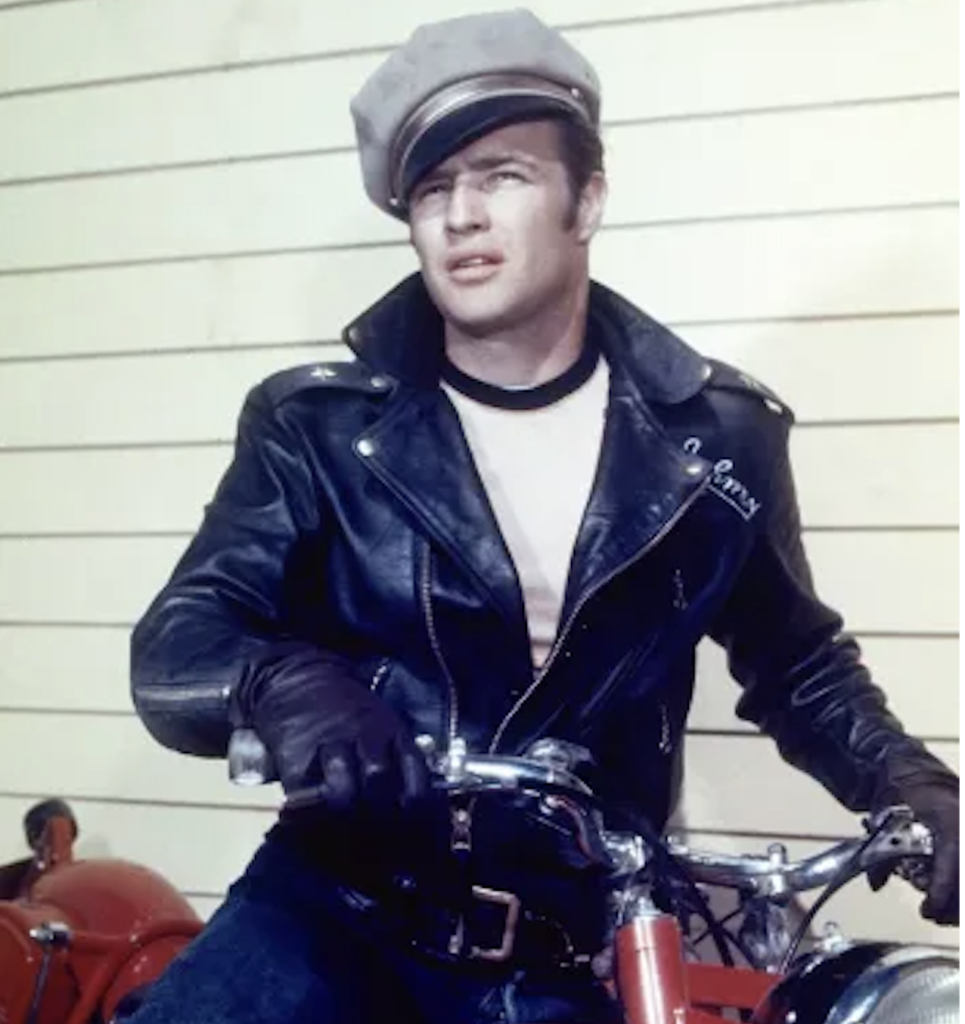
Marlon Brando apparently wore his personal motorcycle jacket in The Wild One: a Durable One Star model. [Publicity photo]
One of the lingering questions about Leathertogs concerns the Harley-Davidson ‘Motorclothes’ line: despite various claims and information circulated at the time, there is currently no verified evidence—through labeled garments, documentation, or contracts—that Leathertogs manufactured long horsehide coats or other leather garments for Harley-Davidson. While the companies were certainly aware of each other’s operations, there is no substantiated link of collaboration. What is more likely is that Leathertogs sold jackets, long coats, and other riding items to Harley-Davidson and Indian motorcycle authorized dealerships, such as C. H. Lang (1704 Michigan Avenue, Chicago), who offered them alongside other riding garments and sundries in their showrooms.

The Beck connection


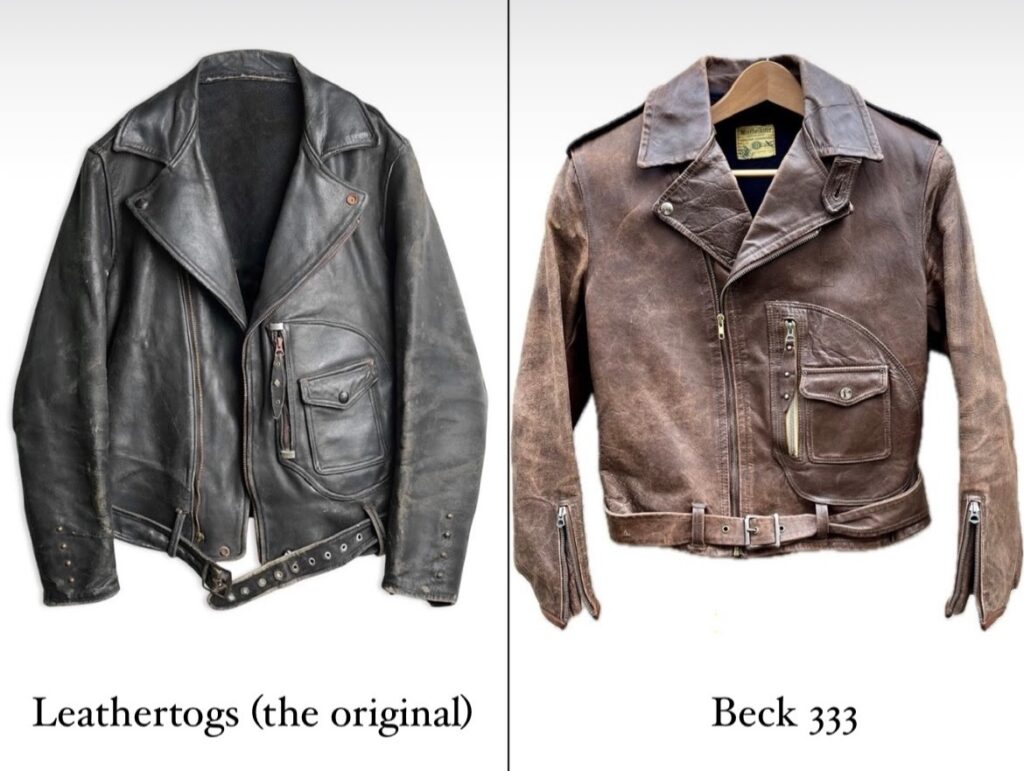
Side-by-side front view comparison of a Leathertogs D-pocket jacket and a Beck Northeaster Flying Togs jacket. [Riley Ward archive]
Another area of speculation concerns leather motorcycle jackets sold under the Beck label, which share many similarities with Leathertogs design features—such as Talon zippers, D-pocket shapes, woven label graphics, underarm gussets, sloped-shoulder designs, riveted stress points, and collar shapes. Currently, there is only one early conclusive piece of documentation about an overlap of these brands: an advertisement from a 1928 issue of Motorcycle and Bicycle Illustrated that contains both Leathertogs (with a jacket illustration and their Malden, Massachusetts, location) as well as Beck’s name and address within the same advertisement. This suggests that Leathertogs did, in fact, produce some jackets or garments on contract for Beck.

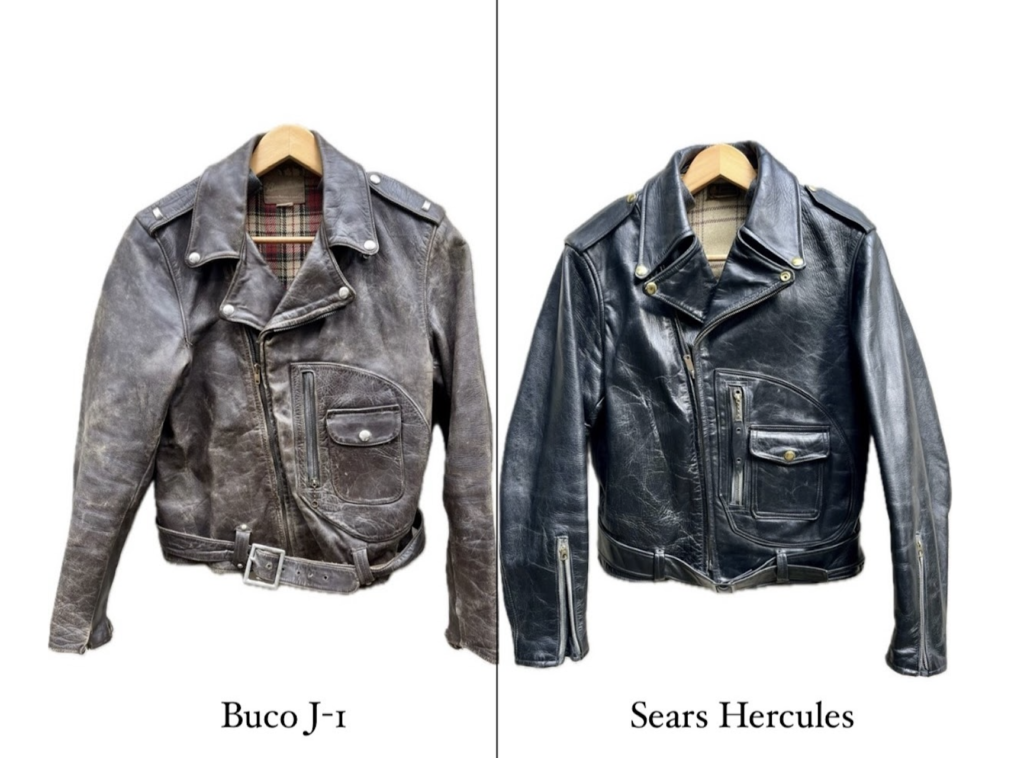
More brands that ran with the Leathertogs ‘D Pocket’ jacket design: the Buco J-1 and early 1950s Sears Hercules jackets. [Rin Tanaka]
Schott has claimed responsibility for Beck jacket production, but their variations differ notably from Beck’s late-1930s–into–early-1940s iconic “333” models. It is widely believed—by the author of this piece and other reputable collectors and researchers with hands-on experience—that Beck’s early jackets were produced by Leathertogs at one of their locations. These appear to be inspired by Leathertogs designs with simplified construction, made for mass-production, rather than the bespoke approach of Leathertogs per se.  The designs reflect input from Beck regarding specific customizations, available materials, and their intention to appeal to a broader range of motorcycle riders.

Leathertogs lives on…through Sears
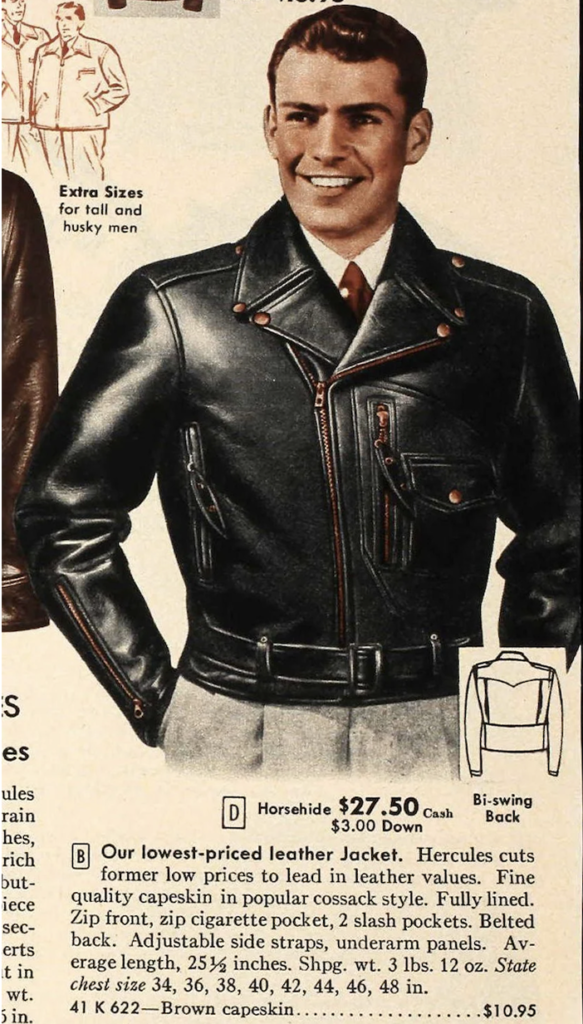
Thoroughly modern mister: the 1949 Sears catalog feature their first ‘biker’ jacket among their other fashion offerings. The jacket is a Beck J21, and clearly based on the Leathertogs D-pocket design of the 1930s. [Sears Roebuck & Co]
After the closure of Leathertogs in 1945, its design lineage survived directly through Beck, forming the basis for the most popular and best-selling motorcycle jackets in the USA and perhaps the world, through Sears Roebuck & Co.  Beck was contracted to produce a line of leather motorcycle jackets for Sears, sold from 1949 onwards under the in-house Allstate and Hercules labels.   These early Sears jackets are clearly based on Leathertogs designs, and were made from the start for both men and women, made in both cowhide and horsehide, with a material unavailable to Henry Shaw: nylon lining.

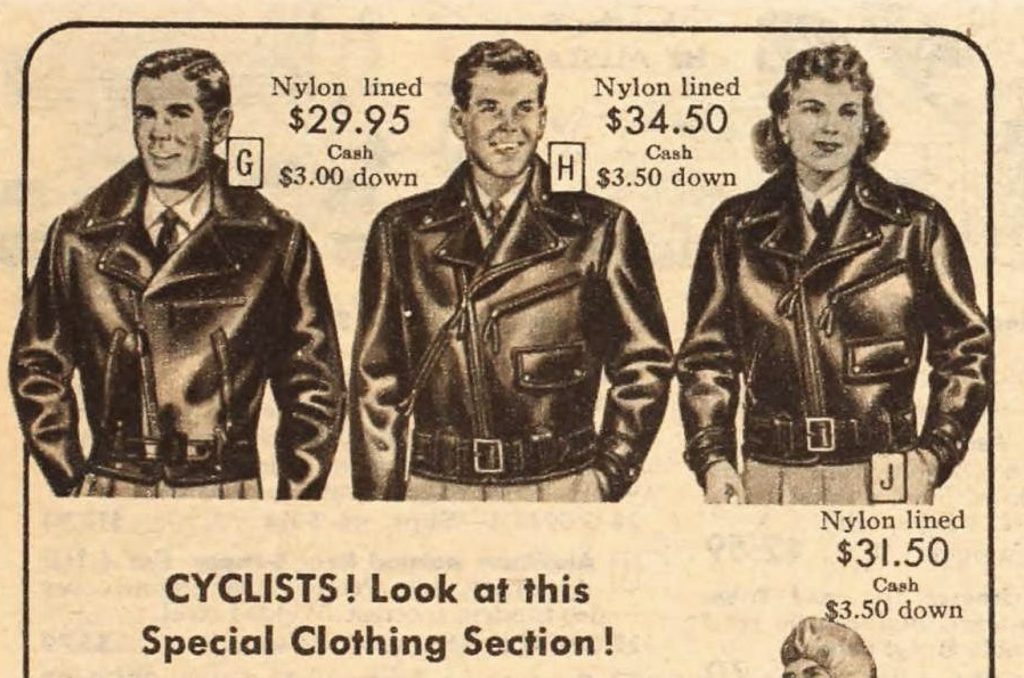
Sears’ first leather biker jacket designed for women appeared in 1950: this is the 1954 catalog, with a lady biker placed on the same page and at the same scale as her male model counterparts. [Sears Roebuck & Co]
T. Mitchell, a moderator on the menswear forum Fedora Lounge (with nearly 60,000 members), has done terrific research into the history of the Sears leather jacket, documenting every appearance of the biker jacket in Sears catalogs from 1949 onwards.  His thread ‘Sears Motorcycle Jacket History 1949-1963’ gives interesting view on how leather motorcycle gear was popularized after WW2:

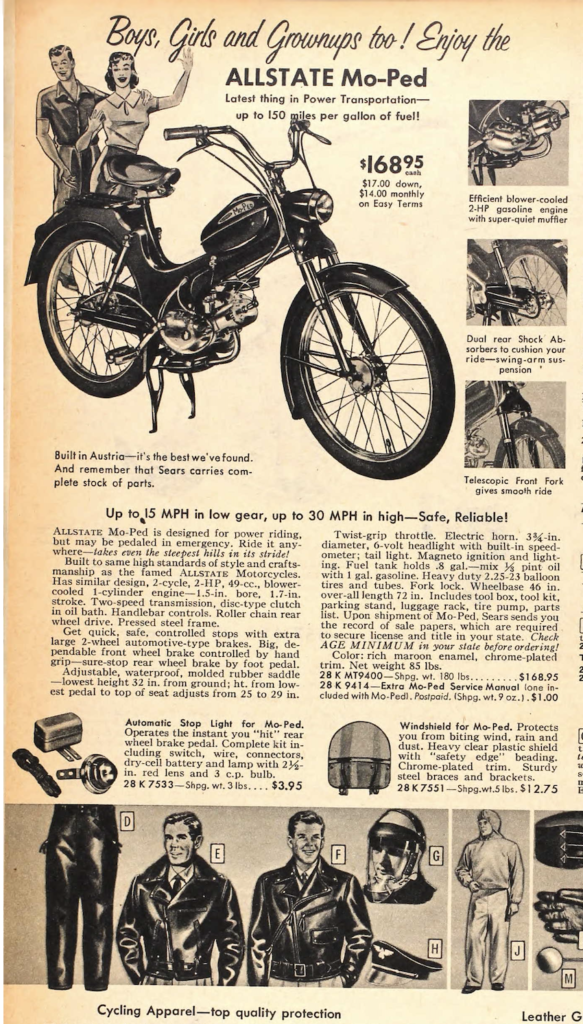
While Sears pioneered motorcycle sales via catalog starting in 1912, they took a hiatus in 1915, and didn’t recommence selling motorcycles (rebranded Vespas) until 1952. This 1957 catalog shows their first Allstate (Puch) moped, along with riding gear and accessories. [Sears Roebuck & Co]
“Sears is credited as the largest supplier of traditional cross-zip motorcycle jackets. Not surprising given their huge retail presence in the 1950s. 1949 is the first year that the Sears catalog shows a traditional motorcycle jacket: black horsehide with a wool lining. The catalog describes red, green, and black linings. The wool-lined jackets only lasted a couple of years, and wool lining was quickly replaced with the “new” nylon lining, which was the all the rage. Buco [who apparently made the leather jackets for Sears – ed.] also dropped their early-wool lined jackets for the new material. Wool linings in jackets seem to end around this early ’50s, replaced with the more modern material.”

Leathertogs in the Vintage World Today: The Phantom Grails
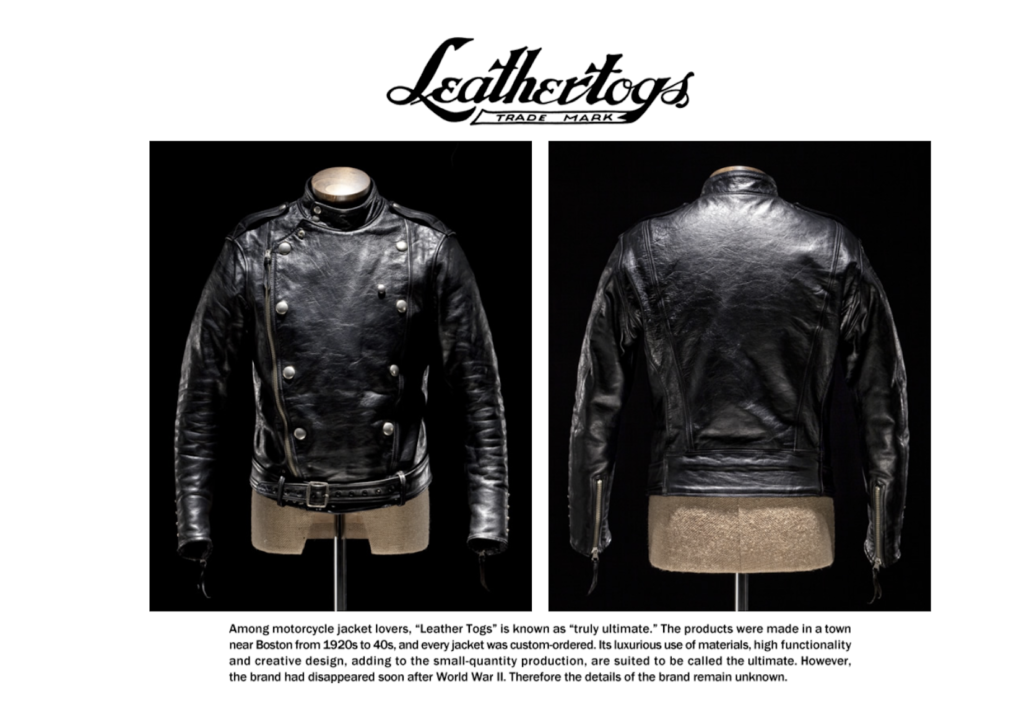
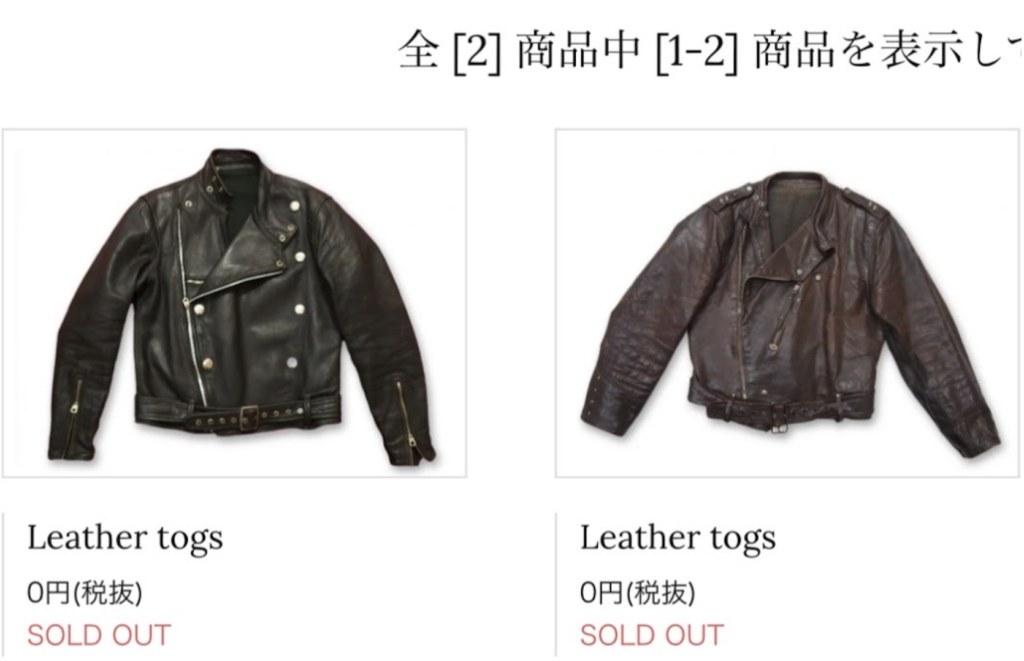
As with all things collectable, Japanese specialists have defined the coolest and best of everything, and revere Leathertogs as ‘The King of Vintage’. [Freewheelers.co.jp]
In the world of vintage leather and motorcycle gear collecting, Leathertogs garments are considered the stuff of legend. Rare, coveted, and exceptionally valuable, original Leathertogs jackets and breeches are among the most desirable pieces a collector can find—if they can find one at all. Due to their scarcity, collectors often refer to these garments as “Phantoms.” They surface so infrequently on the market that spotting one—let alone acquiring one—feels like encountering a ghost from another era. When original Leathertogs pieces do appear, they command top-tier prices. Depending on factors such as condition, model configuration, and custom features, a Leathertogs jacket can fetch anywhere from $1,800 to over $30,000. Intricate, customized examples and well-preserved pieces are especially sought after, and men’s garments tend to sell at a premium compared to women’s.

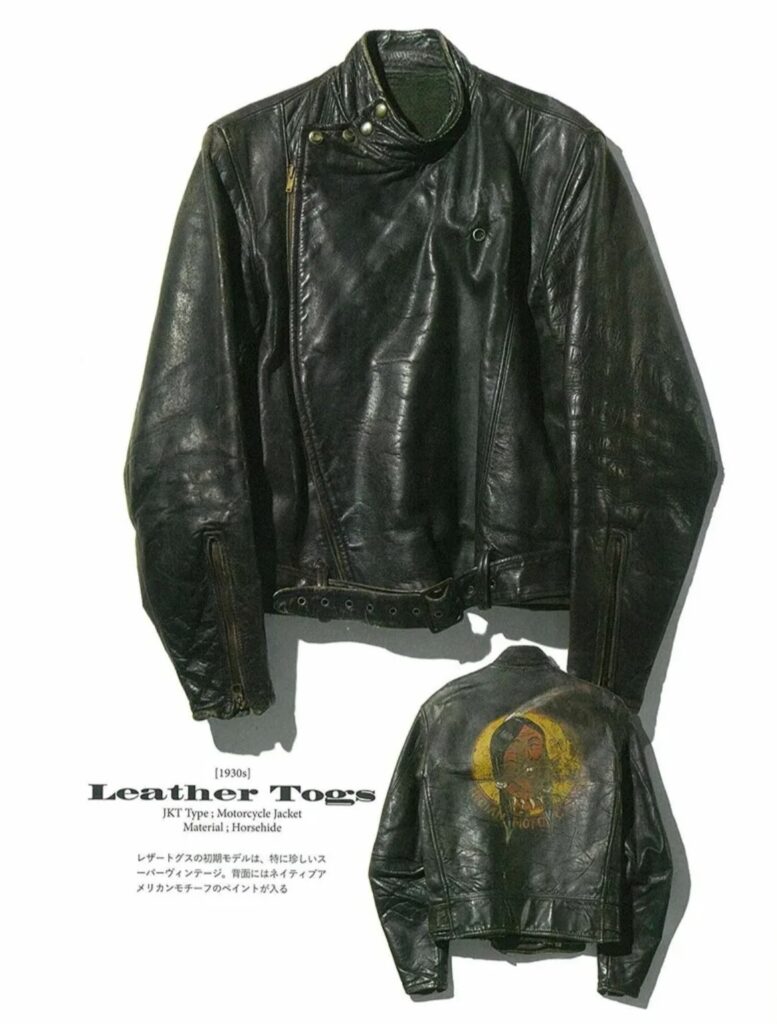
Leathertogs were always custom, and sometimes customized beyond Henry Shaw’s workshop, as with this ‘laughing Indian’ Motocycle logo on the back of a 1930s Isle of Man jacket. [Rin Tanaka]
A defining characteristic of Leathertogs garments is their woven interior label, often accompanied by the original owner’s name and address. Many surviving examples trace back to East Coast states, including Massachusetts, Connecticut, Rhode Island, New Hampshire, Vermont, Maine, New York, and Pennsylvania. Thanks to Leathertogs’ robust mail-order system, pieces have also surfaced from as far west as Washington, Oregon, and Nebraska, demonstrating the brand’s wide nationwide reach and broad appeal.

Good luck, friend. Thousands of vintage collectors around the world keep a standing search for Leathertogs on every auction site, and given the extremely limited supply, demand has forced prices into the stratosphere, with pristine jackets being offered for as much as $30,000. [Riley Ward archive]
These garments were not just stylish; they were functional, made for hard riding in unpredictable conditions. Whether a standard model or a custom commission, each Leathertogs piece reflects Henry F. Shaw’s vision for craftsmanship, attention to detail, and rider-focused design. It is no surprise, then, that some surviving examples now reside in private collections and museums, including the Harley-Davidson Museum, and that brands today continue to use original Leathertogs garments as templates for exacting reproductions.

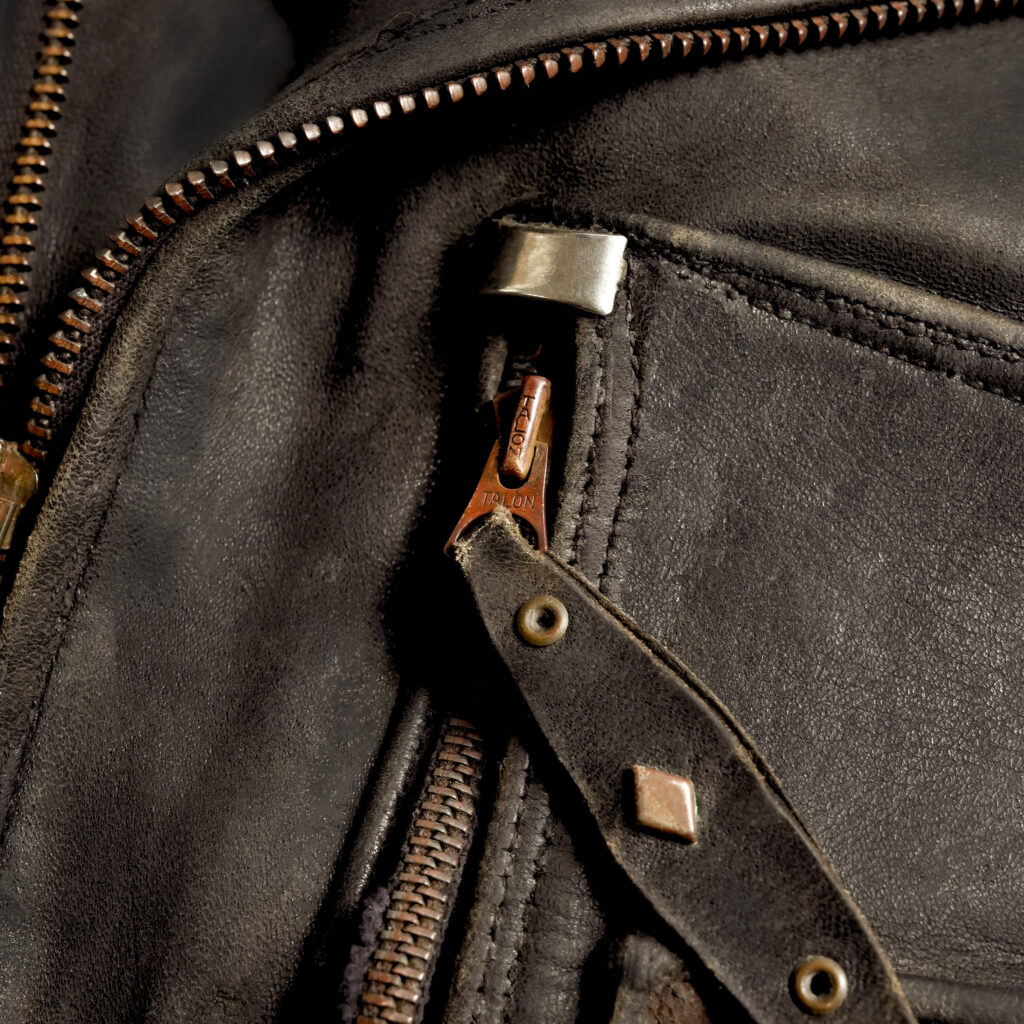
Quality construction details – like studs and rivets to strengthen pulls and zipper stops – make the difference between a jacket that lasts generations, and the also-rans. This jacket is nearly 100 years old! [Riley Ward archive]
To discover an original Leathertogs jacket—to hold it, feel the weight and grain of the leather, see the meticulous stitching and historical wear patterns—is more than just a collector’s joy. It is a direct connection to the motorcycling pioneers of the early 20th century and a testament to Henry Shaw’s legacy as a forgotten innovator who helped shape the intersection of style, sport, and utility.

Last Thoughts from the Author

Although this article is now published, I want readers to know that this is still a living, ongoing project. My research into Leathertogs and the legacy of Henry Franklin Shaw continues, and any new, credible information I uncover—or that readers may wish to share—will be added to a master record. My hope is to periodically update the historical record and keep expanding what’s known and accessible about this unique and pioneering company and Henry Shaw’s life.
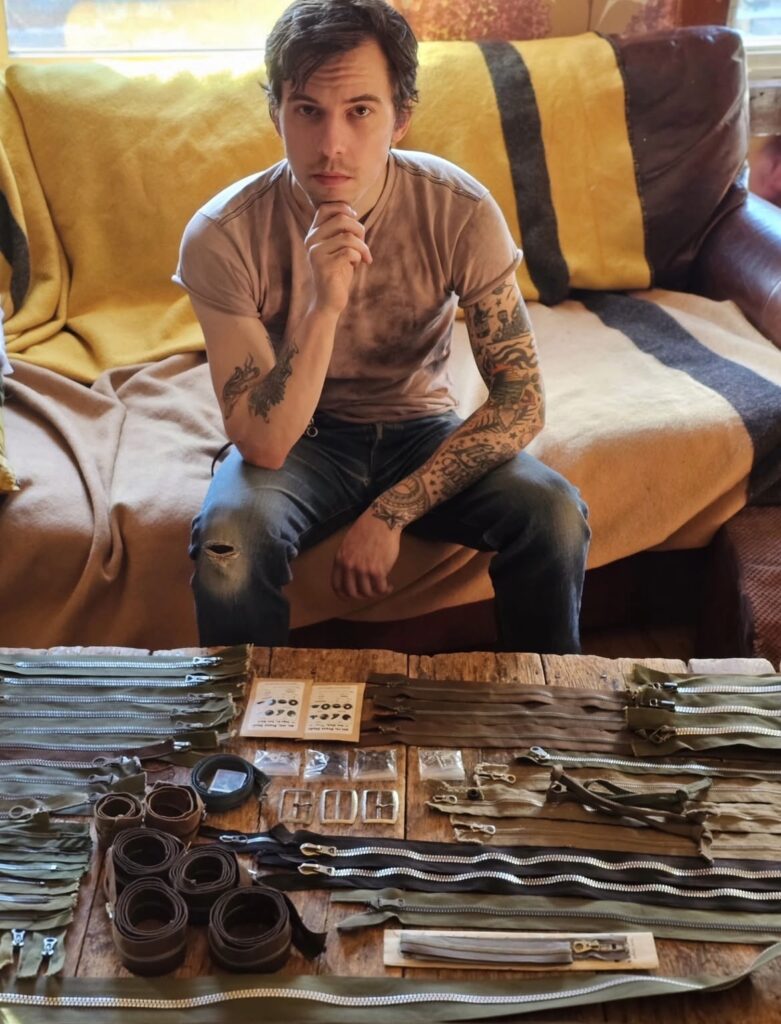
The author at work, digging in on the fine details of vintage jacket construction. [Riley Ward]
There are still many things I’m searching for: a photo of the original Leathertogs store or factory, any information on employees, unseen photographs of riders wearing Leathertogs gear, and surviving examples of garments—especially jacket and breeches models that are currently undocumented in the vintage community. Each new discovery, no matter how small, adds invaluable depth to the story. If you have anything to share—photos, documents, anecdotes, or artifacts—please don’t hesitate to reach out. All information will be kept confidential, and permission will always be requested before anything is shared or published.

Thank you very much for reading. I hope this work has illuminated the historical importance of
Leathertogs and helped you come to admire Henry Shaw as I do—for his innovation, creativity,
and enduring craftsmanship.

Warmly,
Riley Ward

Acknowledgments
I would like to thank everyone who inspired and helped along the way, including David Himel of Himel Bros. Leather (himelbros.com), author Rin Tanaka (myfreedamn.com), Jonathan Evenchen (@vintageleatherjawn on Instagram), Stuart Clurman of Lost Worlds NYC (lostworldsinc.com), Johnny (@us.blues on Instagram), and many others who generously shared knowledge, photographs, and pieces from their private collections. I am also deeply grateful to my dear friend MJ Quinn, who contributed to the research of Henry Shaw’s life and background.

A very special thank you goes to Henry’s living granddaughter, Kerry, who warmly and graciously shared personal stories about her grandfather, as well as never-before-seen photographs of Henry, his wife Helen, their son Elwin, and daughter Dorothy.


Read the whole Leathertogs saga in Parts 1-5 of The Lost Empire of Leathertogs.
 

Riley Ward is a vintage motorcycle jacket historian, as well as a collector / material sourcing / aspiring collaborative menswear designer. Check out his Instagram, and follow his history of Leathertogs here.