[This article originally appeared in the May 2024 issue of The Automobile magazine.  It looks much better in print: order a copy!] Picture a scooter.  Any scooter, every scooter.  Regardless of brand or era, they’re fundamentally the same, a genotype of unthreatening little motorcycles with three common elements: enclosed bodywork, a flat footwell, and small wheels.  They are ubiquitous and popular around the world, because, in our murky subconscious, sitting in a chair does not conjure the psychic potency of straddling a horse.  Dedicated motorcyclists understand that a scooter’s harmless countenance is an illusion, that ponies are the cruelest of mounts, and that we are all of us doomed knights on an unforgiving road. It’s understandable that most people find it daunting, or inconvenient, to gear up and saddle up for a coffee on a motorbike, so the wide world is enamored with the scooter for its ease and simplicity; especially women.  More on that anon.
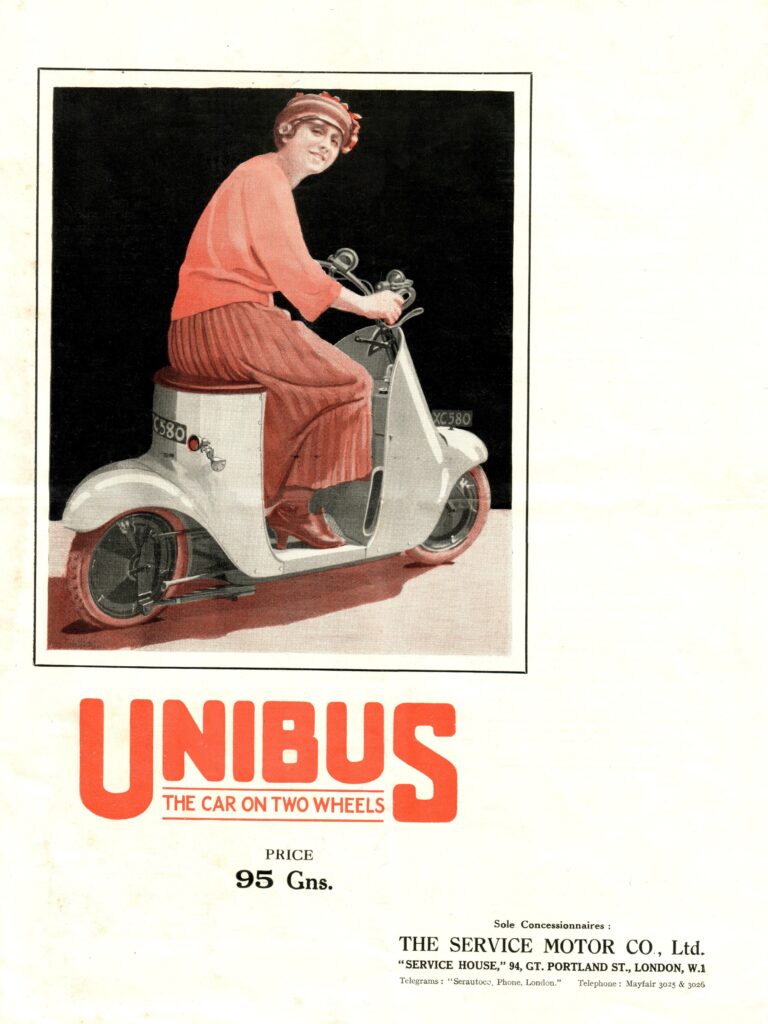
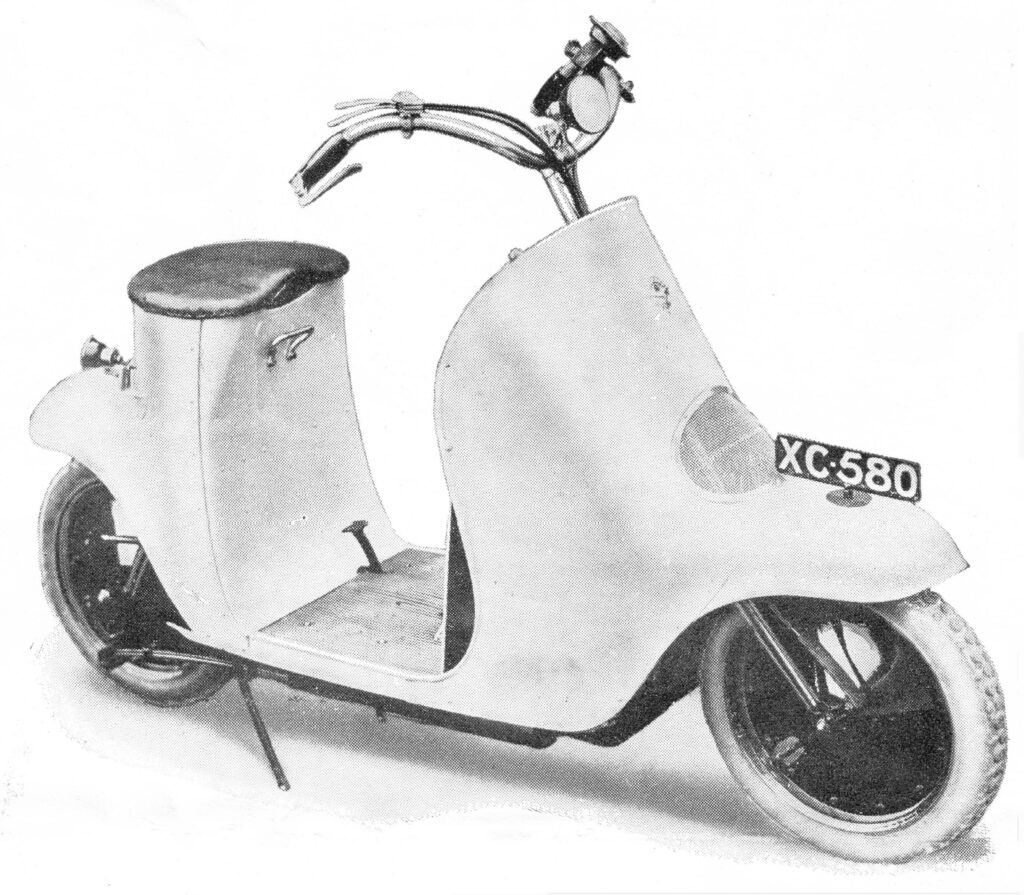
A 1921 Unibus catalog, showing all the characteristics of a scooter: flat footwell, small wheels, enclosed bodywork. [The Vintagent Archive]
All of the above – the design characteristics, the grasp of the human psyche, and the social implications of apparently harmless two-wheeled travel – can be laid at the wheels of the Unibus.  On its introduction in 1920, the Unibus coalesced several ideas floating around the motoverse, and rolled out of the primordial swamp of mobility fully formed as the very first scooter.  That’s a controversial statement, because there are respectable claimants for the rootstock of the species, but the Unibus was the first to have all the defining elements in place: footwells, enclosure, small wheels.  One might expect the first vehicle of any specific morphology to be crude, but the Unibus was brilliant and far too sophisticated for its day, and was thus expensive, dying an early death after struggling for only two years.  Scootering as a whole took decades to catch up with its shining example.

Even more clearly, one can see in this 1920 photo how modern the Unibus was in its design and execution. [Francois-Marie Dumas]
The provenance of the Unibus was exactly that of the most successful scooter in history, the Vespa, born of the imagination and technical expertise of an aviation engineer working for an aircraft company left with excess capacity after the cessation of formerly-profitable hostilities.  It’s well documented that Corradino d’Ascanio hated motorcycles, so when tasked by Piaggio with designing a two-wheeler after WW2, he stole Harold Boultbee’s notebook in its entirety, whether or not he knew the mighty Gloucester Aircraft Company built scooters after WW1, after demand for Bristol fighters dried up.  While Piaggio’s clever design was introduced simultaneously with dozens of other scooter brands vying for transport-hungry postwar masses, Boultbee’s Unibus stood alone in 1920, as the first of the species.

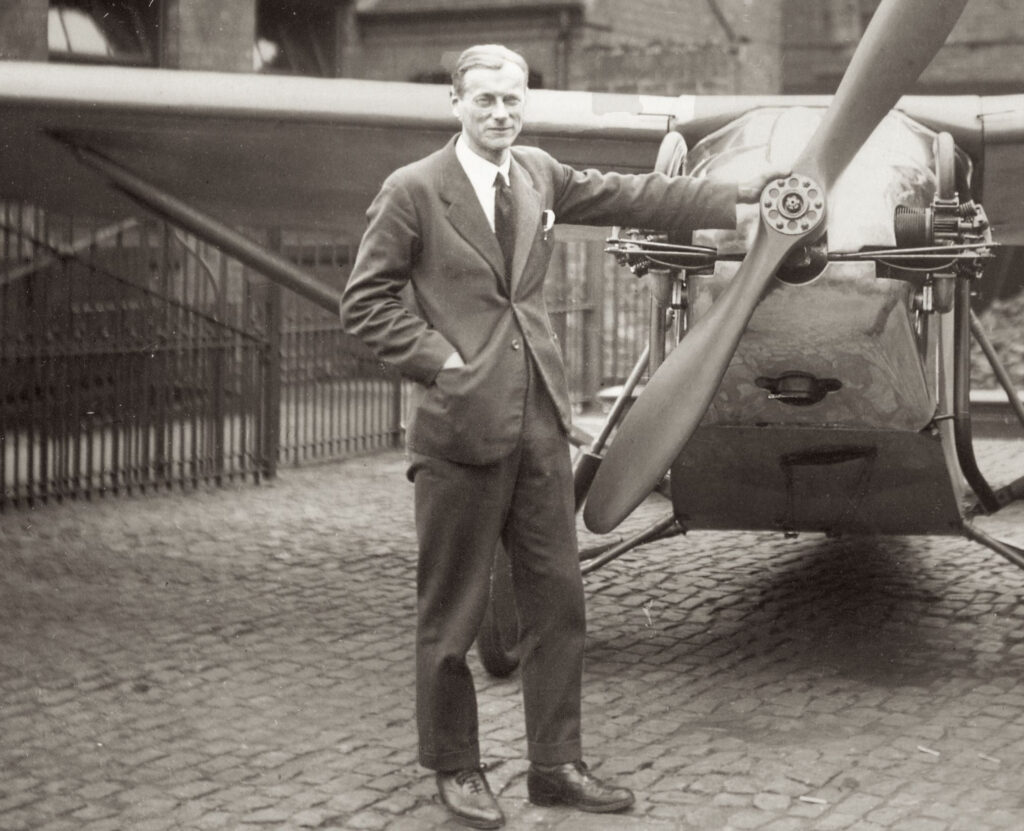
Harold Dalton Boultbee with his Civilian Coupé, a metal monocoque plane with a flat twin motor, built by the aircraft factory he formed in 1928, Civilian Aircraft Company at Burton-on-Trent. [The Vintagent Archive]
Boultbee’s Baby

Harold Dalton Boultbee, born 1886 in Eaton, Yorks, graduated from Cambridge in 1908, when young men of a certain economic strata were infected with aero fever.  The Wright brothers had proved a kite launched by rubber band and boosted by an anemic motor could sustain flight for a few hundred yards, and changed the world forever.  That the litigious Wrights proved more an impediment than a boon to the development of flight was immaterial, as the point was made it could be done, albeit better, and soon was.  Boultbee was one of those eager to improve the breed, and in 1909 made his point by patenting the first design for retractable landing gear: it was his first association with wheels on vehicles, but not his last.
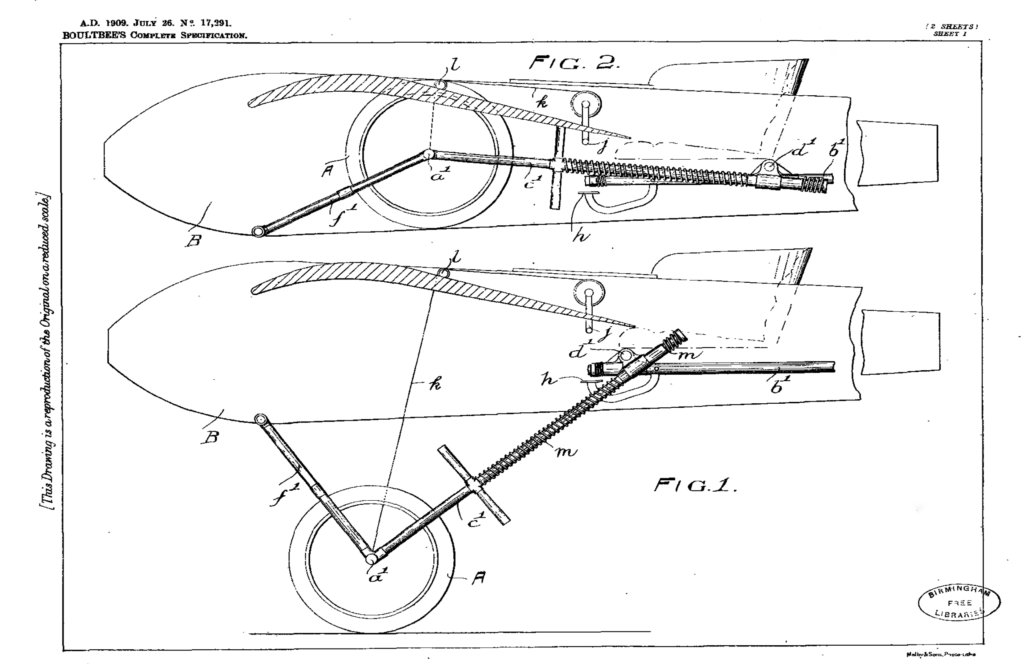
Boultbee’s patent for a retractable landing gear, another industry first. [UK Patent Office]
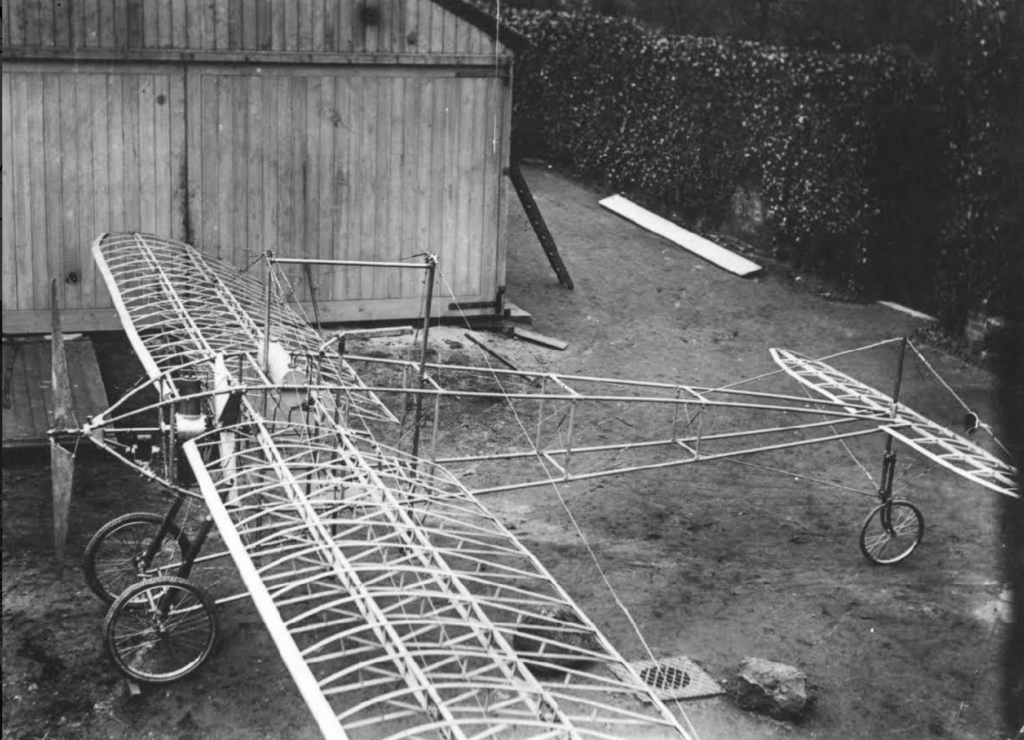
Boultbee’s landing gear was only the most remarkable aspect of his airplane designed with partner James Gardiner of Liverpool: a single-seater midwing monoplane with a chassis of steel tubing.  The undercarriage was fitted forward on the fuselage, and used long coil springs to retract into the body (patent No.17291/1909), although the controls used a retrograde wing-warping system (patent No.14990/1909), and a tail wheel for landing.  The engine was a 12hp rotary built by Scott Motors of Shipley, Yorks, and was apparently their first aero engine design, as their daily bread was motorcycle manufacture from 1908, using Alfred Anglas Scott’s revolutionary watercooled two-stroke twin-cylinder motor (patent No.3367/1904) in an all-straight-tube chassis (patent No.16564/1908).  It’s unknown if Boultbee rode a Scott motorcycle, but he certainly would have known of the company from his home turf.  A.A. Scott should have stuck with two-strokes, though, as on tests, Boultbee and Gardiner’s rotary nearly shook the plane to pieces, and quickly lost all performance when the camshafts lost their bumps from a lack of hardening.  That wasn’t what killed their aero project, though: it was an approach from an engineering firm, who suggested they partner on airplane manufacture using the design, a situation which Gardiner, for reasons unrecorded, wanted to no part.  Exeunt Boultbee, and the nearly-finished plane was scrapped.

The skeletal frame of Boultbee’s first aircraft design of 1918. [The Vintagent Archive]
H.D. Boultbee, with two patents under his arm, found other work in the aero industry, including as a draughtsman at British and Colonial Aeroplane Company (better known as Bristol) under Henri Coanda from 1913.  After the cessation of hostilities, he was hired by the Gloucester Aircraft Company in Chelthenham (soon shortened to Gloster, as nobody outside Great Britain could pronounce it), presumably to save their bacon after war contracts dried up.  BMW also built flat-twin engines for motorcycles, after being forced to give up aircraft by the Treaty of Versailles, but the British aero factories fared no better in victory – the order books were empty, and new ventures were required.  Rival aircraft maker Sopwith had introduced the remarkable ABC flat-twin OHV motorcycle in 1919, which it soon licensed to Gnome-Rhone: a rising throttle lifts all wings…or at least buys time to reorganize.

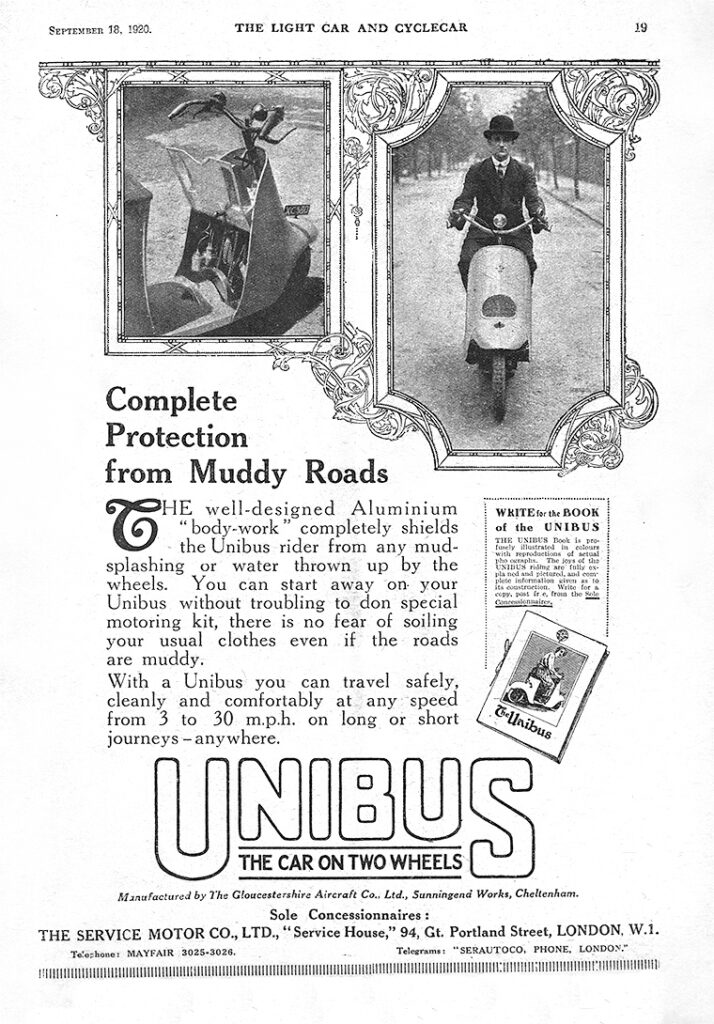
The Car on Two Wheels. A 1920 Unibus feature in Light Car and CycleCar magazine, Sept. 18 issue.

Harold Boultbee’s design for Gloster was unique, and caused a stir when the Unibus was revealed in the Summer of 1920.  Dubbed ‘the car on two wheels’, the Unibus was aimed at a genteel clientele, and was priced accordingly at 95 guineas: the same price as the new Brough Superior superbike, and a year’s wages for most working folk.  What did one get for such extravagance?  Among the most sophisticated two-wheelers on the road, in specification if not in sheer speed (George Brough having comprehensively claimed that space). Technically that meant a simple two-stroke with two-speed gearbox built ‘on automotive principles’, with full springing front and rear plus total bodywork enclosure.  The frame was also built on automotive practice, being a sheet steel ‘tub’ with drilled-out horizontal runners and simple cross-panels forming boxes that extended upwards for the steering stem and seat post.  The pressed-aluminum bodywork enclosed the whole of the engine, fuel/oil tanks, and mudguard up front, and the flat seat (with copious enclosed cubbys beneath for tools and storage) and rear mudguard combo.
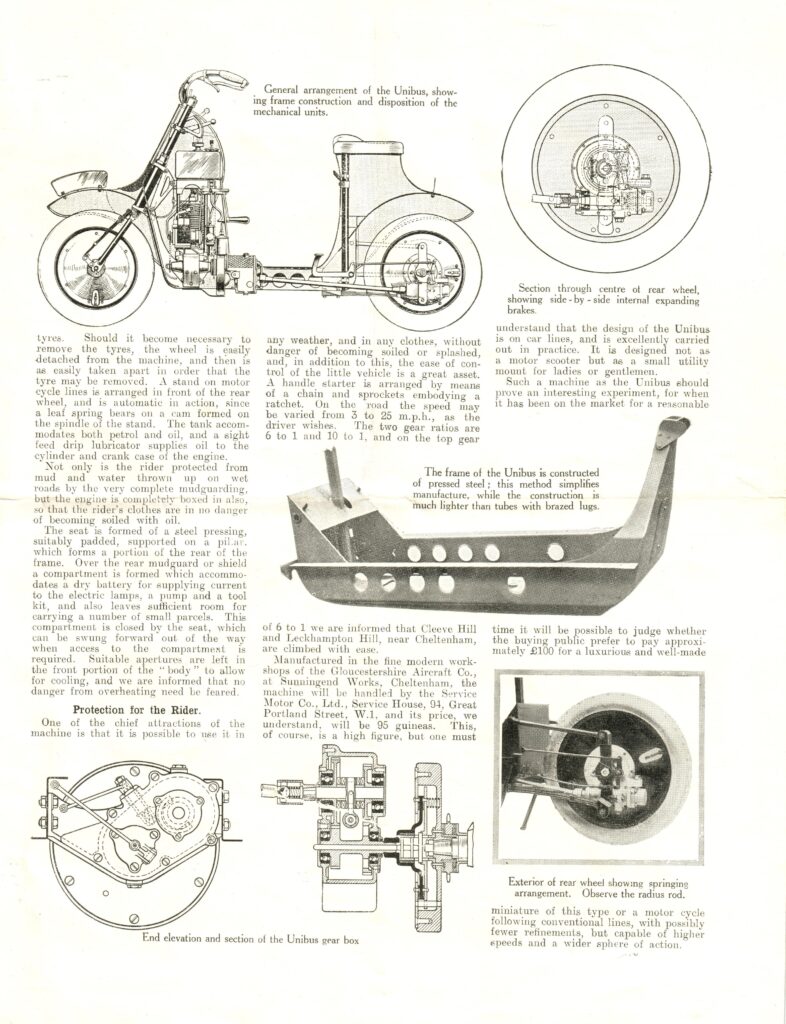
The remarkable tub-like monocoque chassis of the Unibus seen clearly here, in a 1921 feature in The Motorcycle.

The motive power was a 2½ h.p. (269cc) two-stroke single-cylinder engine set across the frame, which drove through a single dry-plate clutch to a two-speed constant-mesh gearbox set across the frame. The gearbox was connected to a prop-shaft ending at the rear wheel, and used an enclosed worm drive. Perhaps the most unorthodox feature of the Unibus was its dual braking system, with two internal-expanding brakes, one controlled by hand and the other by foot, both acting inside the rear drive housing, rather than the wheel hubs, as later became the norm. Unusually for a motorcycle of the period, the rear wheel was fully sprung, using quarter-elliptic springs attached to a bracket on the worm drive housing, with parallel pivoting arms. The forks were also leaf-sprung, with short fork legs pivoting from the lower steering stem, and the ends of the quarter-eliptics attached to the steering stem and a leading link ahead of the front axle, meaning the fork’s movement was purely fore-and-aft.  This was terrible physics, as the wheelbase changed with fork flexure, but in practice (as on the later Neander using the same principles) is surprisingly comfortable and does not spoil handling.  Stability was enhanced  by using 16” diameter wheels, made of split steel discs (like a Vespa), providing a far more secure ride than a small-wheel machine, and echoing modern practice for more powerful scooters.
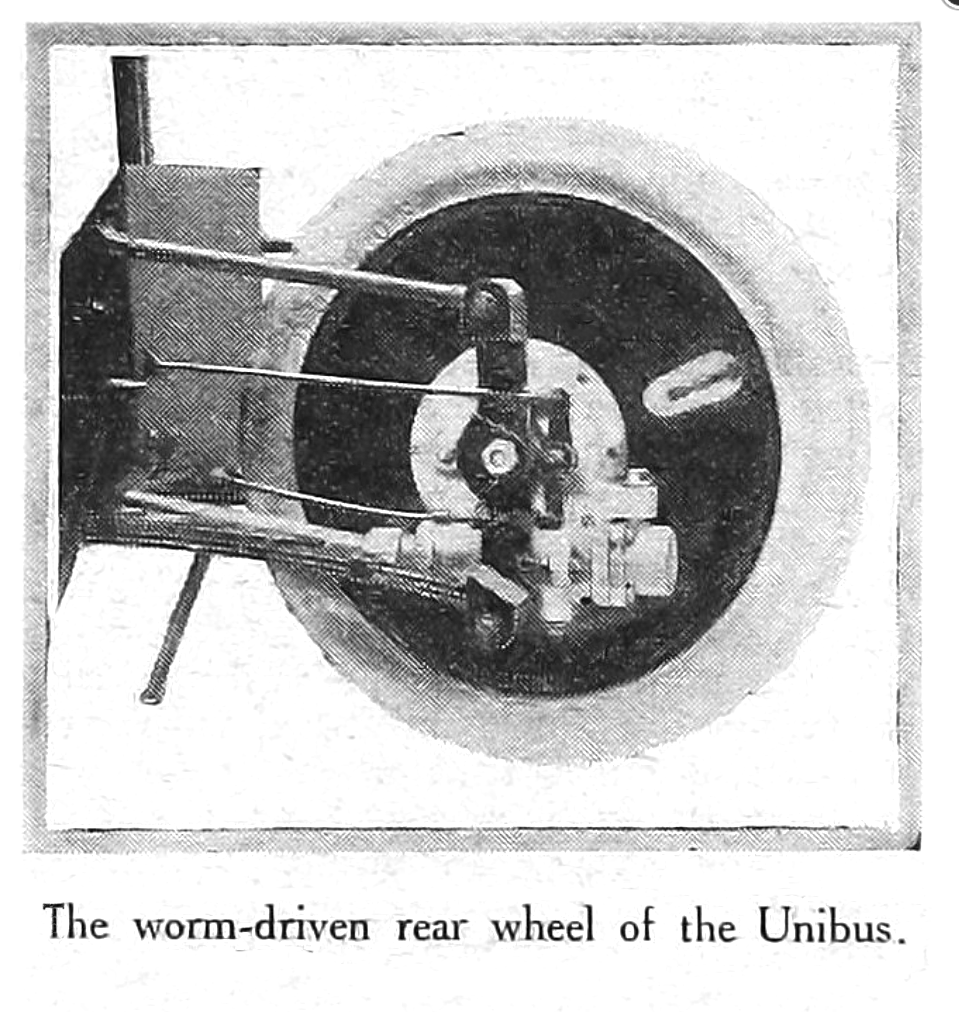
The shaft drive and rear suspension of the Unibus. [The Vintagent Archive]
The engine was started via a wooden-handled crank mounted on the aluminum dashboard, connected to the flywheel via chain: a smart pull on the crank (a freewheel mechanism protected the starter’s wrist) set the low-compression motor pop-popping.  The engine was totally hidden beneath the bodywork surrounding the steering stem, and breathed through an oval mesh grille at the front of the scooter. The engine placement gave excellent weight distribution and balance, and rider reports of the day mention secure handling and comfort worthy of the Unibus’ expense.  The Unibus was, in sum, a very tidy design, thorougly considered by an engineer who understood the need for compactness, good weight distribution, comfort, and a pleasing shape. On every one of these points it succeeded admirably, and laid the pattern for all scooters to come.

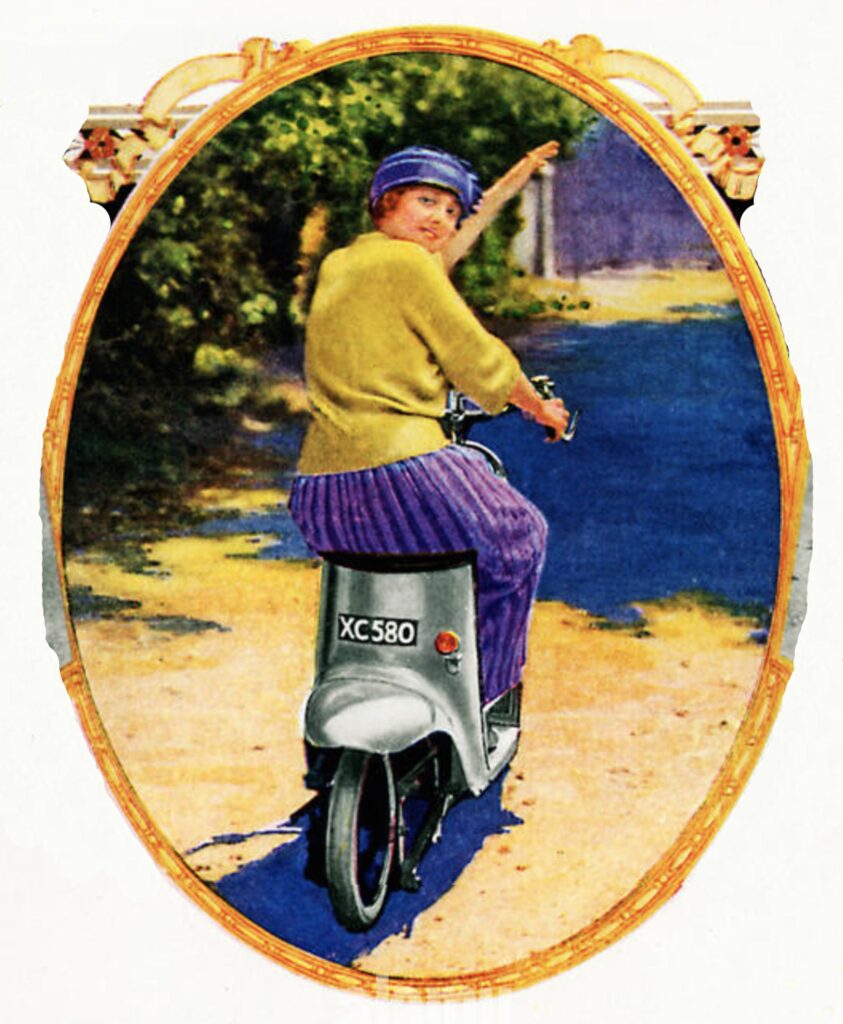
A lovely image from a 1920 Unibus catalog: women were clearly the intended audience. [Francois-Marie Dumas]
The press of the day felt the same.  Motorcycling commented on June 28 1920 “From whatever standpoint the Unibus is viewed, it stands as an engineer’s job from start to finish. The design marks a new era in the march of progress of the two wheeler.”  The Motor Cycle commented that December 2nd, “One of the most interesting exhibits in the miniature line is the Unibus chassis, which shows distinct originality… Ease of cleaning and weatherproofing are keynotes of the design.” The Unibus was primarily advertised using women riders in velveteen gowns and chic cloche hats, riding a wave of motorcycle industry attention directed at females before and after they gained the right to vote: again, more on that anon. Gloucester also provided test machines to non-motorcycling publications with well-heeled target audiences, such as The Field (The Country Gentleman’s Newspaper), a generally anti-motorcycle publication, which nevertheless praised the Unibus’ “complete protection from the road for both rider and mechanism in any weather”.   Presciently, The Field noted the 95 guinea price as “too high to attract popularity”, which proved all too true.  Fewer than 100 Unibus’ are thought to have been built between 1920 and 1922, and perhaps only six remain today, a sad commentary on the fate of being first in any field.

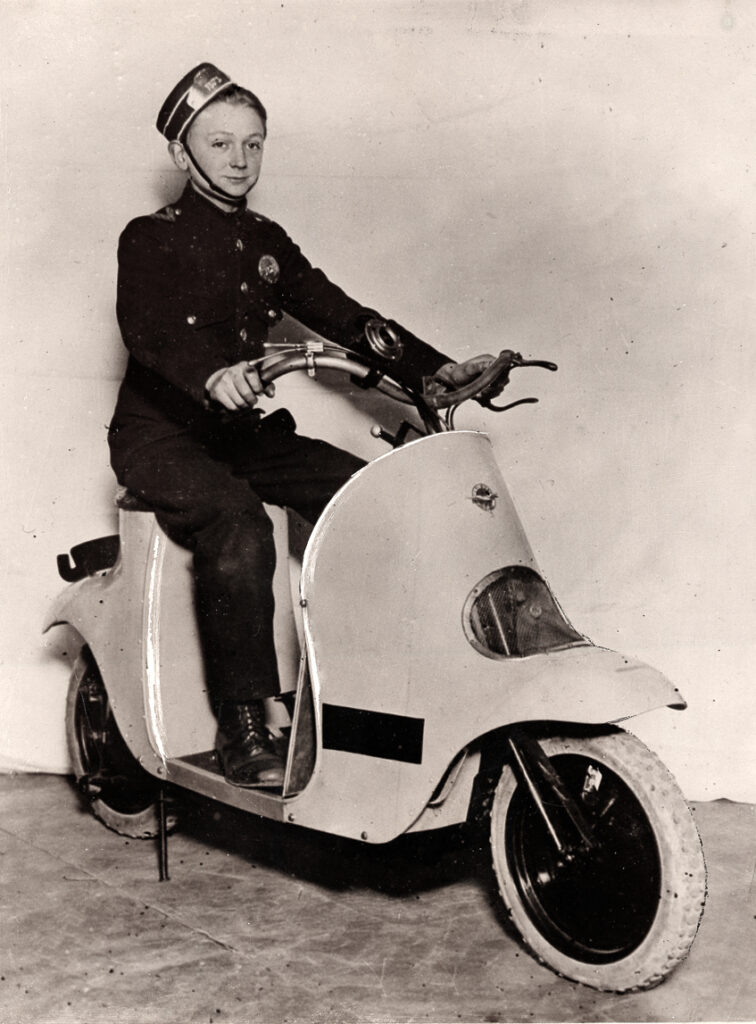
Pageboys could use the Unibus too, as seen in this French image from 1920. [Francois-Marie Dumas]
Women on Wheels: The Scooter Legacy

There’s another story to tell around the Unibus and the invention of the scooter: the social history of women on wheels. Two wheelers played an important role in societal changes for women, as the bicycle rolled over Victorian ideas about suitable clothing for women, and their  freedom of movement. The Ordinary bicycles’ extraordinary popularity from the 1870s onward had exposed bodices and hoop skirts as simply impossible for a modern lady on the move.  In the late 1880s, the smell of freedom wafted around the new Safety bicycle, the original Suffragette conveyance, and in the late 1890s, at the dawn of the motor industry, advertisements featured women riding motorized trikes. By the ‘Noughts and ‘Teens, motorcycles designed especially for women – the Ladies Models – appeared in the catalogues of most British motorcycle manufacturers.  The ‘Teens were a heady time for women’s suffrage movement, women were on the verge of gaining the vote in the UK and USA, and the motorcycle industry was eager to exploit what seemed an imminent new market as women took to the wheel.
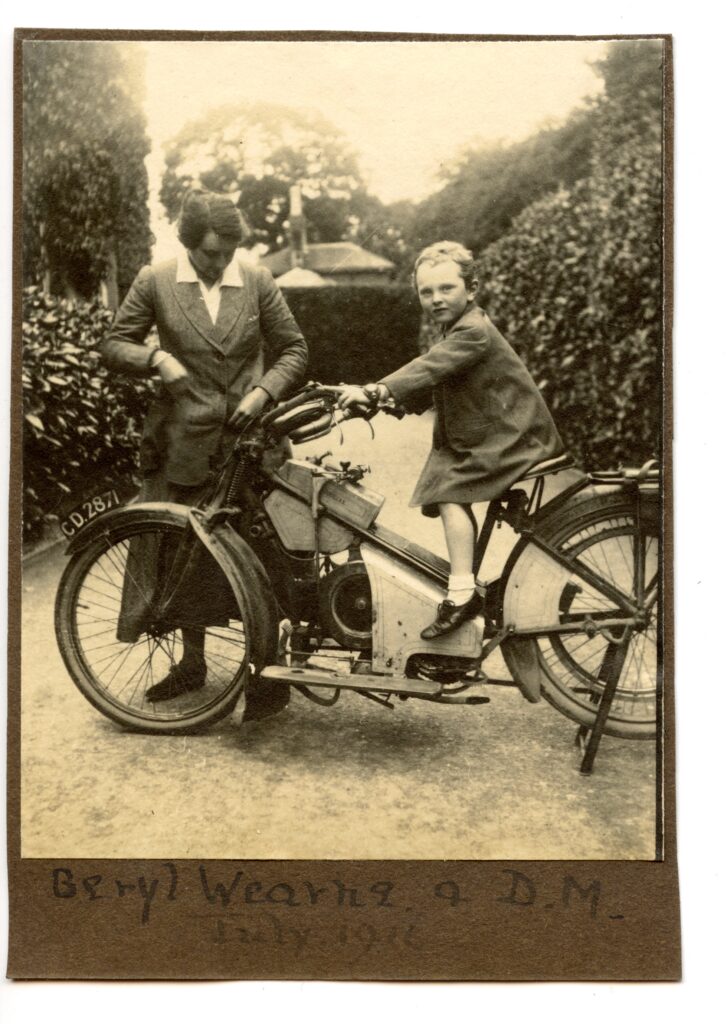
A typical Ladies Model motorcycle: a 1912 Douglas flat twin Ladies Model, with typical lowered top rail for skirts. Beryl Wearne is the rider. [The Vintagent Archive]
The Ladies Model was effectively a development of the open-frame bicycle chassis, a design almost as old as the Safety bicycle that first appeared in the UK in 1888 as the Psycho Cycle by Starley.  This was only 3 years after they commenced production of their Safety cycle design that set the pattern for all bicycles to come.  By the early 1900s, women had a choice of two distinct motorcycle designs advertise primarily to female customers: the stand-up scooter (just as you see on every urban street today) and the Ladies Model. The Ladies Model no longer exists as a category of motorcycle, but soldiers on in the bicycle world: in profile their chassis is the same, with a dip between headstock and saddle tube to accommodate a skirted rider. Any man who’s accidentally slipped from his bicycle saddle onto the frame tube knows the ladies bicycle should have been the men’s standard, but clothing, not anatomy, set the pattern.

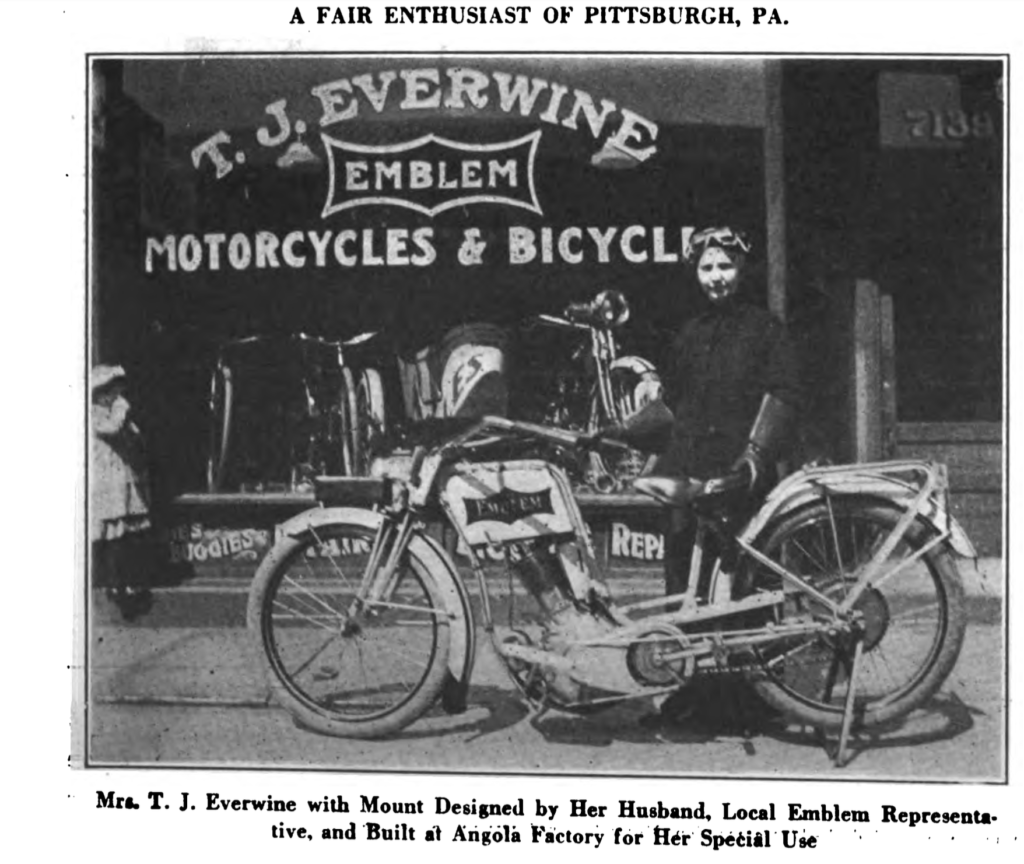
The Brits were not the only ones to build a Ladies Model: this Emblem was modified in 1915 for Mrs T J Everwine. [The Vintagent Archive]
 A surprising number of British manufacturers built Ladies Models, literally from Ariel to Zenith, and in between them Brough, Douglas, Royal Enfield, Velocette, and many more. In the ‘Teens, women riders were featured on the catalog covers of marques like Ner-A-Car and ABC, and within their pages too, with recommendations by women riders.   Ner-A-Car was the most aggressively marketed to ladies, distributing catalogs wholly illustrated with Flappers in cloche hats and slim dresses burbling along in an Art Deco universe.  ‘Go as you are in your Ner-A-Car!’   While the 1922 hub-center steered bike used ‘only’ a 225cc two-stroke as motive power, it goes very well, handles in a beautifully stable manner (I once did several laps of the Montlhéry race bowl hands-off on one), and with its totally enclosed bodywork, won’t soil your clothes.  Almost a scooter, in other words, barring the flat footboards and feet-forward riding position. The Unibus, however, had it all, but was simply too expensive.

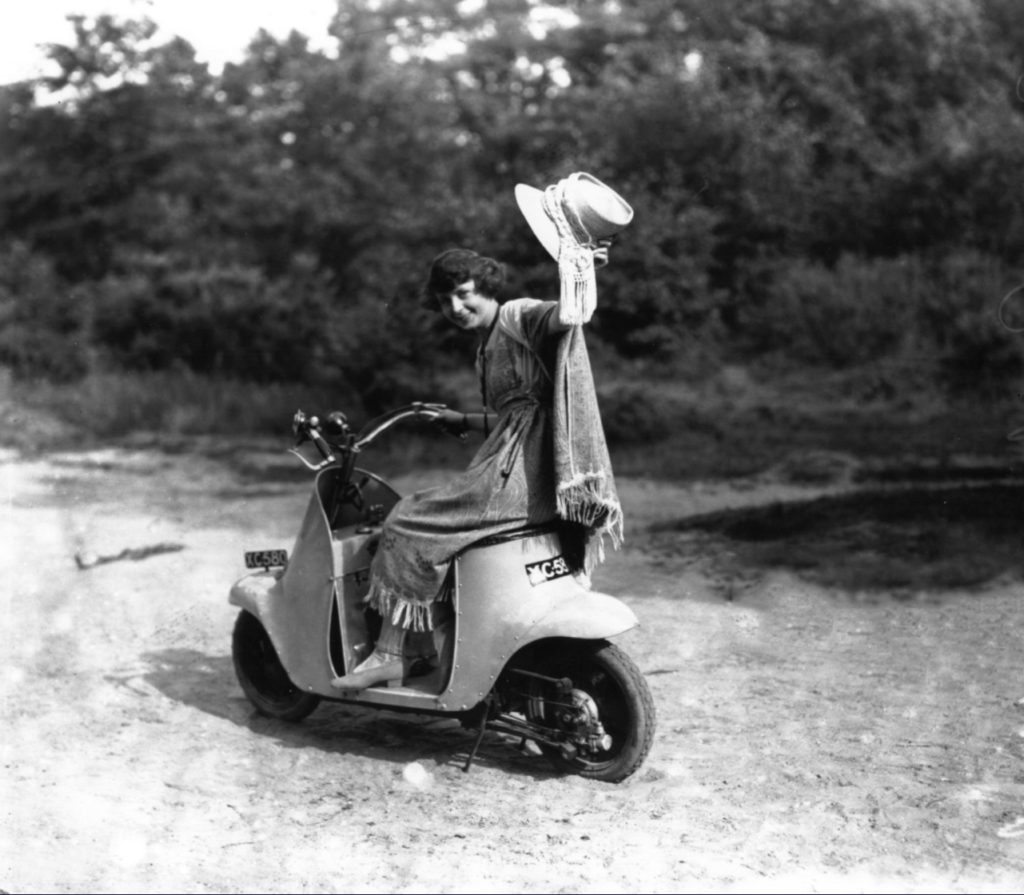
A lovely 1921 publicity shot of a lady rider wearing paisley velvet on her Unibus. [Francois-Marie Dumas]
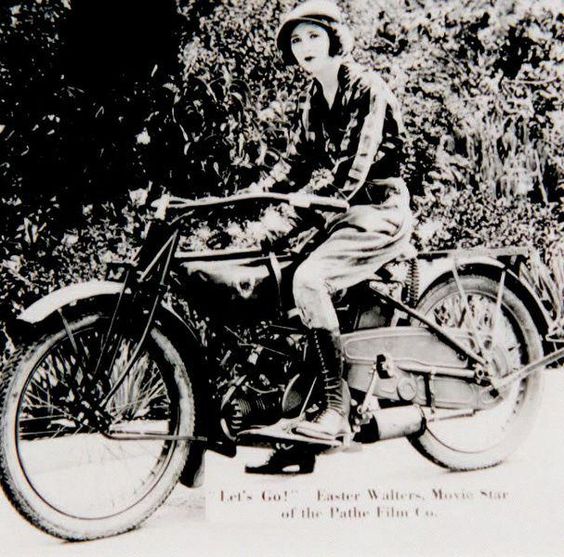
The Ladies Model flourished from the late Noughts through the Depression, which was a golden era for women riders, who could see the industry taking them seriously and competing for their attention.  In the ‘Teens and Twenties, trade magazines featured articles and columns written by women like The Motorcycles’ ‘Through Feminine Goggles’, and women competitors in trials and racing were frequently photographed and discussed with surprisingly little condescension, and often with great charm…perhaps because gentlemen of the press often attached themselves romantically with these pioneering women. Trials riders like Marjorie Cottle and dirt track racers like Faye Taylour became big stars and household names. In the ‘Teens and Twenties in the USA, advertising was also directed at women, but no American manufacturer built a Ladies Model, only small-capacity motorcycles.  Regardless, there was a highly visible cadre of American women riders in the silent film industry, with stunt riders like Easter Walters or Mabel Normand working alongside Buster Keaton and Bobby Townsey.  Stunt rider Helen Holmes even founded the ‘Riding and Stunt Girls of the Screen’, a union of women stunt riders!  And women could always be found in the carnival grounds, riding the Wall of Death.

Silent film star Easter Walters was happy wearing trousers aboard her Indian Model O in the early 1920s. [The Vintagent Archive]
This motorcycle industry’s flirtations with women changed in the 1930s, when women were specifically banned from most racing.  The general enthusiasm and support for women in motorcycling turned sour after a few very talented ladies like Faye Taylour and Beatrice Shilling began beating the boys at speedway and track racing, respectively.  After WW2 women were nearly invisible in trade publications except as support for men’s events.  By the 1950s women were primarily visible as sales tools, with decreasing clothing coverage as the decades ‘progressed’. The industry forgot they’d been falling all over themselves to reach female riders in the early years, and ceased designing full-sized motorcycles just for them.

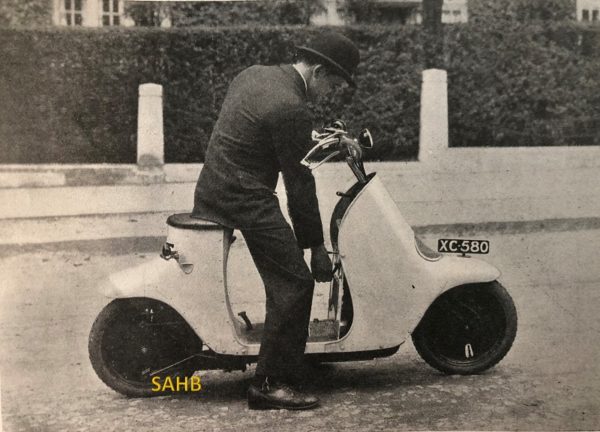
Well, gents could ride them too. A 1920 publicity image of a man riding a Unibus. [The Vintagent Archive]
What became in effect the new Ladies Model was the legacy of Boultbee’s Unibus: the scooter.  It took another big war, and the next wave of aircraft manufacturers scrounging for work, to finally bring the scooter to the masses.  Haltingly in the late 1940s, then with a vengeance in the 1950s, the scooter and step-thru motorcycle became by far the biggest sellers in a truly global market.  The most successful scooter companies in Italy, Germany, and Japan had learned the tricks of mass production and employee management supplying weaponry and vehicles to their respective militaries, and brought the experience to bear on civilian production.  Of the hundreds of scooter and step-thru motorcycle builders after WW2, these were the factories that thrived, and survived.

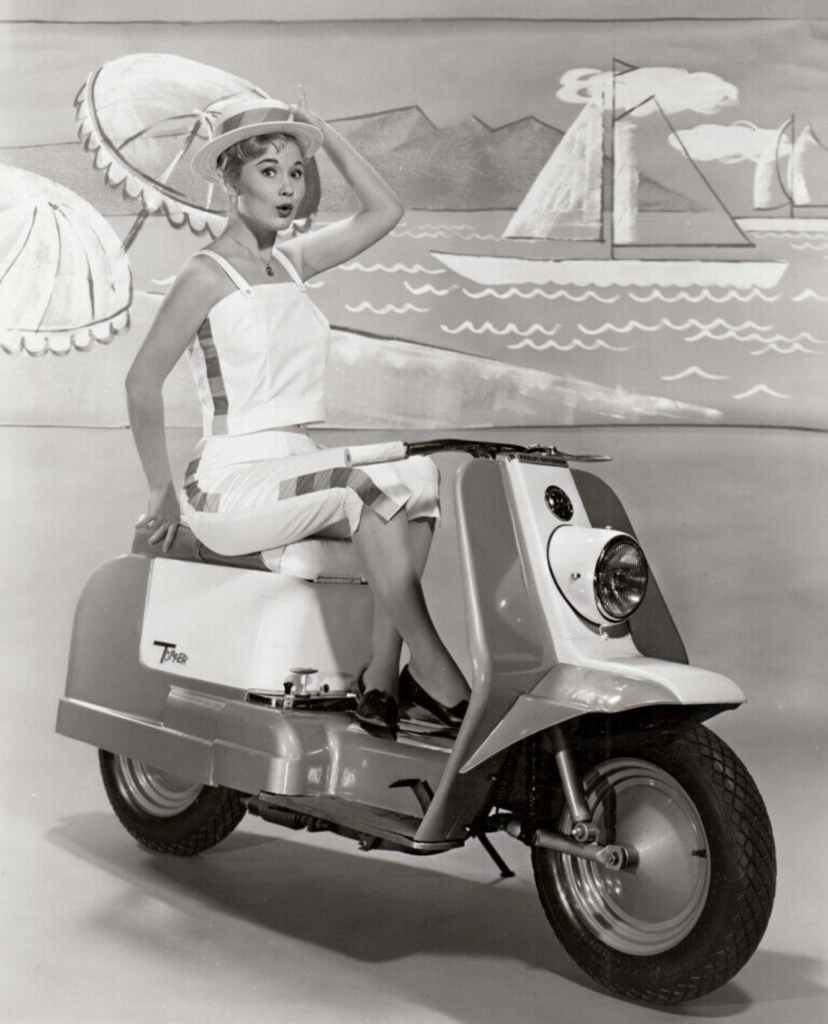
A 1957 Harley-Davidson promotional photo featuring a woman with their new Topper scooter. [The Vintagent Archive]
The commercial failure of the Unibus did not sink the Gloucestershire Aircraft Company, nor the reputation of H.D. Boultbee.   He seems to have taken a design job at Handley-Page before forming his own company in 1928, the Civilian Aircraft Company at Burton-on-Trent. Their sole product was, in echoes of Boultbee’s past, a light monoplane, this time a two-seater called the Civilian Coupé, built in a factory at Hedon.  Only six were finished before C.A.C. declared bankruptcy in 1933.  Had Boultbee been tasked by Hawker to build a scooter after WW2, it’s possible he would not be so forgotten today, and his Unibus revered for its visionary genius and sophisticated design.  But it took Italian design flair ignite the public’s passion for scooters in the 1950s, Japanese production methods to make them affordable, and a permanent demand for light mobility to make them the most popular vehicle in the world.


Paul d’Orléans is the founder of TheVintagent.com. He is an author, photographer, filmmaker, museum curator, event organizer, and public speaker. Check out his Author Page, Instagram, and Facebook.