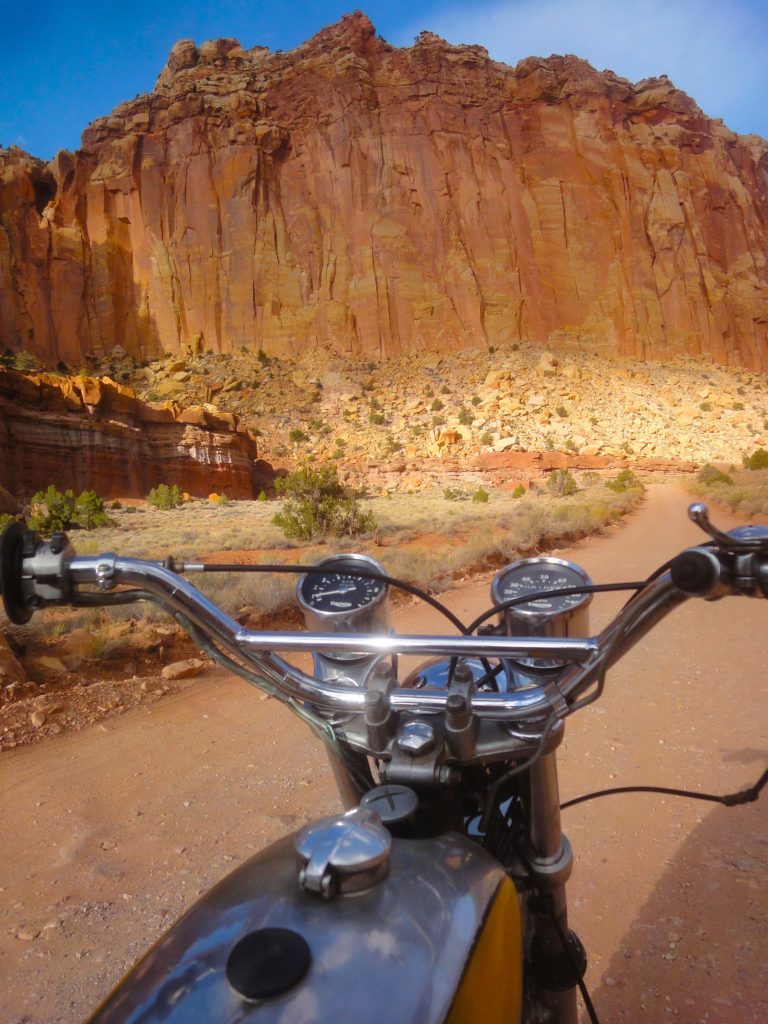
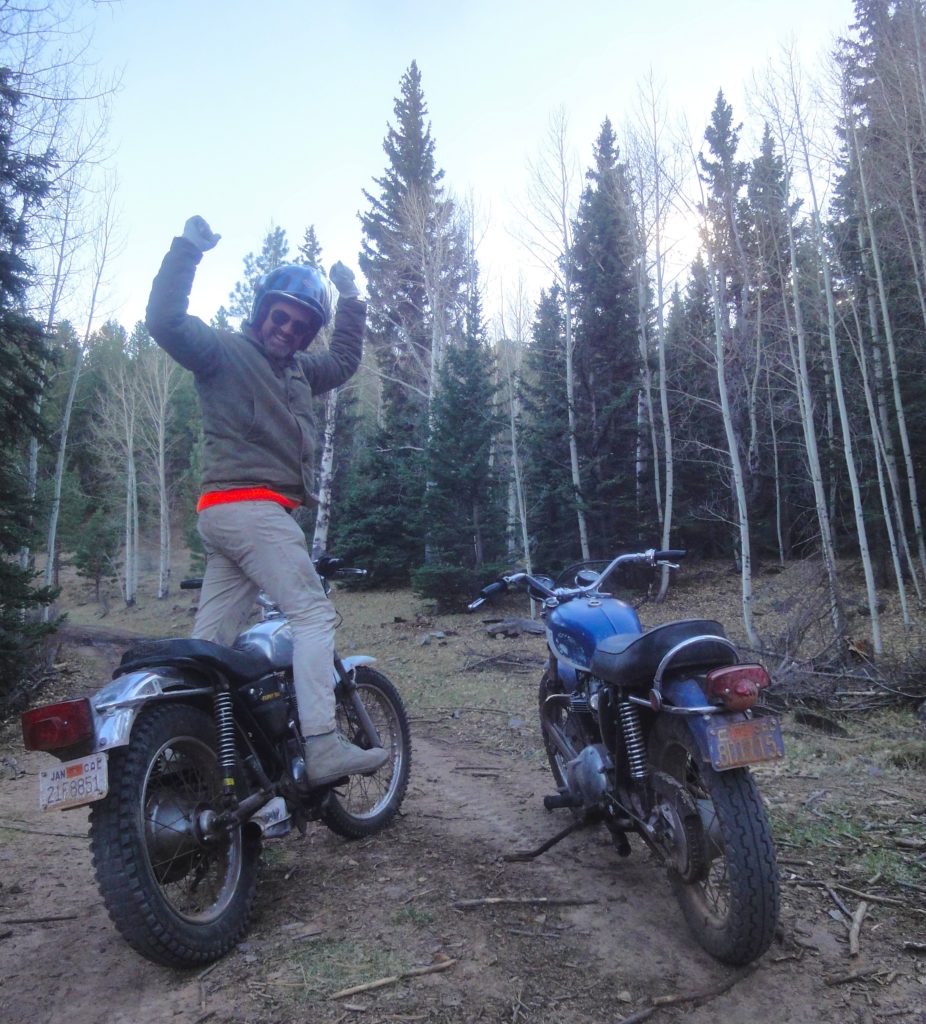
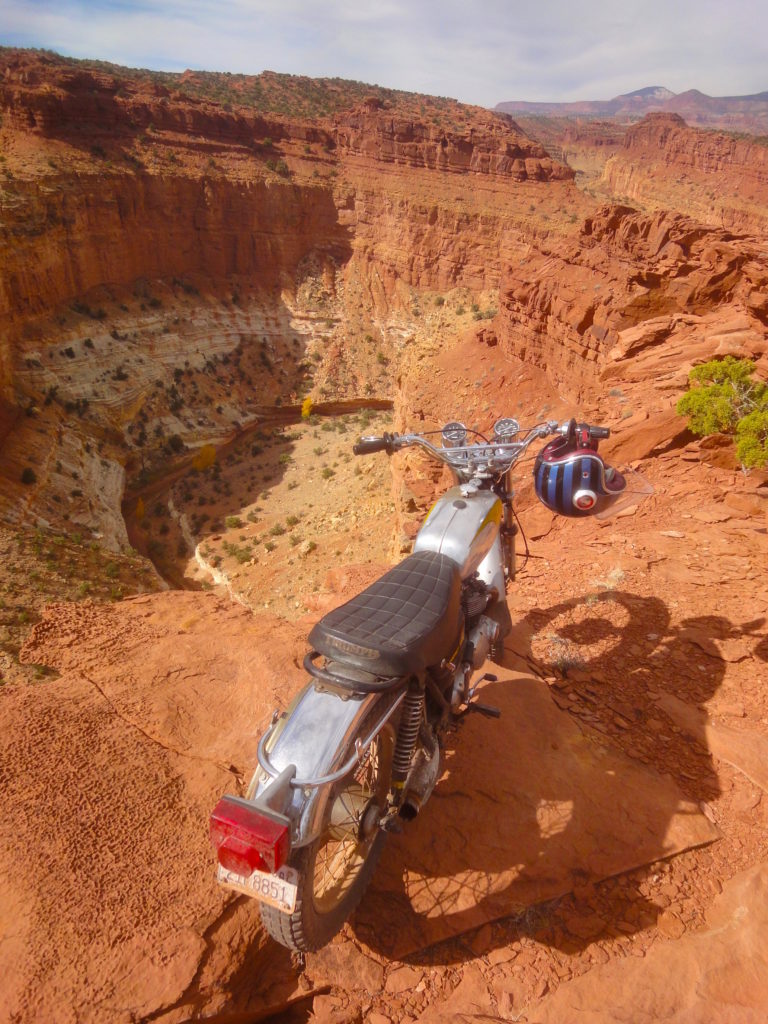
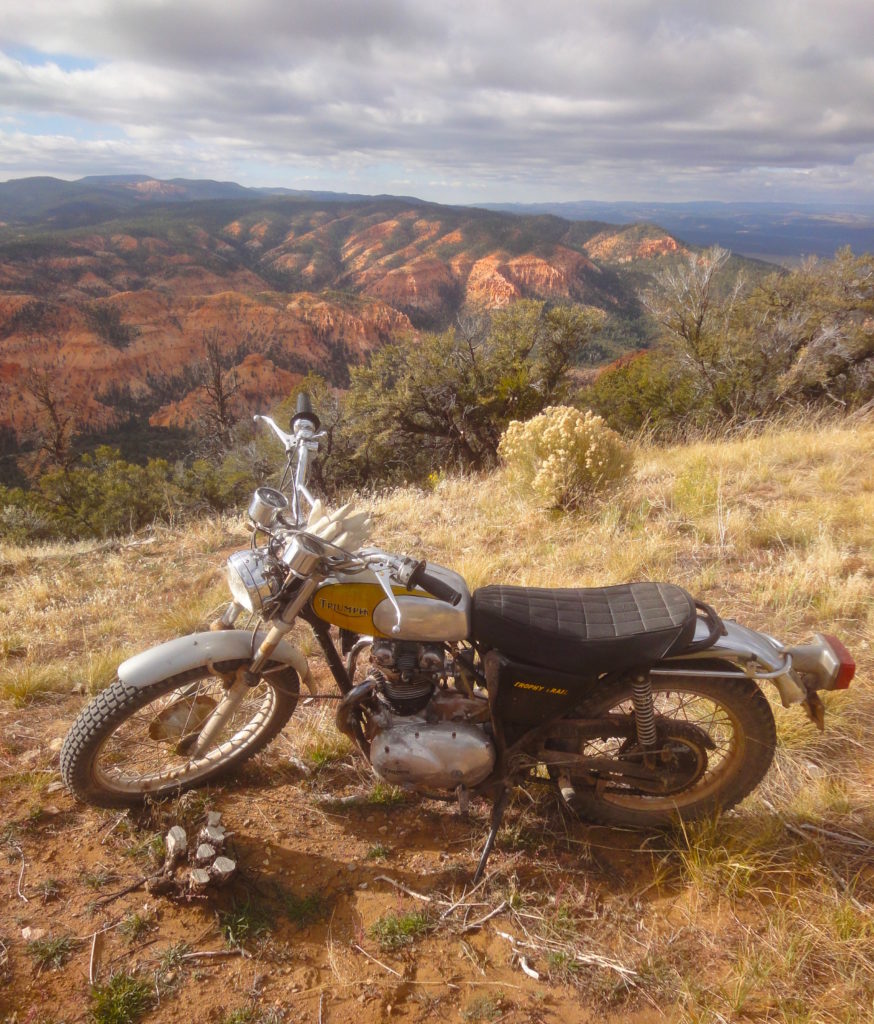
Dirt; it’s how Americans race. That was the story in 1961 anyway, when Daytona still referred to a beach. Honda wanted to crack the American market, and that meant building dirt bikes; they’d dominated global GP racing, but were mostly absent on the rough stuff. The machine they developed to spearhead an off-road push was the CL 72 Scrambler, which used the sophisticated OHC twin-cylinder motor of the CB 72 Hawk, installed in a new full-cradle frame with a bash plate and high ground clearance, high-level exhausts, minimal fenders, and a small fuel tank. To modern eyes, the Honda CL 72 Scrambler looks more enduro or street scrambler, as it was fully road legal with lights and all, but pure motocross machines were rare in 1962 – most scramblers were roadsters with their lights removed.
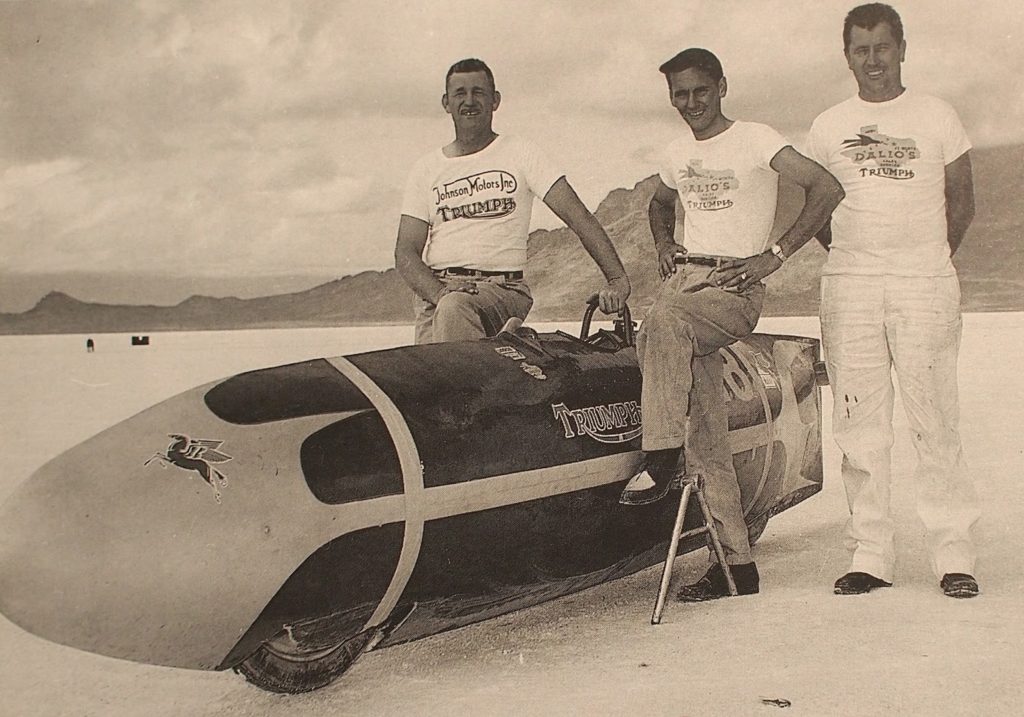
Sand is perhaps the most difficult terrain for a motorcycle, but the Triumphs weight was an advantage over newer, lighter machines.
American Honda’s lightbulb moment to launch the CL 72 was a record run over the wide-open desert of Baja, Mexico. While plenty of SoCal racing took place in California’s Mojave desert, very little happened south of Tijuana, and an audacious 1000-mile endurance test could be conducted out of the public eye. Legendary desert racer Bud Ekins was tapped, but his contract with Triumph meant Honda was a no-go, so he passed the opportunity to his equally talented younger brother Dave, who teamed with LA Honda dealer Bill Robertson Jr. No official record existed on the run from Tijuana to La Paz, so the bikes only needed to finish the 963-mile ride, and send telegrams from each end to confirm their time. That didn’t mean the prospect was easy; with no gas stations from Ensenada to La Paz (851 miles), and few villages, the riders would need to be supplied en route. The going had only a few miles of pavement, and long stretches were untracked sand through desert wilderness.
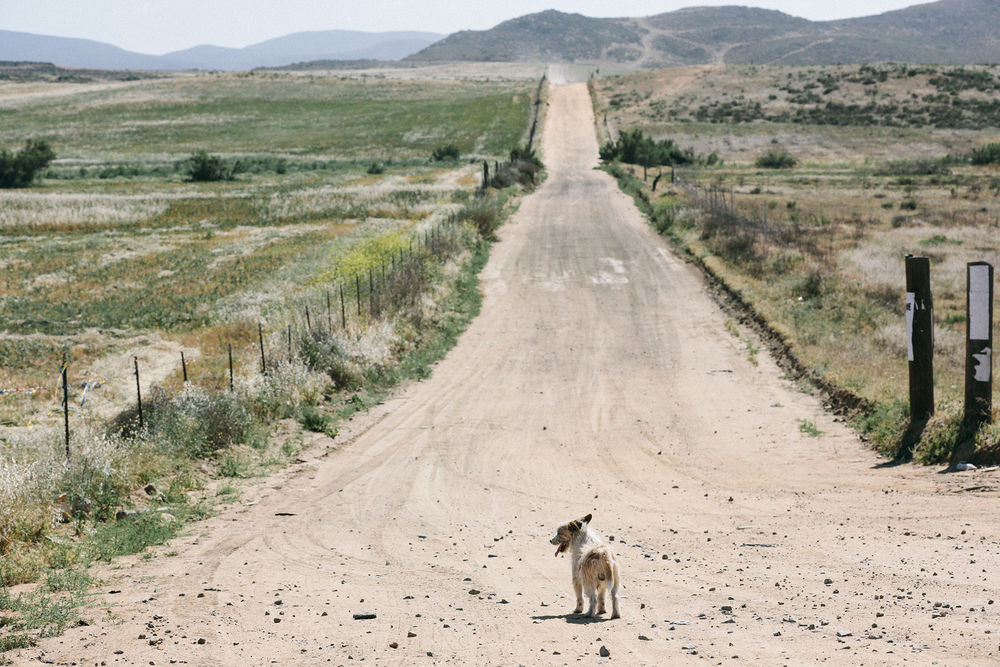
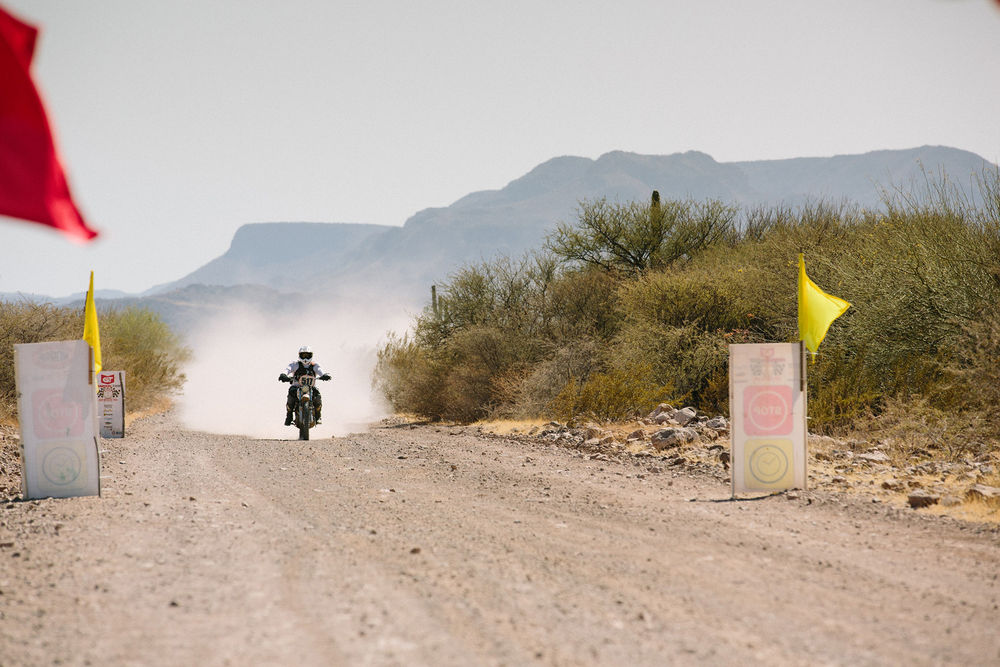
The easy part - a lousy dirt road is the best road you'll find in the Mexican 1000
The riders’ route was scouted by air, then food, gasoline, and support were provided the same way. John McLaughlin, former Catalina GP winner (on Velocettes) piloted a Cessna 160 with Cycle World founder Joe Parkhurst and photographer Don Miller as passengers. A larger Cessna 140, piloted by Walt Fulton, carried the food and fuel for the riders, along with Bill Robertson Sr. The bikes needed 9 refills, and landable spots were chosen for riders to meet the planes. Come ride day, Ekins and Robertson sent their telegrams from Tijuana at midnight, and headed south on Highway 1. There were hardships and lots of crashes; they got strung up on barbed wire fences while sun-blinded, Ekins fell 13 times in one night, and they were lost and rode in circles for 6 hours. Robertson’s Honda holed a piston 130 miles from La Paz after crushing his air cleaner in a crash, and grit entered the motor, but he carried on with one cylinder, catching up to Ekins 2 hours after he’d clocked a 39hour, 49minute elapsed time. The point had been proven, and the publicity for Honda was certainly worthwhile, as they sold 89,000 CL 72s from 1962-68.
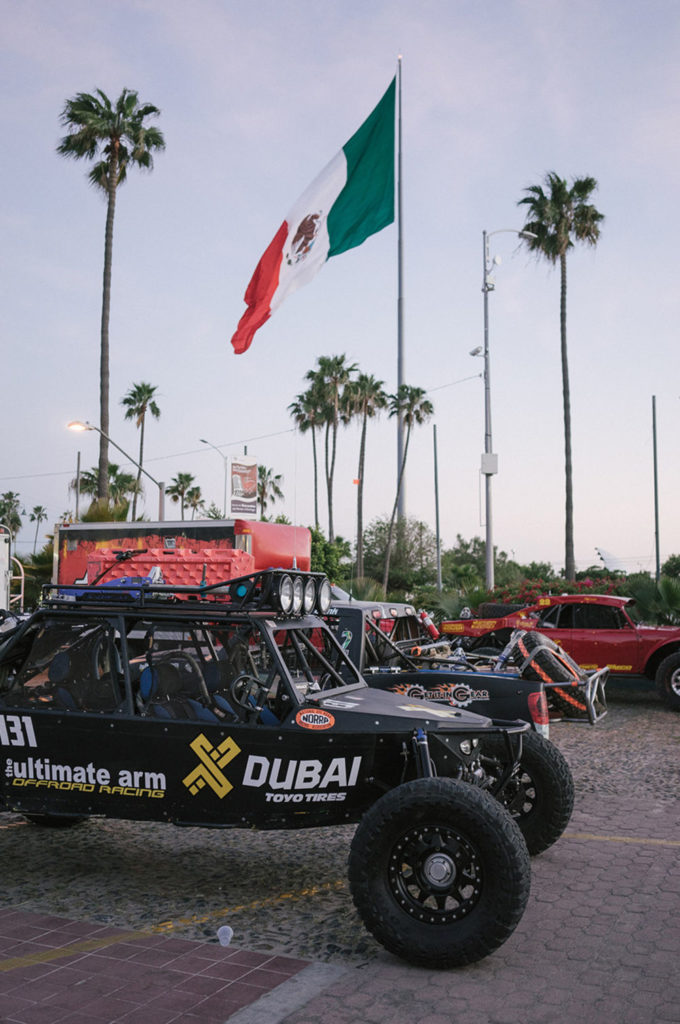
Baja buggies from vintage to new compete side by side with motorcycles
Not long after Honda’s ride, Bruce Meyers took his prototype Meyers Manx VW dune buggy along the same route, and lopped 5 hours off Ekins’ time – those hours spent lost at night no doubt. Thus was born a car/bike rivalry, which sparked the idea for a proper race, and Ed Pearlman founded the National Off-Road Racing Association (NORRA), which ran the first Mexican 1000 race in 1967. Motorcycles, cars, and trucks ran the same route, using a rally format, with mandatory checkpoints in the multi-day event. The Mexican 1000 was run for 6 years, before the Oil Crisis of ‘73 dampened everyone’s spirits; NORRA was disbanded, and there was no race that year. But nobody had asked Mexico’s opinion on the matter; the attention focused on the nearly vacant Baja peninsula was too good to let lapse, so they promptly announced their own Baja 1000 race over the same course. They contracted Mickey Thompson of Southern California Off-Road Enterprises (SCORE) for organization, who hired Sal Fish (of Hot Rod magazine) to created SCORE International to organize the Baja 1000, which it has done since 1974.
Historic Era entry Mark Post's highly modifed 1992 Ford F-150 racer
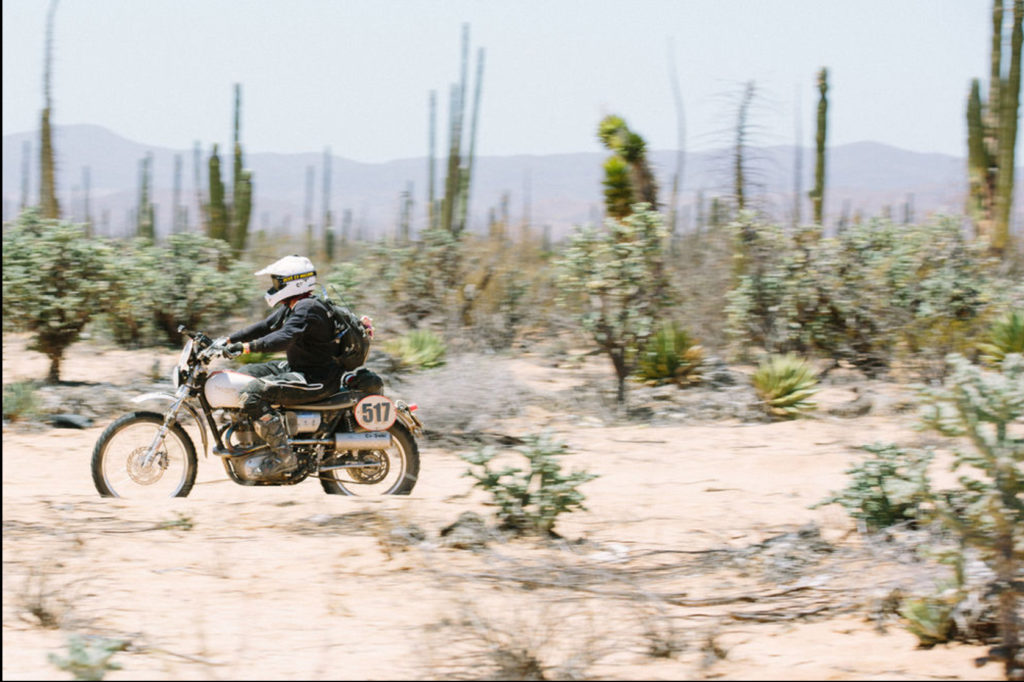
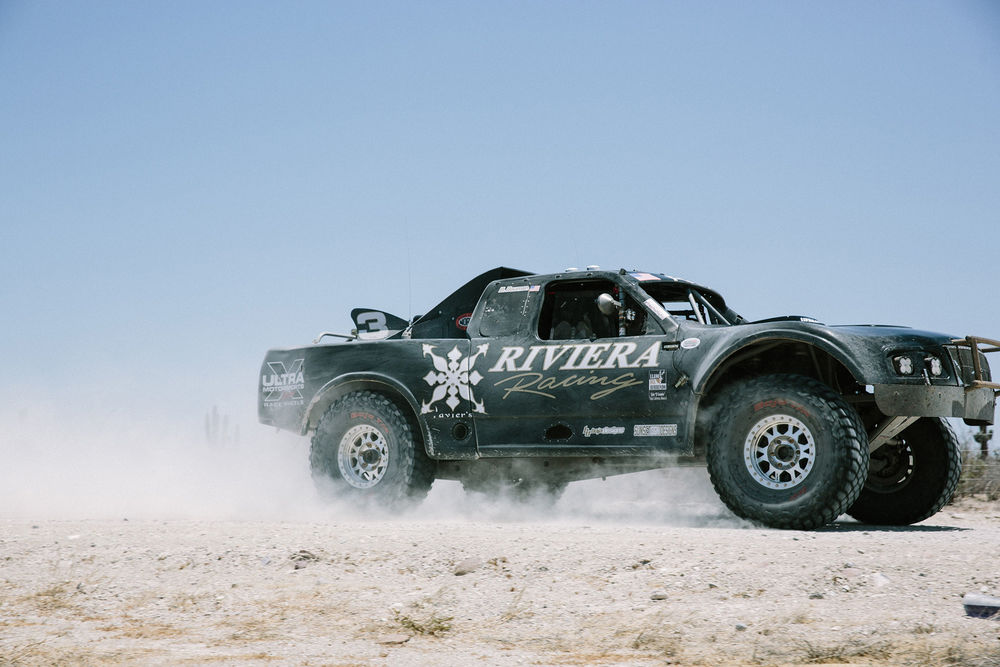
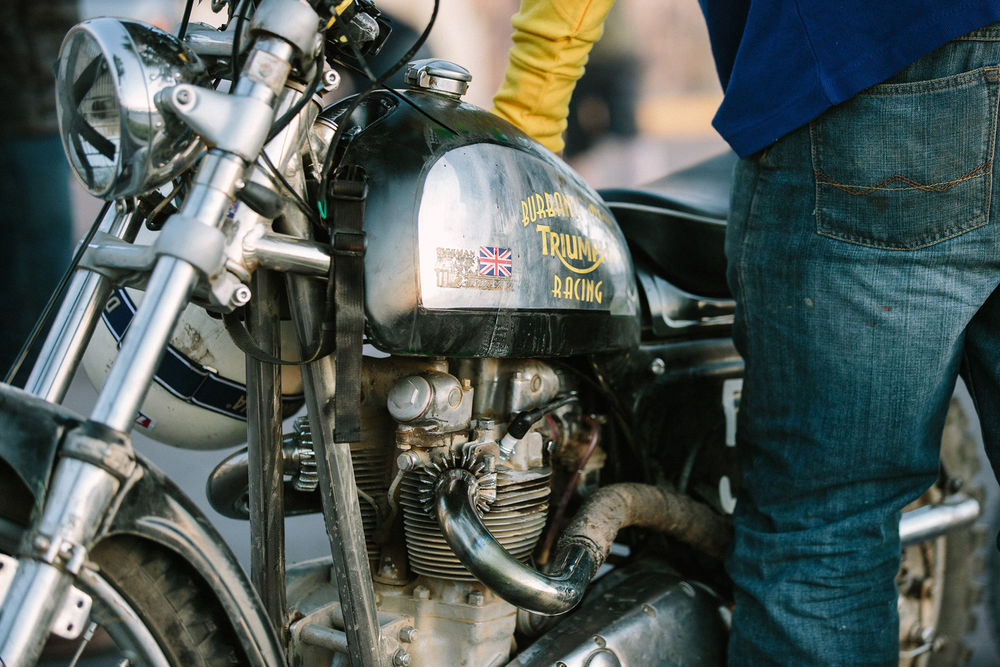
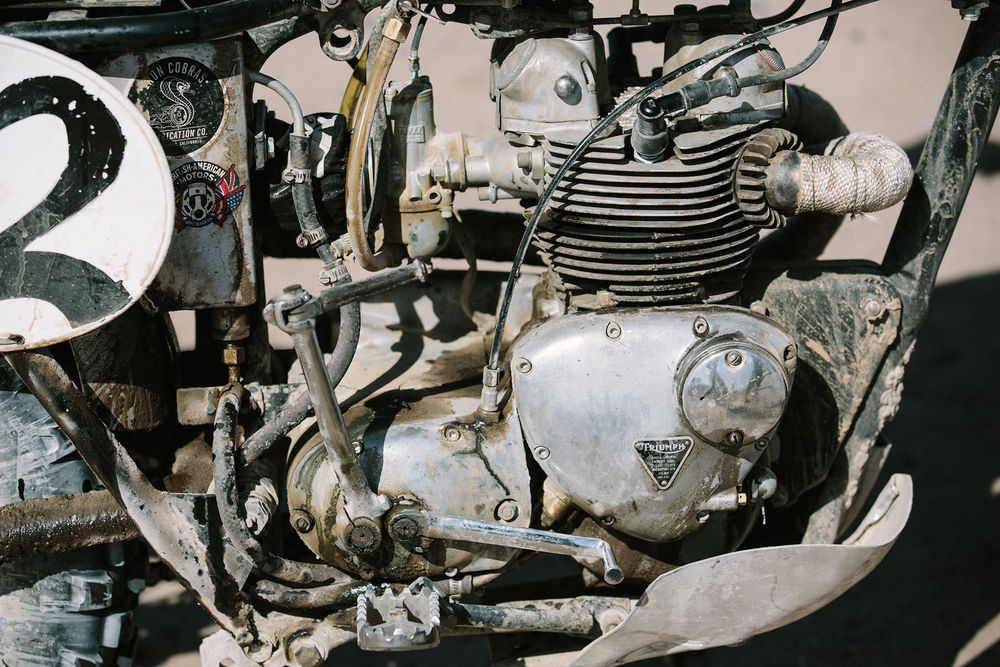
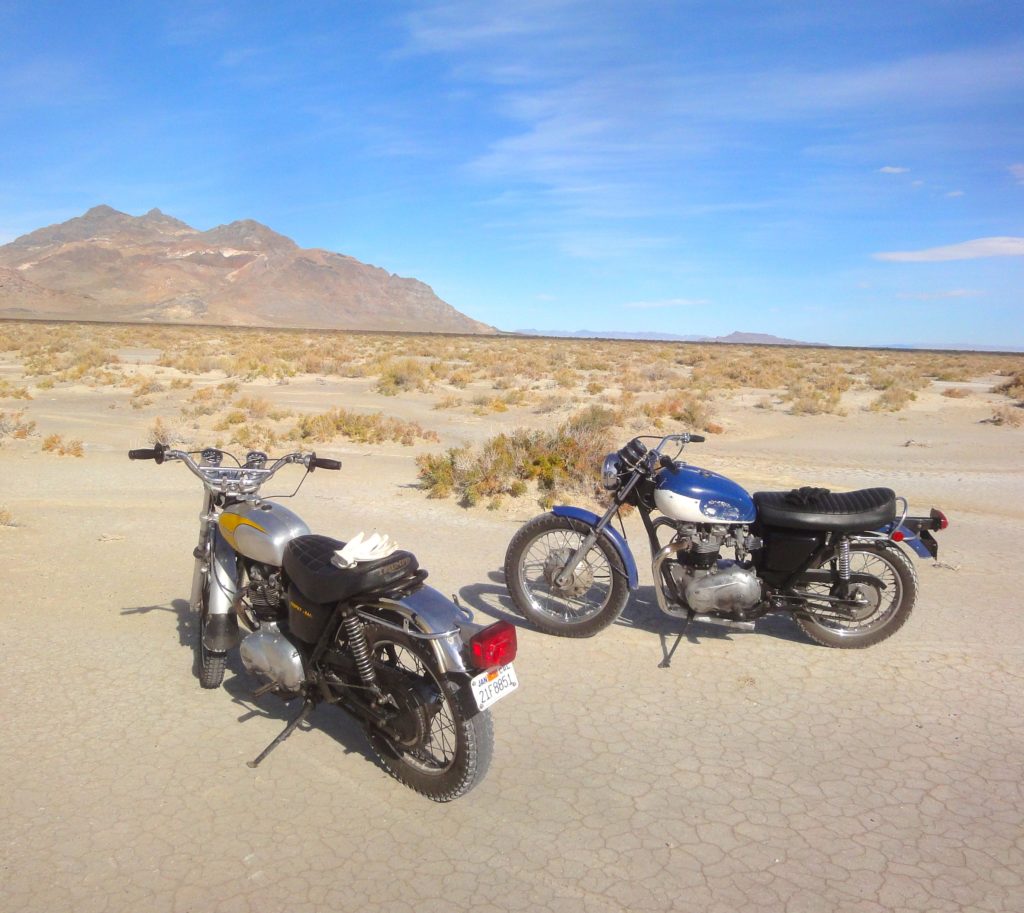
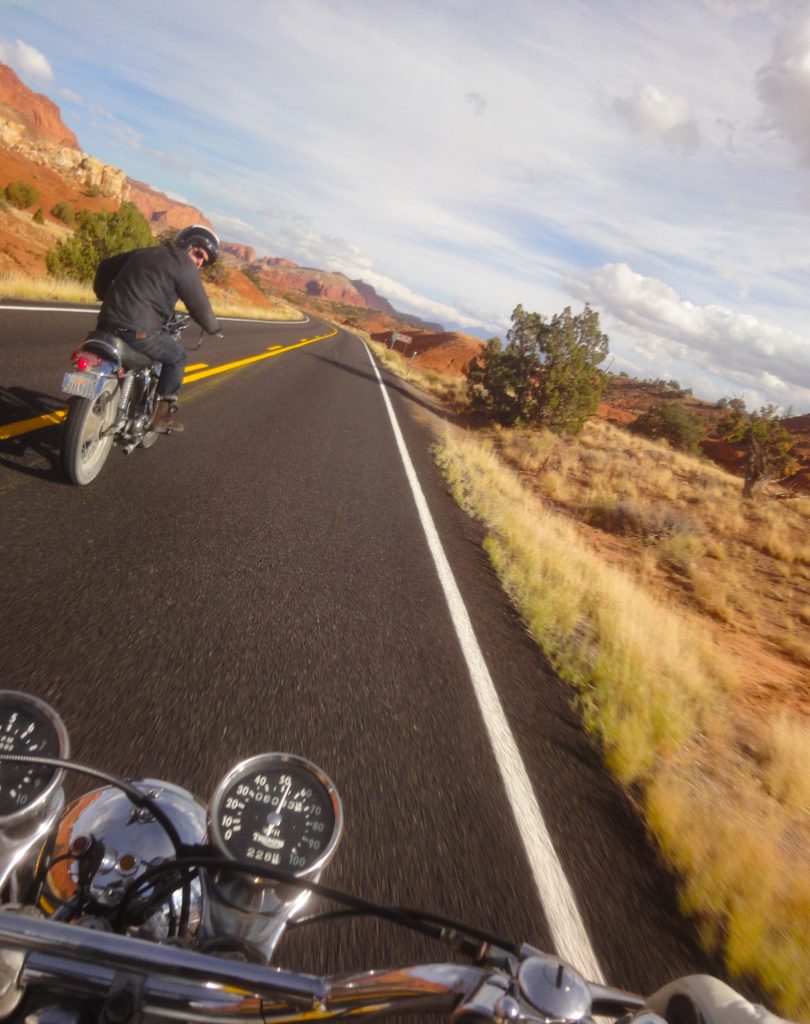
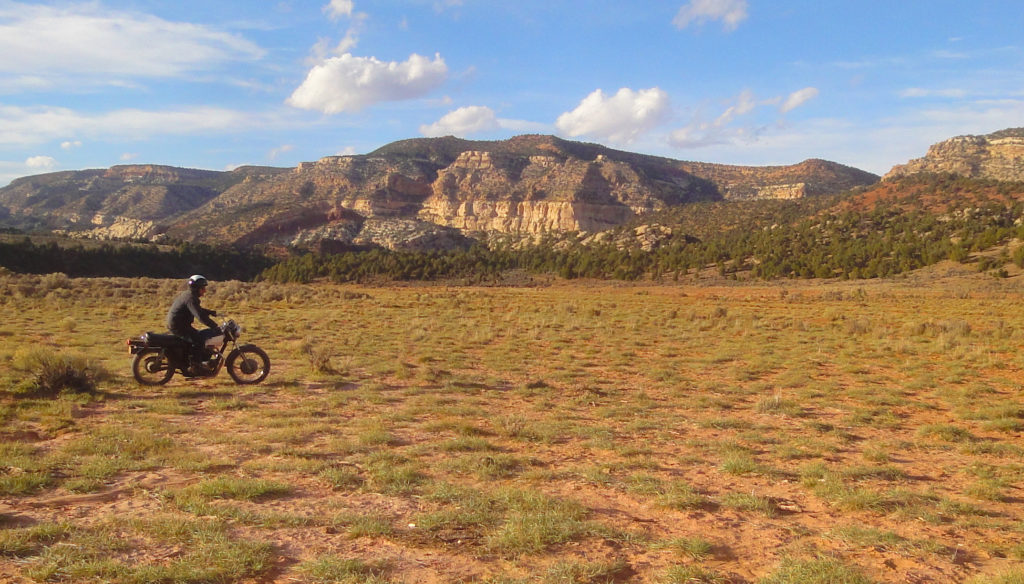
The rising interest in vintage dirt racing in recent years spurred Ed Pearlman’s son Mike to revive NORRA, and bring back the original Mexican 1000, with its multi-day rally format. Started in 2009, the race originally catered to pre-1998 motorcycles, cars, and trucks; now there are classes for modern vehicles as well, in case your 800hp trophy truck needs exercise between professional Baja bashes. Running superfast modern desert tools alongside vintage motorcycles and cars is daunting, but also part of the fun, at least according to Julian Heppekausen. He recently rode his 1966 Triumph T120 desert sled, ‘Terry’, to victory in the Vintage Triumph Thumper class, becoming the first rider ever to win, and one of only 3 to complete a 1000-mile Baja race on a Triumph.
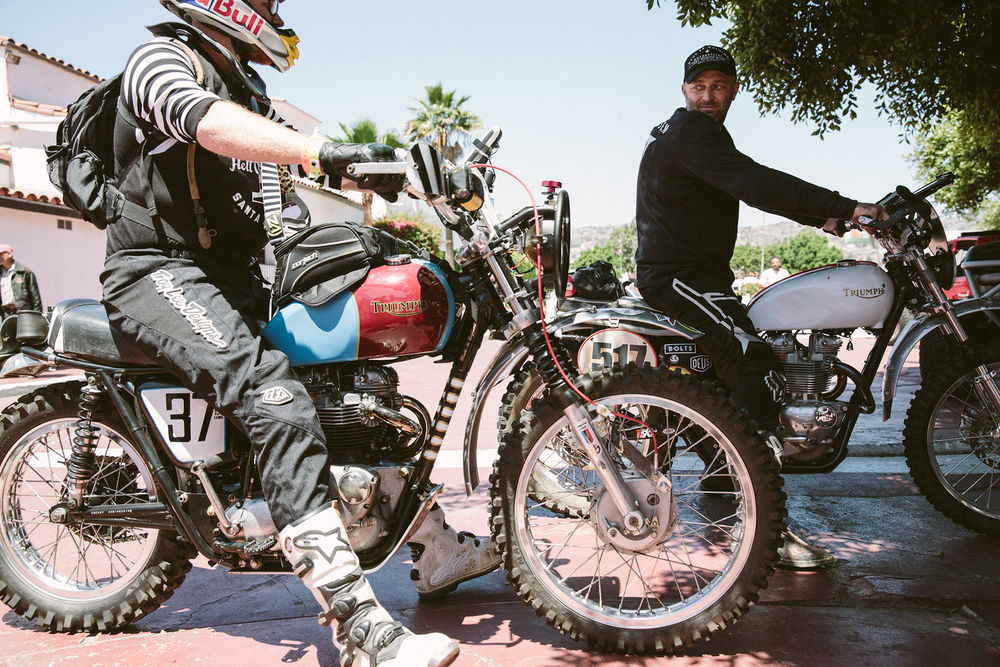
Hayden Roberts ('65 Triumph TR6) chats with Julian Heppekausen ('66 Triumph T120)
You might know Julian Heppekausen as CEO of the Deus store in Venice, CA, or for his exploits on Terry the Triumph in the Barstow-Las Vegas off-road race, which he’s finished 4 times. He credits this success to the quality of Terry’s original construction by motorcycle industry icon Terry Prat, for whom the bike is named. Prat was the European MX correspondent for several magazines in the 1970s, then a manager at Cycle News from 1979 – 2011. The ’66 Triumph T120 desert sled was his last build, which he raced in the Barstow-Las Vegas Rally in 2011 (it’s not a race; that’s not allowed in the tortoise sanctuary – but everyone knows who finished first). Heppekausen bought the bike in 2012, and carried on competing across the Mojave desert every year since, finishing the ‘hard’ route twice. The means riding with new KTMs and Honda 450s, and his Triumph is the only 1960s bike to finish the Rally in a very long time. “They really don’t have a class for such an old bike – they call 1980s twin-shock motocrossers vintage!’
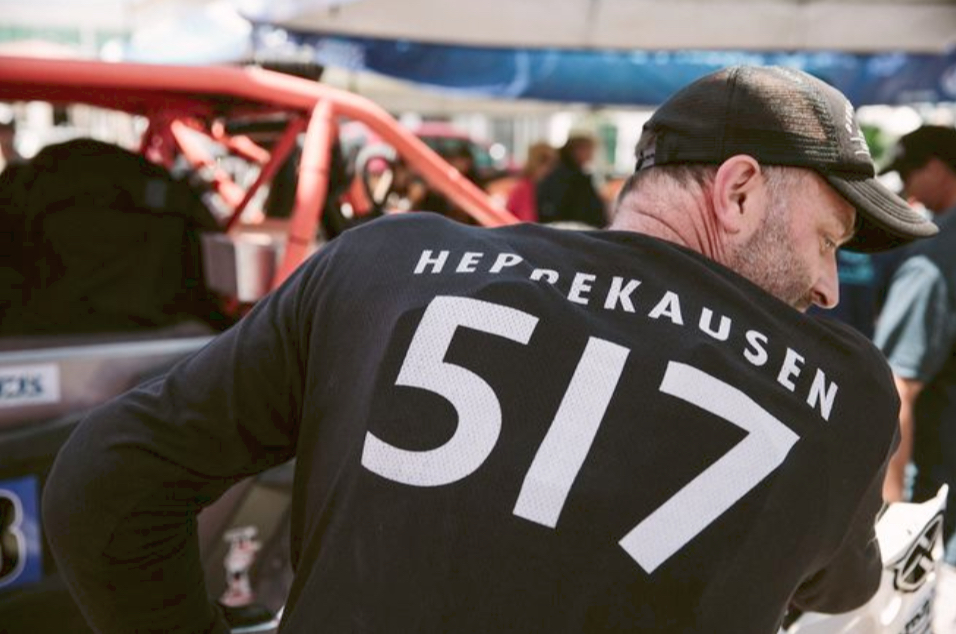
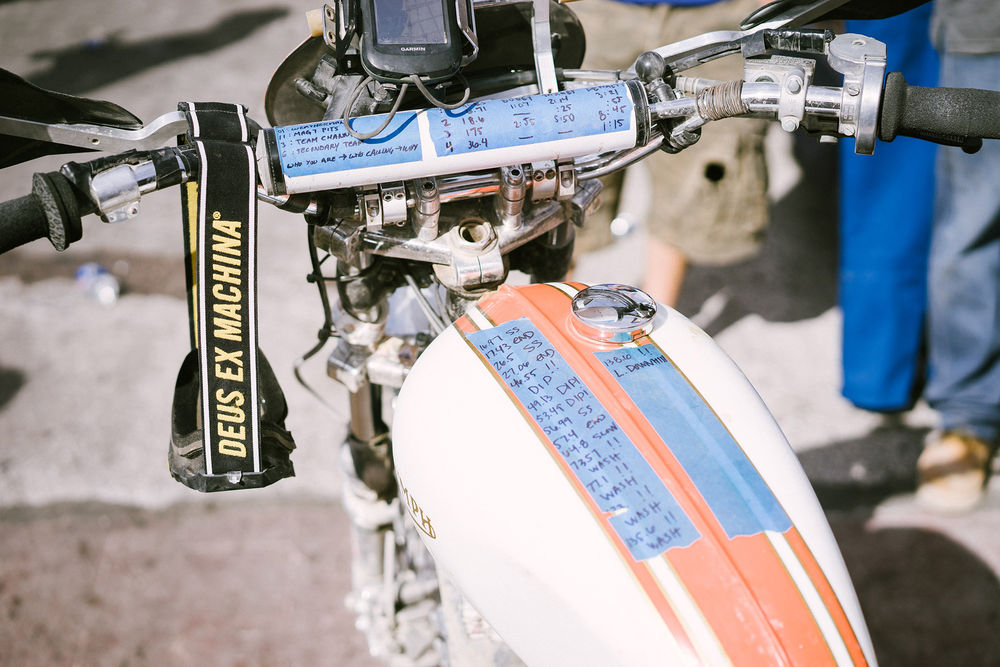
Julian's lucky number! An arcane mix of family numerology, which apparently works
Keeping a 50-year old Triumph from grenading mid-desert exposes Heppekausen as a sensitive hooligan; “You need to know your bike really well. There’s a harmonic hum at certain rpms, where it seems like the motor will go forever, and in a long race you have to bring it back to that pace when you can. I continually pat the tank and thank Terry for not breaking!” Some vintage riders are scared of breakdowns on gentle street rides, but the old saw ‘the more you ride them, the better they get’ seems to apply here. Julian shipped Terry the Triumph to Europe in 2014, competing at events in Germany and England; it’s also been filmed wheelying in front of the Eiffel Tower under Dimitri Coste. After successes in Vegas-Barstow, he decided to try the revived NORRA Mexican 1000, along with several friends on their own vintage Triumph dirt bikes, although Terry the Triumph was the only finisher.
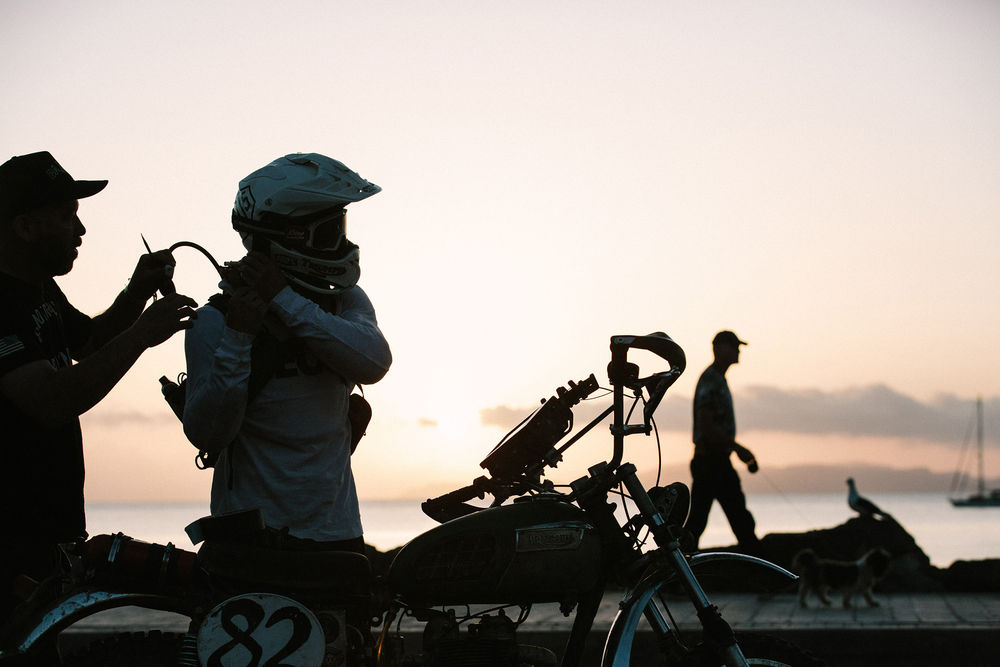
Viet Nguyen's 1969 Triumph T100 at dawn, ready for the day's stage on his 500cc twin
That’s perfectly understandable – all the bikes were at least 50 years old, and 1000 miles of desert racing is insanely demanding. Julian notes, “Modern trophy trucks with special tube-frame chassis and high-HP motors run 36” of suspension; they can run over a basketball and not feel it. I can’t do that on a Triumph with 3” of travel, and when the road is full of rocks, I could hit a baseball and be thrown off. Near the end of the race was a 15-mile stretch of rocky downhill, which was mentally challenging after 1000 miles, especially with trophy trucks passing at 140mph! I have to go to work on Monday, so kept way left to preserve myself.” While running with $200k, 600hp specialized desert trucks is hairy scary, it has benefits too, “Robbie Gordon passed me around a corner, driving like I’ve never seen a car driven. I was doing 60mph, and he was doing 110mph – I don’t know how he got around! And I was the only one watching – it’s the best view of the race, from the saddle.”
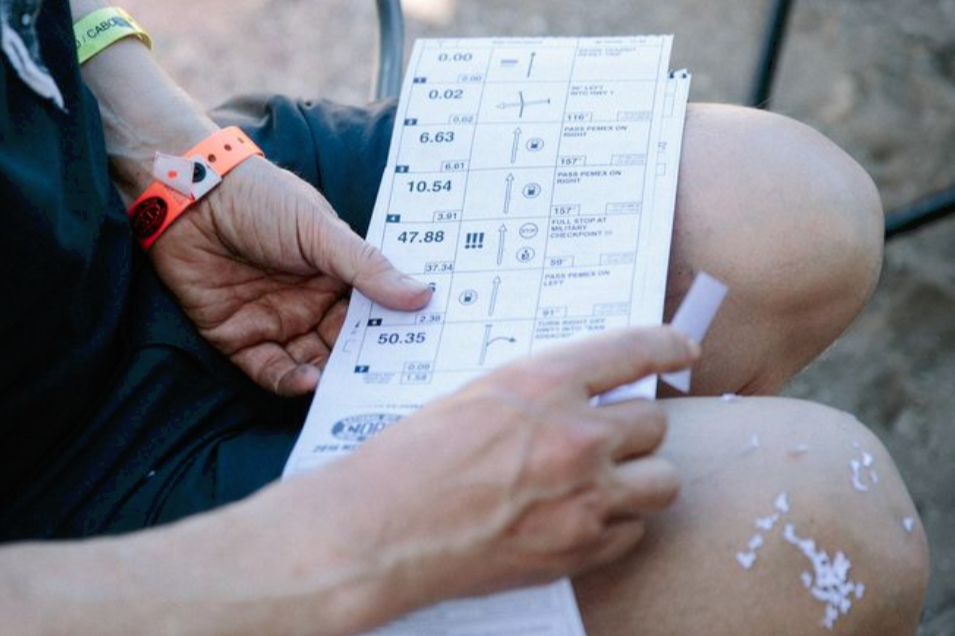
Classic rally roll-charts keep the riders from getting lost...too often
While Julian races Terry the Triumph far and wide, it isn’t actually his machine; when purchased from Terry Prat, he immediately gifted the Triumph to his son Henry, as a legacy. Henry isn’t big enough to ride a Triumph yet, but he likes to remind his dad whose bike it is, “My wife and kids met me at the finish in La Paz, and Henry told me to clean the bike! I said let’s leave it dirty a little bit yet. Terry’s had some real adventures, including wheelies in front of the Eiffel Tower. The best people have worked on it, and it’s been in many hands, but you know, we build these bikes for ourselves, and they eventually end up with someone else. That’s why I gave it to Henry - for the future.” And the future will remember that Terry was the first Triumph to win (let alone finish) a 1000-mile Baja race, an epic accomplishment in any decade - our hearty congratulations to Julian Heppekausen and all who helped make his win possible.
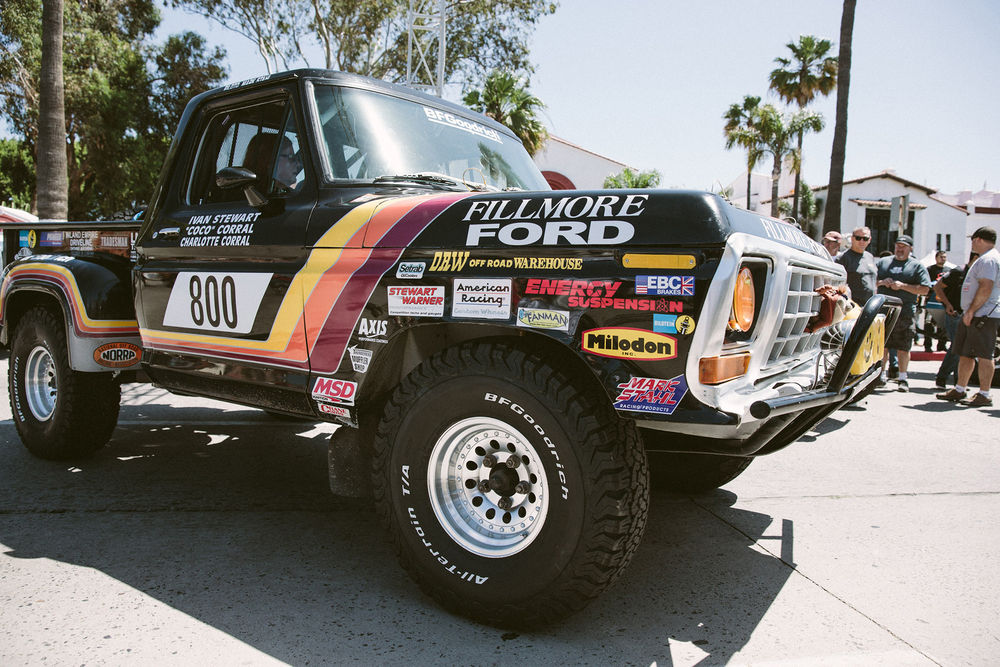
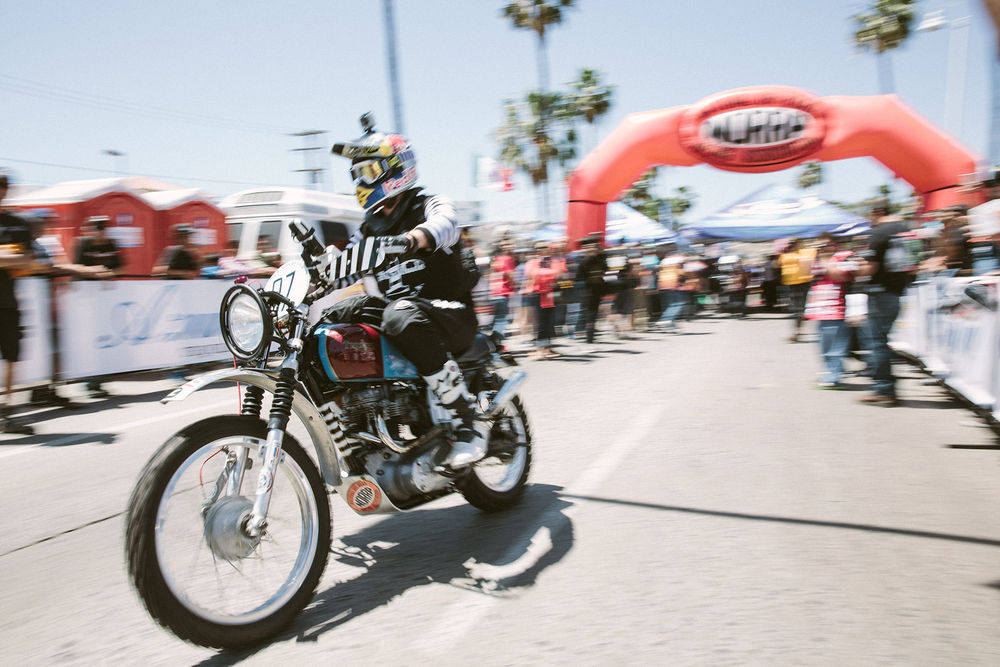
Julian abandons the roll-chart for an impromptu mileage-based warning system for sand washes and potholesMark Stahl's Legend category '78 Ford F-100 pickupJulian finishes a stage, alone againJohn Crain's beautiful 1953 Rickman-Triumph pre-unit racer, the most exotic Triumph in the raceNate Hudson's 1969 Triumph T100 after a day in the desertHayden Roberts exits Tijuana on his 1965 Triumph TR6
Von Dutch. Artist, Custom Culture demigod, legendary misanthrope, tee shirt brand. Kenny Howard was many things - in his lifetime and beyond - but regardless his troubled personal legacy, he deserves credit as a keystone in the development of the American custom motorcycle. Howard's wacky custom Indians and Triumphs of the mid-1940s were like nothing else, and pushed custom motorcycles away from purely performance-oriented modifications, and into the realm of Style, creating a movement that would ultimately find its expression in the chopper, and beyond.
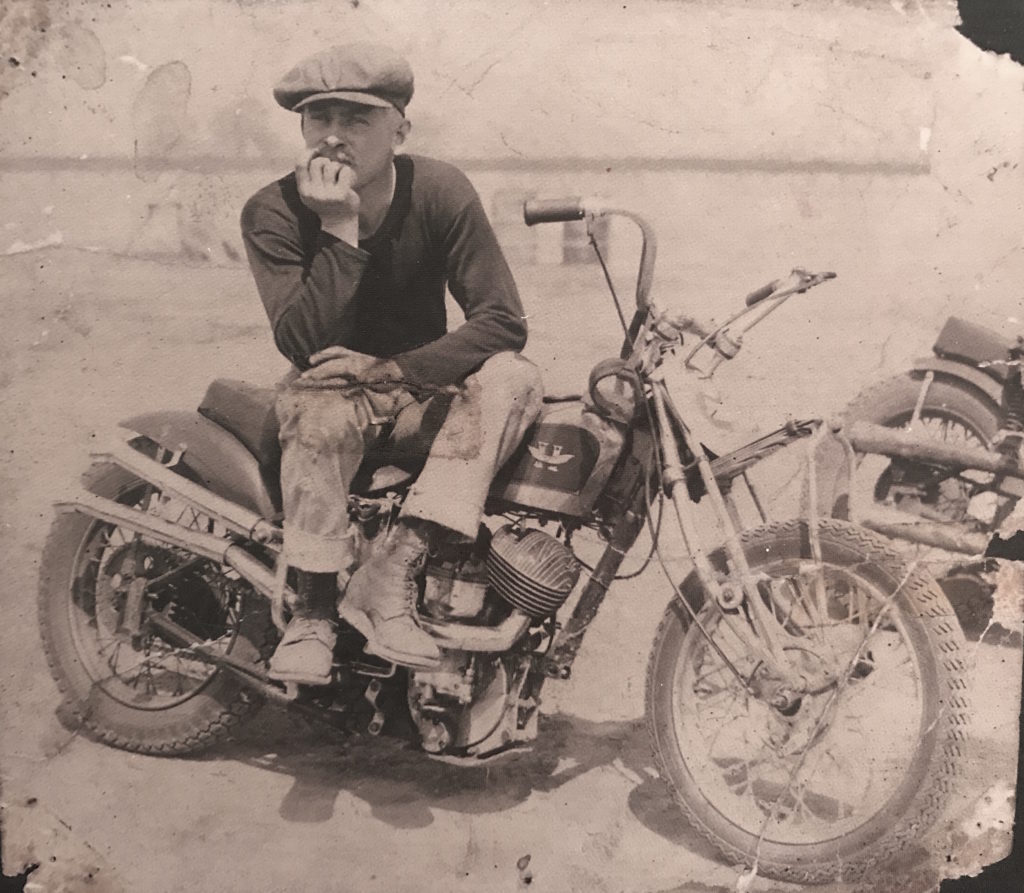
Kenneth Howard (aka Von Dutch) in 1946, with his Indian Scout in its first modified iteration, with his Howard 'H' chrome tank, hi-rise bars, and upswept exhaust. He shortly painted the tank with flames, among the very first vehicles so decorated. [Photo from the terrific biography 'The Art of Von Dutch' by Kahan/Nason/Quattrocchi/Smith, 2006]Howard was also a pioneer of the cultural controversy we see today in the #metoo movement; his hatred of just about everyone, especially people of color, made many retailers drop the Von Dutch brand in 2004, after artist Robert Williams revealed Dutch's dark side in OC Magazine. Kenneth Howard is a perfect example of our conundrum around important figures with distasteful personal views, which is especially problematic as we make legends and heroes out of actual human beings; Von Dutch the myth versus Kenny Howard the man. The myth sells a lot of tee shirts, the man was a compulsive outsider artist, and was pivotal in launching an enormous aesthetic movement. Having studied the Western canon of art and architectural history extensively, I can assure you Von Dutch was not alone in having terrible politics.
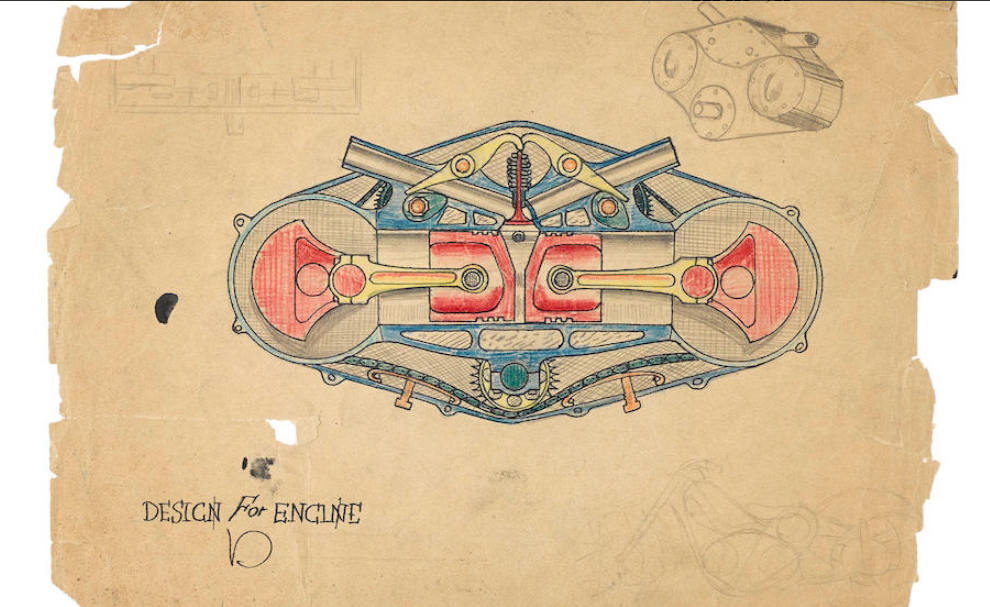
A lovely drawing of an Opposed-Piston four-stroke engine in a self-contained unit. The O.P. engine was invented in 1882! [Bonhams]At the big Las Vegas vintage motorcycle auctions this month, Bonhams will sell 14 of Kenneth Howard's drawings, 11 of which feature 'alternative' engine configurations - one of his well-known penchants, along with surreal, dystopian imagery, and drawings of guns (an example of each is also included in the sale). The art is apparently from a single collection, and it's difficult to speculate on the sale price of these works; Von Dutch-painted motorcycles have sold for as much as $276,000, although his paintings and drawings fetch a small percentage of that. Bonhams' estimates range from $400-$750 for each drawing, which seems calculated to draw interest from ordinary hopefuls. But you never know how it will go at an auction! Have a look at the Bonhams catalog here.
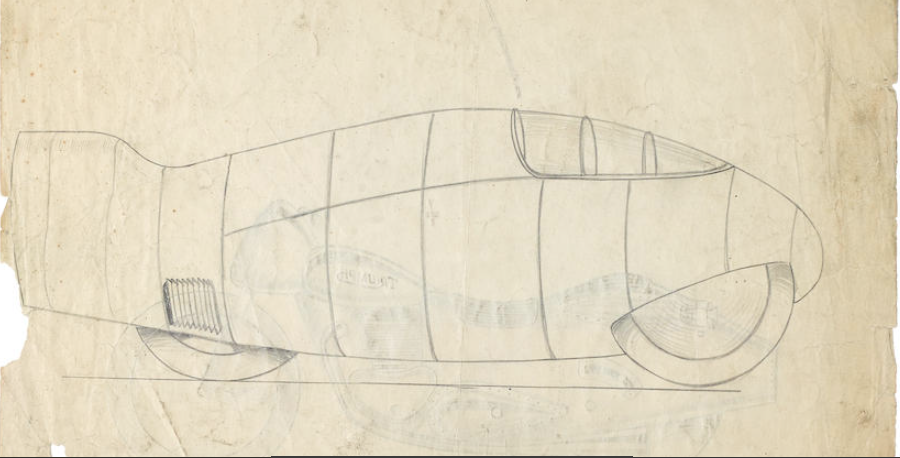
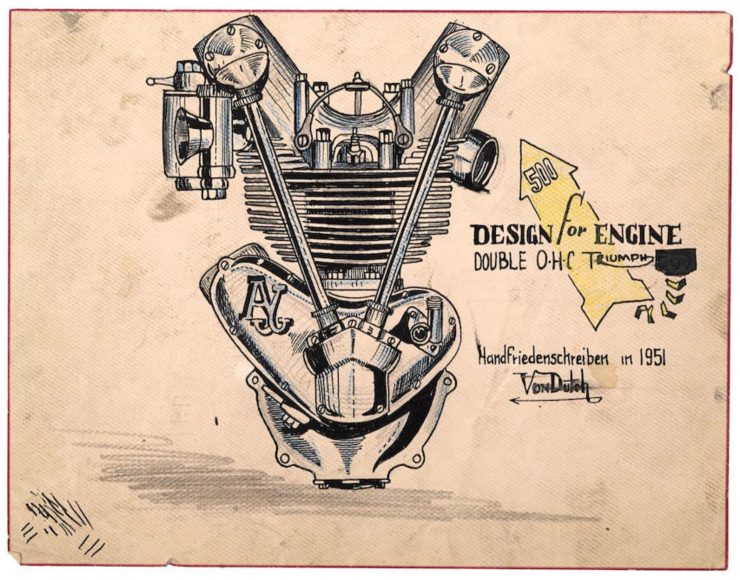
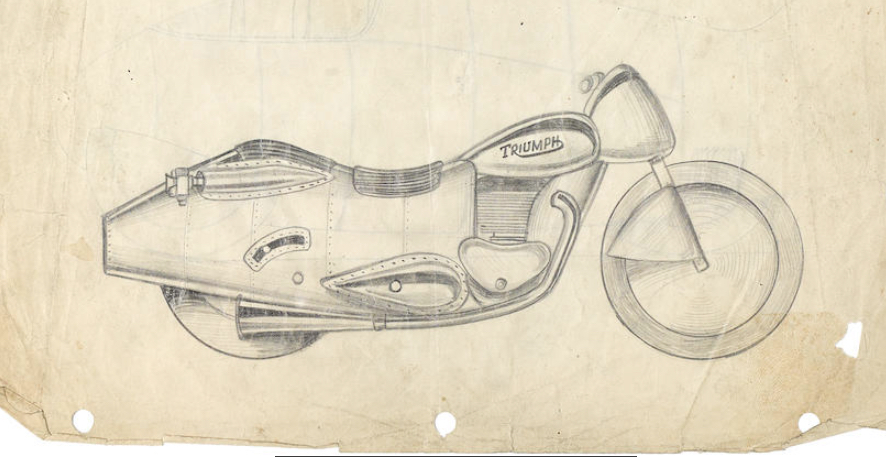
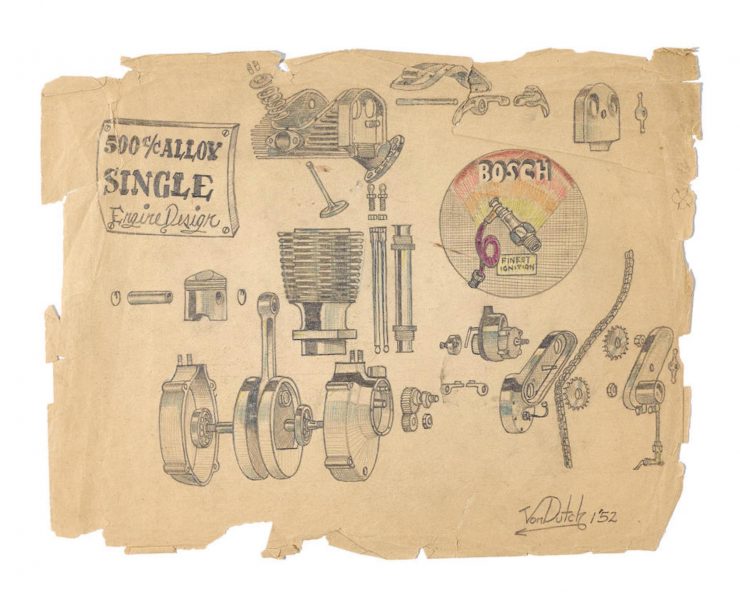
A notional streamliner, along the pattern of 1930s BMW/Gilera land speed racersA redesign of the Triumph twin-cylinder engine with a DOHC conversion; the notes say 'drawn freehand by Von Dutch, 1951'A streamlined Triumph with an air intake at the back, presumably for a supercharger.'500 alloy single engine design, Von Dutch 1952'
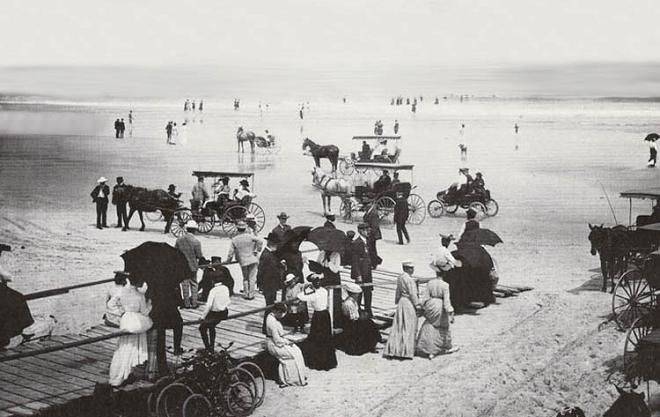
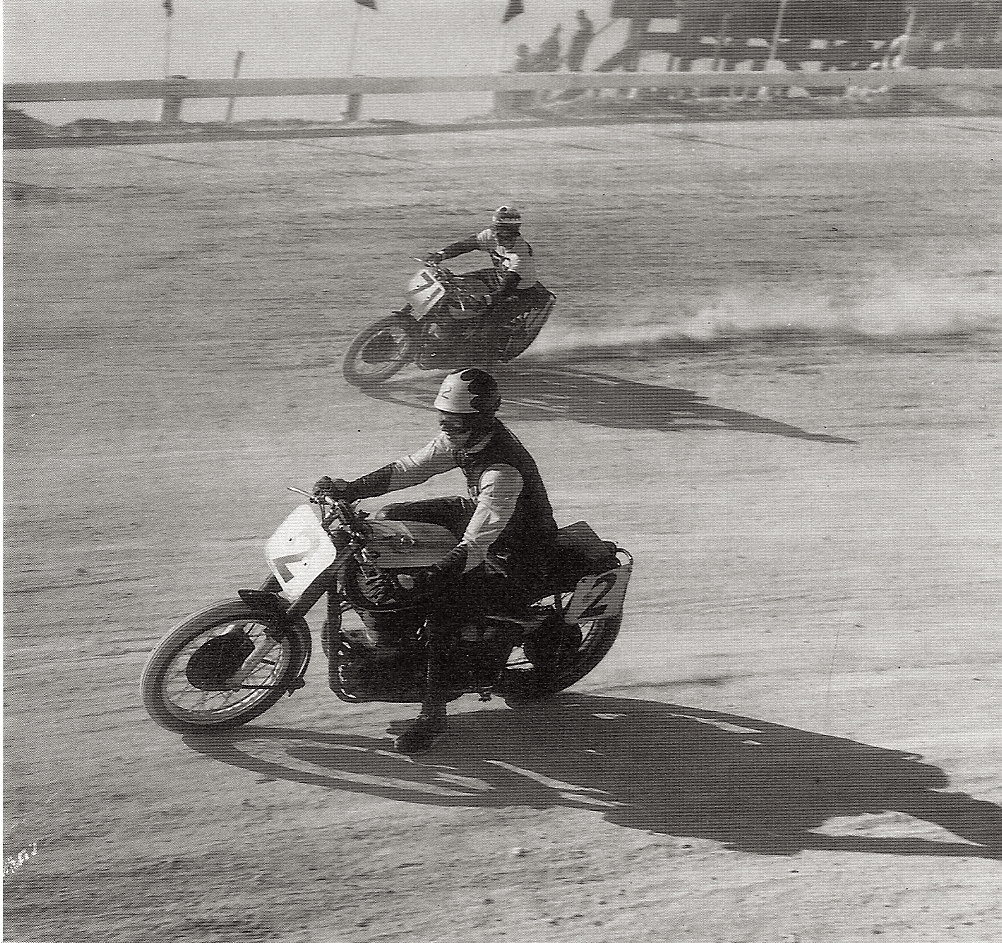
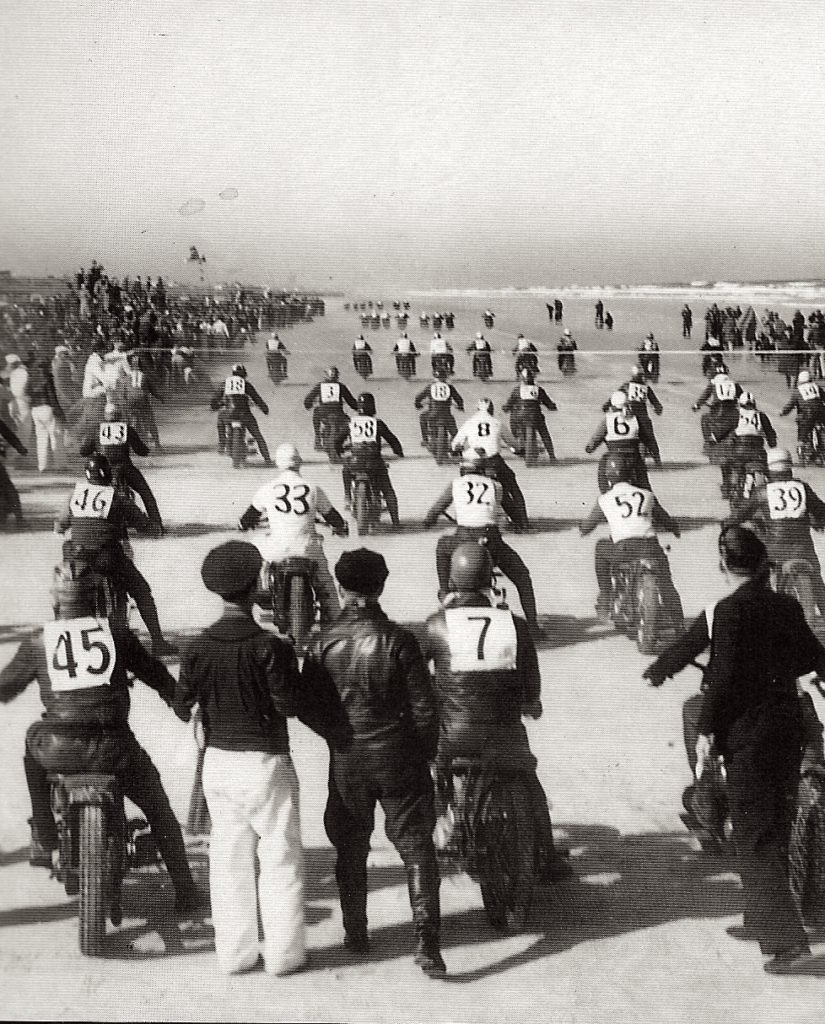
At the dawn of the 20th Century, Florida’s beaches were a prime spot for top-speed runs. Daytona/Ormond beach is 23 miles long and spans over 500 feet wide at low tide, with an ideal spectator vantage provided by the bordering grass-covered dunes. A shallow taper into the sea makes the sand flat and smooth and plenty hard from retreating tides. A perfect natural race track, provided free by Neptune, rebuilt daily, with no speed restrictions.
Daytona beach in the late 1900s, before the roar of cars and motorcycles setting speed records and racing
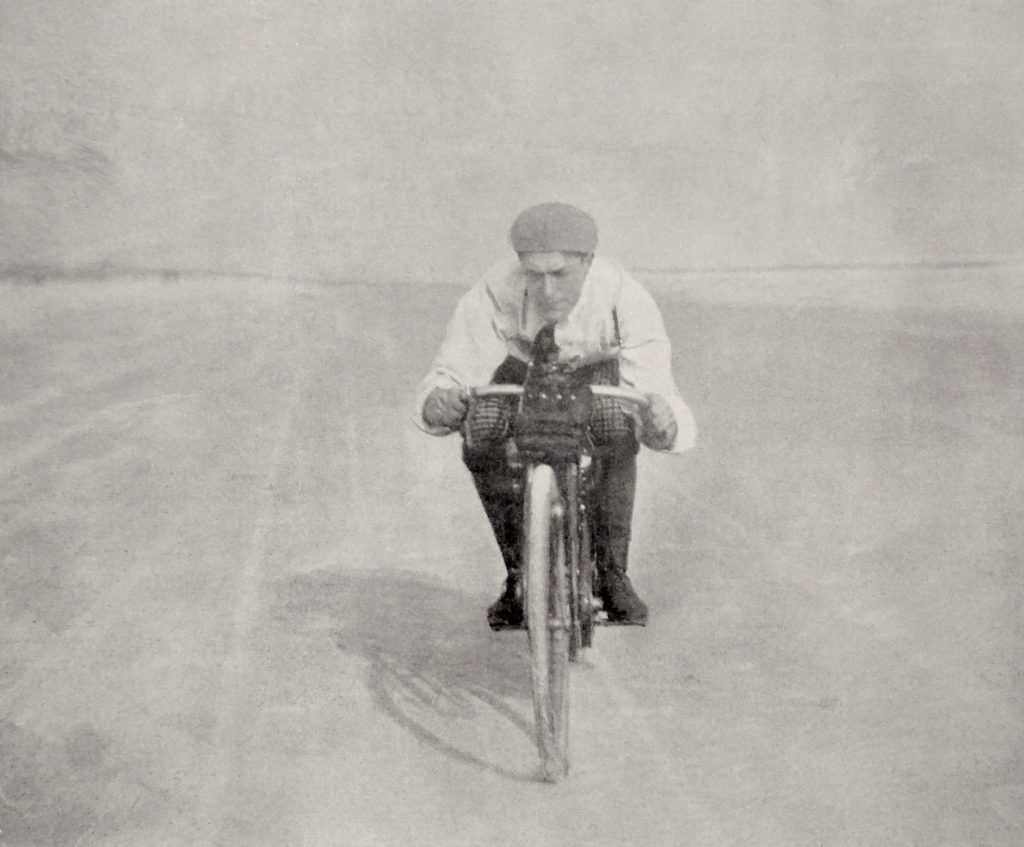
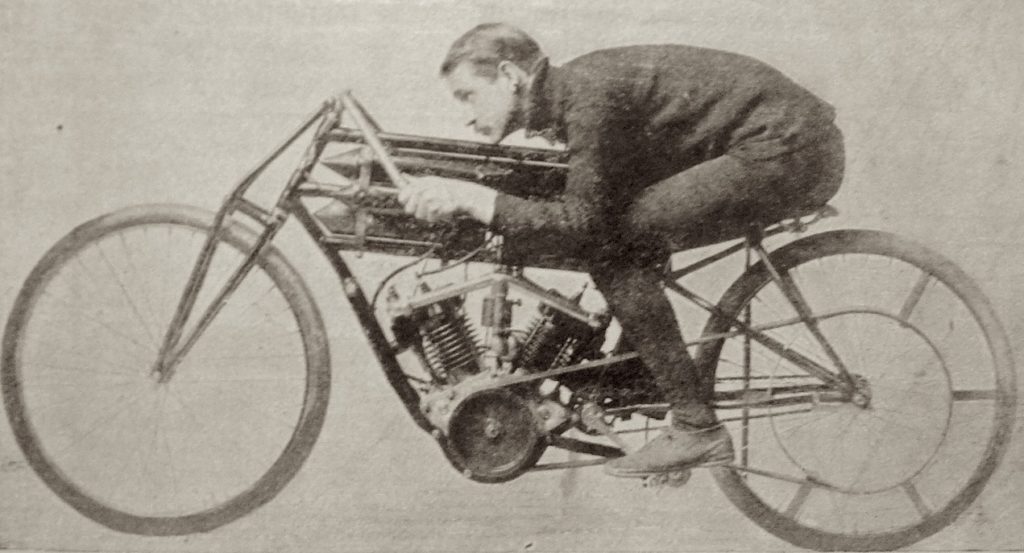
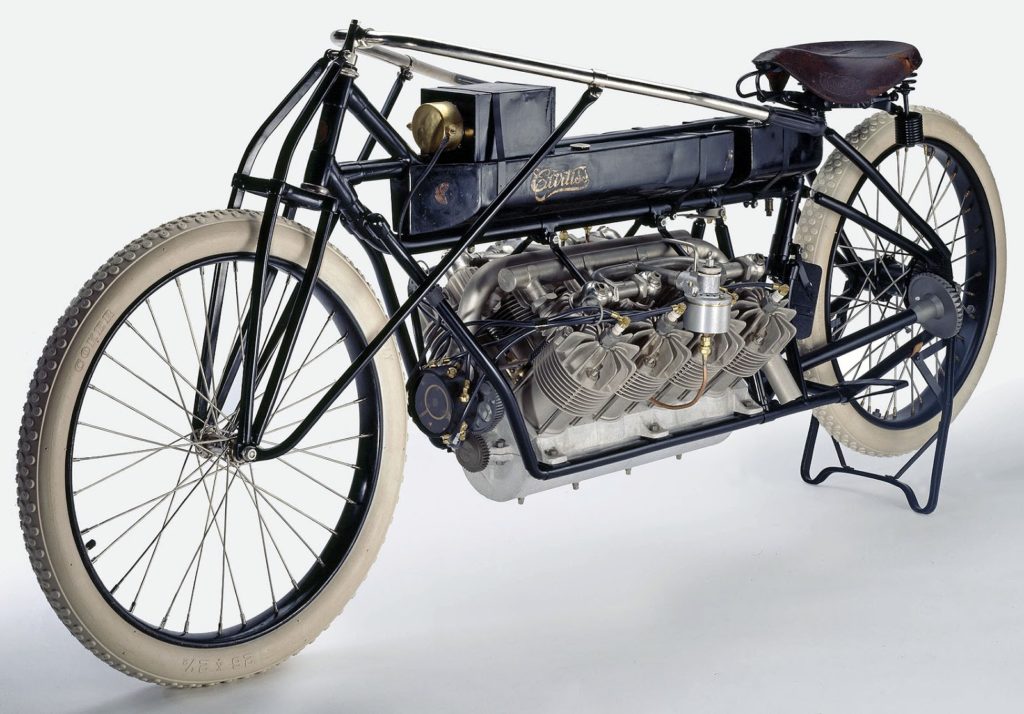
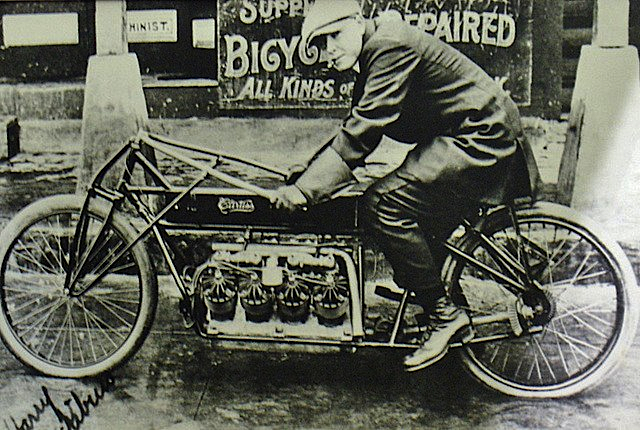
Between 1903 and 1935, Daytona was the premier Speed Record surface in the U.S., and in 1907 Glenn Curtiss stuffed his prototype V8 airplane-engine into an elaborated bicycle frame, clocking a blistering 136.8mph in one direction – the bike disintegrating on the return run down the Ormond half of the beach. The clubhouse/timing hut used for record attempts sat just over the boundary line on the ‘other half’ of the beach (there being no physical boundary), and ‘Daytona’ became notorious - probably good, as there’s no ring to a Ferrari ‘Ormond’. By 1935, record-breakers sought even saltier terrain in Utah, but only after Malcolm Campbell had seen 330mph in his ‘Bluebird’ car, passing through a 40’ wide arch under a public pier! The limitless expanse of a dry lake looked like a safer bet at such speeds.
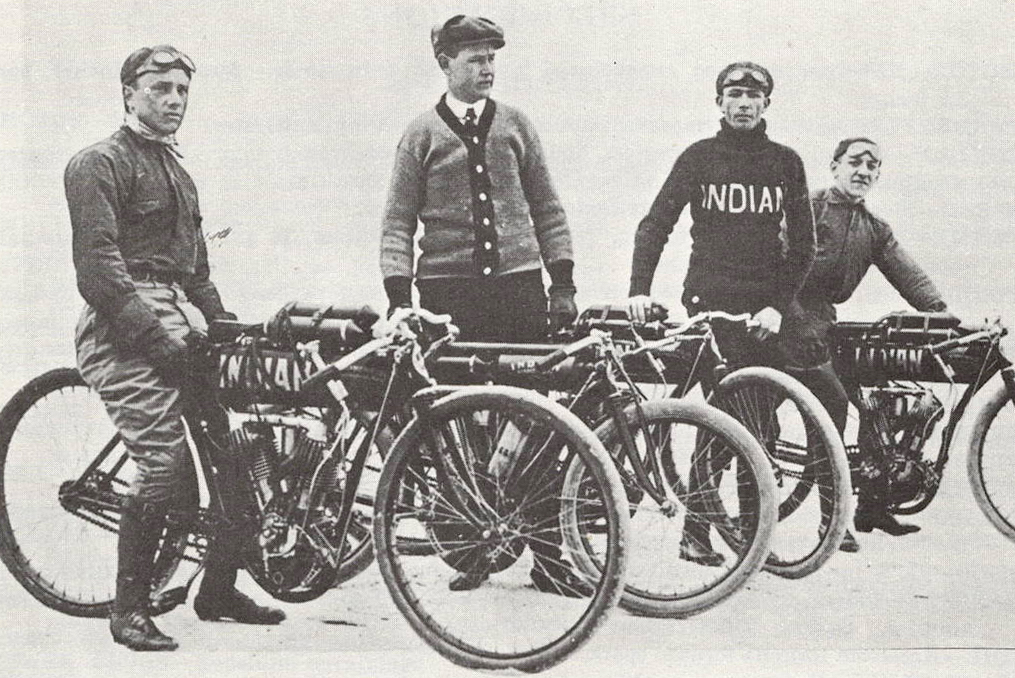
The Indian factory team at Daytona beach in 1909, on a record-setting expedition that proved successful. LtoR: Walter Goerke, Oscar Hedstrom (with a 1.5L Peugeot v-twin he was testing), Robert Stubbs, and AG Chappie. [from 'The Iron Redskin' by Harry Sucher]While unofficial bike match-ups had scored the beach for decades, the inaugural Daytona 200-mile motorcycle race was held Janaury 24th 1937, after Volusia County lobbied hard to the Southern Motorcycle Dealer’s Association, overseers of bike racing in the South. 15,000 spectators showed up, fulfilling the promise of lucre for the City Fathers. The town set up a 3.2 Mile ‘track’, consisting of parallel 1.5 mile stretches of State Highway A1A and the beach, with sandy U-turns at either end. Like King Ozymandias, the organizers hadn’t negotiated properly with the tides, and by the end of the race, riders had a choice of adding saltwater to the already abrasive sand covering their machines, or risking the softer/drier beach closer to the dunes.
Years before the inaugural beach races, Ormonde/Daytona beach was used for speed records. This Indian did 112mph in 1907 [TheVintagent Achive]An Indian won that inaugural year, with Ed Kretz aboard a Sport Scout fishtailing sand into the goggles of his rivals, averaging 77mph. Two months later, Joe Petrali took a top speed run on his streamlined Harley Davidson, averaging 136.183mph; a harbinger of many years of Harley beach strength; they won 10 of the 19 races held on the sand, while the Indian camp tallied 3 beach wins.
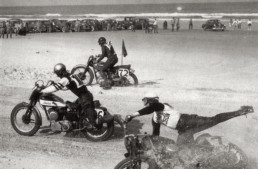
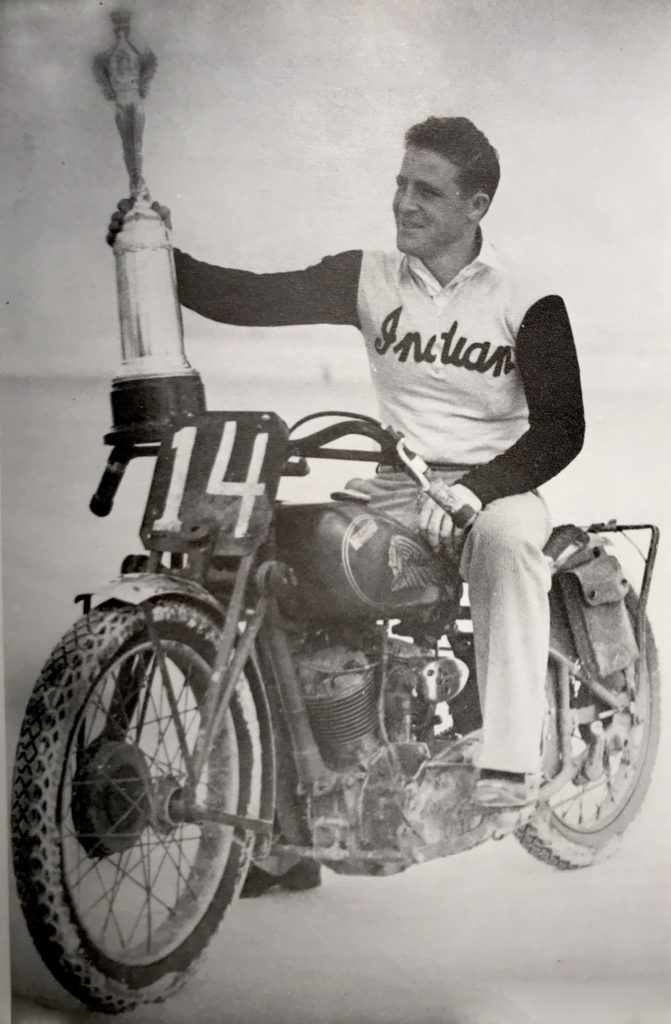
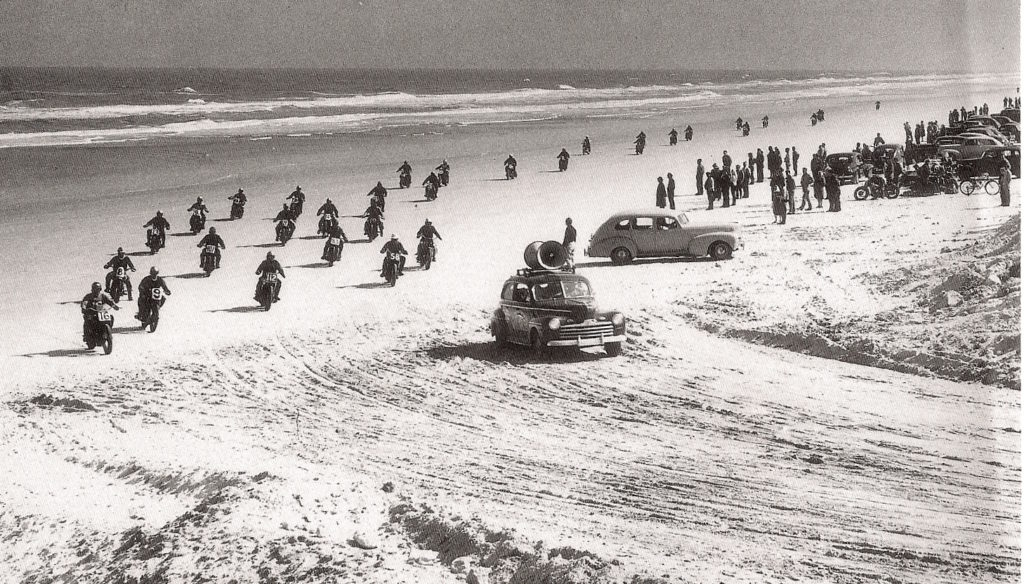
Ed Kretz after winning the 1937 Daytona Beach Classis on his Indian Sport Scout [Archives of the Indian Motocycle Co.]The SMDA wised up in 1938, and the ‘200’ began at half-tide, giving a full 6 hours of wide beach - the race lasted 3 hours, for the winners at least. Hence forth, race start times from 1937 to 1960 were determined by Mother Nature. A Harley won in ‘38, with Ben Campanale aboard. The abrasive sand took its yearly toll on machines and riders – spills and mechanical failures regularly decimated the pack. By 1940, only 15 out of 70 racers finished the full 200 miles.
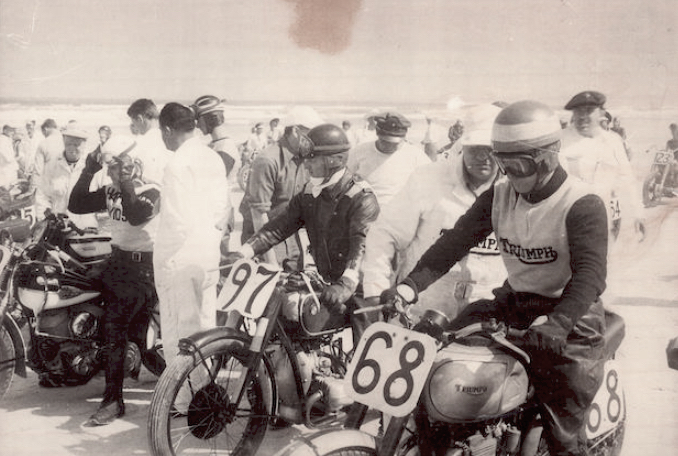
Variety on the beach! The 1941 Daytona Beach Classic, with a 1940 Triumph Tiger 100 and a 1938 BMW R51RS (ridden by Joe Thomas), a Harley-Davidson WR, and a Norton International![Bonhams]In 1941, while Europe was in flames, Billy Matthews took his Norton Model 30 to victory, the first of 5 wins for the Black and Silver, despite having valve gear exposed to a 3-hour sandblast. Harley and Indian rivals had fully enclosed valves, although theirs were popping happily beside the combustion chamber, due to quirks in the Class ‘C’ rule book, which allowed 750cc sidevalvers to compete with 500cc OHVs from Europe. A situation brilliant H-D tuners used to their advantage, bringing this humble engine configuration to its finest expression anywhere in the world with their KRTT, ultimately good for 135mph… ‘Flathead’ indeed!
The post-War threat! A pair of Norton Manx racers coating their exposed chains (and valves) with sand...
The ‘200’ was discontinued between ’42 and ’46 so racers could try their luck with guns, but the next year 176 riders indulged their pent-up Need for Speed, and Johnny Spieglehoff took the honors on his Sport Scout in front of 16,000 fans. The races became part of Bike Week, a two-wheeled invasion of Volusia County, which grew increasingly fun and ugly and crowded over the years.
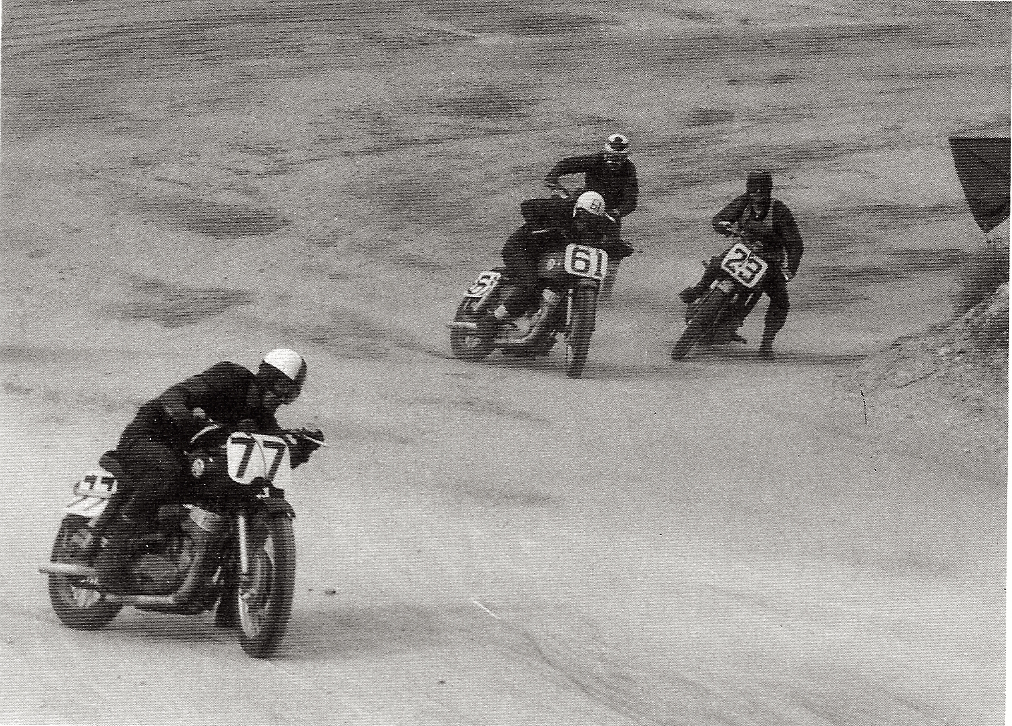
A slew of Harley-Davidson KRs sliding around one of two bends in the oval track
By 1949, the British Invasion scared the pants off H-D and Indian, as a Triumph Grand Prix (ridden by Jack Horn) led most of the race, and when it broke (as they usually did), Nortons swept the board, and won the next two years to boot. Harley responded by replacing their old ‘WR’ racer with the new ‘KR’, and kicked butt in ’53. Indian responded by buying the import rights for Nortons…
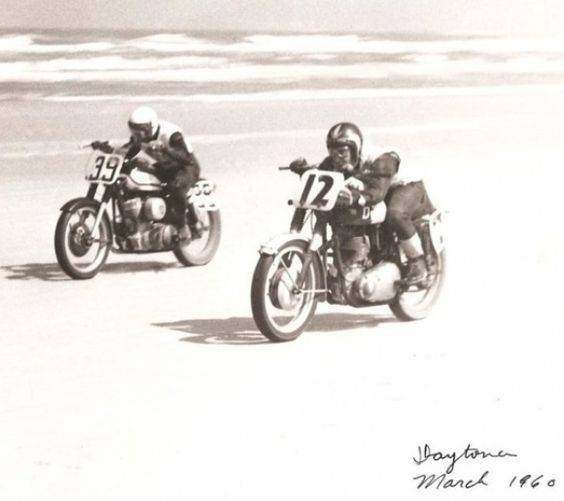
The 1960 Daytona, with a BSA Daytona Gold Star pitted against a Harley-Davidson KR
Amazingly BSA became the next great threat in ’54, pulling it all together for a sweep that year, using specially-built machines based on their ‘A7’ model. Daytona had become the premier motorcycle advertising venue in the States, and every major manufacturer wanted a piece, even BMW and Moto Guzzi, who were forced by the Class ‘C’ rules to field their prosaic roadsters instead of their Works GP bikes.
The post-War Daytona races, showing clearly how perilous the track could be when facing a changing tide...
Race averages hit 95mph in the 50s, and the KR Harley became unbeatable in ’55 and for the duration of Sand Racing. American tuners extracted amazing power and reliability out of the sidevalve top-end, and used their 50% engine capacity advantage to the hilt. But Real Estate calls the shots in Florida, and development along the beautiful beaches meant motorcycles would shortly be unwelcome. Luckily Bill France had already built a giant banked track just out of town, which started a whole new era at Daytona, but sand racing was finished by 1960.
While the Italian motorcycle market after WW2 was dominated by practical, small-capacity machines, they were built by Italians, for whom competition is a cultural imperative. While the tales of success by small manufacturers in Grand Prix and the Giro d'Italia are the stuff of legend, the fierce competition in the scooter market is less well known. The two major scooter manufacturers, Piaggio (Vespa) and Innocenti (Lambretta), were fierce rivals fighting over a global market, and racing was one way to prove superiority. So was record breaking, and both factories indulged in a bit of long-distance and top speed record attempts, besting each other with ever more special and streamlined racers bearing only the barest resemblance to their scooters.
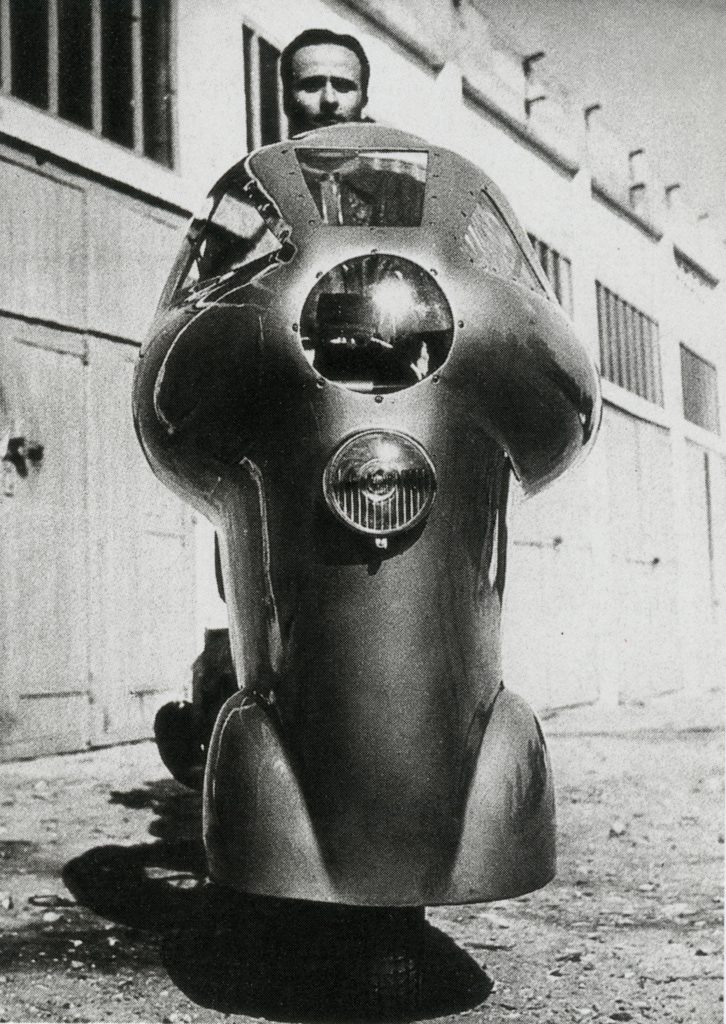
Front view of D'Ascanio's first streamliner for long-distance attempts at Montlhéry
Piaggio is a very old company, founded in 1884 to produce railway carriages, and by the 1920s was building aircraft as well. By the late 1930s their planes are world record holders for speed, and they naturally supplied the Italian Air Force with planes during WW2. Their factory in Pontedara was bombed flat, but the urgent need for personal transport convinced Enrico Piaggio to develop a two-wheeler for the masses, to commence production immediately. Their first prototype was nicknamed 'Donald Duck' for its awkward shape, so Piaggio turned to aeronautical engineer Corradino D'Ascanio for help.
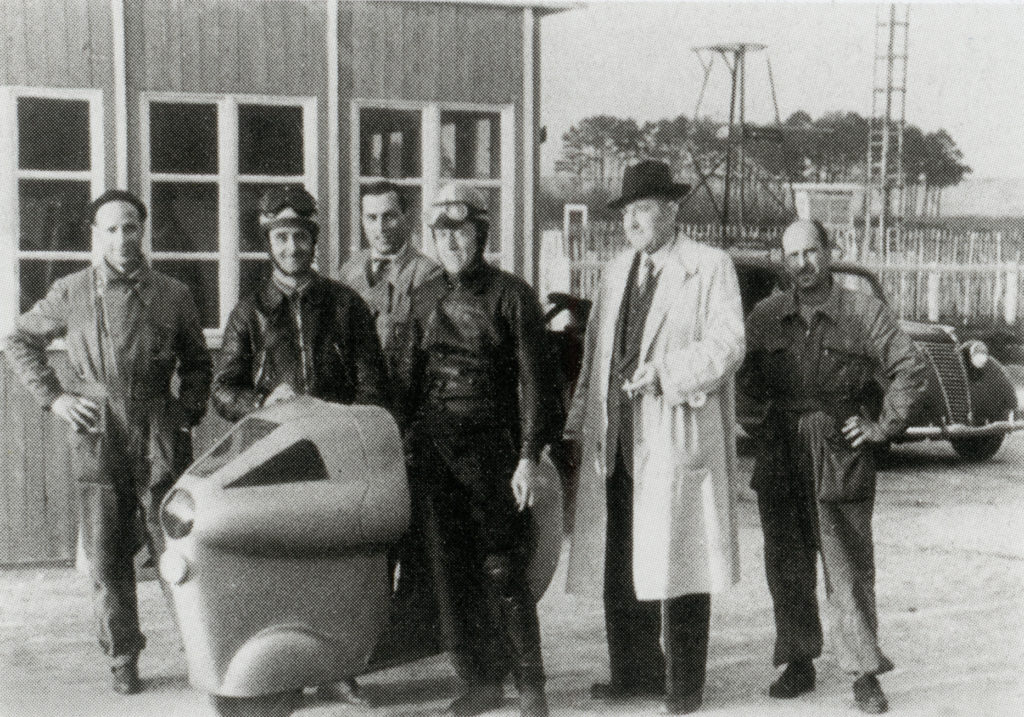
The Vespa team at Montlhéry in April 1950
D'Ascanio hated motorcycles, finding their engines 'a tangle of exposed parts', but he'd already made sketches for a pressed-steel chassis scooter, which he fine-tuned in just a few days for Piaggio. D'Ascanio's scooter would be easy to drive for both men and women, could carry a passenger, and didn't get its rider's clothes dirty. The first prototype was made within weeks of the final sketches, and manufacture began in April 1946. Piaggio dove in feet-first on production, with a commitment to build 2500 machines before they'd taken a single order.
At speed on the Montlhéry autodrome
D'Ascanio's design relied heavily on aircraft practice, which was no surprise; he had already built the world's first functional human-operated helicopter, the DAT 3, in 1930. The MP6 prototype scooter of 1946, with its smooth, pressed-steel chassis, aerodynamic and enclosed shape, plus the front wheel support recognizable to any pilot in the day, was clearly related to D'Ascanio's flying macines. Enrico Piaggio's gamble paid off, as they'd sold 150,000 within 4 years, and over 15 Million to date.
The diminutive size of the 1951 streamliner is evident, as is the torpedo shape
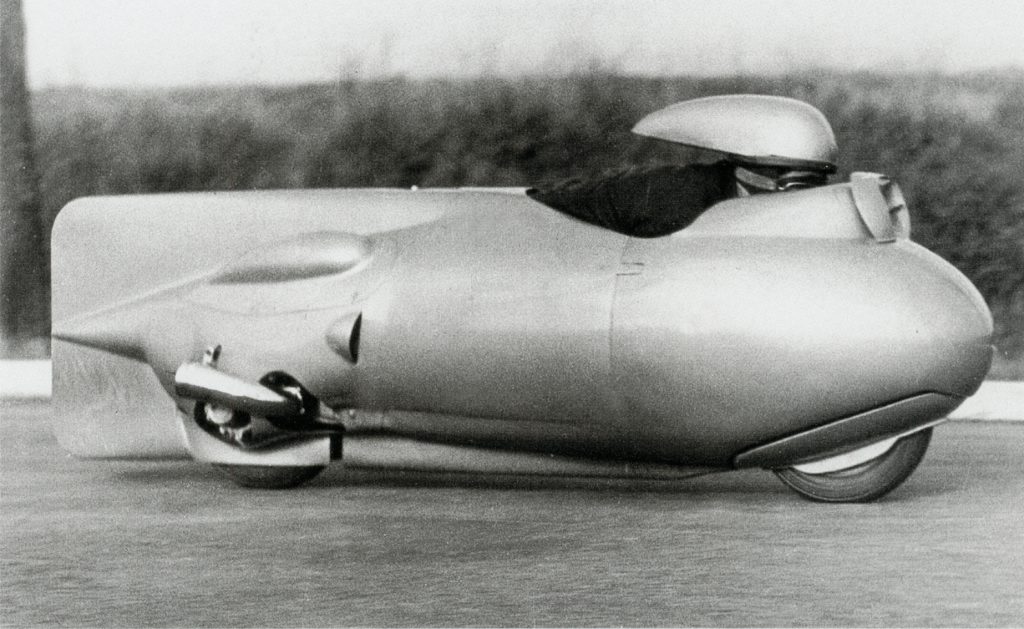
That didn't mean the Vespa had an easy time; their arch rival Lambretta competed in the same events and on the sales floor, and were always finding ways to top the Vespa in competitions. In April 1949, for example, a specially built Lambretta with streamlined fairing took a slew of long-distance records at the Montlhéry speed bowl, in many mileage/time brackets up to 8 hours, for the 125cc class. Piaggio responded with a specialized racer only loosely based on their scooter, also designed by Corradino D'Ascanio. The engine was clearly visible at the side of the machine, which looked like the pre-War Gilera Rondine record-breaker, or a slightly gawky wingless aircraft, than a strictly modern streamliner. On April 6, 1950, it did the trick, taking a string of records, including those for 500 and 1000kms, taking 10% off the Lambretta's time. Its average speed for 3 hours was 78.11mph, and after 9 hours it averaged 76.76mph. Six months later, a new Lambretta racer took those same records at 82mph...
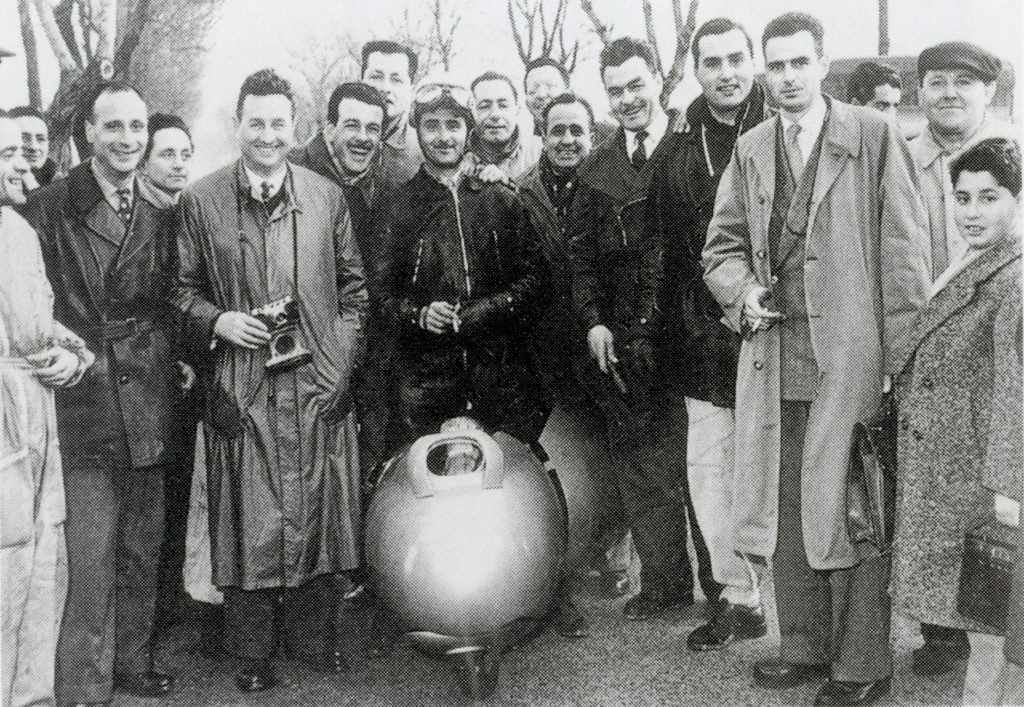
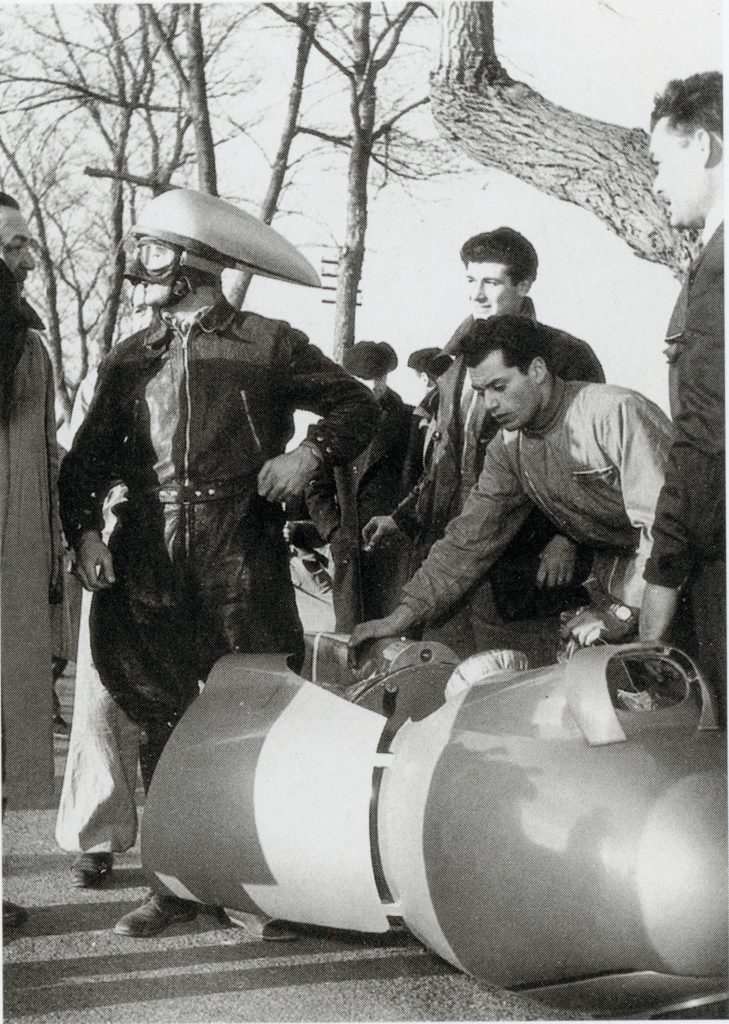
The streamlined helmet was an essential part of the design for the second Piaggio land speeder, and gives a comic-heroic feel to the crew setup outside Rome
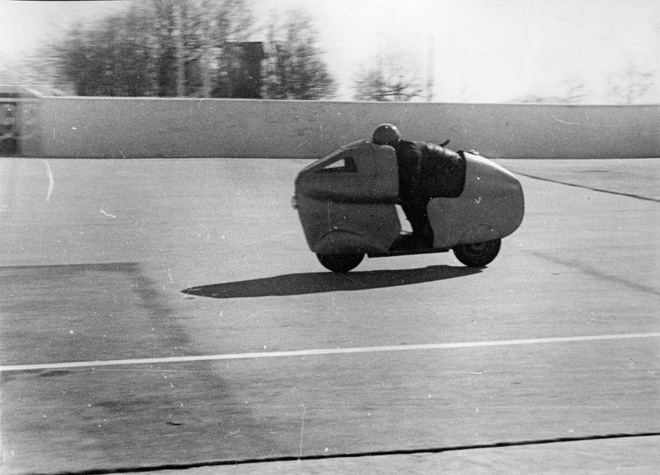
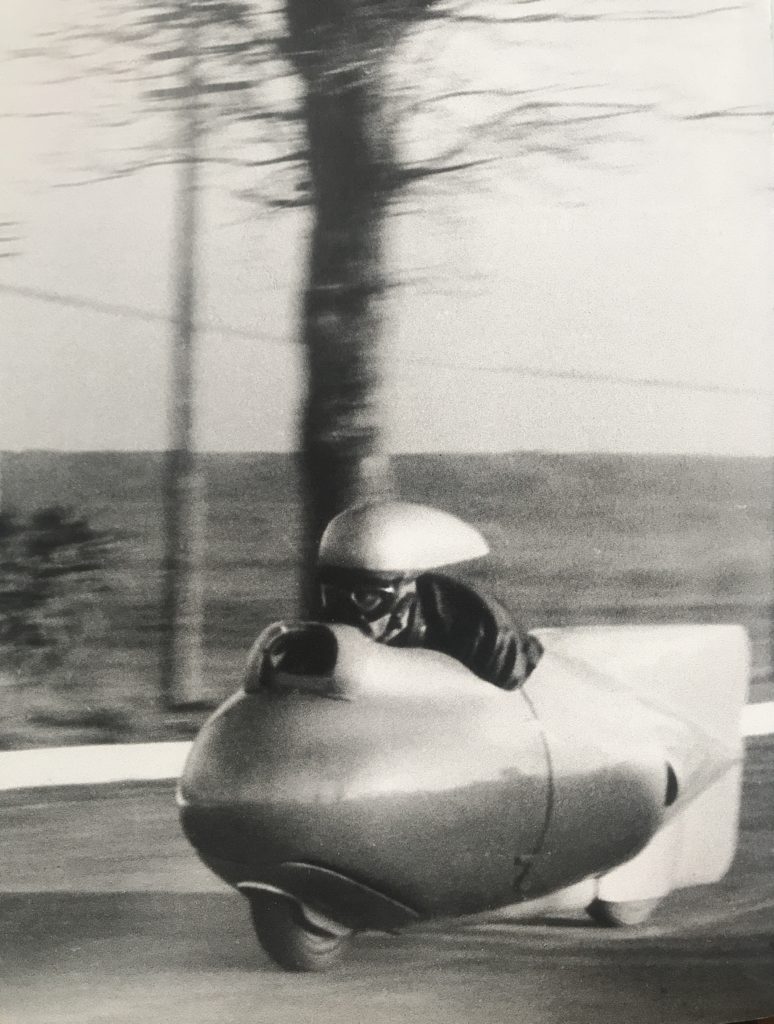
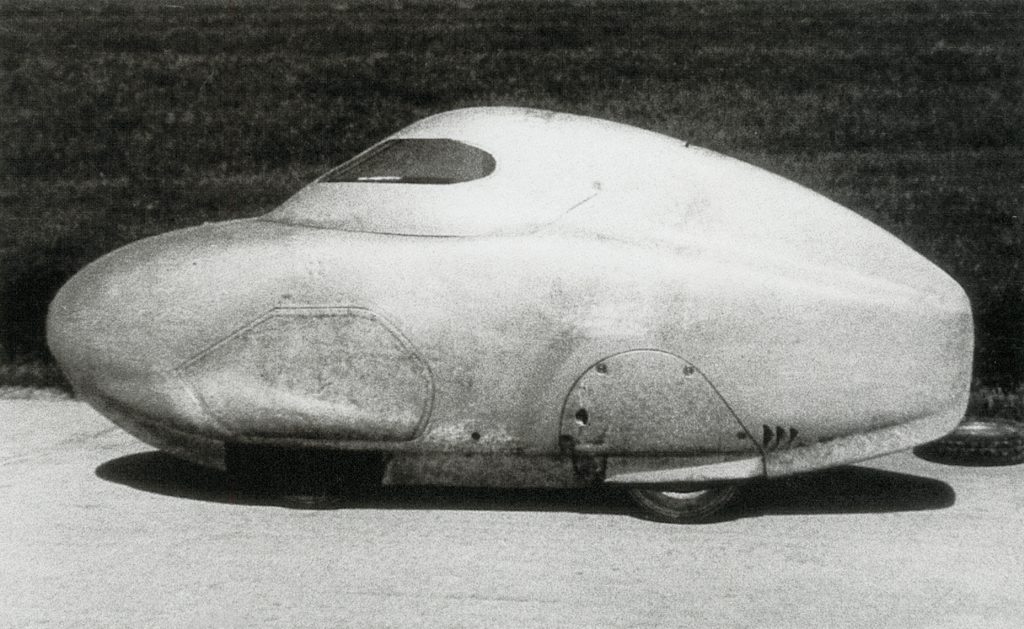
In 1951, a totally new racer was rolled out onto the Rome-Ostia Autostrada, between kilometers 10 and 11, to take the 125cc land speed record. This new machine was long, low, and shaped like a rocket, which completely enclosed the rider, barring his streamlined helmet! The engine was far from standard, too, with a twin-crankshaft, opposed-piston two stroke, with a common cylinder. The pistons moved towards each other, and at the top of their stroke formed a combustion chamber with their piston tops; it produced 19.5hp @9500rpm. While an unusual engine design for a motorcycle, it was common enough as a nautical engine using two-stroke diesel power. The engine used two carburetors and two spark plugs, and was water-cooled, and was held by an single rail aluminum frame, but the motor was placed beside the streamliner's rear wheel to give some family resemblance to the Vespa roadster. It recorded a two-way average of 103.26mph.
At speed (103mph) on the Rome-Ostia autostrada, at 103mph in 1951
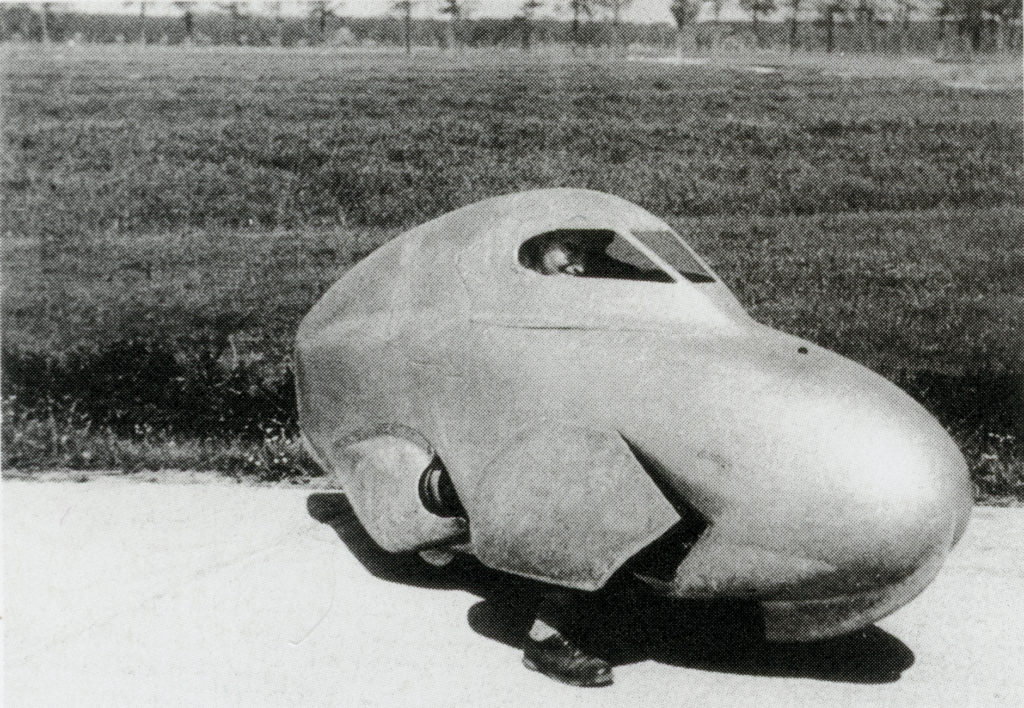
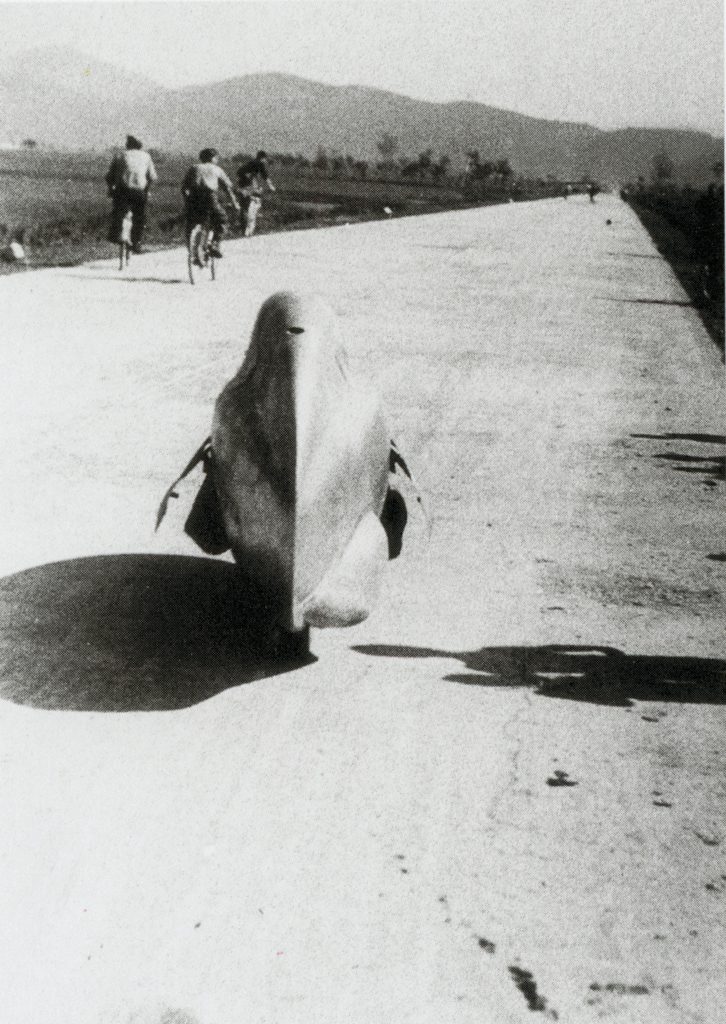
In 1958, a third Piaggio streamliner with full enclosure - a real wingless airplane - was tested on the Autostrada, but I can find no information about this attempt, just a few evocative photos. Factory battles for Land Speed Record supremacy faded out by the 1960s, after a Golden Age of 30 years' effort on the international stage, that produced some of the most intriguing, no-holds-barred motorcycle designs of all time.
Another view of the 1951 Piaggio full streamliner at speed, showing the requirement of a streamlined helmet! Also, the location of the motor beside the rear wheel, to reassure the public this machine has a Vespa connectionThe 1958 fully-enclosed streamlinerLooking very much like the 1930s DKW streamliners, on a smaller scale, this last Vespa bodywork is fully enclosed, with clever hatches for the rider's legs. Not the cramped riding conditions, and the diminutive size of the machine!The 1958 streamliner about to take off on the Rome-Ostia highway. Not the nonchalant bicyclists on the road...and that the engine is fully enclosed now, but still by the rear wheel
These photos were published in a terrific book, 'The Flying Machines of Corradino D'Ascanio', by Alberto Bassi and Marco Mulazzani (1999, Electa - Elemond Editori Associati, Milan Giorgetti), published for the exhibition of the same name in 1999 at the Spazio Giorgetti in Milan. The photographs are from the State Archives of Pescara, the Archive Services for Abruzzo and Molise, Pescara, and the Walter Vitturi-Technifoto, Venice.
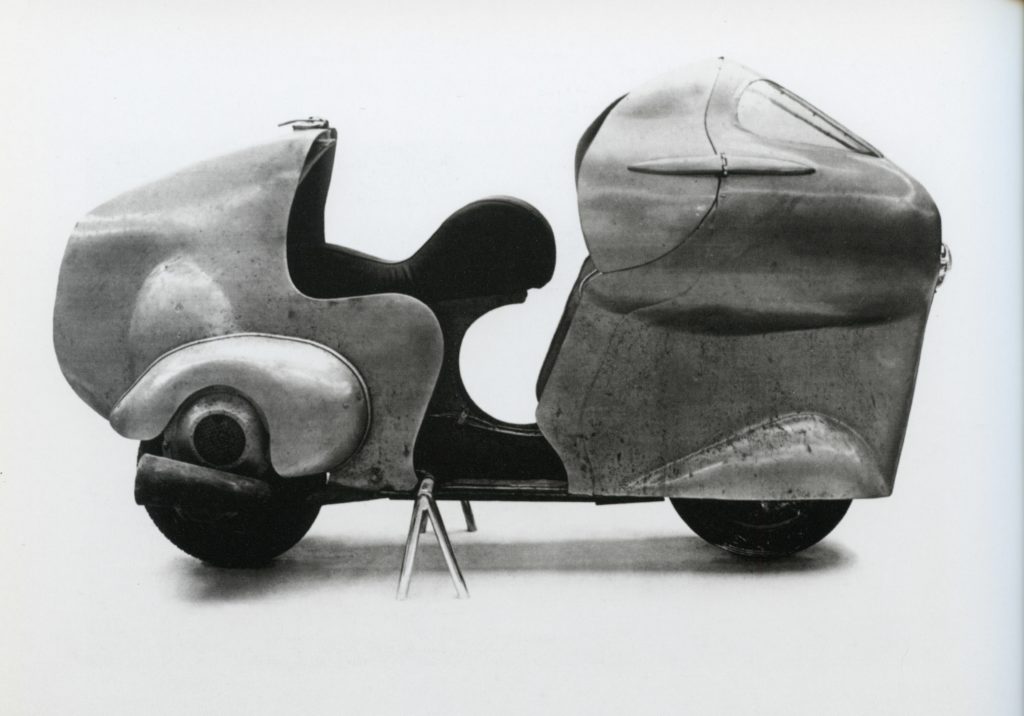
Corradino D'Ascanio's original Piaggio racing design, built for record-breaking at Monthléry, and clearly influened by his aviation design experience over the previous 35 years. The machine is entirely hand-built, with its retro-futuristic shapes erotically organic, before the streamlined 'torpedo' shape - with is much smaller frontal area - was found to be much more suitable for top speed runs.
Paul d'Orléans is the founder of TheVintagent.com. He is an author, photographer, filmmaker, museum curator, event organizer, and public speaker. Check out his Author Page, Instagram, and Facebook.
Bonneville. Tiger 100. SS100. TT Replica. Clubman. Sport. Super Sport. Sportster. Rapid. Rapide. Vitesse. Superswift. Sprint. Speed Twin. Quick. Quickly. Gold Star. Shooting Star. Comet. Meteor. Rocket. Super Rocket. Atlas. Bullet. Jet. Lightning. Black Lightning. Cyclone. Hurricane. Manx. Manxman. Manx Grand Prix. Daytona. Brooklands. Silverstone. LeMans. Ulster. Thruxton. Bol d’Or. Montjuich. Arrow. Blue Arrow. Golden Arrow. F1. F3. Mach 3. Falcon. Hawk. Nighthawk. Super Hawk. Thunderbird. Flying Squirrel. Capriolo. Greyhound. Tiger. Cheetah. Panther. Lion. Crocodile. Red Hunter. Dominator. Commando.
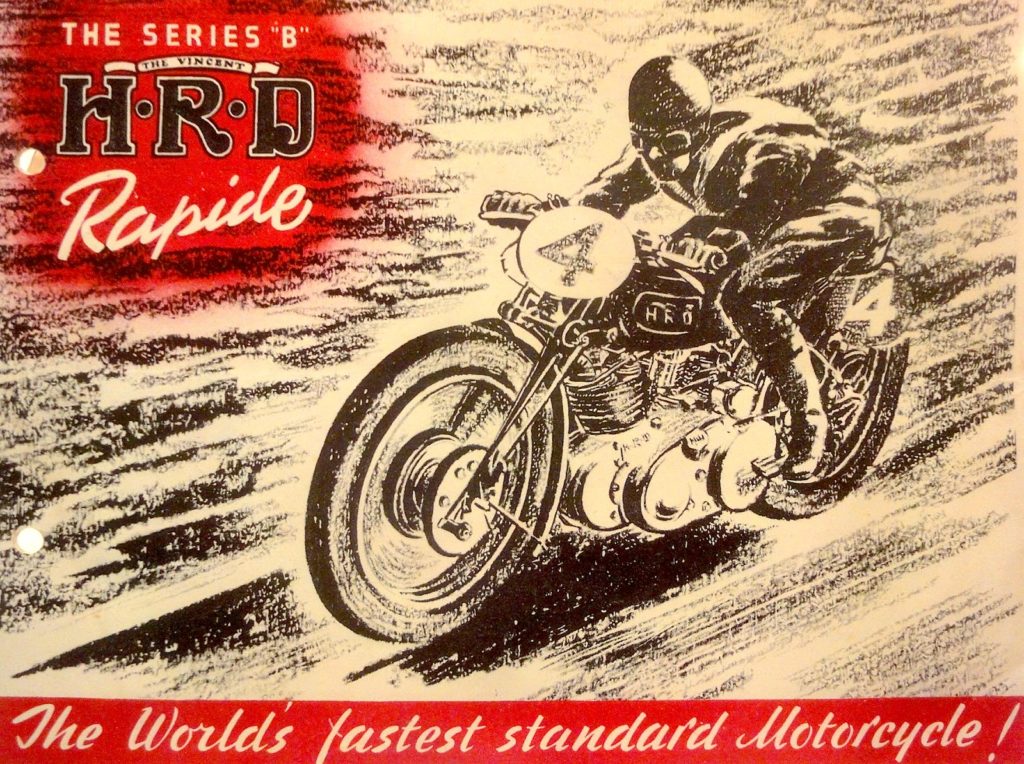
Well, you can't just call it the 'Really Fast'...better to Frenchify the name...'Rapide'! [Vintagent Archive]It was Adam’s first job before the Fall -naming the animals- and he set a precedent, using distinct words for each beast, and not a numbering system. Without the pressure of God looking over their shoulders, motorcycle designers have often failed at Adam’s task, relying on a factory code to identify their work, and we are left with a century of Model 4s, TA3s, CB200s, and other, utterly forgettable ‘names’. Granted, the TR6 and GSXR earned their fame with a series of numbers and letters, which proves even nonsense syllables can gain the status of a proper name, just as with mantras used for meditation, which are sometimes intentionally meaningless - its their repetition which counts…and advertisers feel the same way. Keep repeating the sound, until you buy one.
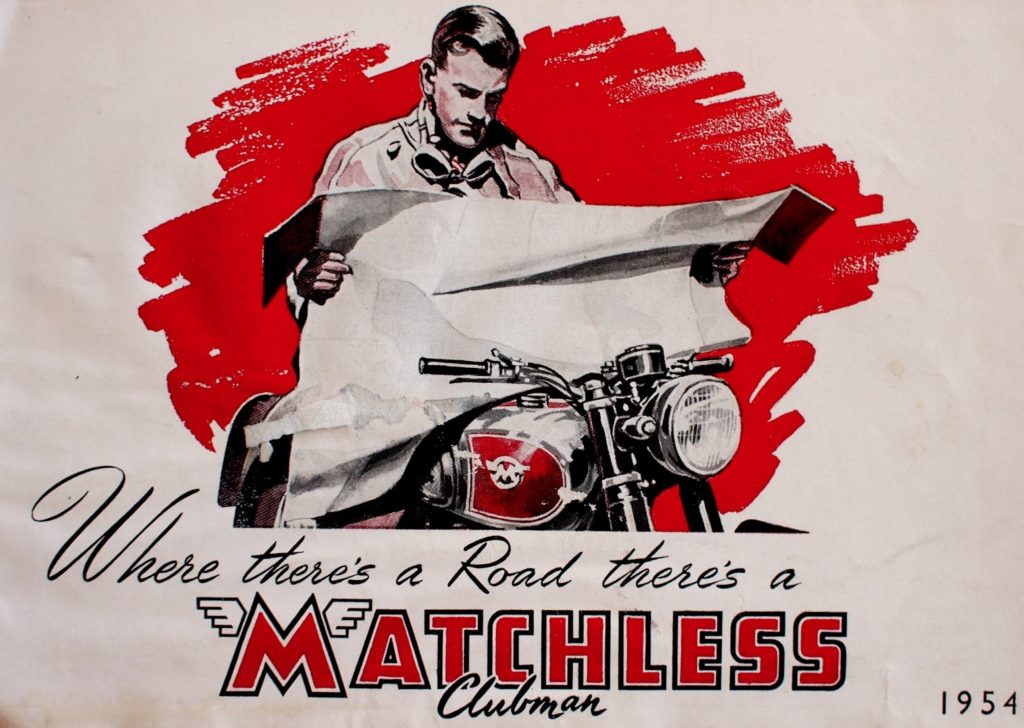
Full points to the Collier brothers for coming up with 'Matchless'. Followed up in the 1950s with the 'Clubman' models, which didn't imply a charitable society, but the potential for racetrack fun. [Vintagent Archive]Motorcycle manufacturers figured out early that a memorable name carried a punch, and if a good name was matched by a good product, you’d scored a hit. This insured the health of the company, and continued employment of the designer giving names, no small matter in the lethal business of selling bikes. Automobile companies have whole departments conducting tests in rooms with one-way mirrors, measuring reactions of citizens to car names (they didn’t ask my opinion of Impreza, Aspire, or Celebrity…), but motorcycle companies rarely have that kind of budget, for testing or even advertising on a mass scale. Barring the Japanese boom years of the 1960s/70s, the general public has been spared interrupting their favorite TV soap opera with images of bikers having good, clean, dangerous fun.
Not just a Number
Here’s a parable on the value of a good name over a number. Valentine Page, Triumph’s head designer in the early 1930s, built a very well-engineered vertical twin Triumph 650cc, but you’ve never heard of it, because while beautifully made, he lacked the imagination to give it a name, opting instead for a designation; the ‘Model 6/1’. Plus, it was ugly. And Triumph nearly went bankrupt. Two years later (1936), an upstart megalomaniac named Edward Turner was hired away from Ariel to revive Triumph’s sagging sales. He tarted up Val Page’s bikes, and drew up cheaper, simpler, and lighter machines, which nonetheless were fast and fun. And he gave them names; Tiger 70, 80, 90, and the Speed Twin. Valentine Page’s vertical twin was solid and well-engineered, but that didn’t matter; it lacked a flashy paint job and shapely tinware, and wasn’t called a Tiger. Metaphorically, while Val Page was concerned with ‘rocking couples’, Edward Turner was screwing a mistress on his desk.
Johnny Allen and company, at Bonneville, with the proto-Bonneville, a Triumph 6T with a twin-carb head [Hockenheim Museum Archive]It was that kind of world in the 1920s and 30s; Turner had effectively discovered the Language of Speed, and backed it up with just enough competent engineering to make the names stick, forever. He knew it, too; his principal draftsman Jack Wickes (the man assigned to refine Turner’s sketches, who some feel deserves as much credit as ET for Triumph’s designs) recalled in much later interviews; ‘I told E.T. the steering head angle on the Speed Twin was wrong, and the bike would handle much better if we steepened the forks. His response was ‘the lines are right – moving the wheel closer to the engine would ruin the looks’. This may have been the reason why Turner, after he took over the helm of Triumph as Director, refused to support a factory racing department or even an official racing team until the mid 1960s (after he'd retired). He’d seen enough snapped crankshafts, broken cylinder barrel flanges, and cracked frames when his Tigers were ridden hard at Brooklands just before WW2, and wasn’t of the opinion that ‘racing improves the breed’. At least, not the brood he sired… While visiting America in the 1950s, Turner spectated at the Big Bear Enduro, and was treated to the death of a Triumph rider when his frame broke in two. Then Triumph introduced a stronger frame. The Triumph strategy was to let dealers play the racing game, and improve the models via their feedback; racing on the cheap.
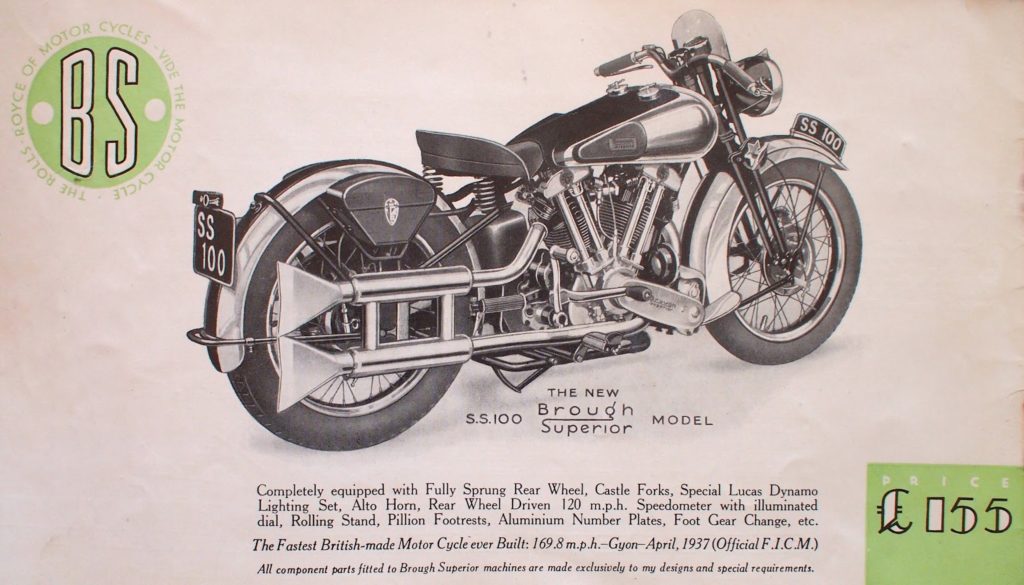
The SS100 Brough Superior; if George Brough hadn't delivered on his promises, he'd have looked the fool, but he did what he claimed, and doggedly pursued the 'world's fastest' title for nearly 20 years [Vintagent Archive]After WW2, more Speed Twins, Thunderbirds, and Tigers gave way to a marvelous stroke of inspiration, when a laconic Texan named Johnny Allen stuffed a twin-carb Triumph 6T motor into a fiberglass cigar, launching that missile over a dry salt lake in Utah at 214mph in 1956. A lightbulb in Edward Turner’s head clicked, and the ‘Bonneville’ was born, which drew the ire of GM's lawyers (who introduced their own Bonnie in ’57 – called the ‘Parisienne’ in Canada…WTF), and birthed a legend. And what a name; Bonneville is still the hallowed chapel of Speed, every red-blooded biker on earth wants to visit the most inhospitable place imaginable; absolutely nothing lives there, the landscape is pure salt, there aren’t even flies out there in the middle of pure white nothingness. But, there’s also nothing in the way; just point and shoot.
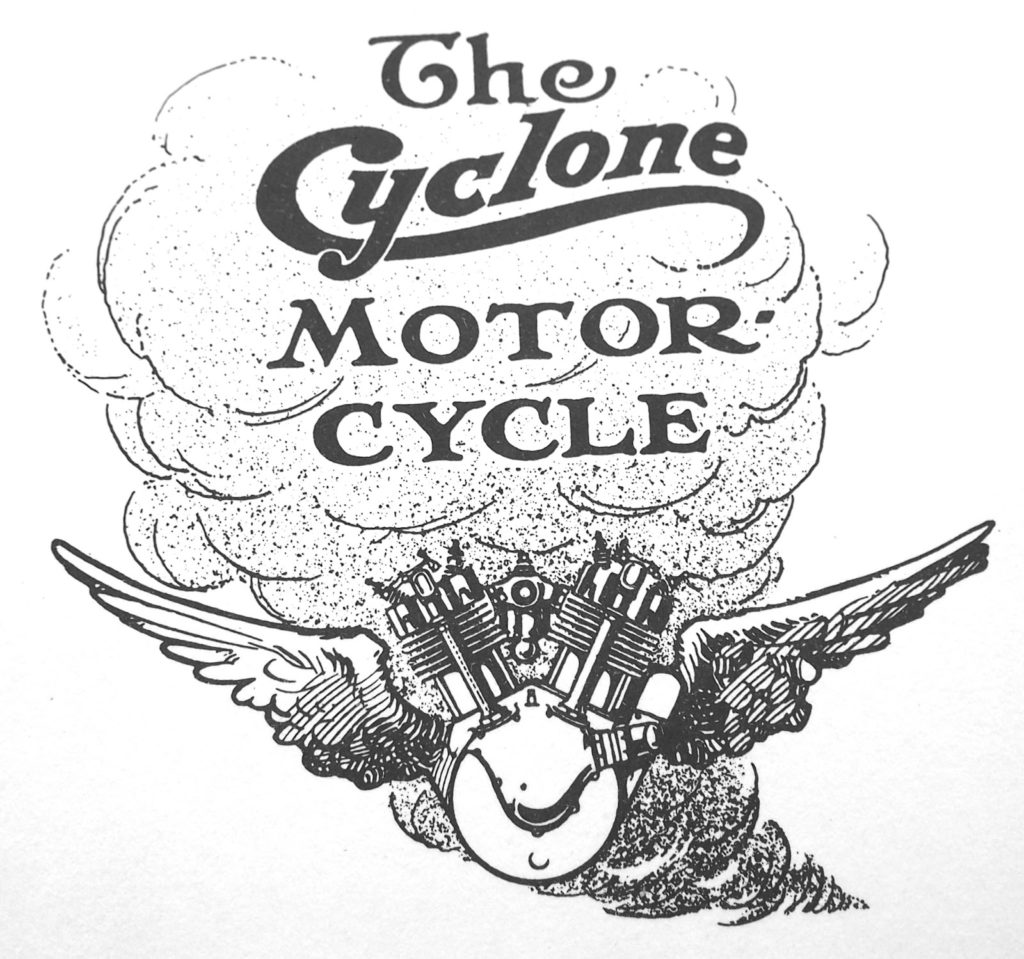
If you're going to harness the wind, you might as well go all the way, and make it a Cyclone. And they were fast, until they broke. [Vintagent Archive]Motorcycles with place names are typically associated with races; if you won at a track, nothing stopped you slapping a sticker of Le Mans, Daytona, the Manx, or Silverstone on your oil tank. Sometimes there was duplication, as with the ‘Thruxton’; nowadays, you can buy a new Triumph with that name, but nobody remembers the bleak, ex-military airfield in southern England on which hay bales outlined a circuit, and long-distance races were held in the 1960s. Velocette did well there, and named their last production racer after the track; their Thruxton is rightly revered as, perhaps, the ultimate production café racer of the 1960s. But that was the 500cc class; at the same time, Triumph was winning in the under-700cc class, and they put out a racer too – the ‘Thruxton’ (they made ~60) from which your brand new Triumph has stolen its name. Why do re-heats of a good name always turn out fatter and slower than the original?
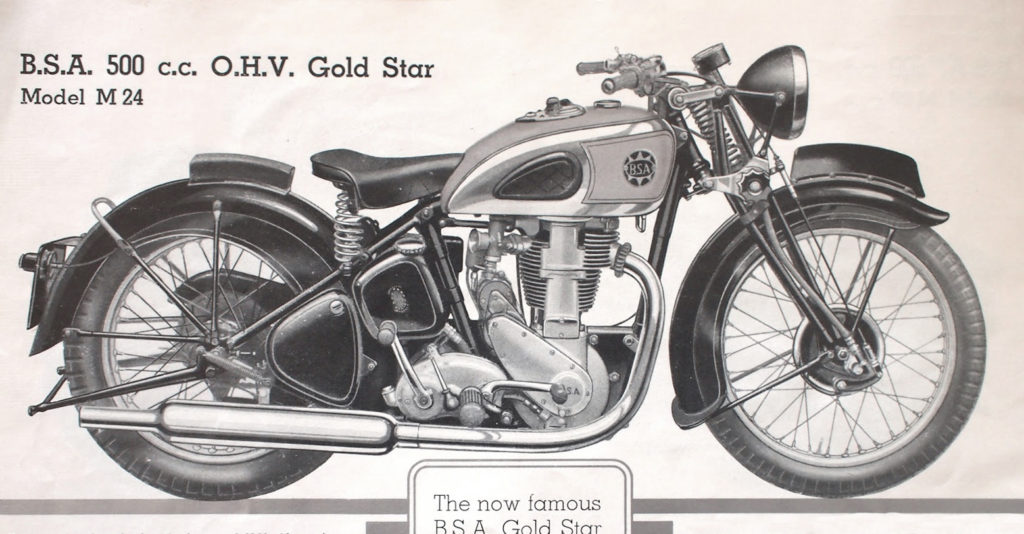
The original BSA M24 'Gold Star', named for the little brass medal given competitors at Brooklands who'd managed a 100mph lap during a race. Coveted thing, that medal. [Vintagent Archive]The curious neuro-mechanism pumping a chemical cocktail to our bloodstream as a word-response has long been understood by political speechwriters and product hawkers, since the power of speech first developed. A potential customer may never have seen a race at LeMans, but the word acts like a mantra of Speed and excitement; repeated often enough (like Goebbel’s lie which becomes true), that mantra has a fixed association. LeMans = Speed! This is the power of advertising (and other forms of progaganda), but the roots of our response are Very Old. Goebbels didn’t invent advertising, not even advertisers invented the mesmerizing attraction of a good name or catchy line. Going back to Adam, words are the very thing which separates us from animals, and language has replaced inborn instinct. Animals don’t need to be told what to do, they are born knowing, are hard wired to be themselves, and survive. Humans need language and repeated demonstration in their years-long struggle to become self-sufficient. These instructions for life are hidden in stories passed down for thousands of years; the accumulation of these stories is called culture. As our very survival has long depended on story/instruction, we are vulnerable by our very nature to the lures of advertsing copy. Its how we’re built - we respond to stories. The simplest form of a story is a single word; a name so packed with associations and ‘subtext’ that you’ve said a mouthful in one or two syllables. LeMans. Bonneville. Tiger. Guide that association with a little visual imagery in advertising, and you’ve created a brand.
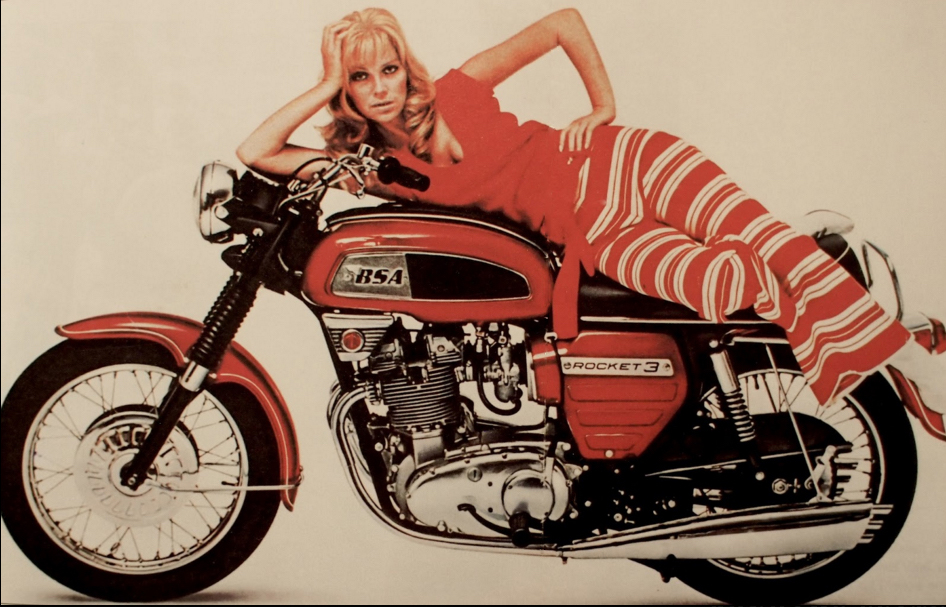
Riding the Rocket. The use of women as drapery on motorcycles is a post-War phenomenon; believe it or not, women were actually catered to as riders in the first half of the 20th Century! [Vintagent Archive]Triumph’s Turner didn’t invent the sexy motorcycle tag, we have to jog further back in time, to the first motorcycle race tracks of 1907 being used to fire the buying public’s imagination. By 1912, ‘TT Replicas’ appeared in motorcycle catalogs, promising speed beyond imagining to the average Joe. These were utterly impractical machines, typically without suspension or gears or a clutch, but a determined rider could use them on public roads for maximum bragging points. In 1914 Norton created the ‘Brooklands Special’ for racing, and by gosh, the next year they offered the ‘Brooklands Road Special’, proving that moto-poseurs have been good business for a century.
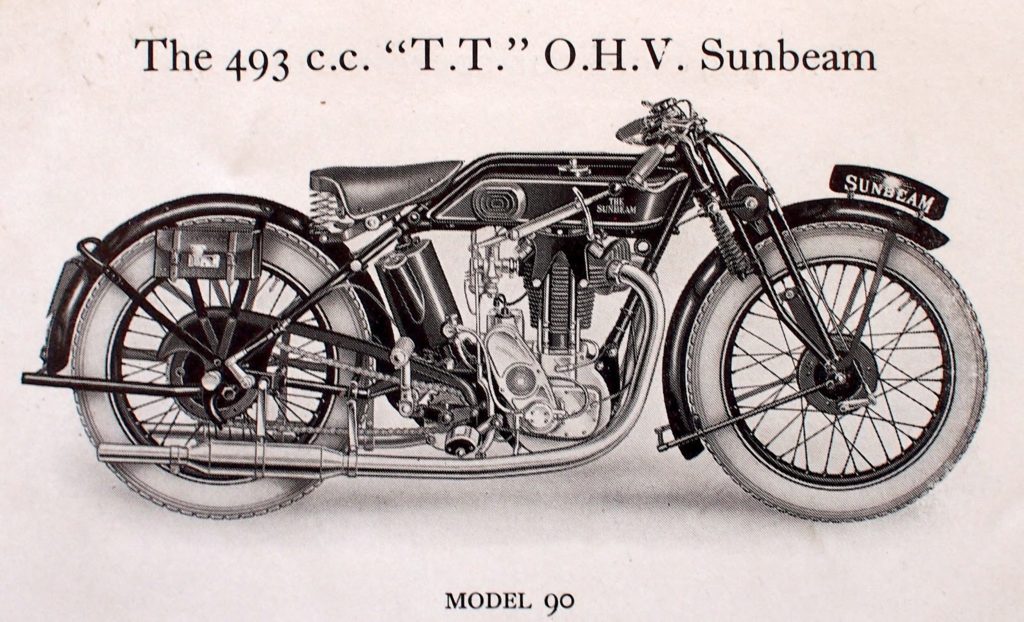
Can't resist adding another 'TT' Model...as I have exactly this Sunbeam! Such a thing of beauty; light and fleet and fit as a greyhound. [Vintagent Archive]The first true master of advertising copy - the catchy phrase, the sexy moniker - was George Brough. A born sloganeer and braggart, his company claimed ‘Superiority’, and his models, like ‘Super Sports 80’ (SS80) and ‘SS100’, promised speed in their very names. In 1925, 100mph –guaranteed- from a production bike was radical, and flaunting the top speed in the bike’s name would be imitated for decades, especially by Triumph, whose bikes grew faster on your tongue, from the Tiger 70 in 1935 all the way to the T160 three-cylinder in 1975. Nowadays, motorcycles are so illegally fast, top speeds are whispered behind hands.
Animals are faster than people
Tigers, Cheetahs, and Hawks - the terrifying creatures of our distant past, the ones which snapped the necks of slow runners in our first million years of upright bipedalism, hold a special place in our hearts. With several hundred thousand years of Fear lodged in our genetic memory, every culture treats predators with a godlike respect. We envy their strength and violence, and are awestruck by their exquisite, functional beauty. The only surprise regarding predators and the motorcycle industry is how long it took to make the associative leap from four legs to two wheels.
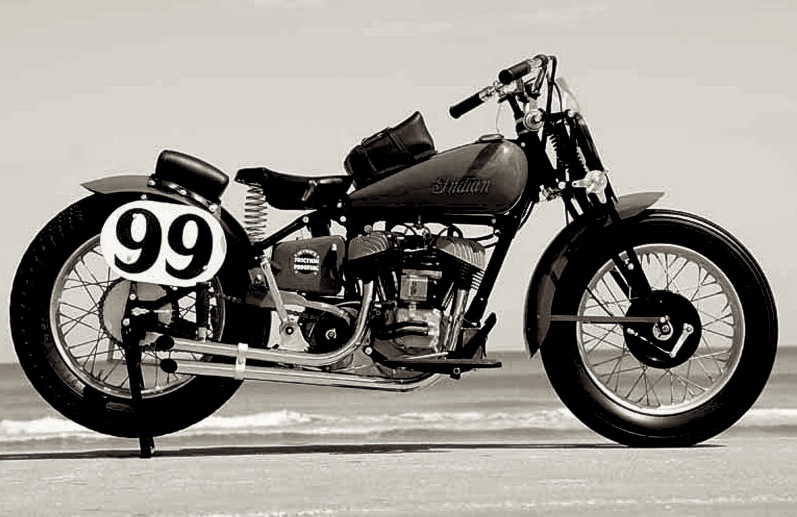
The 'Scout' became the 'Daytona Scout' when tweaked for racing at the famous Florida beach. You could also buy 'Bonneville' cams for your Chief... [AMA Museum]Then again, until the 1920s (that’s 30 years into the development of a proper motorcycle industry), motorcycles were basically crap. The lure of Speed was clear from the first wobbling miles of powered riding, but the pursuit of speed’s pleasures was often frustrating. When bikes became reliably fast, didn’t catch fire, skid uncontrollably, and handle like drunken camels, they changed radically in appearance as well. Bikes built before the mid-1920s looked like picket fences stuck with a mailbox and a pineapple. The slow progress to move engines lower (and drop the center of gravity) coincided with smaller wheels, shorter frames, and heavier proportions of components. The best designers of the 1920s, men like George Brough and Max Fritz, were able to gracefully integrate these tendencies to shrink motorcycles into compact and powerful tools.
The Velocette 'Thruxton'...well named, a strange mashup of 'thrust' and 'sex' and 'ton'...which is perfect. This is my green Thruxton, nicknamed 'Courgette', which I've owned for nearly 25 years, and was my sole transport at one point... [Vintagent Archive]The evolution of a completely new motorcycle aesthetic in the mid-1920s brought a gradual evolution of a new metaphor; the two-wheeled animal. Whether the new motorcycle shapes were a case of Biomimicry (using nature’s solutions to inform design), or an inevitable response to the natural forces a motorcycle must overcome (friction, gravity, wind, inertia), the result was a machine we humans could relate to viscerally. With a clear ‘skeleton’ and musculature of engine and gearbox, the best-designed motorcycles had a harmony of form and grace of line which triggers something very old in our brains; we respond to these shapes with much the same feelings evoked while watching a tiger strut or a falcon shriek through the sky. We feel awe at the beauty and implied power of the beast / motorcycle, a combination of feminine grace and masculine power.
Lots of British companies sold 'Isle of Man TT' models, or simply 'TT Replicas', or in the case of Norton, simply the 'Manx'. [Vintagent Archive]Lose that masculine/feminine balance, and you’re left with the also-rans of the moto world, the forgotten models, which only anoraks like me care about. Why bother with the ugly Tina scooter when you could fill your dreams with a Tiger 100? Why remember the spindly Sunbeam Model 5 Light Tourist, when the ‘TT’ 90 was a perfect object? Who gives a shit about the Brough Superior '680 Sidevalve' when George Brough could have retired in 1925 after penning the 'SS100', and be remembered forever?
Tiger Tiger! Burning bright! The 1951 Bol d'Or with a beautifully race-kitted Triumph Tiger 100R, with the factory race kit installed (megaphone exhaust, TT carb, rearsets, dropped 'bars, etc. Note the extra lights for this 24-hour race, but the empty generator hole in the front engine plates. [Hockenheim Museum Archive]We remember the ‘animal’ bikes when the pairing is successful, the Tigers and Capriolos and Hawks, but a good name doesn’t guarantee success. The Tigress scooter was a dismal failure, as was the Harley XLCR ('Excelsior!'); the motorcycle Hall of Fame has a basement stacked with rusting also-rans, and for every Thruxton, a dozen forgotten models languish in the shadows. Even the cosmic power of the Word has its limits.
[This article originally appeared in French Café Racer magazine, in their second 'Speed' special issue]
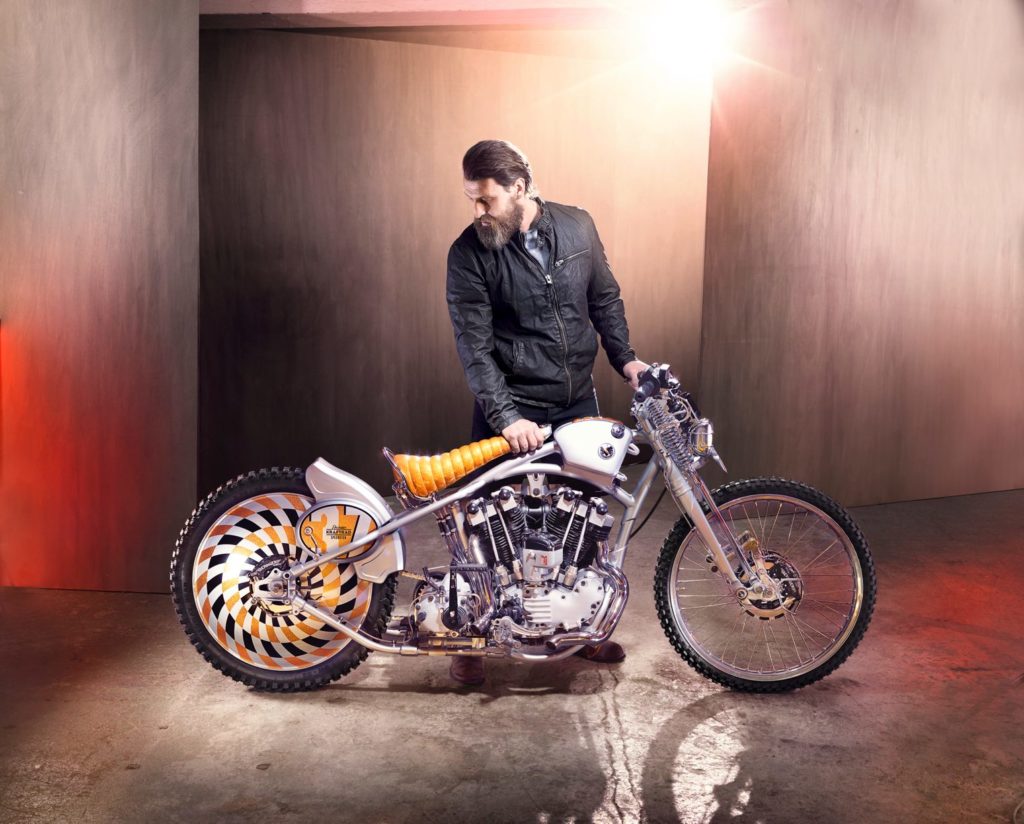
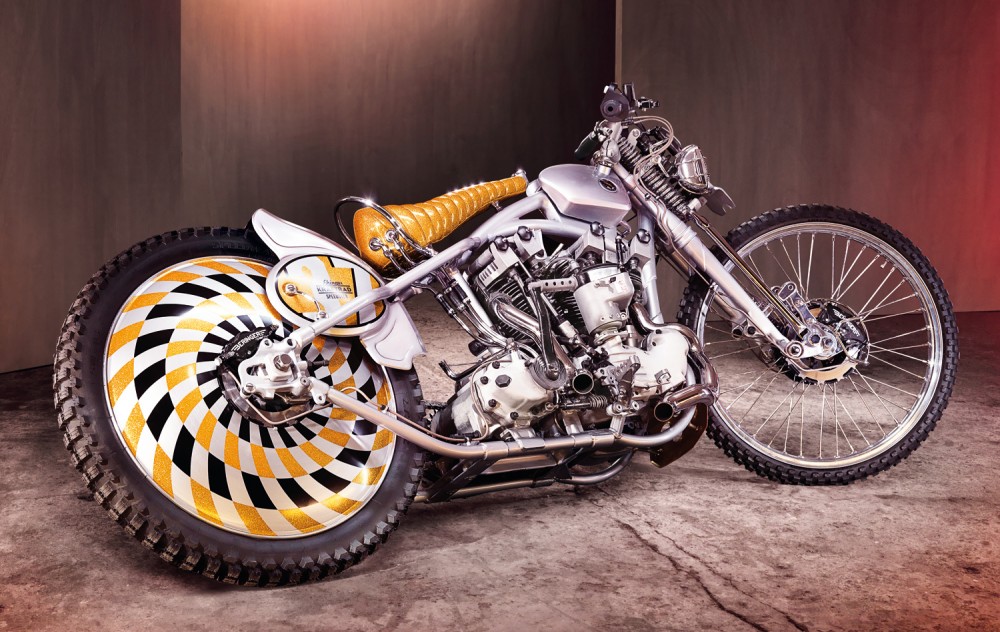
Ehinger Kraftrad’s remarkable ‘Speedster’; history through a hi-tech lens.
While stylistic exuberance can shroud its origins, racing has always been the #1 starting point of most custom bike styles – Class C racing begat the bob-job, dragsters led to the chopper, GP the café racer, and dirt racing the tracker and scrambler styles. Uwe Ehinger of Germany’s Ehinger Kraftrad isn’t a typical custom builder, and takes his inspiration from the far corners of racing; hillclimbing, ice racing, and now speedway. Speedway is the toughest genre of all to riff on, and few builders have successfully adopted what’s cool about these hyper-specific machines. Speedway bikes are absolutely minimal, and little about them has changed from their perfected golden era post-1930. A modern Rotax-powered racer could be set beside a 1930 Rudge-Whitworth or Harley-Davidson Peashooter, and one could justifiably wonder if any progress has been made in the sport? Then again, part of its enduring popularity is exactly this simplicity and tradition, which keeps the price of entry for spectators and riders very low.
Traditional custom builders usually shun small bikes, and speedway racers are tiny, with ultralight rigid frames, single-cylinder engines, no gearbox, and flimsy forks. They’re delicate and fit only for a single purpose, so translating their visual cues to a roadworthy motorcycle, especially with a big-capacity V-twin, often looks like a fat man in a tutu. But two builds debuted this year have successfully captured the spirit of speedway; the single-cylinder ‘#7’ by Jeremy Cupp, and the Ehinger Kraftrad ‘Speedster’. Uwe Ehinger explains, “Jeremy and I both built speedway bikes – we discussed how two people can have the same idea at the same time. His machine is much more like a real speedway bike, and mine is more a mix from everything.” Still, it was Ehinger’s bike that took and award -‘Best Sidevalve’ - at Born Free 7.
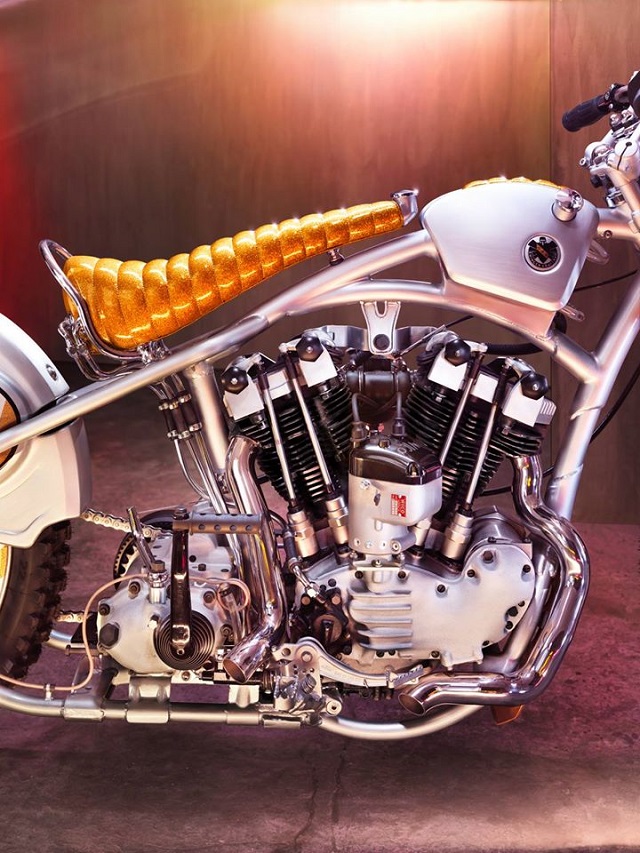
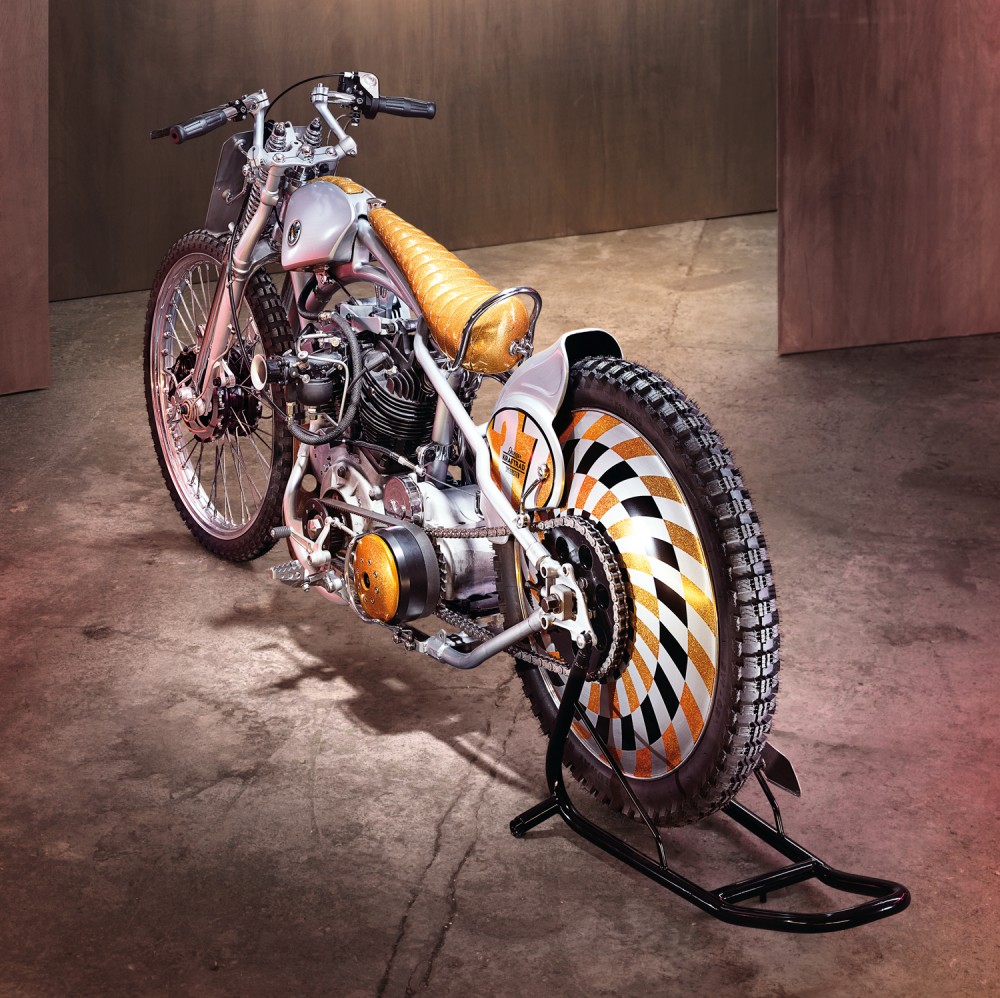
You’re reading that correctly – the BF7 organizers stretched their category a bit to fit the Ehinger Kraftrad machine, which as you can see has an OHV engine. But the crankcases are sourced from a ’37 Harley-Davidson UL, with modified Knucklehead top ends grafted on. Uwe Ehinger considers the engine the heart of his creations, and chose the UL motor for its four cams hidden within that shapely timing chest. To anyone savvy with H-D history, the 4-cam motor is what the factory raced from the ‘Teens till today, and was first offered on a road bike in 1928, with the JDH. Four cams give better valve control, meaning higher revs and more HP, but in this case, the UL’s lifters don’t exactly line up with the pushrod positions for a Knucklehead. While H-D are reputed to never unnecessarily change anything, the truth is there’s little interchangeability of motor components between different models. For example, putting aluminum XR1000 cylinders and heads on an XL Sportster bottom end might seem a logical job, until you wear two footprints in front of a milling machine to make them fit. Same story with the Ehinger Knuck conversion – the tale is told by the pushrods, which sit at unnaturally wonky angles. Uwe doesn’t mind – that sort of thing is a calling card to the cognoscenti, who recognize the work involved to make it functional.
Part of that work was making new rocker arms to accommodate the odd pushrod angle, and therein lies a tale; one might picture a gifted mechanic sketching out the necessary design on a graph paper or even a CAD program, but Ehinger’s process goes far deeper than that. “Ehinger Kraftrad custom bikes are only 1% of my business; I do a lot of other work for the film industry and design consultancy. I’ve digitalized all Harley parts from 1903 to the present; that’s over 62,000 parts 3d modeled, and with this I can do 3d simulations of a running engine complete with stress analyses, just like the car industry. When I build an engine like the Speedster, it’s already been worked out in 3d, with all the angles, ideas, and materials required, before I even start. In the end I’m 90-95% certain the design will work well. When I first started digitizing in 2002, everyone thought I was crazy, but now with a 5-axis milling machine I can build a whole bike out of aluminum. I used to create animation for films, and also studied particle physics and engineering, and I’ve worked with Audi and Porsche, etc. The bikes were more a hobby until 2008 when I turned 50, and decided to move away from working with the big industries, and bring this technology to custom bikes.”
Ehinger Kraftrad customs might appear traditional, but how they’re designed and built is clearly not. Uwe Ehinger is digging through the past with a high tech toolkit, and while you might have only recently heard of him, he’s built choppers since 1977. He also spent ten years (’79 to ’89) unearthing vintage bikes from South America at a time they were more likely to be scrapped than restored, as documented in his book ‘Rusty Diamonds’. His love of vintage machinery is clear, and evidenced in the ‘Speedster’ even in his choice of rocker gear for the OHV heads; rather than use the aluminum covers of the Knucklehead, he’s kept the cast iron rocker supports exposed, showing off his aluminum rocker arms. The impression is no longer H-D, but J.A.P., looking more like a late ‘20s Brough Superior KTOR racing engine, which powered many a World Speed Record machine in the day.
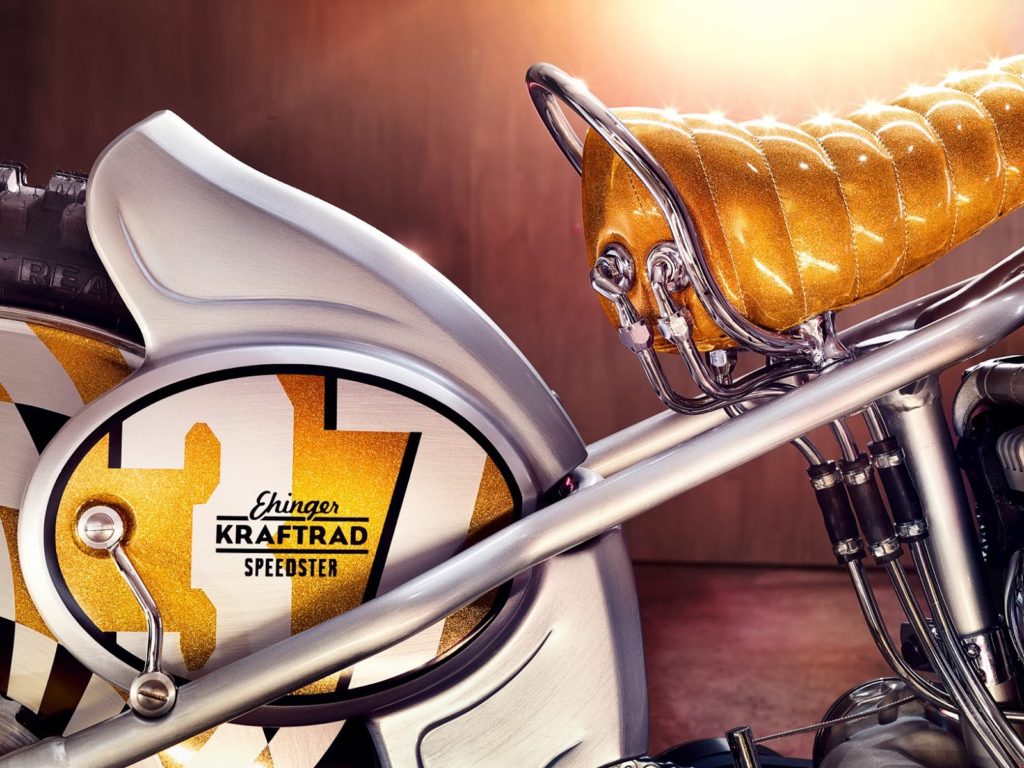
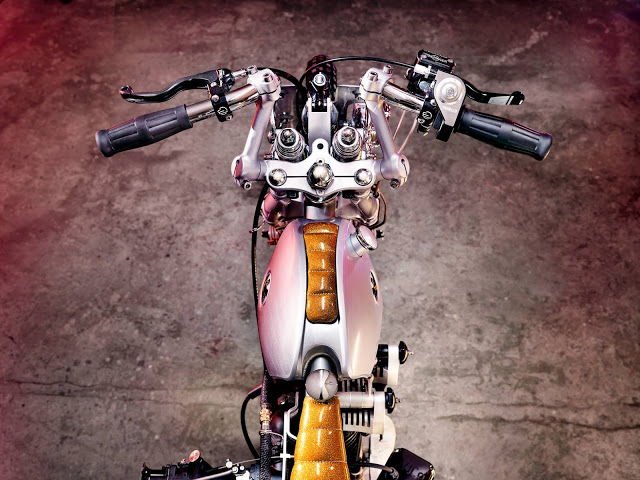
A shorter throw on the wayback machine explains the oil tank–cum-banana seat, a wholly unique creation harkening back to everyone’s Schwinn Stingray. Hidden under the metalflake vinyl padding, the oil tank is transformed into a psychedelic golden caterpillar. The oil filler sits at the seat nose, while the plumbing exits at the rear, and yes of course the seat is going to get warm, but the bike lives in Germany, not the Mojave desert, so it might remain a tolerable ride. That cater-padding extends atop the minimal fuel tank, which mimics a popular chop-job on Harley Peashooter tanks in the ‘30s, an example of which is famously housed in Jeff Decker’s basement. The headlamp is a chopper trope from the 1960s - a VW Beetle backup light.
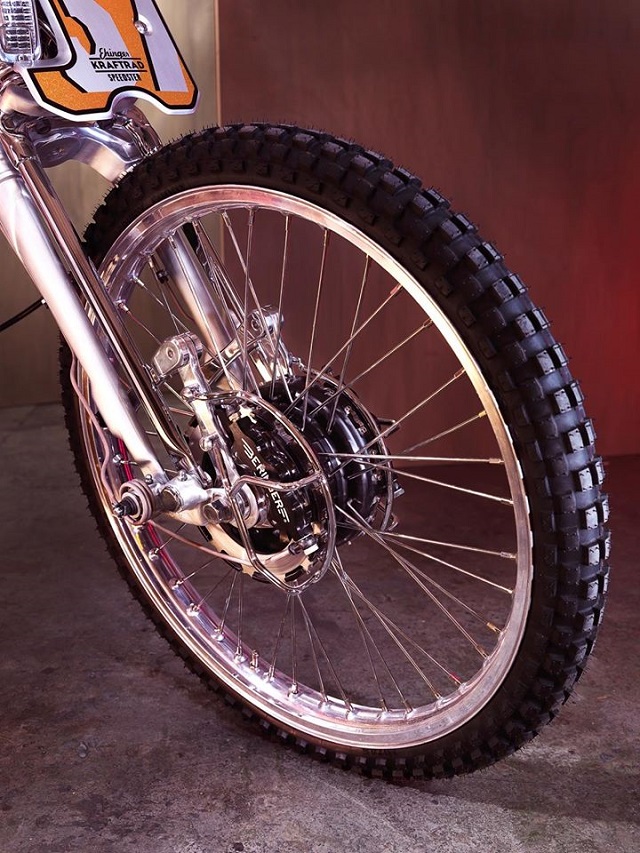
Those unusual brakes are Beringers, originally developed for Cessna aircraft. Hardcore moto-historians like Uwe grok the connection between planes and bikes, especially as early motorcycles poached advances in aviation. We must thank Velocette’s Harold Willis for his the swingarm/shock absorber idea, inspired by the Oleomatic landing gear on his beloved Tiger Moth. OHV and OHC cylinder heads were adopted on aircraft a decade before they came into general use on bikes, although racers like George Dance grafted aero heads onto his sidevalve Sunbeams in the late ‘Teens. “The inboard brakes from Beringer are a nice idea – they’re originally from small airplanes. It’s hard to tell the story of motorcycling without the aircraft industry, but you need a lot of knowledge for an understanding of it. I felt it was over the top to try and discuss this at Born Free – nobody is really interested there.” Ah, but we are, Uwe!
Ehinger prefers to keep the steering geometry of his machines to the factory standard, and no longer builds raked choppers; “I use standard because it’s more reliable – its really about the bike functioning on the street, because it’s all about the road in the end, not the show. It’s nice to have a good-looking bike but it’s all bout the street. To have a non-riding bike is stupid.” He adds, “It’s not an original idea to put the OHV top end of the sidevalve lowers - Koslow did this in the ‘30s. My idea is to make the mix 100% H-D, but surpass what H-D did. For example I’ve used the ‘70s Sportster bottom with a Shovelhead top end for drag racing, it’s not a new idea but different in the way I did it. In bikes everything has been done before – today everyone is talking about 8-valve motors, and those ideas are a hundred years old.”
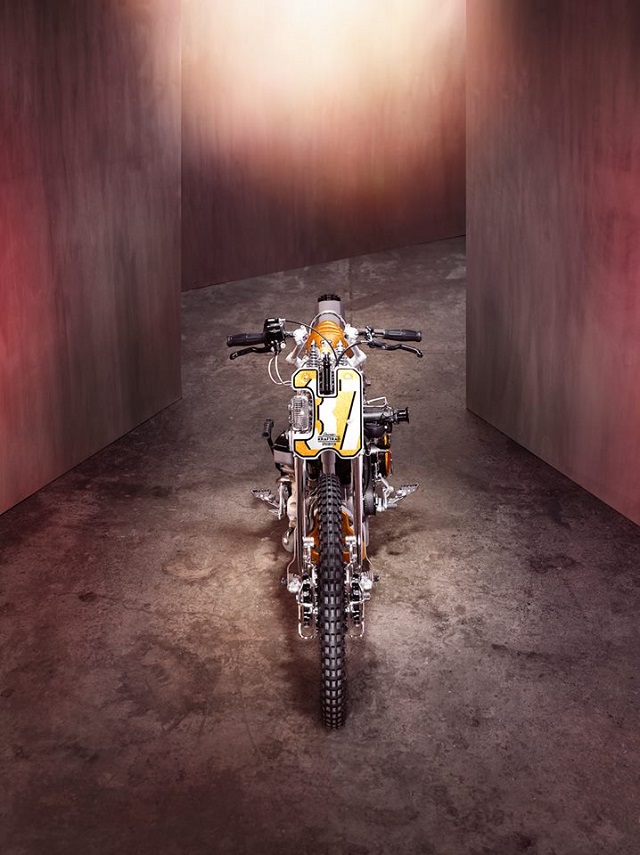
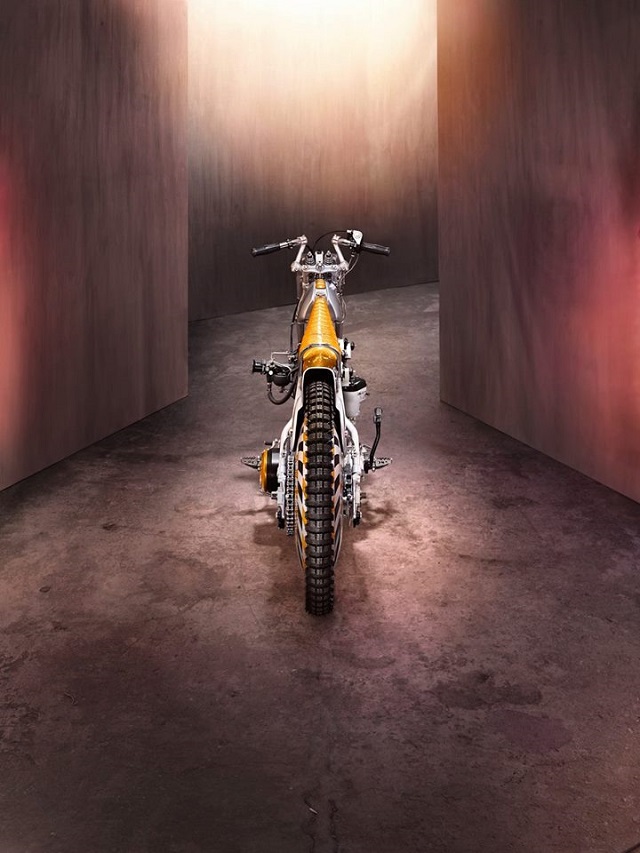
Ehinger’s ‘mix of everything’ method includes, as he puts it, ‘a bit of a California beach cruiser vibe’, although the mechanical details are too gnarly for a cruise. Wild handlebar risers attach to clip-ons, creating an aggro roadster stance atop the narrowed springer forks. The horn of the black Schebler carb is no bong song; it’s a racer’s trumpet, and the faired metal number plates integrated with the hyper-abbreviated rear fender (with a classic H-D kicktail) all suggesting competition. That dramatic rear-wheel disc cover is a speedway convention, being a convenient spot for team colors or sponsor logos on racers with no other sheet metal. The disc is the first thing one sees on the Speedster, and its arresting signature; the black/gold/white pattern was actually borrowed from a hypnotherapy book. Gaze deeply on the wheel…relax…you will like the Ehinger Kraftrad Speedster…and will open your eyes feeling alert and refreshed.
This article orginally appeared in Cycle World: subscribe here to the world's largest-circulation motorcycle magazine!
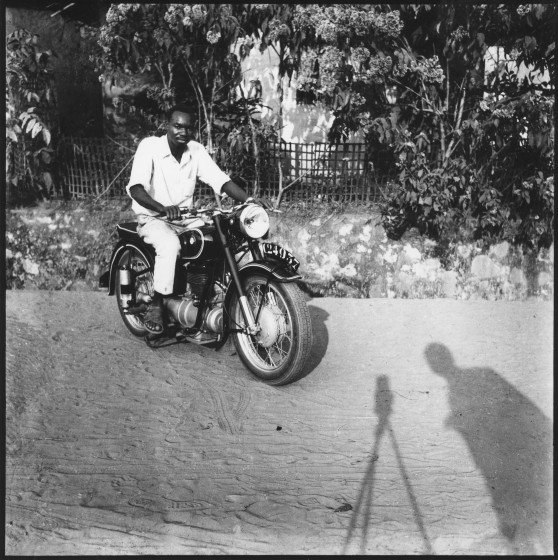
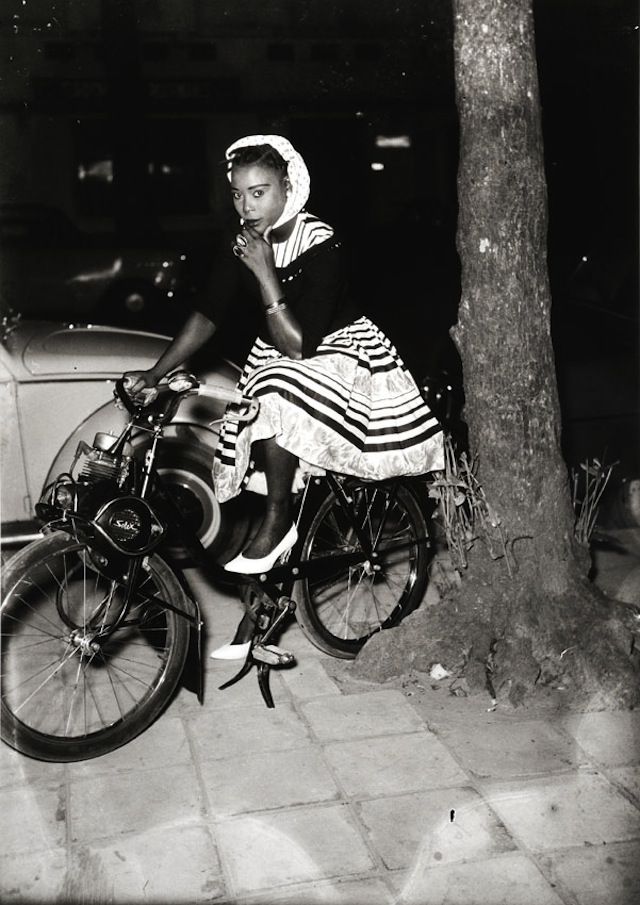
There's been a recent shift in Fine Art photography with African subject matter; instead of being wholly photos OF Africa by outside professionals, photographers FROM Africa have finally gotten their due. The most famous of these is Malick Sidibé, who worked in Mali from the 1960s onwards, documenting street life and capturing the fashions and moods of Mali in his portrait studio (Studio Malick). Included in his many portraits are a few props from his subject's lives, which often meant small motorcycles and mopeds, with sharp-suited young men or whole families draped over their hard-earned mounts.
A portrait of a BMW R26 rider, with a shadowy self-portrait!
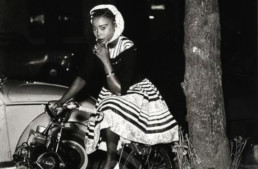
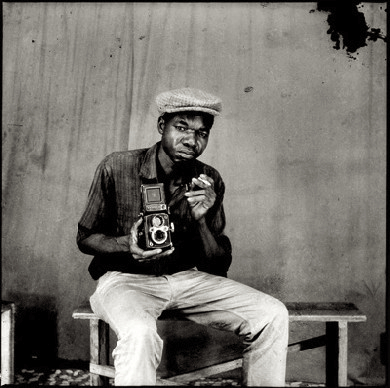
Congolese photographer Jean Depara (1928-97) had his first full retrospective at Maison Revue Noir in Paris, in 2012. Depara's ouevre is similar to Sidibé, although his 'Jean Whiskey Depara' photo studio shots were less interesting than photographs of the world he preferred to inhabit; the happening nightclubs and bars of Leopoldville (later, Kinshasa). Depara bought a camera (an Adox 6cmx6cm) in 1950 to document his wedding, but he became enthralled with image-making, and the interaction of photographer and subject.
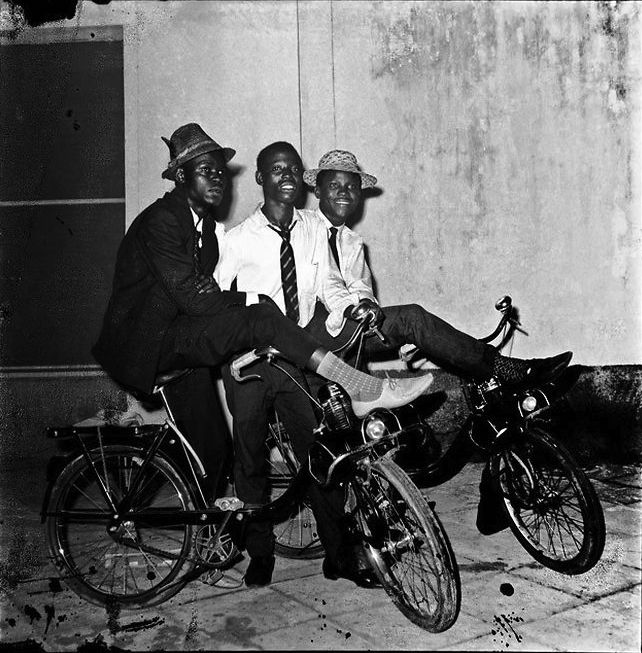
Three 'sapeurs' in snazzy outfits with their mopeds. A Congolese Rat Pack!
Leopoldville was named after nightmare King Leopold II of Belgium (his mother Louise Marie d'Orléans may be a distant relation of mine), who used the famous explorer Henry Stanley (the inspiration for Conrad's 'Heart of Darkness', and Coppola's 'Apocalypse Now') to lay claim to the Congo as his private property, brutalizing and killing millions of Congolese in the process of extracting valuable rubber. The Democratic Republic of Congo gained independence in 1960, and in 1966 Leopoldville was renamed Kinshasa, after a local tribe who inhabited the area when Stanley established his settlement in 1881, as part of the Africanization process common in formerly colonized countries after liberation. [Only Brazzaville retains the name of a European founder - for more on that, read my article from Men's File #4.]
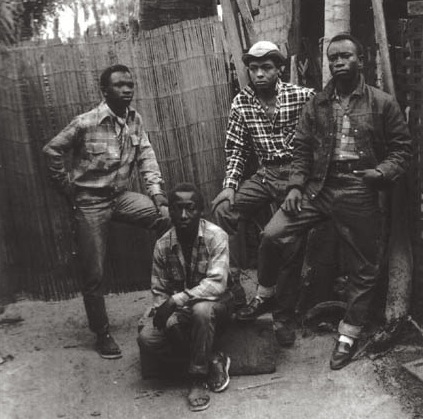
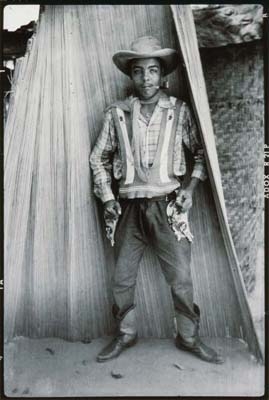
Cowboy style...the gent on the right could have been captured in Brooklyn today!
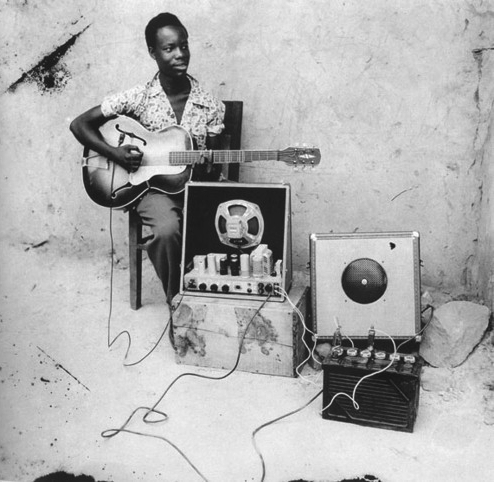
Depara was in the thick of a cultural explosion in the mid-60s, as the country experienced an exhilarating wave of energy after independence. Kinshasa was musically the heart of Africa in the 60s, and Depara spent much of his time around the hot bands and night clubs, where his talents were noted by the famous musician Franco (Francois Makiadi Luambo), who needed an official photographer. This suited Depara, who by this time had honed his technique with the camera as an image-maker, and as a tool for seduction of women!
Jean Depara captured an era of curious integration of American culture as well, as local sapeurs (sharp dressers) sometimes wore cowboy outfits - the 'Bills' - and these make an interesting contrast with the work of Swiss photographer Karlheinz Weinberger and his 'Halbstarke'. Mods and cowboys, women in (or out of) gorgeous dresses, Vespas and mopeds, Depara gives us a glimpse of a very hip world we in 'the rest of the world' didn't have a clue existed.
Looking like a Karlheinz Weinberger photo, and showing the influence of Americana worldwide
In the mid-1970s, as revolutions, coups, and communist takeovers swept Africa, Depara was offered a secure position as official photographer of the Congolese parliament, which he held until retirement in 1989. Uninterested in color photography, and due to the declining profitability of his genre, Depara hung up his camera afterwards, and lived a comfortable existence with his 'villa and a convertible'. His work was published outside Congo only after his death in 1996, and is now appreciated by a global audience.
A self-portrait of Jean Depara with his trusty Adox 2.25" cameraThe origin of the amazing Congolese electric guitar sound - Congotronix!
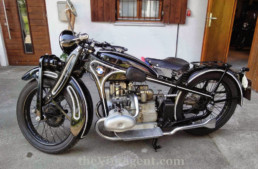
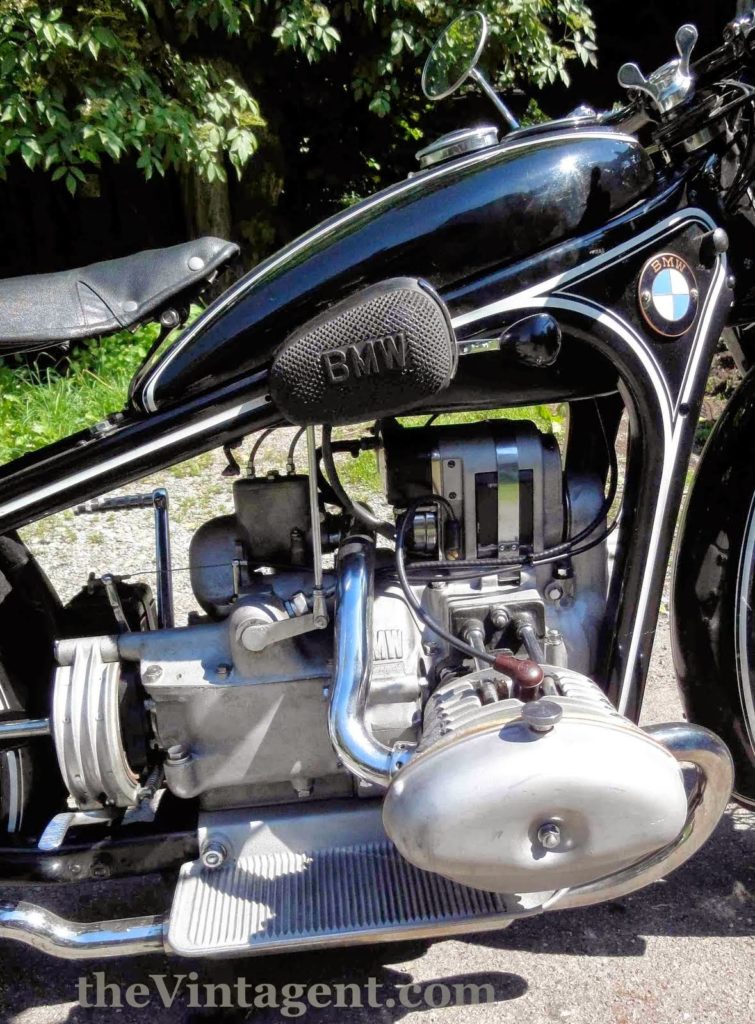
We publish a lot of Road Tests of rare German machinery in The Vintagent for one very good reason: rides on amazing machines have been offered by a long-time supporter, the Motor-Sport-Museum at the Hockenheim race track. This is a favorite of our host, a 1929 BMW R16 with 750cc ohv engine, the top of the BMW range in the Vintage era, with a pressed-steel frame and leaf-sprung forks, three-speed gearbox with hand shift, and a rear brake which squeezes the drive shaft. And according to our host, the R16 'starts easily and rides with never a problem'. With such a warm recommendation, would it be possible not to love this machine? In common with all the Hockenheim motorcycles loaned out for Road Tests, this BMW has been fettled to the highest standards by a demanding owner, who expects motorcycles to run as they did when new, and in fact, rides them as if they were. No pussyfooting around, he winds it on to see what they'll do and how they'll perform.
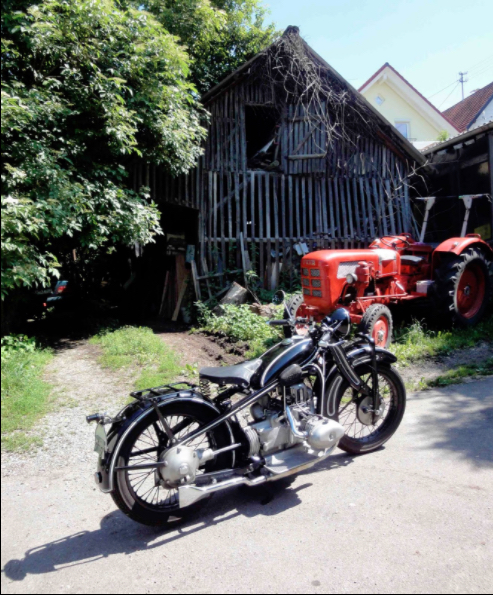
Definitely not a tractor! The BMW R16 is a sports-tourer of the first order. [Paul d'Orléans]In other words, no points lost for full-throttle work by a journalist, as long as I don't throw the plot in a ditch; that would be simply poor form, and likely end my access to some of the most interesting motorcycles on the planet! So, a hot ride, with conscious care, is the order of the day. No GPS required either, I'd be following the owner in his 1952 Hotchkiss Gregoire 2-door coupe, with an aluminum body and flat-four 2.3liter engine. Never heard of it? Don't worry, this example is probably unique, one of 7 made with a Chapron body that year, fast and lovely.
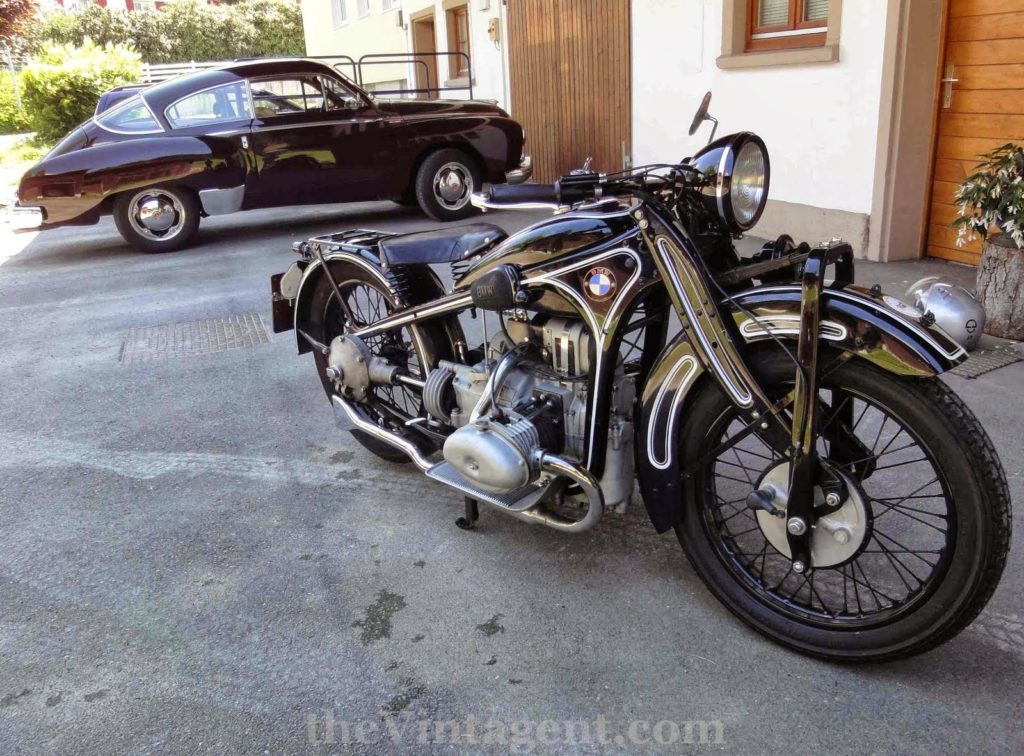
The road test BMW R16 with it's stable-mate, a super rare Hotchkiss Gregoire with Chapron body. [Paul d'Orléans]Starting the beast was simple as with all BMWs; flood the carbs a little, knock back the ignition timing, wind the choke closed, and kick it over; the magneto is strong and the bike starts instantly, surprisingly loud in fact, not mechanically (although there is a whir from the gear-driven timing chest), but from the exhaust - definitely not your brother's BMW, it's rorty with a flat bark from the twin fishtails at the back. It doesn't take long for the engine to warm up and the choke to become redundant, and the bike has a roll-on center stand with no fiddly rear stand to look after.
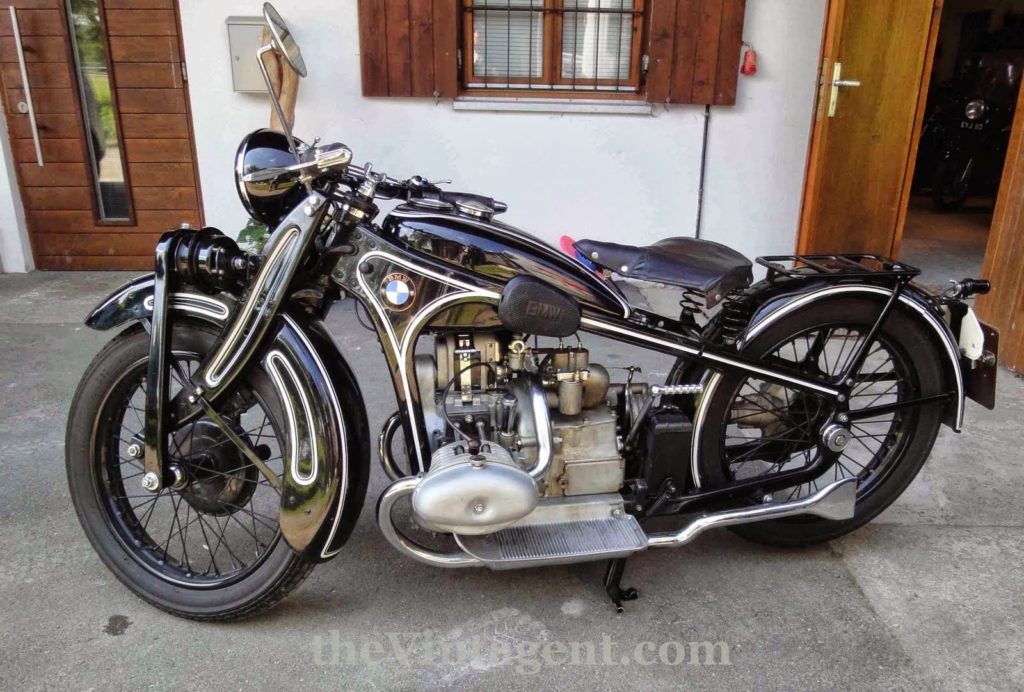
A motorcycle full of visual appeal! The leading-link forks would be replaced in 1935 with the R17 model, which was otherwise identical barring technical improvements. [Paul d'Orleans]So, when it's revving freely, roll it off the stand, hand-shift on the right from neutral to 1st with a very slight clunk, and move on out. The hillsides in this area are green as jealousy from weeks of spring rain; today is the first with full sun, and motorcyclist sprout like daisies everywhere. The power band of the BMW is soft with plenty of torque, and winding the motor out in first and second definitely gets one to 60mph briskly - this isn't a measly 500cc ohv, the extra 50% capacity makes a clear difference in rideability in modern conditions. The owner has "become a bit of a snob, as the 750cc has spoiled me for the smaller capacity BMWs" No points lost there either.
Overall, a very pleasing assemblage of lines and volumes, with the ovoid valve covers echoed by the fuel tank and the graceful arc of the pressed-steel frame. [Paul d'Orléans]Shifting through the 'box takes a bit of practice to match revs to road speed, and double-declutching helps when downshifting to retard speed. The front brake is quite good, but the heel-operated cardan shaft brake at the back is anemic. I got the hang of upshifting soon enough, but both up and down gear changes required a full beat longer than I'm used to...patience, grasshopper. My host says "keep it in third (top) gear, it's all you need", which is true, but the bike lugs a bit at a village pace, and I like the challenge of rowing through the gears. Besides, acceleration out of second gear is very satisfying! Gearbox noise in the intermediates isn't noticeable, perhaps because of the rorty exhaust, or maybe because this bike has been sorted completely. It has the quietest vintage BMW gearbox I've experience; the 1928 BMW R63 I formerly owned whined so badly I was convinced it would explode...
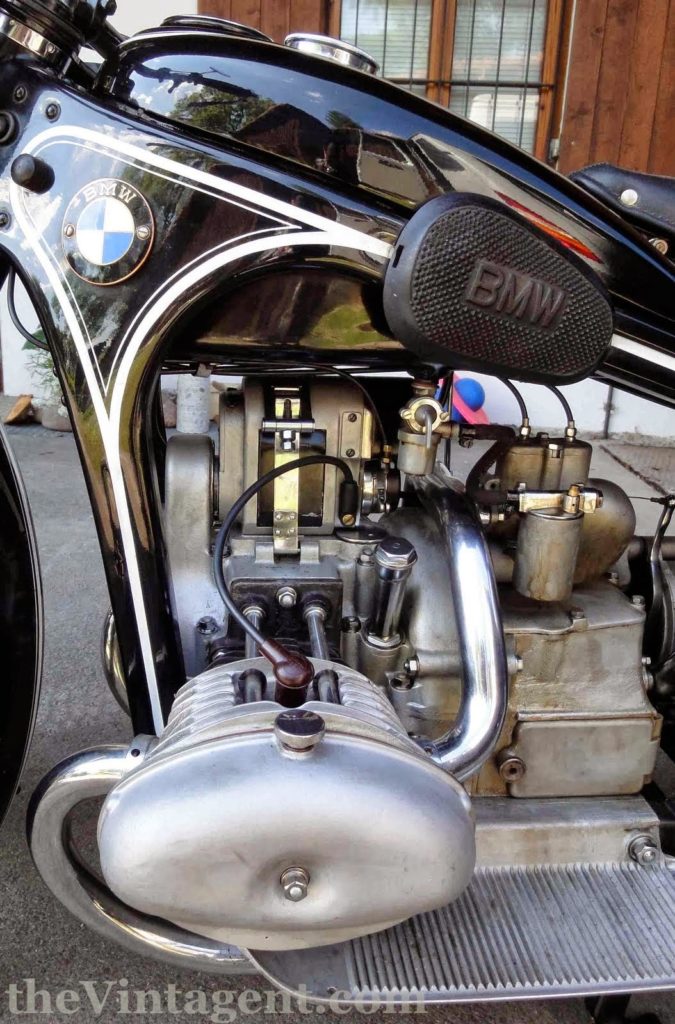
The stack! In typical 1930 fashion, the magneto is not integrated into the design of the motor, but is a bought-in accessory. It would take BMW a few more years to sort that out. Also not the twin-slide carburetor, for a finer air/fuel mix control. And the oil filler cap on the valve cover - no direct oiling of the valves yet. [Paul d'Orléans]As for power, some full-throttle top gear work going slightly uphill yielded 145kph on the speedo, which corrected means 138kph actual, which is near enough 85mph. More is possible in the right conditions, so let's say best case scenario 90mph, which is really going some on an 80 year old machine. The handling was impeccable, and even at 80mph the bike felt rock solid. It's spoiled by the smooth German roads, and I might have a different opinion of the undamped leaf-sprung front forks over lousy Cali roads. But cranked over and on the gas, the bike went where it was told with absolutely no drama. Shifting left/right/left on some fast s-turns revealed a hint of flywheel torque reaction on right-handers, which meant a barely perceptible push to crank it over on that side. But the wide handlebars made for graceful changes of lean, and an ergonomic riding position to boot.
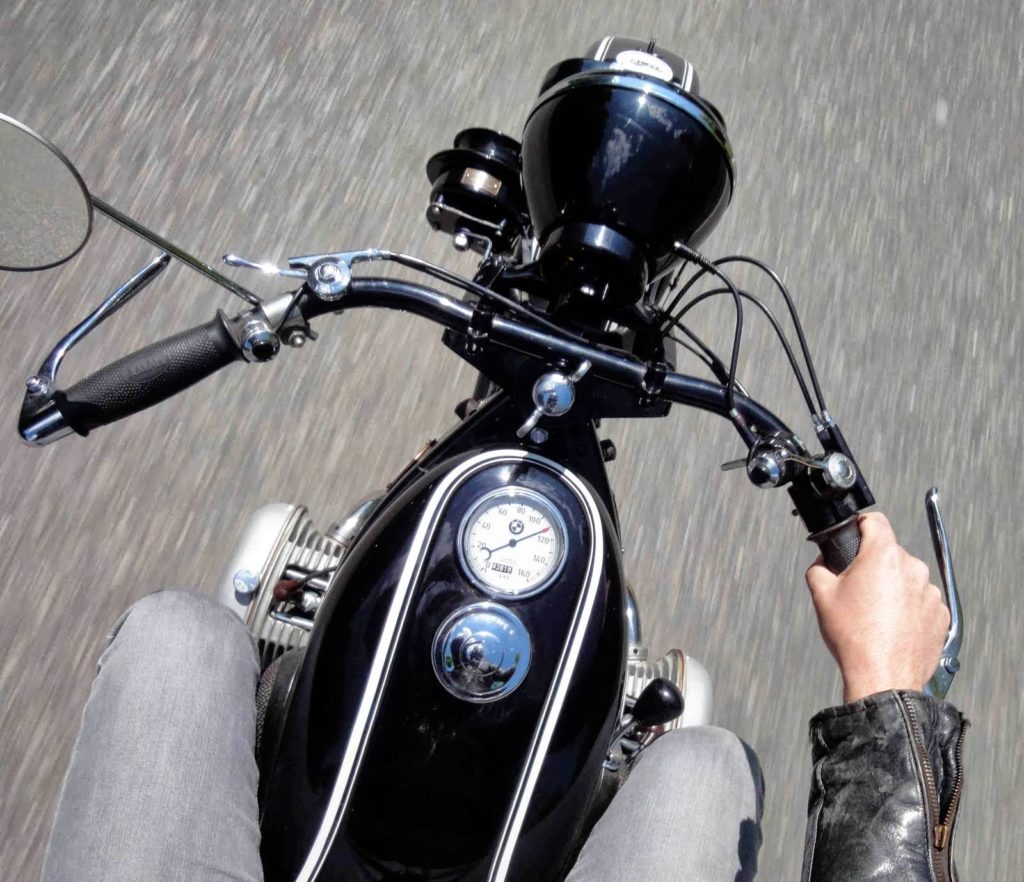
The view from the saddle: all the controls fall easily to hand, with only the heavy Bosch horn looking like an afterthought. [Paul d'Orleans]Aesthetically, these late Vintage BMWs are Art Deco perfection, with their modernist industrial steel chassis mated to an engine with clear aero heritage. The hand-painted pinstriping over basic black emphasizes the line and curves, echoing engine-cover ovals and frame-press indents. They hadn't yet sorted out integrating the ancillaries like magneto/generator/carb, which sit atop the smooth engine lines and remind one that this is in fact a 'machine with other mechanical bits bolted on which do important things'. In German, that's one word.
If I were in the market for a totally rideable prewar bike, a BMW R16 would be at the top of my list. I could have ridden all day without fatigue or worry about mechanical disaster, at a rapid if not racing clip. It's the very definition of a sport-tourer, meant to be hustled along through beautiful countryside, just like I did on the test day. Perfect.
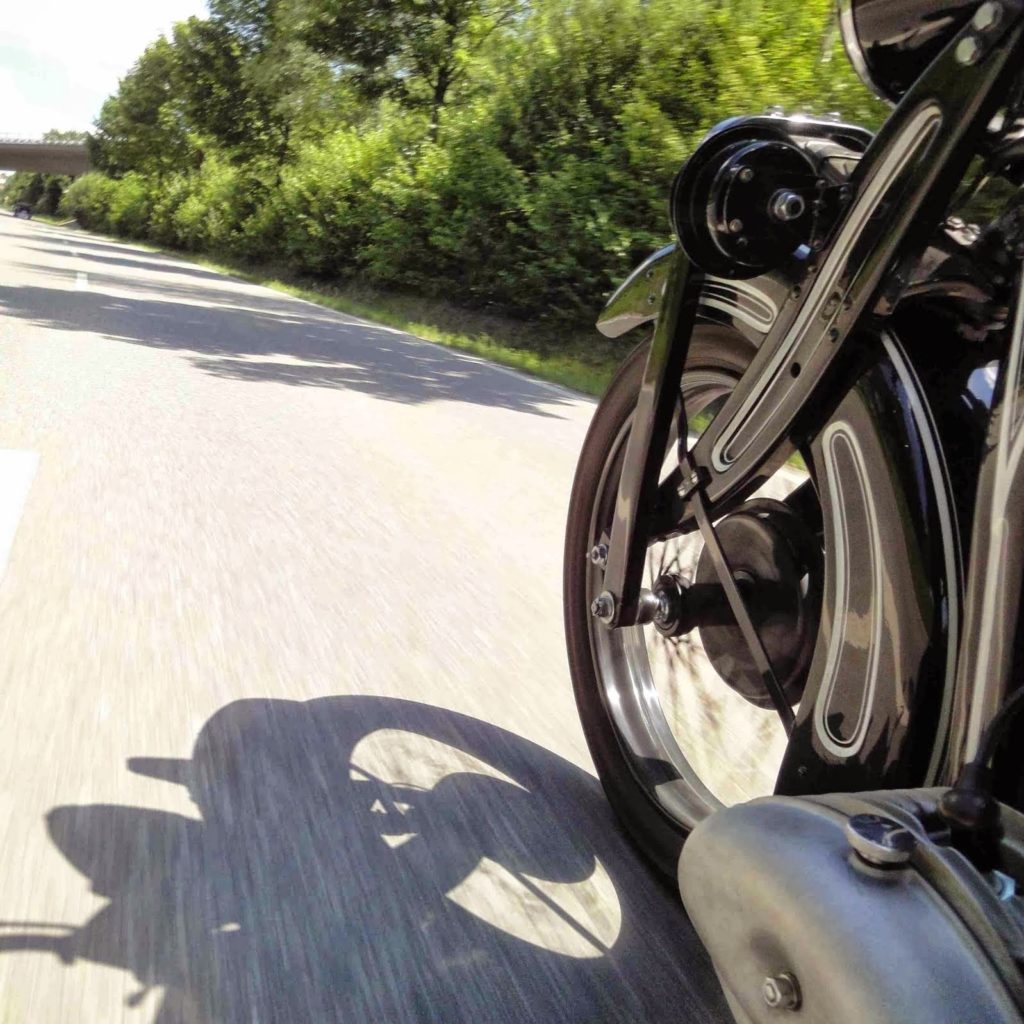
Point the wheels down the road and twist the grip. Let's see how she rolls! [Paul d'Orléans]
Paul d'Orléans is the founder of TheVintagent.com. He is an author, photographer, filmmaker, museum curator, event organizer, and public speaker. Check out his Author Page, Instagram, and Facebook.
"Yes, but what's it like to ride?" Every time we've seen the handiwork of eccentric constructor Friedl Münch, we can't help but be impressed by the sheer scale of the Mammuts which bear his name. While every single one of his limited-production motorcycles is unique, they have a remarkable consistency of build quality and use of trademark components, notably the NSU four-cylinder car engine from their Prinz or 1200TTS models, from which all parts radiate.
The open road beckons! How will she perform? So much legend to live up to... [Paul d'Orléans]
Münch began his career in the late 1940s as an independent tuner and inveterate modifier of motorcycles. His first notable work was on a Horex in 1948, which had such good performance the factory offered him a job in their competition department. He had no desire to work for someone else, and refused their offer, but later relented due to financial difficulties, a consistent theme in his business life.
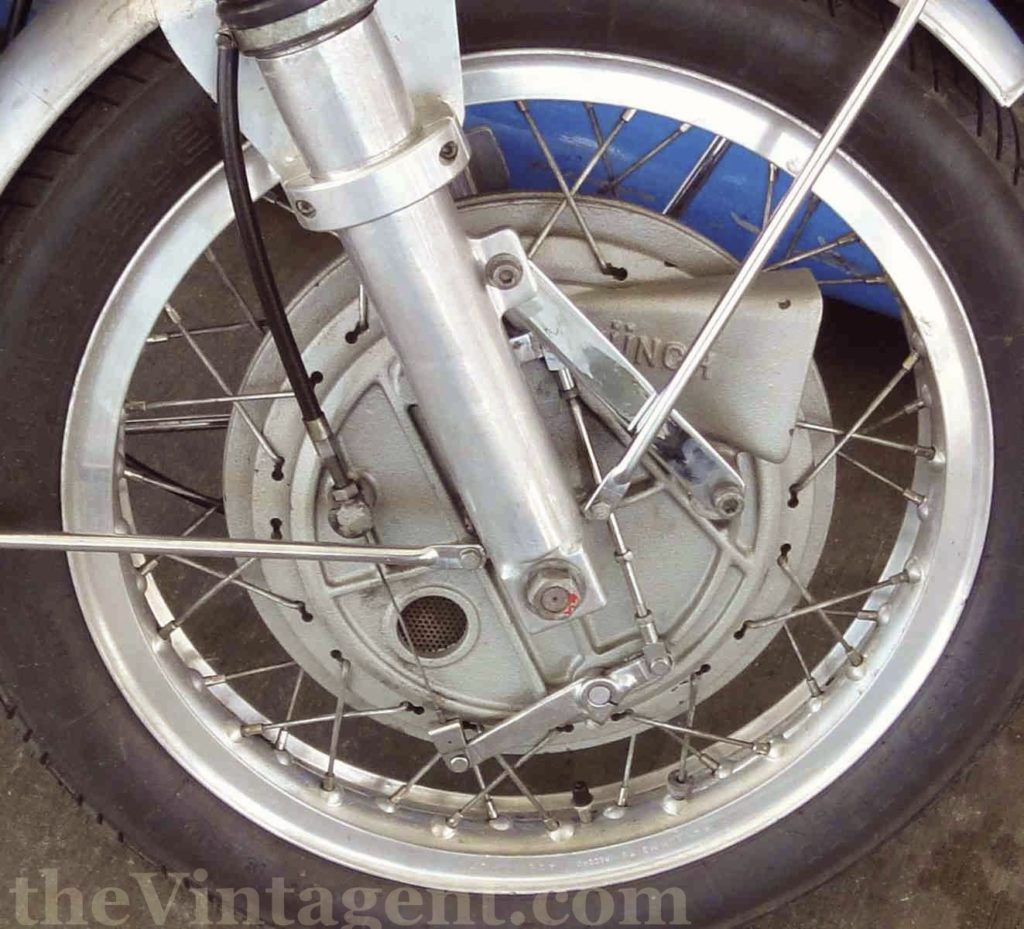
After Horex went bankrupt in 1960, Münch bought their tooling, and made spares and built Horex specials (such as the tasty cafe racer above). In the quest for more speed, he created a 'relatively' light racing motorcycle using the NSU ohc four-cylinder engine, weighing in at around 480lbs total, and giving good performance. The frame was based on a Norton Featherbed, as were all his subsequent chassis. The first proper 'Mammut' (Mammoth) was built in 1966, with 996cc and 55hp, which gave good performance for the day at 115mph or so. It used a very large (250mm) magnesium front drum brake which Munch had originally developed for racing Nortons. The new machine was a sensation for its speed and impressive scale, and Munch pursued the idea of series production.
Friedl Münch's first production bike, with a Horex motor and his own chassis - note the huge magnesium wheels that would reappear on the Mammut. [Paul d'Orléans]By 1968, the capacity was increased to 1177cc with 88hp with the '1200 TTS' model, the state of tune reflecting the NSU car of the same name. Münch created the cast magnesium rear wheel with flat spokes which became a trademark of all later Mammuts, as even with robust 5mm spokes for his original wire wheels, the threads tended to strip on the spoke nipples. As well, the seat/mudguard unit, headlamp bucket, and chainguard were cast in magnesium, for lighter weight. Petrol tank and side panels were hand-hammered aluminum, and the single headlamp Sports models were joined by dual-headlamp Touring machines. Despite all the magnesium, the bike weighed in at a mammoth 295kg (650lbs); not far out of line with 70s/80s sports machines from Japan actually, but in 1970 sports bikes were still typically under 500lbs.
The man himself, Freidl Münch with an early version of the Mammut. [Private Collection]The early 1200 TTS models used twin Weber DCOE carbs, but by 1973 fuel injection and 1278cc were available in the TTS-E, giving a full 100hp, with true Superbike performance. American publisher and controversial motorcycle enterpreneur Floyd Clymer invested in Münch with an intention of large-scale production for the US market, but died before the project was fully underway, a tale of woe shared by his links with Velocette, Indian, Royal Enfield, Italjet, etc.
The scale of the Mammut revealed: our Road Tester is 6' tall, and the Mammut looks no larger than a Honda CB750 here. Where's the scare? [Paul d'Orléans]Münch, always struggling financially and casting about for backers, eventually sold his own name in association with his motorcycles to businessman Heinz Henke, who intended to series produce 'Münch' bikes (only a few were built, perhaps only 4). Friedl maintained 'Mammut', and shortly began producing models under this name in limited numbers for collectors. Every machine from the first was bespoke around a similar core, although the state of tune, shape of tanks, seat, mudguards, handlebars, headlamps, color, etc, were all optional. Each machine was hand-built by Friedl Münch and his employees, and his legend grew for his unique and mighty machines. Less than 500 were ultimately built.
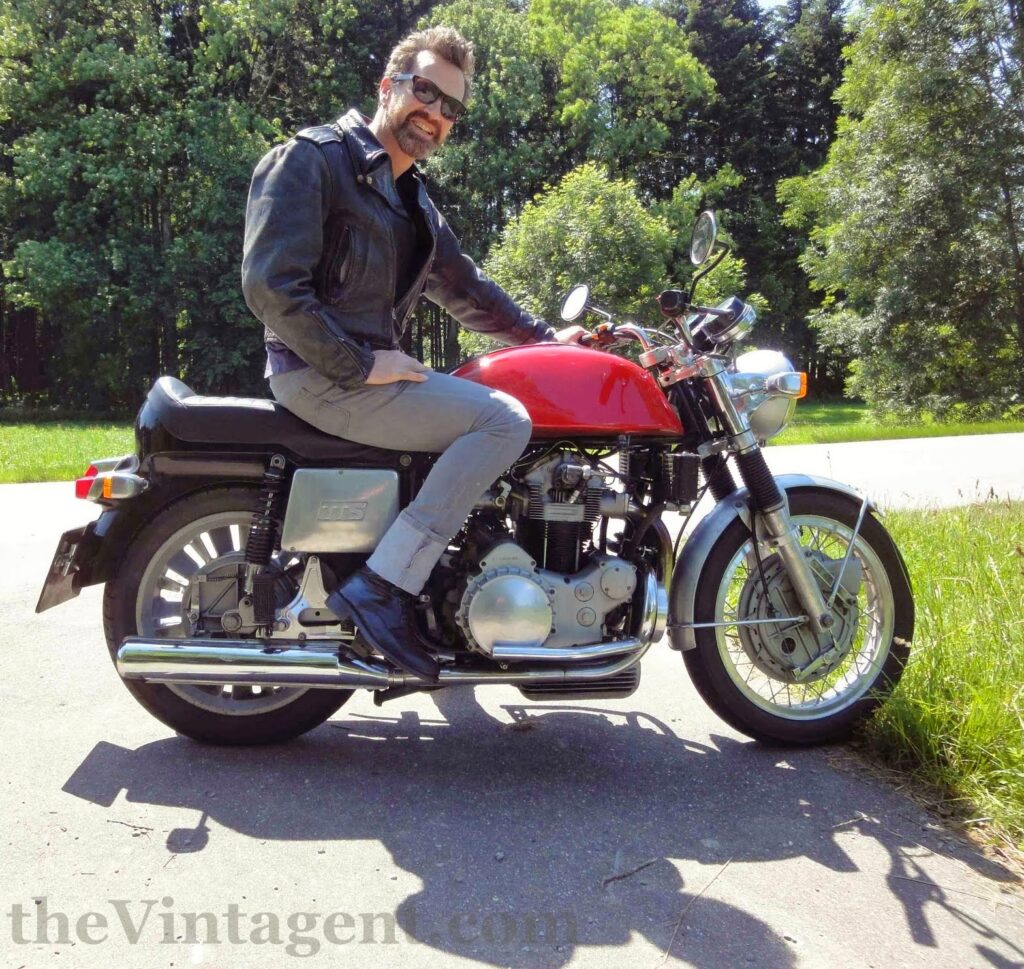
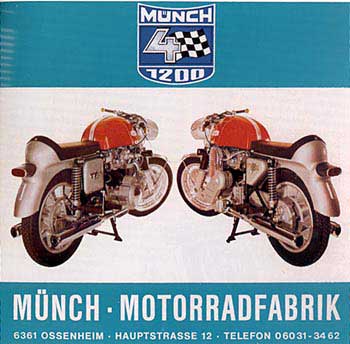
Double trouble: a 1970 Münch catalog. [Private Collection]So, what is it like to ride? Our Road Test machine is a 1970 model with 1177cc engine, set up in Sport mode with the large single headlamp and twin 40mm Weber DCOE carbs. These would have been hot stuff on any sports car of the day, so why not a 4-cylinder motorcycle? The instruments and switchgear are as per Honda, while turn signals and lamps are Bosch. The big engine starts up with a button, revving slowly and lumpily, and takes a little while to warm up as there's a lot of aluminum and steel lurking under that big red tank. The exhaust is subdued with Lafranconi-pattern silencers made in Frankfurt keeping things quiet. A rorty cafe racer this is not.
Our host warns to keep the revs up when moving off, as first gear is tall and the clutch doesn't fully engage until the end of its reach. Regardless, we almost stall the bike as of course he's right; give it some welly and slowly engage the clutch - the engine, clutch, and gearbox are robust and can handle such abuse.
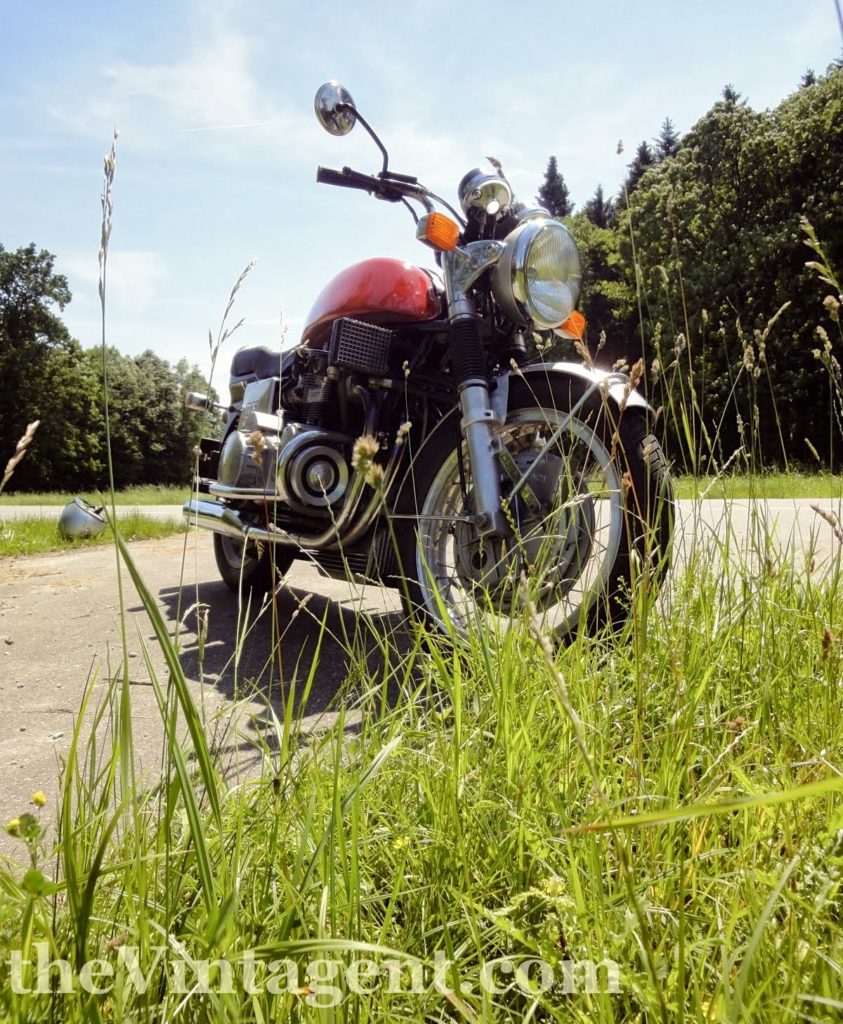
Splendor in the grass. The Mammut felt much lighter on the road than its bulk suggests. [Paul d'Orléans]With a reputation for awesome power, we feared the TTS would leap out of hand with revs in first gear, but the engine isn't especially torquey despite the large capacity, and doesn't produce much power at all below 2000rpm. In fact, when moving out or riding slowly, dropping below this figure meant hesitation and incipient jerkiness - just keep things on the boil and all will be well.
On the open road, the engine seemed happiest above 3000rpm, and hit a sweet spot between 4000-4500revs, at which point the machine is hustling along at 80mph in top gear, with a quiet motor and soft induction hiss from the Webers. But, redline is a long way away yet on the Nippon Denso tach, and winding the throttle back produced a total change in character. From smooth and quiet tourer, Mr Hyde emerged, and while it wasn't arm-pulling, the satisfying surge of power combined with a sonic wail to remind us that there was indeed a tuned motor between our legs. Sounding for all the world like an early '70s race car in Rally Sport mode, the carbs loudly sucked air while the mufflers gave a harsh rasp, the rev needle swung around past 5000, and the speedo was well into the illegal zone. There was no point in revving past 5500rpm, as the bike didn't seem to spin quite so freely anymore, and the handlebars began to buzz slightly.
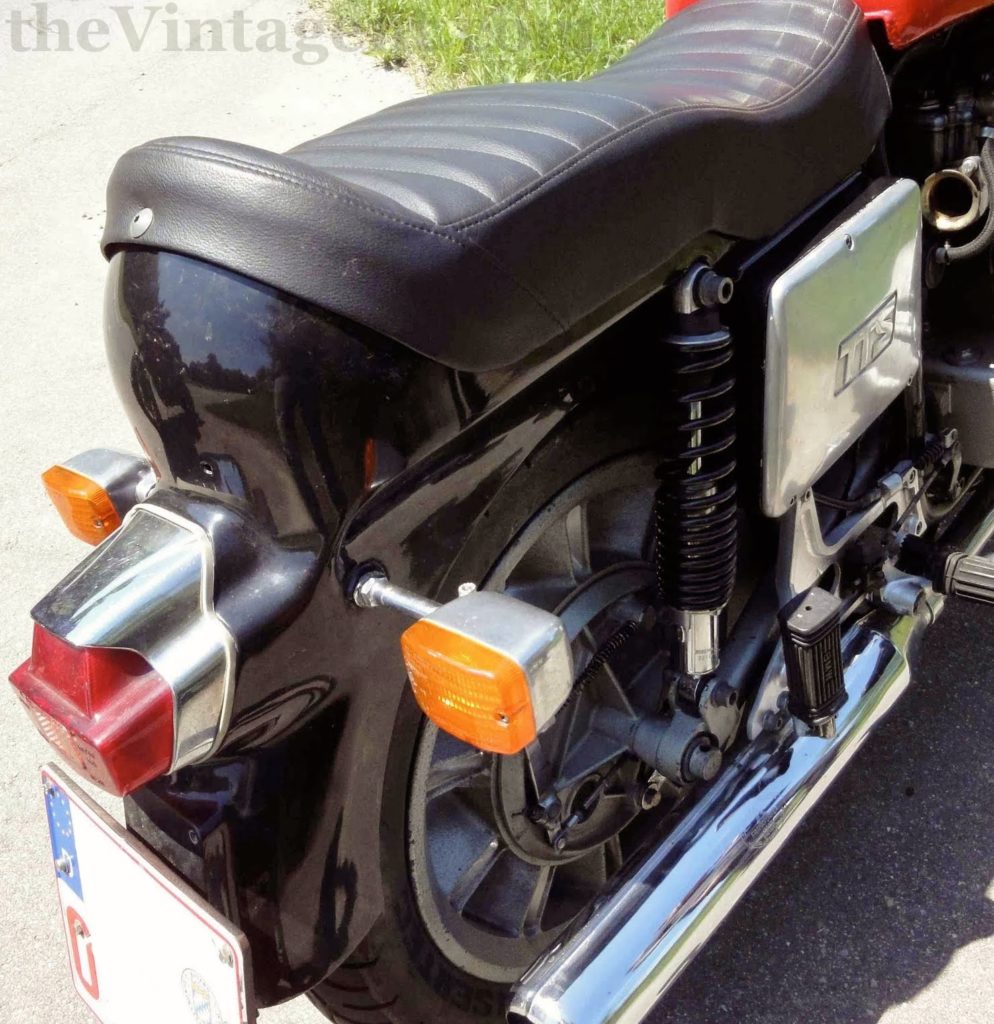
The seat of the Münch is a one-piece aluminum casting that incorporates the taillight housing and fender. The rear wheel is a massive multi-spoke design from Münch himself. [Paul d'Orléans]Southern German country lanes wind between forest and hills, affording a great chance to assess the handling of this tall machine. True to its Norton frame heritage, the Mammut tracked straight and true and secure on all corners, with no drama or fuss. The high center of gravity and weight disappeared once in motion, and it felt completely secure and familiar banking around corners. Changing direction on short 'S' bends was easy and required no effort, the Mammut proving silky smooth when transitioning from left to right. The wheelbase is short for such a large machine (giving rise to a cobby appearance with the large tanks and double-headlamp variants), and above 80mph, a slight weave set in; nothing dramatic, just noticeable, and it didn't get worse, nor disappear in a straight line. When banked over at the slightest angle, any such uncertainty disappeared.
Braking with the extra-large Münch drums was very good for such a heavy bike (all-up weight with rider and fuel in this case being 820lbs!), and while not in double-disc territory, they hauled up the Mammut quickly. This was especially welcome as the engine provided almost no compression braking, seeming to have very little flywheel effect in general, from idle onward...of course, Münch used a much lighter flywheel than the NSU car. The suspension wasn't really noticeable, which is itself a high complement; the front forks are Rickman items, and hold the road very well without being Italian-stiff. The riding position was very comfortable, more sport-touring mode than uncompromising boy racer, as of course, most Mammut owners were middle-aged connoiseurs, able to afford a handmade Superbike.
The massive front brake casting of the Mammut is legendary; nothing lightweight or fragile about this machine! [Paul d'Orléans]The advent of inexpensive Japanese 4-cylinder machines only a few years after the introduction of the Mammut meant that sales were based on bespoke build quality, excellent handling, exclusivity, and charisma in spades - all of which the mass-produced motorcycles lacked. The Japanese 4s did have power though, and to keep ahead, Munch regularly tuned his engines to higher outputs, eventually turbocharging the fuel-injected motor with the 'Titan' model. We'd love to try one of them!
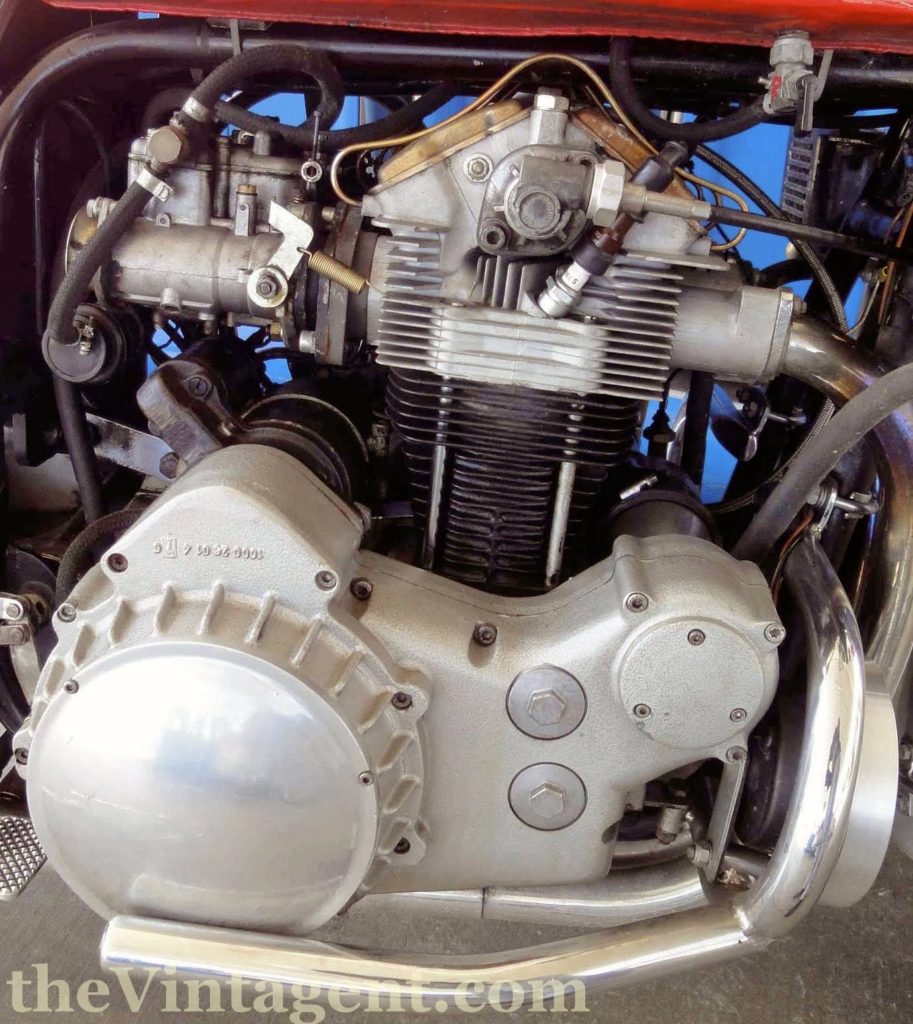
The heart of it all; the big NSU 1200TTS engine, with dual Weber side-draft carbs. [Paul d'Orléans]
Paul d'Orléans is the founder of TheVintagent.com. He is an author, photographer, filmmaker, museum curator, event organizer, and public speaker. Check out his Author Page, Instagram, and Facebook.
He made his way from a local newspaper writer and sports photographer, to a stylistic pioneer of action photography, to the most famous and well-paid fashion and celebrity photographer in the world. And yet, only dedicated photography fans remember Martin Munkacsi, who died in 1963 in poverty, 30 years after he escaped Nazi Germany via a $100,000 annual contract from Harper's Bazaar. How he came to be forgotten, and lost the career that made him famous, has never been satisfactorily explained. On his death, his negatives were lost, and his ex-wife found his apartment nearly empty, barring a half-eaten tin of spaghetti, the fork still in the can.
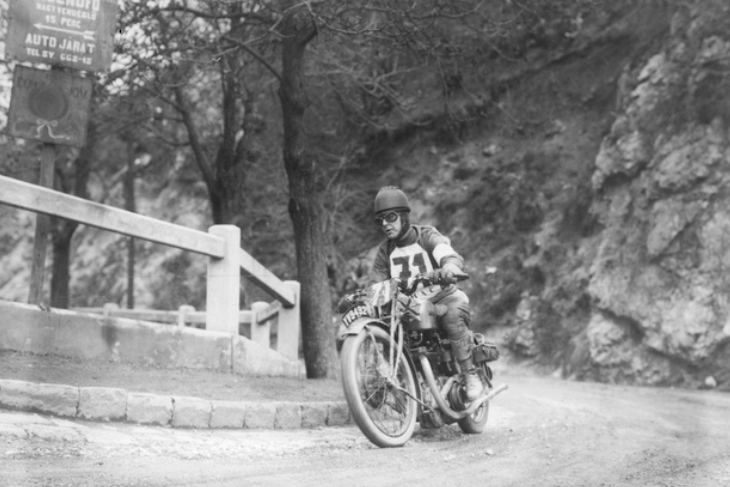
'100 Kilometers Per Hour', shot at the Hungarian TT in 1927, of a rider on an Ariel Red Hunter
Munkacsi's career got a boost from a murder; he witnessed a street fight, camera in hand, and the published photos helped convict the killer. This new use for photography made him famous, although he'd already made a name for himself in Hungary, shooting motorcycle races (like the Hungarian TT) and car races, boxing matches, and other sporting events. He claimed, “My trick consists of discarding all tricks," and his work emphasized plein-air naturalness throughout his career, even in 1930s fashion photography, which was notoriously static before he began shooting models outdoors with natural light. It was how he learned to shoot, after all, using a 4x5" Graflex camera at sporting events, where strong natural light was required. His trick, though he denied it, was an innate genius for composition, with his best photos - even spontaneously shot - looking perfectly structured, with a balance of light and dark, but full of energy and motion. As one critic put it, 'his work should come with a soundtrack.'
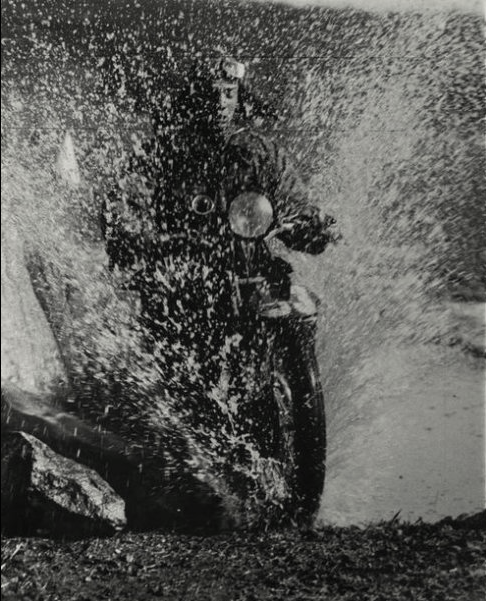
Munkacsi's first published photos in Berlin, of a rider fording a stream
After the 'murder photo' spread his name in 1928, Munkacsi was called to Europe's thriving capitol, Berlin, to work for the Berliner Illustrirte Zeitung (Berlin Illustrated Times). His first published photo was a motorcycle splashing through water, and while he was ever attracted to machines in motion, his big paycheck came from the fashion world, where he un-crossed the legs of proper ladies, and photographed them running through nature in beautiful clothes, which nobody had ever done. He followed the muse of the latest type of image-making, the snapshot, saying "All great photographs today are snapshots." What would he think of the ubiquitous iPhone selfie?
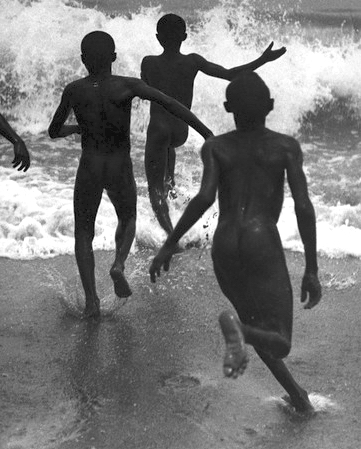
The photograph that so influenced Henri Cartier-Bresson, 'Three boys at Lake Tangnyika'
His fashion work for Die Dame (The Lady) made him internationally famous, and allowed him to travel globally, capturing people in Turkey, Sicily, Egypt, London, and Liberia, sending back amazing photo stories for the Zeitung. These photos were profoundly influential to a younger generation of photographers, and Henri Cartier-Bresson, on seeing the photograph 'Three Boys at Lake Tanganyika', said "For me this photograph was the spark that ignited my enthusiasm. I suddenly realized that, by capturing the moment, photography was able to achieve eternity. It is the only photograph to have influenced me. This picture has such intensity, such joie de vivre, such a sense of wonder that it continues to fascinate me to this day."
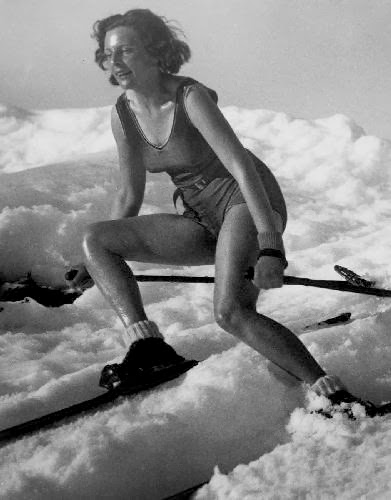
Munkacsi was commissioned by Time magazine in 1934 to photograph Nazi propagandist filmmaker and Hitler protégé Leni Reifenstahl for the magazine's cover. He mocked her typical heroic camera angles with a posed, static shot while skiing in a bathing suit.
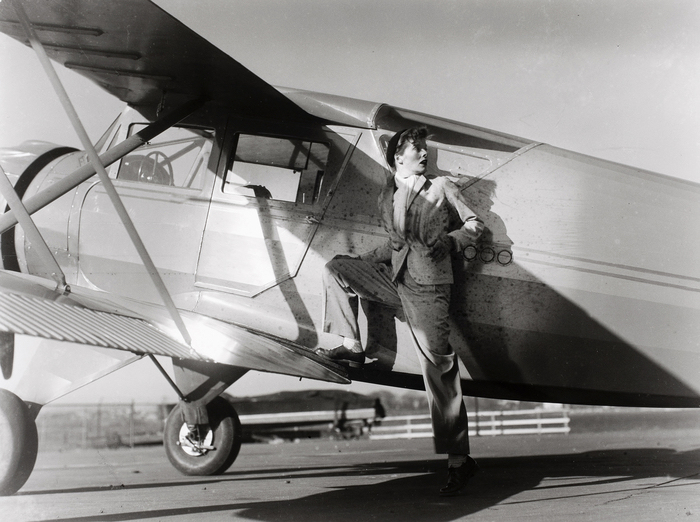
On March 21, 1933, Munkacsi photographed 'the Day of Potsdam', when German President Paul von Hindenburg relinquished power to Adolf Hitler. The following year, the Jewish-owned Berliner Illustrirte Zeitung was nationalized, and published only photos of soldiers henceforth. Munkacsi was himself Jewish, born Márton Mermelstein, and his father had changed the family name to avoid the anti-Semitism prevalent in all of Europe at the time. But a name change wasn't shield enough from the Nazis, and Munkacsi left for New York City in 1934, where he landed that job at Harper's Bazaar. His outdoor shoots transformed fashion photography in the USA, and soon led to a thriving celebrity portrait career, using the same style of impromptu yet brilliantly choreographed photos capturing movie stars in their home (or fantasy) worlds. His shots of Katherine Hepburn, Joan Crawford, Louis Armstrong, and Fred Astaire are legendary, and sometimes definitive; the typical glamour shots of movie stars of the day are hazy and static, but Munkacsi brought their energy to the page.
Katherine Hepburn looking very Amelia Aerhart with a plane
For whatever reason, several museums and universities declined the offer of his archives in the early 1960s, and on Munkacsi's death in 1963, his life's work was considered lost. Amazingly though, his archive turned up on eBay. That's where the chief curator of New York's International Center for Photography, Brian Wallis, spotted it for sale for $1Million (it's always a Million Dollars!), and the collection was right across the river, in Connecticut. A personal visit, some fundraising, and 300lbs of cardboard boxes filled with glass negatives later, and thousands of Munkacsi's photographs are in the collection of ICP, who held an exhibition of the work in 2007, as 'Munkacsi's Lost Archive'. It was the first push towards a revival of his reputation, which had nearly vanished into obscurity; his work deserves a better fate.
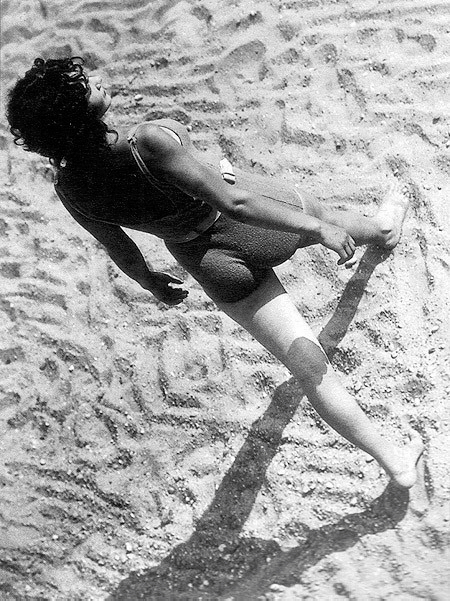
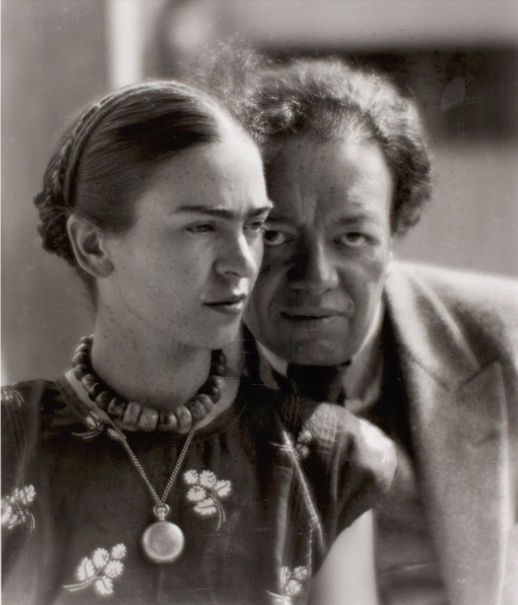
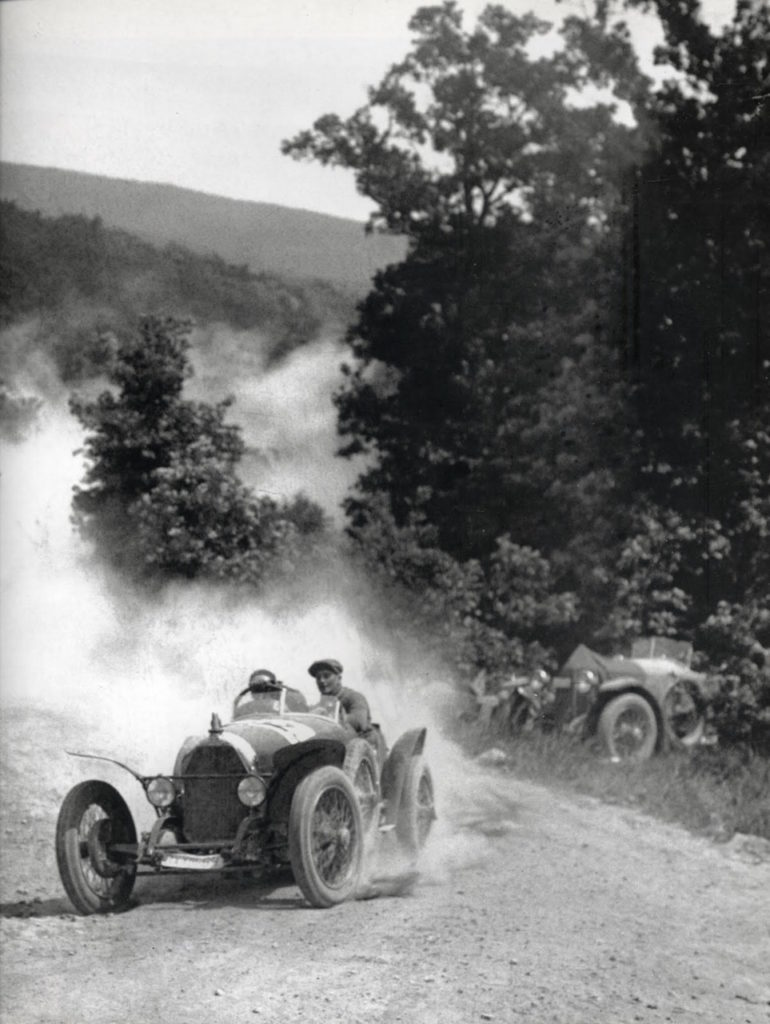
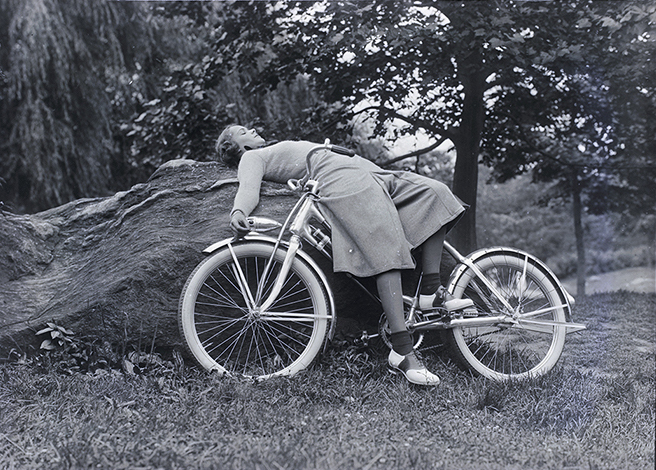
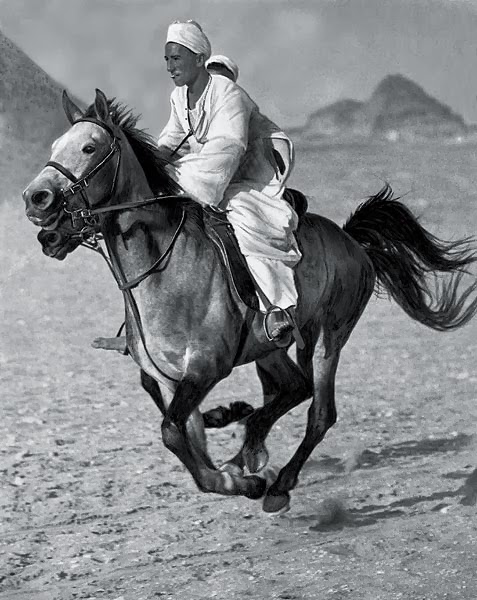
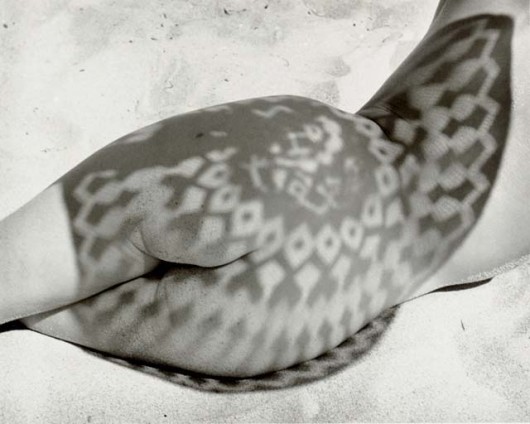
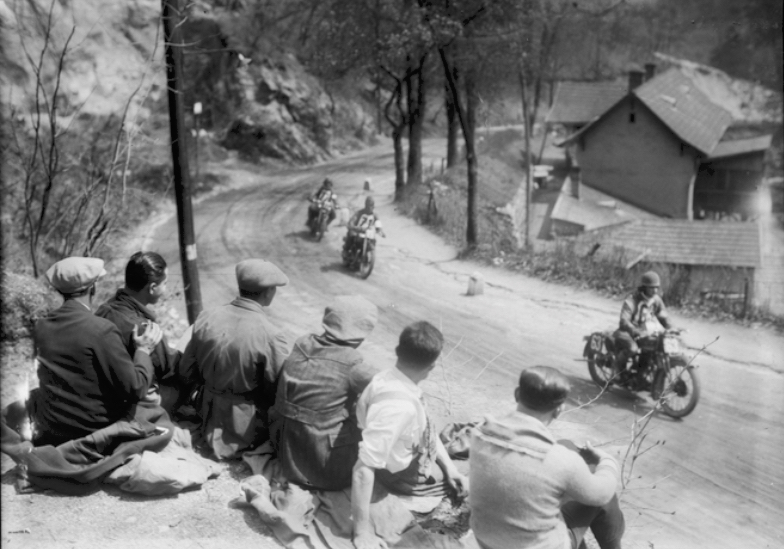
Another shot of the Hungarian TT in 1927A swimwear fashion photo from the 1930s, shot at an unsual - and unusually provocative - angleMunkacsi shot Frida Kahlo and Diego Rivera at their home in Mexico CityDirt roads make wonderful effects on camera; an early auto race in HungaryAnother fashion shot, with a bicycle, typically out of doorsHorse racing in Egypt in the late 1920sMunkacsi was the first photographer to include nudity in the pages of a fashion magazineAnother shot of the Hungarian TT in 1927A Madrid street scene in 1930
Paul d'Orléans is the founder of TheVintagent.com. He is an author, photographer, filmmaker, museum curator, event organizer, and public speaker. Check out his Author Page, Instagram, and Facebook.
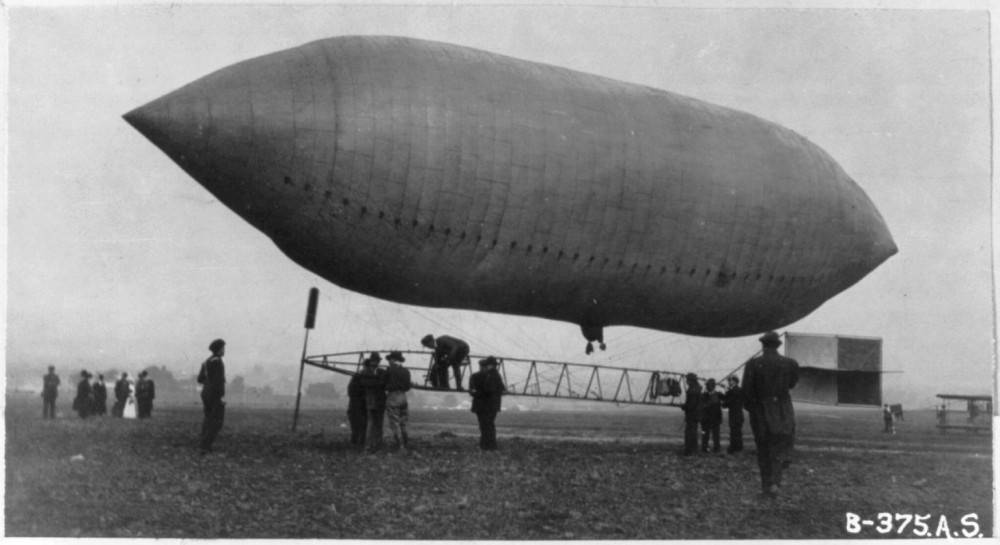
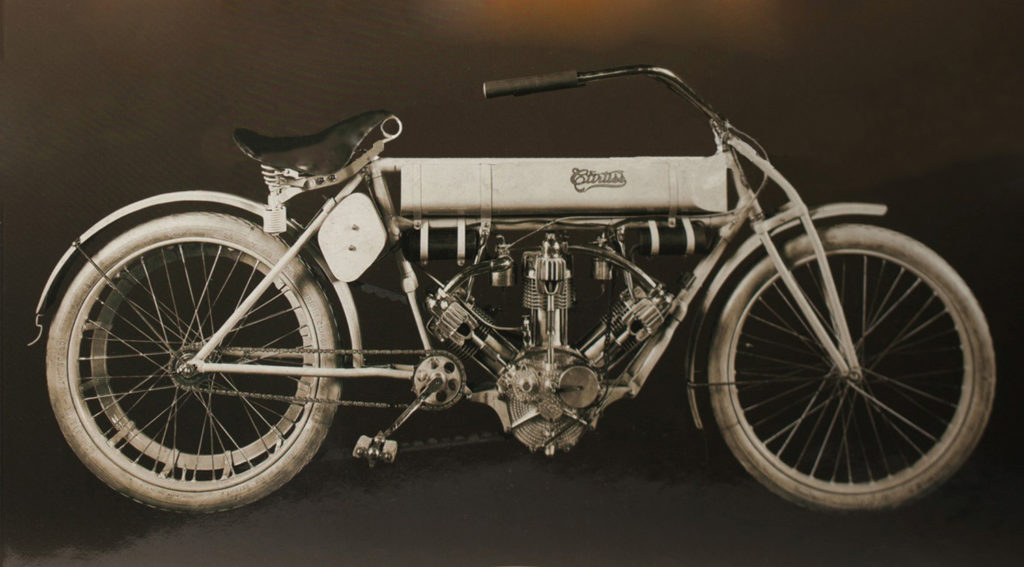
Glenn H. Curtiss is best known as the founder of American aviation, but he also played an important role in the technical development of American motorcycle design. It was motorcycles, as well, that led to Curtiss' involvement with airplanes and dirigibles, as his v-twin motors proved extremely reliable by the standards of the day, using ball bearings throughout, instead of poorly lubricated plain bushings common with main and big-end bearings at the time.
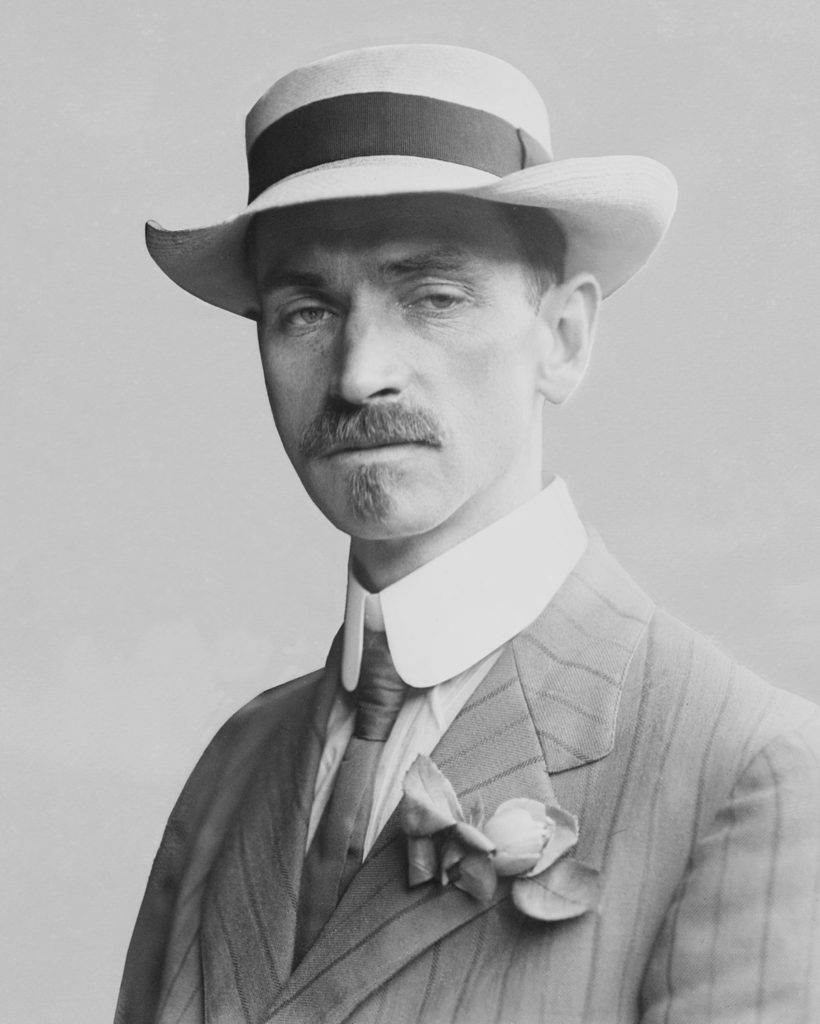
Glenn H Curtiss in his prime, ca.1908
Curtiss discovered 'the need for speed' as a young Western Union telegram delivery boy in the 1890s, where a quick delivery of a message often meant a good tip, and the boss typically give more lucrative/important clients to the fastest cyclist. Curtiss graduated from informal sprint challenges with other bicyclists, to become a full-fledged track racer, and was soon a well-known champion on around Hammondsport, NY. His aptitude with mathematics, engineering, and tinkering was evident from a young age, and soon he began manufacturing bicycles under the 'Hercules' name. In 1899 Curtiss built his first motorcycle, after purchasing an E.R. Thomas engine - sold as the Auto-Bi - a 1hp single-cylinder AiV motor (no intake camshaft, just suction to bring in the fuel mix). This first machine became known as the 'Happy Hooligan', but the engine was too weak for his taste, so he ordered the most powerful engine kit from Auto-Bi (3hp), which was an improvement...when it ran.
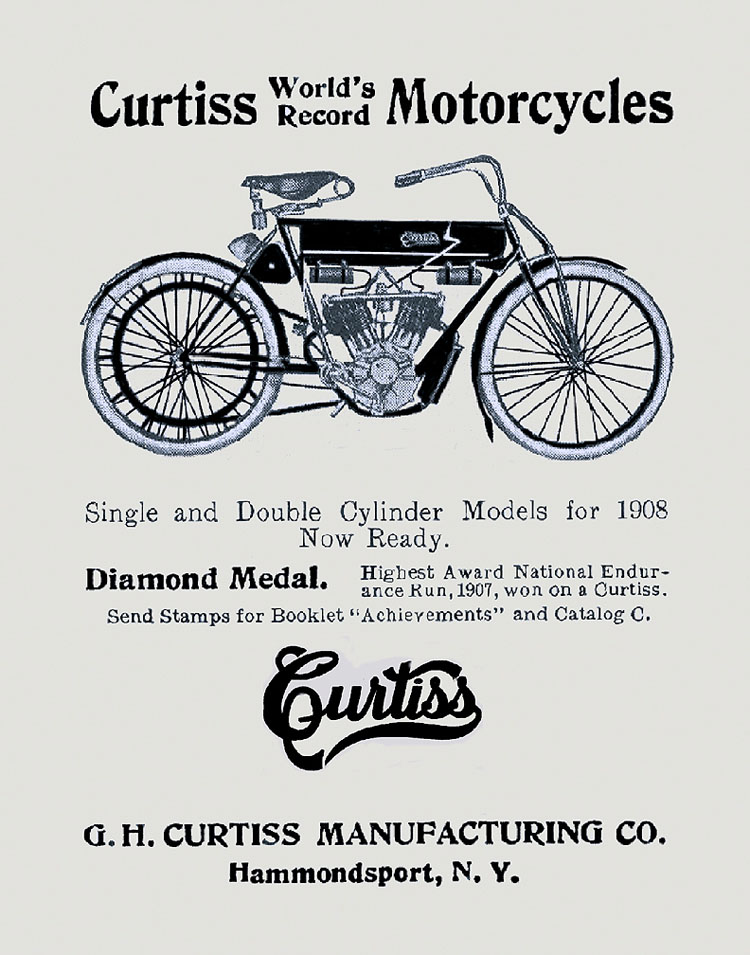
A 1908 advertisement for the Curtiss 'Double Cylinder' motorcycle
Curtiss felt he could do better, and had engine castings made to his own design in 1901. By the spring of 1902 he was marketing his own motorcycle, also called the Hercules, a single-cylinder machine which was sold at his 3 bicycle shops, in Hammondsport, Bath, and Corning. The engines were robust but light, and Curtiss pioneered the use of ball bearings throughout the engine, which reduced internal friction (compared to shafts running direct in poorly lubricated castings); he claimed his motors produced the most power of any motorcycle available, and proved it on the race track, gaining the nickname 'Hell Rider' Curtiss.
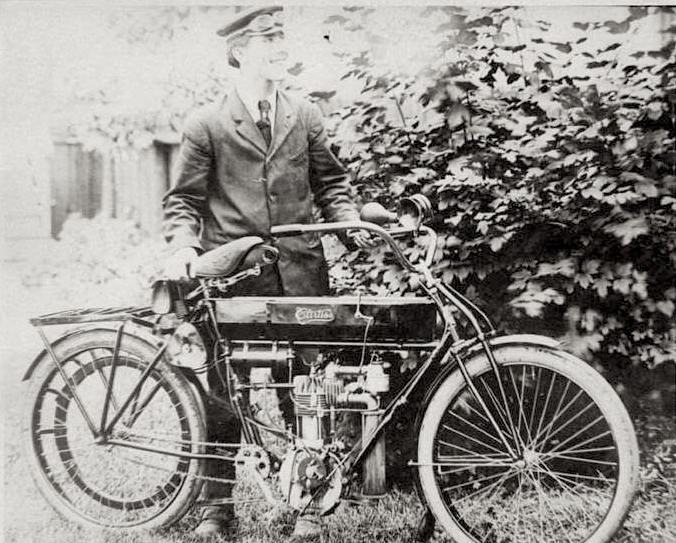
A single-cylinder Curtiss motorcycle in 1909, with solid front forks, rigid rear frame, simple 'can' exhaust, and direct belt drive with no clutch. Curtiss never truly developed his motorcycle line, and abandoned it altogether by 1911
In 1903, Curtiss himself set his first Land Speed Record at 64mph for one mile. He also won an endurance race from New York to Cambridge, Maryland, beating out the products of much larger factories, like Indian. E.H. Corson of the Hendee Mfg Co (manufacturers of Indian) visited Curtiss in Hammondsport in July 1904, was somewhat shocked to find the legendary Curtiss motorcycle was built in a very small shop on Curtiss' property, with the help of family members and friends. Curtiss production was quite small (and some estimate only a dozen or so survive today), but his impact on the industry was enormous. By 1904, Curtiss built a racing motorcycle of 5hp, and began to make the rounds of competitions, winning frequently. He journeyed to Daytona that year to participate in the open speed trials on Ormond/Daytona beach, breaking all the 2- to 10-mile records in the process, and averaging 67.41mph for the 10-mile record.
Curtiss aboard a special racing version of his 'Double Cylinder' model in 1905; note the dual torpedo tanks!
By 1905, the 'Hercules' name was forcibly dropped, as another company was found to own the brand, and henceforth his machines were simply called 'Curtiss'. The range included 2.5hp and 3.5hp singles, and a 5ph twin, all with direct belt drive. His engines gained renown for their strength, reliability, and speed; qualities in rare supply in 1905! His reliable engines attracted 'Captain' Tom Baldwin, a circus performer turned daredevil, who travelled to county fairs all over the US in a hot air balloon. Baldwin wanted a good motor to power a dirigible, which he built at his workshops in San Francisco. Baldwin's 'California Arrow' became a regular sight in the Bay Area, and Baldwin entered a competition in St. Louis in 1904, with a prize of $100,000 - a phenomenal sum - offered to an aviator who could successfully fly to 2,000 feet, make a 3.5 mile loop, and land at the take-off point. Baldwin's machine was the only airship capable of making the course, and the response from the huge crowd was tumultuous. Seeing that controlled flight was indeed possible, demand for Baldwin's dirigibles grew exponentially. Baldwin returned to San Francisco after an extensive tour with his flying machines, and continued building dirigibles until the 1906 San Francisco earthquake leveled his factory.
The incredible Curtiss V-8 record-breaker with prototype dirigible motor, currently on display in the Smithsonian Institution
Captain Tom Baldwin, having established a successful relationship with Curtiss, then moved to Hammondsport to begin business together, and explore heavier-than-air flight. This marked the beginning of the Curtiss aviation story, and soon the end of the Curtiss motorcycle story, as the company began to focus on building better motors for dirigibles and airplanes. Alexander Graham Bell was suitably impressed with Curtiss, considered him "the greatest motor expert in the country," and invited in 1907 Curtiss to join his Aerial Experiment Association (AEA), with the aim of building a functional airplane. Curtiss was the primary designer of the 'June Bug', the AEA's 3rd aircraft, which used wing-warping to lift, turn, and descend, and was entirely successful, becoming the first officially observed flight in history on July 4th, 1908, winning the Scientific American trophy and $2500 in the process. The Wright brothers may have catapulted a motorized kite into the air before Curtiss flew, but flew he did, in front of the world.
The California Arrow in 1904, the first truly successful powered aircraft in America, capable of flying thousands of feet high, and propelling itself wherever it was directed, weather permitting. It used a Curtiss v-twin engine in the framework below the oiled silk gas bag. The entire contraption weighed a mere 520lbs, and took 8000cu' of hydrogen to fill the 52' long bag.
But his greatest motorcycle feat was yet to come; in a final bid to quench his speed lust, Curtiss built a spindly motorcycle frame around an experimental V-8 dirigible motor in 1906, and travelled again to Ormond Beach Florida for a bit of sand racing. After the end of 'normal' speed runs with production bikes, Curtiss brought out his Behemoth with 40hp, and scorched through a 1-mile trap at an average speed of 136.3mph - the fastest speed of any powered human to date. His 'return' run was marred by the disintegration of the direct shaft-and-bevel drive used at the rear wheel (and should one be surprised, with an exposed u-joint, 40hp, and a sand bath?), and the rear wheel locked at speed while the drive shaft flailed away at the rider... but Curtiss' considerable track experience came to the fore, and he was able to haul the beast down without further drama. Curtiss had some hairy moments, but never crashed his motorcycles or his airplanes, which ranks as unique among his peers.
Curtiss aboard the V-8 at a photo op before the speed run. An incredible machine then as now!
While Curtiss' record was unofficial, it spoke volumes about the man's bravery, riding skill, and technical abilities. As aviation took more of his interest by 1908, and demand for his services as an airplane designer increased, Curtiss turned his attention away from motorcycles, and handed over the running of the business to friends and family members. Development of his remarkable motorcycles stopped when their creator turned away, and the company was wound down by 1911. Curtiss turned his full attention to wings, becoming the first man to design and fly a proper airplane, capable of taking off under its own power and maneuvering back to its starting point. He traveled the world demonstrating his machine's abilities, which were unequalled in the day, and went on to invent the seaplane, and became the first licensed aircraft manufacturer in 1909. During WW1, Curtiss Aviation produced planes for the US Military, like the Curtiss JN-4 'Jenny', and the company expanded for what was a bright future. In 1920, Curtiss sold his stock in Curtiss Aviation for $32Million, a simply enormous sum in those days, and pursued other projects from his home in Florida. He died of complications from appendicitis in 1930.
An amazing 3-cylinder Curtiss motorcycle, no doubt patterned on the Anzani motor powering his rival Bleriot's monoplane in France. [From the cover of Stephen Wright's amazing 'The American Motorcycle']A single cylinder Curtiss in 1909
I breezed right past Bryan Fuller’s latest custom at the Handbuilt Show last April. With my third ‘Vintagent’ cocktail in hand (nice touch, Revival), and a loud party slowly gyrating through the hall, the BMW R75/5 ‘toaster tank’ café racer, in its quiet black and silver livery, was hidden amidst a sea of ‘look at me’ customs. A thoughtful (sober) friend took my elbow, whispering ‘you need to see this bike’, and while the party roared, my head quieted, taking in Fuller’s gorgeous subtleties. It’s as discreet as is possible for a radically lightened, classically shaped café racer, mostly due to the minimalist paint and non-bling finish – even the originally chrome ‘toaster’ panels on the tank have been swapped for aluminum. The back end is cleaned up with a monoshock, but otherwise, the architecture is standard, including the stock, vintage drums up front. With the heavy /5 mufflers swapped for a pair of 1960s-style trumpets, and classic bump-stop racing seat, this bike says ‘built in 1970’, except nobody built them this well 45 years ago. Nor as slim – the café seat of BMW’s 1973 R90S is twice the width of Fuller’s, which highlights the design freedom custom builders enjoy, which factories just can’t match, a point reinforced in a conversation with Edgar Heinrichs (BMW’s head of design) last week, when asked if BMW could make a ‘simple’ motorcycle again. ‘With a 5-liter airbox and 7-liter exhaust required by law – no.’ So, dig your free-breathing, noisy mofo vintage customs, baby, while you can.
Fuller’s abbreviated BMW deletes the instruments and turn signals, and blacks out the engine cases, but retains a pair of alloy fenders, by gum; a righteous bulwark against the silly trend for a full-spray Custom riding experience in anything but SoCal weather. Fuller kept the standard airbox, which means he intended it to be ridden longer than a photo shoot, a point he proved by offering me the bike for the Quail Ride, after my ’28 Sunbeam racer split its soldered-up fuel tank. He knew I’d spank her, so reminded me the BMW’s lucky new owner would be waiting at the far end of my 110-mile test through the twisting, bumpy roads of California’s central coast range. There’s no kicker, the bike fires easily on the button, and the gearing is standard, which means the potential for higher speed offered by a light-spinning motor is traded for quick acceleration. She rockets off the line with a satisfying basso burble from those near-empty pipes, and winds up beautifully if the throttle is kept open hard. The Quail Ride has a full CHP escort, which clocks along at the speed limit, but 100 bikes stretches across a mile, with hot laps around Laguna Seca the apex. Let’s just say Fuller’s BMW feels good at the ton, wherever that happened, and flattens out like a cat at speed, after arching its back when taking off from rest. The monoshock was rock hard until a Fox Shock pal dialed down the preload, after which the ride was less plank, more ‘70s Italian.
After the relatively smooth prelude through the Salinas valley, the Ride turns back towards the coast, snaking through the lonely canyons of Carmel Valley Road. The spectacular Spring landscape and righteous twisties are offset by California’s bugbear – deferred road maintenance. Hammering a vintage café racer through here means little Dieter really does fly, the /5 aviating frequently, with a waggle of yaw but no drama. More dramatic was hard braking for decreasing radius, off-camber corners, which revealed the limits of that front drum, and the shaft-drive rear end to cope with bump-braking and the front fork fully compressed. An amazing combo of hopping, chirping, and bucking resulted in one corner – ok, don’t do that. Mind you, no vintage bike would have done better, and a rigid-rear custom would have been skittering horizontally in identical conditions (don’t ask how I know), so we’ve found the limits of a BMW chassis designed in 1968. On smooth corners, the bike was a blast, with quick acceleration accompanied by a charmingly obnoxious exhaust note, and very predictable handling from the double-loop tube frame, inspired by the Norton Featherbed.
Paul d'Orléans aboard the Bavarian Café [Stacie B. London]Bryan Fuller’s simple, delicately detailed BMW café racer should be an inspiration for anyone walking this path. The stainless steel brackets holding the fenders are truly elegant, and match both scale and curvature of the white pinstriping on the tank, seat, and engine cases. Cheeky details include the seat’s integral taillight, and the fuel cap, inspired by a Grolsch beer bottle – study it, and wonder why nobody’s done it before. A hundred such understated design decisions adds up to an incredibly tasteful motorcycle, built by a true professional at the top of his game.
Exploring country roads on the Quail Ride with the Fuller Custom Moto Bavarian Café [Paul d'Orléans]
Paul d'Orléans is the founder of TheVintagent.com. He is an author, photographer, filmmaker, museum curator, event organizer, and public speaker. Check out his Author Page, Instagram, and Facebook.
It’s time we admit it; we don’t ride much. At least, not in the numbers (or hours) of other countries. If you travel abroad, you’ve already clocked it; in Paris or Barcelona or Rome, two-wheelers crowd their sidewalks, and the Stoplight Grand Prix is a way of life. Any Asian city makes Europe seem car-centric, and the haze of 2-smoke in Bangkok or Saigon can be choking. China, once the world’s biggest motorcycle market, is steering out of the smog with e-bikes in urban centers, but India is going gangbusters with little bikes, and is now the largest producer and consumer of internal-combustion two-wheelers on the planet. How big is big? Indian manufacturers sold 17.59 Million motorcycles in 2016… they exceed annual US sales (about 500k per annum) every 11 days. But, as Sir Mixalot said, ‘we like big bikes and we cannot lie’. So we can ignore China and India, no?
The 1950 Royal Enfield Bullet, built under license by Enfield India for decades, and regularly upgraded from the 1990s
No. There’s already a made-in-India ‘big bike’ outselling every US and European manufacturer; Royal Enfield. While their 350/500cc capacity is beneath the notice of most American riders, to 1.27Billion Indians it’s an ‘aspirational’ bike. And while the retro-themed Triumph Bonneville and Ducati Scrambler are their most popular models, the Bullet – the original retrobike, designed in 1948 - outsells both by a huge margin. In fact, H-D, BMW, KTM, Triumph, and Ducati combined sell about the same as Royal Enfield, which built ~700,000 Bullets in 2016. But Royal Enfield’s output is small compared to other Indian manufacturers, like Bajaj or Mahindra, or the unacknowledged 800lb gorilla of the motorcycle world, Hero, selling 7 Million motorcycles per annum. The vast majority of their products are under 250cc, but they’re on a buying spree; Mahindra now owns BSA, Jawa, and Peugeot (2-wheelers), while TVS builds BMWs, Mahindra builds Harley-Davidsons, and Bajaj is a big investor in KTM.
The 2016 Royal Enfield Bullet Classic
We haven’t seen an Indian buyout of an active motorcycle brand yet, but Royal Enfield made an offer of $1.8 Billion to buy Ducati; Mahindra made an offer too, but all bids were ultimately rejected. The next target of an Indian takeover could be one of the old American ‘Big 3’ brands, as Excelsior-Henderson goes up for grabs in January, when Mecum hosts their annual Las Vegas sale. And who knows how Harley-Davidson itself would answer to a cash offer from Hero? Either one of these would place the only other major American manufacturer, Indian, in competition with actual Indians, which boggles the mind.
The new Royal Enfield twin-cylinder Interceptor, revealed at the 2017 EICMA show
In case nobody’s mentioned it, we’re witnessing the 21st Century version of the ‘Japanese Invasion’ of the early 1960s, when great design and brilliant advertising proved a 1-2 punch to slow-moving British and European brands. Only today, Asian companies already dwarf their big-bike competition, and it makes more sense to buy old brands than put them out of business. In that regard, the Bullet’s story arc is rich in irony, or perhaps karma. ‘Royal Enfield’ and ‘BSA’ were first encountered by Indians in the 1800s, stamped on gun barrels pointed in their direction. They’ve certainly had the last laugh in that relationship, as the old firms went bankrupt, and the world’s fastest growing economy snapped them up. The yoke of colonization has been replaced with the whiff of nostalgia, and a reputation for solid quality. Time and business savvy have proved their own Truth & Reconciliation commission, no apologies required. “May we sell you a motorcycle, sir?”
Paul d'Orléans is the founder of TheVintagent.com. He is an author, photographer, filmmaker, museum curator, event organizer, and public speaker. Check out his Author Page, Instagram, and Facebook.
Let's say you're a recently graduated mechanical engineer in India; the next step is a job in IT, right? But sometimes, motorcycles get in the way, and that's the case with Piyush Verma and Nishanth Patel of Bangalore, who decided they'd rather build motorcycles for a while, and see if there's a career in motorcycle design and/or photography for him. They'd got their feet wet building custom vehicles with 3 years running their own off-road racing team, entering the Baja SAE (Society of Automotive Engineers) competition, run by SAE India. The 'Baja' is a worldwide inter-collegiate vehicle design competition, with over 140 entries annually for engineering students to build off-road racers, which are put through a variety of speed, agility, economy, and design tests.
"When college (KS Institute of Technology) ended, we had a placement period, and the only companies that came to recruit us were all IT-based. Even though we did get jobs, it wasn't something we wanted to do. So we decided, out of our love for handmade motorcycles to make a custom bike." Clearly, Verma and Patel are rebels, and better still, Patel had a Honda CBR 400 RR, which was in poor condition cosmetically, that he suggested they build as a project. "I was like, let's do it!"
"We wanted it to have a retro Endurance Racer look, in contrast the sharp-edgy bikes of today. We made a cardboard template and then made the entire fairing and seat from an aluminum sheet. The paint scheme is from a Rothmans Honda; we felt it best suited the character of the bike. The entire chassis was buffed for a mirror finish, including the swing arm. The bike has its original head lights, a freeflow exhaust and racing hoses and brake lines." Verma thinks this might be the first inline-4 Custom in India, since the Indian 'big-bike' market is dominated by Royal Enfields, which are the typical custom-fodder. "So that's our story for now, it's short since we just came into the field! Someday we'll hopefully make an epic build." As fans of vintage Endurance Racing, we'd say this is pretty epic already, and it's great to see young customizers branching out in India from their typical Bullet beginnings. We can't wait to see more from young builders like these!
Piyush Verma with the Rothmans Honda customNishanth Patel and the custom Honda CB400RR
More ‘Henne’ than Hemi, but still the loudest bike in town
One benefit of trolling European bike shows is bumping into ex-factory race bikes hauled from the vaults. Munich’s BMW Museum was in a generous mood in 2013, and toured a pair of its crown jewels – Ernst Henne’s 1932 and 1937 Land Speed Record racers – to both the Concorso di Villa d’Este and its opposite, the Wheels+Waves festival in southern France. I’m a moto-judge at the Concorso, and crawled around that supercharged ’32 750cc LSR machine like a horny snail. In as-raced condition, it’s among the most beautiful wheeled vehicles ever built, with elegant shapes cladding brass-balls technical savvy. In Biarritz, it sat defiantly amidst a sea of Alt.Customs, which paled beside it. I bent the ear of any builder listening, wondering why nobody had taken inspiration from this, to escape the humdrum sameness of café racers and choppers. The next year, Japan’s Cherry+Co displayed a BMW RNineT homage to Henne’s bike in that very hall, with gorgeously updated sheetmetal and pinstriping; a work of inspired genius.
Alan Stulberg of Austin’s Revival Cycles also heard the siren call of that ’32 BMW at Wheels+Waves; the LSR bike paced in his imagination, and he grew obsessed. “Seeing that Henne bike was the seed, and I came home racking my brain - how could our team at Revival build something like this? But money is tight, we can’t afford to do it for ourselves. Then I was introduced to a Dallas collector who’s opening a gallery of motorcycles, who said ‘Let’s build what You want. Here’s my budget, what can you build for this?’” Such carte blanche saw Stulberg waffling between dreams - a Vincent custom or Henne throwback – and he ultimately tilted towards BMW for entirely practical reasons; “Our money’s better spent on labor than the starting material, and old BMWs are cheap.”
An internal issue nearly scuppered the plan, as Revival’s technical core – Stefan Hertel and Andy James, who’d nail down the technics and fabricate the thing - were opposed to building a bike for display only. Stulberg explains, “Our core ethic is functionality; that this wasn’t going to be ridden was a huge issue. I saw it as an opportunity for creative design, without the shackles of the street; not worrying legality meant we could spend more time on aesthetics. We argued about it for hours, but Stefan and Andy finally acquiesced… only because we decided to build two! One for racing and one for display. When we cut the sheet steel for the frame, we duplicated it for a second chassis.”
Revival’s flat steel chassis, while familiar to fans of pre-war BMWs, is a departure from the Henne bike, which actually uses a tube frame from a late ‘20s R63 under aerodynamic aluminum panels. The new bike is scaled up slightly, with the wheelbase a few inches longer, the frame a little taller, and while Henne’s forks were trailing links with leaf springing and a small friction damper, Stefan Hertel’s tech bent meant a modern upgrade for the front end. The original fork was stable enough for a 159.1mph record on the Frankfurt-Munich autobahn in 1936, but the ‘non-display’ Revival Landspeeder will handily top that (read to the end for why). Hertel designed a trailing-link fork with a longer pivot arm (and elegant ‘speed holes’), using a modern shock with a kinematic adjustable preload, plus a very steep fork angle combined with 6” of trail, as he feels steeper head angles handle better even at speed. Building that fork with contemporary performance expectations caused plenty of grief; “Stefan spent almost 6 weeks designing that front end; I walked in at 10pm one night and he was almost in tears. He was looking at the forks on a Max Hazan bike on his computer, and knew they couldn’t work at speed, but still said ‘look how elegant this thing is, but I have to make mine function at 150mph and last 50 years.’ I said it doesn’t have to be so elegant, but it does have to work. An hour later he was done. He was emotionally spent solving the technical problems, but he gets credit for how beautiful the bike turned out.”
The Landspeeder is indeed beautiful, and dramatic, and while conjuring the spirit of Henne’s racer, in construction it’s a completely different animal. The use of an inexpensive BMW 100/7 powerplant left plenty of space for Revival’s stamp, seen from the streamlined valve covers inward. Distinctive details include the quilt-padded knee indents, the faired-in handlebar, exhaust, and fork blades (all as per Henne), and that crazy trumpet air intake just behind the shifter knob, where the fuel tank normally sits. All the stainless hardware holding the front end and frame together is custom made – “no parts-bin cap nuts here”. The Landspeeder features ‘all black everything’ as the team omitted the distinctive pinstriping of the original; Henne’s body panels are hand-hammered and lumpy as a bag of lemons, but Andy James had the luxury of time for a perfect fit and finish, and those purposeful, Deco-streamline shapes need no accent.
It’s an onerous task for a designer to update a legend, made still harder today with internet trolls lurking under every comment box, pikes and torches at the ready. Stulberg was plenty nervous when Revival’s Landspeeder debuted on BikeExif, as it’s by far the most outrageous custom they’ve built. “I presented the bike as the truth, and the truth will save us. This bike wasn’t even meant to run, but it does; that was critical for us, and we shot a video blasting down the road. It’s so loud!” He needn’t have worried; the comments box was overwhelmingly positive, but more surprising was the interest from established collectors like Peter Nettesheim and the BMW factory itself. “That’s the best approval you can get - from the old school - it means more to me than all the dudes on the internet”.
In a few short years, Revival Cycles has moved smack into the middle of the moto-culture Renaissance. They build innovative Alt.Customs, travel the globe to ride their machines and support events, and host the increasingly important Handbuilt Show (April 20-22, 2018) in Austin. Much-shared photos of the Revival team wheelying their customs at drags and ice races tells the tale; their stuff works. And it had better; that second iteration of the Landspeeder will house a supercharged BMW HP2 motor, with near 200hp on tap, and should handily exceed Henne’s record on its Bonneville debut. Given Revival’s knack for gorgeous functionality, there’s little doubt we’ll be ogling a very fast black projectile in the near future, made even more appealing with a coat of high-speed salt spray.
[Words: Paul d'Orléans. Photos: Revival Cycles. This article originally appeared in Cycle World]
Paul d'Orléans is the founder of TheVintagent.com. He is an author, photographer, filmmaker, museum curator, event organizer, and public speaker. Check out his Author Page, Instagram, and Facebook.
The Outlaw Bicycle; a Streamlined Middle Finger to the Man
Motorcycles owe a huge debt to bicycles. The invention of the ‘Safety’ frame in the mid-1880s - the same basic chassis used on 99% of bicycles today – inspired builders to hang a motor inside, from their very first appearance. After experimenting with every possible engine location (even on the handlebars!), the issue was more or less settled by the ‘Noughts, with a motor down low in a safety frame. As the Century progressed, motorcycle frames got heavier and more specialized, eventually diverging from bicycle technology via pressed-steel monococques (from the late 1920s), beam-frames of wood, steel, or aluminum (all 1920s inventions), and double-loop frames like the Norton Featherbed (1950s).
Looking as wicked and horny as the best contemporary sportbikes, the fUCI is the first no-rules e-bike built for the joy of speed [Specialized]Motorcycle designers first tried streamlining in the 1930s for Land Speed Record attempts, and from the 1950s onwards a lot of research went into fairings and other wind-cheaters. Bicycles rarely used fairings except for speed and distance records, and in competitions sanctioned by the UCI (Union Cycliste Internationale) fairings are banned entirely.
From the front, the fUCI gives an admirably minimal yet aggressive face. [Specialized]The crude plastic bubble fairing sported by bicycles today are only seen on a few recumbent bikes, and are the same as Burt Munro used on his Velocette beach sprinter in the ‘50s thru ‘70s. But production motorcycles are decades ahead of bicycles in the streamlining game. A few cyclists resent this fact, and one in particular, Robert Egger, creative director of Specialized Bicycles, decided on a major upgrade with clear motorcycle inspirations.
Robert Egger with his initial model of the fUCI, and the prototype behind [Specialized]It might seem old hat to moto-folks, but Egger’s hawklike nose fairing is a flipped bird to UCI rules, from a company which supplies competition bikes…and worse, it includes an electric motor in the undercarriage. It’s an electric sports-racing bicycle, appropriately named the fUCI. “‘This is an e-bike. It has a motor here, in the bottom bracket, so just like when you ride a turbo and you put your foot on the pedal and it lurches forward, the same thing here. this little motor will get the flywheel up to speed so when you’re stopped at a stop sign, or when you’re starting out of your garage in the morning, this’ll be that burst of power to get the flywheel up and running.” Zzzzip!
The fUCI has a radical asymmetric profile, in the service of higher speed and wind-cheating. Egger sends a clear message to the Man. [Specialized]The UCI’s competition rulebook keeps strict limitations on wheel size, frame construction and shape, rider position, and streamlining. Because many riders clamor for bikes that look like racers (sound familiar, you café racers?), production bicycles hew pretty close to ‘the rules’. Egger has opinions on this; “The UCI really caters to a very small population, but there’s so many other people out there who couldn’t care less about the UCI. They don’t follow the racing and they don’t even know all the limitations that are put on bikes for the UCI riders. So my feeling was, let’s design a bike for someone who really just wants to go fast on a road bike.”
De rigeur today; an iPhone dock in your electric vehicle [Specialized]UCI technical regulations require both wheels be the same size, but Egger went big out back with a 33.3” wheel, which acts as a flywheel to conserve high speed energy. A lithium battery for the motor is removable, but Eggers build a stand with a solar charger, so there’s no need to plug the bike into a wall, at least during the day. There’s a head and taillamp, and a smartphone dock to keep track of energy use, tire pressure, speed, etc, and even a mini-locker in the wasp tail for a windbreaker (or spare tube – a maddening certainty with our smaller cousins). The carbon-fiber frame escapes the ‘double diamond’ convention still extant in the bicycle world, and with the big back wheel gives and aggressive, wind-cheating rider position.
The streamlined matching helmet is reminiscent of 1920s/30s rider streamlining for LSR attempts [Specialized]With the fairing and wind-cheater profile of the tires and frame, the biggest sail is the rider, and a little help in that regard comes from a matching aerodynamic helmet, the modern offspring of Ernst Henne’s aluminum BMW teardrop from the ‘30s. It should be no surprise from the visual cues of the fUCI that Robert Egger is a motorcycle fan. For those of us more likely to wear leather than spandex, it’s intriguing to watch the start of some back-and-forth between our disparate worlds, which will surely increase with the rise of e-bikes. We’re siblings from the same 19th Century crib, and are only starting to look alike at 130 years old.
A generation ago, we lost the Future. For over a century, a better, more functional, more equitable, and technologically cooler place was tantalizingly just out of reach, but certain to become today, soon. Snapshots of the Future arrived as drawings and models created by designers and artists in tune with the new, and beyond the new to the currently impossible. Anything we could dream was possible, and it was just a matter of time before it became everyday.
The Colani motorcycle design study of 1973
The recent Age of Irony took a scant view of the Future's unbridled optimism; forward-looking, visionary projects, from architecture and urban planning to product and technology design, had shown a fundamental flaw in the Future, a deep contradiction within its gleaming heart; the Future was not for everyone. Or, if it was planned for everyone, these envisioned socialist utopias smelled totalitarian, and had proved, when actually built, to be failures on a grand scale.
The MRD-1 before the record attempt; the rider (21 year old Urs Wenger, an Egli employee) carried his own streamlining, harking back to 1920s efforts to cheat the wind...
The tall housing projects with surrounding parkland, so geometrically beautiful in Le Corbusier's 'Plan Voisin for Paris', had been built on a smaller scale in New York and Paris, and by the 1970s had become dangerous slums. Critic Jane Jacobs rightly assailed such out-of-touch and un-human urban planning, and her influential analysis of what makes cities healthy was groin-kick to Future planning. Whether homespun like Frank Lloyd Wright, socialist like Corbusier, or outright fascist like Antonio Sant'Elia, rigorous urban planning looked bitterly dystopian by the 1980s - we had seen the Future; it wore jackboots, and didn't age well.
A portrait of Luigi Colani in his heyday
Luigi Colani is an old-school future-dreamer, the type of hyperconfident character whom skeptics disregarded during the ironic 1980s. His career as an industrial designer began in 1953, at the special projects division of McDonnell-Douglas aircraft, after studying aerodynamics at the Collége de Sorbonne. During the late 1950s and early 60s, he worked with several Italian auto makers (Fiat, Alfa Romeo, etc), creating special bodies and winning design awards.
The RFB 'Fanliner' of 1977; powered by a Wankel engine (an ideal aircraft engine, now used extensively in RQ-7 Shadow 'Drone' aircraft by the US military...which are powered by Norton engines! UAV Engines was spun off from Norton, with David Garside leaving motorcycles to continue developing the Wankel motor he designed for BSA, then Norton. His engine won the British F1 championship, the Isle of Man TT, and now patrols the skies in the Middle East...)
By the 1970s he was famous for his increasingly outrageous organic shapes, which he calls 'biodynamic', in imitation of Nature's graceful forms, and designed products ranging from tea sets and cutlery to heavy articulated trucks and aircraft. “Soft shapes follow us through life. Nature does not make angles. Hips and bellies and breasts — all the best designers have to do with erotic shapes and fluidity of form.”
Erotic, feminine forms applied to wheeled vehicles...a design study for a motorcycle
Feeling underappreciated in Europe, he relocated to Japan in 1982, and flourished, producing both 'improbable' designs for vehicles, and very up-to-date products, including the first 'ear buds' for Sony (1989...long before the iPod), and the first ergonomic body for a camera (the Canon T90 of '86), along with uniforms for SwissAir and the German police. Among his many transportation projects, Colani has long dabbled with motorcycle design, from sculptural shape-studies to creative bodywork over incredible machines, most notably the Münch Mammut and Egli-Kawasaki - an incredible turbocharged fire-breather with 320hp, which set the 10km flying-start speed record in 1986.
The Colani-Münch of 1972
Colani doesn't consider himself a designer; “I am a three-dimensional philosopher of the future.” With the necessary combination of third-person egotism and unbridled imagination, Colani developed from an industrial design innovator to a full-blown psychedelic guru of flowing organic shapes for every application. While he sounds ripe for ironist derision, Colani's work is enjoying a resurgence after a long period of embarrassed silence from industrial designers.
A rare shot of Yamaha/Colani prototype, the 'Alula' of 1980
After decades of developing, envisioning, and championing flowing organic shapes, the Future has finally caught up with Colani, and he is enjoying another day in the sun. The practical development of computer 3D modeling, and more recently the rise of rapid prototyping systems, has given 'Colani's children' - Zaha Hadid, Ross Lovegrove, and the new generation of organic-shape disciples - the kind of real-world relevance unthinkable in the 1960s and 70s, when Colani's work seemed utterly fanciful, even self-indulgent. Now superwealthy backers and attention-hungry governments actually build structures which seemed impossible a mere 20 years ago. Colani's future has arrived.
An articulated truck study...The Colani-Egli MRD-1 produced 320hp from its turbocharged, nitrous-breathing engine, and broke the World Land Speed Record for 10km from a standing start, at 170.26mph (272.41kmh); his top speed was 330kmh (198mph). The record was previously held by the Honda ELF, with full Works support of rider Ron Haslam (265.4kmh).Colani's organic shapes for Canon T90 cameras won awards for ergonomic utilityThe Colani-Egli MRD-1 of 1986, a turbocharged Kawasaki Z-1 1428cc engine in an Egli chassis, with Colani-designed bodyworkThe MRD-1's backside; muscular!
It sounds like the start of a good yarn; two friends haul their crappy old Triumphs to southern Utah for some canyon-hopping. While it turned out to be a very good boys-on-Triumphs story, it had an inauspicious beginning. I'd only ridden my 1973 Triumph TR5T ‘Adventurer’ on paved roads, and don't consider myself an off-road expert. But the canyonlands of Southern Utah are my favorite places to ride, being geologically unique and breath-takingly beautiful. I'd long yearned to explore the region's secrets away from the highways, poking into the canyons on the dirt roads tantalizing my curiosity on every map. My pal Conrad, a native of Canterbury, England, had a similarly limited off-road resumé, and had recently emigrated to the USA. To a newly arrived Brit, the lure of Southwest canyons was irresistible, so we hatched a plan to take the only dirt bikes we had - vintage Triumphs - to Utah.
Conrad Leach fording the Fremont River in Capitol Reef National Park, on his '71 Triumph hybrid.
Well, Conrad didn't actually have a Triumph to hand. Earnest searching on Craigslist revealed a 1971 Triumph TR6R 3 hours away in Sonora, for only $1300, so the first part of our adventure was driving to the Foothills to meet Jeff Epps. Jeff turned out to be a true mountain man, living in a remote cabin he built himself, and in the manner of all owner-built domiciles, the shack was unfinished. The imposing 1953 Ford F150 truck with tiny cabin on its flatbed gave a clue to Jeff's relaxed building pace - he had a truly mobile home on site. The TR6 for sale stood next to a nice BSA B50, and looked good, although it was understood to need work, and was cheap, so we did the deal. Unfortunately, looking good and actually being good are very different; the Bonneville engine was knackered, and our Utah dreams faded. Fortunately, we found another motor in San Francisco, powering a fairly awful bob-job. Suddenly Conrad was 2 bikes deep, so we swapped their motors, and voila, a week later we were ready to roll with his '69/'71 desert sled.
Jeff Epps with his 1953 Ford F150 flatbed/mobile cabin. Who needs a cabin? Or shoes, for that matter...[Mototintype]It's a 14-hour drive to Torrey Utah from San Francisco, and with no real timeline, we explored whatever looked interesting en route. While crossing Donner Pass (7200’), we spotted a perfect road winding up from Donner Lake, lined with yellow Aspen leaves in a solid granite landscape. We had to try that road, and test our bikes at altitude - the road was gorgeous, and the bikes ran perfectly, which seemed a good omen.
Conrad Leach twisting the throttle at the Bonneville Salt Flats. The salt was much smoother in 2011 than today, and in some areas it's only an inch thick, imperiling the future of Land Speed Racing.
Our next stop was the Bonneville Salt Flats, where nothing happens in mid-October; Speed Week is long over and the place is deserted, but if you like solitude, and to ride any speed in any direction for as long as you like, there's no place like it. We did all that, and explored the borders of the lake too, which takes a surprisingly long time to reach. There's no gauging distance with no features in the middle ground, and the lake ranges from 20-40 miles wide at spots. We were tempted to head up the dirt trails in the bordering mountains, as we'd heard there are caves with petroglyphs in the area, and evidence of human habitation 10,000 years ago, when Lake Bonneville was a hundred feet deep, and enormous.
At the edge of Bonneville's salt lies acres of salt-resistant scrub, and trails through the mountains
Springville, Utah, is 5 hours from Bonneville, and the site of Jeff Decker’s Hippodrome Studio, with his Crocker and Harley-Davidson racers, Miller track car, and collection of Biker memorabilia. Jeff was inspired to shoot Wet Plates in the old ghost town of Eureka, so we headed into the desert, where Google Maps instructed us to a dirt road shortcut to Eureka. We bumped over a deteriorating, shrinking, rutted cow trail with deep ravines and dry stream beds, until we got stuck. Then 3 city boys in our ‘workwear’ dug big rocks out of the dirt with our bare hands, jacked up the truck, and made a path out with sticks and stones…we survived to shoot photos at Eureka.
Jeff Decker and Conrad Leach at Eureka, Utah, with a 1930s Levis sign painted on a brick building [MotoTintype]A chain of National Parks is strung between Nevada and Colorado, a continuum of canyons between Zion National Park near the Nevada border, thenBryce Canyon,Escalante, Capitol Reef, Canyonlands, and finally Moab near the Colorado border. My favorite is the least-touristed; Capitol Reef National Park, with large swaths of brilliantly-colored cliff faces ('reefs') lining the highway, white Navajo sandstone domes ('capitols') towering overhead, an old Mormon settlement with a still-vibrant fruit orchard, and a lot of dirt roads crossing its mesas and sand washes. We stayed just outside the park entrance, in Torrey, and asked a ranger for a good day-ride dirt loop; she suggested Pleasant Creek/South Draw Road, "a really good 4WD road" that began at 6000', followed Pleasant Creek to its source, and would loop us back to Torrey in about 80 miles.
Heading into Capitol Reef NP on Utah Highway just outside Torrey, approaching a long day off-road
Always listen to the locals; South Draw Road is a challenging mix of stream crossings, soft red powder, deep rock-lined gulleys, and steep climbs up rock staircases. It also threads several red-rock canyons, follows a beautiful stream to its 9500' high source, and traverses grassy high-altitude meadows that beckon a traveler to stop and look. It took all of our motorcycling experience to navigate the treacherous path without coming to grief, or damaging our road-going 1970's Triumphs. We passed exactly one vehicle in 80 miles; a Jeep struggling up a steep Devil’s staircase of flat sandstone slabs, which was strewn with loose square boulders. We asked if we could help, but they demurred, and we carried on, arriving at a grassy mesa surrounded by spectacular cliffs.
Conrad wandering over a high-altitude grassy meadow, surrounded by multi-colored cliff faces
If we had tents, we would have slept in this beautiful place, but we had 40 more miles to go, it was already mid-afternoon, and we didn’t like the idea of dirt-riding by 6 volt headlamps. We were sometimes blinded by the low sun, and rode with one hand shielding our eyes, the other twisting the throttle and guiding our wheels through dirt gulleys separated by grass hillocks. By the time we left the red rocks and entered an Aspen forest, we'd climbed to over 10,000’, and soon joined little Hwy 12 at its summit, which already had snow in its hollows.
Where the pavement ends, a new kind of fun begins. The start of Paradise Creek Road, at the end of Scenic Drive in Capitol Reef NP
It was cold at the 10,000' summit of Hwy 12, so we rode directly, dirty and bike-rough, to the best restaurant in town, drank several margaritas each, and had a terrific dinner. We rode home by full moon and our pilot lights, as the serious pounding had broken both our main headlamp bulbs. In the moonlight we saw the shadows of deer running beside us, and were beat but elated at a memorable day's ride.
The start of the Aspens meant the end of our first day's ride
The next day we found Goosenecks Overlook, just outside Capitol Reef Park, a dirt road leading to a loose red shale landscape, and the fierce 600’ drop into Sulphur River canyon. Needless to say, the photos were dramatic, although the cliff's edge gave Conrad the heebie-jeebies, which meant only my TR5T made it to the edge of the cliff! The cliff's-edge photos make a compelling argument for 45-year old motorcycles; they're still competent in rough terrain, they're cheap and fun and easy to keep working, and provide a high ratio of smiles/mile. Why oh why don’t more people take their old bikes on adventures?
The goosenecks at Sulphur River Canyon, after a red-shale ride with no trail. Spectacular, no?
After the Goosenecks. we headed further outside Torrey to the Great Western Trail, which spurs off Hwy 24 due East into the mountains, and seems to have no end at all. It seemed, looking at the maps, that one could ride for days or weeks exploring the area in a single thread, camping in the vast wilderness stretching clear into Mexico, and beyond the border even, if one had the gumption and an idea of supplies. There are hundreds of dirt roads winding through the mountains and canyons of the Southwest, on their way to God knows where, or whose property or reservation, which is exactly their allure. One day, we told ourselves, one day.
The canyon at the edge of the world on the Great Western Trail. Had we the supplies, we might still be exploring
The next day we drove to Bryce Canyon National Park, just ahead of the snows that reached Capitol Reef that day. Bryce Canyon itself is a weird pink wonderland, and while there are no roads inside their colorful hoodoo wonderland, there are plenty of dirt roads just outside the Park. We chose a road through Coyote mesa, where Conrad discovered that old Dunlop TT100 tires are really slippery over sandy roads, by launching himself sideways over a banked dirt corner. Remarkably, he didn’t crash, and we carried on exploring the best Utah had to offer. In our 4 days of intense off-road riding, nothing broke - not us or the bikes, which wore a caked mix of salt, red dirt, and sand. We power-washed every crevice of our Triumphs just before leaving Utah on our 2-day drive back to California, tired and happy, ready to do it all over again.
Paul d'Orléans is the founder of TheVintagent.com. He is an author, photographer, filmmaker, museum curator, event organizer, and public speaker. Check out his Author Page, Instagram, and Facebook.