Building the First Leather Motorcycle Jackets

The exact founding date of Leathertogs remains uncertain, though some evidence supports an establishment year of 1919, based on an extant company catalogue bearing the original logo and trademark. A conflicting source is a 1928 newspaper advertisement celebrating Leathertogs’ “five-year anniversary”, suggesting 1923 as the year of formation, but they had been advertising in magazines a year before that, so perhaps the anniversary was only at the Malden location. The earliest known Leathertogs advertisements appeared in various issues of American Motorcycle & Bicycle Illustrated in 1922, suggesting the 1919 origin date is the accurate one.
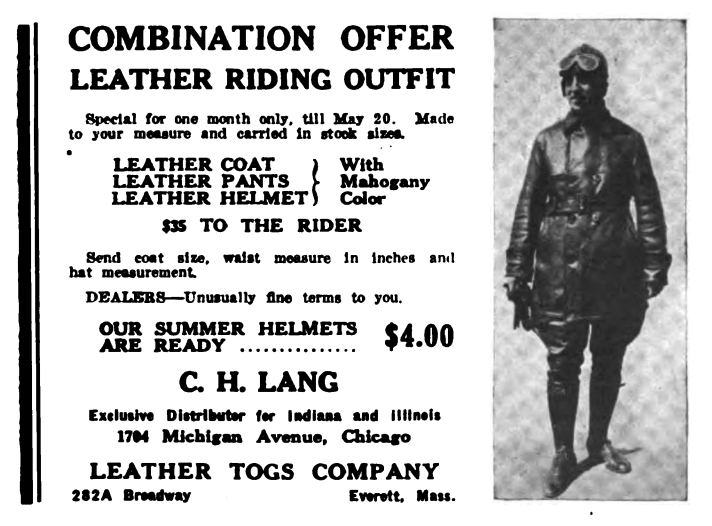
One of the earliest Leathertogs print advertisements, a full leather motorcycle riding outfit from  American Motorcycling and Bicycling Illustrated in 1922. Leathertogs offered long leather coats originally, as it was the current style, before Henry Shaw fine tuned his jacket designs into the models they were best known for by the mid-1930s.  It appears C.H. Lang was an early distributor of Leathertogs goods. [Riley Ward archive]
Clearly, the available documentation makes it difficult to determine the exact foundation date for the Leathertogs business.  Because Leathertogs advertisements and garments can appear with either the Malden or Everett addresses, it is possible that two locations existed and served different purposes: perhaps one had retail manufacturing (associated with Beck and others) and the other for the custom manufacturing of the Leathertogs brand. Municipal boundaries may have also been in transition, affecting how the company’s location was recorded.

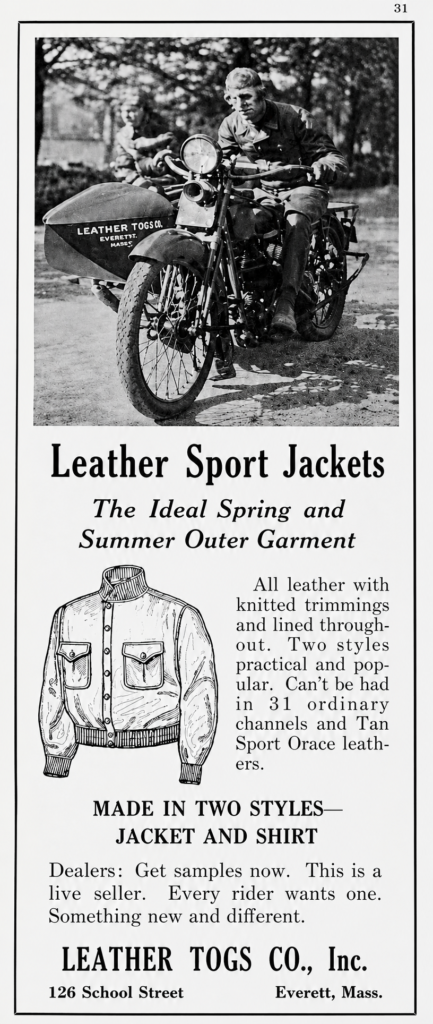
Another ad from Motorcycle and Bicycle Illustrated, this time from 1924, showing further refined motorcyclist designs. The Harley-Davidson J rider wears a future classic: a double-breasted cropped riding jacket with a belted waist: the ‘biker’ jacket before the detachable zipper was invented.  The drawing depicts a clear design precursor to the US Air Force regulation ‘A-1’ jacket of 1927, with knit cuffs, waistband, and collar. [Riley Ward Archive]
Henry Shaw was himself a motorcycle rider and enthusiast, who attended locally held events and designed products suited for real-world riding conditions, such as hill climbing, flat-track racing, and long-distance touring. He understood the benefit of a snug fit to repel the weather, and improve comfort during rides.  In its early years, Leathertogs produced a variety of items: woolen garments, leather helmets, horsehide coats, breeches, and wind cuffs, all primarily marketed to motorcyclists.  Over the next few years, Shaw developed new designs to better suit riders, that proved to be in parallel with developments in aviation clothing design.   Eventually his designs would be seen as iconic, and laid the foundation of the iconic ‘biker’ jacket.

Motorbikes vs Aeroplanes: Evolution of Design [Paul d’Orléans]

The true origins of protective leather clothing are deeply rooted – hundreds of thousands of years deep.  Stacked, stiffened, and shaped leather was among the first types of armor protecting the body in battle for many cultures around the world.  Even further back, animal skins were found to provide insulation and wind protection even among our precursor species, and leather or fur clothing still clings to Ice Age corpsicles and bog men pre-dating modern history.  So, leather for wind / abrasion protection and warmth was nothing new when motors came along.

The Romans used well-crafted leather armor for their uniforms, including helmets, 2000 years ago. [Wikipedia]
In Part 1 we briefly discussed the influence of aviation gear on motorcyclists, but it’s perhaps more accurate to say they evolved together, that the common needs of each activity influenced the other.  For example, sporting helmets as used by racing motorcyclists on banked oval tracks from the 1890s onwards were found to be beneficial for pilots as well, and for the same reasons – keeping the head both warm and protected from blows.

An English leather jerkin dating to 1580: while more extravagantly decorated than the slimmed-down motorcycle racing jacket, it’s still a direct ancestor. The gent on the right wears leather riding boots and breeches as the height of fashion in Paris, just before the Revolution. [Metropolitan Museum of Art and an illustration from ‘Galerie de Modes’ 1782]
Motorcyclists were ahead of the curve in developing protective gear because motorcycles had been around longer than aircraft (the first production motorcycle was the Hildebrand & Wolfmüller of 1885), and when production airplanes finally appeared around 1910, motorcycles were simply faster. For example, in the 1910 the fastest plane in the world was a Blériot XI monoplane, piloted by Alfred Leblanc to 68.2 mph (110 km/h).  But at board track races that same year, riders like Joe Wolters regularly reached 90mph, and by 1911 would reach 100mph.  Accidents at these speeds quickly exposed the need for rider protection, but it was European racers who appear to have donned leather first.

Jack Marshall rode for Triumph in the first and second Isle of Man TTs, in 1907 and ’08, when he won aboard this machine. Note his leather racing jerkin (no collar), woolen trousers, tall lace-up boots, leather helmet, and goggles. An early example of motorcycle racing clothing. [The Vintagent Archive]
Racing riders adapted the leather jerkin – with a military history dating back at least to the 1500s – by the time of the first Isle of Man TT in 1907, as shown above.  Much like other design disciplines (think architecture and product design especially), this new motorcycle racing outfit was stripped of decorative elements and was entirely functional, and in the process became an iconic design.

An original D. Lewis (Lewis Leathers) racing suit from the late 1930s modeled (but sadly not owned!) by author Paul d’Orléans at their London showroom in 2011. The style is little evolved from 1907, and still using buttons, instead of zips on the chest, which is honestly curious.  Was using buttons a case of tradition, style, or some other, practical reason? Improvements over the 1907 version includes padding at the shoulders, elbows and knees. [Marcus Ross]
These adapted jerkins were double-breasted for maximum wind protection and warmth, had no collar, and were usually paired with leather jodhpurs and initially, leather brogues with leather puttees that covered the ankles and calves.  Leather brogues with puttees went out of fashion by the 1920s, but this ensemble set the pattern for racing motorcycle gear through the 1950s, when the one-piece racing suit gained popularity. Street riders had less urgent needs, and their gear tended towards practicality mixed with style, and companies like Dunhill, Barbour, and Harley-Davidson’s Motorclothes sold a mix of wool and leather riding gear.

Dunhill’s ‘Motorities’ catalogs in the early 1900s were cheeky and fun, featuring products that spoke to sporting drivers, riders, and aviators. These ‘bobby dodger’ driving binoculars from a 1913 catalog are ridiculous, and were more likely created to generate attention and a feeling that the brand shared their interests. [The Vintagent Archive]
By contrast, photos of aeronauts in the 1910s tend to feature jaunty men and women wearing boater hats and cotton or wool jackets, primarily because flying was a fair-weather activity, as well as being slow (40-60mph) and low altitude.  The first production airplanes had no cockpit at all, with pilots and passengers hung about the framework of the plane itself, exposed to everything, so if the weather was poor, they preferred not to fly.  And if they did, early flying manuals instructed pilots to stuff newspapers under their coats or sweaters to provide insulation and cut the wind, but that didn’t help much if it rained.

The overlap: this aviatrix models the latest in 1920s leather flying fashion, which is nearly identical to contemporary motorcyclist’s gear. At the time, considerable marketing was aimed at women pilots, drivers, and motorcyclists. [The Vintagent Archive]
As speeds and altitudes rose, feedback from pilots spurred manufacturers like Dunhills to develop warm, wind-proof gear from leather and fur: coats were typically double-breasted, and buttoned (zips were yet to appear) up to collars that could be turned up to protect the back of the neck.  Thick and fur-lined helmets and mask-style goggles, at times with leather face masks, protected the head and face.  Coat cuffs used buckles to tighten down to keep the wind out, and long gauntlet gloves fit over the cuffs.  Even during WW1, with the rapid rise of aircraft technology, no air corps had a standardized uniform for pilots: they were free to shop for themselves among a rising tide of leather goods suppliers aimed at their needs.  By the middle of WW1, the Sidcot suit – a literal development of the boilersuit – led to one-piece leather flying suits lined with fur as the ultimate in protection and warmth.  Specialized one-piece leather racing suits would not appear until the late 1940s.

The Sidcot suit, introduced in 1917, was the first truly specialized pilot’s outfit, invented by Sidney Cotton after flying in greasy coveralls that kept him warmer than his woolen street wear. [The Vintagent Archive]
One clear thread of influence between motorcycle and aviation clothing is the leather ‘bomber’ jacket, a style that remains popular to this day.  The popular understanding of the bomber jacket’s origin is from its first regulation as military gear in 1927, with the legendary A-1 design.

A Leathertogs style from a 1925 ad that became the military A-1 jacket; leather with knit cuffs and waistband, with two pockets up front. [Riley Ward archive]
But the A-1 was clearly based on an existing style already in use by motorcyclists, as Leathertogs had been producing its own ‘bomber’ style since at least 1925.  This shows how motorcycle outfitters initially influenced the styles of aviation gear, and not just the other way around, as is generally assumed.  It might be most accurate to say that the development of motoring technology (autos, aircraft, motorcycles) spurred the development of protective leather clothing for every activity, until each required even more specialized clothing by the 1930s, as the requirements for each activity diverged.

Leathertogs: Innovation and Quality

Leathertogs’ earliest known factories and showrooms were located at 282-A Broadway in Everett, Massachusetts (1922) and at 38 Commercial Street in Malden, Massachusetts (circa 1927), which later moved to 115 Centre Street (circa 1929). By the mid-to-late 1930s, operations had relocated permanently to Everett, Massachusetts, at 11 Spaulding Street—a location confirmed by numerous surviving company labels and print advertisements bearing the “Leathertogs” name and the location mark “Everett, Mass.”
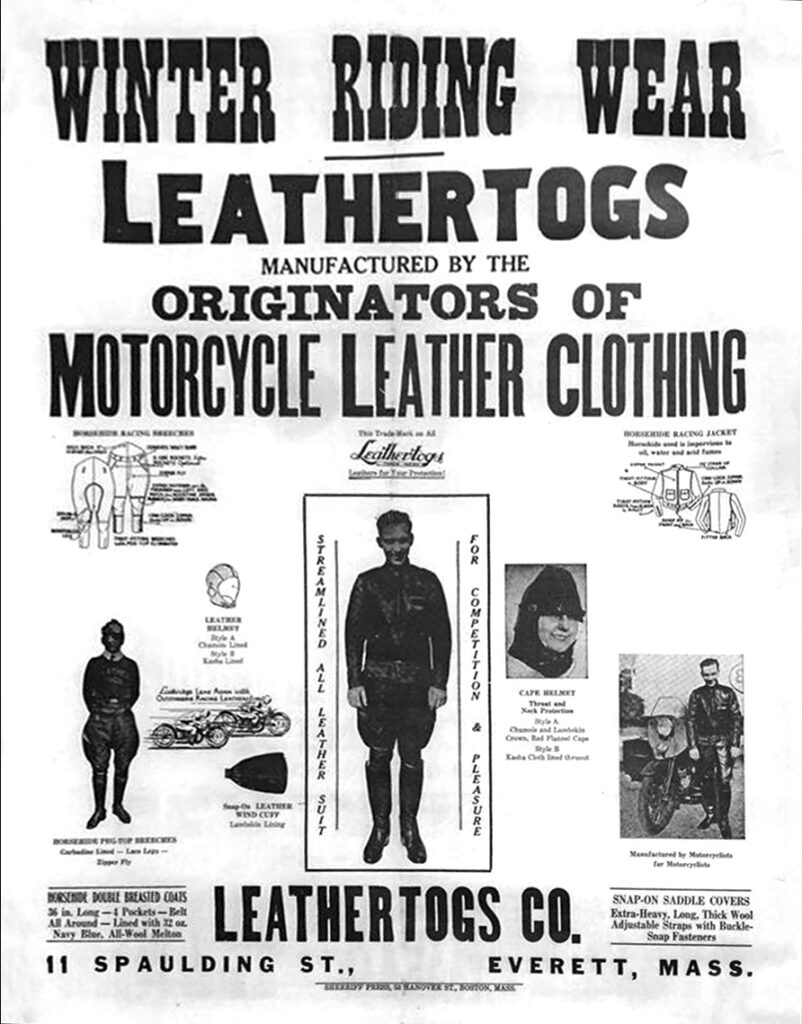
This mid-1930s broadsheet ad proclaims Leathertogs as the “originators of motorcycle leather clothing.” [Rile Ward archive]
Leathertogs distinguished itself as an innovator in the field of sporting clothing, and was among the first to advertise leather clothing for motorcyclists: at least by 1922. Shaw was also among the first leather manufacturers to utilize zippers instead of just buttons or snaps.  Zippers were an innovation in the 1920s, and still costly at the time, at times doubling the price of a garmet.  While the ‘slide fastener’ was first patented back in 1891, the all-metal zipper was developed in 1913 by Gideon Sundback.  It was BF Goodrich that coined the term ‘zipper’ in 1923, when they used Sundback’s patent as quick closures for a line rubber boots.

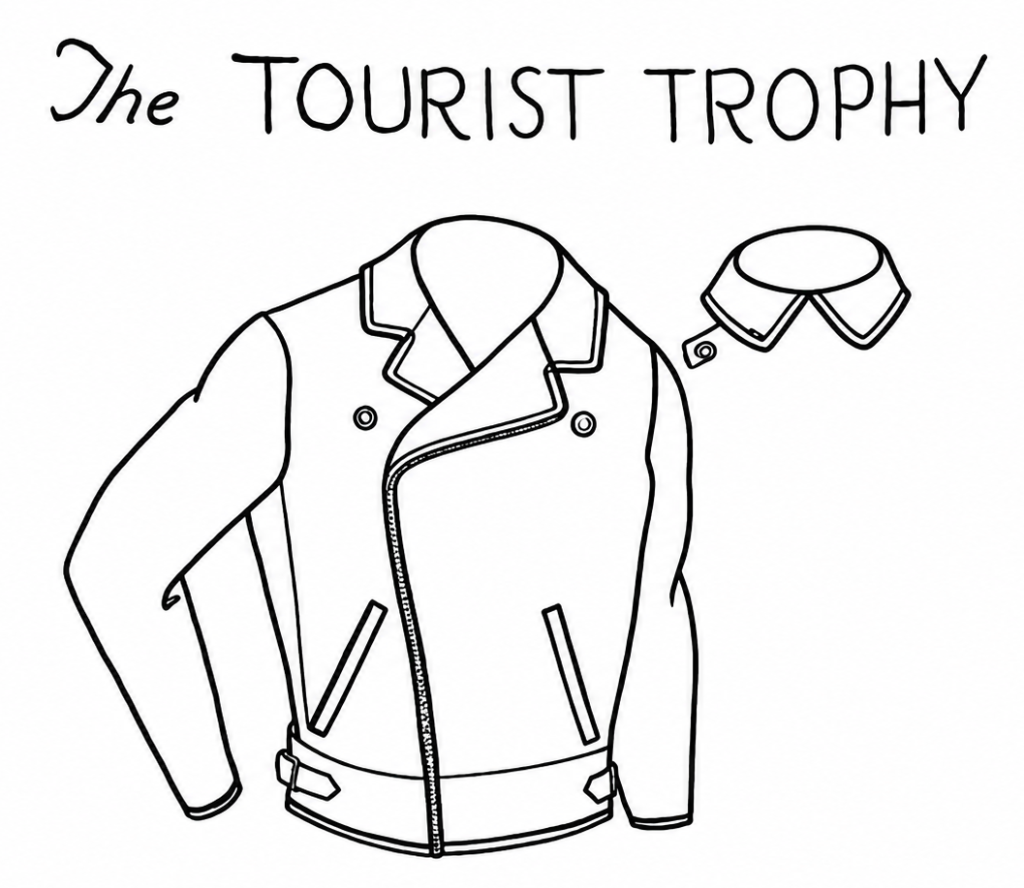
From a 1937 Leathertogs catalog: “The Tourist Trophy, tight-fitting dress jacket. Double breasted; two muff pockets; inside pocket closed with snap fasteners; leather lapels; hip strap-on belt; zippers inside of the under sleeve; high yoke and inverted pleat; two small side pleats; lapels snap down; length 25″; light weight horsehide; celanses or woolen lining. Really a nice jacket for dress wear.” [Riley Ward archive]
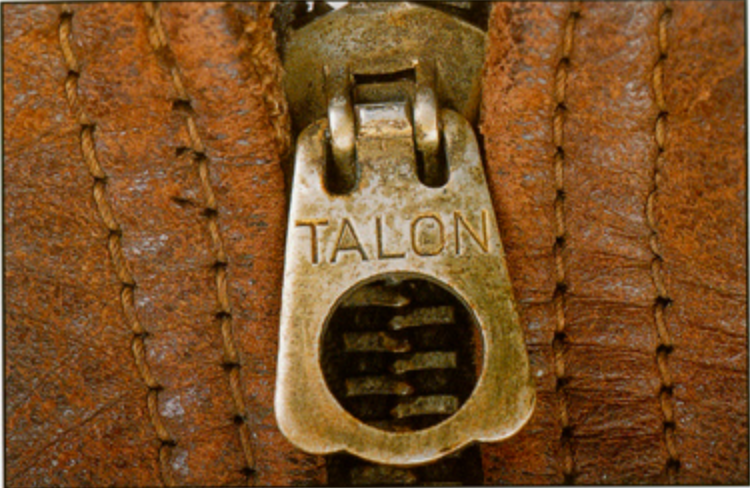
The first fully separable zipper was invented in 1927 by Gideon Sundback: previously a zip-front jacket needed to be a pullover.  Schott claims to be the first manufacturer to use a zipper on a jacket in 1925, but the zipper would not be invented for another two years: perhaps they meant a pullover.  Sundback’s applied for his patent in 1927, and added several improvements in the following years, which is likely why it took until 1930 for the first ads to appear hailing the zip-front as a new feature. Shaw was among the first to innovate with zippers on in his designs, quickly favoring them over traditional buttons to ensure a tight seal against the elements. Talon zippers, sourced from Pennsylvania, were predominantly used, and were known for their quality and reliability. Some surviving garments also feature zippers from Kwik and other manufacturers.

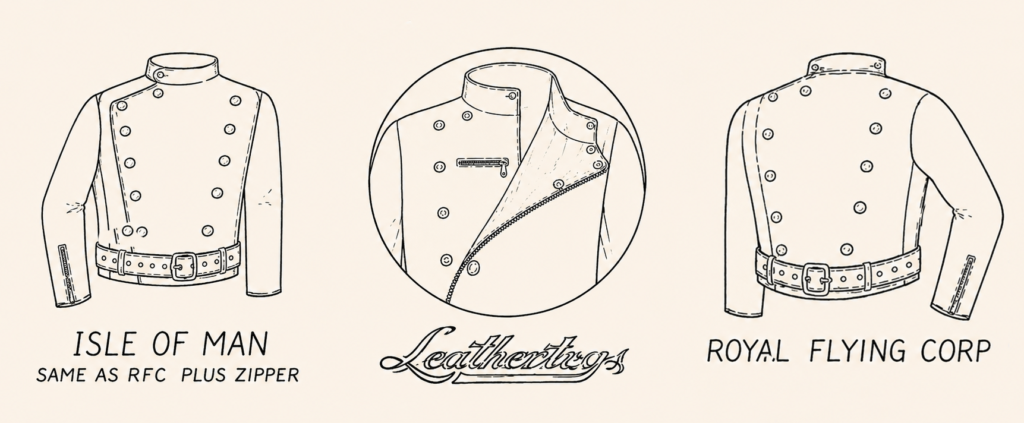
The Isle of Man and Royal Flying Corps jackets used a double row of snap in addition to a zipper, giving a unique style to these Leathertogs models that is instantly recognizable. [Riley Ward archive]
Shaw’s approach was uniquely comprehensive. Unlike many of his contemporaries, he didn’t just make ‘off-the-rack’ items, he offered customizable garments tailored to a rider’s specific measurements and needs, down to the placement of pockets or inclusion of specialty features. This was a rare offering in leatherwear at the time, and it distinguished Leathertogs as a company focused not only on performance but also on individual expression and rider experience.

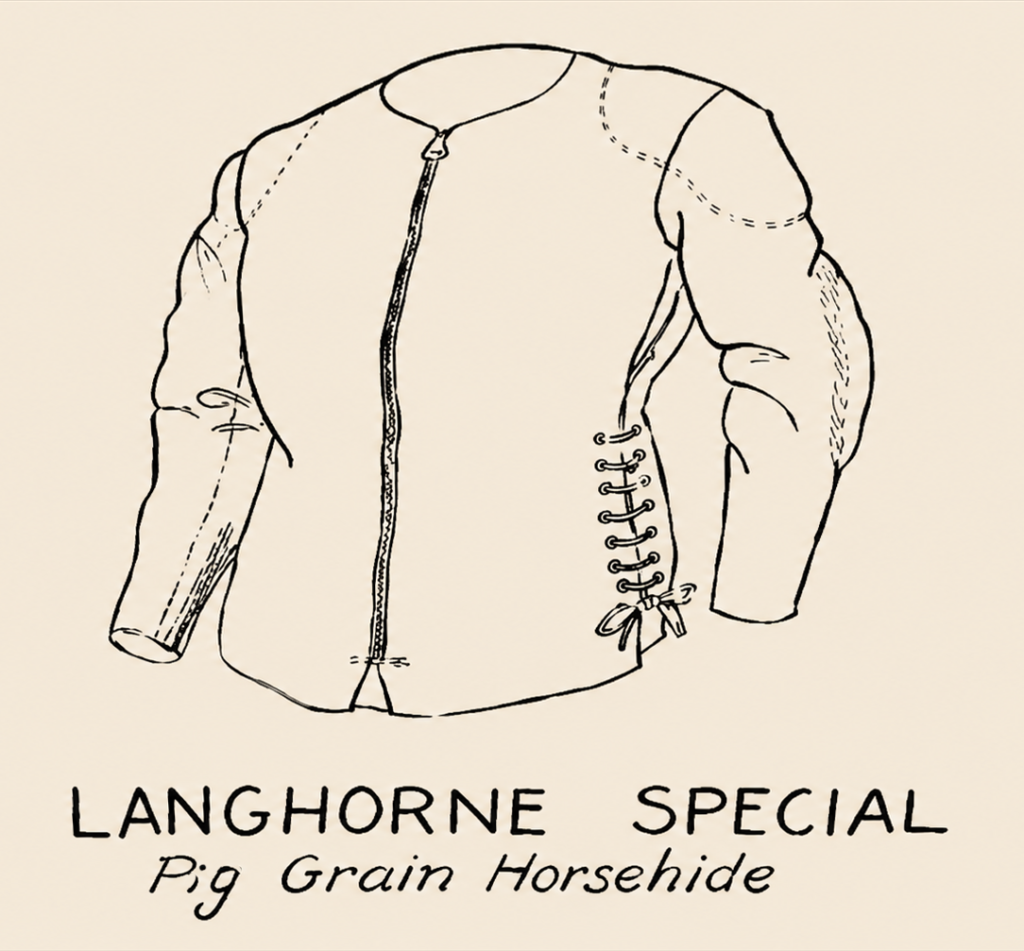
The Langhorne Special was made for dirt track racing, and is a development of the earliest type of racing jersey, but with a zipper instead of buttons. [Riley Ward archive]
Thus Shaw’s designs mixed function with fashion: the jackets and breeches he developed were stylish, durable, and weather-resistant, embodying the spirit of the motorcyclist. His designs were informed by real-world feedback: Henry himself attended local motorcycle events, listened to riders who visited his shop, read motorcycle newspapers, and even named some of his jacket designs after famous riding and racing events across the U.S. (e.g., The Isle of Man/Tourist Trophy, The Muroc Special, The Daytona, The Grand Prix, and The Langhorne Racing Shirt).

An exquisite Leathertogs custom women’s Tourist Trophy jacket from the 1940s. [Rin Tanaka]
Leathertogs reached its peak from the mid-1930s through the 1940s. The rise in motorcycle popularity during this period contributed directly to demand, and Leathertogs became a trusted name among serious riders.   The company was known for offering customized fits and modifications, which added to its prestige. By 1938, Leathertogs offered eleven jacket models and three styles of breeches, though only a few of these survive today in contemporary collections. Each piece emphasized durability, thoughtful design, and premium materials. Painted-on artwork was also available at an additional cost if desired, such as club logos, member names, or World War II squadron insignia.

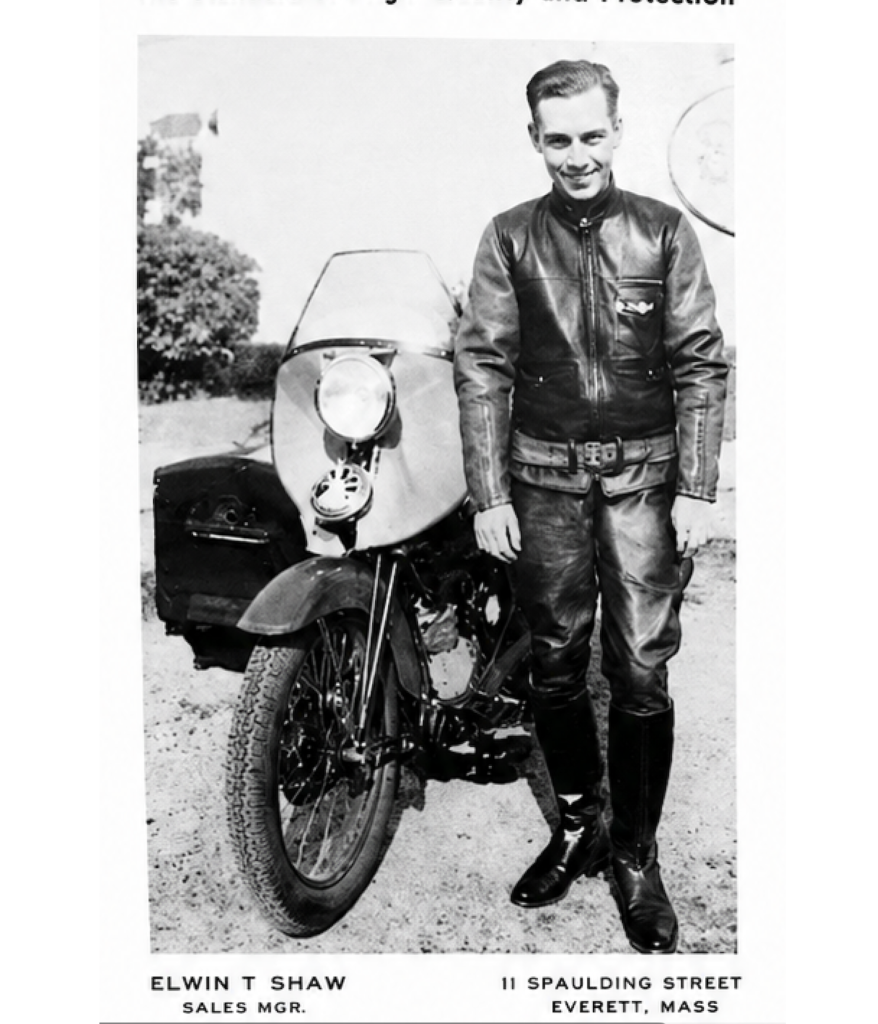
Elwin Shaw was featured in Leathertogs advertising in 1937, as he assumed the position of Sales Manager.  He appears to be wearing a two-tone, all-zip pocket version of the Daytona Streamline jacket, adorned with a custom ‘winged wheel’ insignia, plus leather riding trousers and tall riding boots.  The sidecar outfit is a ca.1936 Indian Scout with trade delivery sidecar and stylishly trimmed canvas/perspex fairing. [Riley Ward Archive]
By 1937, Henry’s son, Elwin Shaw, had joined the business as sales manager, taking on some of the company’s responsibilities. Leathertogs likely operated with a small, tight-knit team, as an independent workshop taking on bespoke clothing orders. Throughout the 1920s and 1930s, the company placed seasonal job listings in The Boston Globe for cutters, further suggesting a modest but active workshop as demand increased.

Design Details

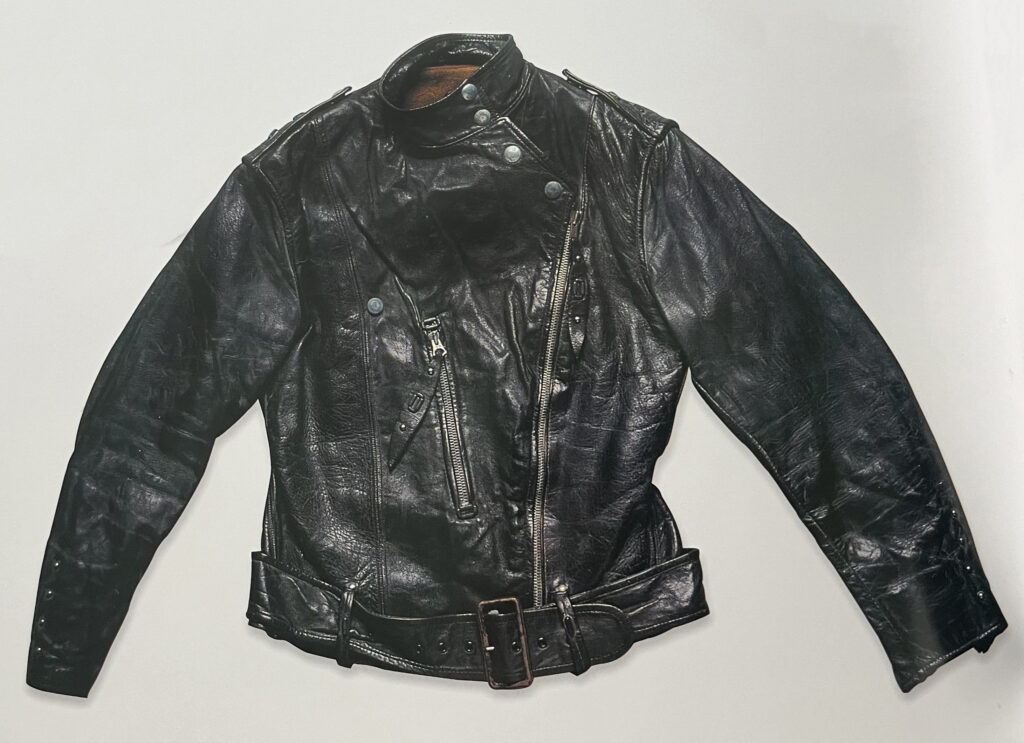
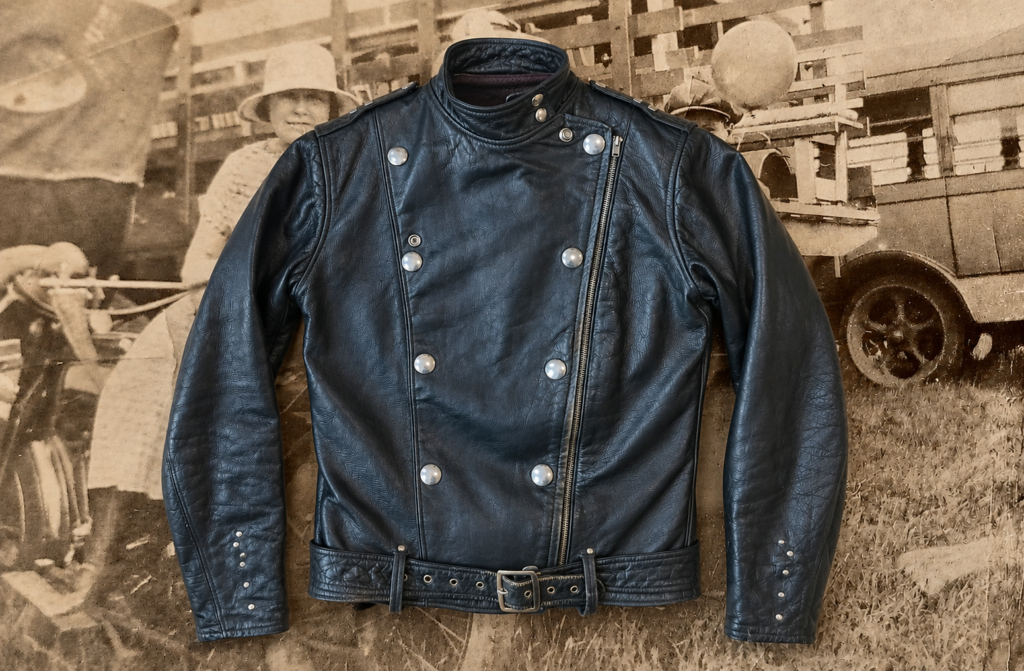
The iconic Leathertogs ‘biker’ jacket – the ‘Isle of Man model’ – of the 1930s: a timeless double-breasted design, close-fitting for wind protection, with distinctive and sturdy snaps and studs. [Riley Ward archive]
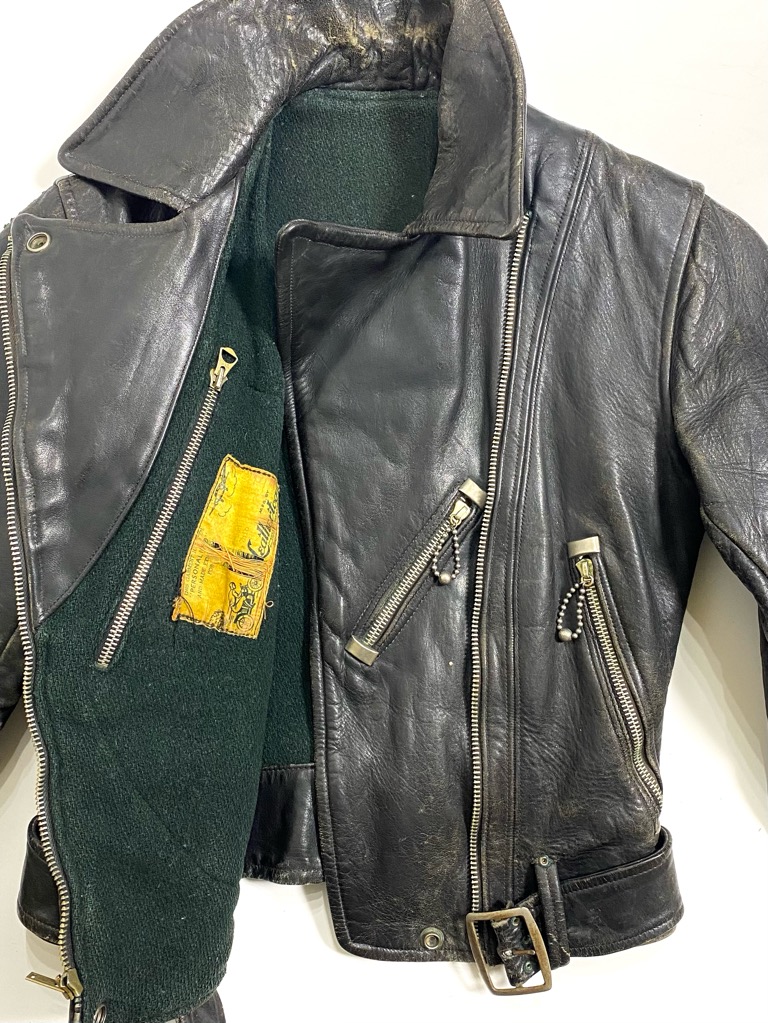
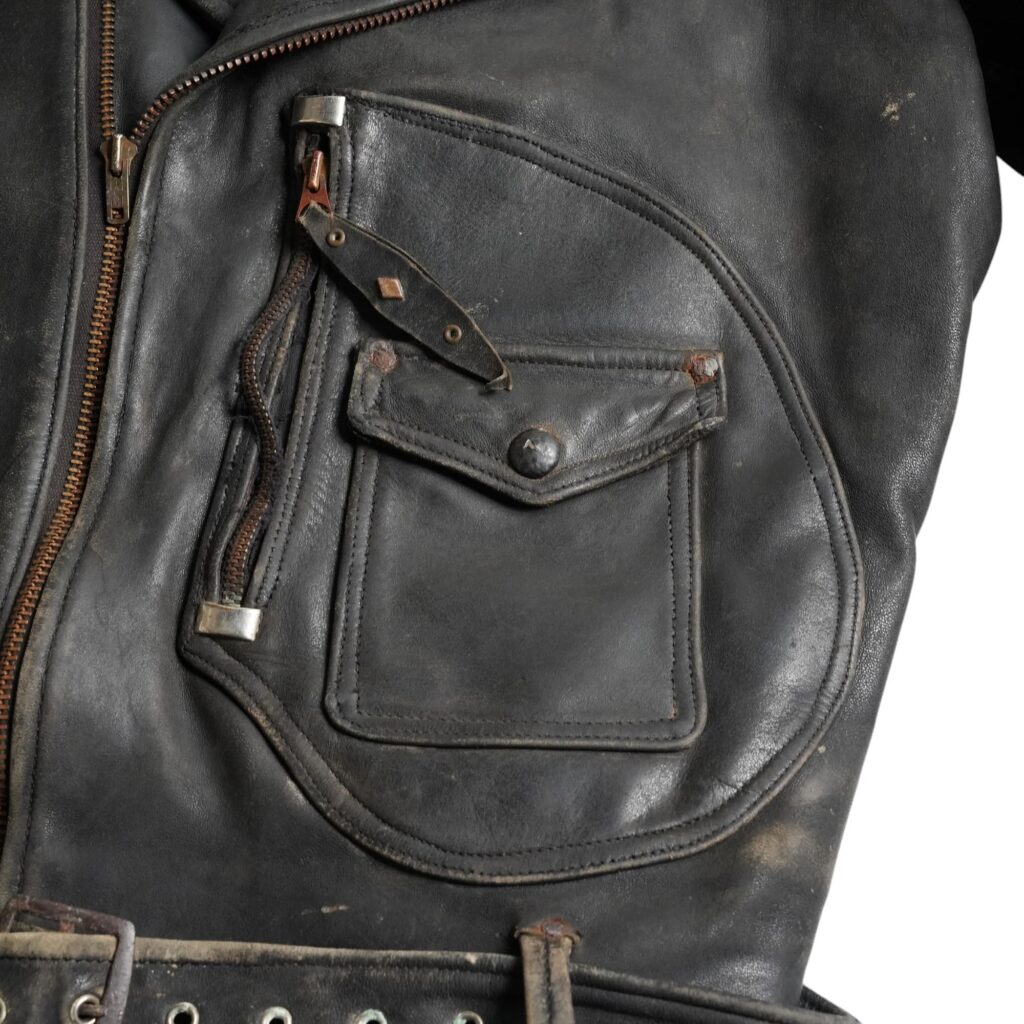
Lots of beautiful details to be seen on this original Leathertogs ‘biker’ jacket from the 1930s…Talon ball pull zippered pockets, metal decorative embellishments, zippered inner pocket, woven label, woolen liner, riveted belt loops and tailored body panels [Credit unknown]
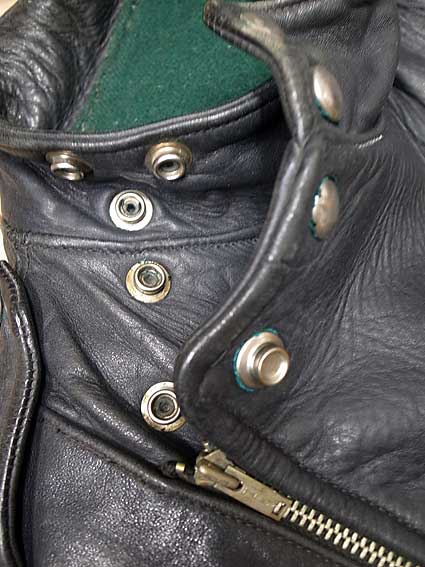
This forest of snaps shows the lengths Henry Shaw went to ensure good air-tightness on his jackets. Snaps were faster to use and more durable than buttons. The leather used was typically horsehide, which is far more durable that cow leather, and the interior lining was wool, usually a solid color like this green, but not always. [Riley Ward archive]
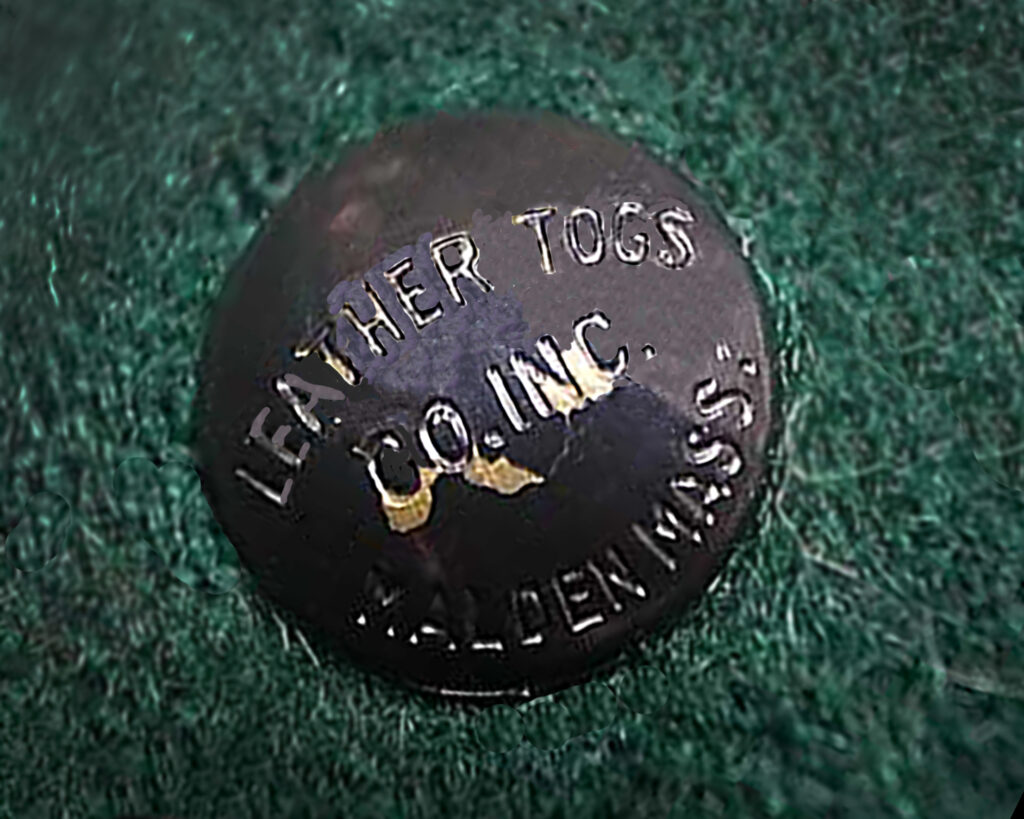
No detail was too small: the snap caps were stamped with the Leathertogs logo. [Riley Ward archive]
A close-up of a Talon ‘cam-lock’ zipper on the sleeve of the Daytona Streamline leather racing jacket by Leathertogs. This would mean the jacket was produced between the very late 1920s and the mid-1930s. If I had to guess the manufacturing year I would say c.1934-1936. [Rin Tanaka Archive]
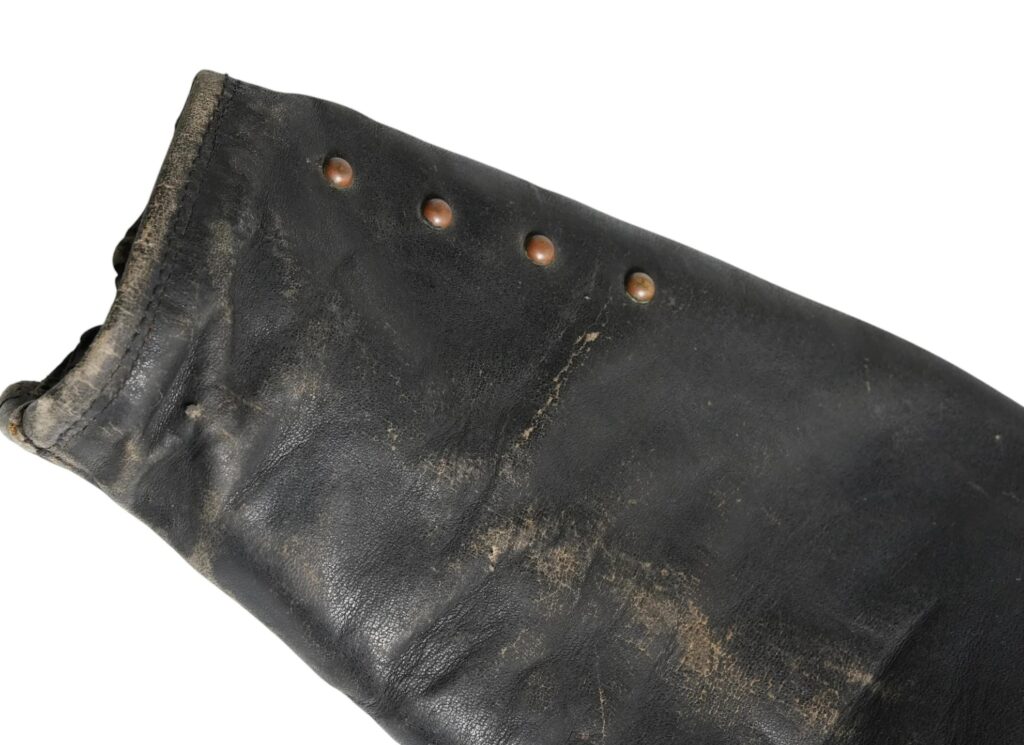
Leather studs were a distinctive feature of Leathertogs jackets, and are a great help in identifying them in photos. The studs protected the leather in the event of a fall. [Riley Ward archive]
The ‘D-pocket’ was another distinctive feature of 1930s Leathertogs jackets, although several other manufacturers used them. Note the durable chrome zip-stops, the handy studded leather pull-tag, and the snap pocket. [Riley Ward Archive]
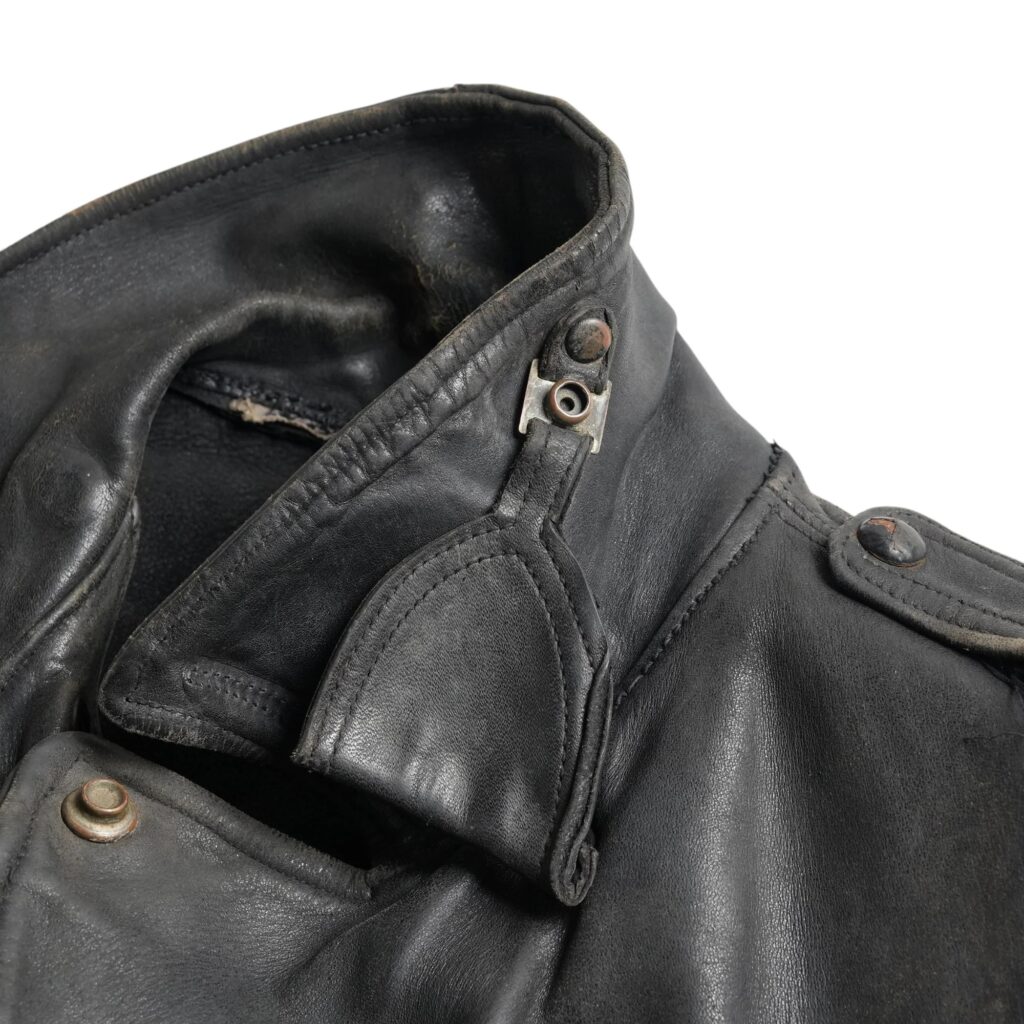
This leather pull was held back by a stud, and closed by another stud, and prevented wind from entering the gap at the front of the collar in cold weather. [Riley Ward Archive]
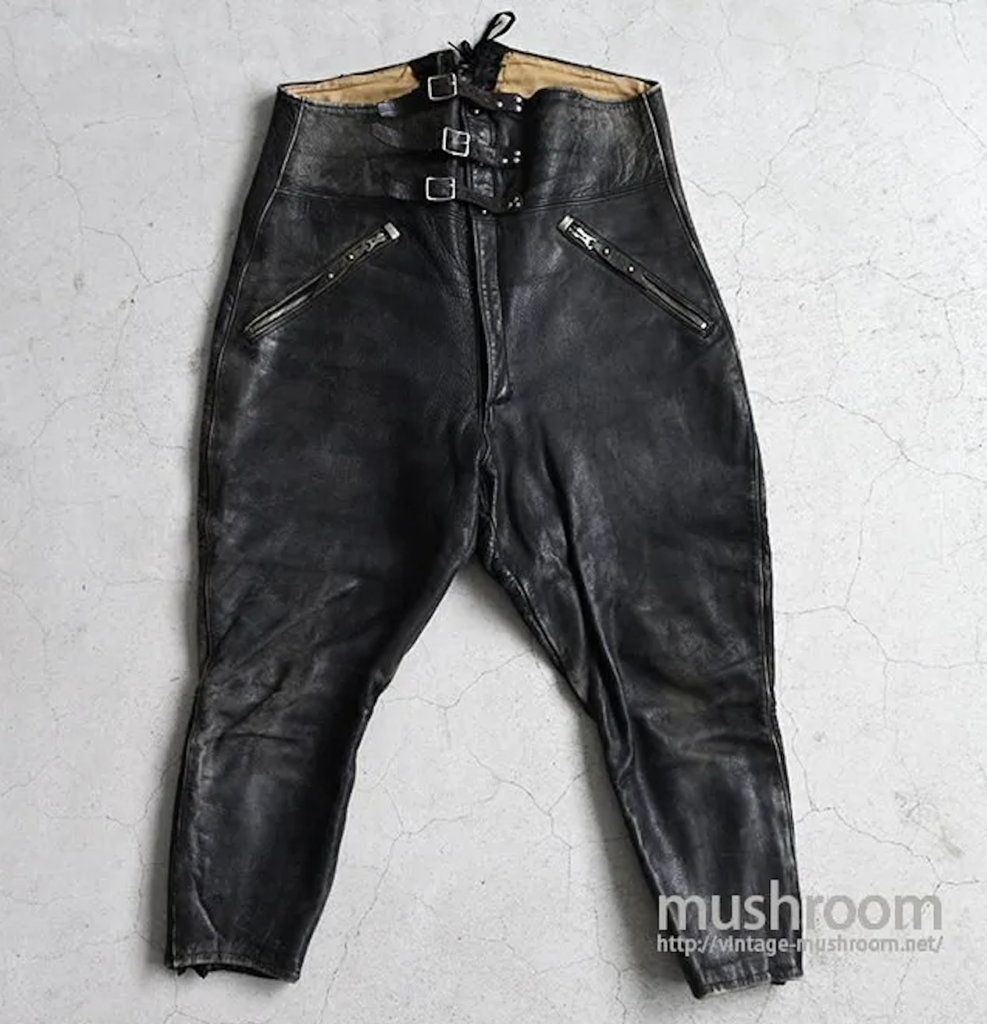
Breeches were most likely one of the first garments Leathertogs built. Breeches were popular in the late 1800s with military uniforms, horseback riding, and outdoor sports like hunting. Many motorcyclists in the 1920s are seen in photos sporting Breeches, both wool and leather. [Mushroom]
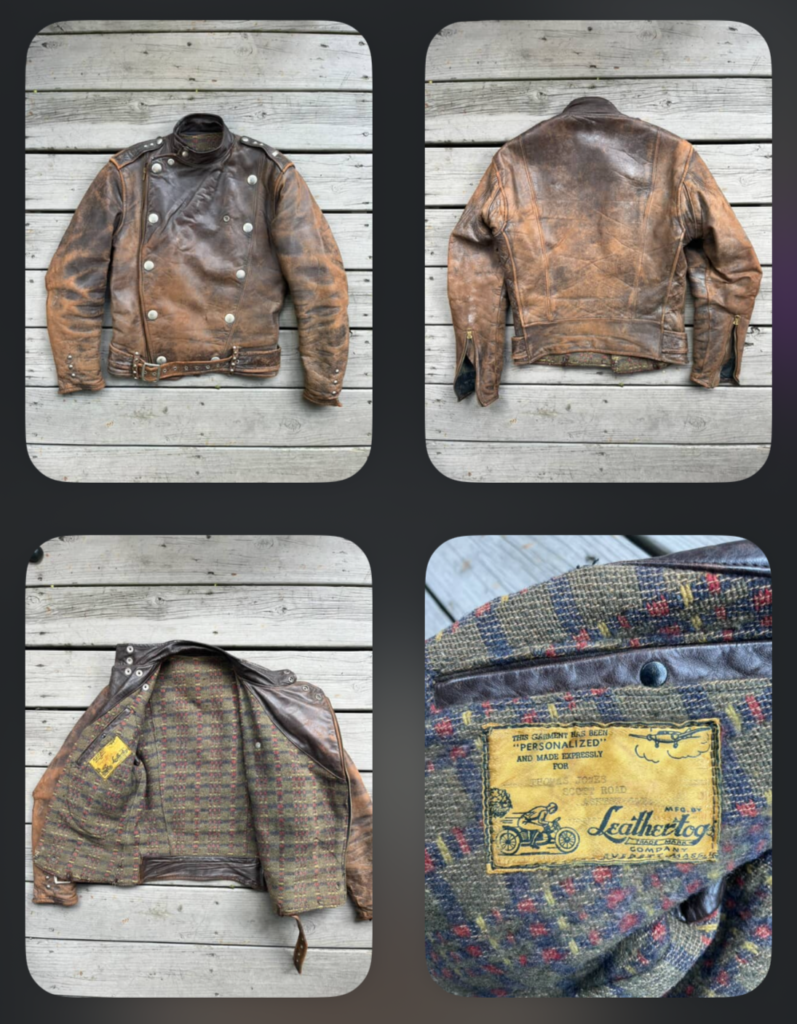
An original Leathertogs Isle of Man model with wonderful details…metal ‘spot’ embellishments, patina, a colorful woolen liner, and premium quality horsehide leather that has survived generations. [Jonathan Evenchen Archive]
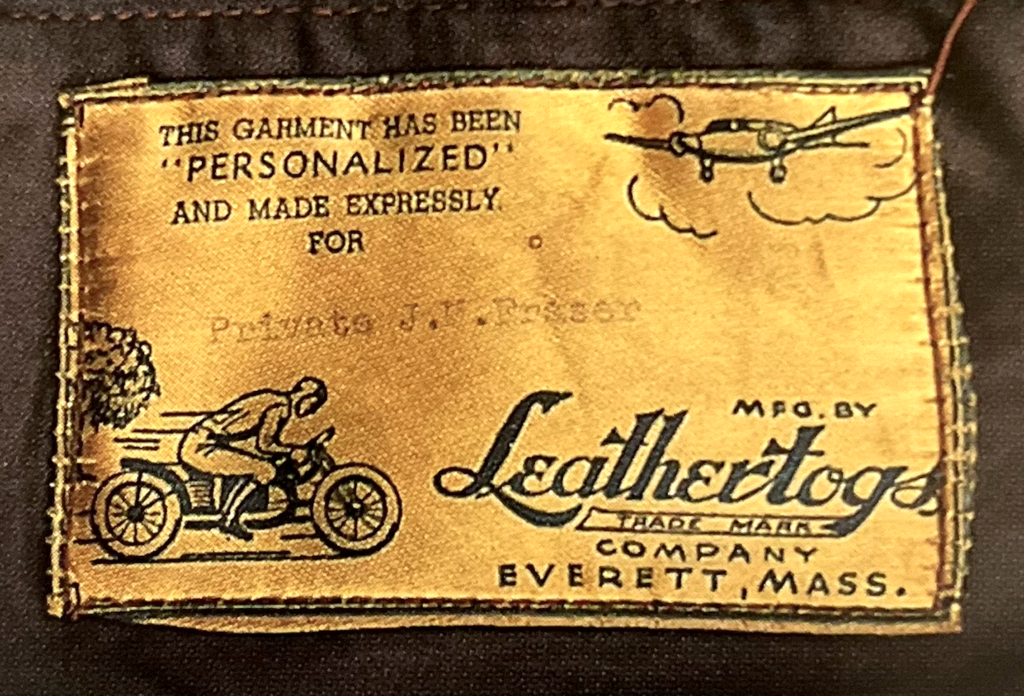
Every Leathertogs garment had a lovely silk label, and the garments were all made to measure, hence the ‘personalized’ note, and room for the first owner’s name. [Riley Ward archive]
 

Riley Ward is a vintage motorcycle jacket historian, as well as a collector / material sourcing / aspiring collaborative menswear designer. Check out his Instagram, and follow his history of Leathertogs here.