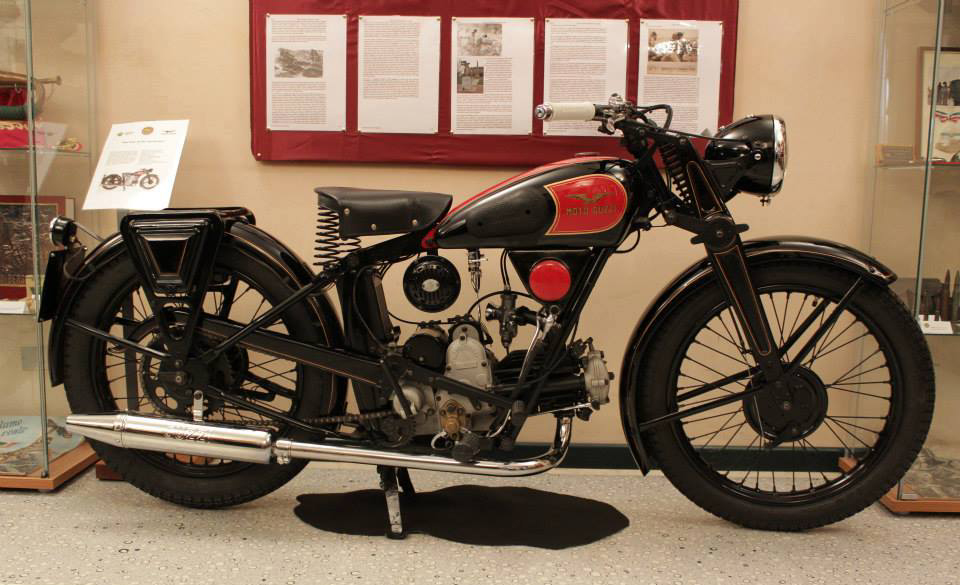
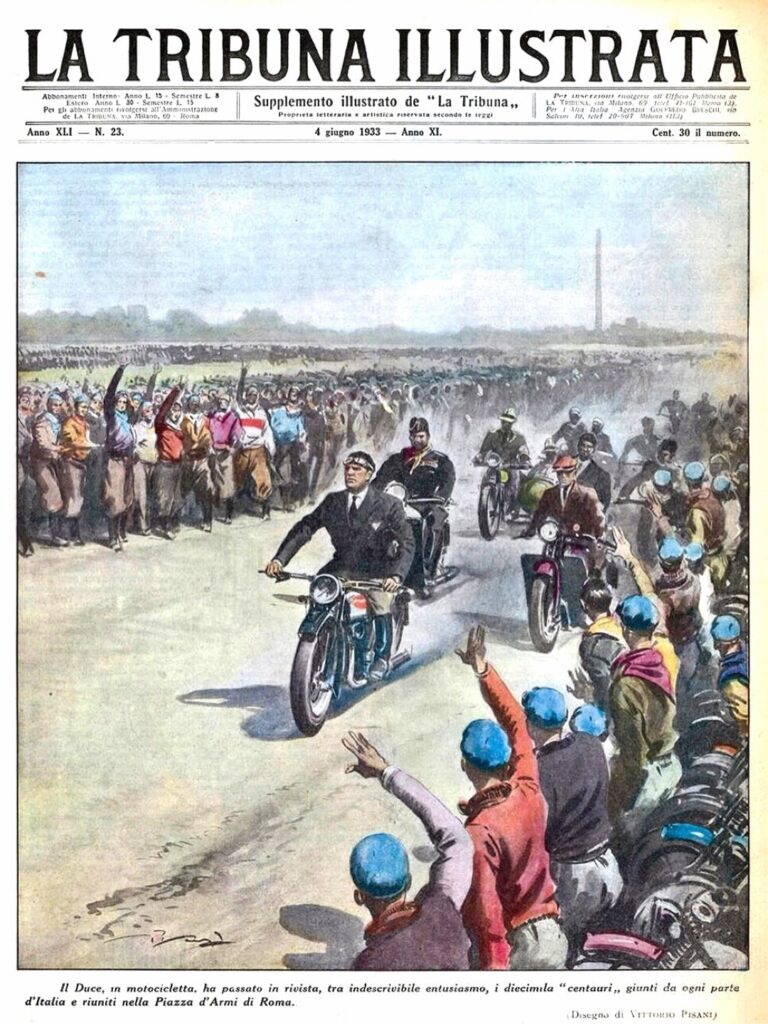
In 1933, Benito Mussolini posed astride a Bianchi motorcycle, embracing the rather grand title: Il Primo Motociclista d’Italia (the First Motorcyclist of Italy), a title he had claimed in 1931. It was a good photograph for a dictator: Mussolini sits squarely atop a powerful machine, looking every bit it’s master. The motorcycle offered him speed, strength, technology, and modernity in one convenient package.  But Mussolini was hardly the first Italian to understand what a motorcycle could represent. By the time the Fascist regime made motorcycles part of its imagery, artists, engineers, manufacturers, racers, and advertisers had already spent two decades turning the machine into a symbol of modern life.
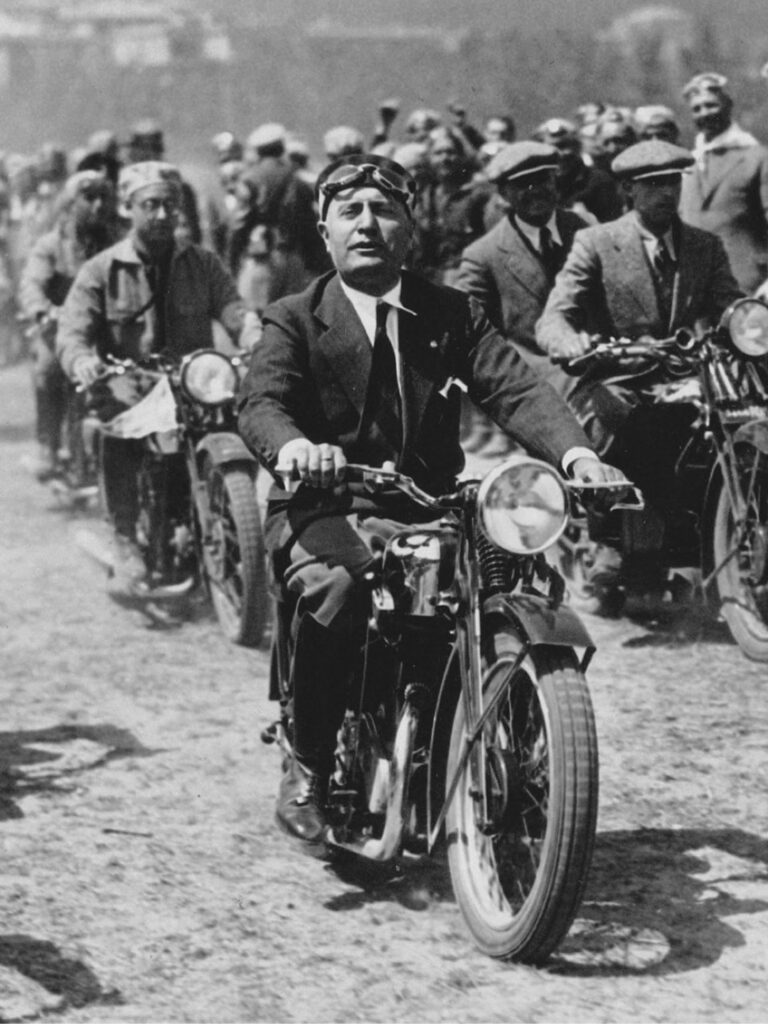
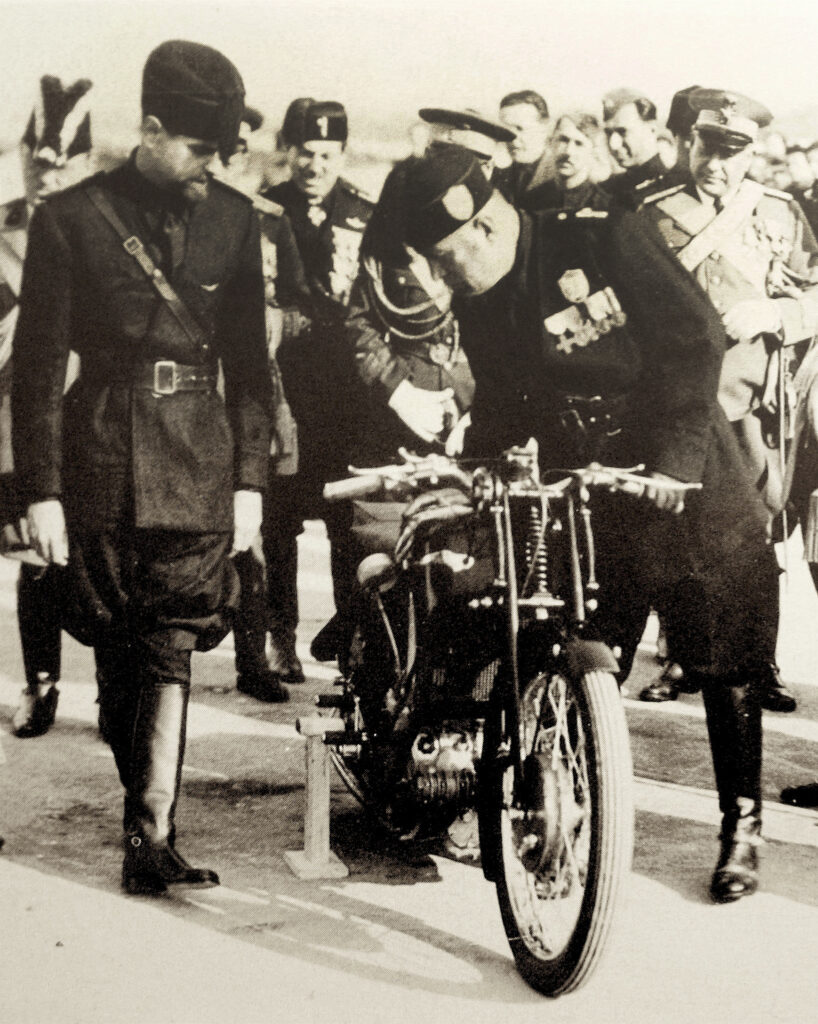
Italian dictator Benito Mussolini in civilian clothing, aboard a Bianchi 175cc motorcycle, proudly promoting himself as ‘Motorcyclist #1’. The image is from Reale Moto Club d’Italia’s 1933 “Raduno dei Centauri” (Centaur Rally of the Royal Moto Club of Italy). The Moto Club preceded the Federazione Motociclistica Italiana. [The Vintagent Archive]
The story of the Italian motorcycle in the first half of the twentieth century is, in many ways, a story about speed. By the the 1910s, artist aligned with the Futurist movement had already developed an entirely new visual language for the world of machines, motion, and acceleration. After World War I, Moto Guzzi turned some of those ideas into reality, drawing on the founders’ experience in military aviation and the war’s technological culture. By the 1930s, Fascism had discovered how useful exploiting that language could be.  They incorporated existing Futurist imagery and language around speed, machinery, youth, physical strength, and technological power, appropriating and redirecting it toward its own political agenda.

Mario Sironi’s extraordinary painting from 1918, ‘New Man’, showing an integration of rider and machine far in advance of the reality of 1918, and setting the visual tone for motorcycle imagery in the 1930s. [The Vintagent Archive]
Imagining Speed

The story begins not in a motorcycle factory but in artists’ studios.  The Futurist movement, founded by Filippo Marinetti in 1909 with the publication of the Futurist Manifesto, celebrated movement, machinery, youth, danger, and acceleration as defining features of the modern world.  Futurist artists didn’t just want to paint new machines, they wanted to capture what it felt like to live in a world suddenly transformed by machinery. Speed became both an artistic subject and an ideal. The motorcycle was particularly useful to this project because it put the human body directly into the environment. An automobile enclosed its driver. A motorcycle left the rider exposed: to speed, noise, wind, danger, and movement. The rider sat on the motorcycle rather than inside it, becoming part of its motion. For the Futurists, that relationship suggested a new kind of human-machine hybrid: a mechanical “centaur,” part person and part machine.
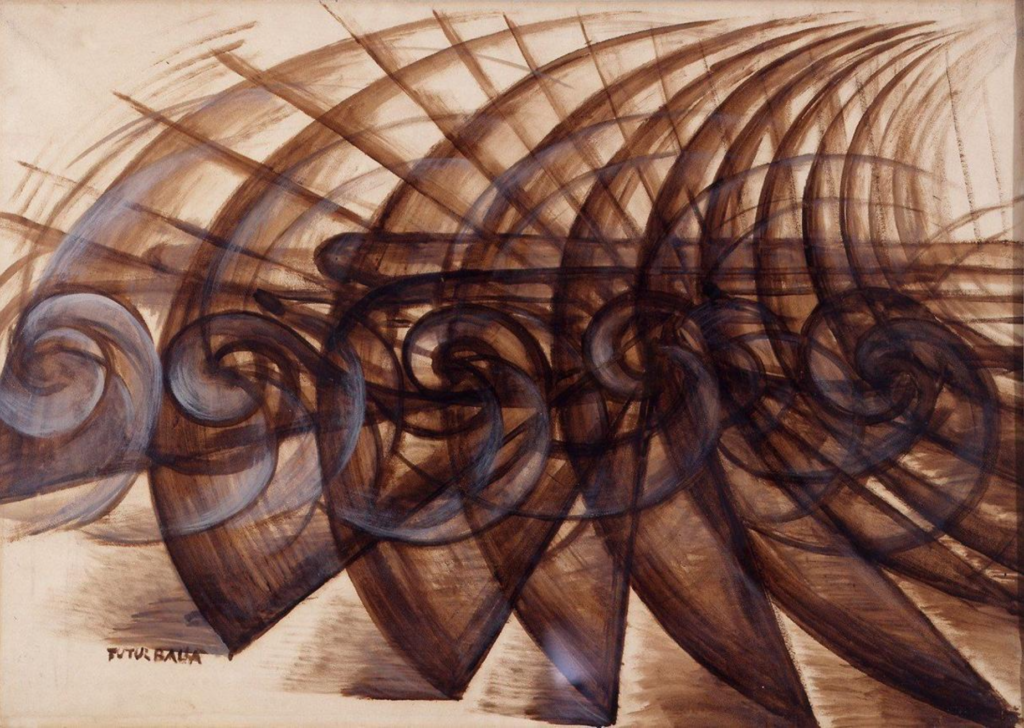
Detail of Giacomo Balla’s Velocità di Motocicletta, 1913. Note the signature ‘FuturBalla’: several Futurist artists merged their names with the artistic movement. [The Vintagent Archive]
Giacomo Balla’s painting Velocità di Motocicletta (1913) captures the idea. Balla was not interested in giving us a neat portrait of a motorcycle. Repeated forms, diagonal lines, fractured perspectives, and sweeping trajectories turn the painting into an attempt to depict velocity itself. The motorcycle almost disappears into the movement around it.
The question was not simply, What does a motorcycle look like? It was: What does it feel like to move through space on one?
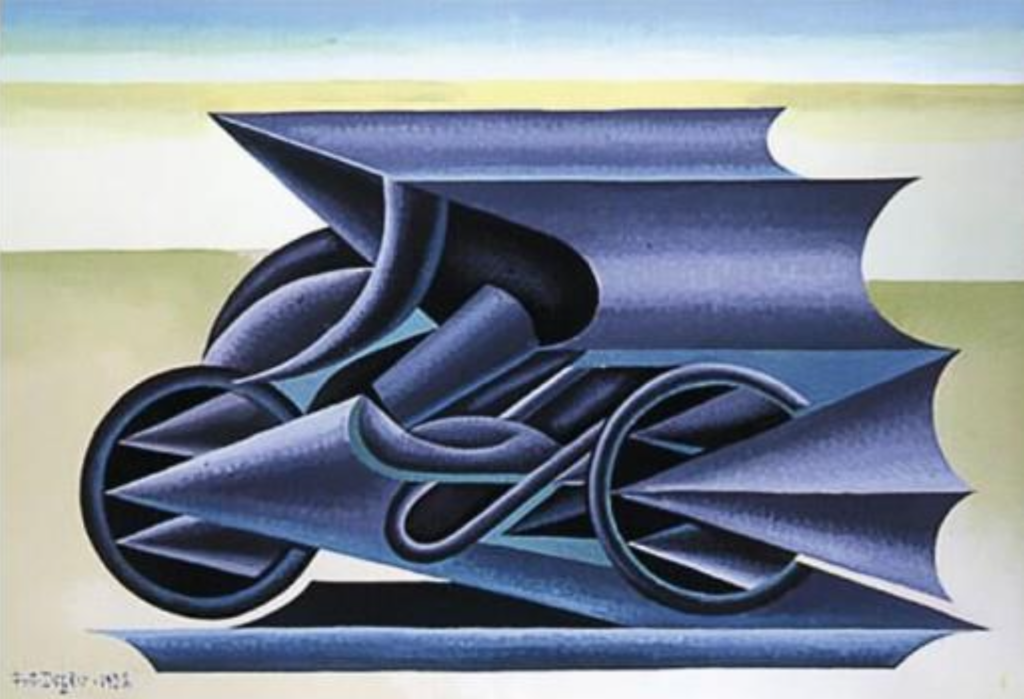
Fortunato Depero is perhaps the best remembered Futurist artist, mostly because of his graphic work, including the evergreen Campari label. This painting Il Motociclista (1923). [The Vintagent Archive]
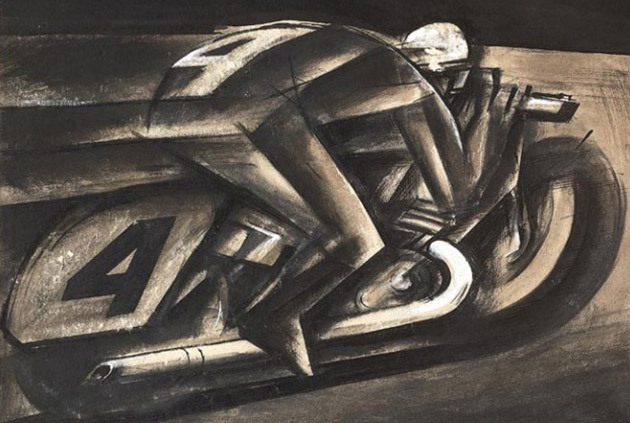
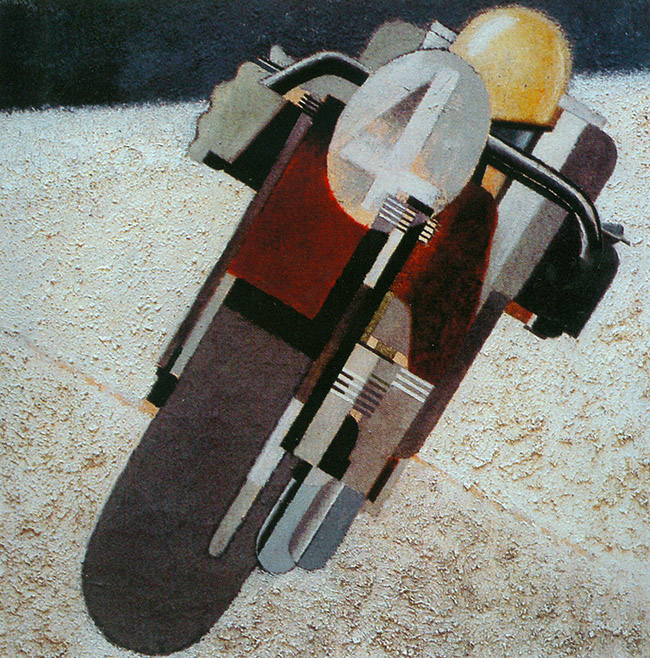
Fortunato Depero carried this mechanical aesthetic into painting, graphic design, and commercial illustration. His Il Motociclista (1923) belongs to the mechanical-dynamic phase of his work, while his advertising demonstrates how Futurist ideas could escape the gallery and enter everyday commercial life. Ivo Pannaggi’s Centauro, painted in 1931, pushed the human-machine relationship further still. The rider and motorcycle become a single mechanical organism, a modern replacement for the ancient human-horse centaur.

Ivo Pannaggi’s Centauro (1931), showing a rider fully integrated with a racing motorcycle. [The Vintagent Archive]
Together, these artists created a recognizable visual language for the machine age: diagonal compositions, compressed perspectives, abstraction, and bodies fused with machines. The motorcycle was an especially powerful subject because the rider remained visible while simultaneously becoming part of a machine. The motorcycle was not just moving through the modern world, it represented the modern world.

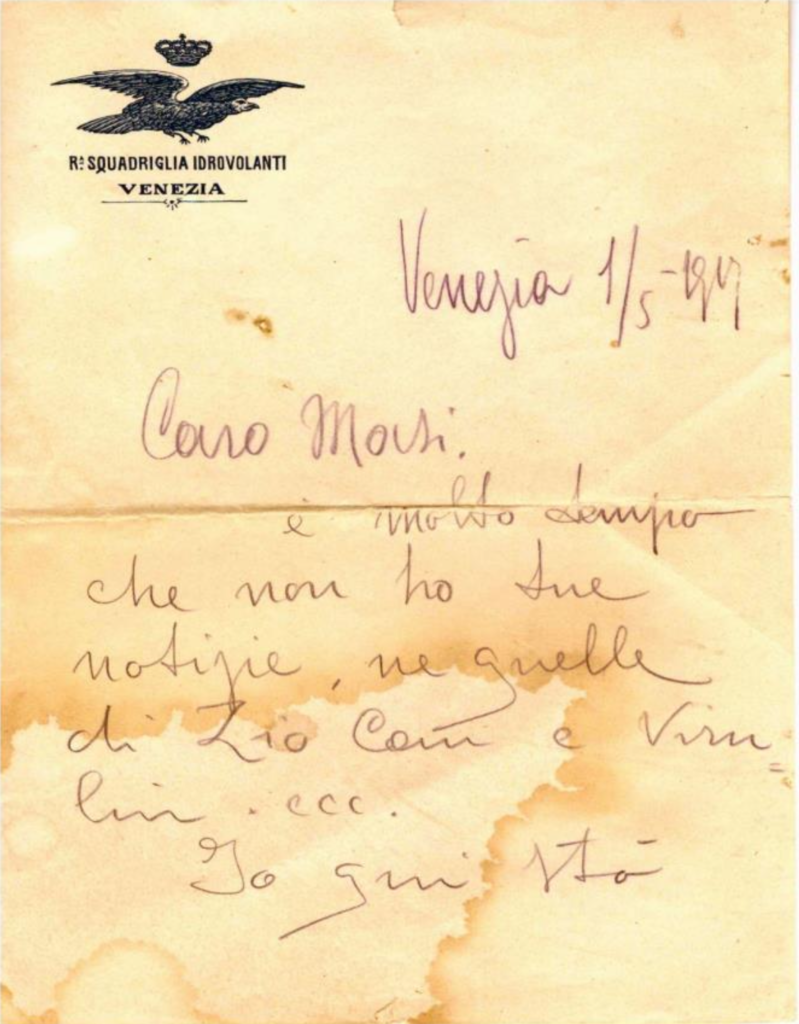
The origin of the Moto Guzzi winged eagle logo, adapted from Carlo Guzzi’s WW1 flying group logo, from the Squadriglia Idrovolanti. [Wendy Pojmann, from Carlo Guzzi point, Mandello del Lario]
Building Speed

World War I gave some of the Futurist’s artistic fantasies a much more practical setting. Military aviation brought pilots, mechanics, engineers, and machines together in new ways. Aircraft engines, technical expertise, speed, and mechanical skill became matters of national importance. When the war ended, that technological culture did not simply disappear. It moved into civilian life. The Moto Guzzi brand emerged directly from this world. Carlo Guzzi and Giorgio Parodi both served in the Servizio Aeronautico della Regia Marina during the First World War alongside their friend Giovanni Ravelli. Guzzi worked as a mechanic responsible for aircraft engines. Parodi and Ravelli became military pilots. Ravelli was also an accomplished motorcycle racer, and Guzzi had already developed a deep interest in motorcycle design. During the war, the three men began discussing the motorcycle they hoped to build. Ravelli never saw the results of their discussions: he died in a test-flight accident on August 11, 1919. Two years later, on March 15 1921, Guzzi and Parodi formally founded the Società Anonima Moto Guzzi in Genoa. In Ravelli’s memory, they adopted the winged eagle used by the naval aviation service as the company emblem.
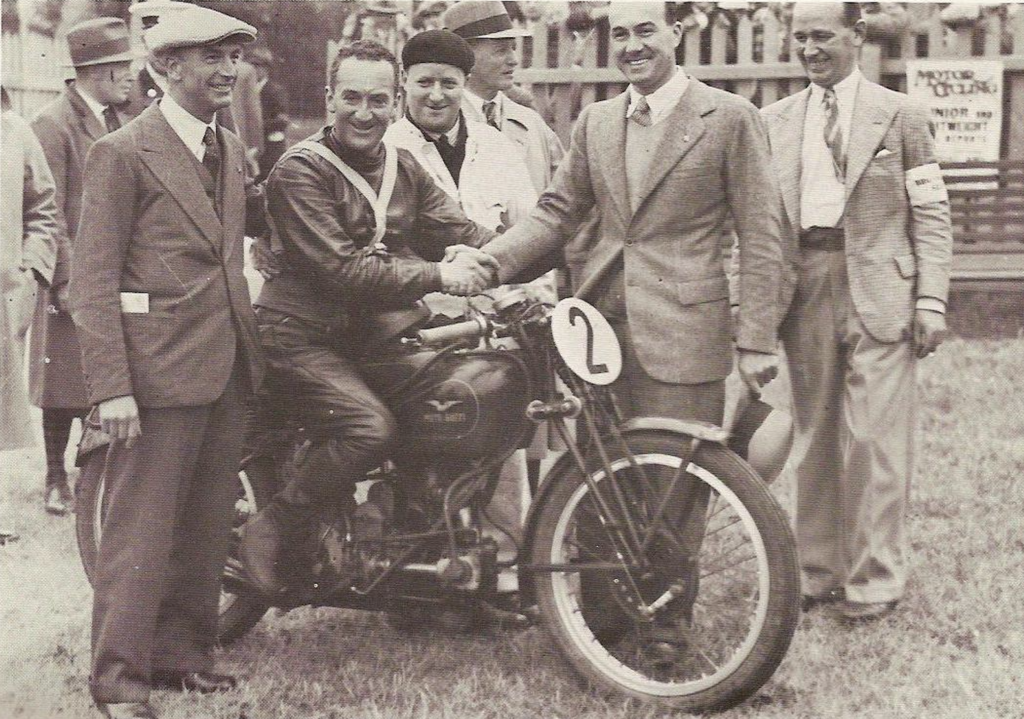
Sometimes raising the flag for Italy meant hiring the best rider: here Carlo Guzzi (L) and Giorgio Parodi (R) congratulate Stanley Woods at the 1935 Isle of Man Senior TT, which Woods has just won aboard their remarkable 500cc OHC racer.  The day before, he also won the Lightweight TT aboard another Moto Guzzi racer. [Keig Collection]
Moto Guzzi brought aviation experience into the postwar motorcycle world. Parodi and Ravelli brought military pilot experience; Guzzi brought his knowledge of aircraft engines. Parodi received three Silver Medals for Military Valor during the First World War; Ravelli flew hundreds of combat missions and also earned three Silver Medals.
What had been developed for military aviation now helped create civilian mobility. This is where Futurist vision and the war’s technological culture began to converge. Artists had imagined a world in which humans, machines, and speed were increasingly inseparable. Moto Guzzi built motorcycles that made that relationship tangible.
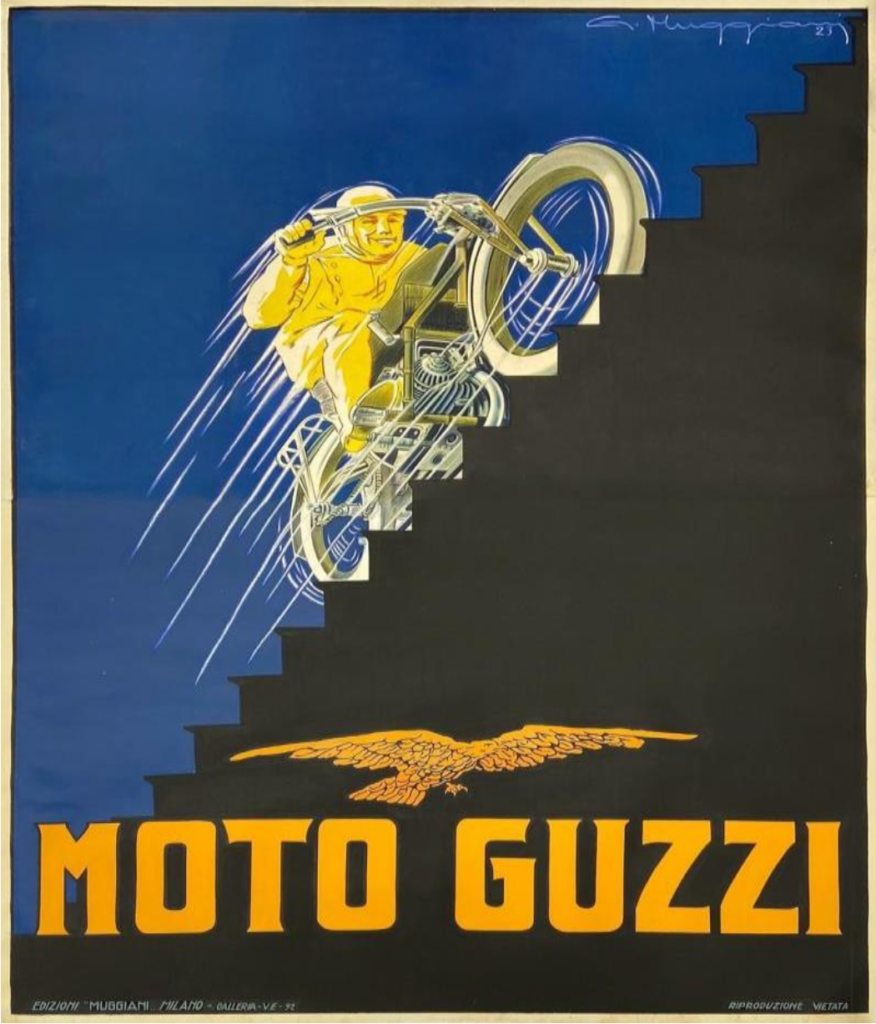
A 1923 Moto Guzzi poster with Giovanni Ravelli in the saddle, climbing stairs with the grin of a demon. [Moto Guzzi Archive]
Giorgio Muggiani’s 1923 Moto Guzzi poster makes the connection especially vivid. It shows racer and aviator Giovanni Ravelli riding a Moto Guzzi up a flight of stairs, beneath the company’s winged eagle. The composition is all diagonals, compressed perspective, and movement. Its visual language belongs to the same broader culture of speed and machinery that Futurist artists had helped make recognizable. Muggiani knew the motorcycle was not simply an image of modernity. Consumers could buy it, ride it, and become centaurs themselves.

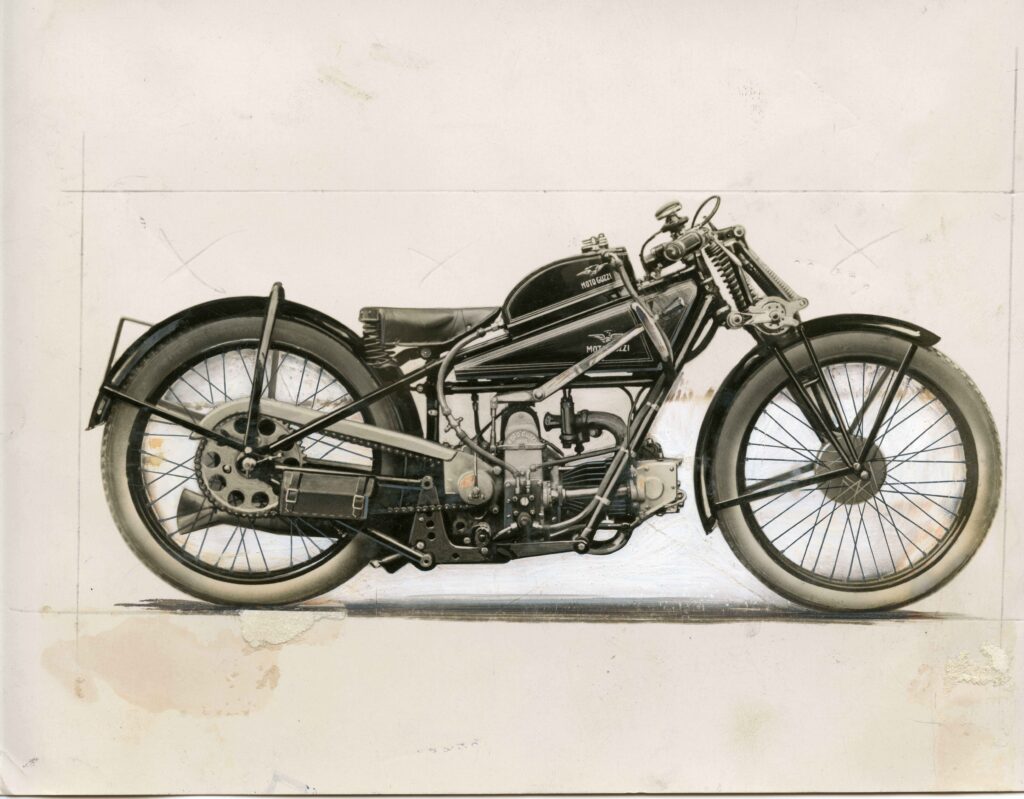
The beautiful lines of a dedicated racer. Factory 1925 press shot of Moto Guzzi’s brilliant C4V racer, a 500cc OHC design with four-valve cylinder head. The design had been Guzzi’s first prototype of 1921, but it was decided the hand-built assembly of the OHC motor would be too expensive for production. The C4V was produced four years later, as a racer. [Private Archive]
The story of Moto Guzzi also shows how a motorcycle company could connect a very specific place to a much larger idea of Italian modernity. Although the company was legally established in Genoa, it set up production in Mandello del Lario on Lake Como, where Carlo Guzzi had grown up and developed his mechanical expertise. By 1925, more than 300 workers were producing more than 1,000 motorcycles per year there. By 1934, Moto Guzzi had become Italy’s largest motorcycle manufacturer. The factory became part of Mandello’s identity. Its motorcycles carried that identity onto roads across Italy and eventually beyond. Local craftsmanship and industrial knowledge became part of a national story about mobility, engineering, racing, travel, and technological progress. Moto Guzzi was selling motorcycles. It was also selling an idea of what Italy could become.

Inspecting speed: Mussolini looks over the remarkable supercharged Rondine DOHC four-cylinder racer in 1937, originally developed by the Italian consortium O.P.R.A. in 1924, before the design was sold to Gilera, and raced with great success. [The Vintagent Archive]
Performing Speed

By the late 1920s and early 1930s, the Fascist regime was becoming increasingly interested in the political possibilities of mechanized modernity. The relationship between Futurism and Fascism was complicated: it would be misleading to draw a straight line from Futurist art to Fascist politics. Some Futurists, most notably its founder Filippo Tommaso Marinetti, embraced Fascism, but the movement also contained competing political and ideological currents. But the Fascists didn’t need to invent the cultural language of speed and machinery. It was already there. Speed. Youth. Physical strength. Technology. Machines.  The Italian Fascist party appropriated those ideas and put them on display.
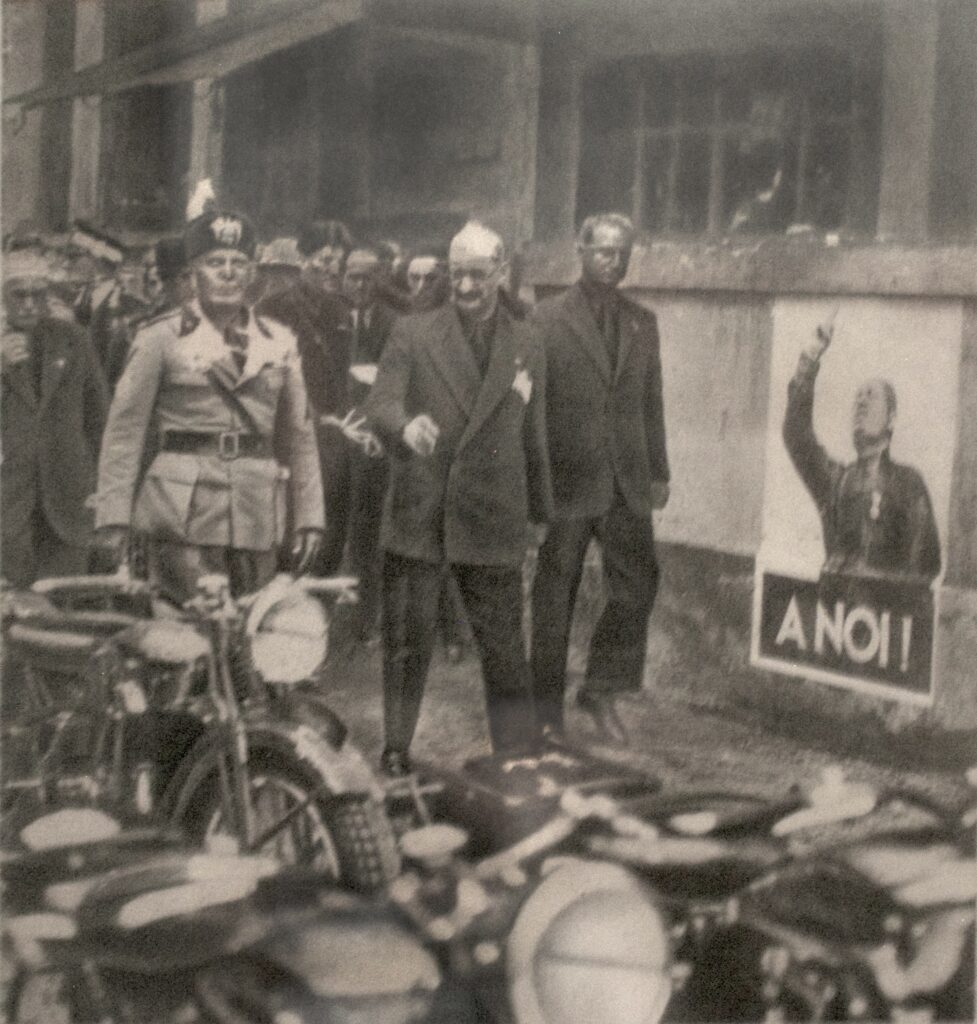
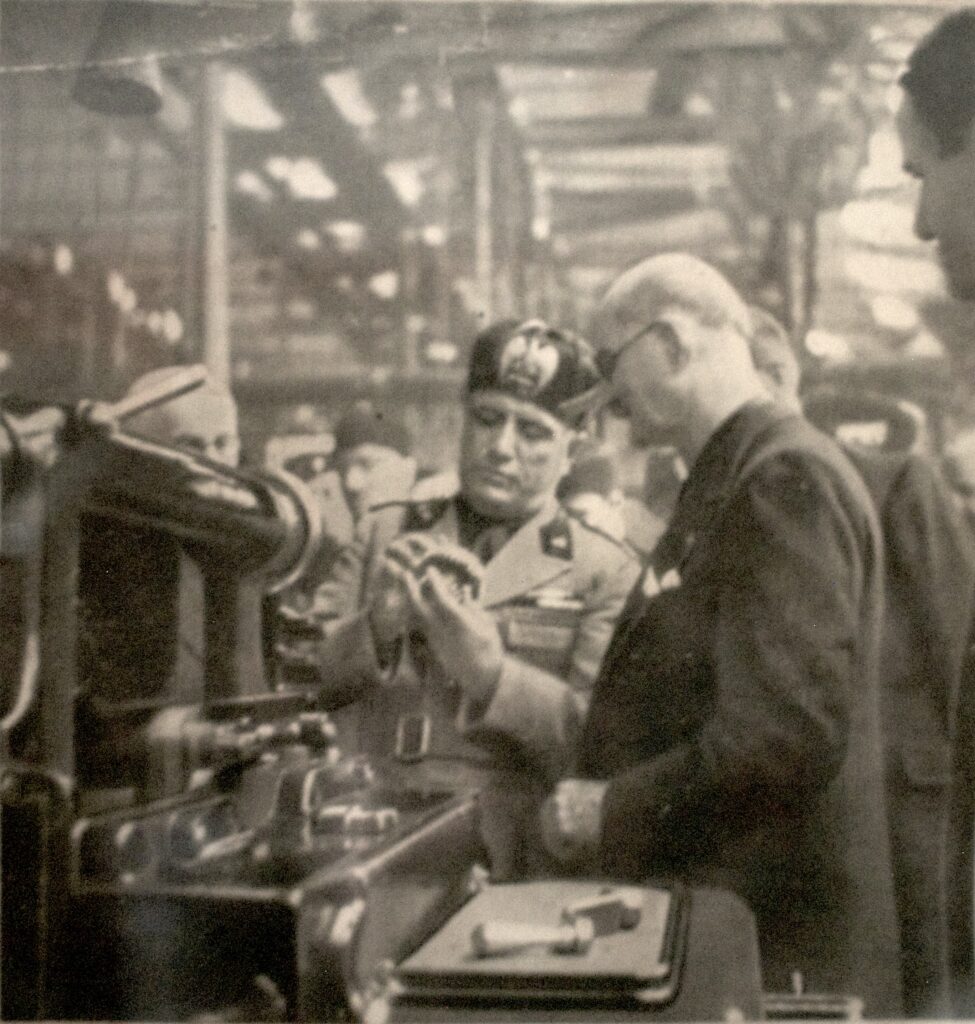
Benito Mussolini touring the Bianchi factory. No the ‘A Noi’ poster – a Fascist propaganda poster with a simple slogan, ‘to us!’. [The Vintagent Archive]
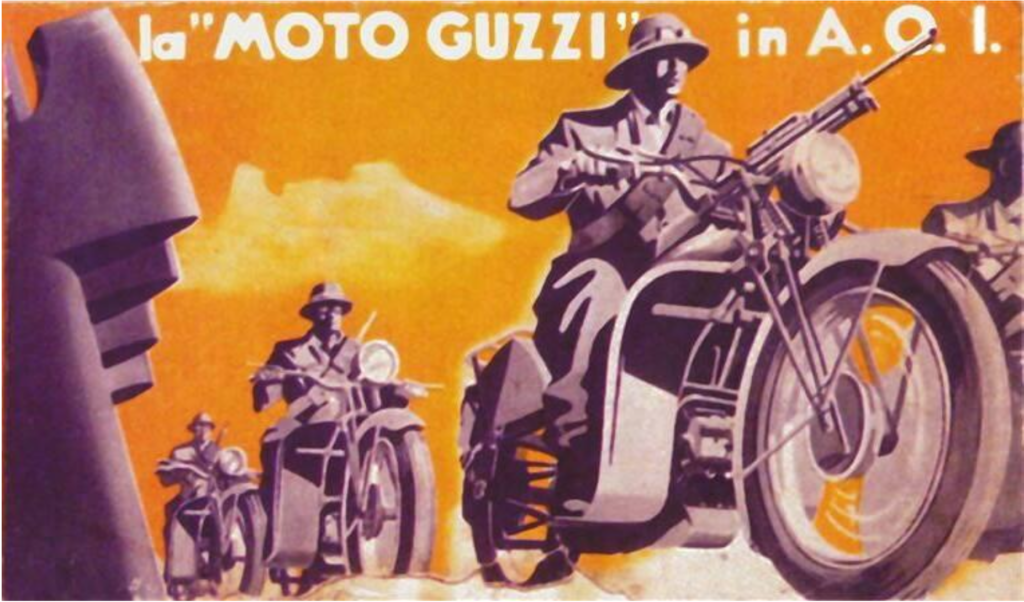
Motorcycles entered this political culture through both government policy and symbolism. Beginning in the late 1920s, state contracts helped expand Moto Guzzi’s production, including an initial 1928 order for 245 of their 175cc machines for the Italian Army. Government commissions increased as Italy prepared for the Ethiopian war of 1935–36, and Moto Guzzi eventually became the state’s principal motorcycle supplier. Fascist economic policies also encouraged smaller, less expensive motorcycles for personal mobility. The Moto Guzzi P175, introduced in 1932, benefited from tax advantages established in the 1920s for 175cc motorcycles. Other Italian manufacturers developed similarly small-displacement machines. The motorcycle could now serve two purposes: it was practical transportation, but it also showed Italian industrial capability.

Mussolini touring the Bianchi factory in 1936, from a Bianchi catalog. [Aldo Carrer Archive]
That connection became darker with colonial imperialism. The Moto Guzzi PL 250, introduced in 1937, soon acquired the popular nickname “Faccetta Nera” (Little Black Face), after a song associated with the Ethiopian campaign. Its black finish, accented with red, reinforced its association with Fascist visual culture (black and red were its signature colors in uniforms and propaganda) and the colonial project. Motorcycles also entered Italian military formations, including the Bersaglieri, and Moto Guzzi machines served Italian forces in East Africa.

The Moto Guzzi PL 250 “Faccetta Nera” was the ‘motorcycle for the people’.  It was derived from the Moto Guzzi P 250 built in 1934, with 10hp. [Colonial Italy]
Giorgio Parodi exemplified the overlap between aviation, military service, motorcycle manufacturing, and Fascist imperialism. In 1935, he volunteered for service in the Ethiopian war and received a Bronze Medal for Military Valor for a low-level attack on the Addis Ababa airport. The founder of one of Italy’s most important motorcycle companies was now directly participating in the Fascist regime’s colonial war.

The Moto Guzzi PL250 ‘Black Face’, named for a popular song by Renato Michele promoting Italy’s invasion of Abyssinia (Ethiopia) in 1935. The lyrics speak of integration of the ‘Black Face’ (Abyssinian) into Italian culture via colonialist expansion: the situation was complicated, as Ethiopia still practiced slavery until the Italian invasion: its abolition was ratified by emperor Haile Selassie after the Italians were expelled in 1942. [Colonial Italy]
And then there was Mussolini. By 1933, Mussolini held membership card number one in the Reale Moto Club d’Italia (Royal Moto Club of Italy) and was publicly celebrated as the “Primo Motociclista d’Italia.” He was frequently photographed riding a Bianchi 175 Sport Freccia d’Oro, whose license plate read “1 Roma.” The photograph worked because the motorcycle already meant what Mussolini wanted it to mean: Speed. Courage. Technology. Modernity.
He did not have to invent those associations. He simply climbed onto the machine and wrapped them on the body of the nation’s leader.

Racing for Italy

Motorcycle racing tells a similar story. The Fascist regime did not invent this sporting culture. It gave it a new political vocabulary. Italian road racing was already well established before Fascism. The Coppa Regina Margherita, held in 1911 to mark the fiftieth anniversary of Italian unification, was among the country’s earliest long-distance motorcycle events. The 1914 Circuito d’Italia helped establish the tradition of long-distance road racing that later produced the Motogiro d’Italia, while the Raid Nord-Sud between Milan and Naples ran annually from 1919 through 1925. From 1932 to 1936, the revived race ran as the Milano-Napoli and was known as the Coppa Mussolini. In 1937, the course was extended south to Taranto, becoming the Milano-Roma-Taranto.
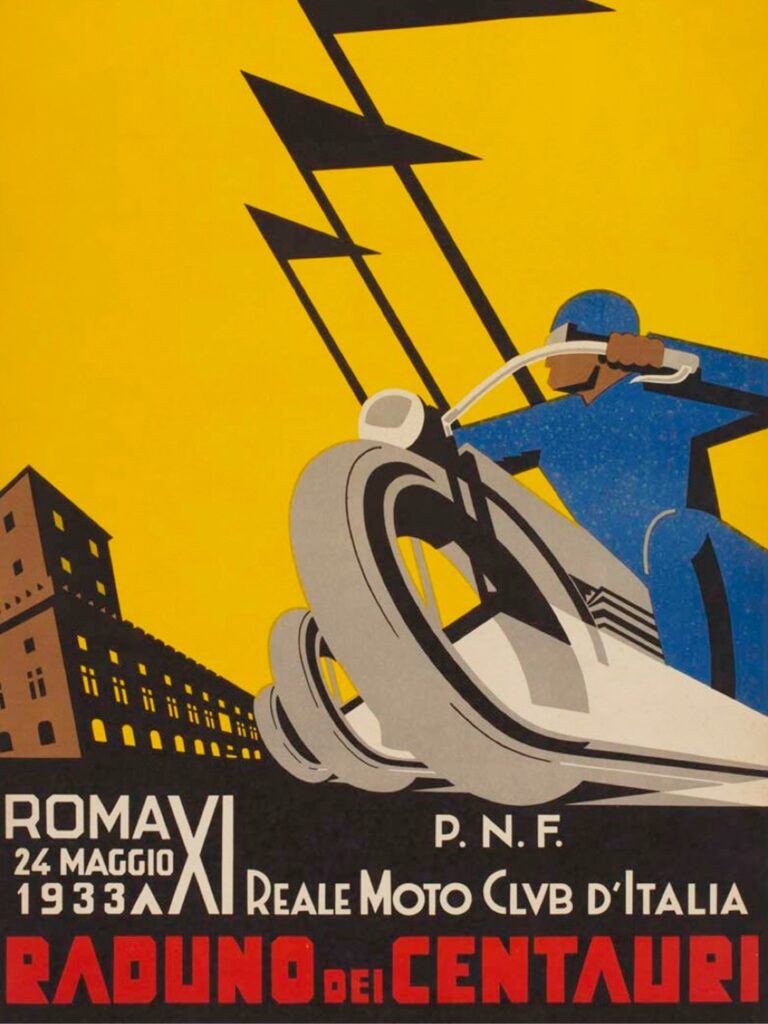
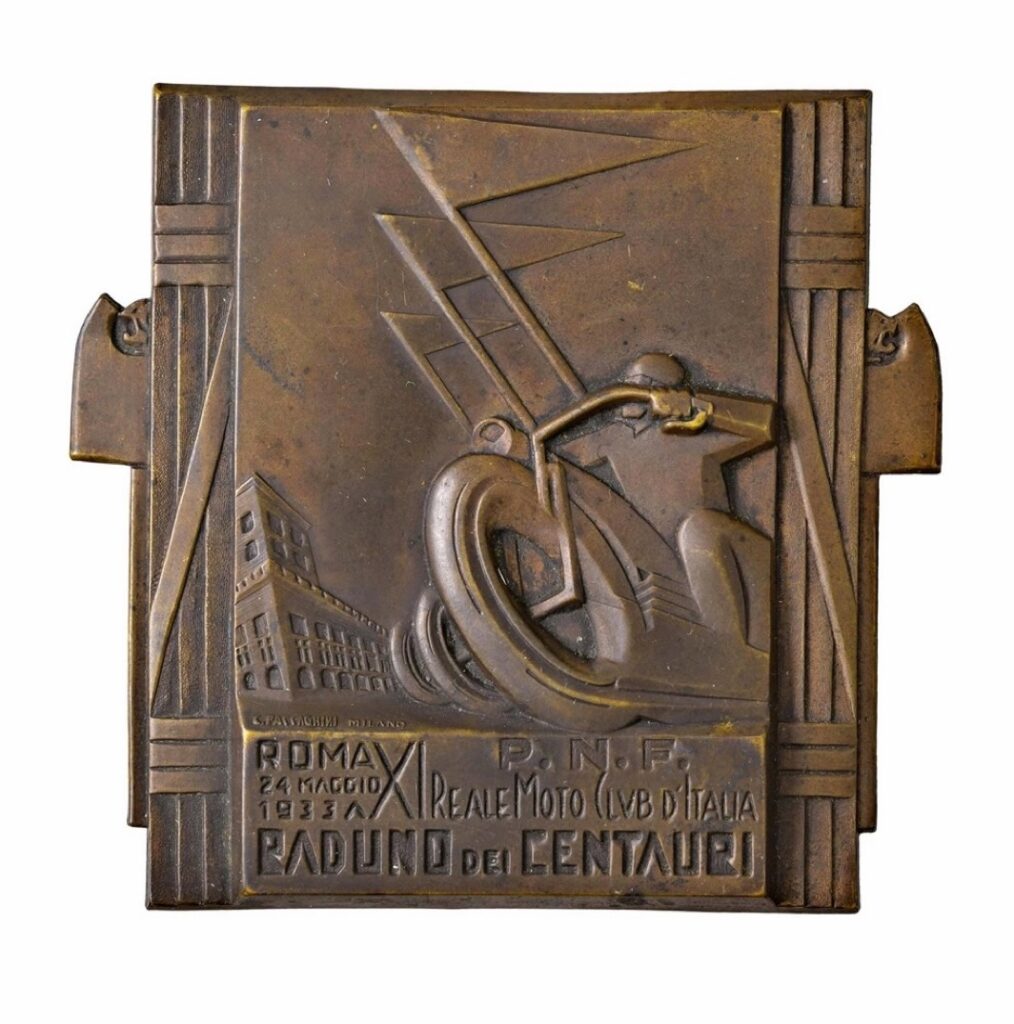
Futurist-inspired poster for the 1933 Raduno dei Centauri race, hosted by the Reale Moto Club d’Italia. [The Vintagent Archive]
The name mattered. Riders crossed Italian cities and countryside on Italian-built machines while spectators gathered along the route. Manufacturers gained visibility, and motorcycles became rolling advertisements for Italian engineering. Endurance, discipline, courage, mechanical expertise, and speed could all be presented as qualities of the individual rider, and by extension, the nation. Racing was particularly useful because it made technological achievement visible. A factory could demonstrate engineering behind its walls. A race put that engineering onto the road. Spectators could watch the machines approach, hear their engines, see riders wrestle with the course, and connect a motorcycle’s performance with Italy’s technological capabilities. That kind of spectacle was central to Fascist political culture. Factories, machines, athletes, soldiers, rallies, races, and public ceremonies all made a modern, powerful Italy visible.

A bronze participant’s plaque from the 1933 edition of the Raduno dei Centauri, closely aligned with the poster design, but flanked by the ‘fascisti’, the bound bundle of twigs containing an axe that was the source of the name fascism. The plaque is marked ‘C. Passaghini Milano’. [The Vintagent Archive]
Motorcycle racing fit perfectly. It combined machinery with the human body. The motorcycle did not simply move. Someone had to ride it. That distinction matters. Fascism did not create the cultural language that made motorcycles useful as political symbols. Futurist artists had already turned speed and machinery into aesthetic ideals. Wartime aviation linked technological mastery to national achievement. Manufacturers such as Moto Guzzi had translated those associations into industrial production and commercial imagery. Fascism gathered those strands together and redirected them toward political spectacle.

‘Il Duce’ leading the pack as ‘First Motorcyclist’ of Fascist Italy, from a 1933 edition of La Tribuna Illustrata. [The Vintagent Archive]
The First Motorcyclist?

Mussolini’s claim to be Il Primo Motociclista d’Italia carries a certain irony. By 1933, there was nothing “first” about the motorcycle’s place in Italian modernity. For over two decades, artists had imagined its possibilities, engineers had built them, manufacturers had put them into production, advertisers had made them desirable, and racers had turned them into public spectacle. Fascism did not create those meanings: it inherited them and put them to political use.
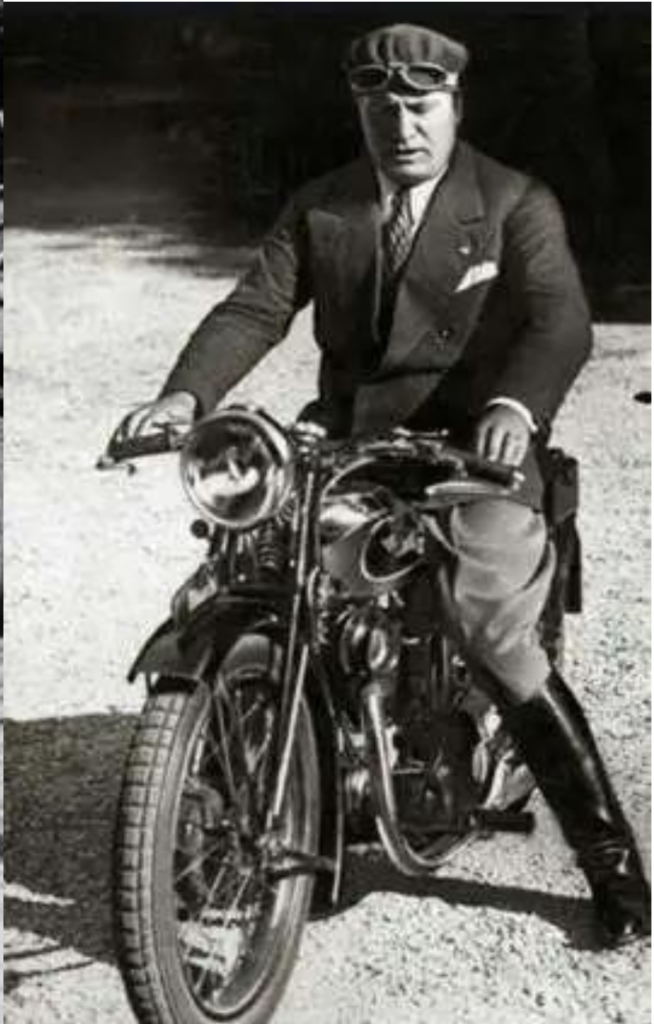
Another shot of the ‘first motorcyclist’ of Italy, Benito Mussolini, taken in 1933 aboard a Bianchi 175cc motorcycle. Soon, he would only appear in public in full military regalia. Originally a Socialist, Mussolini’s politics grew increasingly militarist and right-wing during WW1. He was appointed Prime Minister of Italy in 1922 by King Victor Emmanuel III, and quickly strengthened his grip on all aspects of Italian life, with full support of the country’s wealthy industrialists and the Catholic church, for whom he granted a separate statehood in the Vatican City in 1929. [The Vintagent Archive]
That history changes how we see the famous photograph of Mussolini on his Bianchi. He looks as though he is commanding the machine, but he did not create the meanings attached to it. The motorcycle already carried associations with speed, technological achievement, physical courage, and the future. The regime could appropriate those associations because Italian motorcycle culture had already made them familiar. This is what makes the motorcycle more than a colorful footnote to the history of Futurism or Fascism. It was one of the places where Italians experienced modernity firsthand. Modernity wasn’t just something artists painted or politicians proclaimed. A rider could feel it in an engine’s vibration, the rush of air, and the changing landscape beneath the wheels. Mussolini could call himself Italy’s ‘first motorcyclist’. But by then, Italians had already been riding into the future.

*I presented a version of this paper, “The First Motorcyclist: Futurism, Fascism, and the Making of Italian Motorcycle Culture,” at the New York State Association of European Historians conference, SUNY Cortland, October 10, 2026.
 

Dr. Wendy Pojmann, Ph.D., is Professor of History at Siena University in Albany, New York. Her latest book is Connected by the Street: The Myths and Realities of Motorcyclists in the USA and Italy, available at www.parigibooks.com. She splits her time between Rome and upstate New York. Follow her on Instagram @wendysespressolife. See her other articles for The Vintagent here.
Related Posts

The Vintagent Classics: The Italian Machine

I've just seen the greatest motorcycle…
The Universal Racing Motorcycle

Dimitri Coste attempts the impossible:…
Legend of the Motorcycle Attire

It was an event that changed the…


Subscribe to Our Weekly Newsletter