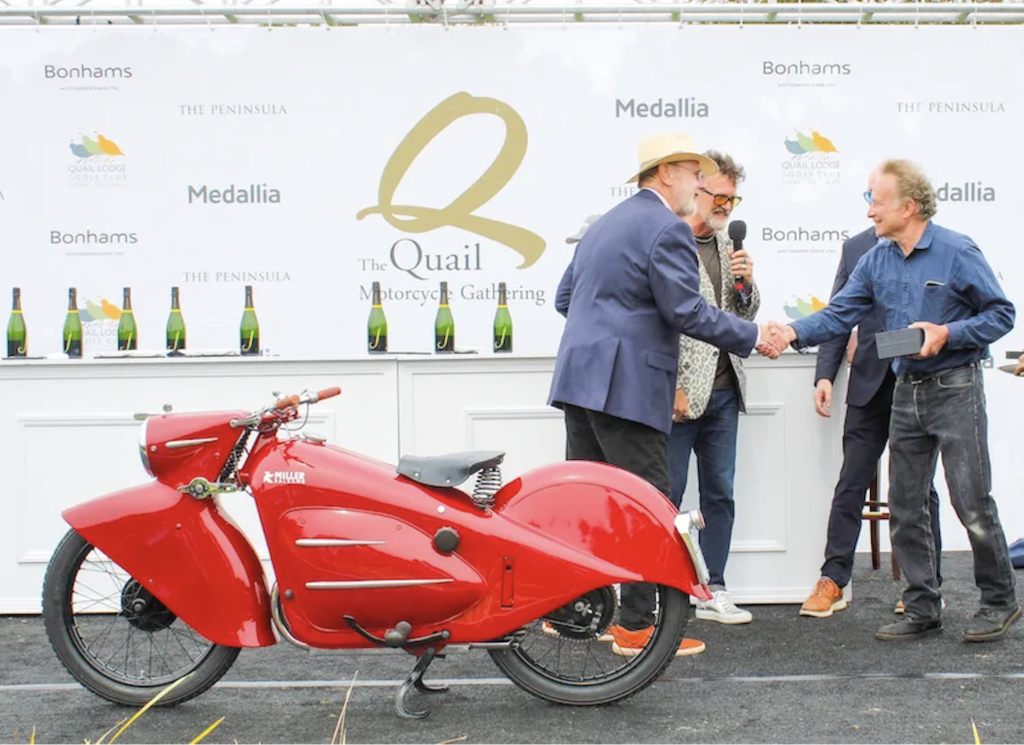
I was recently commissioned to write an article for Mecum Auctions’ monthly magazine about John Goldman’s remarkable collection of Italian masterpieces, which included his extraordinary 1939 Miller-Balsamo 200 Carenata. I’d first seen Goldman’s Carenata when it won Best of Show at 2023 The Quail Motorcycle Gathering, but had previously encountered another Carenata (one of perhaps 4 in existence) at the 2018 Concorso d’Eleganza Villa d’Este. Goldman, a San Francisco architect, is especially fond of Streamline Moderne design, a passion that opens a fascinating window onto one of the twentieth century’s most influential aesthetic movements.At the 2023 Quail Motorcycle Gathering, John Goldman’s 1939 Miller-Balsamo 200 Carenata won Best of Show. Here he’s congratulated by Chief Judge Somer Hooker, while Paul d’Orléans handles the microphone. [Quail Motorcycle Gathering]
While Streamline Moderne found its fullest expression in architecture, locomotives, ocean liners, and consumer products, a handful of motorcycles emerged from its speed-whiskered umbrella. These machines were less concerned with practical transportation than with embodying a vision of the future. Their creators sought to capture the spirit of speed itself, even when standing still.
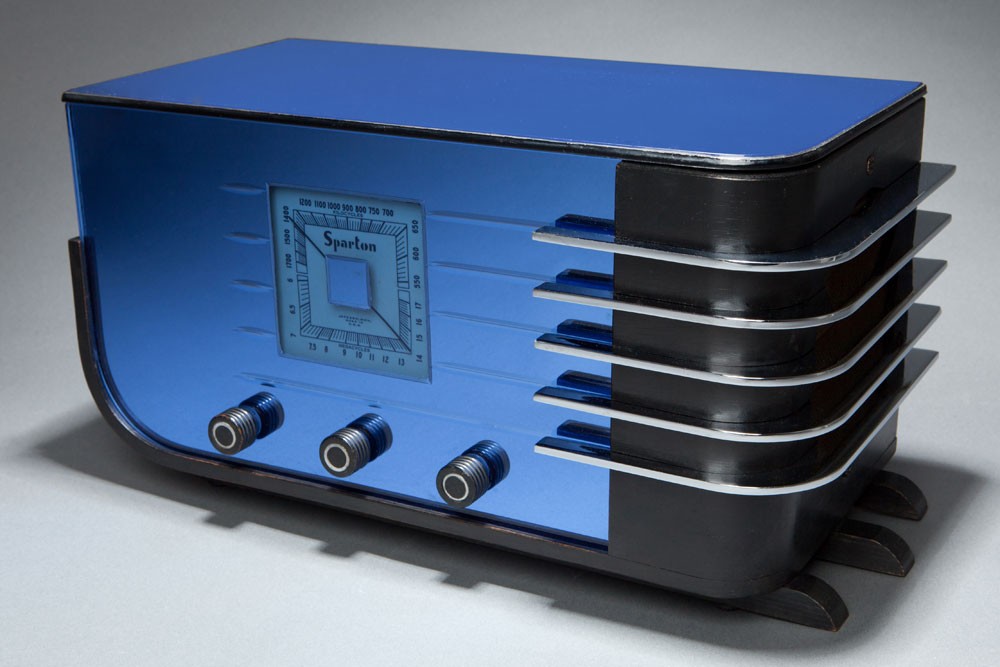
From toasters to radios to locomotives to one-off cars and motorcycles, Streamline Moderne captured an era’s imagination. This 1936 Spartpon ‘Sled’ Model 557 radio was designed by Walter Dorwin Teague. [Case Auctions]
To understand the origins of Streamline Moderne, it helps to step back and consider the evolution of industrial design during the twentieth century. The movement emerged during the 1930s as a late expression of Art Deco, replacing geometric ornamentation with flowing curves, horizontal lines, and aerodynamic forms. Designers became captivated by scientific advances in aerodynamics and transportation. Wind tunnels, aircraft engineering, and the promise of modern mobility shaped everything from radios and refrigerators to trains and automobiles. The movement’s greatest champions included industrial designers like Norman Bel Geddes, Raymond Loewy, and Henry Dreyfuss. Their work transformed everyday objects into symbols of progress.
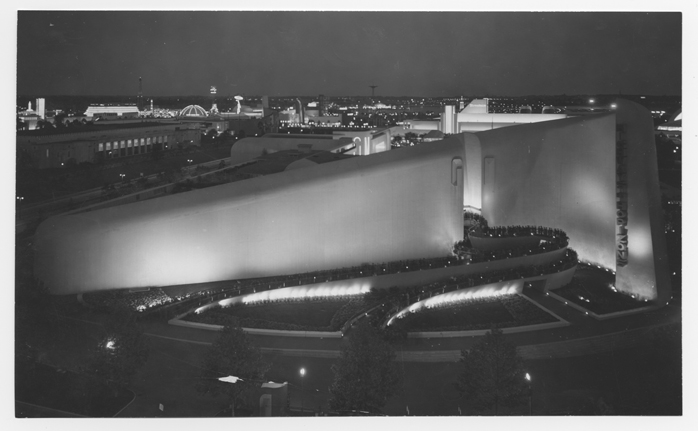
Norman Bel Geddes’ design for the General Motors building at the 1939 New York World’s Fair [Bel Geddes Database at the Harry Ransom Center]
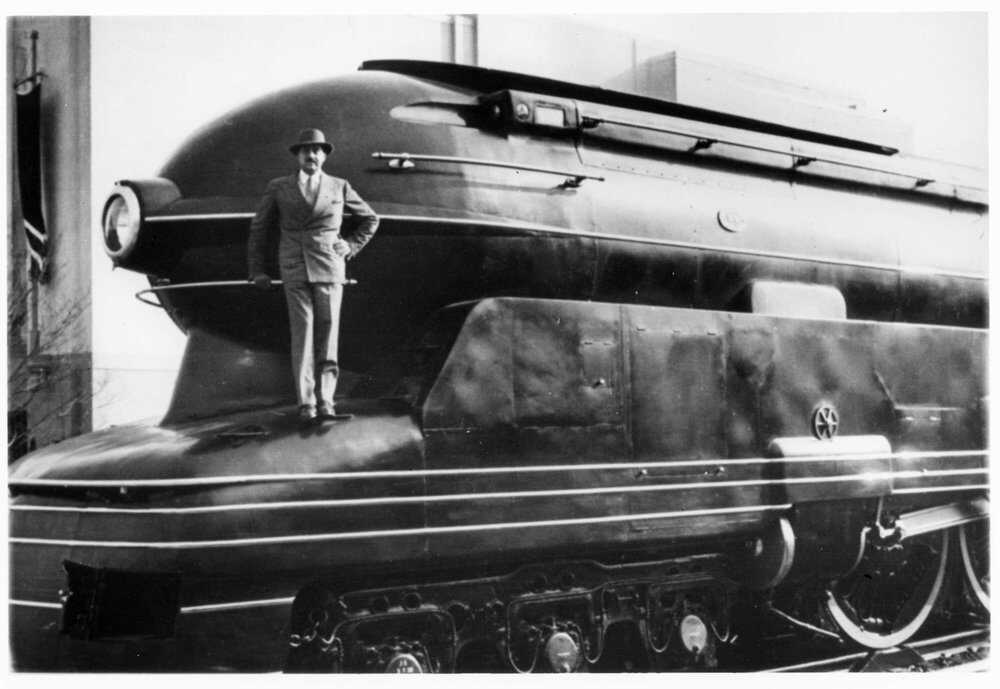
Bel Geddes became famous for his visionary book Horizons and his “Futurama” exhibit at the 1939 New York World’s Fair, where Americans glimpsed a future of streamlined highways and automated mobility. His influence extended beyond individual products to entire systems of transportation. He understood that design was storytelling: every curve implied motion, every surface suggested efficiency.Raymond Loewy aboard his streamlined train, the Pennsylvania Railroad Class S1, nicknamed “The Big Engine” and built in 1939. Only one these Streamline Moderne masterpieces was built. [Wikipedia]
Raymond Loewy became perhaps the most famous industrial designer in history. His streamlined locomotives, automobiles, buses, and consumer products helped define the visual language of modernity. One of his greatest achievements was the Pennsylvania Railroad’s mighty Class S1 locomotive of 1939. The largest rigid-frame passenger locomotive ever built, the S1 wore a dramatic Streamline Moderne shell that transformed the underlying raw machinery – a train built in 1924! – into a thrilling sculpture. Its elongated prow, smooth flanks, and uninterrupted lines suggested tremendous speed even when standing motionless. Freudians will have their own opinions on the subconscious resonances suggested by this unabashedly phallic shape…but people loved it.Loewy’s work demonstrated a fundamental truth of Streamline Moderne: perception – especially unconscious perception – often mattered more than performance. A streamlined shape conveyed optimism, efficiency, and technological mastery, even if the aerodynamic advantages of a fast-looking toaster were negligible.
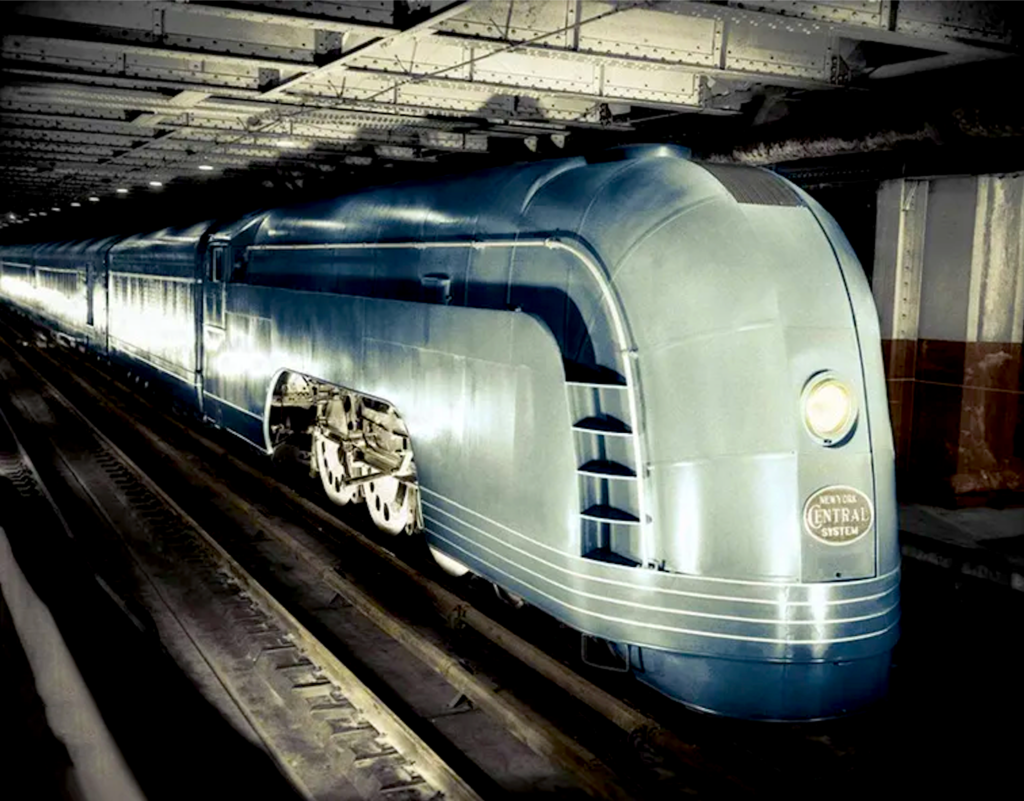
Henry Dreyfuss’ extraordinary Mercury train designed for the New York Central Railroad, and built from 1936 for daytime passenger service. [Getty Images]
Henry Dreyfuss pursued similar goals. His streamlined designs for New York Central’s Mercury trains in the mid-1930s gave rail travel a glamorous new identity. One famous publicity photograph shows locomotive No. 4915 posed beneath Grand Central Terminal after receiving its sleek metal skin. The train was PR for an optimistic future, a promise of speed, elegance, and modernity—qualities that manufacturers across every industry sought to emulate.
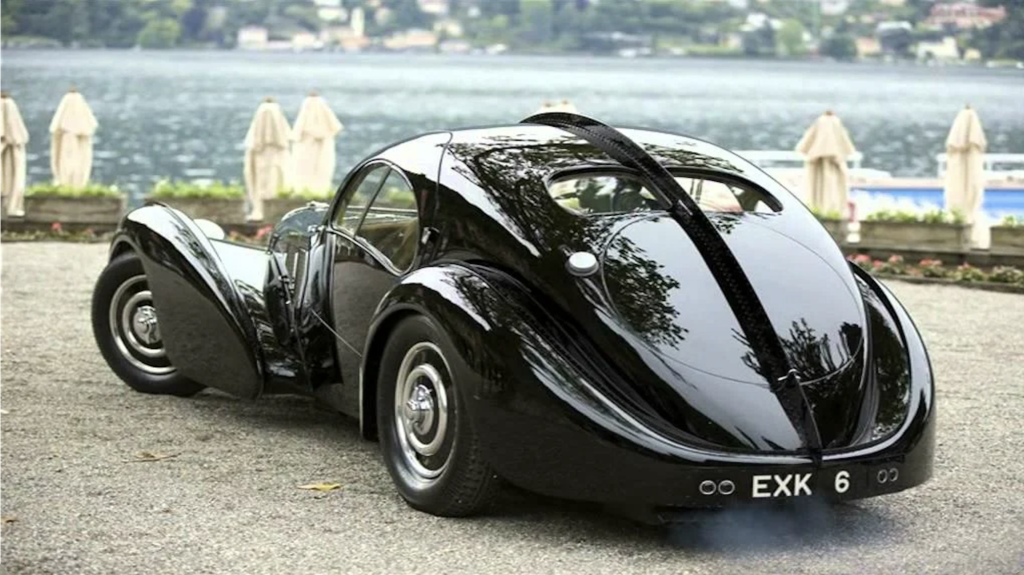
Bugatti Type 57S Atalante number 57502, built in 1937 by Automobiles Ettore Bugatti, is one of 43 Bugatti Type 57S made and one of only 17 Type 57S produced with the in-house Atalante magnesium coupé coachwork. [Concorso Villa d’Este]
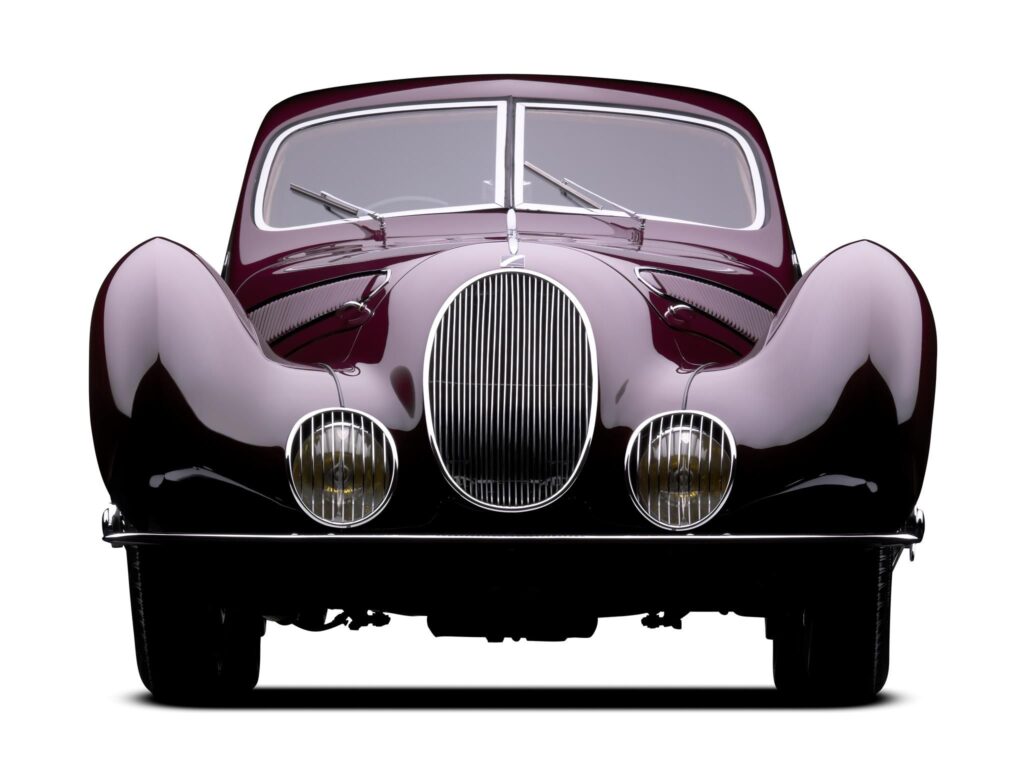
While locomotives represented the industrial face of Streamline Moderne, its most exquisite artistic expression appeared in the coachbuilt automobiles of France during the 1930s. Here, the movement transcended mere styling and became rolling sculpture. No automobile better embodies the era than the legendary Bugatti Type 57SC Atalante. Designed by Jean Bugatti, son of company founder Ettore Bugatti, the Atalante (Atlantic for English speakers) remains one of the most celebrated and expensive automobiles ever created. Its dramatic riveted dorsal seam running from grille to tail originated from the limitations of working with sheet Elektron magnesium alloy, but that limitation became its defining aesthetic feature. The car’s teardrop profile, enclosed rear wheels, elongated hood, and flowing proportions transformed engineering necessity into pure art. Even among the extraordinary automobiles of the 1930s, the Atalante appeared futuristic, as though it had arrived from a more elegant century. It’s a future I think we’d all like to live in, or at least drive in.The extraordinary 1937 Talbot-Lago T150SS with body by Figoni et Falaschi. [Christie’s Auctions]
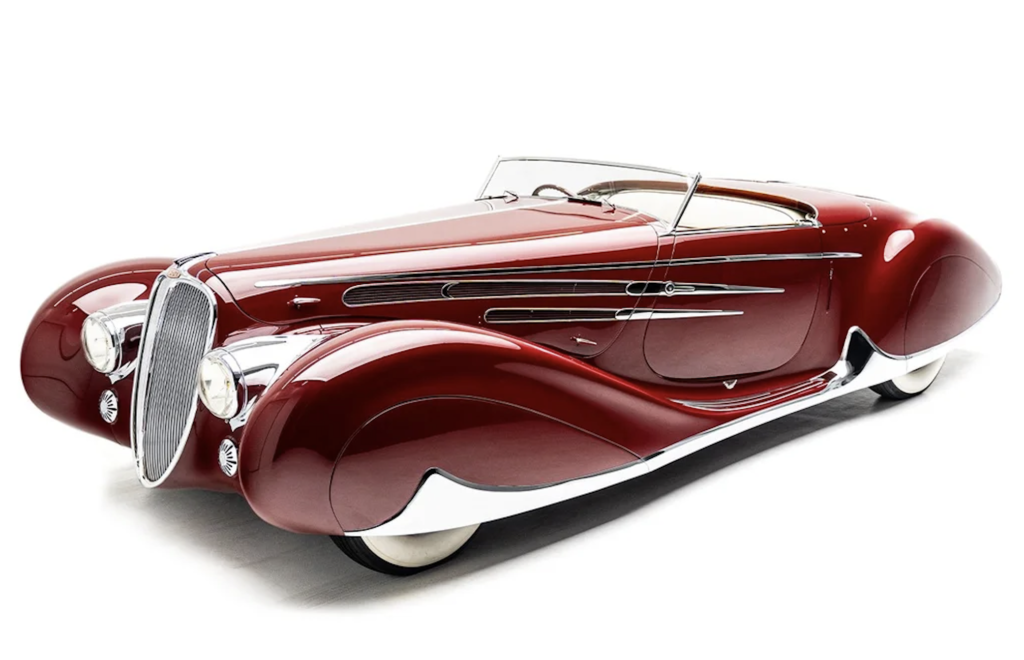
If the Bugatti represented the aristocratic pinnacle of French design, the Parisian coachbuilding firm of Figoni et Falaschi elevated Streamline Moderne into fantasy. Under the direction of Giuseppe Figoni and Ovidio Falaschi, the firm’s creations for Talbot-Lago and Delahaye became the visual icons of the Art Deco age. Their celebrated goutte d’eau (teardrop) bodies employed sweeping fenders, disappearing running boards, fully skirted rear wheels, and uninterrupted curves that seemed shaped by flowing water rather than human hands.The extraordinary 1939 Delahaye Type 165 ‘Worlds Fair’ by Figoni et Falaschi. [Petersen Auto Museum]
The firm’s coachbuilding on Talbot-Lago grand tourers rank among the most beautiful automobiles ever constructed. Long, impossibly elegant hoods flowed into cockpit-like passenger compartments before tapering toward streamlined tails. Horizontal chrome accents emphasized movement and speed, while the voluptuous fenders suggested motion even when parked on a concours lawn. Likewise, Figoni & Falaschi’s Delahaye roadsters and coupes pushed aerodynamic styling to its artistic limits. Their forms often bore little relationship to actual wind-tunnel science; instead, they expressed a romantic vision of speed, luxury, and modernity. These French masterpieces demonstrated a central truth of Streamline Moderne: the movement was never solely about aerodynamics and technical necessity, it was about aspiration. Whether on rails, roads, or eventually two wheels, streamlined design promised a future of effortless movement and technological sophistication. The motorcycles that followed were involved in the same international conversation, translating the visual language of the Atalante and the great French coachbuilders into forms balanced on two wheels rather than four.With all types of industrial designers rushing to aerodynamicize their products, it’s not wonder that motorcycle designers joined in the fun. The desire for total enclosure on a motorcycle dates back all the way to the early 1920s, despite the clunkiness of the reality versus the dream of speed. Designers recognized that the exposed mechanical components of traditional motorcycles created aerodynamic drag and projected an image of mechanical complexity. Machines such as the Ner-A-Car, Majestic, and the Ascot-Pullin experimented with enclosed bodywork, integrated chassis designs, and novel rider ergonomics. These pioneering efforts hinted at a future in which motorcycles might resemble aircraft fuselages more than bicycles with engines: it’s a design trope that emerges with some regularity, including with the Ducati Paso and Bimota DB1 and Honda Pacific Coast, etc.
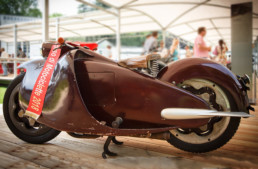
The Miller-Balsamo Carenata could be seen as a Futurist expression, with its total streamlined enclosure suggesting speed and modernity. [John Goldman archive]
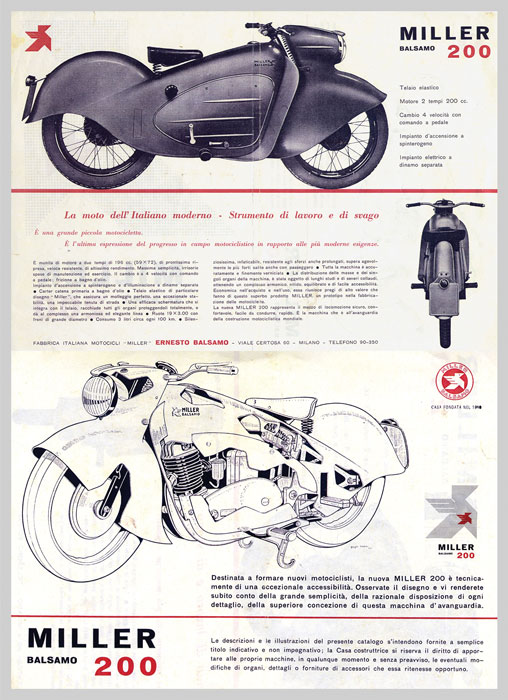
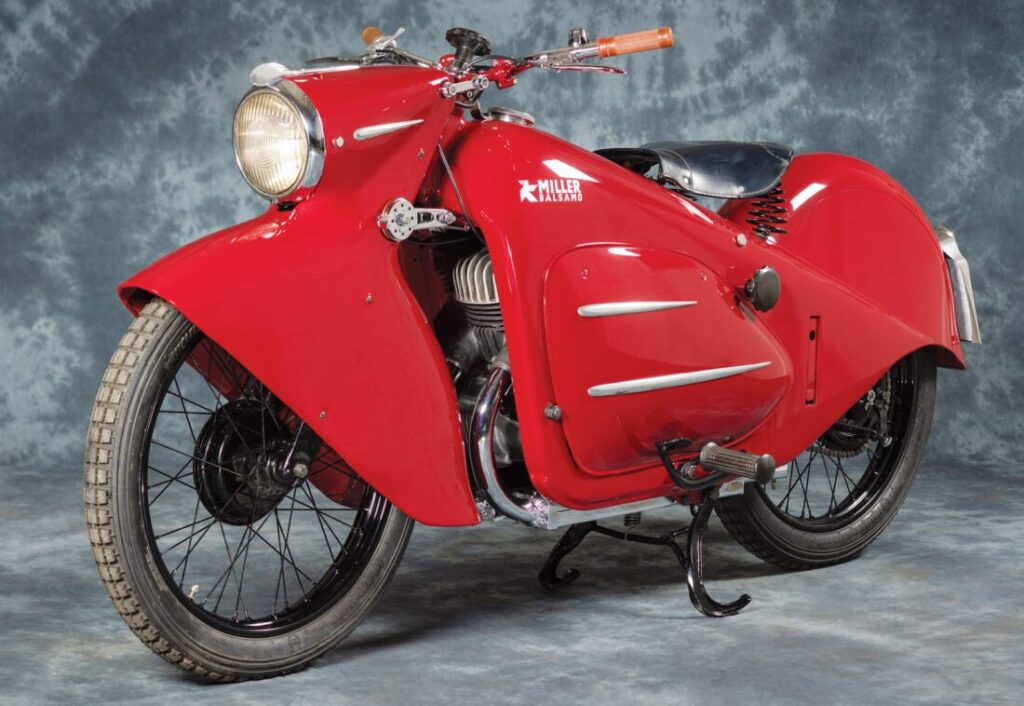
And, returning to the machine that spurred this article, among the most successful expressions of the streamlined dream was the 1939 Miller-Balsamo 200 Carenata. Built in Milan by the Balsamo brothers, who marketed their machines under the Miller name since the ‘Teens to capitalize on the prestige of British motorcycles, the Carenata represented an extraordinary synthesis of engineering and styling. The motorcycle featured a pressed-steel frame, extensive sheet-metal bodywork, and a compact two-stroke engine concealed beneath flowing body panels. The result was a motorcycle unlike almost anything else of its era. The wheels seemed to emerge organically from the body. Mechanical components disappeared beneath elegant metal surfaces. Horizontal lines emphasized horizontality and motion. Every styling detail of the Carenata reflected Streamline Moderne principles.
John Goldman’s 1939 Miller-Balsamo Carenata as featured in Motorcycle Classics magazine. [Phil Aynsley]
The Carenata was produced in very limited numbers, and remains a show-stopper: the psychic buttons that Streamline Moderne design pushed in the 1930s are still active. Some consider the Miller-Balsamo a perfected design: looking at it, one can imagine a European future that never quite arrived: cities filled with elegant enclosed motorcycles gliding silently through modern, elevated boulevards, something like Antonio Sant’Elia’s concepts for La Cittá Nuova. Sadly, that dream never arrived, although the Fascist connotations of Utopian urban design did come to fruition, as European dictators sought to re-create urban centers according to their visions of grandeur. Absolute power breeds bad taste; you can quote me on that. But I digress.
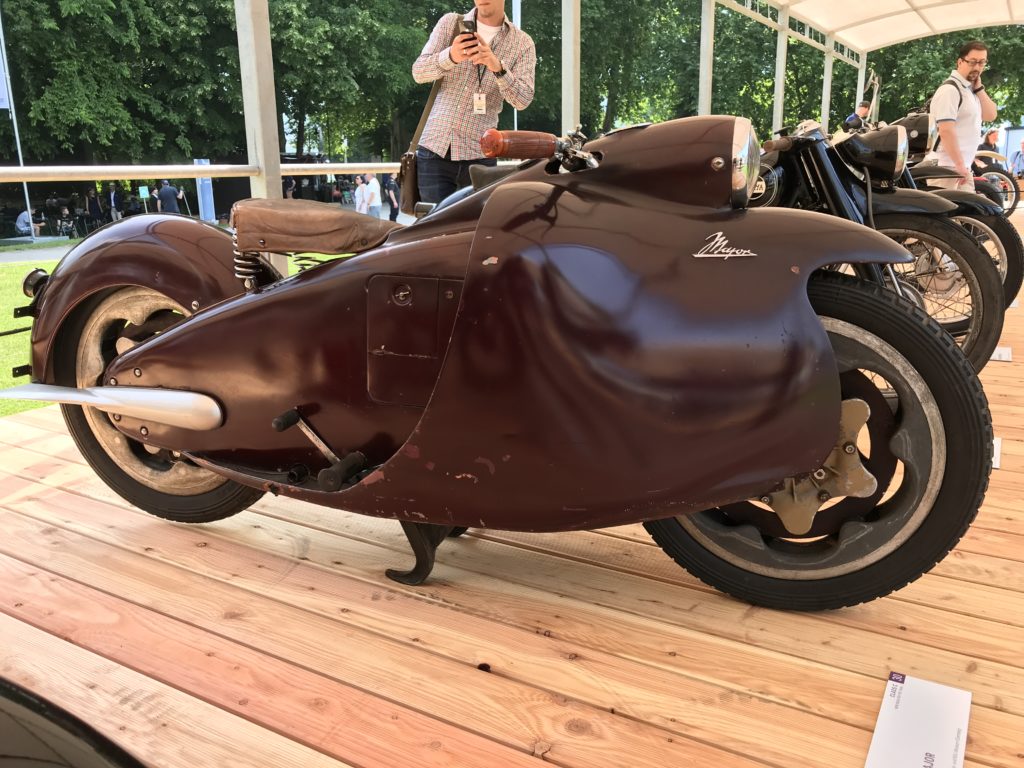
Form over function: the extraordinary and unique 1947 Moto Major, with a 350cc motor and suspension by rubber blocks in the wheel. As seen at the 2018 Concorso Villa d’Este. [Paul d’Orléans]
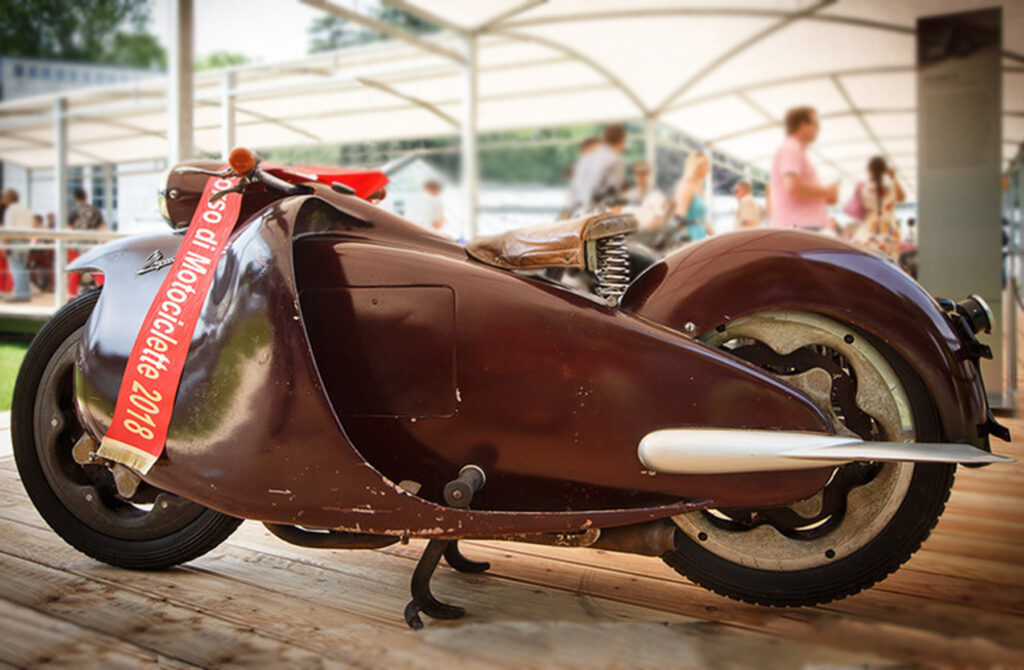
If the Miller-Balsamo was a production motorcycle influenced by Streamline Moderne, the Moto Major (see our article ‘Italy Reinvents the Motorcycle‘) represented the movement’s most extravagant fantasy. Introduced in 1947 by Salvatore Maiorca of Turin, the Moto Major has haunted motorcycle encyclopedias and books on Italian design ever since. Despite its fame, the motorcycle never entered serial production. Yet few machines better capture the streamlined spirit of design, as applied to motorcycles. The bodywork appears less like motorcycle than a fish created by aircraft designer. Fiat’s aircraft division contributed both manufacturing expertise and mechanical components to the prototype, and every surface flows seamlessly into the next. Fenders, fuel tank, side panels, and fairing merge into a unified form that appears almost organic.
Streamline Moderne in extremis; the 1947 Moto Major won Best in Show at the 2018 Concorso Villa d’Este, proving the style is eternally popular. [Francois-Marie Dumas]
The engineering of the Moto Major was equally ambitious: Maiorca employed an unusual in-wheel suspension using compressed rubber discs, an innovative solution that promised exceptional ride comfort. Unfortunately, it also produced unpredictable handling characteristics that negated the possibility of production: nobody thought it was a good idea, although it looked amazing. The concept of in-wheel suspension goes a long way back into the history of bicycles, as inventors explored ideas for increasing rider comfort. Today, its technical shortcomings hardly matter, and the Moto Major survives as an industrial design masterpiece. When it won Best of Show at the 2018 Concorso d’Eleganza Villa d’Este, judges and spectators responded not to its practicality but to its sheer beauty. It stands as one of the purest expressions of the Streamline Moderne ideal ever applied to a motorcycle.
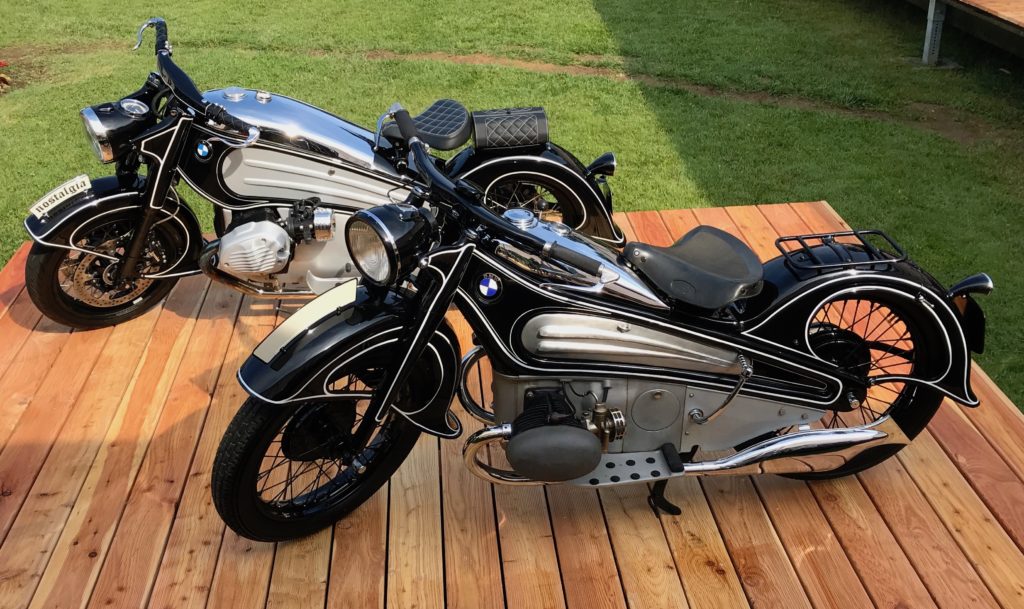
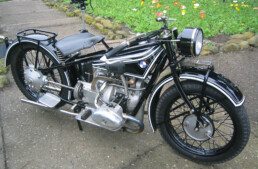
The BMW R7 at Villa d’Este with a new motorcycle (NMoto) inspired by its design. [Paul d’Orléans]
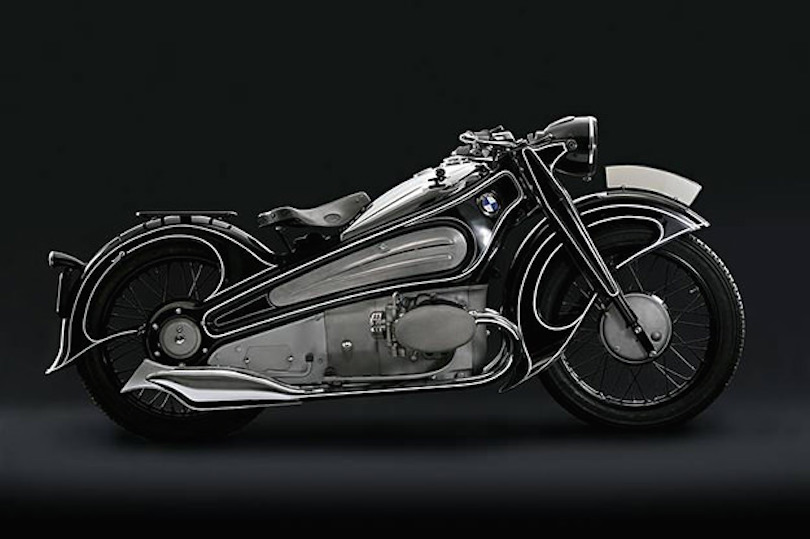
The most famous German streamlined motorcycle remains BMW’s remarkable R7 prototype of 1934, ‘The Best Bike BMW Never Made’. A serious exploration of technical and aesthetic ideas, the R7 was an enigmatic and fascinating machine, that appeared only briefly in small press photos, then vanished. Those photos resonated for generations among BMW fanatics, and it was only Its pressed-steel frame, integrated bodywork, concealed mechanical elements, and sculptural detailing represented a radical departure from conventional motorcycle construction. The design of the R7 was likely by Alfred Böning, the designer of BMW motorcycle chassis from the 1930s onwards. While no names were attached to the curved frame and swooping mudguards of the R7, “it is perfectly clear the hand of an artist was involved”, according to Stefan Knittel, author of several books on BMWs.
Elegant symmetry: the 1934 BMW R7 prototype. The only piece to reach production as the front fender, which graced the later R17 model. [BMW]
The prototype R7 is elegant, simple, and perfectly balanced – did Böning unleash a hidden flair for styling, or were BMW automotive ‘fender men’ called in for a bit of curvaceous appeal? In the early 1930s, individual designers were rarely celebrated, although a few ‘stars’ in the industrial design world were rising, like Raymond Loewy and Norman Bel Geddes. BMW first gave kudos to their ‘pencils’ with the 1940 Mille Miglia streamlined racing cars…in the 1980s! No surprise then that so little remains of the R7’s genesis. Seen today, the R7 feels astonishingly contemporary. It anticipated not only postwar scooter design but also the integrated styling that would become common on motorcycles many decades later. Like the Miller-Balsamo and Moto Major, it embodies a future imagined rather than realized.The Streamline Moderne style was mostly popular in the late 1930s, but carried over postwar, as with the Moto Major. Another fantastic example is the work of Louis Lucien Lepoix immediately after WW2, on his very own BMW R12. Lepoix went on to have a successful career in industrial and vehicle design, which included Maico Mobile and Bastert scooters.
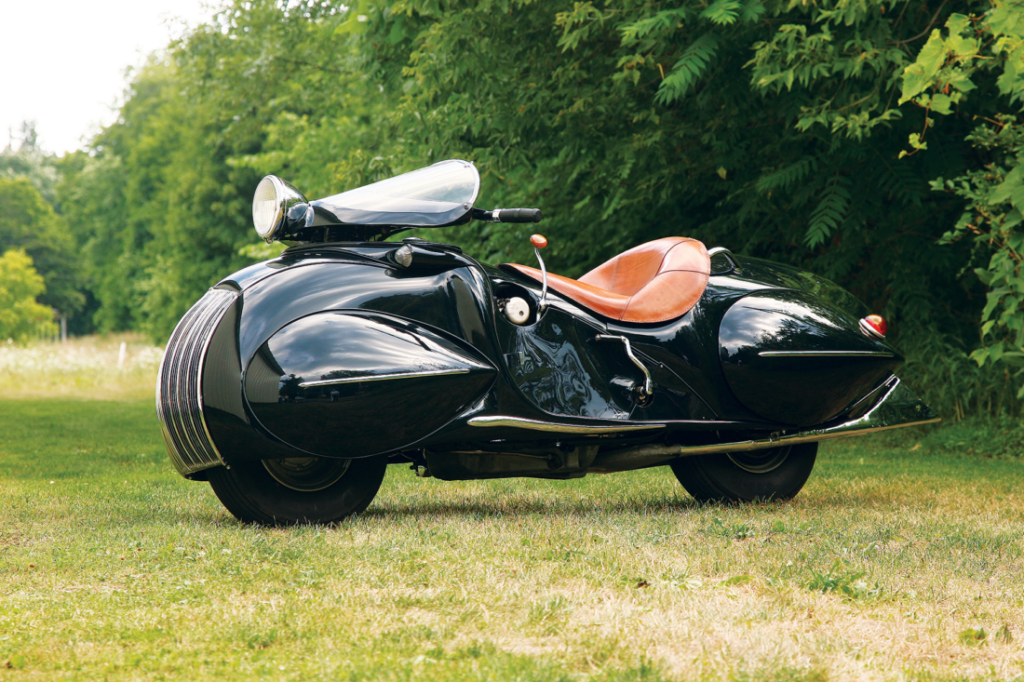
Louis-Lucien Lepoix’s amazing BMW R12 with his own extravagant enclosure. [Lepoix family archive]Home-made Moderne: the Henderson KJ streamliner, with bodywork built in 1935 by O. Ray Courtney, a Michigan-based metalsmith employed at the Oldsmobile car factory. [Kel Edge for Motorcycle Classics]
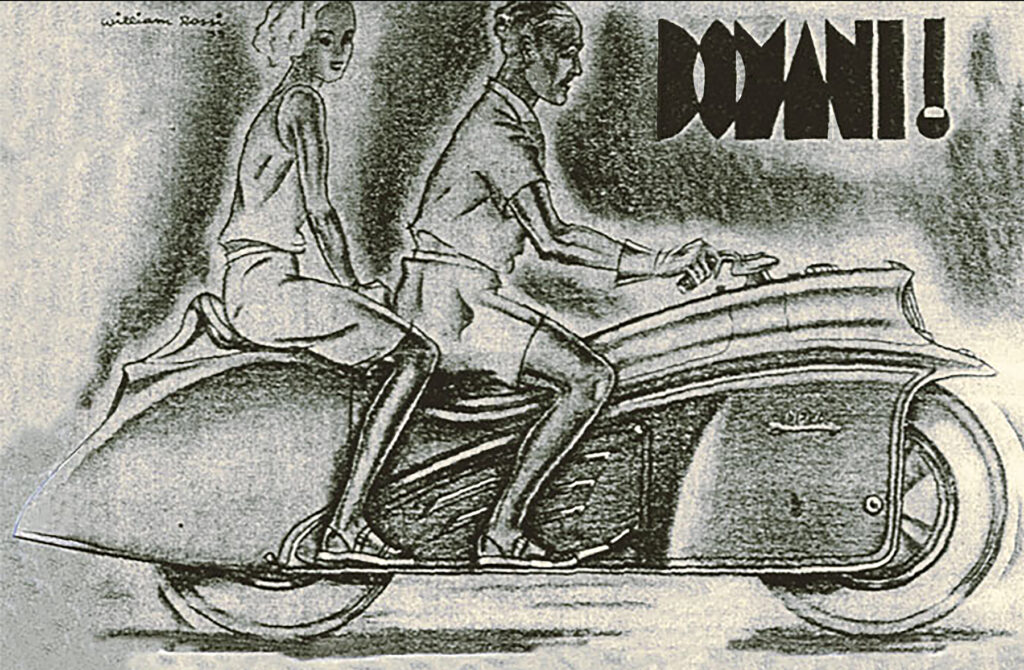
The Futurist graphic artist William Rossi’s conception of the future – Domani! [John Goldman archive]
Ultimately, that may explain why Streamline Moderne continues to fascinate collectors and enthusiasts. These machines were never merely vehicles. They were a physical manifestations of optimism. The designers of the 1930s and 1940s believed technology would create a cleaner, faster, more elegant world. Their streamlined trains, automobiles, appliances, and motorcycles embodied that faith. The future would not arrive with sharp edges and exposed machinery; it would arrive wrapped in smooth curves, polished metal, and aerodynamic grace. Streamline Moderne vehicles remain rolling sculptures from an age when designers believed beauty and progress were inseparable – and when even a motorcycle could look like tomorrow. Paul d’Orléans is the founder of TheVintagent.com. He is an author, photographer, filmmaker, museum curator, event organizer, and public speaker. Check out his Author Page, Instagram, and Facebook.


Ahem … methinks you mean Art Deco … as Streamline Modern was but a mere subset of Art Deco … not a style in itself . A common mistake ( especially among gear heads ) but one I wouldn’t of expected y’all to make . I mean seriously … any 2nd year art/architecture student knows that PdO !
But yeah … Art Deco … from fine art to trains to planes to automobiles to architecture to furniture to dinner ware. to jewelry , fashion and all places in between .. it really was an all consuming era … and one we still see on occasion today
Not to mention … one look at those bricks on wheels ( full size P/U and SUVs ) tells anyone with a brain and a modicum of aesthetics … a style we’d do well to bring back …
….. and the majority of todays M/C’s ? Eeesh … Fugly oversized piles of disparate parts sums em up all too well
When Andy Warhol met Raymond Loewy for the first time he became so excited that Loewy had to ask him to calm down
Yeah, I’d probably be that excited too. Remember, Andy was in advertising and product design before he was a Pop artist, so he knew who was The Man…
Motorcycle design fashion was once futuristic rather than nostalgic?
Shocked.
Amazed.
“If new ideas were any good, they would already be old ideas” seems to be the current death-spiralling mindset in the MC world.