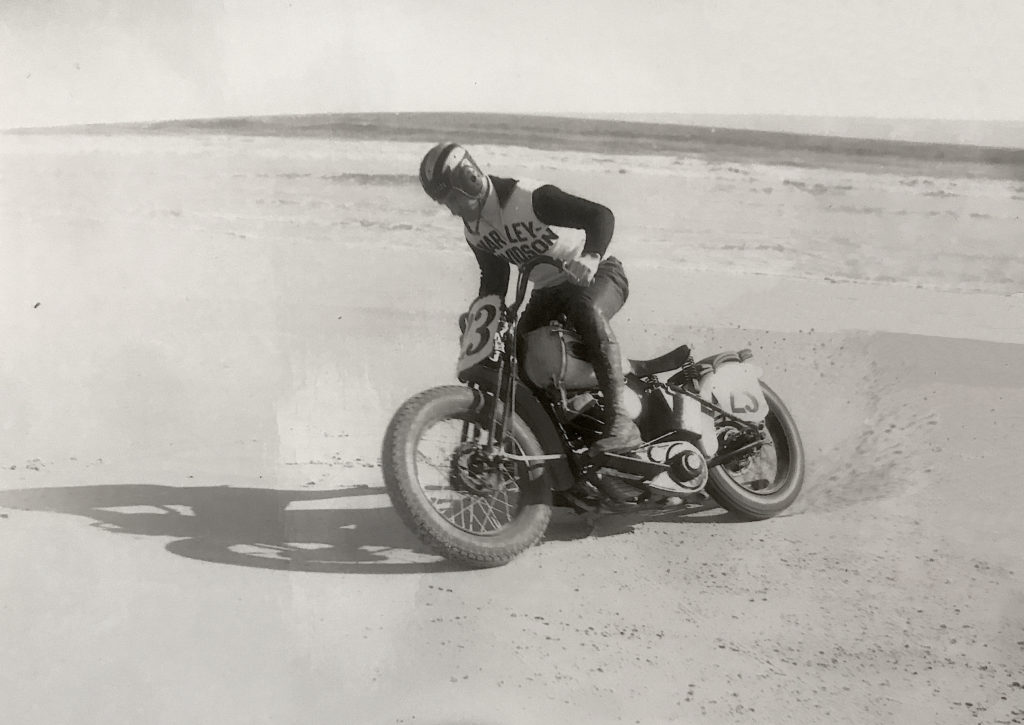
Daytona/Ormond Beach had been used for speed trials since the dawn of motorcycle competition in the USA, in 1902. The earliest speed records for cars and motorcycles were taken on the Ormond Beach end of this very long strand, probably because the Ormond Beach Hotel was the only hotel in the area, as difficult as that is to imagine if you've been to Daytona today. At the turn of the Century these beaches had yet to be developed, but were one of the few places in the country where flat-out speed could be explored without harassment by local authorities. Land Speed Record attempts continued through 1935, when Donald Campbell and his Bluebird racer shot between the pilings of Daytona Pier at over 300mph! Everyone involved knew the speed jig was up, and the whole speed circus decamped to Bonneville for their annual fun, once a minimum of facilities were established in that former desert wasteland.
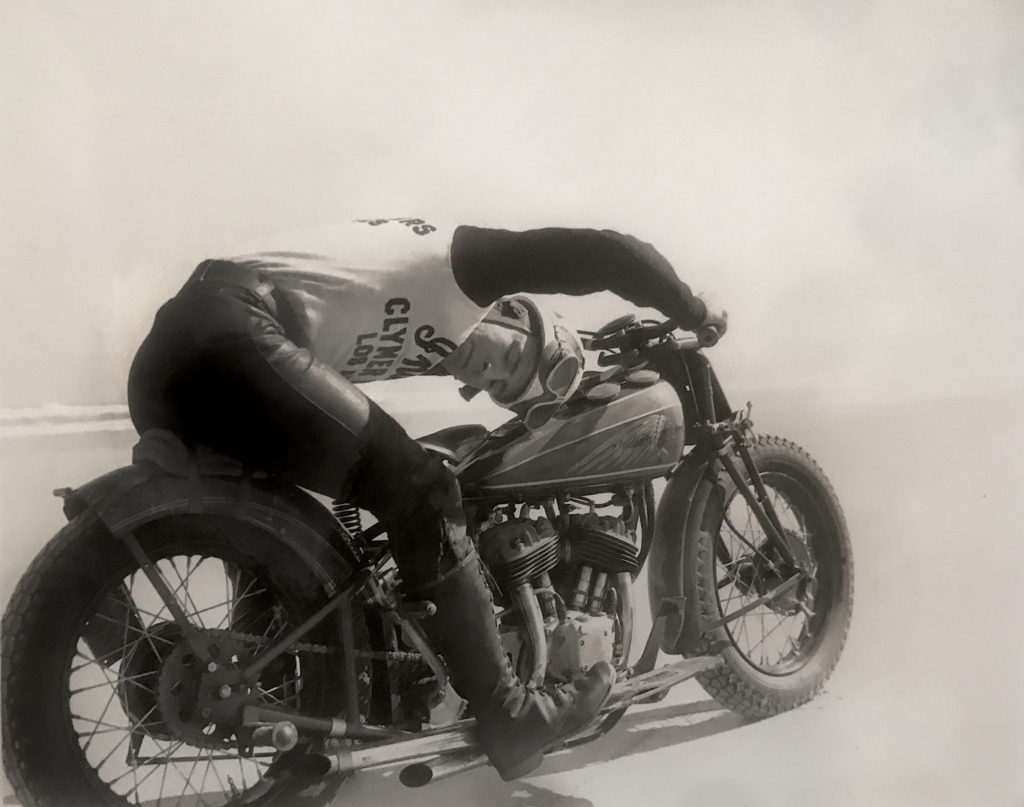
Ed Kretz, Sr. won the very first Daytona 200 in 1937, aboard an Indian Sport Scout racer, sponsored by Floyd Clymer. Here he shows off his wind-cheating pose: Kretz was 5'8" and weighed 185lbs, and was known to throw hay bales single-handed into his flatbed truck: 'Iron Man' indeed. [Jeff Decker Collection]The Southeastern Motorcycle Dealers Association (SMDA) had been hosting AMA Class C 200-mile dirt track races in Savannah, Georgia, since 1932, on the old Vanderbilt Cup racing course. By 1936 the Daytona Beach chamber of commerce was desperately looking for a motorsports attraction to replace the annual speed trials, and the City of Daytona worked with the SMDA to bring the Savannah 200 to its shores in 1937. The track was a mix of road and beach straightaways, with wide hairpin bends at either end, with a hairy transition from sand to pavement on the 3.2-Mile course. There was also the small matter of the tide to contend with, and early races were ill-planned in this regard, with riders often getting wet at the end of the long race, as the sea encroached on the track. The beach race continued until 1961, when the banked oval Daytona Speedway was completed, and the sand was finally abandoned for good.
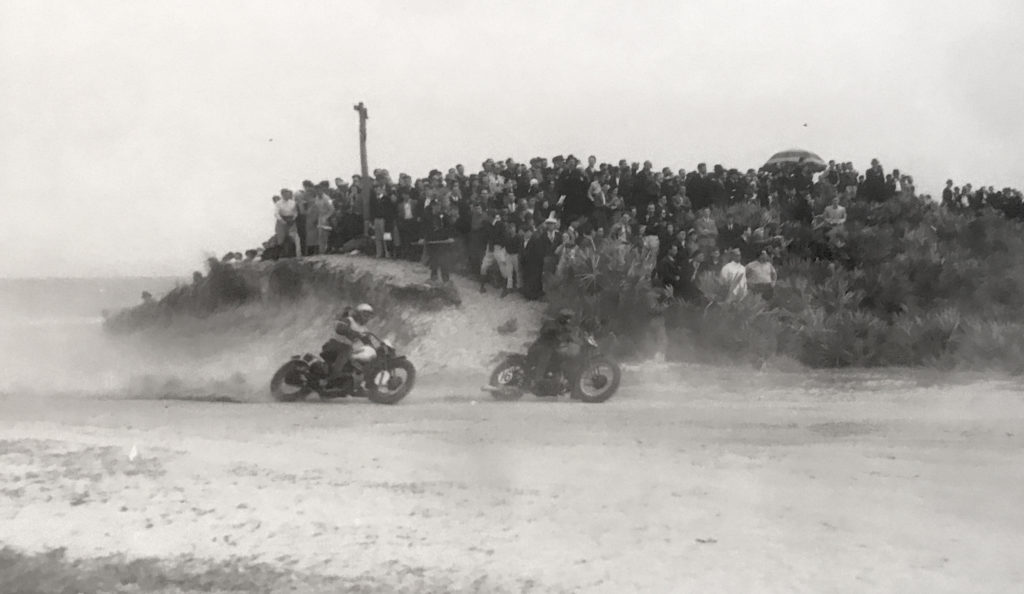
The 1/4mile U-turn at each end of the race was particularly treacherous, and the site of the most spills, especially on the difficult transition from sand to pavement, and back again. While plenty wide, it was still a very bumpy course after a few laps. Spectators watched from nature's bleachers - the sand dunes. [Jeff Decker Collection]The 1937 beach race was the first Daytona 200, and Ed Kretz (of Monterey Park, CA) won on an Indian Scout racer. Kretz was on a streak, having won the last Savannah 200 the previous year, and also the inaugural Loudon Classic race. He was legendary for his endurance and physical strength, and gained the nickname 'Iron Man' for sheer endurance in long-distance racing. He was sponsored in that first Daytona 200 by Floyd Clymer, an Indian dealer who later became a publisher, and owner of the Indian name in the 1960s.
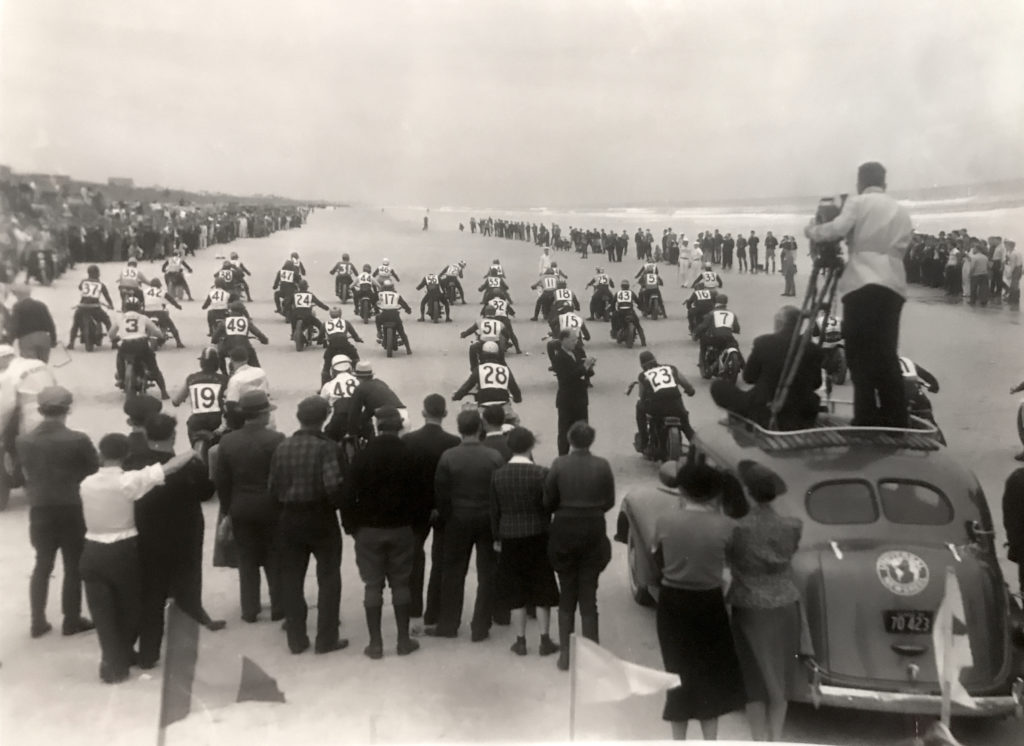
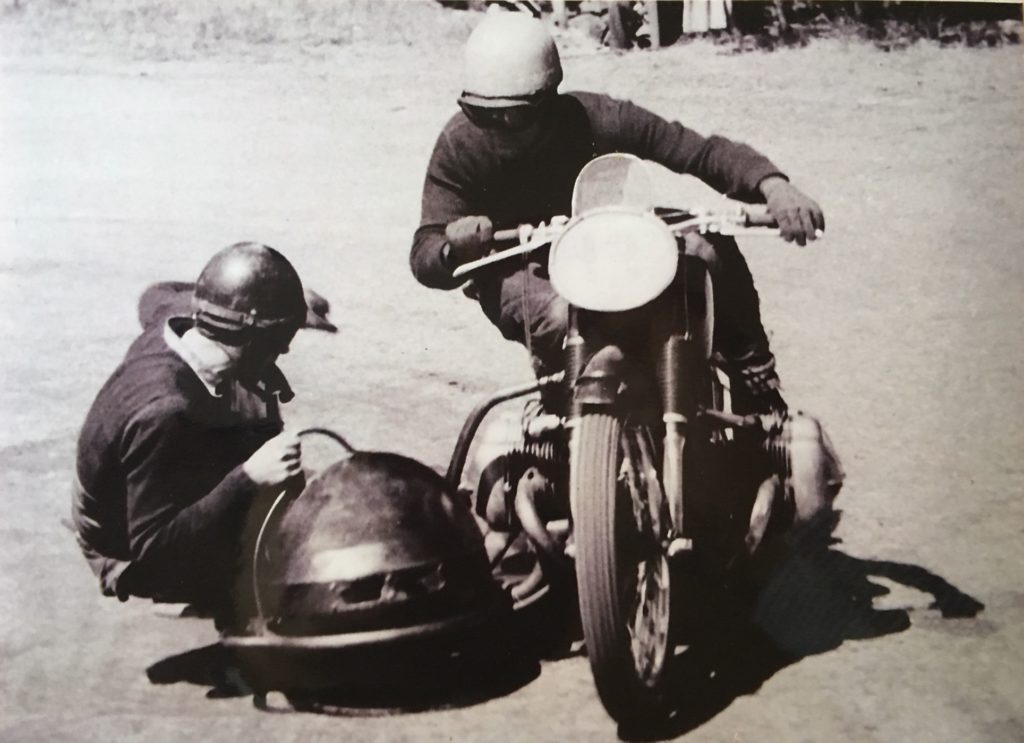
The start of the 1937 Daytona 200, with crowds spread thickly on both sides of the 'course', which narrowed with the encroaching tide! Note the film crew atop the sedan: cars are made of much thinner steel today! [Jeff Decker Collection]In the 1938 Daytona 200, Ben Campanale won on a Harley-Davidson WR, and for the next 17 years of racing on the beach (barring 1942-46, when racing was cancelled due to the war), race wins alternated between H-D, Indian, Norton, and BSA. While Triumph, BMW, and Rudge also competed, they didn't take top spots on the sand, but did make a spectacular presence, as seen in these photos, some not published since before WW2.
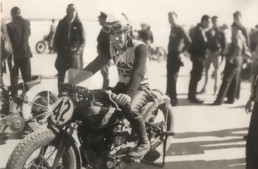
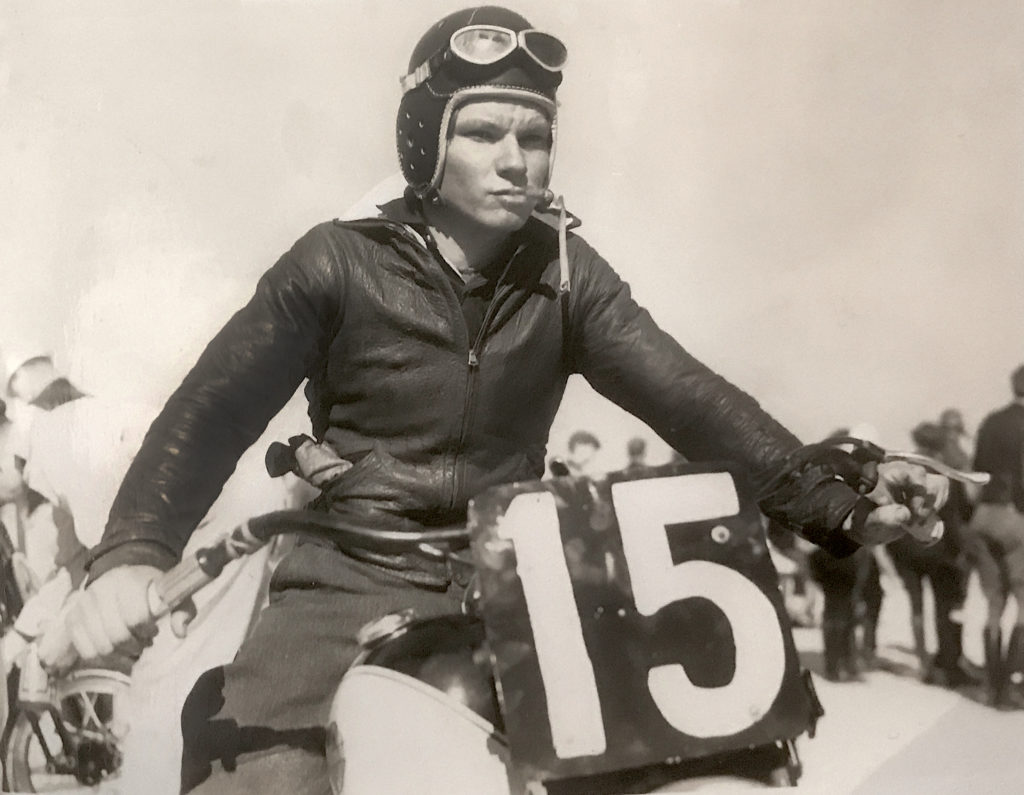
A competitor chomps a stogie, in a real he-man pose. Note his helmet and leathers - helmets were required, but no testing standards existed yet. Goggles were usually ex-Air Force. [Jeff Decker Collection]This photo collection was generously loaned by artist Jeff Decker, whose collection of motorcycle ephemera is legendary, and includes perhaps the largest assembly of 1%er outlaw motorcycle club 'cuts' (cutoff vests with embroidered club colors) in the world. Jeff brought a significant stash of interesting historic art and automobilia to the Las Vegas auctions this year, where he traditionally keeps a booth to display his sculptures. Many thanks to him for allowing us to publish these rare photos on The Vintagent!
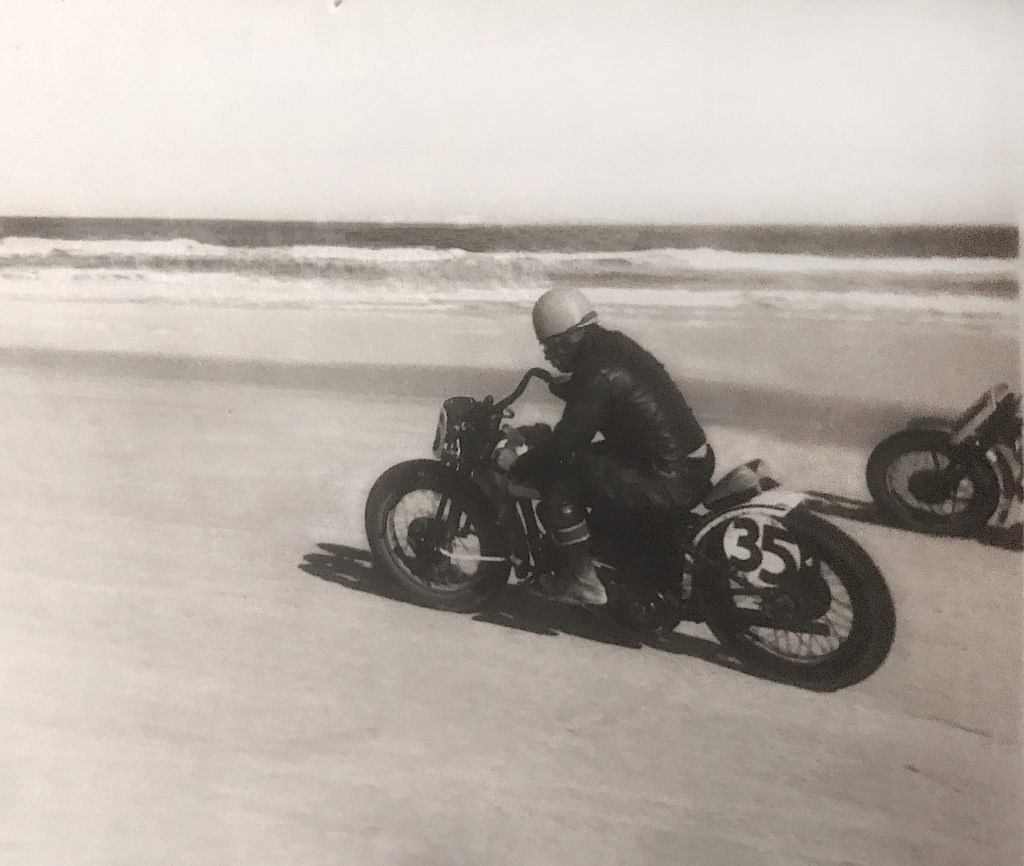
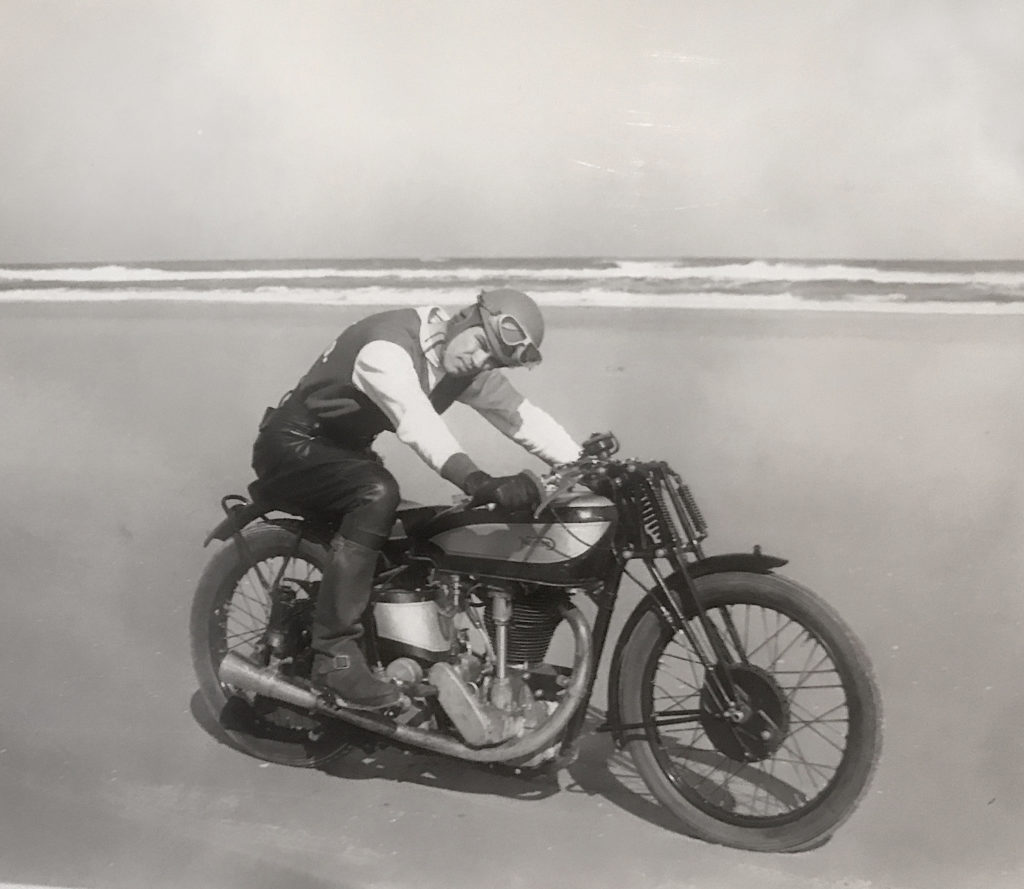
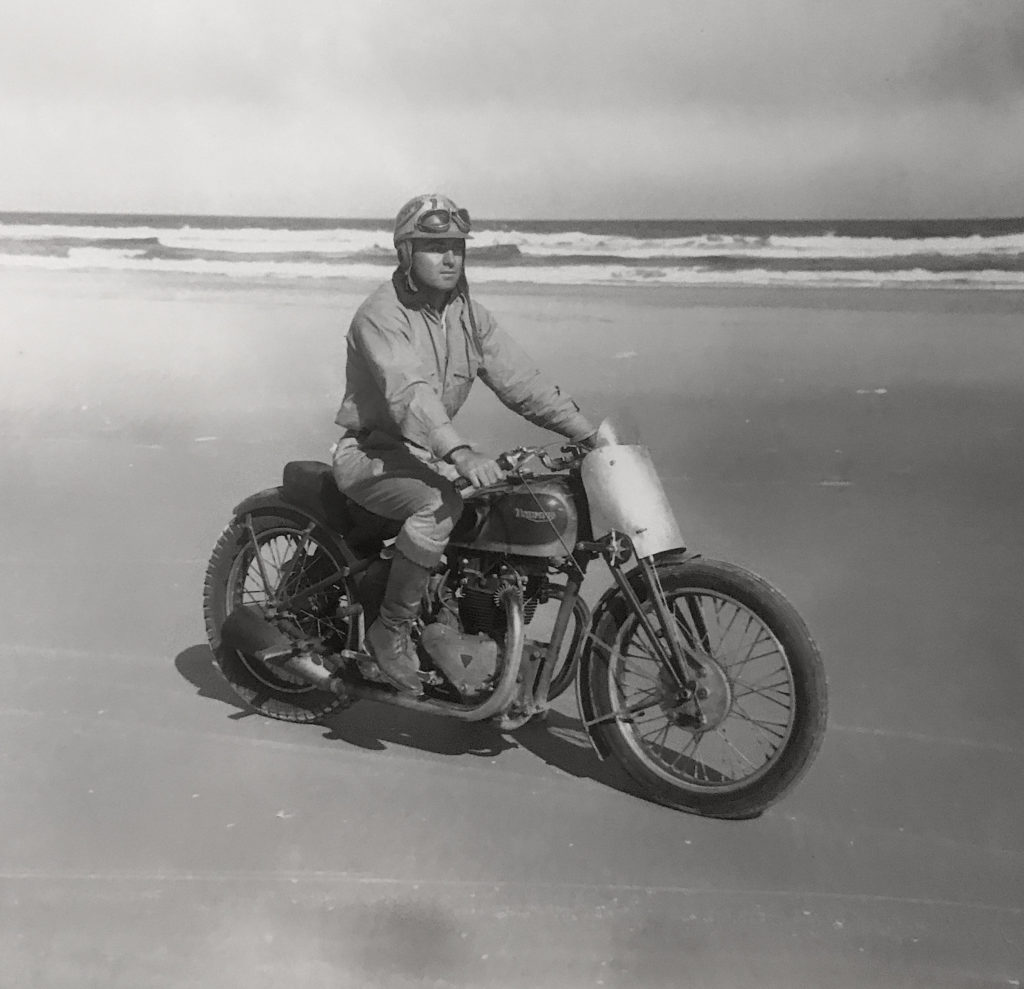
Warm-ups on the sand, or a bit of sport before the race for this Harley-Davidson WR rider wearing an English Cromwell-style helmet. [Jeff Decker Collection]George Rahterson of New York City rode the one of two Nortons in the race in 1937: this bike is a 1936/7 Manx Grand Prix, with plunger rear suspension. The exposed valve gear and chains must have had a hard time with the sandblasting... [Jeff Decker Collection]Several Triumph Speed Twins were entered in the pre-War Daytona races, and acquitted themselves well, especially when the Tiger 100 was offered, with speed tuning kits available from 1938. Note the abbreviated aluminum fairing, with a celluloid screen. [Jeff Decker Collection]Daytona donuts! All of the riders competing had extensive experience sliding on dirt, as that was the only racing surface in the USA at the time, with Board Tracks finished by the mid-1920s. This Harley-Davidson WR rider shows proficiency in sliding - a very useful skill on the slippery sand. [Jeff Decker Collection]
The 'bike week' in Las Vegas hosts the world's largest motorcycle auctions, with a total of 1850-odd vintage machines on sale this year. With two sales during the week, hosted by Mecum Auctions and Bonhams Auctions [full disclosure - both supporters of TheVintagent.com], the variety of motorcycles available makes this literally a 'something for everyone' event. All price ranges, all types, makes, configurations, ages, and countries of origin were present, from a replica 1894 Hildebrand&Wolfmuller, the world's first production motorcycle, to sport bikes from 2016, with literally everything barring steam motorcycles represented on the auction block. Many come to buy, many come to sell, but all come to enjoy seeing that many old motorcycles in one place, as the auctions are by default also the largest vintage motorcycle display in the world. It's a museum where everything is for sale, although you never know what any machine will fetch once the hammer falls. Bargain or world record? It's impossible to tell beforehand.
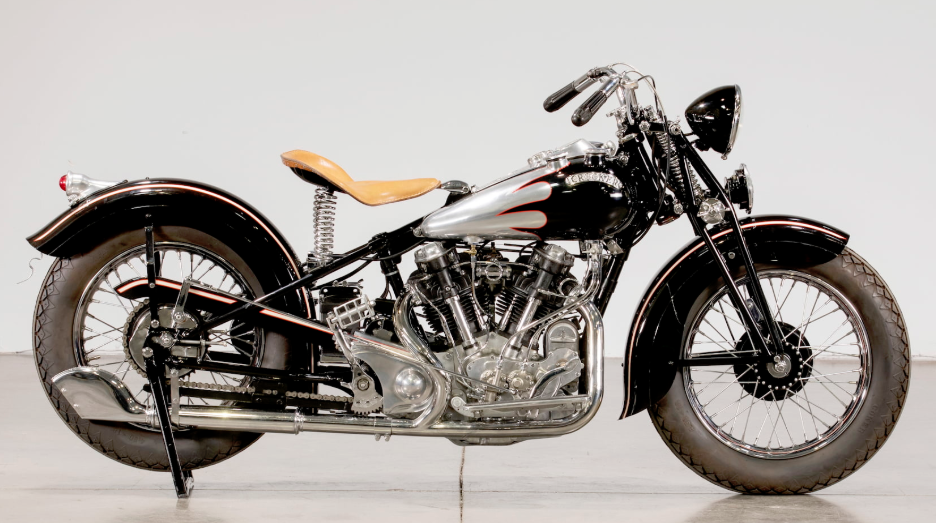
Star of the Show: this 1939 Crocker Big Tank brought a whopping $705,000, the second-highest price ever paid for a motorcycle at auction. A second Crocker big twin brought $423,500, which would have been the highest price ever paid at auction for this legendary American make, but it was eclipsed earlier by this machine! [Mecum]With this a huge sampling of verifiable prices, the Las Vegas auctions are also a snapshot for the vintage motorcycle market. Prices this year were decidedly mixed, and totally unpredictable, which may reflect domestic politics more than the economy! Take it how you will: either the price of a Crocker V-twin has shot up wildly, or remains at a 5-years status quo, as two similar machines sold, for $705,000 and $423,500, one day apart at the Mecum sale. Was there enough difference between the two machines to justify the $282,000 price difference? Both were restored, both looked tremendously appealing, but the top price came from the MC Collection of Sweden, who provided excellent documentation for this machine, and all their 240+ bikes sold at Mecum.
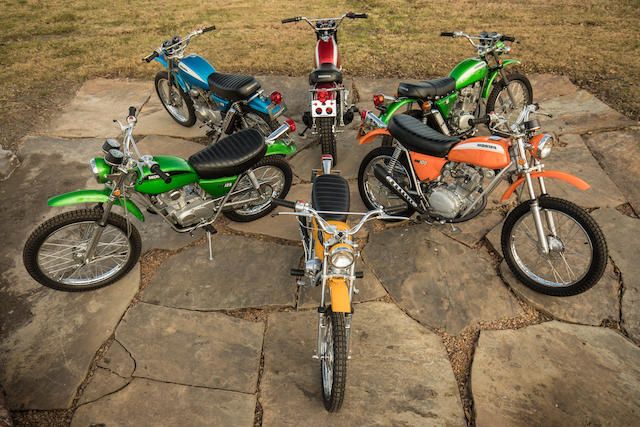
We loved this fun collection of 1971 Honda SL street scramblers - every model in Honda's CL range that year. They went to a new French museum, which took home many machines this year's auctions. The set of 6 brought $51,000. [Bonhams]Records for particular models were certainly set: a pair of new-in-crate Honda Z50 'monkey bikes' brought an astonishing $51,150. These were dealer-only 'Christmas Special' models, gifts from the Honda factory to their best-selling dealers, and had an all-chrome finish. Twenty other Honda Z50s of various vintages were sold at Mecum's South Point Hotel venue, with an average price of $5500, although one other Christmas Special sold for $13,200, which bends my mind, but says a lot about collectors in general: it doesn't matter what it is, if people want it, they'll pay what they need to get it.
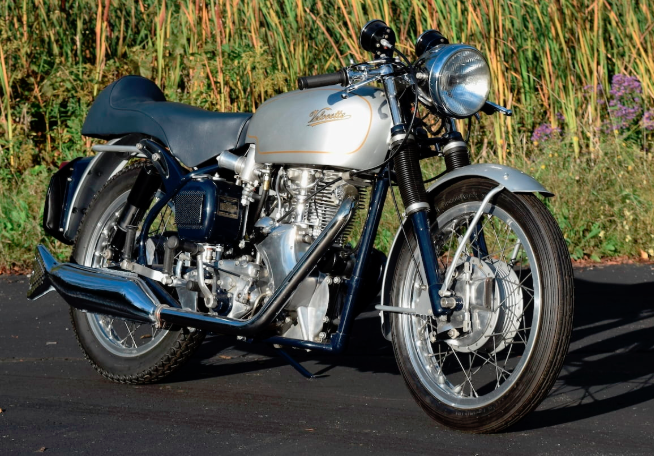
This gorgeous 1967 Velocette Thruxton broke all the rules in fetching $56,100, while another one sold for a more 'reasonable' $42,100! [Mecum]The following are probably the top prices ever paid at auction for these machines:
The takeaway: most of these are for post-1980 bikes. That's the hottest part of the motorcycle marketplace now, with recognition (in the form of money) going to the best motorcycles of the 1980s. Generally, bikes from the 1920s/30s/40s held their value (barring the '25 SS100 at $357,500, about $100k off the expected price), while those of the 1950s/60s slipped on the whole.
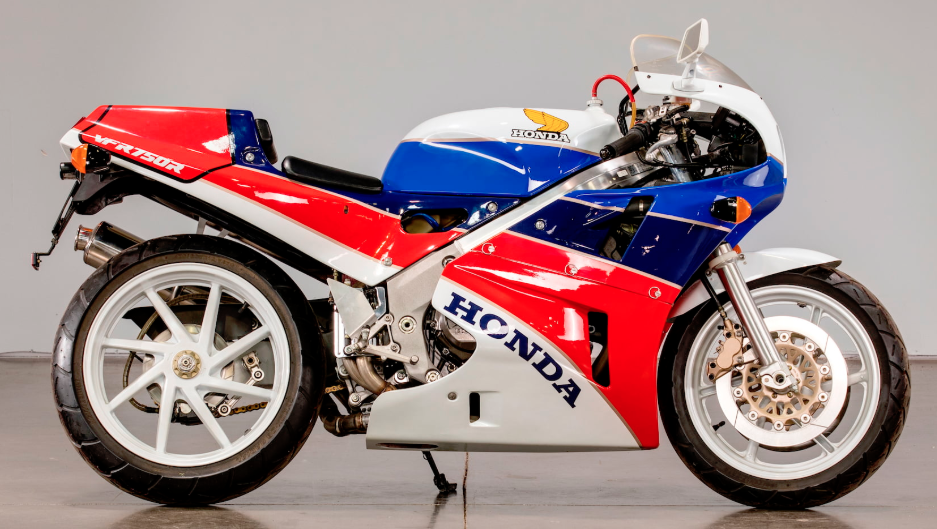
The Honda RC30 is a perfect design object with wicked performance, and has been collectable since it was released - many have zero miles! This one has 3 miles, solely from being pushed around at the Mecum auction... [Mecum]In a unique scenario this year, 240-odd machines from the MC Collection in Sweden were sold in one day (Friday Jan. 5th at Mecum): the 50-year collection of outstanding machines from Christer Christensen. Prices varied greatly, from bargains to world records (for a 1938 Crocker 'Big Tank' at $705k), but on the aggregate, prices were above average, and at the end of the day Friday his collection (minus 7 machines sold Saturday), fetched over $9.5 Million...which used to be the total for the entire 'bike week' in Las Vegas. But there was still another 1500+ machines to sell! Those 'other' bikes boosted the Mecum total to a staggering $26Million, which is an 87% increase over last year. With a 92% sale rate, the 2019 Mecum sale will be remembered as the largest and most successful motorcycle sale in history.
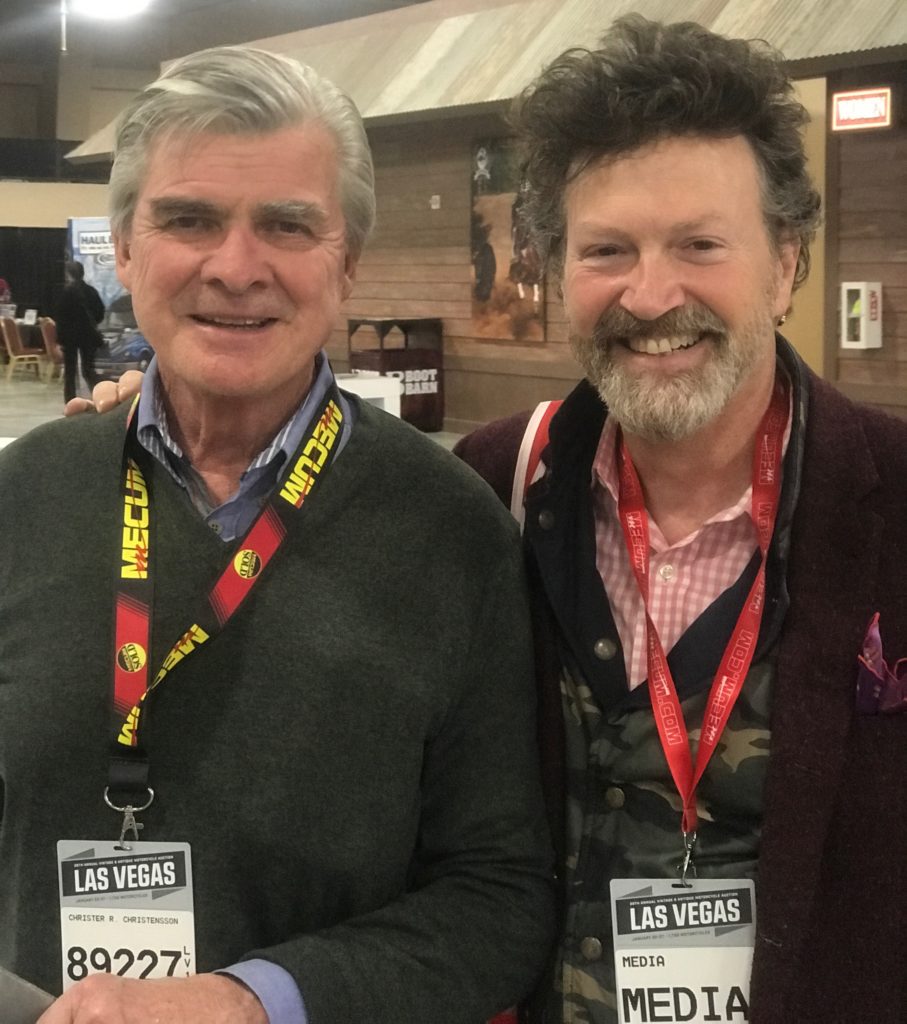
Christer Christensen of the MC Collection was sad to see 245 of his motorcycles dispersed around the globe, after 50 years of collecting. But $9.5M helped. [Paul d'Orléans]The venerable Bonhams Auctions sale at the Rio Hotel featured a manageable 120 motorcycles on Thursday afternoon, with a sell-through rate of just under 80%, and prices generally at or below the expected averages. One bright spot was Steve McQueen's 1938 Triumph Speed Twin, which fetched $175,000: a 4X factor courtesy the King of Cool. No other McQueen bike in Las Vegas at either auction house, though, had that kind of Steve multiplier, so there's nothing to be learned here. A surprising number of no-sales at Bonhams for restored 1960s Triumph twins may reflect their seller's unrealistic expectations - prices at both auctions were well down on mass-produced British twins compared to 2016, and we rarely see $16k+ prices for these bikes anymore. Managing the expectations of motorcycle owners is perhaps the most difficult job of an auction house, as people remember the very top prices for special machines or reached in one-off auction fights, but fail to realize their machine is not in the same situation, even if apparently identical!
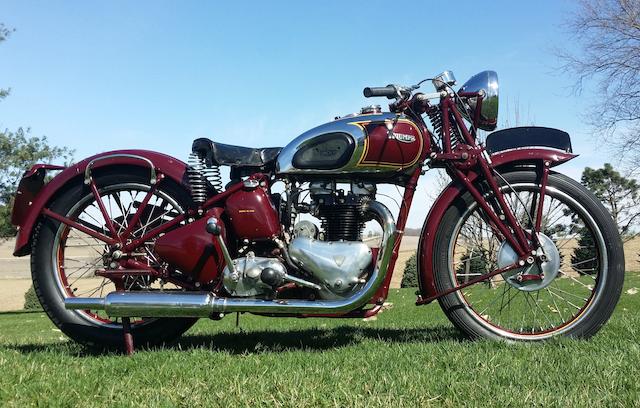
The magic of Steve McQueen launched this 1938 Triumph Speed Twin into the stratosphere! $175,000, which is 4X the usual top price. [Bonhams]While British parallel twins prices continue to weaken, it's the Vincent Black Shadow that's the auction-world weather balloon...or the canary in the coal mine, depending on whether you're buying or selling. VBS prices have been a rollercoaster indicator of global economic health for the past 3 decades, swinging between $25k and $150k and back again several times over now. They're the go-to bike for first-time collectors, a box to tick on every must-have list, but such checkbook buyers vanish in bad times. Restored Black Shadows reached a high average of around $140k two years ago, but today have sunk back to $85k, which is in line with prices within the Vincent Owner's Club, according to my sources. A 1951 Vincent Black Lightning failed to sell at Bonhams after bidding peaked at $320k, which is a mystery, as last year a similar Lightning - both with long, documented histories - set a world record at $950k. Three more Lightnings sold privately in 2018 - two at around $350k, plus an amazing Craigslist discovery at $20k. Yep; keep your eyes peeled, there's still treasure to be found! Yaar!
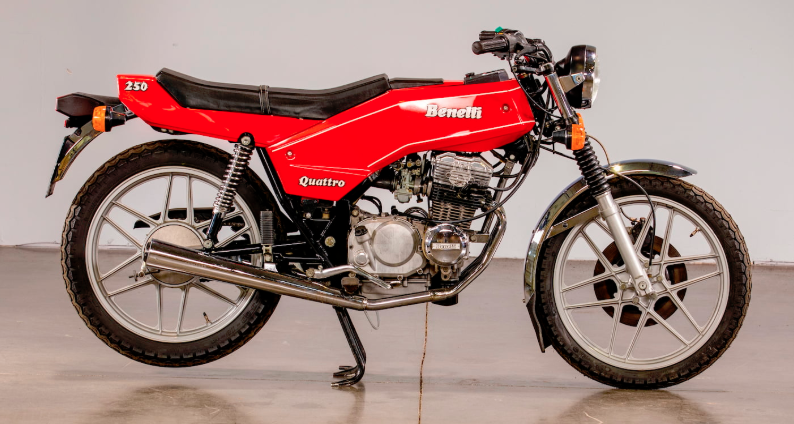
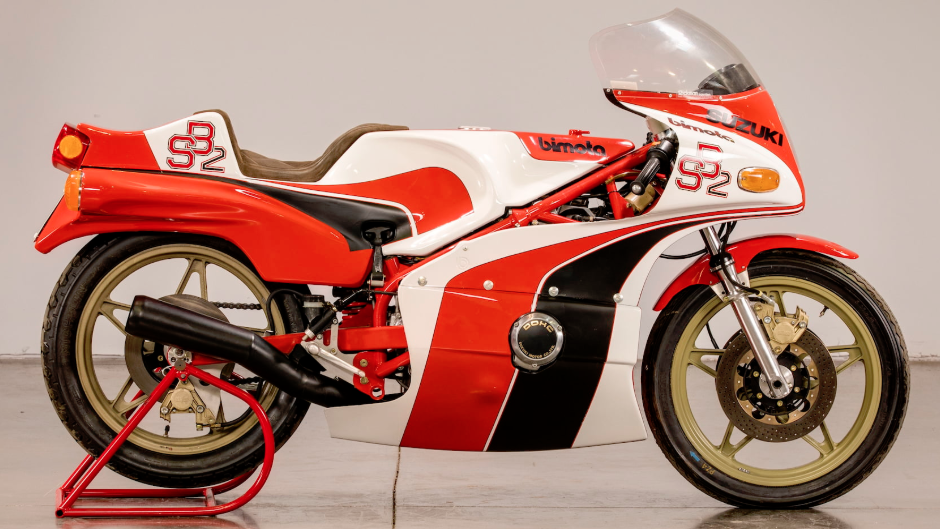
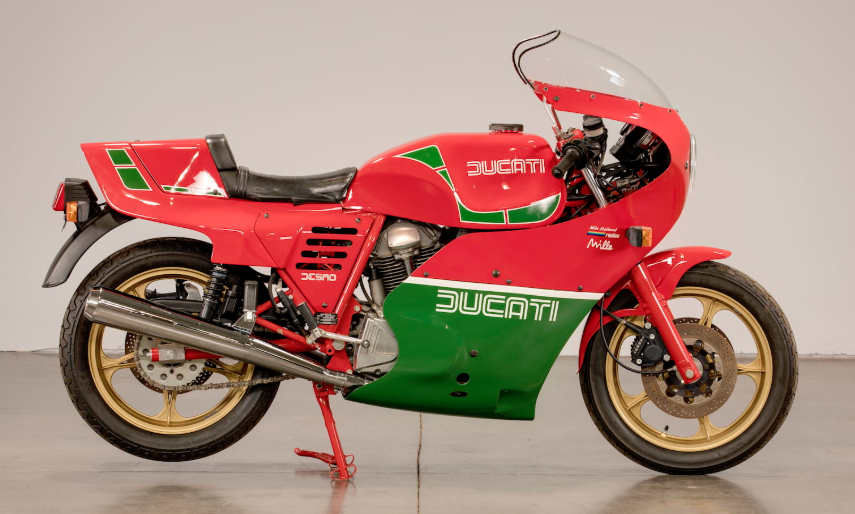
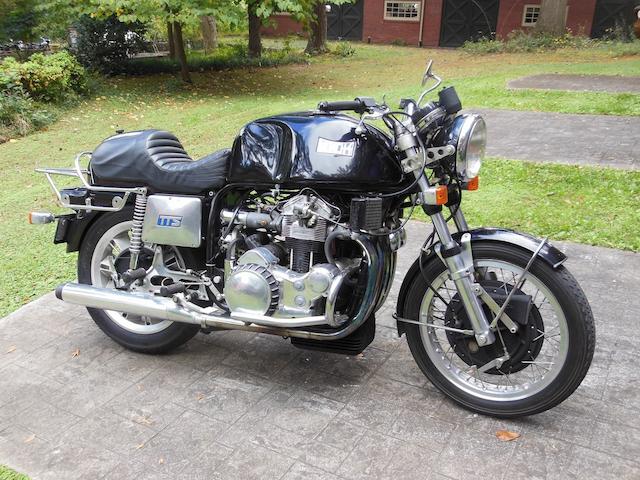
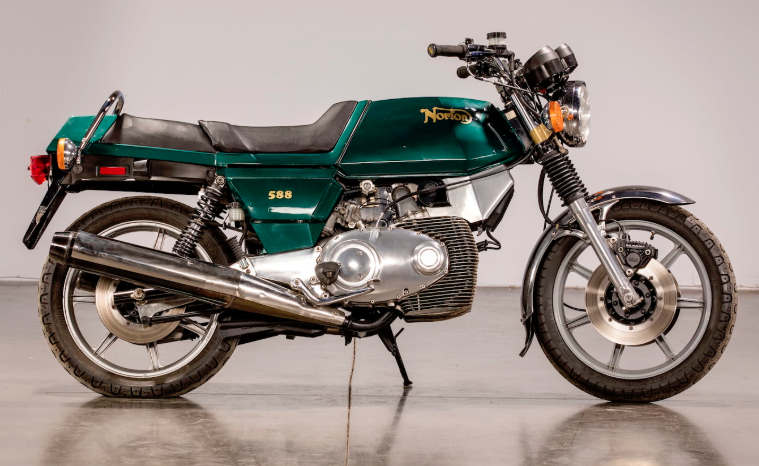
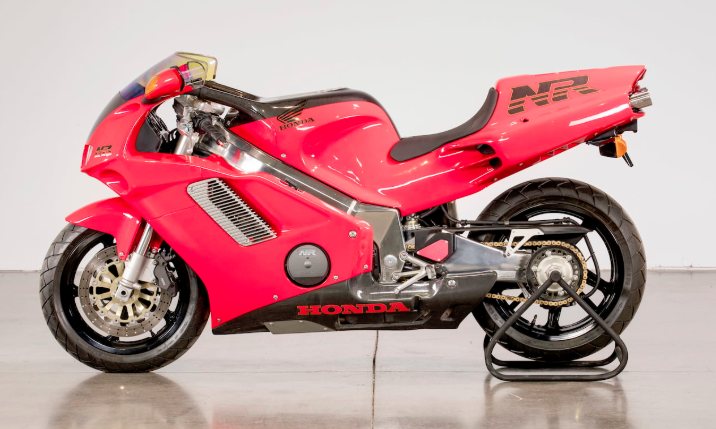
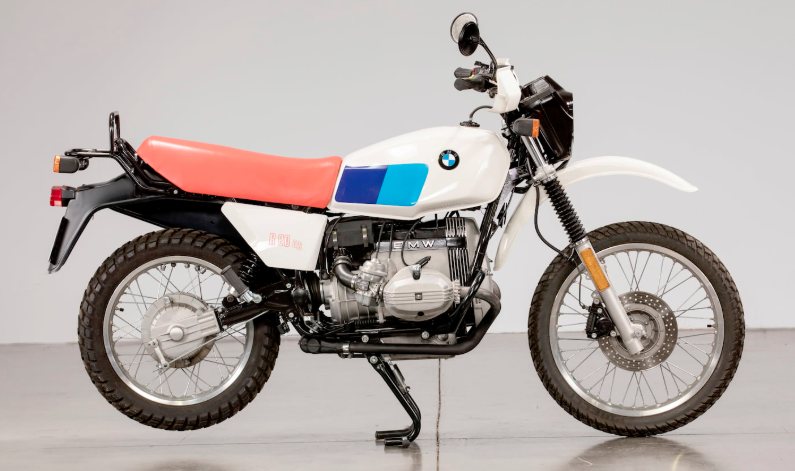
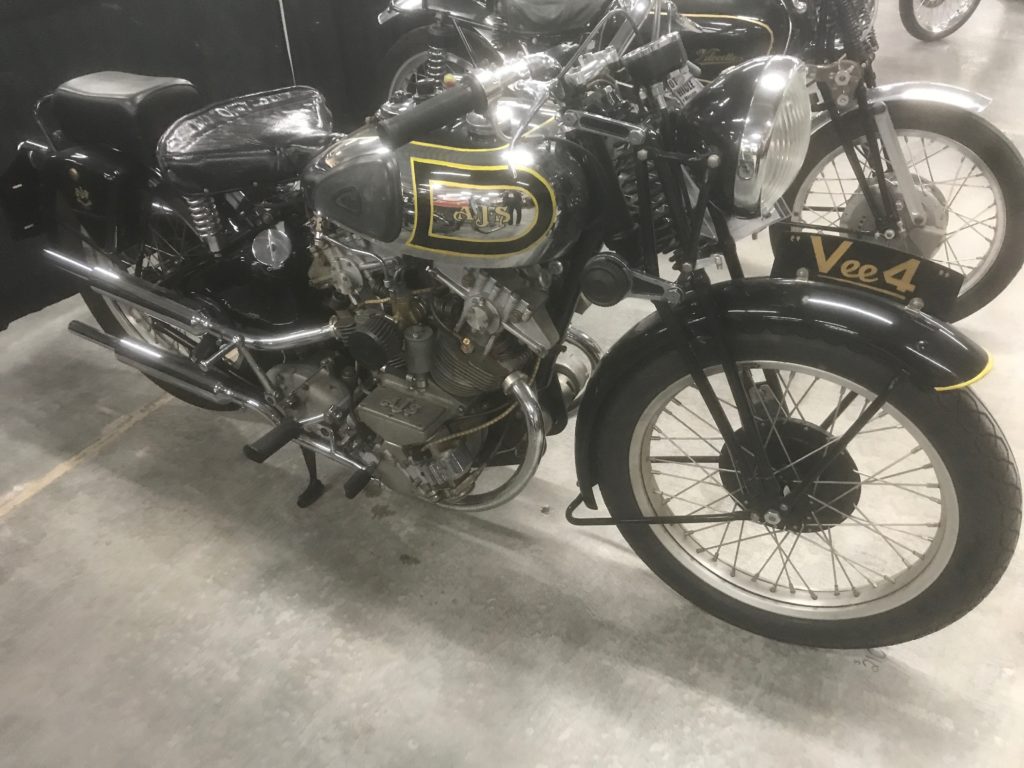
Likely the highest price ever paid for a Benelli 250 Quattro (which can also be found as a Moto Guzzi): $15,400 [Mecum]Perhaps all the pre-auction swooning over this 1981 Bimota SB2 helped kick it to $52k at auction? [Mecum]This 1986 Ducati Mike Hailwood Replica sold for $49,500, although other, identical machines sold for less than $15k during the week! [Mecum]This mighty Münch Mammut set a high water mark of $115,000. [Bonhams]What must be the most expensive 'civilianized' Norton Interpol II rotary, a 1986 model for $33,000. [Mecum]Exotica! And perhaps the ultimate Honda supertech superbike. The NR 750 was crazy expensive when new, and remains so at auction at $181,500. [Mecum]I'm not sure why this 1981 BMW R80 G/S brought $38,500, but it did, and now sets the high bar for the G/S series. [Mecum]Also sold at Mecum, the uncategorizable full-scale model of an AJS V4, built from photos and ridden 15,000 miles by Dan Smith, its creator. Mecum asked, 'what's it worth, Paul', and I said, 'maybe $80k', and I guess it was, at $85,250. [Paul d'Orléans]
Paul d'Orléans is the founder of TheVintagent.com. He is an author, photographer, filmmaker, museum curator, event organizer, and public speaker. Check out his Author Page, Instagram, and Facebook.
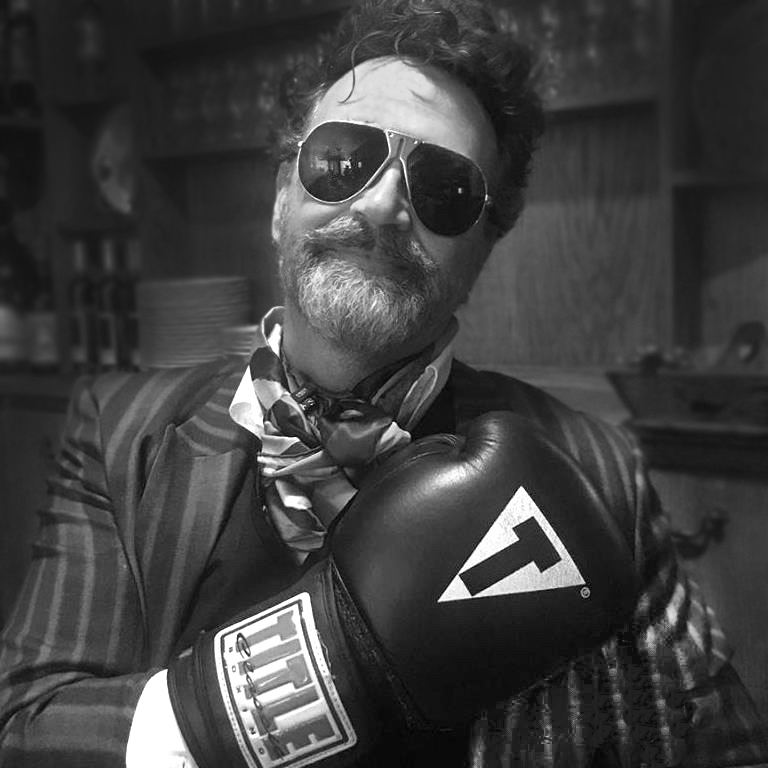
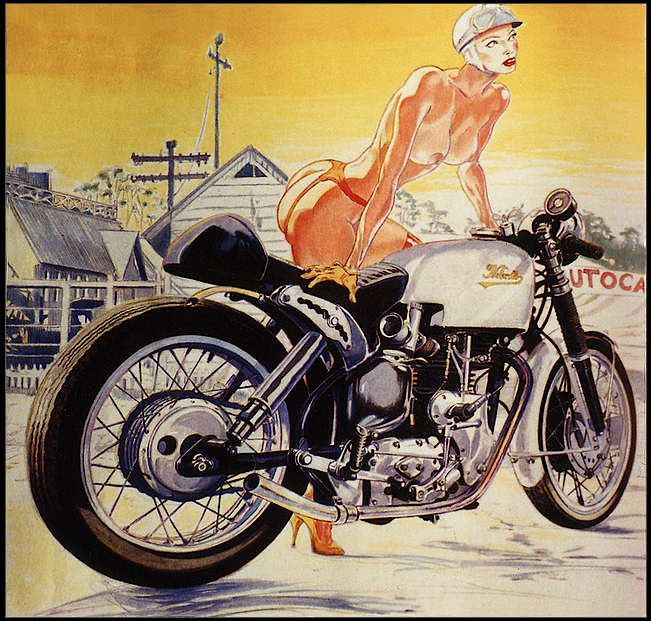
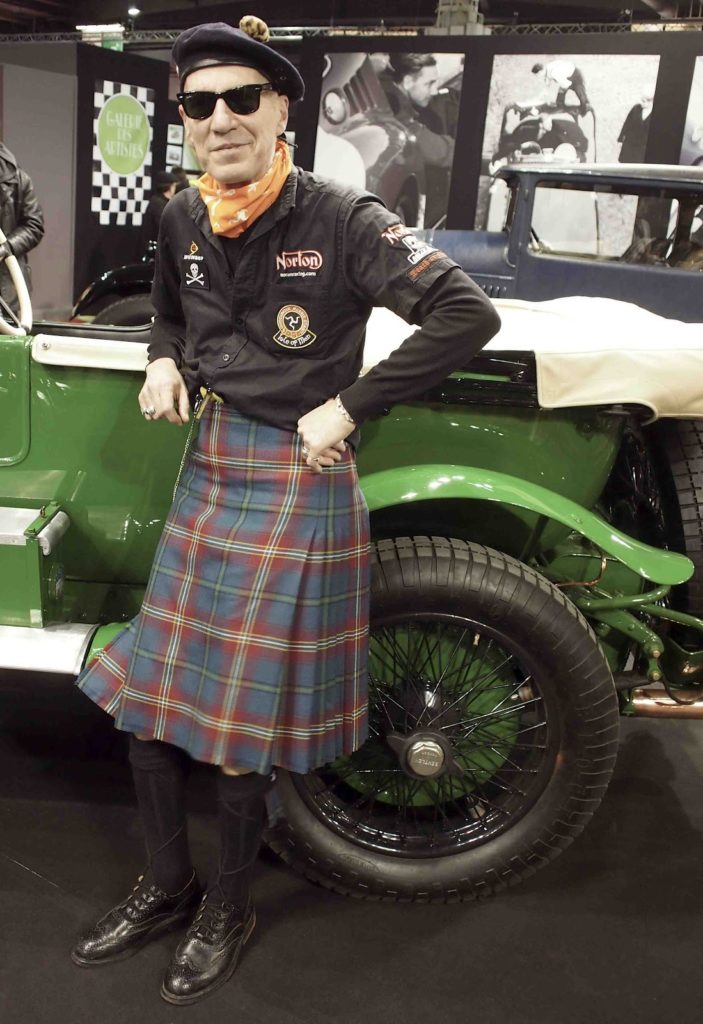
Legendary motoring artist Denis Sire, champion of inserting fantastical pinup girls into historical situations, has died. His work is well known to a generation who came of age in the 1980s, during the second wave of Rocker style, when Sire was already well established as an artist and musician in France, and his work was exposed worldwide in popular magazines. Sire was born in 1953 at Saint Nazaire on the Atlantic coast, and studied art in Paris at ‘L’Ecole des Arts Appliqués. His work is most familiar to 1980s readers of Playboy and Heavy Metal magazines, and I've had a copy of his Velocette Thruxton sketch on my office wall since the mid-1980s, and admired his outrageous mix of scantily clad femininity with hot rods, record breakers, fighter planes, and motorcycles. Meeting Sire in person last February at Rétromobile in Paris, I discovered he also possesses a unique sense of style, befitting his outré artistic ouevre.
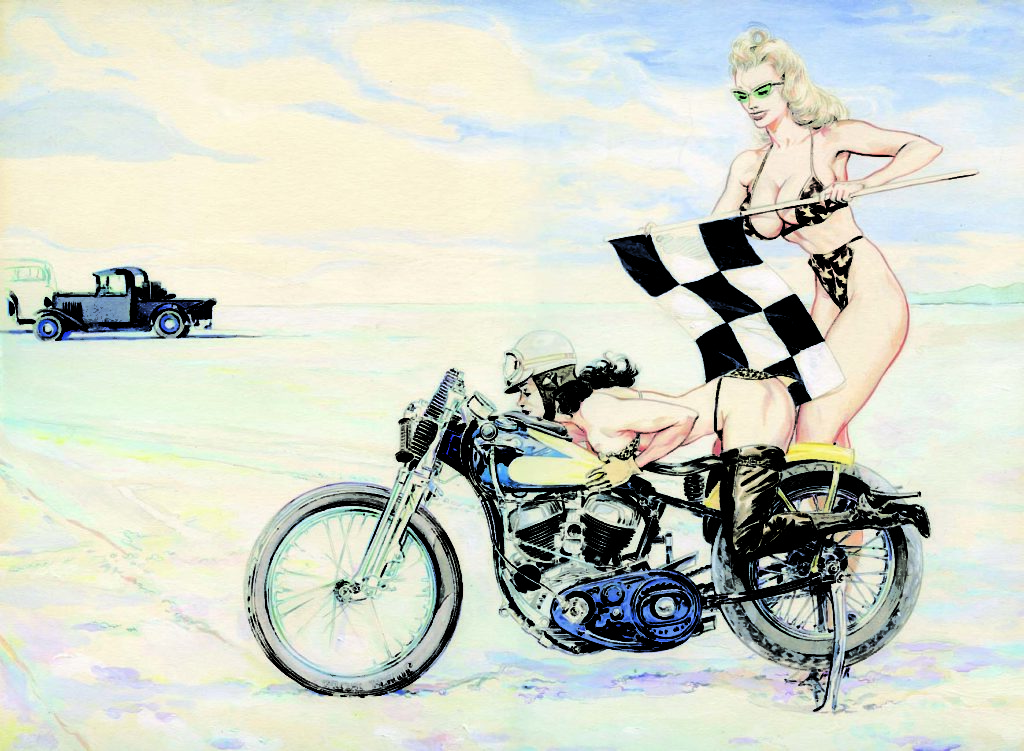
'Moto Femmes'. The Bonneville Salt Flats were a constant source of inspiration for Sire [Galerie Jean-Marc Thévenet]While in Paris studying art circa 1980, Denis Sire met Frank Margerin, and they formed the band Los Crados. His comic art simultaneously appeared regularly in Heavy Metal magazine, the first slick publication devoted to a new generation of comic artists: after the R.Crumb/ZAP comix era of the 1960s/70s, and before the current craze/praise for manga and graphic novels. Sire's published many books since the 1980s, and his work appears in countless editions of magazines, but you can start digging into his print publications here.
The following excellent interview appeared in 2015 on the French website, Monsieur Vintage, who regularly featured his work. I've translated it from the French for our readers, as it gives the best insight to his character and story. Vale, Denis:
Denis Sire you have 2 facets, rocker and draftsman. In a few words, who are you? I am a dandy rock and roller and refined designer, although the profit is not always the result, but in any case I feel free.
Denis Sire in the 1980s [Denis Sire]When did you get your motorcycle license? In 1972. I started with a Moto Morini: it's like a drug, once you have tasted it is difficult to do without it, because the sensations are unique, it is made with the machine. It's awesome. I never had any Japanese except one that was offered to me by a friend; a Yamaha 900 Diversion. A gift that allowed me to escape at the time. Later, when flirting with the future mother of my son, I told her my biker escapades, so she wanted to ban me from motorcycles. Since that period, I ride more.
My Japanese moment was very short, I followed up with a BMW R68, Aermacchi 350 Sprint, Harley Sportster 1000 XLH, H-D Duo Glide (which I never rode), a BSA B31, a Norton 850 Commando (Fastback), an H-D Cafe Racer (cast iron Sportster), a Panther Model 100, a Triumph TRW (ex-Paris Police), BMW K 75. Then a Buell M2 Cyclone (orange fusion), for me the greatest pleasure on 2 wheels.
'Thruxton', the work that alterted me to Denis Sire...while I owned a Velocette Thruxton, I never found quite this accessory! [Heavy Metal]What made you want to draw? In my memories, I have always pretty much drawn. My father was an old biker and told me his motorcycle stories. He still had an Indian Big Chief, coming from the American surplus of the 1940s war. Passionate about mechanics, he was painting, so drawing for me was something natural. And my parents did not hinder me on that side. Fortunately, because they understood that a classical school did not fit me.
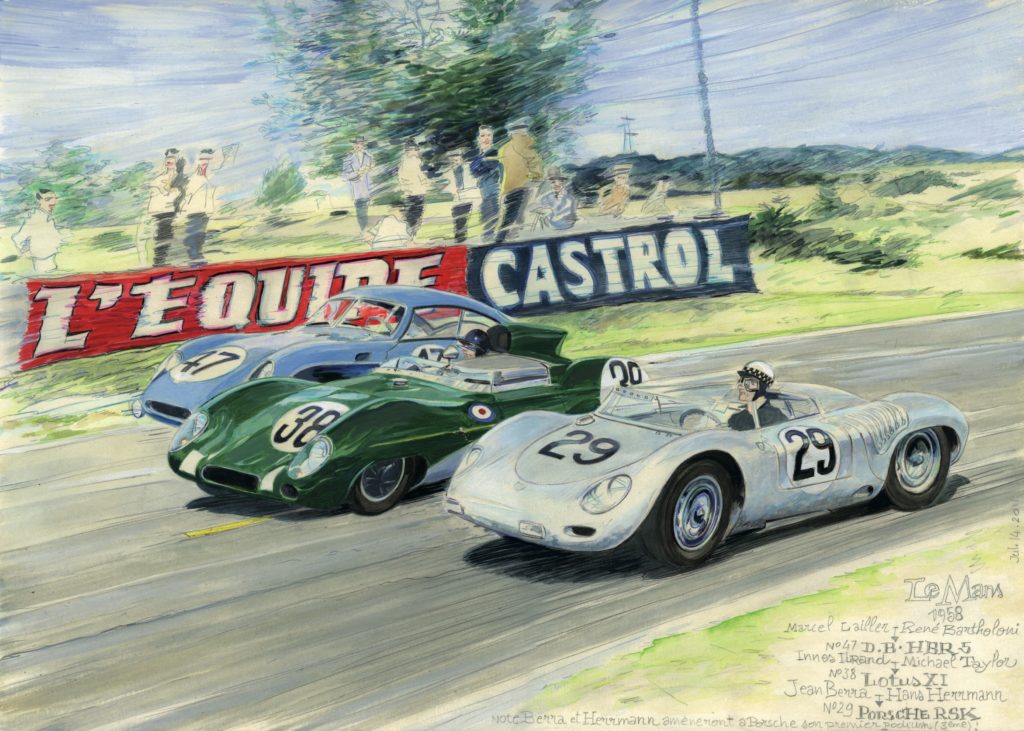
'LeMans, 1958' [Galerie Jean-Marc Thévenet]You are from Saint-Nazaire, when did you arrive in Paris? We arrived in Paris in 1962, I was 9 years old. The arrival in Paris for me was dramatic, I lost everything leaving Saint-Nazaire; the house, the dog - a royal poodle. I was very small, after we ended up in the upper part of Rue Lepic, at number 22. A 2 room apartment. We'd had a garden before, but I was not allowed to go out, because at the end of our garden, there was the sea. In Paris it was another story: I went to school alone, the public school was just across the street. This is where I started to fight, because at the time there were tough kids, and there was the underworld of Montmartre, the OAS...a pretty hot atmosphere.
Later we moved to Sceaux fortunately [a suburb of Paris - ed.]. We were in a refuge city, a garden city, great. With the Parc de Sceaux in the 60s it was great, it was crazy, still old-fashioned with small farms, the shopping street, there were still printing houses, those who printed Bibi and Fricotin, Feet Nickelés ... I was skateboarding and cycling, and at 14 I rescued a moto Solex from a cellar. I went straight to bikes, there was no moped between the two. I bought a Honda PC50, with 4 speeds and a horizontal motor: I though that had class. My father told me "You can ride a moto, but you have to buy them."
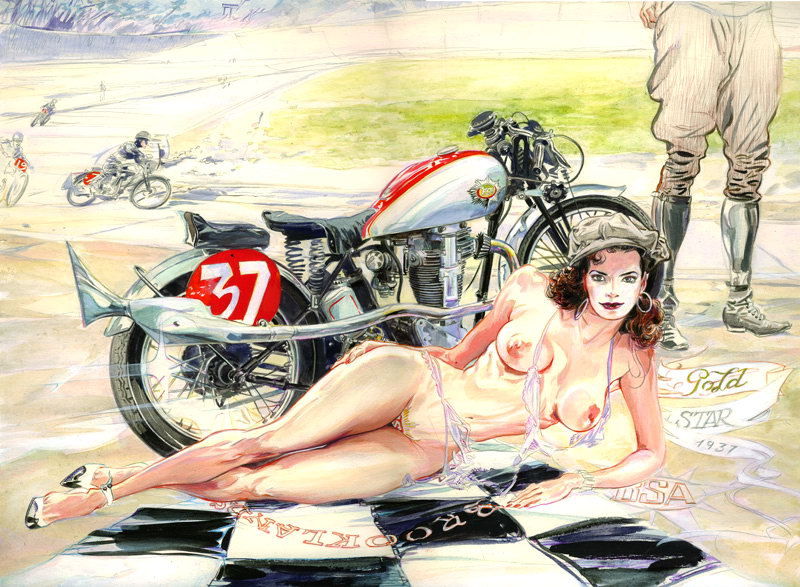
'Gold Star'. A riff on Wal Handley's epic 103mph lap on a BSA Empire Star, that founded the Gold Star line [Galerie Jean-Marc Thévenet]The motorcycle often appears in your drawings, like cars, pin-ups. Where does your passion for 'retro' come from? When I studied the Applied Arts in 1970, I also discovered Jimi Hendrix and Jim Morrison, but they died. Then I was interested in the Stones, and I discovered Eddie Cochran in a compilation made 10 years of his death. A gray metallic sleeve: I listened and said to myself: "It's not bad the Rock, huh ..."
Later, I met Frank Margerin, who studied Applied Arts at the same time as me, and I went to flea markets with Los Crados, and we formed a good band. I was already doing comics, I decided it at age 11 because my father bought me Spirou, I always had the Spirou it gave me ideas. Franquin was my master, I managed to meet him and interview him before his death.
To come back to the past: what interested me, came from the past. To please the ladies, it was great, we did a concert on the Place de la République in '81. We sang the twist, it was the easiest thing to sing, I did not think I was bad in English. We cut our hair and slicked it back. At the time the news was Yes and groups like that, I did not like them, so I stayed stuck in the past. I rediscovered the Early Beatles, which is pure Rock'n'roll, and their premiers on the BBC were crazy, McCartney sings great, as on Long Tall Sally.
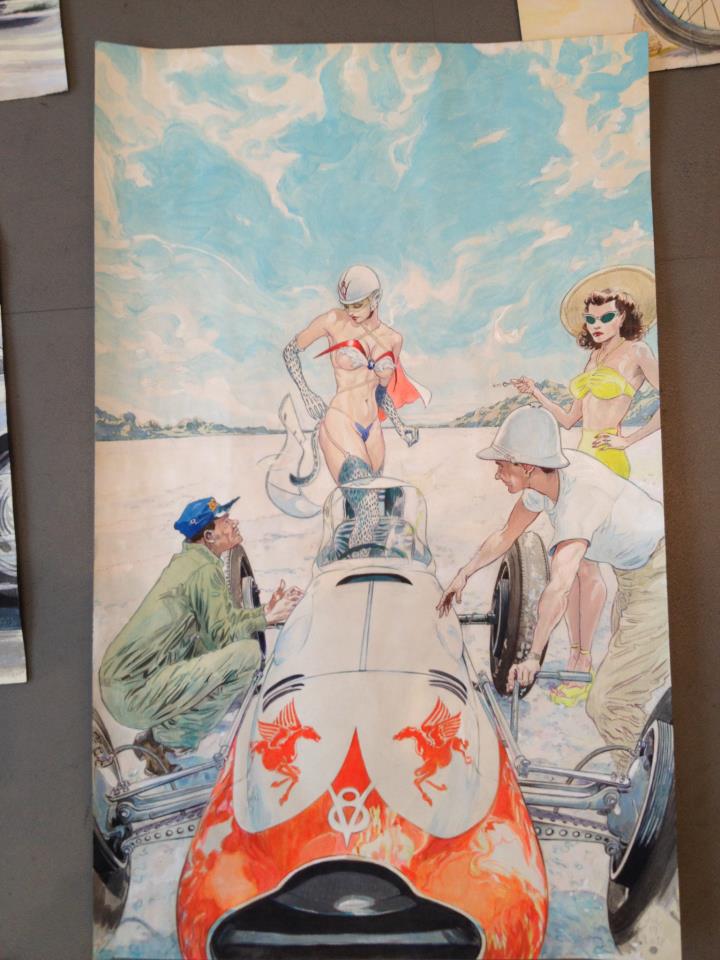
Captured at a comic art booth at Retromobile in 2012, another Sire drawing depicting the Bonneville Salt Flats, with a 1930s Indy Car. Sadly, I could not afford to buy it at the time... [Paul d'Orleans]You are someone nostalgic? I am always saying "it was better before." The Volkswagen Beetle, I always preferred the first model, the Chevrolet Corvette is the same, the Stingray with the Split window demented, the Mustang when we see how they have evolved it has nothing more to see. Yes, it was better before.
My father told me his stories from the war, it was fascinating, the Guérande peninsula. My grandfather Sire was an engineer at the Atlantic shipyards, he made sea tests from Normandy. My father was a great storyteller, where I discovered the childhood of my parents, and my grandparents.
I am also interested in history, of the 1940s among others, where the French social malaise comes from all accounts. The '30s are very interesting, the Speed Twin Triumph, it dates back to the '30s we did not invent anything better. These motorcycles were perfect machineries: we see that when we draw them.
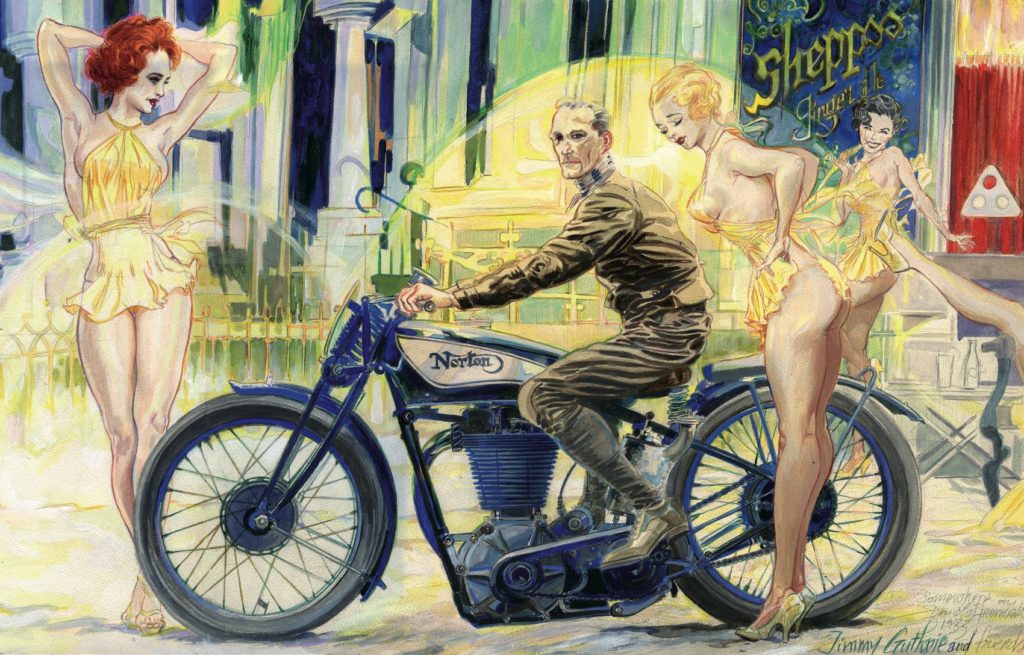
'Jimmy Guthrie' on his factory racing Norton, circa 1935 [Galerie Jean-Marc Thévenet]Does the past have a future Denis Sire? Yes, I think so. You have to think about turning off the computers, getting back to drawing. Today all cars are similar, because they come out of a computer that has a binary operation. I was a fan of Jim Hall and his Chaparral. In his studio in Texas, this guy was alone, although he was a descendant of an American oilman, he found himself orphaned very young. He started ragging on the cars of others saying " I'm going to improve that and that .. ", he's done fabulous things, it's part of the beauty of the past.
Your drawing stroke is very fine and dynamic, how do you work? I'm crazy, I cut my pencils to 0.5mm on the cutter to have a finesse. They are already thin and I size them more. I can not do that anymore because of my eyes. In my Zybline and Bettie comics, I worked in India ink, extremely fine. It was wash and brush. With Willys Wood, we were influenced by a lot of people, including Americans. With Will Eisner and The Spirit he used the same technique. I met him through Heavy Metal for the first time, with my first print publication.
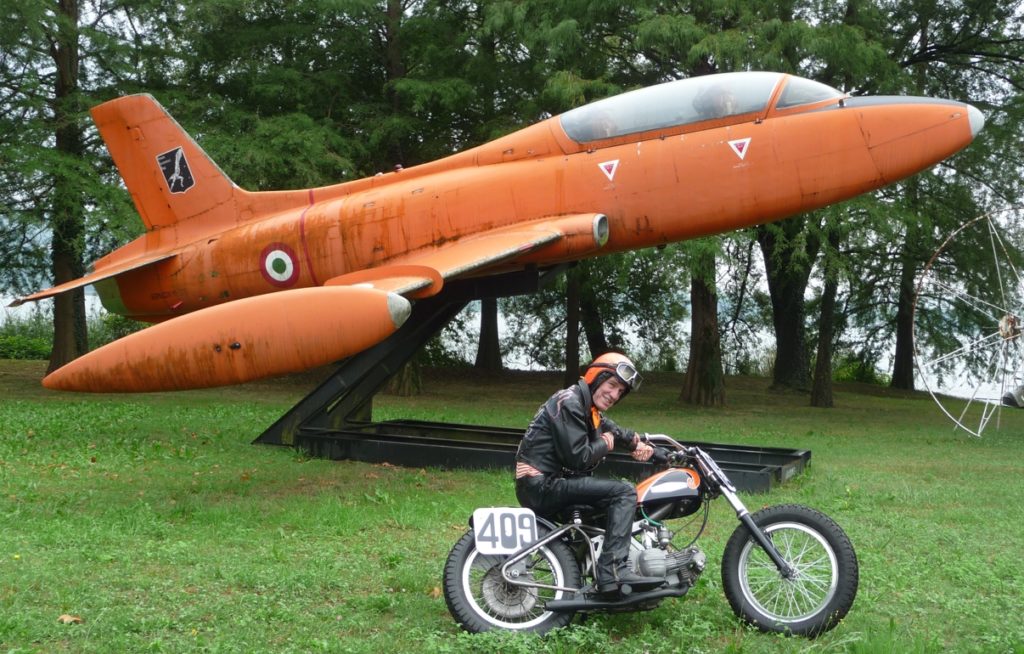
Denis Sire on his Aermacchi 350, in front of an Aermacchi jet! [Denis Sire]Your first job was with Heavy Metal? Yes, there was Driver too, but it interested me less. I was doing comic book competitions. At Pilote, they had asked me to leave my box saying "we will write to you." I left, I reconsidered, and went back to get my work. Heavy Metal did not look like any other magazine, there was Charlie Hebdo monthly but there were few designers.
Willys Wood, this is a reference to the Betty Page pinup? I discovered Betty Page through Jean-Pierre Dionnet and it was a timeless love story. She was also the muse of Dave Stevens.
In your artistic journey, if there was anything to change, what would it be? Better to surround myself. All alone is rather hard, especially since I do not know how to sell myself.
You are edited by Zanpano Editions, is there a comics project at home? No, no comic book, a Volume 3 of Dolls of Sire and then that's it.
Do you work for hire? Yes, I'm currently working with Vincent Marquis on the Continental tire brand, but that's another approach. There are delays, more constraints, and an order remains an order.
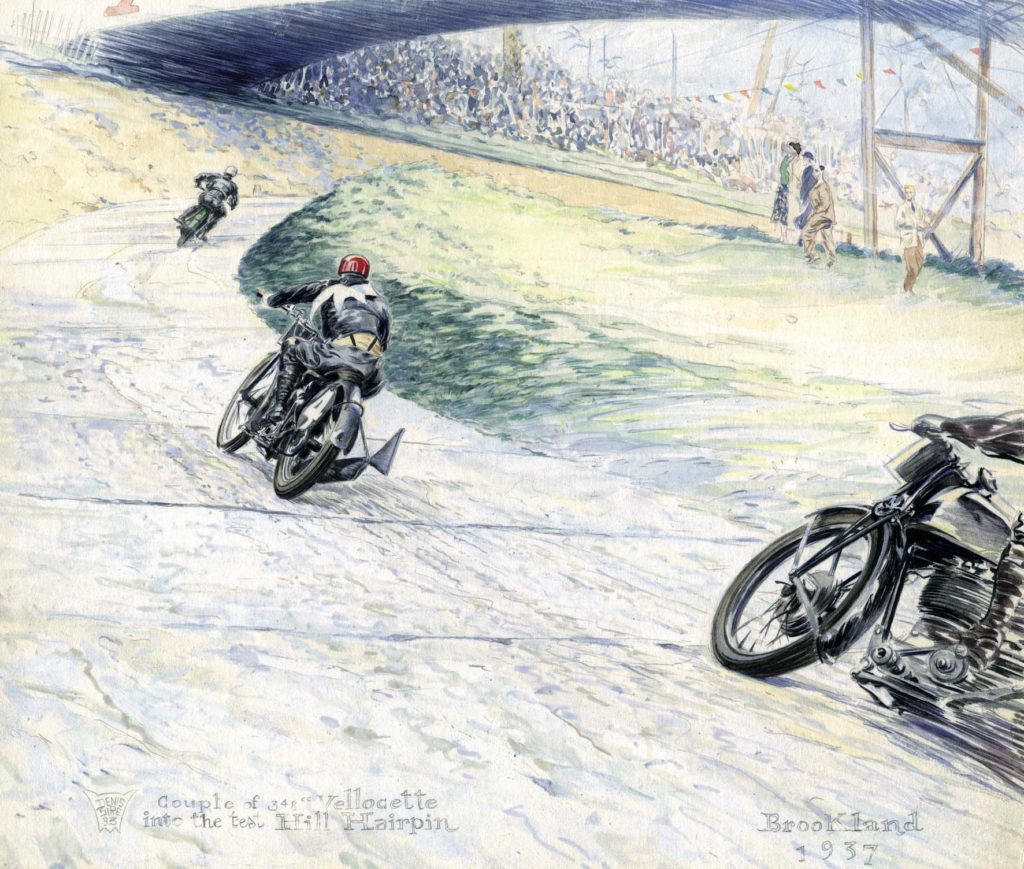
'Brooklands 1937' [Galerie Jean-Marc Thévenet]You never thought of working in design? No, it never attracted me. I am an admirer of the work of others, but I prefer to transcribe.
Do you work on media other than paper? No, I had proposals for cars, but I don't see too much interest. I want to use perspective, but they want flames: what Alexander Calder did on the BMW LeMans racer was great - it suited the car. Calder it is not figurative and it would be more in that sense that I would work.
Have you ever wanted to re-group a rock band? We would only want to go back on stage. But hey, there was the death of Schultz [of Parabellum], which clipped my wings a little. And then, there is the alcohol, the drugs, and you say to yourself "What am I doing? I do with, or I do without?" When we look at the history of Rock all this is related, it's the same for the bluesmen: they drink, their fingers are messed up, but they're high and continue to play. There is time to consider too, you can not do everything at once; family life, drawing, music, motorcycle. It's a lot. When I was with Dennis Twist, I could not do comic books, because when you draw there is an immersion that has to be done.
Dennis Sire captured at Rétromobile in Paris, in 2012 [Paul d'Orléans]Is there a drawing you regret doing? It's hard to say. Like that, nothing comes to me. The regrets, they are more connected to the losses of original drawings, from the flights, and there were many. Once in the United States especially, when I worked for Heavy Metal: a poster that I had to fly to New York. I found the original for sale by one of my gallery owners, he had bought in a Comics Convention! Another time, returning from Rome, I lost a whole box on Harley-Davidson, for whom I worked. But that loss is even more stupid, more annoying.
For your Pin-Up drawings do you work with models? I drew the Heavy Metal boss's wife, but it depends.
Today, if we want an original Denis Sire, how do we find one? There are exhibitions that I do sometimes, but I do not sell live, I do not sell myself either, it is better to go through my publishing house.
Paul d'Orléans is the founder of TheVintagent.com. He is an author, photographer, filmmaker, museum curator, event organizer, and public speaker. Check out his Author Page, Instagram, and Facebook.
Long before he'd earned the nickname 'Fass Mikey' for his rapid motorcycle painting skills, covering the entire factory Yamaha road-racing team practically overnight in the 1970s, Mike Vils was a legend. He'd been building choppers and show bikes since the early 1960s, and worked at Ed 'Big Daddy' Roth's shop from 1967-69, before branching off on his own, working for Yamaha in the '70s before becoming a building contractor in SoCal.
Taming The Brute! Ed Roth hand-retouched his photo of Mike and The Brute for his first article on the bike in 1967. [Roth Family Archive]When I first met Mike in the vintage motorcycle scene in the 2000s, and got to know him on the 2012 Motorcycle Cannonball, I had no idea he had a significant history with custom motorcycles 50 years prior, until I started asking around for imagery and stories for my book 'The Chopper: the Real Story' (Gestalten 2014). The book was my effort to give a historical, researched timeline on the development of this uniquely American-grown custom style. 'Talk to Mike Vils!' was the advice from older motorcycle friends, many of whom had been 'chopper guys' in the 1960s and '70s, before switching to the vintage motorcycle world in the 1980s and '90s.
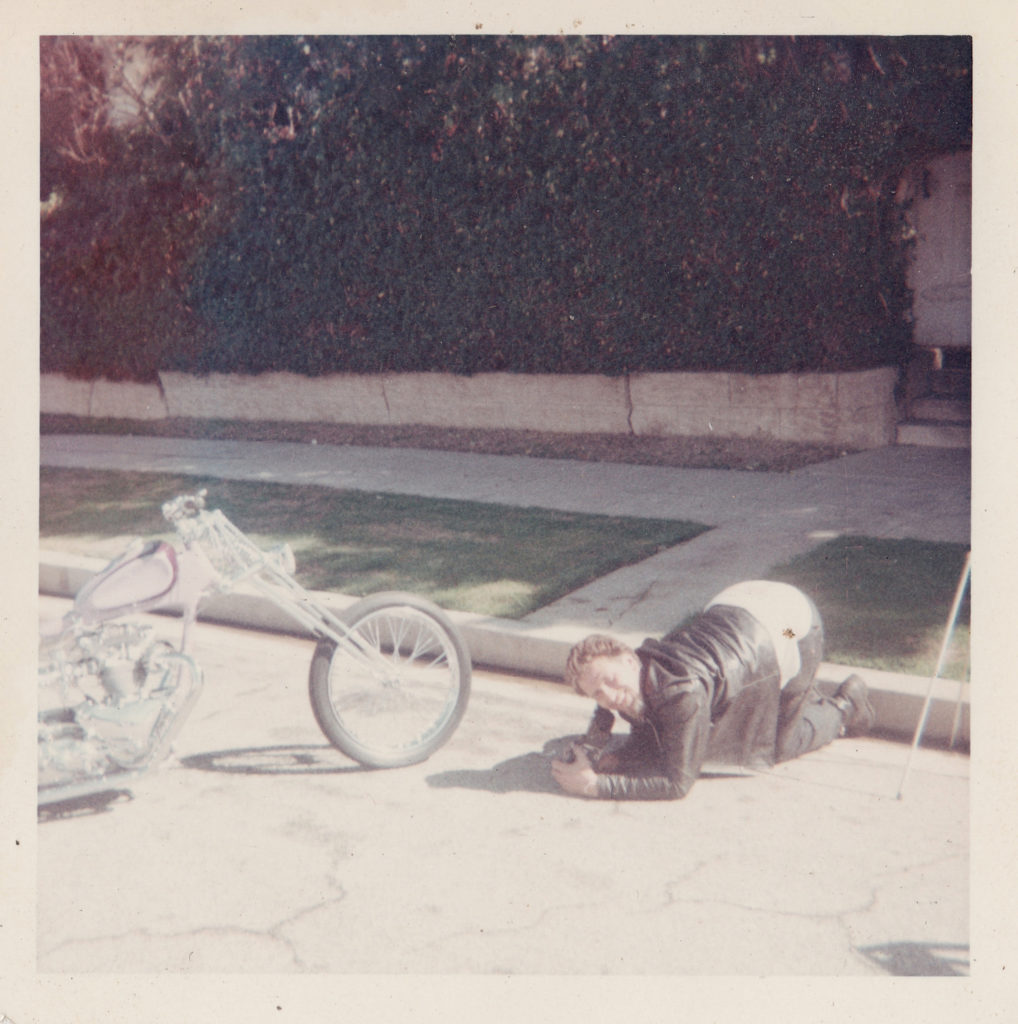
Ed Roth himself photographing The Brute for Choppers Magazine - Ed did most of the writing for the magazine too, under several psuedonyms [Mike Vils]Mike first began working with Ed Roth the year 'Big Daddy' began publishing his seminal Choppers Magazine (1966). It was the first print publication to focus on this custom motorcycle movement, and ran only from 1966-69. In contrast to all later chopper magazines, Roth's magazine was color blind, inclusive, and funny. After the explosion of interest in choppers following the release of 'Easy Rider' in late 1969, an industry was created around choppers, with parts manufacturers and custom chopper shops around the world, and numerous magazines covering the scene. But popular magazines like Easyriders were notorious for including content with nazi and white power symbolism, and never featuring the work of black or brown chopper builders.
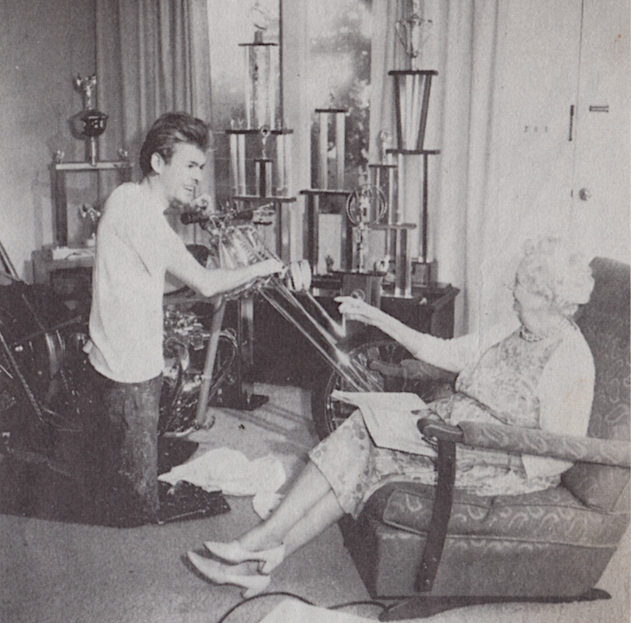
Mike Vils with his grandmother, and his trophy room / her living room! [Roth Family Archive]Chopper magazines of the 1970s and '80s gave a sad distortion of this amazing, home-grown motorcycle style, and colored the public's view of choppers for generations. As did, of course, the choppers' connection with 1% motorcycle gangs, who were in reality a minimal part (numerically) of the custom motorcycle movement of the second half of the 20th Century, but a huge part of the image projected by the media. By telling the story of a chopper builder like Mike Vils, it's my hope that the chopper's artistic merit can be appreciated without the social baggage that has deterred appreciation of this folk/outsider art movement.
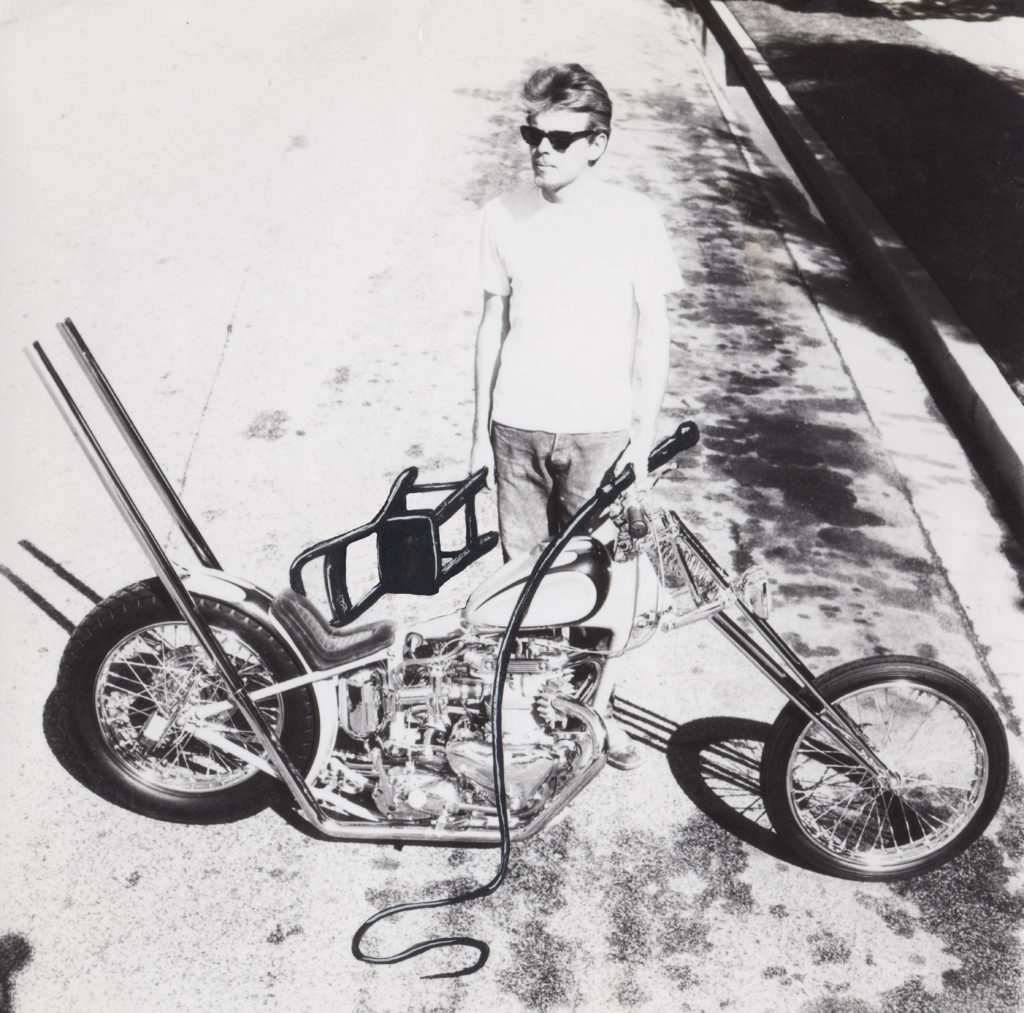
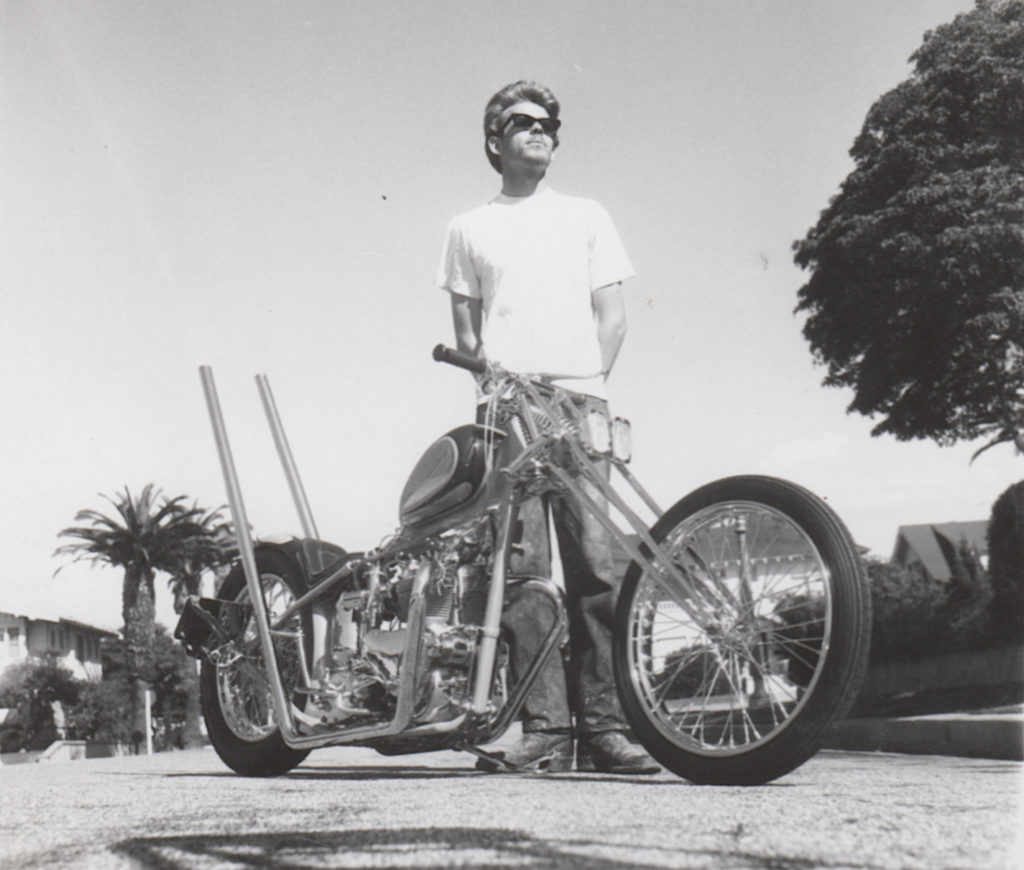
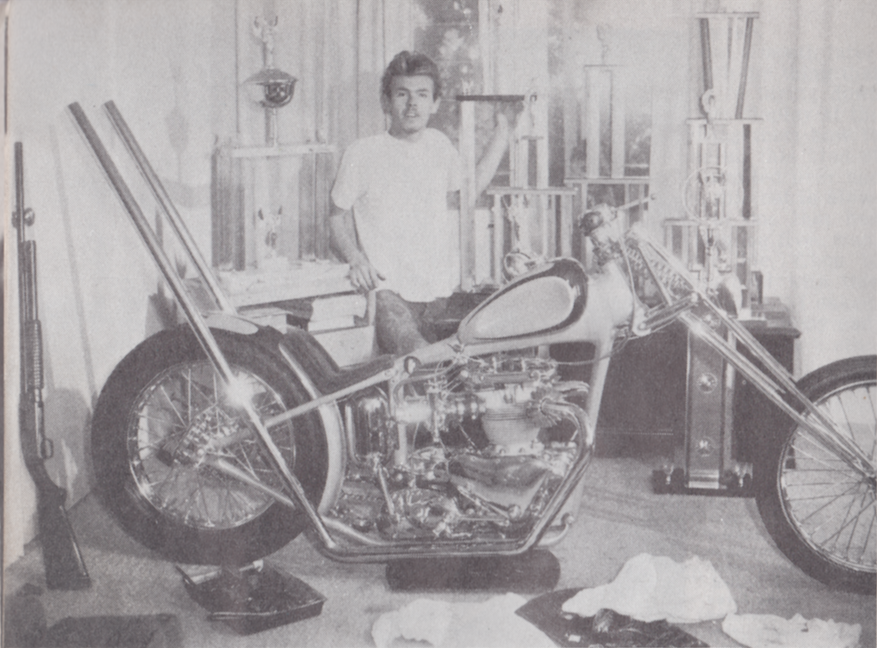
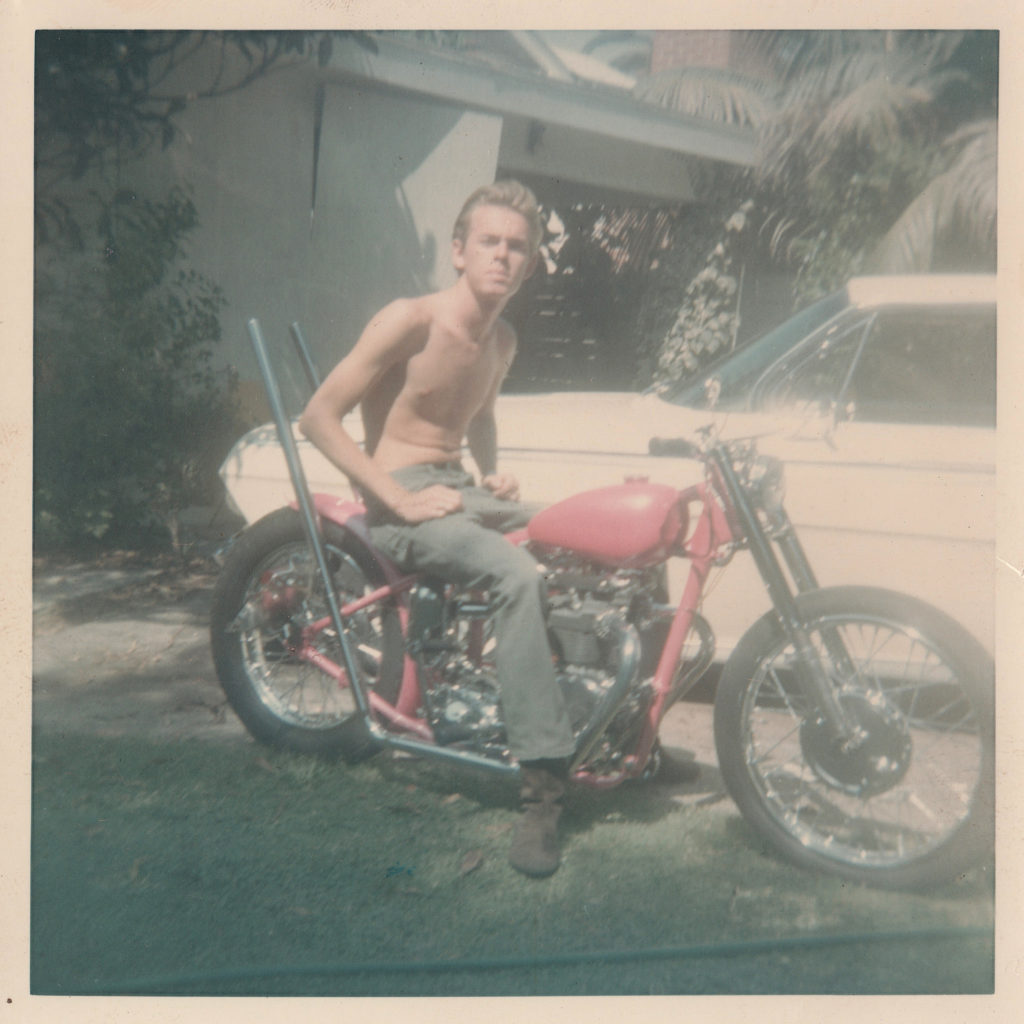
Mike Vils in 1967 with The Brute. Note the shadow of Ed Roth's ladder in the foreground. [Roth Family Archive]While he was still a teenager, Mike Vils built a show-winning custom 1955 Triumph Tiger 100, called The Brute, that evolved over several years in different, increasingly radical forms. The Brute was famous on the mid-1960s show circuit, and collected awards aplenty, as you can see in photos from his grandmother's home! It was also featured in Choppers Magazine, as were others of Mike's creations. The following is an excerpt from my 2014 book with Gestalten, 'The Chopper: the Real Story' (which you can still buy here):
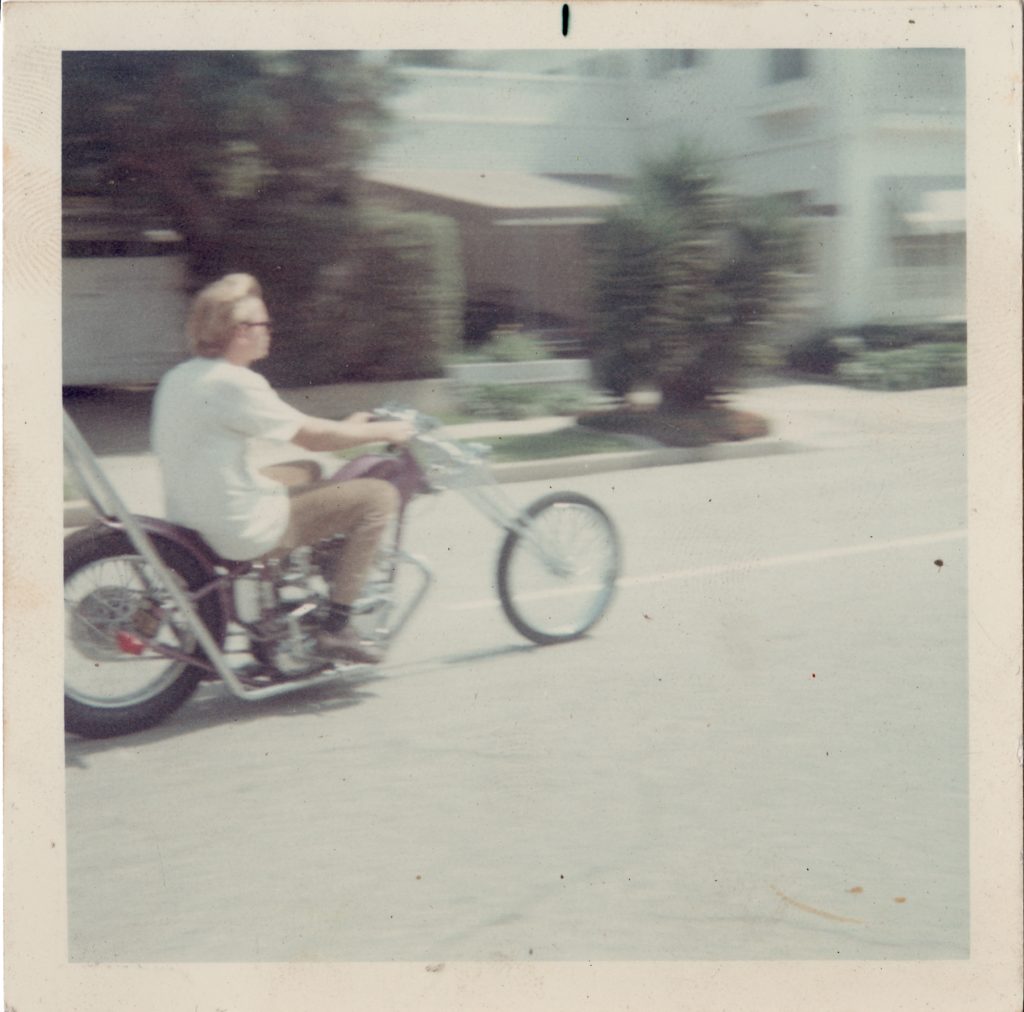
Mike Vils proving The Brute was a rider, not a show queen [Mike Vils]"Mike Vils started riding homemade mini bikes in the dirt lots around his SoCal home when he was 10 years old. In 1957, the hot rod craze was in full swing. “That was 47 years ago, and I was already into the whole custom thing, and put ape hangers on my Doodlebug. When I got a little older (all of 17), I bought a 1955 pre-unit Triumph 500 that had been a desert sled, but I wanted a street bike, so it became a bob-job. For the dirt I rode junky old crap like everybody else – stripped road bikes. I met Gary Deera who was an old ‘outlaw’ rider, who’d gotten into some trouble and retired from the 1% life, and he befriended me, and showed me how to build bikes. I bought an old Knucklehead, and helped me make a rider out of it. That freed up my Triumph to become a showbike kind of thing.”
Mike in Choppers Magazine with his huge collection of trophies won with The Brute over 4 years [Roth Family Archive]That ‘showbike kind of thing’ started out as a very clean bob-job, as was the norm in the hot rod/custom scene at the time, with lots of chrome and a very cool paint job. “In those days we didn’t have catalogs to buy anything; you might buy a Webco peanut tank, or a Harley tank, but otherwise we had to make everything. I did all my own paintwork, and even polished all the metal before taking it to be chrome plated, to save money. Joe Perez did my upholstery – he did it for Ed Roth too. I had to lace my own wheels; nobody had any money. I was just a kid!”
Mike with an early bob-job version of the Brute, with Triumph telescopic forks and front brake, circa 1964. The frame had yet to be chopped and was still standard, although a bolt-on rigid rear end from a TR5 Trophy had been added. [Mike Vils]That bob-job was The Brute, one of the most famous bikes to hit the show circuit in the mid-1960s, winning 22 trophies in 2 years, either 1st Place or Best in Show. The Brute was progressively transformed over three years, from a bob-job showbike to the radical chopper it became. “The custom bike thing was always about ‘no money’, it was all about low budget. Kind of like the original hot rod guys, those cars were just shitboxes they’d found and made something out of. Nobody had any money, there weren’t any rich guys into hot rods or bob-jobs at all, it was all about making it cheaply, by yourself in those early years. Nobody went out and bought a new bike; you might spend some money for someone else to build your motor, but the rest you’d have to build yourself.”
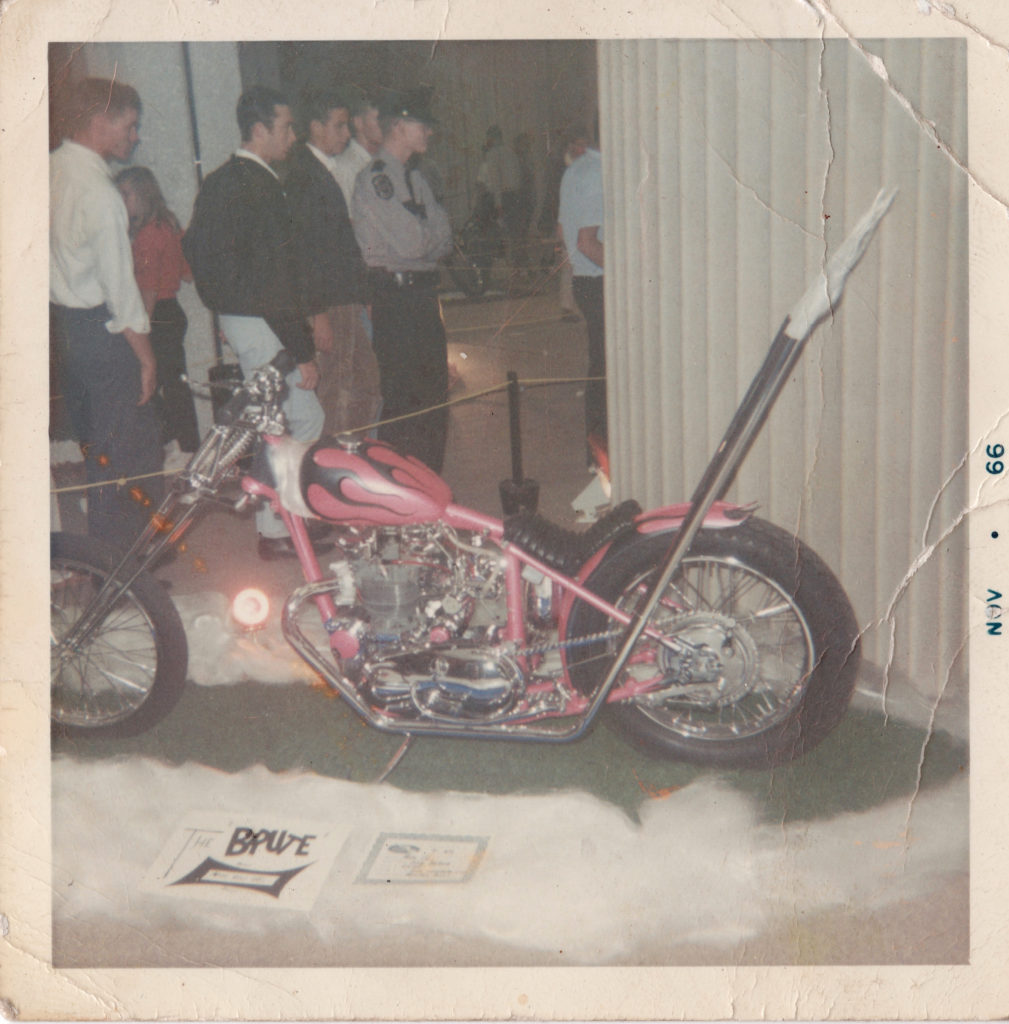
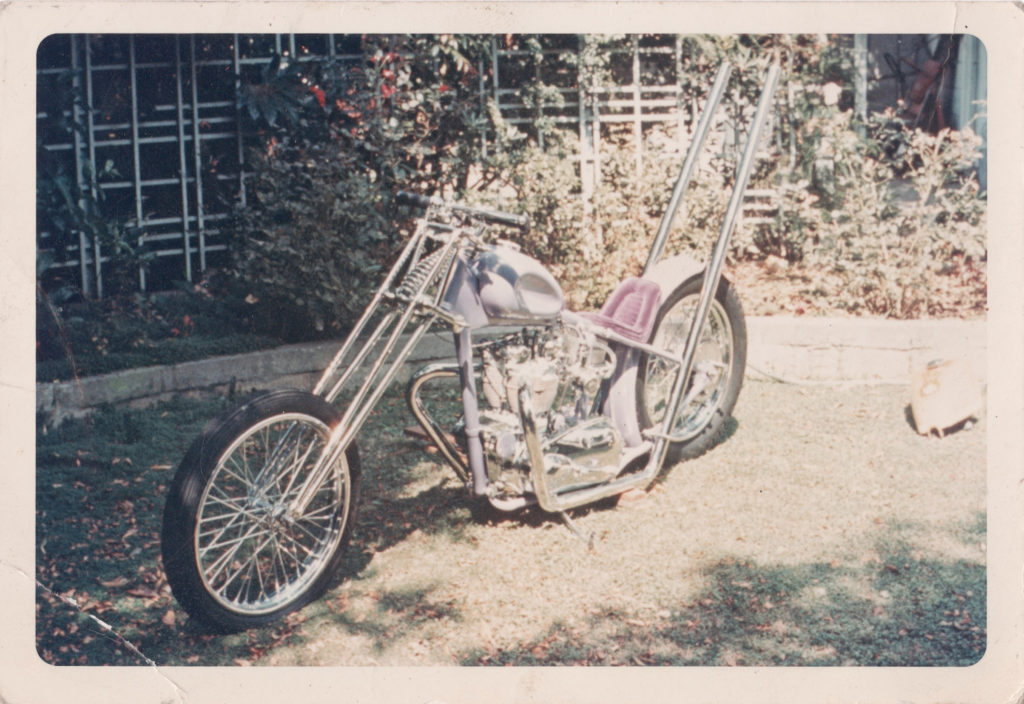
The Brute at a show in 1966, when black flames adorned the pink tank. [Mike Vils]The Brute was transformed from bob-job to chopper with the addition of a pair of Brampton girder forks from a Vincent motorcycle, which Vils cut up and extended 9” himself, by learning how to weld using gas. “I think I had one of the first extended girder forks [1964]. I got a pair of Vincent-HRD Brampton forks from Freddie Elsworth, who won the Big Bear Scramble several times; I met him through Mike Parti. Those forks weren’t worth anything back then, as nobody wanted them. Freddie was in a club of some kind, a real riding club like the Boozefighters, who were into building bikes for performance, and a lot of them were riding Harley JD cut-downs. I wanted a girder fork for my Triumph, and Freddie had the Vincent forks, and I extended them 9”. I gas welded all that stuff. My question to all these new guys is, ‘what did everybody do before TIG welders?’ We did it ourselves; I learned to weld aluminum using a gas torch. Jim Buchanan helped me with narrowing the Vincent forks – they looked dumb, they were too wide. I didn’t have a lathe to do the shorten up the links etc, so Jim did that. I did the rest - the lengthening. It was trial and error as we didn’t know what worked, but the extended forks were where the whole change to a chopper started. It started out as a 1955 pre-unit Triumph Tiger 100, and I found a rigid rear section, so decided to build a show bike.”
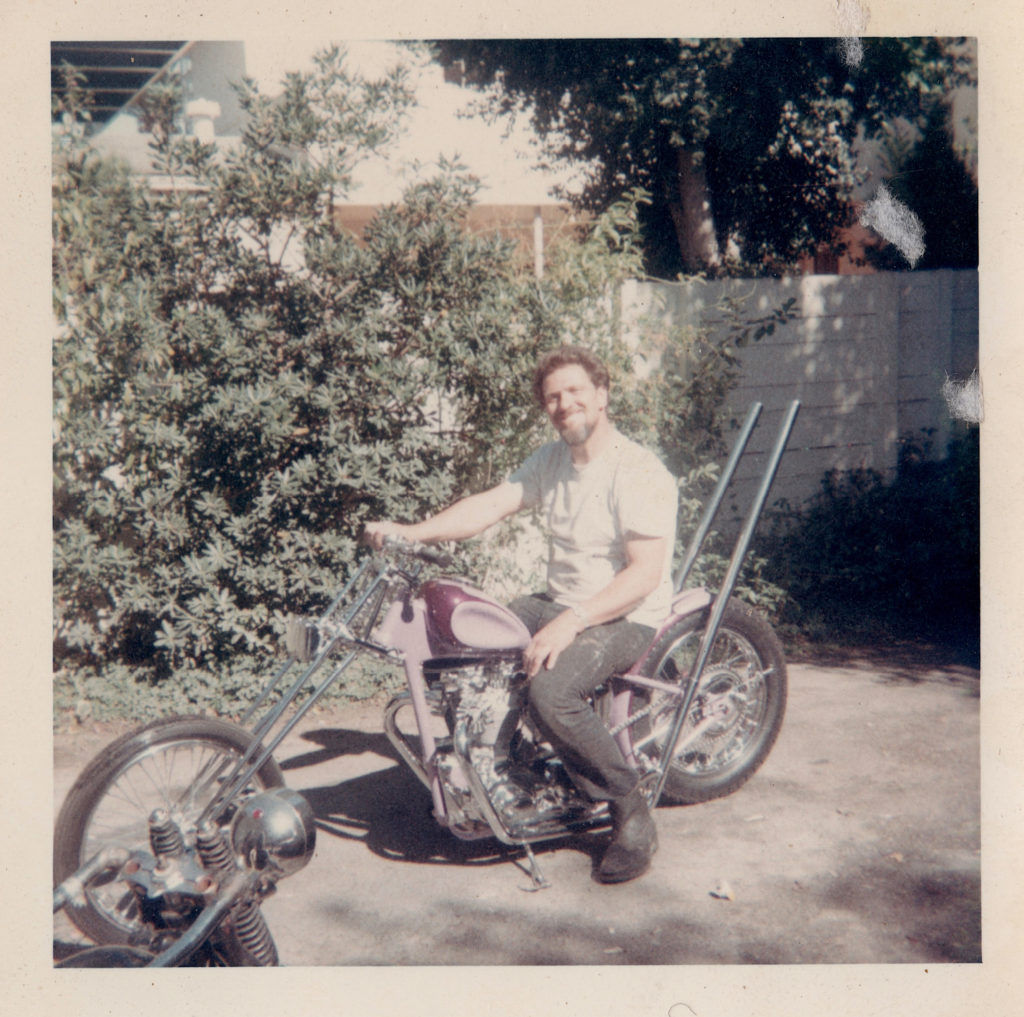
The Brute in its 1968 form, with extended Vincent Brampton forks and tall exhaust stacks. [Mike Vils]Mike lived with his grandmother at the time, building an incredible show bike in her garage, and storing the bike between shows in her living room! Plus an impressive array of trophies as time went by. His father was a policeman, and at times their relationship was rough, so grandma’s house made sense. As Mike grew in stature as a teenage chopper builder, the curious humor of a sweet old lady hosting a radical chopper beside the lace doilies and porcelain dolls was not lost on him, or his friends. But while Mike Vils may have looked the part of a teen badass in photos, his true nature has always been sweet. “I knew all the true modern outlaw guys, Buzzard and Foot and Dick Allen, but I never smoked one hit off a joint, I never took drugs or even drank beer. Which is the reason Ed Roth hired me in 1966; I wasn’t into all the macho bullshit.”
Ed Roth on The Brute in 1967. [Mike Vils]
Hired by Big Daddy
While making the rounds of the hot rod/custom show circuit, Mike met all the characters who also traveled the country showing their vehicles, one of whom was Ed Roth, who was already legendary in the Kustom Kulture scene of the mid-1960s. According to Mike, Roth was a bit fed up with the hot rod scene by then, “Ed got away from cars at that time, as he saw motorcycles were the future, they were going to be a big deal.” Roth began hanging around with members of the Hells Angels like ‘Buzzard’ and ‘Foot’, and even began selling large black-and-white posters of bikers on their choppers at car shows, and via his latest publication, Choppers Magazine, which he started publishing in 1966. Roth saw something refreshing in Mike Vils – a young man with talent, who was creating artistic motorcycles, with no ‘attitude’ or axe to grind. Ed hired Mike Vils, who was “paid $35 a day, and all the cheeseburgers I could eat. I was 6’3” and 135lbs, so I didn’t eat many burgers! There was some cheap and horrible burger place nearby, but you’ll eat anything at 20 years old.”
Part of Ed Roth's photoshoot for Choppers Magazine. The Brute was among the first choppers to use Volkswagen back-up lights for headlamps! [Roth Family Archive]Mike and Irma Vils in 1981: Irma was always a co-rider with Mike, and they're still married! [SuperCycle]Mike in 1981, just before he sold The Brute...for $2500. A lot for an old bike in those days, and we'd love to know where it is today? [Supercycle]
How Speed Work varies on Motor Cycles, in a Car, and in Aeroplanes
[From 'Power and Speed', published by Floyd Clymer, 1944]
By Flt.-LT C.S. Staniland
Chief test pilot, Fairey Aviation Ltd, Motor Cyclist and Racing Driver
I suppose that, before I begin writing about aircraft and motor racing, I had better tell you how I first came to be mixed up in this business of fast moving in the air, on four wheels and on two.
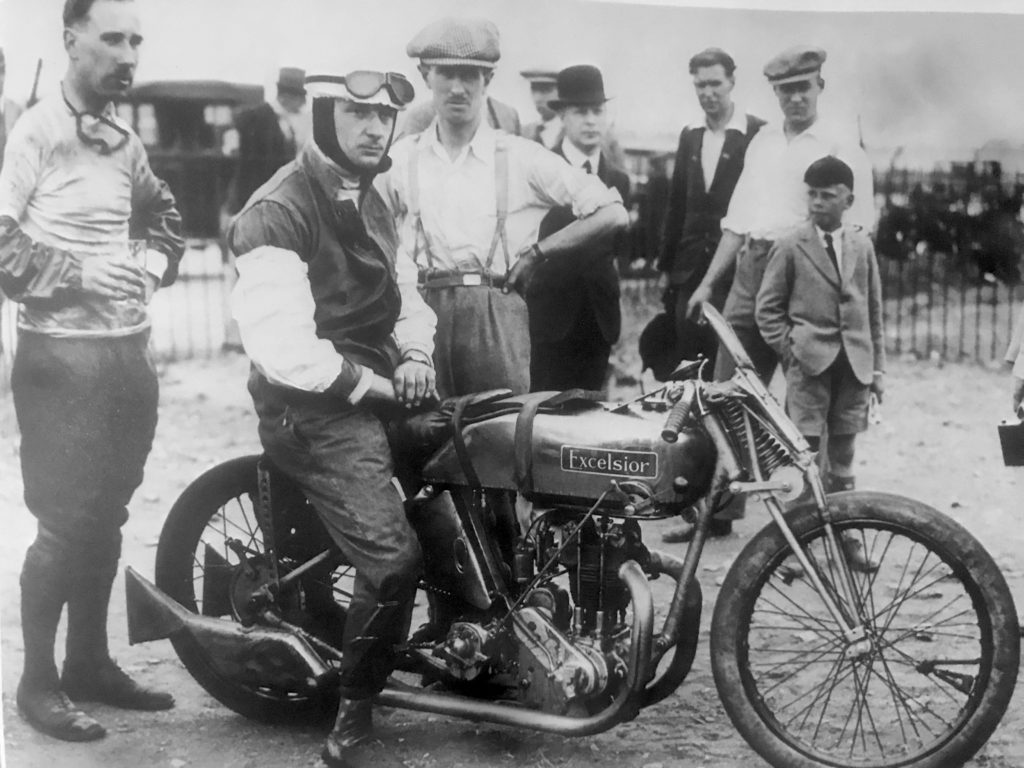
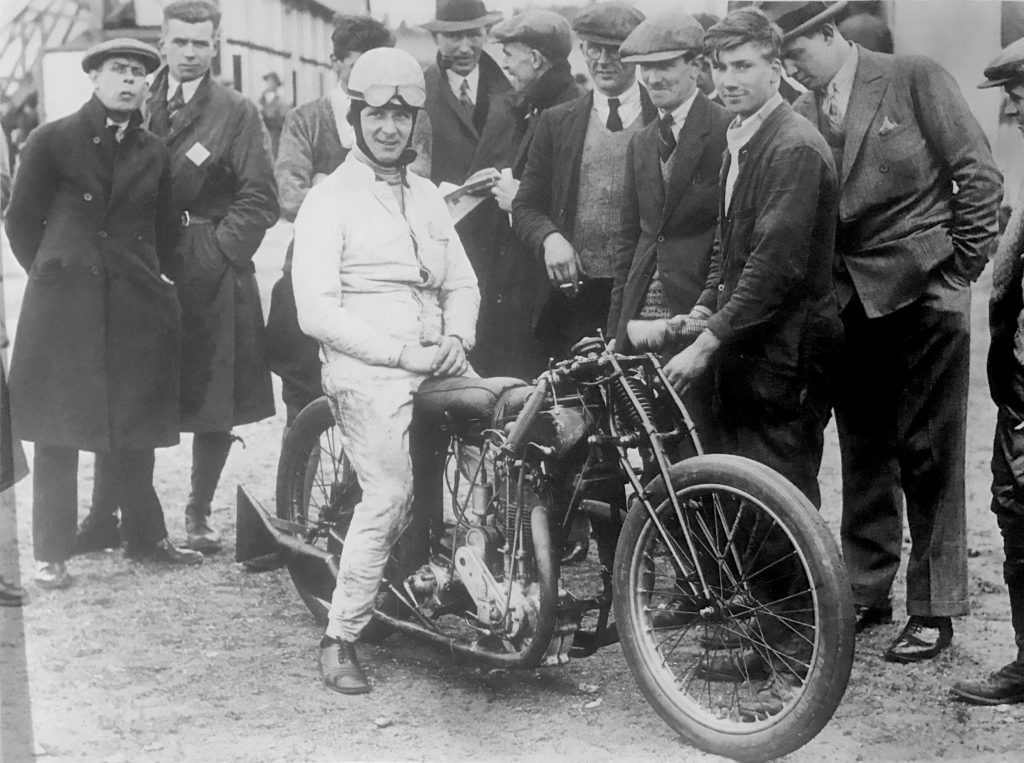
Chris Staniland at Brooklands on Oct. 5, 1929, after winning the 250cc BMCRC Championship at 84.27mph on his Excelsior-JAP [The Vintage Years at Brooklands]I have been keen on machines all my life. Racing cars, motorcycle and aeroplanes have fascinated me for as long as I can remember, and the men who performed great feats in theses spheres were my heroes at a very tender age. My very first machine was a motorcycle. Just after the war motor cars were fabulous machines costing a king’s ransom, or so it seemed, and when young men were infected with the desire of travelling fast, it was usually to motorcycles they first turned, graduating on two-wheels before moving on to four-wheelers, and so it was in my case. My first taste of the joys - and tribulations – of mechanical transport was found on my brother’s motorcycle, which was a 1911 Douglas – a very famous machine in those days on which many a well-known personage in the sphere of mechanical transport first made acquaintance with this form of getting about.
Soon after learning all I could about this Douglas I became the owner of my own machine, a Rudge Multi, looked upon in those days as something very hot indeed. It had a single-cylinder engine, belt drive, and a complicated arrangement whereby moving a lever altered the position of the back-wheel driving sprocket and so altered the gear ratio. The result was that with this device you had a very wide variety of gear ratios, with the option of a high top gear for fast cruising.
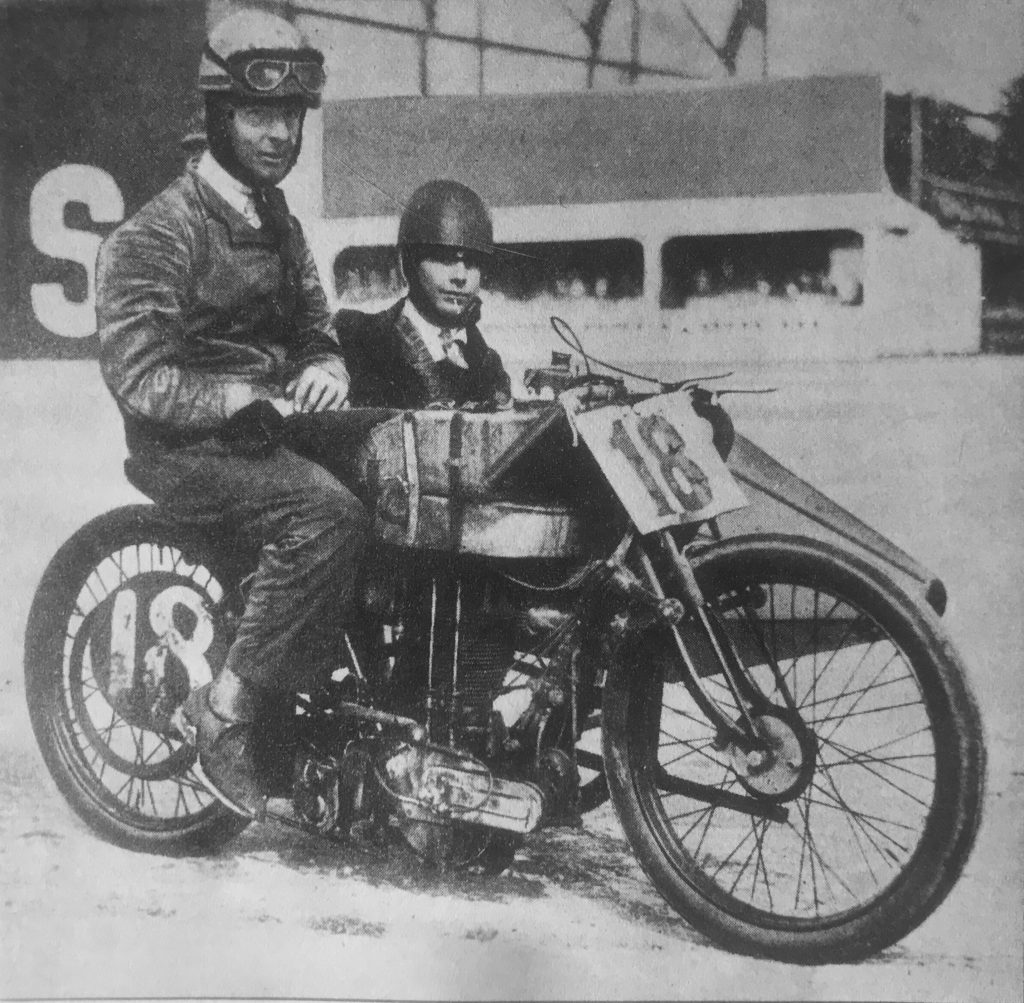
Chris Staniland piloting a Norton sidecar outfit from the Nigel Spring equipe at Brooklands in 1924 [Power and Speed]A variety of machines followed. Another Rudge, then a Velocette two-stroke, two Nortons, a Rex and an Indian, some of which were certainly very fast. This was in the days soon after the war and when I had just left Tonbridge school and was enjoying the cultural ministrations of a gentleman known as a ‘crammer’ – most of us have to undergo examinations at one time or another!
In 1923 I achieved an ambition and raced at Brooklands, and won my first race – a standing start lap at no less than 54mph. I rode Nortons in 1924 and in that year I joined the RAF. During this time I was stationed in Cheshire and raced consistently at Brooklands. Soon after this I began to ride machines for my friend, RM 'Nigel' Spring, and we had rather a successful time in the 500cc and 750cc classes, including the breaking of several records.
Staniland on a 346cc Excelsior-JAP at Brooklands on April 14 1928, where he won the 350cc three-lap solo race at 93.27mph [The Vintage Years At Brooklands]In 1924 I had the good fortune to win four races in one afternoon at Brooklands, which naturally filled me with great glee. In 1925 that great wizard of motorcycle racing, the late Bert LeVack, offered me his 1000cc Brough Superior to ride in the 200 miles race, which excited me quite a lot, as this was without a doubt a very fast machine. In the race, however, things did not order themselves too well, and I had a good deal of bother with the tyres and carburetion, so that I met with no noticeable success. However, to make up for this, I won the 200 Miles Sidecar Race, and a few other races fell to me, plus a few records later in the year.
Up to this time I had always looked down on the motorcar racing game but I very much admired a Bugatti of George Duller’s, and in 1926 I acquired a 2-liter straight-eight Bugatti of my own, the second of the type imported into this country. With this car I had a shot at car racing at Brooklands and met with a measure of success. Since then I have raced motorcycles (not so much on the two-wheelers this last year or so, for various reasons) and all sorts and shapes and sizes of racing cars.
As you may know I was a member of the Schneider Trophy team in 1928-29, and then, leaving the Royal Air Force, I became test pilot for the Fairey Aviation Company, the famous aircraft concern.
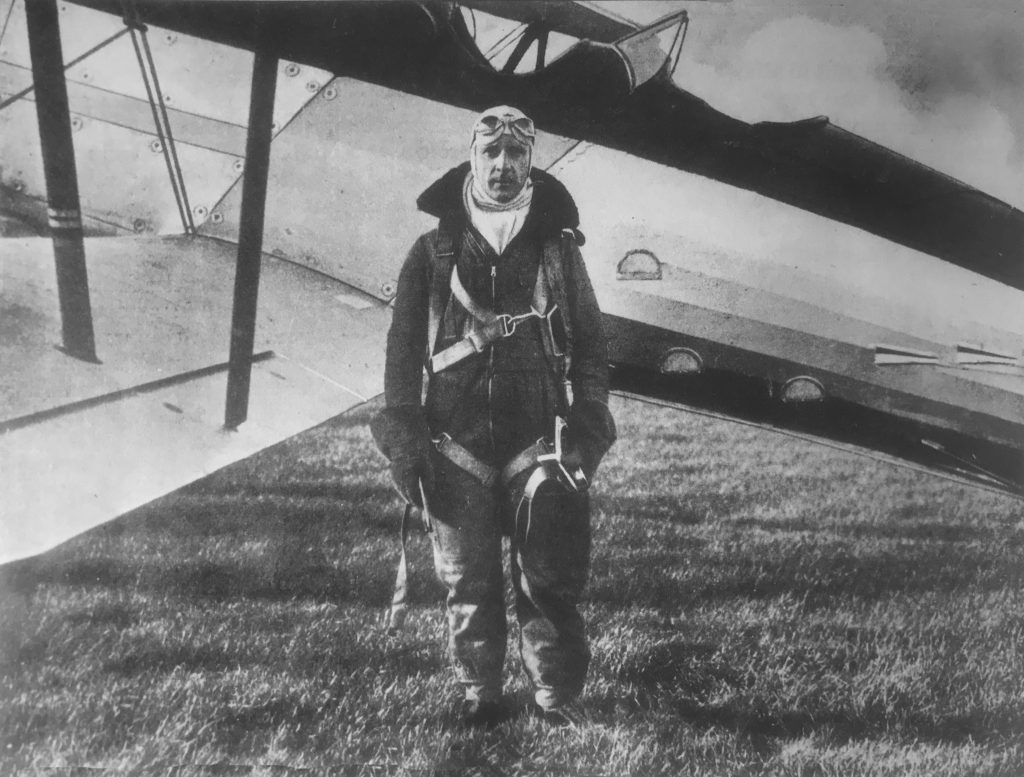
Flight Lieutenant C.S. Staniland in his test pilot's attire ca.1928 [Power and Speed]Although naturally there are similarities, motorcycle and car racing are not very much alike, and of the two, car racing is, I think, the more difficult and, if anything, the more dangerous. Motorcycles seem to steer better than the cars, and in an accident the rider is usually flung clear, which is a great safety factor. Cars are, of course, much faster than the two-wheelers, but the latter form a magnificent training school for car racing. Many of the best racing-car drivers began as motor cyclists – the late Bernd Rosemeyer, Tazio Nuvolari [read about Nuvo's motorcycle racing here - ed.], Achille Varzi, and in this country, Freddie Dixon, are examples.
In both forms of sport there is the same need for perfect judgement of speed, the same gentle touch for braking and the same benefits from experience. A motorcycle has to be ridden – there is no question of a machine keeping itself up owing to its speed. Riding a motorcycle at great speed calls for the utmost physical fitness. When you see a motor cyclist flying down a bumpy road at over 100mph it keeps upright by reason of the skill, courage, and experience of the rider and for no other reason.
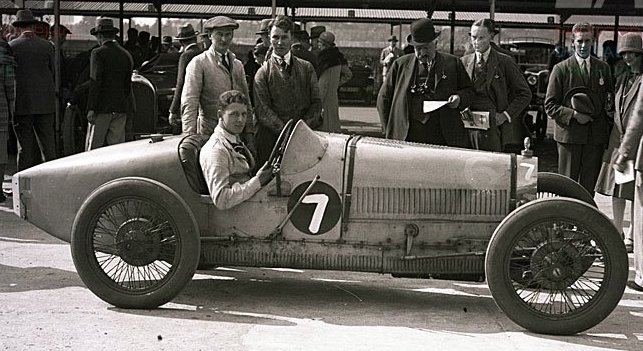
C.S. Staniland and his 1926 Bugatti Type 37 at Brooklands [The Autocar]Both in car racing and motorcycle racing a sense of balance is necessary, for in a car entering a corner, the driver must feel the slightest tendency of the car to slide – which is a sense of balance. In both forms of sport there is a need for the right touch on the controls, gentle when needed, and at times brutal. On the whole I think a car calls for more physical strength, both on a twisty road circuit and at high speed on the outer Circuit at Brooklands. In both forms of racing there is the same matching of hand and eye, the same judgement of distances for braking and of speeds for cornering, the same ear for the engine note and the same careful nursing of the machine. It it a poor driver who bursts his car by overdriving.
The fastest cars are faster than the best motorcycles. The power to weight ratio is about the same in both, but the car has better streamlining. A road-racing motorcycle will weigh about 350lb and will develop about 50 brake horse-power. A Grand Prix car of the 1937 type weighed about 18cwt and gave off about 500bhp. The car has better road holding, better suspension, better braking and greater inherent stability, which all tends to make the car faster on the road. On road circuits where cars and motorcycles both race at various times, the cars have proved the faster, by as much as 10mph on the lap speed.
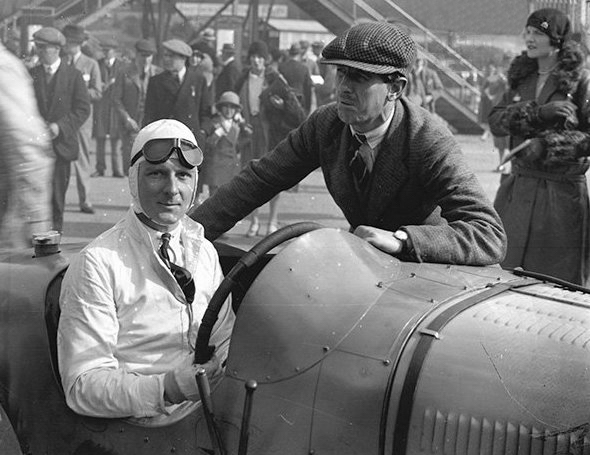
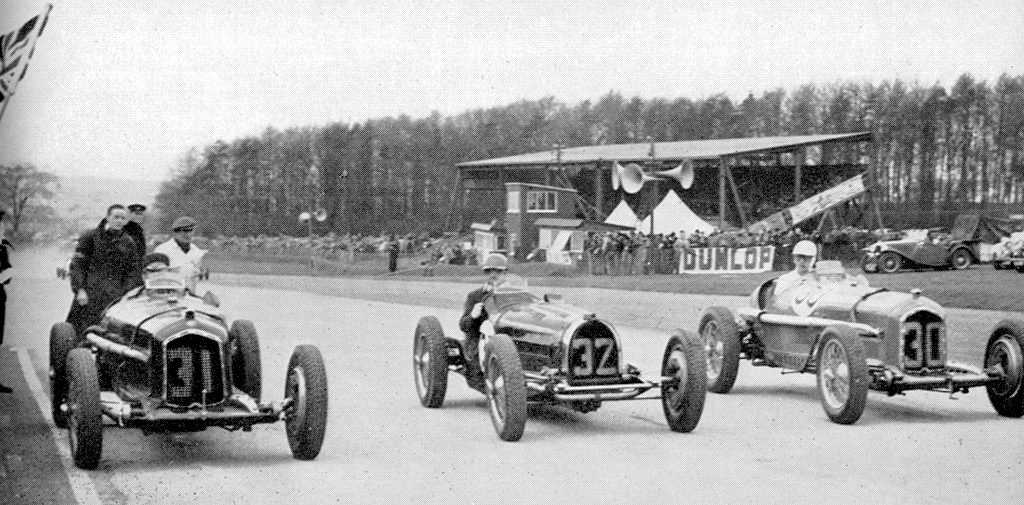
The 1936 Donington BRDC British Empire Trophy Race, with Staniland driving the Alfa Romeo 8C on the right [The Autocar]As to acceleration, I suppose the motorcycle is faster off the mark and faster for perhaps the first 100 yards, but when a Grand Prix car has overcome initial wheelspin and inertia, its accelerations is better than that of the two-wheeler.
The motorcycle record for the standing start kilometre is 98.9mph whereas the car record for this distance is 117.3mph [this is 1938... ed.].
Racing motorcycles will develop as much as 120 or 150 horse-power per 1000cc of engine size, but the latest Grand Prix cars will exceed this. Most racing cars have supercharged engines, producing astonishing power from small units by this means, but supercharging has not yet caught on in the motorcycle world owing to special problems of carburetion, added to which although a supercharger can be mounted on a motorcycle quite neatly, it absorbs some power in the drive and the extra power produced seems offset by the power used up in the driving.
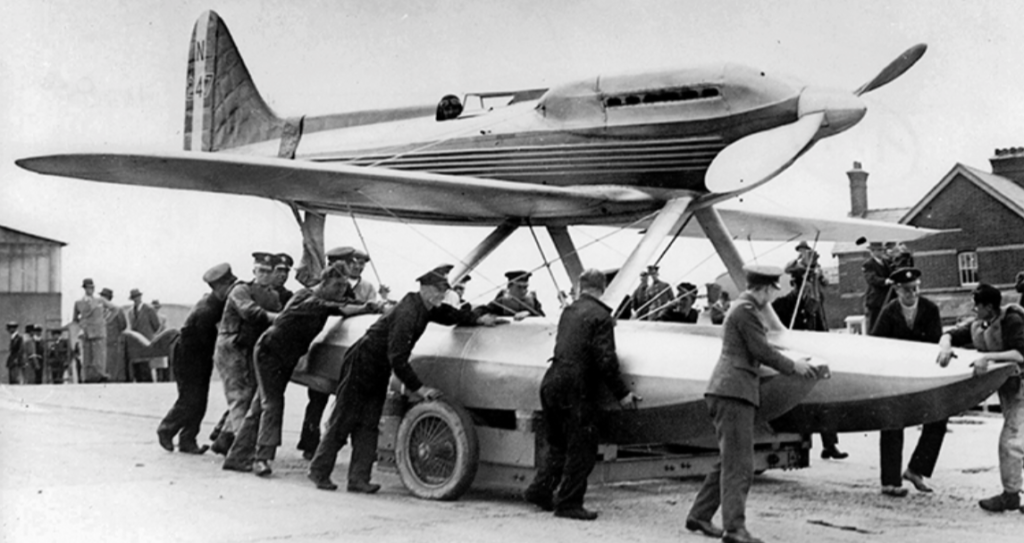
The magnificent 1928 Supermarine S.6 seaplane that took the Schneider Trophy for the British team, with Staniland one of the test pilots
The carburetion problems of aircraft are far more complex than either in a car or a motorcycle. A car operates always at about the same barometric pressure, so that carburetors can be tuned with precision for every given racing circuit and left at that for the race. An aeroplane needs carburation for varying barometric pressures and for varying temperatures according to the height at which the aeroplane is flying, added to which the carburetion must be right for all weathers, including frosty conditions. An aeroplane starts off from sea level and is called upon for maximum speed at say, 20,000ft, where the weight of air drawn into the cylinders is far less than on the ground. Every tourist knows how his motor car loses power in climbing a high Alpine pass of perhaps 6000ft, owing to the fall in barometric pressure which allows the mixture to become too rich. An aeroplane at 20,000ft would in the same way have a hopelessly over-rich mixture and would lose a great deal of power at what is its usual service altitude.
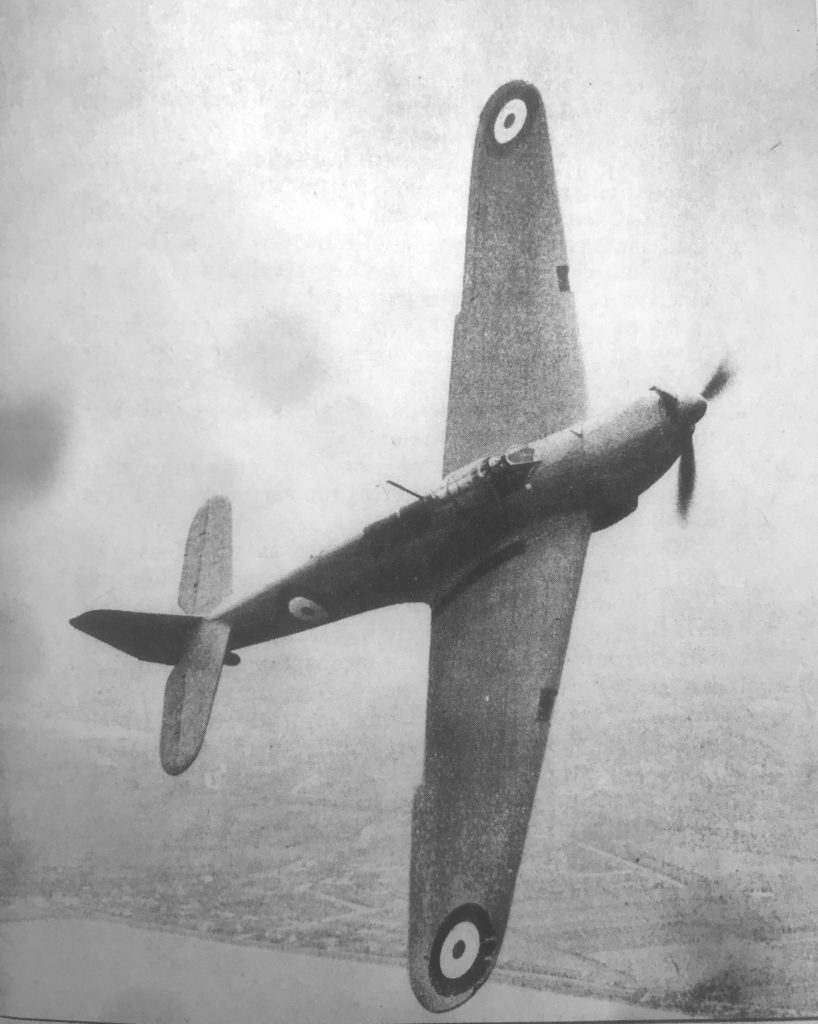
Staniland in 1937 testing a Fairey P4/34 prototype with Rolls Royce Merlin 1040hp engine. It was never produced, but formed the basis of the Fulmar light bomber. [Power and Speed]To counteract this, supercharging is used, but on a more complicated system than in a racing car. Various forms of supercharger control are used, but in all the idea is to give a constant boot pressure at all altitudes. Some use a completely automatic device, rather like a throttle governor operated by a barometer which opens the throttle as the machine climbs higher; other have the same plus an ‘override’ to give extra boost for take-off only. The Rolls-Royce Merlin engine is a good example of the completely automatic type: the supercharger give plus 6lb boost at ground level and at all heights. At ground level the engine runs on a restricted throttle opening, which gradually opens to full throttle at a given height, the supercharger giving its plus 6lb boost all the time up to this height.
Aero engines resemble car engines in all essentials, but are much more expensively made, with the finest procurable materials, the best labour and with exhaustive tests, which all send up the price. A racing car engine is tuned much nearer to breaking point than an aero engine, and after one race has lost its fine edge of tune and has to be inspected and perhaps reconditioned. Thus after a Grand Prix, the German cars are sent back to the works for inspection and re-tuning, while a different team of cars is sent out to the next race. An aero engine, on the other hand, must be capable of giving off its full power for very long periods with only routine maintenance – checking of valve clearances, plugs, filters, and so forth.
Staniland at the wheel of his Bugatti Type 37 GP at Brooklands in 1928 [The Autocar]In road racing the car engine never runs at full throttle for more than a few minutes at the outside – the life of such an engine at full throttle is very short. A Grand Prix engine will give about 500bhp for a matter of a few hours, after which, unless the throttle were closed down, there would be a loud bang in the works. An aero engine must be capable of passing the Air Ministry Type Test which is 100hours on nearly full throttle, and must give off power corresponding to the machine’s cruising speed – ie maximum safe revs – indefinitely (about three-quarter throttle). Reliability is good to have in a car – but is essential in aircraft.
Speed on two wheels feels colossal. A car feels slower at 100mph than a motor-bicycle at that speed owing to the rider of the latter being exposed to the wind and being much closer to the ground flashing away under him.
But 100mph in a car feels far more exciting than an aeroplane at 300mph – and many RAF aeroplanes will do far more than that flying straight and level. It is extraordinary how, after flying at high speed and the pilot comes in to land at 80mph, the machine appears to be crawling. Reduction from high speed to low velocities is always deceptive, as one mechanic found out at Brooklands when his driver slowed down to 30mph and the unfortunate man stepped out under the firm impression that the car had nearly stopped.
Flt-Lt. C.F. Staniland at the controls. After a life spent in pursuit of speed, he was killed while testing a plane in 1942
NAME, COUNTRY, NUMBER AND WHAT ARE YOU RIDING IN THE RALLY?
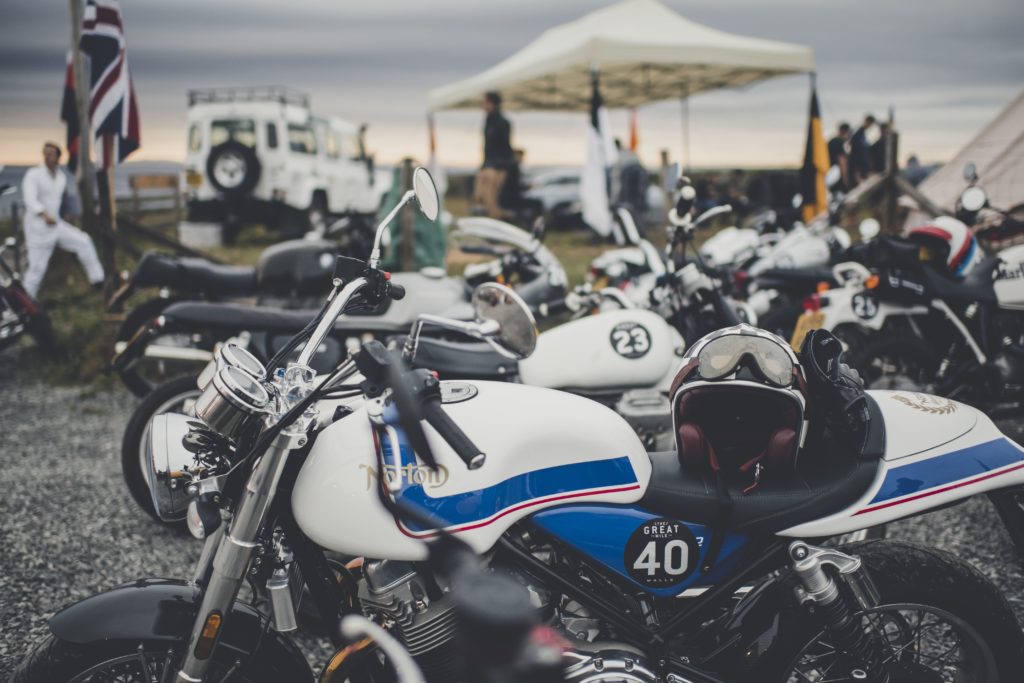
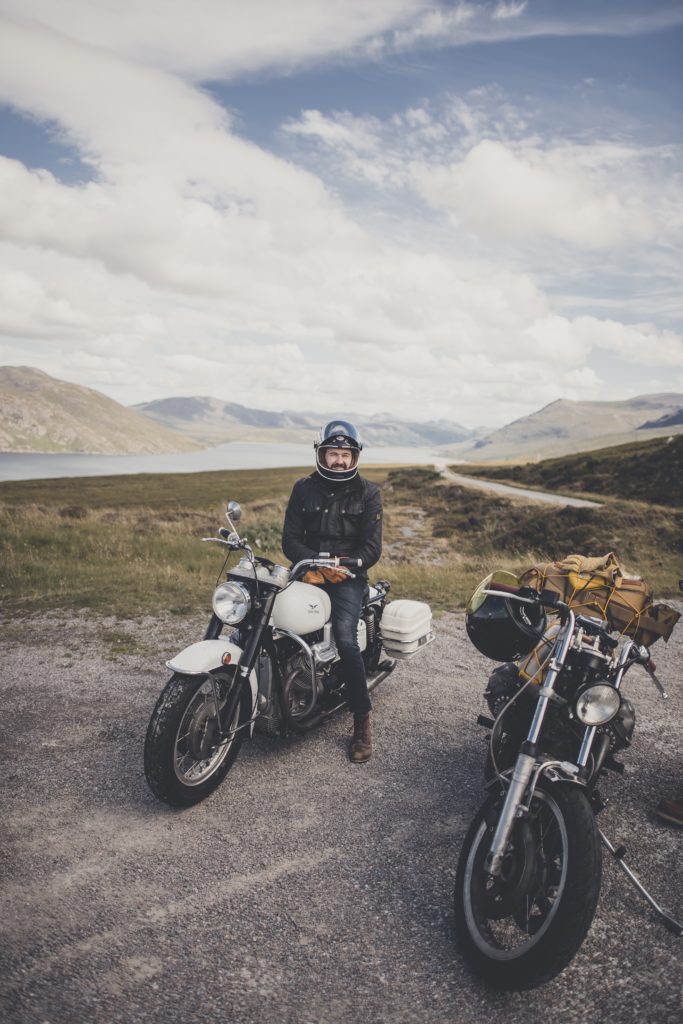
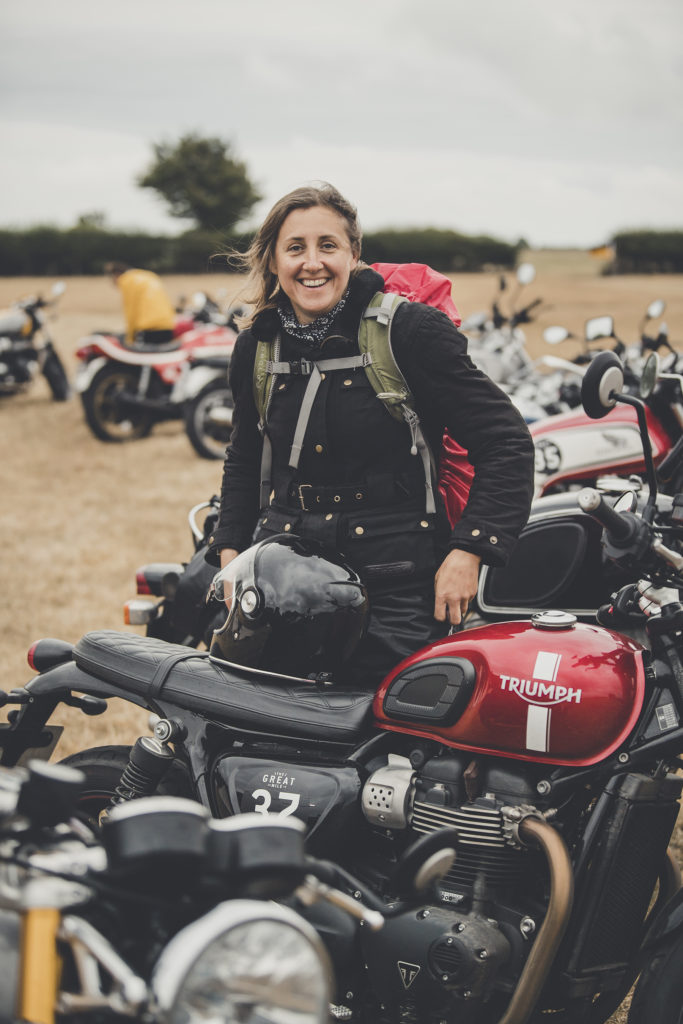
Robert Nightingale, England, Rally Number #57. Against the advice of many, I decided to ride my late-fathers 1957 custom Triumph Thunderbird, which I got working earlier this year and it turned out to be the oldest motorcycle in the 2018 rally.
[Amy Shore Photography]
IS THIS THE FIRST TIME YOU’VE ENTERED THE RALLY?
Over the last 3 years I’ve helped the Malle team research the rally route, normally from the back of a support vehicle, but this was my first time riding in the rally with a team: a completely different experience!
[Amy Shore Photography]
TELL US ABOUT YOUR RALLY PREPARATION?
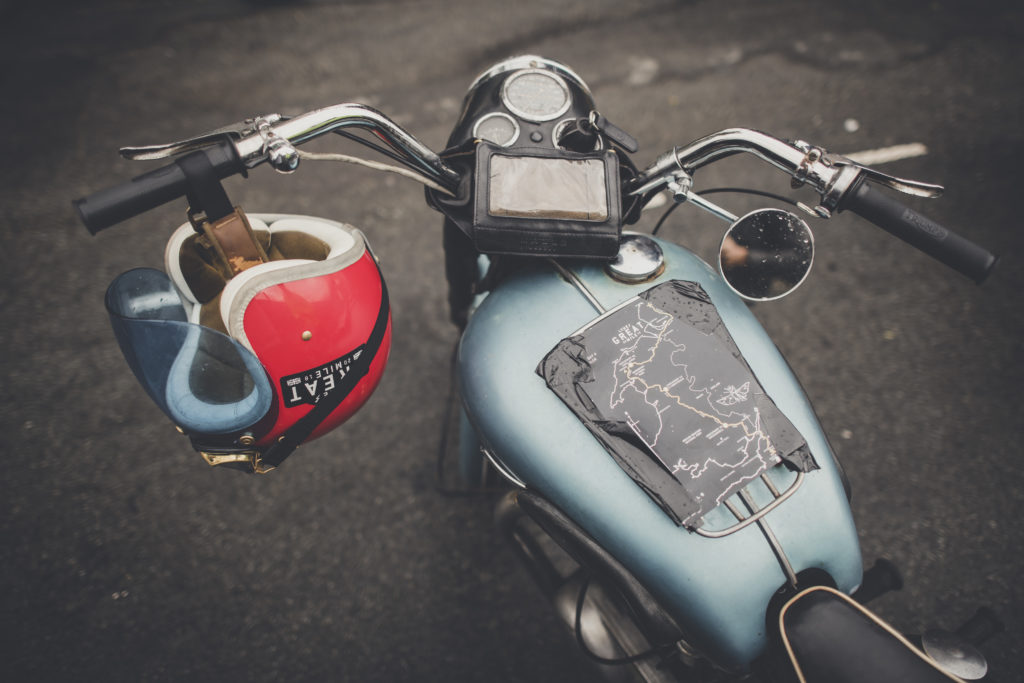
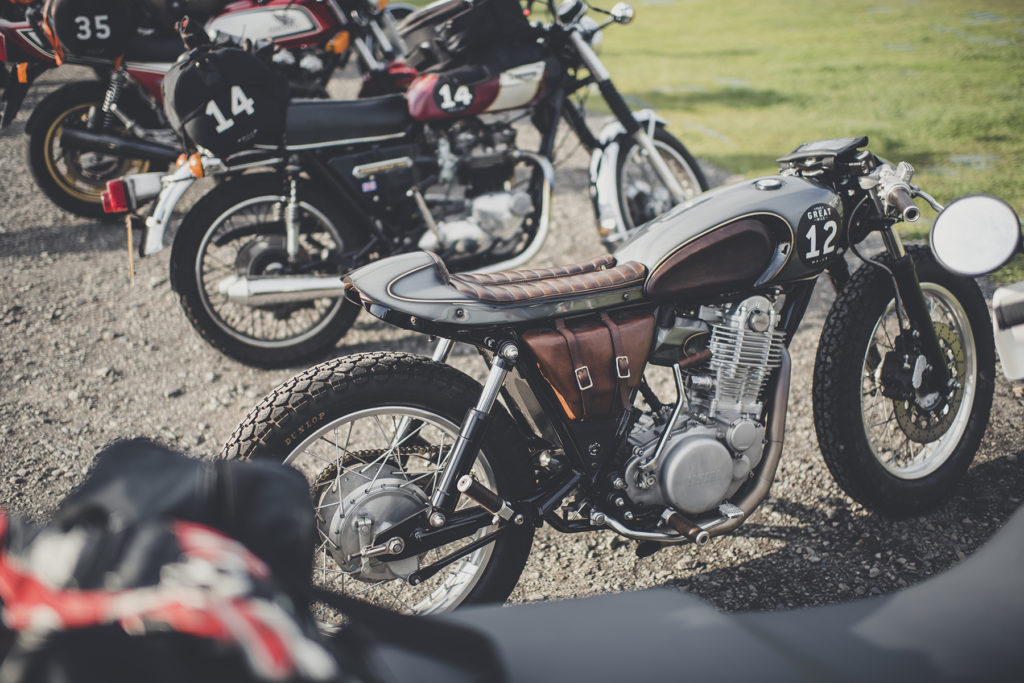
The day before the rally, like most of the riders I was scrambling to complete the bike in time, finding last minute spare parts that might break or rattle off. On the forecourt of The Classic Car Club in London, bits of the Thunderbird were littered around the bike, while more and more custom/classic rally bikes were being dropped off every hour, which only added more pressure to the impending deadline. I managed to fit a new oil-feed pipe, “new” custom California handlebars, bent the mud-guards out a bit to accommodate the larger off-road trials tyres, fitted race plates and gave it a fresh oil change. After a quick lap around the backstreets of Shoreditch past the BikeShed to test the brakes and the oil flow - the bike was pretty much ready to go.
[Amy Shore Photography]
First thing the next morning we helped the professionals load the bikes into crates at The Classic Car Club and onto the rally trucks. Strapped in tight, for the long and slow journey up to the Castle of Mey, located at the very Northern tip of mainland Britain. It was a bit sad seeing my old bike leave for Scotland without me, like sending away the family dog and watching it stare at you out of the rear-window as it was driven away and out of sight.
[Amy Shore Photography]
The boys at Ace Classics helped me fill my tool roll with some more extras (seals, plugs, strange bolts, more cables, levers etc.) and advised me to take it real easy if the bike was to survive the rally - to ideally ride on alternate days, giving the old bike a rest day between stages... which was definitely the plan.
WHAT HAPPENS AT THE START LINE?
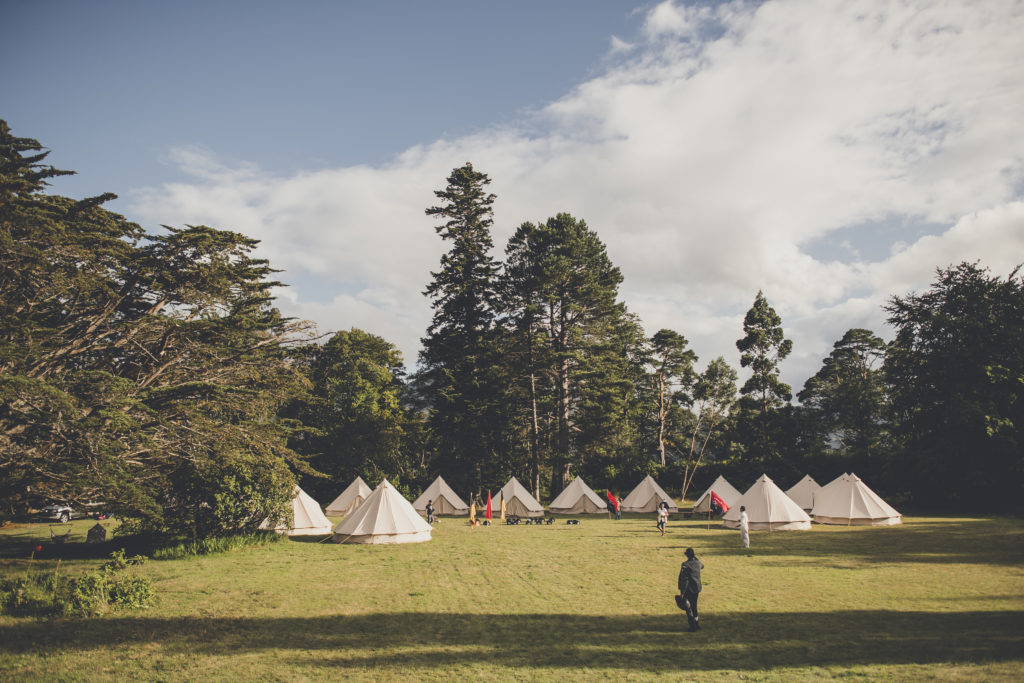
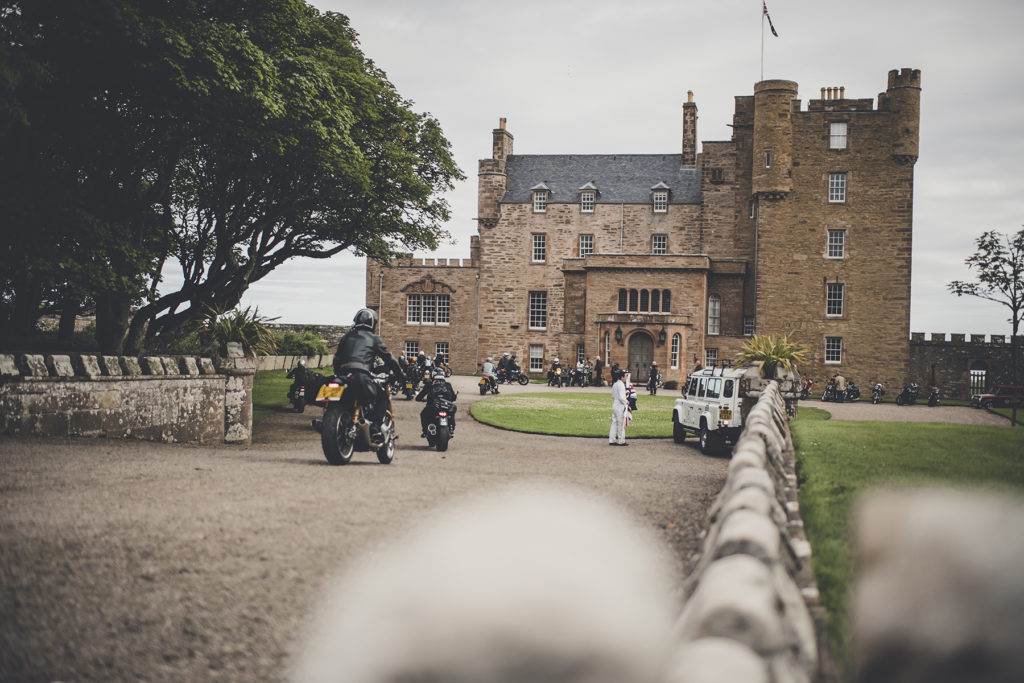
After 24 hours of driving North from London we finally reached the top of the country in the support vehicles and set up in the rally camp at the Northern tip. Overlooking the North Sea from the Castle of Mey, with the glow of the oil refineries on the horizon behind the islands of Stroma and Orkney, seals playing in the bay beneath camp. Up there the coast line is pretty harsh and jagged, with few buildings on the land, the weather can do a full 180 in minutes, turning from sunshine to blizzard.
[Amy Shore Photography]
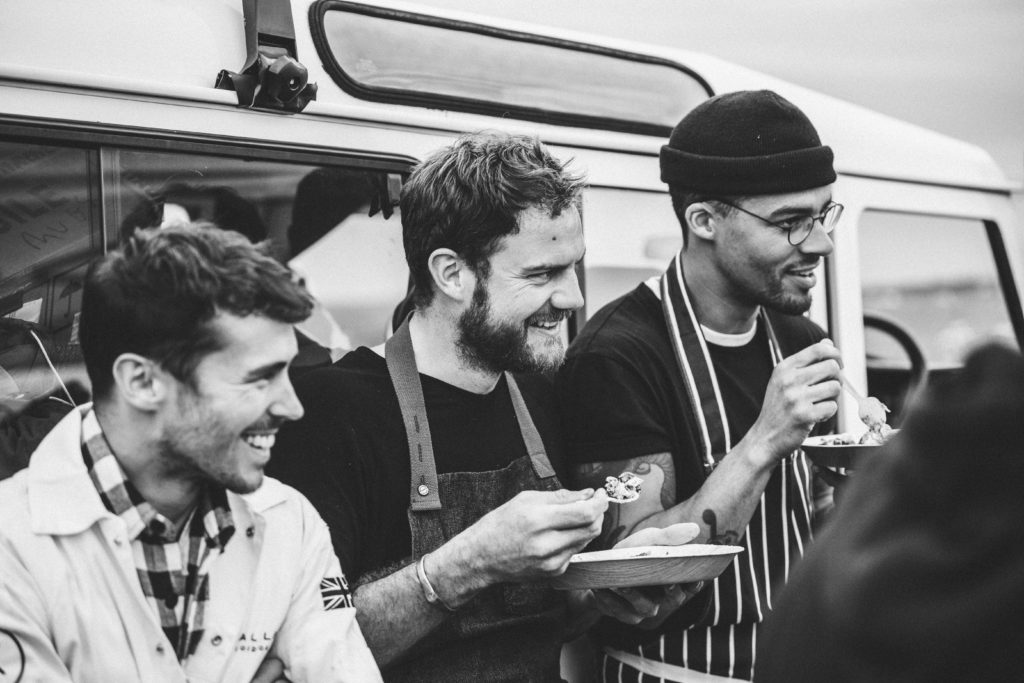
The team from the Nomadic Kitchen (Tom & Will) arrived that afternoon, after riding a pair of borrowed Royal Enfield Himalayans 800 miles straight up from London. As soon as they unloaded, they got out their knives, lit the fires and started prepping the first night's wild cooking feast - fire roasted pork loin and mouth-watering roasted salads. The 70+ riders descended on the Castle of Mey from all over the world (mainly Europe) for the Riders Check-In that afternoon.
[Amy Shore Photography]
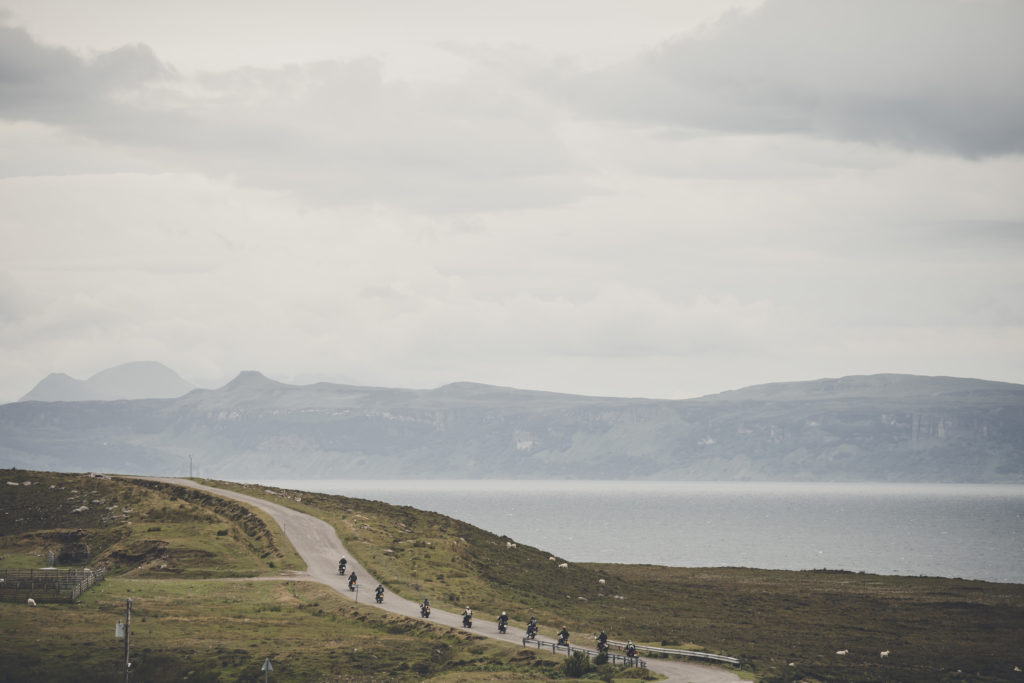
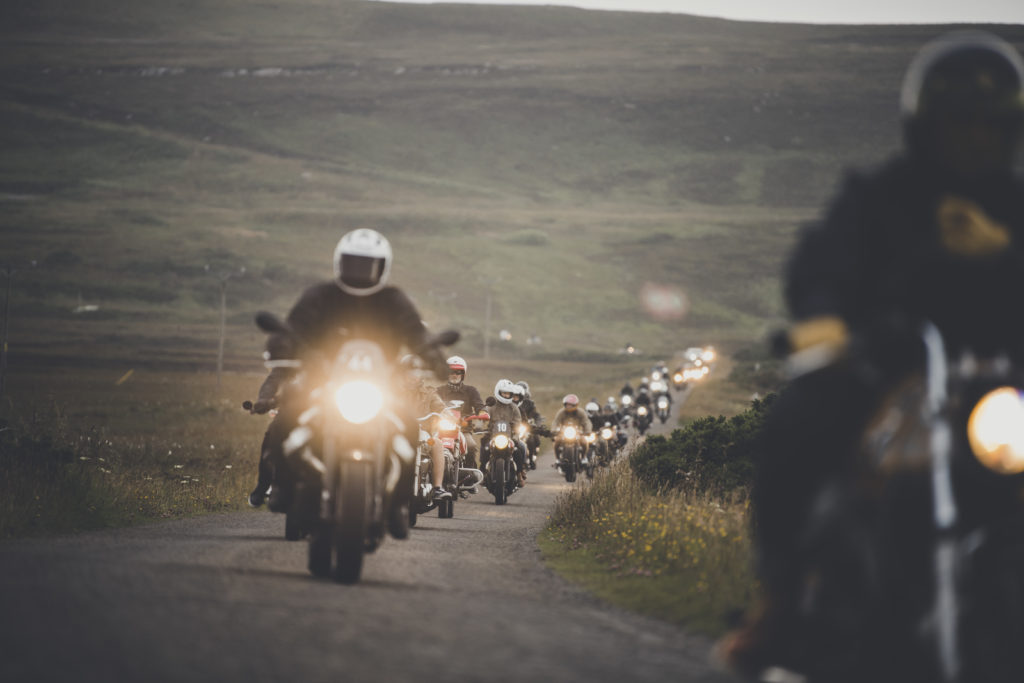
After all riders had checked in, with fresh rally numbers on each machine, we left the castle as a pack. Lead by Jim the head groundskeeper at the castle on his old BMW (after a quick change from his kilt to riding leathers). We rode 5 miles along the coast up to the lighthouse, perched on a slab of rock 250m above the lashing sea. 70 completely unique classic/cafe/custom motorcycles made up the pack, as we snaked back and forth up the hill to the lighthouse. I turned to see all the bikes behind me meandering up the hill in single file, moving as one continuous line, the headlamps lighting up the hill in the dusk - it was a beautiful sight. We road back along the coast and the local villagers had come out of their house to wave the rally past, very sweet. The feeling that the rally was about to begin was building.
[Amy Shore Photography]
Back at camp, we had the first and most detailed riders briefing, describing the next day's route, with riders from last year's rally joining in with local tips on the route and their thoughts on the rally experience and team riding. The briefing was followed by the now customary whiskey pairing; local single-malt with locally caught/smoked salmon. After three attempts at a synchronized toast, there was a cheer, a gulp of whiskey and it was back to the bikes.
WHAT HAPPENED ON THE FIRST DAY IN STAGE 1?
I don’t know if Tom and Will from the Nomadic Kitchen made it to bed that night, I woke at 5am and they were slaving away over the fire, knocking out a hearty wild cooked breakfast for everyone. Rally mornings are always the most rushed and the first day was the most chaotic, bikes and kit everywhere - riders running from tents to bikes, half dressed in leathers, toothbrush in one hand, with a coffee and spanner in the other, trying to find some odd component that they were sure they packed. We had a quick briefing with the rally marshals at 6am, minutes later they tore off on bikes, which in that moment felt like we were about to play the largest game of hide and seek in the land. With a 2-hour head start, the marshals went ahead to set up check-points and report back of any route problems. We threw our rally duffels into the support vehicles and headed to the start-line at the Castle. Luck was already on our side, not a cloud in the sky and it was beautifully warm: when Scotland is good, it’s bloody great!
[Amy Shore Photography]
With all the planning in the world, some things you can’t predict. After half of the bikes and I had reached the start line, with not a soul in sight, a local farmer (not realizing there was another 40 bikes behind us) closed the in-road with a JCB, acting as a blockade for his cows. As we soon learned, the “Royal Cows” take priority, and the big herd ran boisterously down the castle track - you don’t want to put a motorcycle in the way of that stampede.
[Amy Shore Photography]
Minutes later, everyone was assembled in front of the castle, which was the first time some of the teams had really met each other. Log books out, stamped, the flag dropped - and the rally had begun. Teams departed in 5-minute intervals. My plan was to ride out as soon as the last team had left and catch up with them. Second hitch of the morning, a modern street-scrambler suddenly wouldn’t start. Calum from deBolex Engineering who heads up the engineering team can fix anything. He got the King-Dick tool chest out, with jump leads, meters...and found a serious charging issue.
[Amy Shore Photography]
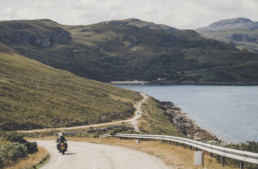
My team departed an hour or so behind schedule, but it felt so good to finally be out on the road, after the months of planning, logistics and comms, we were in it. I was riding with Team #7: two couples on a mix of modern Triumphs and Bobbers. We barely saw another vehicle for the first few hours of the day, hugging the coastline that rises and twists along the hilly coast, one of the best parts of the North Coast 500 route. The Thunderbird was pulling strong and running like clockwork, we made great time: across the Tongue Bridge, through checkpoint #2, on to checkpoint #3 - stage 1 was pretty easy going. We only needed to turn right about twice, the rest the of the day was following one gorgeous yet tiny B-road down the entire Western side of the Scottish Highlands, through truly wild countryside. In places the sea was a turquoise blue, if it wasn’t for the fact that you were in Scotland, the white sand beaches could be in the Caribbean. By the 4th checkpoint we had caught up with a few more teams and met up with the BMW Motorrad team, lead by Ralf and Lucas with photographer Amy Shore [whose photos illustrate this story - ed] who was documenting the rally. That day Amy was flying along in a vintage Mini with the top down, shooting riders out of the back with her cameras.
[Amy Shore Photography]
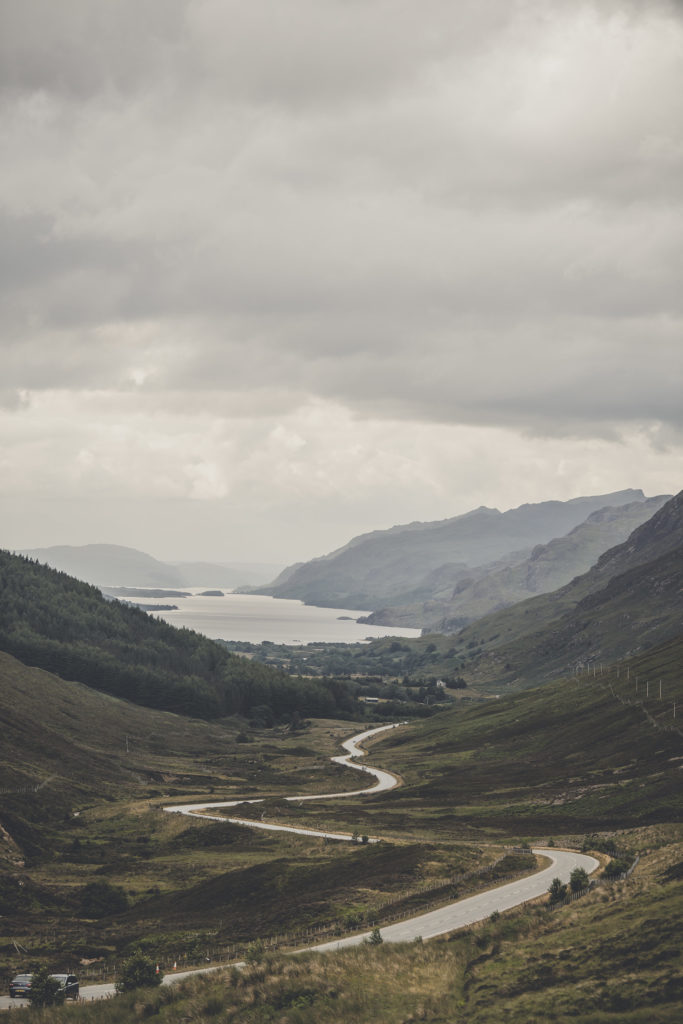
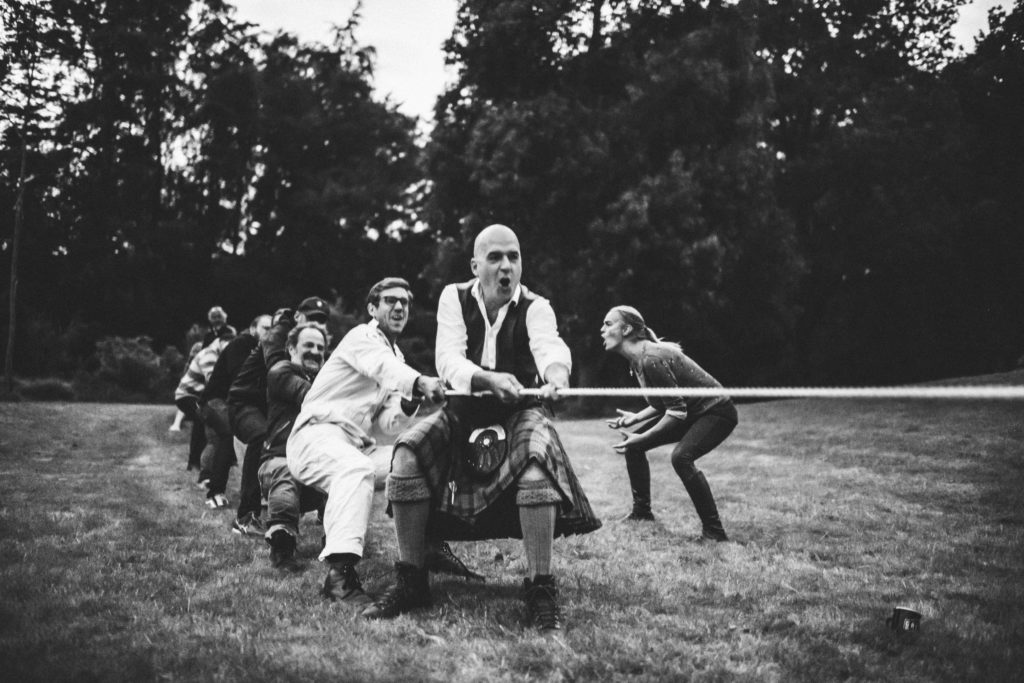
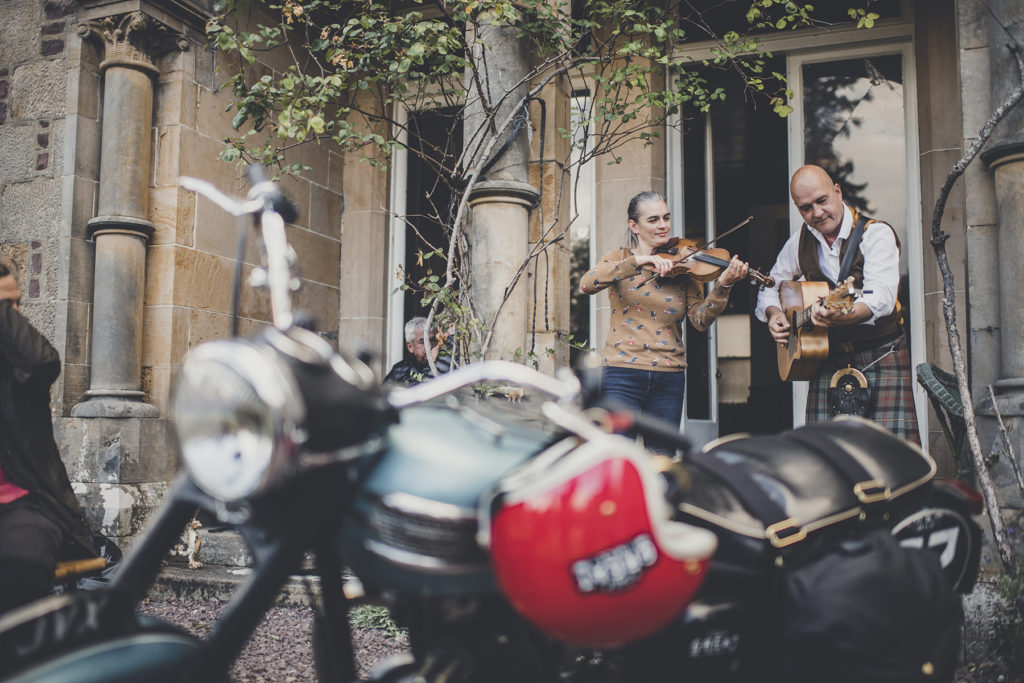
Faster than we realized, the 7-hour ride was ending and the signs for Torridon started to appear. As we came across the small pass from Kinlockewe, reached Loch Torridon, and rode along it until we found the rally camp at the grand Torridon Estate. I kept an eye on the edge of the loch as we rode: the last time we were up here on a research trip, we spent an hour watching a family of otters fishing for trout along the bank. Torridon did not disappoint, the estate is run by a wonderful Scottish/German couple that served up ‘Tartan Tapas’ with local scallops and fish from the sealoch. After the rally briefing and the whiskey pairing, the instruments were out, Scottish music started and somehow ended up in an impromptu Highland Games. After we were thrashed at a Tug of War... I turned to something I was slightly better at, bike tinkering. The bike seemed to be doing well, it was keeping up with the modern BMW’s and she was in her element on these tiny twisty roads, much lighter than most modern bikes I’ve ridden, it’s quite easy to steer the nimble bike with your knees, keeping the bars straight and pushing the back end around corners.
WHAT WAS THE RIDING LIKE IN SCOTLAND ON STAGE 2?
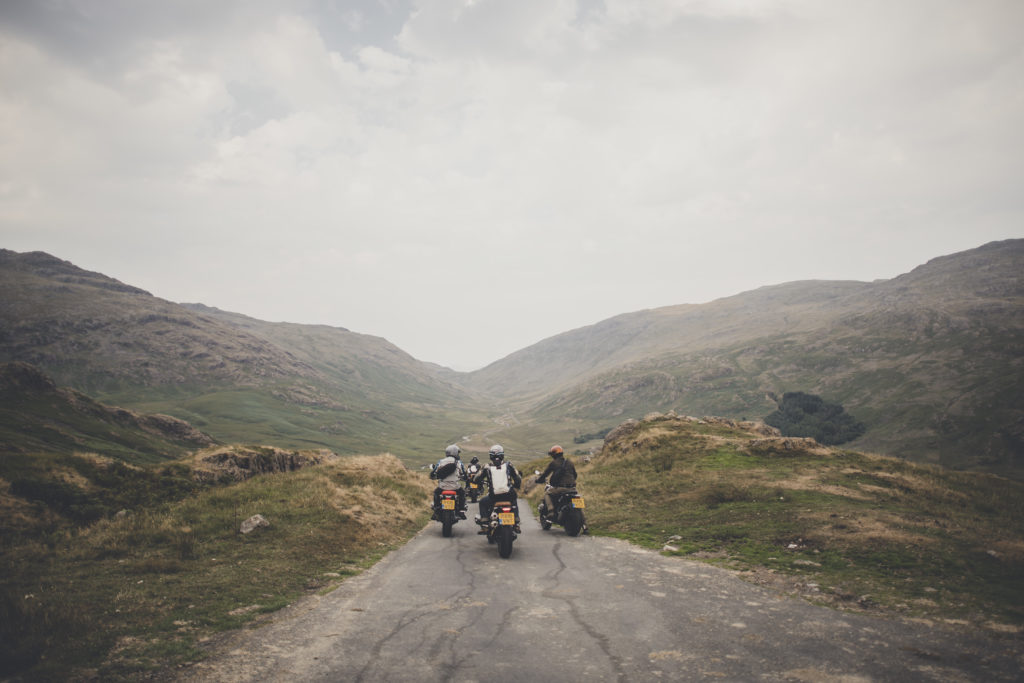
On day #2 of Scotland we had an early start, and after a Scottish breakfast served amongst the trees, the morning rally ritual of oil/coffee/briefing - with the marshal-dash and then pack / suit up - ready for the day. Suddenly the midges decided to make an appearance, within minutes riders may not have had their jackets on, but most of us had helmets on with visors down - midges are a hellish event - this sped up our departure, log-books stamped, flag down - off we rode. Another gorgeous day of sunshine as we headed straight over to the highest pass in Scotland and the steepest legal road in the UK, for the AppleCross pass. The roads around there are beautifully smooth and seem to have been laid out by a roller-coaster engineer, with a good sense of humour, twisting up and down over endless hills, perfect.
[Amy Shore Photography]
First engineering hiccup of the day - Ravi’s Moto Guzzi had arrived at Checkpoint #2 at the start of the pass and then decided to throw up all over the road. A big black pool of fresh oil beneath the bike - a leaky hose or a faulty clip. After 30 minutes of fettling, our new friends in the BMW team arrived. He looked at the hose and said “I’ve got just ze thing”, we thought he was going to come back with a brochure for a modern BMW, but came back with some very smart white plastic gloves, tools and spare hoses. Ten minutes later, both teams were back on the road, and what a road the AppleCross pass is. Getting to the top is one thing, but the view down into the valley with the Isle of Skye in the distance is amazing. The road boasts a dozen hair-pin bends as it progresses down the valley - as soon as I reached the bottom I just wanted to ride back up and do it all again. But there were more mountain passes to come.
[Amy Shore Photography]
Stage 2 was definitely a longer day, about 8 hours or riding in total. We arrived at Checkpoint #3 at the start of Glencoe - the Great Glen. A breath-taking ride through that monstrous valley, imposing mountains on every side, the stags were grazing up on the heather/granite foothills - you’re riding through a whiskey advert! As we came to Checkpoint #4, I parked the bike up and something smelled bad. With an old bike, there’s no warning light if something’s starting to go wrong, you have to use all of your senses, touch, listen and in this case smell the motorcycle - normally the bike has a gorgeous hot-oil aroma to it - something didn’t smell right.
[Amy Shore Photography]
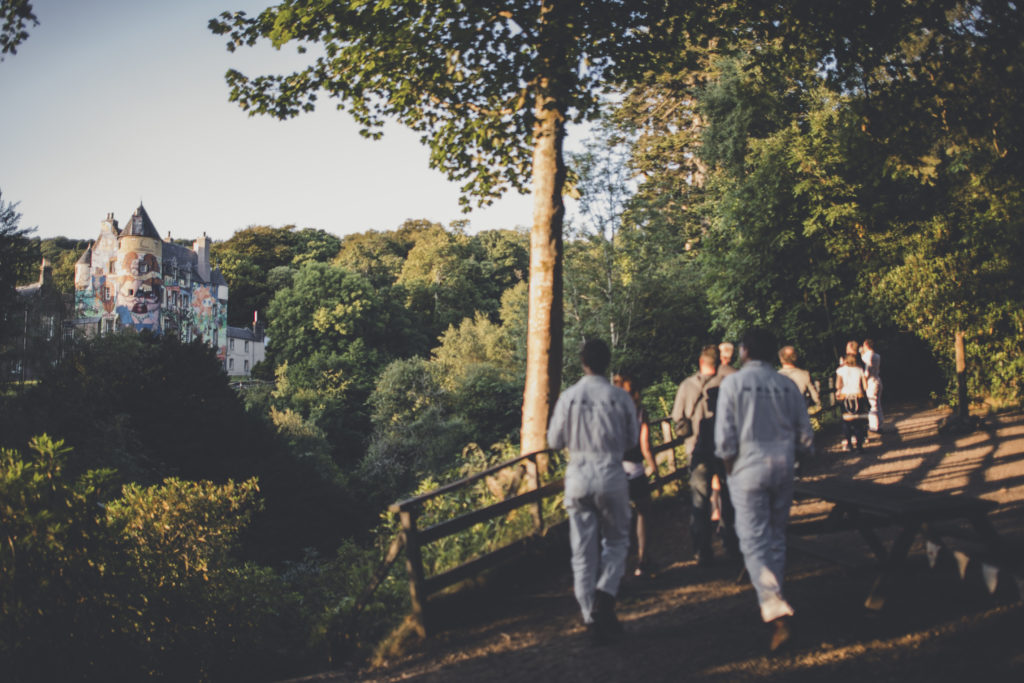
We carried on the ride through Loch Llomand and the Trossachs and down the coast to the extremely bizarre and beautiful Kelburn castle where our rally camp was based for the night (the Castle was painted by a group of Brazilian street artists). As I turned up the drive to the castle, I wasn’t getting as much power as I normally would, or was it just my imagination, when you’ve been riding all day, 280+ miles, you’re tired and your mind can play tricks on you, maybe it’s me not the bike? The Nomadic Kitchen team were already at the fire when we arrived, roasting butterfly lamb. Dinner that night was a well lubricated affair, after a walk around the grounds of the castle, back at camp we were greeted by a fantastic sunset over the bay.
[Amy Shore Photography]
Calum and I had a look over the bike and realised the throttle was misbehaving, sticking slightly...but nothing major it seemed., nothing to explain the smell or the power loss. At this point I should probably have taken that pre-rally advice and maybe given the bike a days rest.
TELL US ABOUT STAGE 3 IN THE LAKE DISTRICT?
Another early start and the good weather was still on our side. I knew this was going to be a long day, 300+ miles on the route card. I joined the last team to leave who were enjoying a leisurely start, but then it appeared that the old Police issue Moto Guzzi had snapped an alternator belt, after some quick calling around, we located a shop 20 miles down the road where we might get one. Our team headed out on a brief detour to source belts and parts, adding an hour off course. After we crossed the border and left Scotland for the lake district, we were happily cruising for a few hours as a team, when I felt power suddenly drop on the Thunderbird. I limped along to the next turning, 2 Minutes down a country lane, I found a safe spot to park up, for some reason the bike was only getting full power when in high or low revs, but nothing in the middle. I searched the electrics, then got word that the support vehicle was only 5 minutes away, we looked over the bike, stripped the carb, gave it a clean and then the bike seemed to be running fine, strange.
[Amy Shore Photography]
I caught up with my team at Checkpoint #3 and we rode as a team down in to the Lake District, across the 2 highest mountain passes in the Lakes - from Buttermere across the Hardknot pass. The Thunderbird was back in her element, throwing it from side to side up the mountain roads. The sun was shining, a fantastic afternoon of riding over the passes and along the lakes, dodging stray sheep, cows and tractors.
[Amy Shore Photography]
Unbeknown to us, late that afternoon a lorry driver had fallen asleep on the M6, knocking out an entire motorway bridge, he was completely fine, but it shut down the motorway for 24 hours (the local newspaper the next morning called him the most unpopular man in Lancashire). Which meant that all that traffic spilled onto every other nearby route, bumper to bumper traffic for 50 miles in every direction - exactly in the area we were all trying to ride through. Luckily we were on bikes and could filter through the bad patches. We should have been back at camp by 6pm, but arrived starving at around 9pm, at the very quirky and eccentric Heskin Hall. Our support crew weren’t quite as lucky, the Malle-Rover turned up at the Manor gates just after midnight, with a Commando in the back (the Norton had fallen off it’s centre stand and snapped a vital lever).
WHAT WERE THE HIGHLIGHTS OF STAGE 4 IN WALES?
By day 4 you could start to feel the toll of 3 solid days of riding, 750ish miles, 2 countries behind us as we crossed over into Wales. I started that day with the BMW Motorrad team, and the thunderclouds threatened to break. A couple of times we stopped, threw on wet weather gear, but most patches were just light showers, so we rode as a pack through the winding tracks of Snowdonia National Park, down the infamous A470 (voted the most beautiful road in the country) around the back of Mt Snowdon and down through the valley. By Checkpoint #3 we were joined by another team with a very fast Triumph Thruxton leading. To keep up with them I really had to press my chin on the tank, tuck elbows in and try to get another 10mph out of the bike. Somewhere in Snowdonia my key must have rattled out, so I borrowed a small teaspoon from the cafe which did the trick of starting the bike. The weather held but as we left the Brecon Beacons the wind picked up, bringing with it the energy you feel before storms. Riding with 3 teams now, 12 or so bikes together, we crossed the Severn bridge at a furious rate. Riding in all 3 lanes, I’m not sure if we were actually going that fast, or if it was the head on wind that was bashing the bikes about as we rode across the huge suspension bridge - quite a departure from the quiet tracks of the Scottish highlands, but riding in a fast pack like that is so much fun. I think the BMWs were politely humouring my attempt at keeping up the pace, through my wildly vibrating side mirror I could just make out the image of Jochen grinning and riding along side-saddle on his cafe-racer BMW and then occasionally wheelying past me. I didn’t think being overtaken would be a highlight...but it was a great memory of that stage.
[Amy Shore Photography]
We were chasing each other down the lanes of the Mendip Hills, when the welcome sight of 2 rally flags appeared up ahead. The guys from Sinroja motorcycles led the Marshal team that day and waved us in smiling. The landscape was completely different around there, the camp was perched on top of the Cheddar Gorge on a large flat plain, with gorges surrounding the area on 3 sides. Word spread that night that there was a full lunar eclipse, with a blood moon - unfortunately the storm clouds had descended on the dark camp, so instead we hosted a motorcycle race.
[Amy Shore Photography]
The boys wheeled out the Mini Malle Moto, a half-thrashed monkey bike from The Malle Mile. I pushed the Thunderbird out into the the long grass a hundred meters away, and the support vehicles turned on full beams to light up the “track”. One at a time every rider and Marshall took a timed lap around the marker-bike and back, 10% didn’t make it across the start-line and then the Belgian rally team proved that it was actually faster to run the route by foot and beat the monkey bike. After the race finished and the winners were awarded a cold beer, I was walking the Thunderbird back across to camp and realised the tank badges must have rattled off somewhere in Wales. Steadily it seemed, I was leaving bits of the Triumph on roadsides up and down the country.
HOW WAS THE FINAL STRETCH TO THE FINISH LINE?
The last day of the rally was supposed to be the shortest day, but the motorcycle gods had other plans....We woke to good news that the storm hadn’t broken yet, but big dark clouds hung menacingly on the horizon, full of water. I guess on the last stage of the rally, you need a little drama - you don’t want everything to be too easy. For the last day we had arranged for the press-marshal Rachel Billings - who was writing about the rally - to ride with our team to shoot 35mm film from my bike....slight problem... the bike wouldn’t start. After 30 minutes of tinkering and some kind words whispered to the bike, she suddenly roared into life. By that time all of the teams were now 30 minutes ahead of us. We jumped on and headed down into the Gorge, ok it’s not the Grand Canyon, but its a great ride. In the rough words of Bill Bryson “England doesn’t have the biggest or the highest or the deepest of anything, but it does a lot with what it’s got” and the county here is unique, varied and pretty. Tiny postcard towns and castles connect the dots all the way from Wales to Devon and on to Cornwall.
[Amy Shore Photography]
En route to Exmoor, it poured with rain, black skies above, the sort of downpour where immediately there are deep pools of water on the lanes, mini rivers at the sides. Somehow water gets into your boots, soaks your socks and you hunch your shoulders and neck to try and close any gaps between helmet and jacket and soldier on. I remember shouting to Rachel “shall we take shelter” as we sped through the driving rain, but she shouted back “just keep going” - she’s got grit! The rain was relentless, but then the rain ended and there was a faint hint of blue sky up ahead, things were looking up...and then bike died. We rolled to a silent stop in an old school house drive. Out with the tools, so much for Rachel’s rally team photos which was the photo-brief for the day. I was pretty sure we were miles behind the other teams. By sheer coincidence Calum and the support Land Rover drove by only 10 minutes later, we went over the obvious things, then took out the battery, only to discover that the 2 new lithium batteries had fused together in some horrible hot-molten-mess. The bike might be out of the rally and only 150 miles from the finish line.
[Amy Shore Photography]
Luckily we weren’t in the wilds of Mongolia: it was midday on a Saturday in England, so we called all the local bike garages to find a classic 6V battery. After 10 no-goes we find a shop on our route that thinks they has one in stock, so we stuck the bike in the trailer while four of the rally teams roared past us, beeping. So we weren’t last after all at that stage. We found the old motorcycle shop, owned by a young guy who specializes in vintage Japanese imports from the 1980s...quite niche, but he had the battery! £6.50 later it was installed, the sun shone and we were back on track. We headed for checkpoint #2, still in the running and things look good. As we reached Exmoor, the landscape changed completely to a wild open moor, with animals running across the roads. We crossed the top and the bike seemed to be struggling again, fine in high revs, but no power below max revs, it coughed, spluttering...and then just the sound of air rushing past, as the bike free-wheeled in neutral down a very long hill into the deepest valley in Exmoor. We rolled to a silent stop outside an old garage that looked closed for decades. No network connection, Rachel walked up the valley, still nothing, I started going over the bike, no joy, the battery was completely dead.
[Amy Shore Photography]
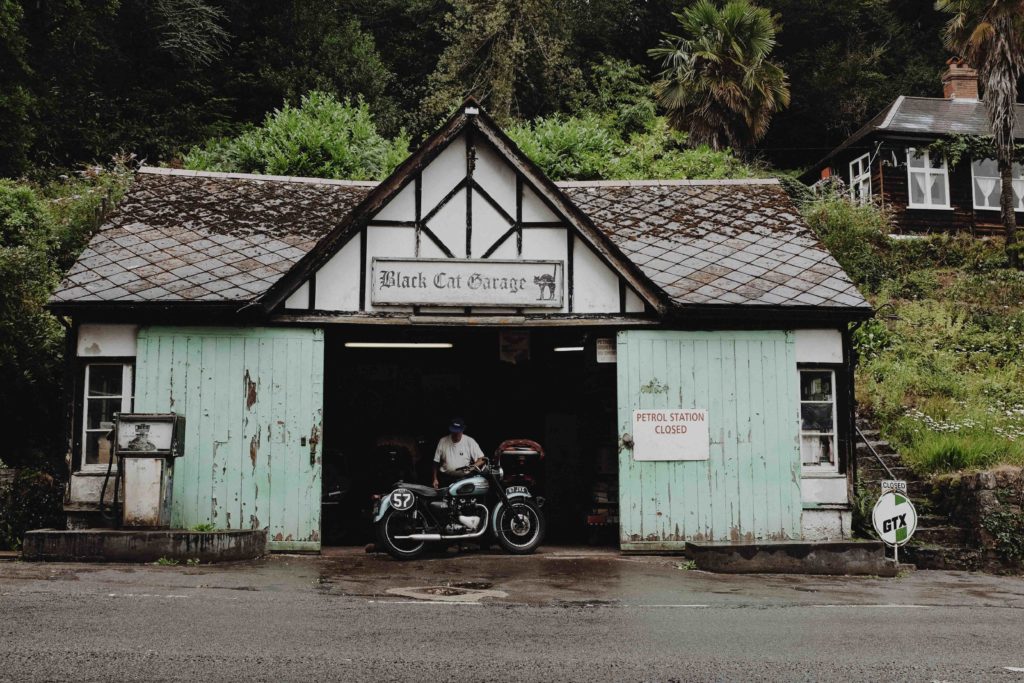
After 20 minutes or so a little voice popped up from the hedge behind the garage “need some ‘elp?”. A small older gentleman, in a blue baseball cap came through the gate smiling. I explain the bike problem, the man in his late 70’s, tells us he used to get a lot of these bikes here back in the day and he owned a similar model once. He rubbed his big mechanics hands over the engine and said “Well let’s try and fix it”. He heaved open the sliding doors of the ancient petrol station, and I noticed the faded paint on the inside walls of ‘The Black Cat Garage’. Inside he had a load of old bike parts, some possibly working, some hanging from the ceiling, but he had a workbench of old tools - this might be the best place we could have broken down in the whole of England! He had an industrial battery charger, but after no success with the old 6V, Fred says “I have an idea”, pulling a battery out of an old scooter. “This might work” - it still has charge. We put it next to the Thunderbird and with makeshift copper wiring we hooked it up. The Thunderbird kicked over first time! Fred wouldn’t accept a penny for the battery, we wrangle it into the battery box on its end, holding it in place with gaffa tape. We thanked him again, loaded up and headed off down the green tree-lined tunnels of Exmoor - and the rain had stopped.
[Amy Shore Photography]
To make it up to Rachel for that last 5 hours of riding in the rain, 3 dead batteries, 2 garages, 4 pairs of soaking gloves, I suggested we stop in Dartmoor for a quick bite to warm up. We rode in to the oldest pub on Dartmoor, where a wedding was going on in the back of the pub. The bride walked out in head-to-toe white lace, looking radiant, while I was dressed head to toe in Black waxed canvas, covered in black oil and dirt, hungry and looking angry. “I think we’re complete opposites” I mentioned. We went to start the bike, nothing, silence. The rain started spitting, I reluctantly called the support vehicle, Calum’s 2 hours South almost in Cornwall. A rowdy group of young male wedding guests came out of the back of the pub, half cut, they all had an opinion on how to start the bike. Moments later they’re taking turns to help me push the Triumph to the top of the hill, across the bridge and bump starting me across the river. On the 15th go, it roared back to life, they cheer, Rachel downs the last of her drink and we’re back in the game.
[Amy Shore Photography]
A few hours later as we crossed into Cornwall, the rain started again, I saw a familiar Land Rover in a country lay-by. After 9 hours on the bike, 6 of them in the rain, Rachel wisely swapped her seat on the bike for a drier one in the support vehicle.
[Amy Shore Photography]
As I pulled away - with determination to complete this rally on the Thunderbird - the rain really set in. Tt was already raining but now it was pouring, my last pair of gloves were soaked, and then the bike started to misbehave again, only running at full revs. Then I realised I’d lost the lights, and then the front brake gave up. I saw the sign for Helston and The Lizard...only 17 miles. I’m not giving up now, and kept the bike at full revs, hammering it down the lanes, taking all of the roundabouts in 3rd gear. I considered taking the more direct route across the middle of a round-about, rather than around it, but thought better of it. Hunched on the saddle, trying to keep the water out, watching the odometer count down the last 17 miles, shouting out at each mile marker for a morale boost “15....14....13”. Finally the sign for ‘Mile End’ appeared, the last mile South on mainland Britain. I arrived at Lizard Point just after sunset, 9pm, 4 hours late to the final checkpoint and the finish-line. No one in sight, the rally flags had long since been cleared away, but so good to be there, gazing over the sea at Lizard Point. I turn to get back on the bike, the lighthouse lighting up the horizon and the silhouette of the Thunderbird, reminding me of the view North from the lighthouse at the Northern tip of Scotland, just a few days ago, but it seems like an age away. The poor bike...bits missing, smelling bad, no lights, exhausted and in dire need of lubrication...we had a lot in common at that moment.
[Amy Shore Photography]
ANY LAST WORDS ABOUT THE RALLY EXPERIENCE?
When I got back to the rally camp from the finish line at The Lizard, the afterparty was in full swing, fires lit, drinks flowing, with a gale still howling across the Cornish peninsula - I walked into the food tent like a half-drowned cowboy. I was the last to leave Scotland and the last to arrive at the finish line, but once I started riding those roads with my team, there was no way I was going to miss out and take a rest day. Things went wrong, bits fell off, but I wouldn’t change it one bit, that was the adventure.
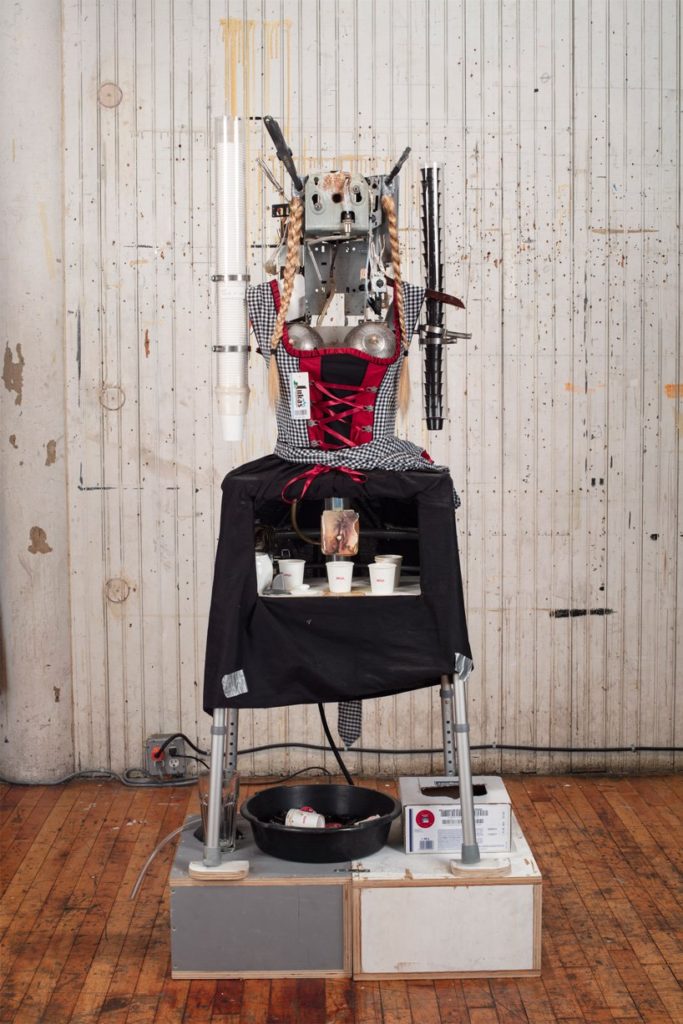
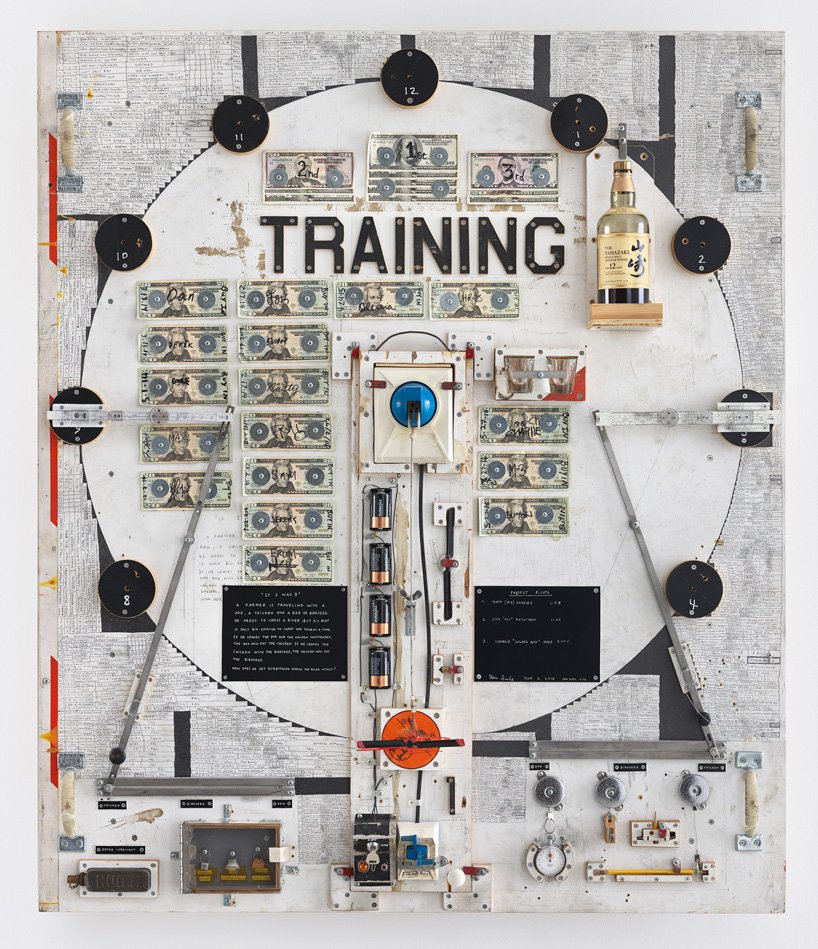
Not so far from Basel (the real town of Basel, not the metastasized art fair), the haute ski town of St Moritz is quietly becoming its own art destination. Painter/film director Julian Schnabel's son Vito Schnabel has chosen St Moritz for his own eponymous Swiss outpost, which is currently hosting an exhibition by artist Tom Sachs. Sachs' deep digs into his personal obsessions, like his years-long Outsider-esque variation-and-theme play on NASA imagery, makes his work among the most intriguing of all contemporary artists, on par with Grayson Perry for his widely variable expressions and air of sincerity in all the mad things he builds.
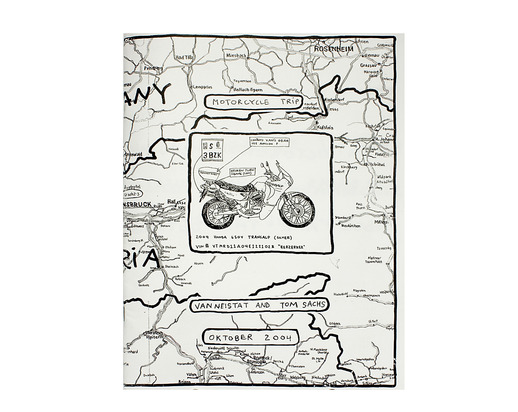
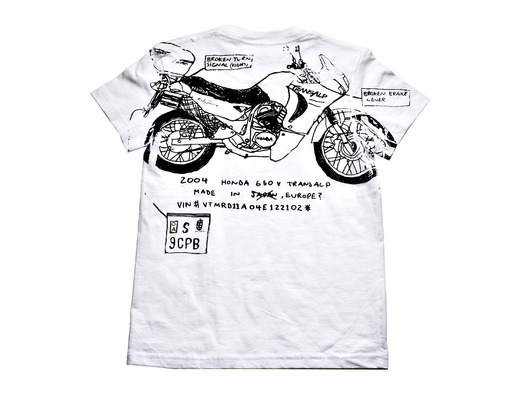
Tom Sachs and Van Niestat chronicled their Alp/Transalp journey in 2004 with a photocopy 'zine, detailing their meals, routes, VIN number, and other minutiae [Allied Cultural Prosthetics]I'd missed that Sachs is also a motorcyclist, and had, in 2004, made an art project around a motorcycle tour he'd taken through the Swiss Alps on a Honda Transalp, with filmmaker Van Neistat. Sachs published a limited-edition of 100 photocopied 'Dollar Cut' zines about the trip (this is on my Christmas list, if you really love me), and even made tee shirts of the hand-drawn cover, including the Honda's VIN number, license, and other minutiae he typically incorporates into his work.
The Transalp Tee: a rare, affordable Tom Sachs artwork...if you were lucky! In his typical manner, dwelling on the details is Sachs' method of exploring cultural meanings typically overlooked [Allied Cultural Prosthetics]This month Sachs opened a new body of work at Vito Schnabel Gallery called 'The Pack', as an homage to the work of seminal conceptual/performance artist Joseph Beuys. The German Beuys shamanically transformed his life story into his art, particularly his 'origin story' of a plane crash while a Stuka tailgunner in the Luftwaffe, where his life was saved by independent Tatar tribesmen, who healed his body by packing him in fat, wrapping him in felt blankets, and dragging him by sled over the snows to medical attention, using flashlights to navigate through the night. Beuys' most famous performance/art included felt, fat, flashlights and sleds, as well at other elements he considered magical, like coyotes... he famously had himself locked in a cage with a wild coyote, covering himself if a cloak, hat, and cane, while ritually negotiating with the frightened and aggressive animal: it was tense, dangerous, and magical at once.
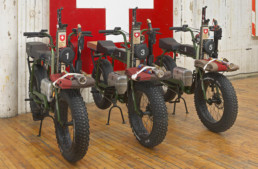
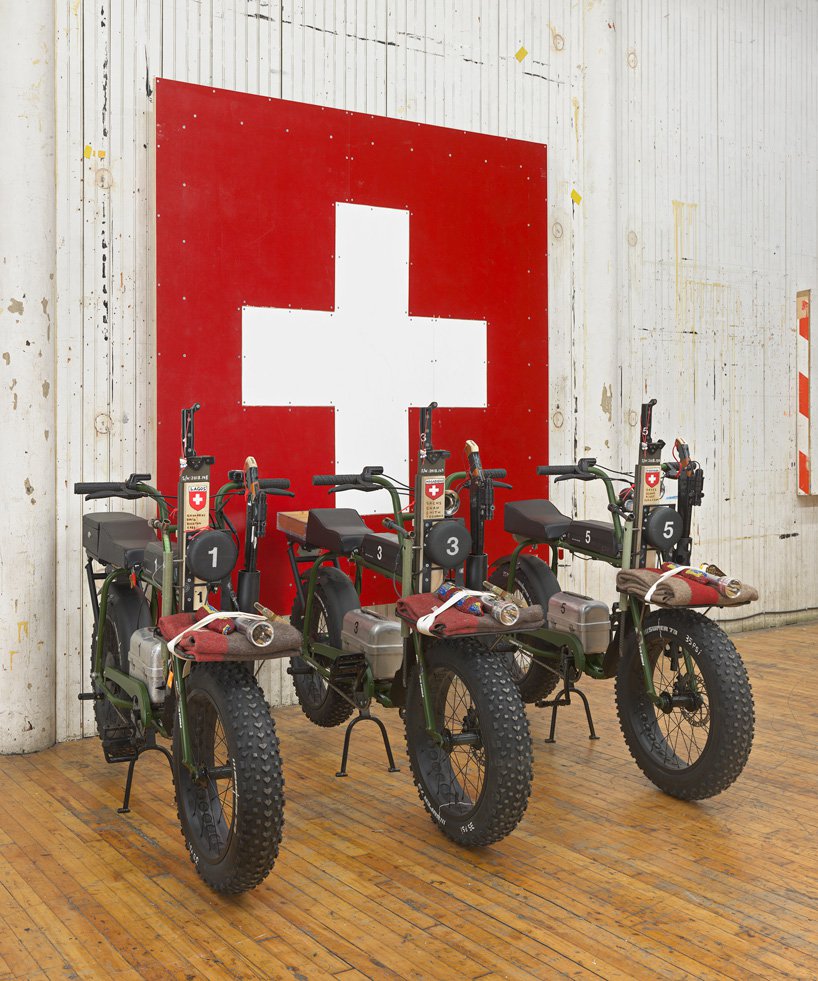
'The Pack: Kinshasa, Lagos, Mogadishu', mixed media (2018), with 'Flag', polymer paint over steel and plywood (2018) [Genevieve Hanson/Tom Sachs Studio]Sachs, in an homage to the master, has himself transformed Beuys' talismans into his own obsession with Switzerland, for his exhibit 'The Pack'. He considers Switzerland an iconic brand, and even opened a 'Swiss Passport Office' for 24 hours in London, from which he issued his own version of the world's most coveted travel document. His interest in Switzerland is on full display in St Moritz, and includes three electric motorcycles dubbed 'Kinshasa', 'Mogadishu', and 'Lagos' (all 2018). Each 'sled' is equipped with Swiss blankets, a flashlight, and symbolic weaponry (a BB gun, a machete), plus snacks(!), all displayed in front of a giant Swiss flag...modern versions of Beuys' work, transformed via Sachs' particular obsessions. There is some discussion of associating these bikes with a 500-year old military outfit, the Swiss Guards, who were created in 1506 by Pope Julius II, and now famously guard the Vatican City.
'Heidi', mixed media (2018). The most robo-erotic-Helvetic coffee dispenser ever. [Genevieve Hanson/Tom Sachs Studio]Other works in the exhibit reference NASA and the moon (staples of his imagery), plus an erotic/robotic X-rated coffee machine called Heidi. Sachs' work is always worth pondering, and his assemblages are consistently crafty, reckoning with culture and its machinery through hand-made totems, which typically become squint-your-eyes simulacra of 'real' objects...like full-scale lunar landers. His art plays both anthropologist and Outsider at once, ignoring the history-book narrative surrounding things, and focussing on their details instead, giving a propaganda-free and openly curious take on our cultural totems.
'Training' (2011-16), plywood, latex paint, steel, vertibird, yamazaki, mixed media. It's all in the details. [Genevieve Hanson/Tom Sachs Studio]'Moon' (2018), polymer over plywood, mixed media. Flags and NASA as branding, unpacked. [Genevieve Hanson/Tom Sachs Studio]
We all love beautiful things, and some people have a flair for creating beauty. It’s like cooking: you can give the same ingredients to a dozen chefs, and maybe, if you’re lucky, one will prepare a dish that’s simply exquisite, makes you roll your eyes back in your head, remembering the smell of madeleines, and the bicycling days of your youth. There are quite a few builders of Seeley-framed race bikes and café racers based on Norton Commando and Matchless G50 motors, but there’s one builder who stands head and shoulders above the rest combining these ingredients – a master chef named Kenny Cummings. His NYC Norton has a reputation for building impeccable race and road bikes around the Seeley frame, which is a great spine on which to hang your work. What is it that makes his bikes so special, especially as there have been so many Seeley-framed special builders since the 1960s?
A wicked Seeley-Norton Commando roadster as only NYC Norton can build: a café racer extraordinaire. [Peter Domorak]The difference is an artist’s design sense: line and proportion and construction harmonized into a perfect whole. Harmony is apropos in Kenny’s case, as his first love is music: growing up as a musician, playing with various bands in Seattle, moving to NYC and clocking in with artists from Aretha Franklin to Elvis Costello. His day job was in contemporary art book publishing, to fund his dream band, Shelby. And on the side, motorcycles played a part starting in the 1990s, when the pull of two wheels proved irresistible, and he bought a Norton Commando. Years later that he discovered Nortons were in his blood, after a reunion with his father, where he was presented with an early 1970s photo of Dad with a Norton N15GS scrambler. Such a coincidence begs the question: free will, or fate?
"Everybody in the club right now, Tell the DJ - turn it up loud." Jon Thorndike playing mixmaster at the lathe. [Peter Domorak]Kenny bought that first Norton Commando in 1995, as he was smitten with its style. But the learning curve with old British bikes is steep, and can be harsh, and he was shortly educated in their highs and lows. “I was riding my Commando around the West Village, and it conked out at 6th Ave and Bleeker. I knew about Hugh Mackie at Sixth Street Specials, so I pushed it to 6th St and Ave C – that’s 1.8 miles. Hugh told me I needed a new alternator, and it would cost $1000. This was right after I’d spent all this money to buy it. Pretty soon after that, I heard a jingle in the motor – the exhaust threads in the cylinder head had stripped. Hugh said, ‘that’s another $1500.’ I sat down on the stoop of his shop, totally bummed out about spending all that money, and Hugh sat down beside me and said in his Scottish brogue, ‘Keeeneeey, the guys who ride these bikes, they’re everything to them. They think about bikes when they eat, when they sleep, when they’re screwing their girlfriend. Maybe you should get a Honda.’ I think about that all the time, what would I be doing if I’d bought a Honda? Would I do shit that normal people do in Tri-burbia? It sounds enticing, because what I do is all consuming. They go to playdates with their kids…what do people do with their time? Because I have none.”
A Seeley-Norton Commando racer with track muffler, necessary to keep the sound below the required 92dB limit [Peter Domorak]Regardless the peerless reputation of NYC Norton, running a bespoke motorcycle business is not an easy calling. “The margin on this work is tiny, I’m busy as shit but there’s no money in this. I’ve got commitments years out, but it’s not polished alloy tanks on Instagram every single day. It’s like you [Paul d'Orléans] said in your Instafamous/Instabroke article – 'a like is not a dollar'. I’ve got a collaborator who helps with our social media marketing, and we have the metrics, but what does all that mean? I have a friend who makes fun of me, and says my complaints sound like ‘my gold bricks are too heavy’.” To an outsider, the veneer of a successful motorcycle builder is as glossy as a new paint job, but if you haven’t run your own business, kept up a bi-weekly payroll, juggled overhead with cash flow, and dealt with customers, you can’t grasp what hard work it is. “It’s something everyone in the motorcycle industry understands: I don’t think anyone does this to get rich, they all do it for love, because the margins are slim. If you get into this business, you’d better love what you do as it’s not an easy road.”
The Man himself, Kenny Cummings of NYC Norton. [Peter Domorak]Then again, Kenny asks “What else would I be doing? When I lost my publishing job in the 2009 crash, I worked on my own bikes, not thinking that was a career choice. But I asked myself, should I do back office work at JP Morgan? Hell no! I’ve worked in the art publishing business, but that was to support my band Shelby. I wasn’t put on this earth to do publishing.” [Luckily, some of us are! – ed.]
The object of our affection: a Norton with aluminum big-bore cylinder barrel for racing [Peter Domorak]NYC Norton builds immaculate café racers and road racers, and even dabbles with the odd British enduro, and every build is superb. Their Seeley-framed customs are known around the world, and The Vintagent team encouraged Kenny – who doesn’t think of himself as a custom builder – to make a bike for our Custom Revolution exhibit at the Petersen Museum. When we pointed out that café racers are a huge part of the custom bike legacy, he began to see our point, and put together an exquisite machine – ‘Blue Monday’ – which you can see in person through March 2019. It's top shelf artisans like Kenny that inspired Custom Revolution: they work with the same ingredients as everyone else, but what emerges from their workshops is simply magic.
Jon Thorndike enjoys tending to interesting machinery at NYC Norton. [Peter Domorak]A belt primary drive conversion is essential for keeping oil off the racetrack. [Peter Domorak]Like an animal tensed to leap forward, the Seeley Commando is an elegantly aggressive design. [Peter Domorak]NYC Norton is located in an enormous warehouse complex in Jersey City, NJ, just across the river from Manhattan, where real estate prices have forced out small businesses. But Kenny still lives in TriBeCa. [Peter Domorak]"Success is not the end of work. It is the beginning of new work." - Kung Fu [Peter Domorak]Kenny Cummings with a Titchmarsh-framed Seeley-Matchless G50 racer [Peter Domorak]Many thanks to Peter Domorak for providing the excellent photography the inspired this article. See more of Peter's work here.
Paul d'Orléans is the founder of TheVintagent.com. He is an author, photographer, filmmaker, museum curator, event organizer, and public speaker. Check out his Author Page, Instagram, and Facebook.
Originally published in Chambers's Journal of Popular Literature, Science and Arts, May 1, 1869
The prototypical Dandy bicyclist, after 1869, with an early pedal cycle, of the type patented by brothers Marius, Aimé and Pierre Olivier, ex-associates of Pierre Michaux. Note the delicate footrests above the front wheel for coasting, and the elaborate brake pedal operating the 'spoon' brake pad on the rear wheel. The pedals are connected directly to the front axle, so speed and effort is related to the wheel diameter. As pneumatic tires would not be invented for 20 years, the steel rims of these bicycles gave rise to the 'boneshaker' nickname, although the tempered steel spring holding the saddle would have relieved many of the shocks on the unmade roads of the day. The first velocipedes were also called 'Dandy Horses', as young men were their most enthusiastic adherents, much as the author of this article from 1869. Picture this fellow as our author, who sadly remains unnamed.
I am not ashamed to admit having always cherished a peculiar admiration, at one time amounting to awe, for anything that would go round. A wheel has never been without its charm for me. I remember, at school, the affection with which I regarded wheels of all sorts, and how all my favourite toys as a child were rotary ones. The knife-grinder who used periodically to stop in front of our play-ground gates to grind the young gentlemen's knives, has probably died without knowing the inward comfort he administered to my breast, through the opportunities he afforded me of seeing his wheel go round at public expense.
Only the other day, I confided to an old friend that I still possessed a sneaking regard for wheels, and though he rewarded my confidence with a pitiful sneer, I know that this wretched old hypocrite himself keeps a wonderful brass top that will spin for an hour, under a glass case on his study-table, and in secret delights to watch it in motion.
A clever marine engineer, who loves wheels too, once told me with great gravity that the human mind has never yet discovered anything so wonderful as the principle of the common wheelbarrow, 'an invention,' he said, 'to which that of the steam-engine itself is nothing. The wheelbarrow,' he went on, 'is the only example I am acquainted with in which the very weight of a load is fairly utilised as a locomotive power.' There was a copy of Punch on my table. Our conversation had turned to the subject of wheelbarrows from looking at Mr Keene's vignette, in which, some three years ago, Mr Punch was depicted as Blondin, but performing the impossible feat of wheeling himself in a wheelbarrow along a tight-rope in the Crystal Palace transept.
Karl de Drais (full name Karl Friedrich Christian Ludwig Freiherr Drais von Sauerbronn) invented the 'Fahrsmachine' (running machine), first presented to the world on June 12, 1817 in Mannheim, Germany, a steerable two-wheeler. Drais was a Baron but an advocate of democracy, so dropped the royal 'von' from his name in the 1840s, and suffered greatly for his beliefs. His is a fascinating story! [Wikipedia]My engineer friend then remarked that, putting aside the tight-rope business, he was firmly convinced that Mr Keene had in jest represented what would by-and-by be accepted in serious earnest as the only correct principle on which to construct a self-driven vehicle - namely, employing the weight of the body as a propelling power, and relying on the fact of motion as the means of balance. One thing will at least be conceded by any person who will take the trouble to turn to the sketch, and that is, notwithstanding all recognised notions and experience to the contrary, the picture of a man driving himself in a wheelbarrow looks strangely plausible, probably from the fact, that the mind of the observer communicates motion to the wheel, and is satisfied to receive that as the explanation of the balance.
The two-wheeled velocipede or bicycle is in part a realisation of Mr Keene's picture. It depends upon motion for its balance. The two wheels, one in front of the other, with a saddle between, whether mounted by a rider or not, will not stand upright for a single instant at rest; but, like the boy's hoop, being kept trolling, they maintain a perfect equilibrium.
A Wonder Which Drove All Paris Mad
The bicycle can hardly be called a 'new invention,' being to a great extent a modification of that very old toy-vehicle of our fathers, the hobby-horse, whereon the rider used to sit and row himself along, so to speak, by paddling with his feet on the ground; at the same time, the entire reliance on the principle that motion would be, under any circumstances, sufficient to produce balance, is sufficiently novel almost to justify the use of such a term. The French appear to be entitled to whatever of credit attaches to the original invention of the hobby-horse (a miserable steed at best, which wore out the toes of a pair of boots at every journey. M. Blanchard, the celebrated aeronaut, and M. Masurier conjointly manufactured the first of these machines in 1779, which was then described as 'a wonder which drove all Paris mad.' The French are probably justified, moreover, in claiming as their own the development of this crude invention into the present velocipede, for, in 1862, a M. Riviere, a French subject, residing in England, deposited in the British Patent Office a minute specification of a machine identical with that now in use. His description was, however, unaccompanied by any drawing or sketch, and he seems to have taken no further steps in the matter than to register a theory which he never carried into practice. Subsequently, the bicycle was re-invented by the French and by the Americans almost simultaneously, and indeed, both nations claim priority in introducing it. It came into public notoriety at the last French International Exhibition, from which time the rage for them has gradually developed itself, until in this present 1869, it may be said, much as it was a century ago, that Paris has again been driven mad on velocipedes.
The Dandy Machine! A Michaux bicycle of 1868, as produced commercially from that year, thanks to the Michaux's association with the fréres Olivier. Earlier incarnations of the pedal-cycle were built by the Michaux pere et fils, in concert with Pierre Lallemant, who also patented his pedal-cycle, but in the USA, claiming it was he who had invented the machine: Lallemant filed 137 patents in the USA in 1868, Michaux filed 187 patents in France in 1869. [Wikipedia]Extensive foundries are now established in Paris for the sole purpose of supplying the iron-work, while some scores of large manufactories are taxing their utmost resources to meet the daily increasing demand for these vehicles. The prices of good serviceable velocipedes range from two hundred and fifty to four hundred francs (ten to sixteen pounds), at a less price than which a really good machine cannot be obtained either in England or France. The best French pattern is that of Michaux et Cie., which is the one now adopted by most of the English builders with more or less correctness. The height of the driving-wheel most suitable for general use is three feet.
Ernest Michaux, son of Pierre, who likely thought up the pedal-cycle with Pierre Lallemant, and built the first examples in the mid-1860s at his father's workshop [Wikipedia]The advantages of the bicycle over the three and four wheeled velocipedes are many and considerable. It is less than half the weight of the old machine, being but a little over forty pounds; and the friction is reduced to something like two-thirds. The power operating directly on the cranks, instead of being communicated through long levers, is wholly utilised, whilst the motion of the feet is more analogous to that of walking. When once accustomed to the use of the two-wheeled velocipede, it is not at all fatiguing, whereas the many-wheelers condemn their riders to a term of hard labour. As the result of several months' experience in driving a bicycle, I have no hesitation in estimating it as a clear gain of five to one in comparison with walking. That is to say, the rider may go five miles with the same expenditure of labour as in walking one, and after a journey of fifty miles he will feel no more fatigue than after having walked ten. Notwithstanding appearances to the contrary to the unaccustomed eye, the bicycle is, moreover, a safer machine than any velocipede with three wheels, and far more under control. To turn a corner with a three-wheeler at anything like speed, is a most hazardous experiment, resulting almost certainly in a 'spill' - because the speed lifts the hind-wheel describing the outermost circle, from the ground; whereas the two-wheeler, when on the turn, stands at an inclination like a skater's body, more or less acute according to the quickness of the curve to be described.
The two-wheeler, when on the turn, stands at an inclination like a skater's body.
With regard to the speed which may be attained, fifteen miles an hour, under the most favourable circumstances, that is, good hard road, not level, but without very steep hills, and no wind blowing, is probably the limit of the velocipede's powers; but a pace of nine or ten miles an hour may be maintained for five or six hours without distress. Long journeys on level road are perhaps the most fatiguing, on account of their monotony, because then the feet, as in walking, are nearly always at work. Still, even in this case, the driver can maintain his speed with one foot, resting the other on the leg-rest; or, if disposed, he may even place both feet on the rests, and run four or five hundred yards without working at all. The slightly increased labour of climbing a hill is nothing to the zest imparted by a knowledge that there is sure to be a hill the other side to go down, and that is the most luxurious travelling that can be imagined. Descending an incline at full speed, balanced on a beautifully tempered steel spring that takes every jolt from the road - wheels spinning over the ground so lightly they scarce seem to touch it - the driver's legs rested comfortably on the cross-bar in front - shooting the hill at a speed of thirty or forty miles an hour - the sensation is only comparable to that of flying, and is worth all the pains it costs in learning to experience it.
The sensation is only comparable to that of flying.
The velocipedist feels but one pang when he reaches the bottom of a hill, and that is, that it is over; and but one exquisite wish, which is, that the entire country might somehow become metamorphosed into down-hill. But the hill is bountiful even after one has left it, for the impetus derived from a good incline will carry the rider at least the hill's length on level ground before he need remove his feet from the rests and commence working again. The slightest incline on a good road is sufficient to obviate all necessity for working with the feet, so that what little labour there is (and it is of the easiest), is by no means incessant. In a journey of twenty miles on good road, a driver should not work more than twelve - the inclines do the rest. Of course, there are hills so steep that to ascend them is impossible: yet, for myself, living in a hilly county, which I have pretty well explored on my two-wheeled steed, I can reckon up their number on the fingers of one hand. There are also hills where the labour becomes as much as, or more than, walking, but these must be of a gradient something like one in twelve, and such hills are not frequent. When they do occur, the rider may, if he will, dismount.
The 'sensation of flying' inspired the concept of adding a motor to the bicycle, to extend the feeling indefinitely. How right they were! The joys of motorcycling were imagined as early as 1818 in a lithograph, and explicitly so in 1820 by Karl von Drais himself, who mentioned in an 1822 interview “I am thinking of improving Draisine by steam." Louis-Guillame Perraux patented his steam-powered velocipede in 1871 (seen above), using a Michaux-type bicycle with a small steam engine modified for the purpose. Sylvester H. Roper had the same idea in the USA, perhaps two years earlier, but used a non-pedal cycle as his foundation [Archives INPI France]It is a subject of smiling pity to many of the uninitiated to behold a velocipedist dragging his horse after him up a hill - and cruelly realised, too, in the case of three and four wheeled machines; but the bicycle is better than any walking-stick to assist a person up an incline, even when only walking beside it. Resting one elbow on the saddle, and leaning the weight of the body on that, while guiding the handle with the other hand, the machine becomes a positive assistance instead of an incumbrance. This sounds like fiction, but it is fact. Experto crede.
The circa 1871 steam velocipede of Louis-Guillame Perreaux, seen outside its home, the Sceaux Museum in Paris. The machine is exhibited occasionally, and is a fascinating construction, well worth study to read Perreaux's mind on how to make bicycle fly. [Musée Sceaux]There are persons who advertise to teach the use of the velocipede in 'a few hours.' Not long ago an enterprising French master advertised to teach the French language (in the intervals of seasickness) during the voyage from Dover to Calais. It should not be concealed that it requires as much time to learn the use of the bicycle as to learn to skate - and there are also occasional falls incidental to learning either. To urge the time necessary to acquire its use as an objection against the two-wheeled steed, would, however, be manifestly unjust. So difficult is it to balance the human body on merely two small legs and a pair of feet, in an upright position (a position such as would be scarcely possible to make an exact model of a man, even without life, retain for a single instant), that it has taken most of us a twelve-month to learn how to do that.
Sylvester H. Roper's 1867 'self-propeller' used a hickory frame without pedals, apparently built for the purpose. The water tank doubles as the seat, while the burner sits low under the rider, and the exhaust (mostly excess heat) exits behind the rider via the stack. The rider twists the handlebars to open up the steam valves - the first motorcycle twistgrip. Roper may have built the first motorcycle, although the same concept was pictured in 1818 in France. This machine can be seen at the Smithsonian Institution [Wikipedia]It is sufficient to say that a person may attain the management of a two-wheeled steed in less time than that of a four-footed one, and when he has done so, for speed, endurance, and inexpensiveness, the former will at least bear favourable comparison with the latter. As in skating, a week's steady and persevering practice is needful to acquire a comfortable balance, and gain control over the unaccustomed form of support. The 'falls' referred to above, as happening in learning the velocipede, are nothing to those incurred in learning to skate. No one should mount a bicycle until he is acquainted with the way to get off, which is really the first lesson. Whichever way the machine is going to fall, the learner has only to put out his foot on that side. His foot being not more than three inches from the ground, the horse, in the act of falling, will deliver him safe on terra firma, if he will only let it, whilst, by retaining his grasp of the handles, the rider at once balances himself on alighting, and saves the velocipede from falling. Some difficulty in remounting without help is sure to be experienced by a learner. For a month he must content himself with the assistance of the first post or gate or palings he sees by the wayside; but he will soon discard such assistance, and be able to vault on the saddle whilst his horse is in motion.
Good hard road is essential for velocipede-driving. In muddy or loose gravelly road, the work becomes proportionately laborious. But with good 'going ground,' it is difficult to convey how little labour is really required to maintain a high rate of speed - in fact, the great trouble with beginners is to get them to restrain the expenditure of muscular force. Velocipede-driving is, I believe from experience, most healthy and exhilarating, since it exercises all the muscles of the limbs in a manner much more uniform than would at first be credited, and certainly without undue strain on any part of the body. To the spectator, the velocipedist appears almost wholly to employ his legs, but in reality the muscles of the arms are in strong tension in the act of grasping the handles, so as to counteract the motion of the feet on the pedals, which motion would otherwise tend to sway the wheel from side to side. In fact, after a long journey, the driver will feel more fatigue in his arms than in his legs. Once mastered, the two-wheeled steed is a docile and tractable animal, equally sensitive to bit and bridle, and a sturdy friend to the traveller. For him the pike-men throw open their gates without asking for toll. He needs neither corn nor beans, nor hay nor straw, neither hostler nor stableman. His stable is a bit of the passage-wall, against which he reposes, without taking up any room, until his master needs him again - his only food, a pennyworth of neat's-foot oil per month.
Pierre Lallemant in 1866, demonstrating his pedal-cycle, which he patented in the USA, but developed in the workshop of Pierre Michaux [Wikipedia]There is a Japanese sauce surnamed the 'Maker to Eat.' It will have little charm to the palate of him who drives a bicycle; for, be he the veriest epicure of the epicurean sort, he will, after a three hours' run, possess an appetite to which the most homely bread and cheese appears dainty. At present, the bicycle is regarded, in England, very much in the light of a toy, and its practice as a pastime: not so in Paris and New York, where persons of all grades may be seen solemnly and seriously going to their daily business on two wheels.
Now that the supposition about the new velocipedes frightening horses has been proved to be groundless, there seems little reason to doubt they will become equally popular in this country; and that after the first 'rage' for the novelty has died away, the two-wheeled steed may drop into its proper place as a serviceable nag, that can do a great deal of work in a very little time, and, after the first cost, at a very inconsiderable expense."
James Starley was another pioneer bicycle manufacturer, whose eccentric tricycle was used to build the first electric vehicle, Gustav Trouvé's e-trike of 1881. [Wikipedia]Paul d'Orléans is the founder of TheVintagent.com. He is an author, photographer, filmmaker, museum curator, event organizer, and public speaker. Check out his Author Page, Instagram, and Facebook.
[Forward: in the book 'The Current' (2018 Gestalten), I stated in my introductory essay that 'Electricity is Modernity'. The scientific and technical process of harnessing electricity for human use defines the modern era, and has transformed our lives in ways we scarcely acknowledge today. We have become creatures seemingly independent of the sun, moon, and stars, or at least, the ability to abolish the night gave rise to such thinking, which increasingly looks like hubris. It's the use of electricity, not fire, that is the 'true Promethean moment', although our embrace of fire in the form of petroleum looks more like a Faustian bargain every day.
The history of electric vehicles is little discussed today, but goes back well into the 19th Century, paralleling developments in steam power for vehicles, and predating the use of petroleum to power engines. We all know the story of Benjamin Franklin and his experiments with kites in storms in the 1700s, but compared to steam (the first experiments date back thousands of years), electricity is a relatively new field. In this series, The Vintagent explores the roots and development of electric powered two-wheelers, as part of our celebration of e-Bikes on our web channel The Current.]
Benjamin Franklin's 'battery' of interconnected Leyden jars from 1769 - exactly 100 years before the electric motorcycle was proposed [Franklin Institute]The invention of electric vehicles was dependent on two technical advances in the 1800s: the battery and the electric motor. The term 'battery' was coined by Benjamin Franklin, to describe an array of interconnected, charged glass plates. The term was adopted to cover electricity generated through a chemical reaction (what we now think of as a battery): it was chemists who first developed a practical method of electrical generation. Allesandro Volta built the first 'wet cell' battery in 1800 - the Voltaic Pile - that used discs of copper and zinc sandwiched with cardboard soaked in brine. Volta used his own research and that of Luigi Galvani to design his battery: both their names are enshrined in our daily vernacular as volts and galvanism.
One of the first electric motors, built by Jedlik in Hungary in 1828 [Wikipedia]The creation of the battery as a stable supply of electric current led to a dramatic increase in research with electricity. By 1802 Humphrey Davy exhibited the first incandescent light (a thin platinum strip stretched between electric wires), and the first electric arc lamp in 1806. It's difficult today to imagine the impact of such inventions on the mindset of people in the day: no longer would our activities be limited to the cycles of nature - humans would soon dominate nature. Davy gave public lectures that spread a new ideology, a paradigm shift in how people saw their place in the world: "[Science] has bestowed on him powers which may almost be called creative; which have enabled him to modify and change the beings surrounding him, and by his experiments to interrogate nature with power, not simply as a scholar, passive and seeking only to understand her operations, but rather as a master, active with his own instruments." (from 'The Age of Wonder', Holmes 2008).
Fiat Lux! Humphry Davy demonstrates the electric arc lamp for members of the Royal Institution of London, with a charge crossing two carbon points, in 1809. The lower half of the image shows rows of large boxes - these are batteries installed in the basement of the Institution! A huge array was required to power a single arc lamp, as batteries were very weak in the early 1800s. [Wikipedia]Various types of batteries were developed in the early 1800s, and were usually messy affairs: open containers of acid with metals suspended in them to create stable chemical reactions and generate electricity. The rechargeable lead-acid battery, as used in just about every car and motorcycle until the 2000s, was invented in 1859 by Gustave Planté, while the first ‘dry cell’ batteries, as we use in portable electric tools, flashlights, and now vehicles, were invented in 1886 by Carl Gassner. Of course, invention and application are very different things, and it took yet more time to develop practical batteries of all types, and commercialize them. A battery small enough and strong enough to power a vehicle was not developed until the 1880s.
The turning point: Michaux's first commercially produced bicycle of 1868, which rapidly spread the joy of two wheels. [Wikipedia]The electric motor is a relatively recent invention, as the theory of electrons and magnets creating motion was first laid down in 1821 by Michael Faraday. The first proper electric motor, able to do real work, was developed by Thomas Davenport in 1834. Still, it wasn't until the 1870s that electric motors made any real impact on the world, in the form of trolleys. They were the first form of electricity to affect people's lives, as by the 1880s there were hundreds of trolleys transporting people in cities around the world, a decade before electric lights were adopted.
Louis-Guillame Perreaux's 1871 (June 15th) elegant patent drawing specifying steam power for his velocipede, using a tiny steam engine on a Michaux bicycle (the first commercially produced bicycle with pedals). While Perreaux first patented the idea of a motorcycle in 1868 (Dec 26), he did not specify the power source until this 1871 addition, specifying steam power for his velocipede. [Archives INPI]The concept of the electric motorcycle was first patented in France by three different people, two of them within days of each other: clearly, the idea had been discussed among peers. The invention of the electric motorcycle is directly related to the first commercial production of pedal bicycles in 1868. In a case of competing claimants, Pierre Michaux and his son Ernest, in company with Pierre Lallemont initially, built the first pedal-cycles in the early 1860s, by adding pedals to the front axle of a velocipede - the idea was apparently inspired by a pedal-powered grinding wheel. Lallemont took the idea to American in 1865, while the Michauxs worked with the Olivier brothers to commercially produce the first bicycles in 1868. But these are dry words: it's difficult to overstate the impact of these first bicycles on people's consciousness, as they were a hell of a lot of fun. Already on May 1st 1869, the English magazine Chamber's Journal of Popular Literature, Science and Arts published an essay on bicycling that's both rapturous and poetic:
"The slightly increased labour of climbing a hill is nothing to the zest imparted by a knowledge that there is sure to be a hill the other side to go down, and that is the most luxurious travelling that can be imagined. Descending an incline at full speed, balanced on a beautifully tempered steel spring that takes every jolt from the road - wheels spinning over the ground so lightly they scarce seem to touch it - the driver's legs rested comfortably on the cross-bar in front - shooting the hill at a speed of thirty or forty miles an hour - the sensation is only comparable to that of flying."
The idea of adding a motor to the bicycle was a natural follow-up, to perpetuate this amazing feeling: the exhilaration felt by all motorcyclists on an open road and a rising throttle. The idea for the electric motorcycle was first suggested (it seems) by the very fellow who first patented the concept of the motorcycle itself: Louis-Guillame Perreaux. There has long been a debate over who built the first motorcycle - Perreaux or Sylvester H. Roper (read our story about Roper here), but it seems today Roper built the earlier machine, while Perraux probably built his in 1870/'71, and patented his steam-cycle in 1871 (Roper never patented his motorcycle, but did ride it extensively). Of course, a credible claim can be made that the motorcycle concept dates back to 1818, as discussed in our post on the 'Vélocipédraisiavaporianna'.
Joseph Marie's patent drawing of April 28, 1869, that details an electric motor to power a "Vélocipède magnéto-électrique." This is probably the oldest patent in the world for an engine other than steam to power a motorcycles, according to Steeve Gallizia, an archivist at INPI (Institut National de la Propriété Industrielle) in France. Many thanks to Steeve for his patent research! [Archives INPI]Perreaux's first patent for a motorcycle is from Dec. 26 1868, but he did not specify the type of motor to be attached to his bicycle. The path was not yet clear: electric and steam were the rivals, as it would be 8 years before a petrol engine was built by Nikolaus Otto (although the internal combustion engine was invented back in 1807 by Nicéphore Niépce, but used powdered moss for fuel!). Small electric and steam engines were both still under development, but steam was decades ahead in actual use, so it was natural the first functional motorcycle was steam powered. Still, on April 28th 1869, Joseph Marie filed the first known patent (#85499) for a Vélocipède magnéto-électrique - an electric motorcycle. Mere days later (May 6 1869), Emile-Joseph Delaurier and Jules Morin patented their machine dite vélocipède électrique. Perreaux didn't patent his steam velocipede until June 15th 1871, as an addition to his original 1868 patent. It isn't known if Perreaux, Marie, or Delaurier/Morin actually constructed these engines and built electric motorcycles, or merely patented the concept. But, the concept is there, and correct, although batteries with strength enough to move a human were cumbersome, and better suited to 3- or 4-wheelers at the time.
Gustave Trouvé's 1881 electric tricycle, the first electric vehicle demonstrated to the world, on April 19th, using a Starley tricycle with Trouvé's own batteries and electric motor attached. The future had arrived. [from Physique et Chimie Popularies, Vol. 2: 1881-83 (Alexix Clerc, 1883)]The first successful demonstration of an electric vehicle was a tricycle built by Gustave Trouvé, demonstrated on April 19, 1881 on the Rue Valois in Paris. Trouvé used a Starley eccentric tricycle chassis, and attached rechargeable batteries of his own design with an electric motor: an assistant drove the first electric vehicle in the world before an appreciative crowd. He was unable to patent his design, as the concept of such a vehicle had already been patented (a Humber trike with a steam engine). Regardless, Trouvé patented 300 other ideas, and swapped the very electric battery/motor combo from the trike into a small boat, and invented the outboard motor! The list of his electric inventions is enormous, from sewing machines and dental drills to wearable luminescent body art and portable UV lights for treating skin diseases. (There's a great book on Trouvé you can find here.) Trouvé is one of those 'lost' inventors only recently rediscovered, whose impact on a dozen fields altered the human experience.
Gustave Trouvé's luminescent dance costume from the 1880s
In the midst of the worst motorcycle market in German history, the NSU factory opted to go big with a remarkable multi-bike assault on the World Speed Record on the Bonneville Salt Flats, taking on six capacity classes: 50cc, 100cc, 125cc, 250cc, 350cc, and 500cc. In 1956 the factory shipped over a quiver of streamliners to Utah, arriving on July 25th, and nothing was left to chance; NSU's Chairman Dr. G.S. von Heydenkampf and Technical Director Viktor Frankenberger were on hand to oversee the mechanics, technicians, and officials (including Piet Nortier, from the F.I.M., in charge of timing). A traveling machine shop had also been shipped from Germany, with enough spares and equipment to deal with any mechanical emergency.
Wilhelm Herz with the Delphin III streamliner before the record attempts, with a clean machine. The black line on the salt is painted by a truck afresh every year: the distance to those mountains in the background is 25 miles [Cycle magazine]NSU had developed a devastatingly successful range of 250cc and 125cc racers in the mid-1950s, winning 5 World Championships in a 3-year span from 1953-55, the last after the factory had officially withdrawn from Grand Prix racing. That year, H.P. 'Happy' Mueller won the 1955 title on a production-racing Sportmax, the first privateer to win a World Championship (at age 46). Two years after they bowed out of racing, NSU spent a considerable sum developing six streamliners of truly innovative configuration, using a 'hammock' riding position for the rider, which kept their height, and thus their frontal area, extremely low. As well, these long, triangular-bodied missiles handled surprisingly well, as proven to the press during the run-up to the record attempts. Their engines were all from NSU's Grand Prix racers, sophisticated Rennfoxes and Rennmaxes (the blueprints of which Soichiro Honda photographed the year prior on a factory tour of Europe), and their almighty supercharged vertical twins. But there was still Nature to contend with at Bonneville, in the form of the wind.
HP 'Happy' Müller pilots the 100cc Baumm II streamliner to 150.3mph - the two small bumps ahead of the windscreen are for his knees! He is prone in his 'hammock' seat, and steers the handlebars beneath his knees. Note the solid disc wheels, and the motor behind (not beneath) the rider, which set the pattern for all future streamliners [Cycle magazine]Road-racer H.P. Mueller piloted the 3 smaller-capacity streamliners, finding his runs on the salt relatively easy going, and taking 121.7mph in the 50cc machine, 138.0mph in the 100cc bike, and 150.3mph with the 125cc, which also overtook the records for 175cc and 250cc categories. Wilhelm Herz, heir apparent to Ernst Henne as Germany's (and the world's) fastest man on two wheels, was in the saddle for the 350cc category, and made 189.5mph on a 1-mile flying start run on the smaller of the blown parallel twins.
Gustav Adolph Baum shows off the construction of the 50cc NSU streamliner, with its 'hammock' seating, in a publicity shot from 1956. For more info, read the Comments section below! [Hockenheim Museum Archive]But Herz didn't have an easy time with his record-breaking, as a few days previously he'd been pushed off-course by a gust of wind, hammered a timing light, and tore a gash in the nose of the Delphin III (named for the sleek shape of the streamlined body). Earlier, while testing the 250cc 'hammock' streamliner, the motorcycle went out of control at 195mph (note that it was faster than the 350cc streamliner) and flipped over, which ended the 250cc record attempts for this session. This was truly unfortunate, as NSU had their greatest technical and racing successes in the 250cc class, with Werner Haas winning 5 of the 7 races counting towards the World Championship in 1954, and his team-mate Rupert Hollaus winning another with the gorgeous Rennmax racers.
The 500cc Kompressor showing its unique chassis for record-breaking, with hydraulic damping front and rear, and brakes! The engine's architecture is clear, with shaft-and-bevel drive for each camshaft, and the supercharger above the gearbox [Cycle magazine]The Rennmax is a machine for the ages, a perfected design matching the technical brilliance of NSU's motor and chassis, with achingly beautiful hand-beaten alloy bodywork. NSU quit Grand Prix racing because of the expense of development and fielding a team: the general turndown in the European motorcycle market in the mid-1950s saw NSU, Gilera, DKW, Moto Guzzi, etc, all drop out of the GP scene, leaving MV Agusta an open field for several years, until Mr Honda got involved and won every capacity class, and Yamaha finished the Japanese takeover with inexpensive two-strokes overwhelming sophisticated multi-cylinder four-strokes.
Pushing the Delphin III to the start line on one of its record runs - note the holes for Hertz' legs - no outrigger wheels [Cycle magazine]On August 4th 1956, ten days into NSU's record-setting spree, the wind conditions had calmed down, and at 6am, Herz leaped from the starting line under full throttle 'with salt spewing from a wildly spinning rear wheel', according to Cycle magazine. He made 211.4mph on his first run, and broke the previous record by 26mph! The record had been held only a year, as on July 2nd 1955, Russell Wright on a Vincent Black Lightning reached 185mph on the Tram Road at Swannanoa, Christchurch, New Zealand. Strangely, Vincent and NSU were financially connected, as from 1954, Vincents sold lightweight NSUs under license in an attempt to stay afloat. Vincent was already out of business by 1956, and NSU, despite its glorious achievements, was absorbed into Auto Union in 1962.
The primary drive side of the NSU 500cc twin, showing the full chassis [Cycle magazine]NSU's 500cc (and 350cc) engine used at Bonneville is a work of art, and had already taken the World Speed Record in 1951 on the Munich-Ingolstadt autobahn. For the 1956 Bonneville attempt, a new, longer and lower frame was built, as seen in these photos, as well as the 'dolphin' enclosed fairing, making the total length 3.7 meters. Girder forks with hydraulic dampers were used up front, and hydraulic plungers at the rear. The unit-construction motor is an inclined vertical twin with shaft-and-bevel driven double overhead cams, with peak revs of 8000rpm. Ignition is by forward-mounted magneto, the supercharger sits atop the gearbox, and is fed by a single (very large) Amal-Fischer TT carb. The crankcases and covers are all magnesium.
A shot of the Grand Prix blown 500cc racer in road-race form [Paul d'Orléans]NSU's 500cc DOHC twin-cylinder engine had a disadvantage in GP racing as it's a heavy lump, and while the power was excellent, the much lighter Moto Guzzi singles and Gilera Fours meant tough competition on the track. Weight isn't an issue during a speed record though, as it only slows acceleration, and doesn't affect top speed. Thus the Delphin III was fully equipped with both front and rear brakes, and lead blocks were even hung on the frame to combat high-speed lift, and keep the front wheel on the salt at 200mph.
Herz in the Delphin III after his crash - note the gash in the nose [Cycle magazine]The smaller NSU streamliners (250cc and below) all used the ingenious 'flying hammock' seating position, in which the rider sits with legs outstretched, to make an especially low motorcycle with minimal frontal area for the best wind-cheating layout. A Cycle magazine correspondent (Ron Britzke) made note of the superior handling and aerodynamics of these smaller machines, and reckoned that the 'dolphin' fairing had seen its limit, while the potential of the 'deck chair' design 'has apparently just been tapped'. How right he proved to be, as future streamliners abandoned the biomorphic tadpole shape popular from the 1930s, and moved toward needle-like missiles with minimal frontal area, and riders feet-first in the cockpit.
The cockpit of the Delphin III with a traditional rider-on-top position, with the fuel tank shown, and the rev-counter [Cycle magazine]NSU had proved their point: they built the fastest motorcycles in the world in 5 categories. But the German motorcycle market was in dire straits in 1956, as the economy as a whole ramped up, and riders could afford the comfort of four wheels. By the early 1960s, most German bike manufacturers were out of business, regardless the country was once home to the largest motorcycle factories in the world (DKW and NSU). But Germany was late in making the transition from motorcycle-as-transport to motorcycle-as-leisure object (which happened in the US in the 1920s), and the 1950s was one of the many great die-off periods in the history of motorcycling, much like 1914-18 in the USA (when hundreds of manufacturers disappeared), and 1930 everywhere else. Two wheels has always been a tough business, and continues to be one today, but we honor the magnificent deeds of those who gave their all to keep worthy manufacturers alive.
A frontal shot of NSU's 500cc machine that took the absolute World Speed Record for motorcycles in 1956 [Cycle magazine]NSU's American importers Butler&Smith (east coast) and Flanders (west coast) boast of breaking the 200mph barrier. Note that the 250cc class record is the same as the 125-175cc record, as it was taken with the same 125cc machine! [Hockenheim Museum Archive]
Paul d'Orléans is the founder of TheVintagent.com. He is an author, photographer, filmmaker, museum curator, event organizer, and public speaker. Check out his Author Page, Instagram, and Facebook.
They were the 'most photographed women of the War' - that war being WW1 - which is a pretty unlikely lot for a couple of nurses. But Mairi Chisholm and Elsie Knocker were a pretty unlikely pair, who spent the War a mere 100 yards from the front line of Ypres ('Wipers' in Tommy slang), in a makeshift basement hospital treating wounded soldiers - British, Belgian, and German alike. Their bravery, and perhaps love of danger, earned both women the highest commendations of that conflict, from Belgian and British authorities. and an awful lot of press in the day. They're nearly forgotten now, but in the 'Teens, Mairi and Elsie were household conversation topics as incredibly brave and 'plucky' women in the Victorian era, before women even had the right to vote. And the path that led to their involvement in that dreadful conflict was a mutual love of motorcycles.
Elsie Knocker with her Chater-Lea v-twin sidecar outfit, with an unknown passenger in the sidecar.
Elsie Knocker was born Elizabeth Shapter (July 29 1884 - Apr 26 1978) in Exeter, was orphaned by age 6 (her mother died when she was 4, her father at 6, from tuberculosis), and adopted by Emily and Lewis Upcott, a teacher at Marlborough College. The Upcotts had the means to send Elsie to study at Chatéau Lutry in Switzerland, and she later trained as a nurse at the Children's Hip Hospital in Sevenoaks. She married Leslie Duke Knocker in 1906, and they had a son, Kenneth, but divorced soon after. She then earned her living as a midwife, and to save face during Victorian social strictures, invented the story that she was widowed when her husband died in Java.
Elsie Knocker with her Douglas Ladies' Model flat twin ca.1912, and her dashing leather Dunhill outfit!
She became a passionate motorcyclist, and wore very stylish outfits while riding, notably a dark green leather skirt and long leather coat, which was cinched at the waist to "keep it all together" - the outfit was designed by Alfred Dunhill Ltd! She owned various motorcycles, including a Scott two-stroke, a Douglas flat twin, and a Chater-Lea with sidecar, which she took to Belgium during the War. She earned the nickname 'Gypsy' as a member of the Gypsy Motorcycle Club, and because she loved the open road.
Mairi Chisholm with her Douglas flat-twin, which she maintained herself, and brought with her to Belgium [Imperial War Museum]Mairi Lembert Gooden-Chisholm was 12 years younger than her friend Elsie, being born on Feb 26 1896 (died Aug 22 1981), in Nairn, Scotland, to a wealthy family who owned a plantation in Trinidad. The family moved to Dorset when she was young, where Mairi's older brother (Uailean) competed in rallies and speed trials aboard his 425cc Royal Enfield single. Her father, no doubt after much entreating, bought her a Douglas flat twin, which she soon learned to both ride and strip down/repair completely. She was 18 years old and loved riding her Douglas around Dorset roads, which is where she met Elsie Knocker in 1912, also motorcycle mounted and enjoying the countryside, even though Knocker was by then 30 years old. The pair became close friends and riding companions, and competed in motorcycle (and sidecar) trials together.
Elsie Knocker (l) and Mairie Chisholm in a car during the War [Imperial War Museum]When War was declared in 1914, Knocker felt the call of duty, and convinced Chisholm to move with her to London and become despatch riders for the Women's Emergency Corps. Chisholm rode her Douglas to London, and her riding skill as a courier negotiating London traffic caught the eye of Dr. Hector Munro, who set up a Flying Ambulance Corps to help Belgians after the German army invaded and brutalized that supposedly neutral country. Chisholm described her meeting Dr. Munro in a 1976 interview, "He was deeply impressed with my ability to ride through traffic. He traced me to the Women's Emergency Corps, and said, 'Would you like to go to Flanders', and I said 'Yes I'd love to!'
Elsie Knocker (l), Dr Hector Munro (in sidecar), and Mairi Chisolm, likely during a publicity shoot before leaving for Belgium in 1914
Chisholm and Elsie Knocker had to apply for Dr Munro's Flying Ambulance Corps, and beat out 200 other applicants. Knocker was a natural, both as a nurse, and because she was an excellent mechanic (and driver), and spoke both German and French fluently, from her Swiss schooling. Lady Dorothie Fielding and May Sinclair were also included in Munro's special unit, with all women acting as nurse/ambulance drivers, and they all landed at Ostend in September 1914. The team initially set up camp at Ghent, but by October they'd moved to Furnesin, near Dunkirk, ferrying wounded soldiers to the hospital who'd been carried from the Front. They soon realized they'd save a lot more lives if they were actually at the Front, regardless the horrors they'd already witnessed. "No one can understand, unless one has seen the rows of dead men laid out. One sees men with their jaws blown off, arms and legs mutilated" - Chisholm.
December 1914, Mairi Chisholm's photo of a fallen soldier near Ypres [Imperial War Museum]In November 1914, Chisholm and Knocker left Dr Munro's Corps and set up a small wound-dressing hospital in the town of Pervyse, near Ypres, in the basement of a destroyed house, a mere hundred yards from the Front lines. They called it the 'British First Aid Post', and it was tiny, with a 6' ceiling, and the women slept on straw, leaving the only (rock hard) bed for the wounded. The local water was so contaminated they had to import barrels of water from England, could eat only canned foods, and the pressures of fighting meant most nights they worked till 3:30, and started again at 5:30. They made hot soup and cocoa for the soldiers, which they delivered every morning, but when things got hairy the women couldn't even bathe; Elsie had to have her vest cut away from her skin after not removing her clothing for 3 weeks in one stretch!
Mairi and Elsie outside their station, 'Pervyse Cottage'
This was their life for an incredible 3 1/2 years; treating the wounded as totally free agents, who had to raise their own funds at first. Luckily, they had a camera, and began photographing the front, which secured them space in British newspapers, and the fame of these women motorcyclists began to grow, and funds to flow. When they needed a bullet-proof door for their clinic, it was supplied by Harrod's! They returned occasionally to London on fundraising tours, riding a sidecar outfit and collecting money, knitted socks and hats for the soldiers, as well as tobacco and cigarettes. The press loved them; 'Sandbags Instead of Handbags!' proclaimed one British paper.
Darlings of the press, the women's efforts no doubt brought many other women to volunteer in the War
Their proximity to a local Belgian garrison eventually gained them an official attachment to the Belgian military. Word of their bravery and their work saving soldiers under incredibly difficult conditions spread far and wide. Fellow Flying Ambulance Corps member May Sinclair described Knocker as "having an irresistible inclination towards the greatest possible danger." Many times the women crossed the front lines to save fallen soldiers, sometimes carrying them on their backs through the mud, and under fire, including one German pilot who'd been shot down and wounded in No Man's Land. For that, they were awarded the British Military Medal and were made Officers of the Most Venerable Order of the Hospital of St John of Jerusalem, and awarded the Order of Léopold II, Knights Cross. Yet more awards and honors followed, including the Croix de Guerre, which meant the ladies had to be saluted by all the soldiers, which they found most amusing.
Elsie Knocker with the Belgian soldier she married, Baron Harold de T'Serclaes, in Pervyse, 1916 [Imperial War Museum]In January 1916, Knocker had a whirlwind romance with Baron Harold de T'Serclaes of the Belgian Flying Corps, and was soon married. "So much of me went into my work that I suppose I was easily swept along on a tide of glamour and welcome frivolity. Perhaps I had a desire just to drift for once, not to struggle ...and after 15 months risking my life at the Front, marriage seemed a comparatively small risk to take." Because of the War, the two saw little of each other. That year Chisholm became engaged to a Royal Navy Air pilot, who was soon killed in his plane. In March 1918, the women were both wounded in a German bombing raid and arsenic gas attack, and taken back to England. It was the end of their Belgian adventure; both women joined the Women's Royal Air Force, and Chisholm got engaged to an RAF 2nd Lieutenant (Wm Thomas James Hall), but soon called it off.
The women driving a Wolseley Ambulance in Belgum
After the War, the Belgian Baron discovered that his wife Elsie Knocker was not a widow, but a divorcée, and the Catholic church forced an annulment of their marriage. Read into it what you will, but apparently that was the breaking point of her friendship with Mairi Chisholm. Chisholm took up auto racing after the War, but her injuries (from the gas attack and septicaemia) had weakened her heart, and doctor advised her to take it easy. She spent the rest of her days on the estate of her childhood friend May Davidson, and moved with her to Jersey in the 1930s, and never married (a man). Elsie Knocker was a senior officer in the WAAF during WW2, and earned distinction, but lost her son in the RAF in 1942, and left the military to care for her elderly foster-father. She lived the rest of her life in Ashtead, Surrey, and was notorious for being "flamboyantly dressed with large earrings and a voluminous dark coat!"
Elsie Knocker and Mairi Chisholm in a trench on the Front, near Ypres, 1916 [Imperial War Museum]With such widespread acclaim and press attention, it was inevitable the women told their stories, and several books exist on their Belgian experiences. In 1916, Geraldine Mitton worked with Elsie and Mairi to write a book from their letters and notes while still at the front, 'The Cellar-House of Pervyse', which is available in reprint here (or original edition here), and more recently, Dr. Diane Atkinson wrote 'Elsie and Mairi Go To War' (2009), which is available here. They're two women motorcyclists who are definitely worth investigating!
You’d be forgiven thinking Honda built the first production 4-cylinder motorcycle in 1968, when they introduced the CB750 and changed motorcycling forever. Nobody had previously built an inexpensive, reliable, high-performance ‘four’ in history; it was a magic trifecta, but in truth, Honda had plenty of four-pots to study, and copy, when designing the immortal CB line. From the earliest days of the motorcycle (and auto) industry, it was understood that more cylinders for a given engine capacity meant higher rpms with less stress, and more horsepower with smoother running, at the expense of increased complication and production costs. The motorcycle press from the ‘Noughts onward dreamed of fours as the ‘ideal’ machine, an exciting vision of the future, which indeed became a reality by the 1970s.
The first known four-cylinder motorcycle was this remarkable watercooled flat four built by Col. Capel Holden in 1899: an example currently lives in the London Science Museum archives [Hockenheim Museum Archive]The first four-cylinder gasoline-powered motorcycle was manufactured in Britain between 1899 and 1902, by Colonel Capel Holden, who’d built his first 4-cylinder steam motorcycle in 1895. The Holden was a water-cooled flat four of 1100cc, and a few examples still exist, notably in the London Science Museum. Like most 4-cylinder motorcycle dreamer/designers, Holden went on to do amazing things, like designing the Brooklands race track in 1906. The Belgian Fabrique Nationale (F-N, still an arms manufacturer) claimed the next viable, serially built 4-cylinder in 1904: it was truly the world’s first production inline four, which laid the pattern of most fours until the 1920s. The FN motor was designed by Paul Kelecom with a 350cc capacity, ‘atmospheric’ inlet valves over the exhaust valves, a single-speed shaft drive to the rear wheel, and a top speed of 40mph. By 1908 there were FN dealers in the USA, and local factories thought they could do better.
A 1905 FN, one of their earliest machines from the Belgian arms manufacturer [Hockenheim Museum Archive]The first to try was the Pierce Motorcycle Co, founded by Percy Pierce, son of the Pierce automobile’s founder George N. Pierce. In the grand American tradition, Percy beefed up the FN motor to 707cc, added a positively-operated inlet valve for hot performance, and designed a radical frame of very large tubing to hold the gas and suspend the motor. The Pierce 4 of 1909 was America’s first 4-cylinder motorcycle, and was a hot potato with a 60mph top speed. Today they’re at the top of most collectors’ list, not simply for being first, but for their dramatic style, and the Pierce auto connection.
A Pierce four-cylinder in 1911, embarking on a 5-day endurance ride in San Francisco, which he won with a total of 1770 miles ridden. The extra-large acetylene headlamp was for night riding sections, and not a Pierce accessory [The Vintagent Library]While the Pierce was the bedrock of American fours, it was William Henderson who established their true dynasty. Henderson was the grandson of the Winton automobile family, and son of the Thomas Henderson, Vice-President of Winton. Young William dreamed of two wheels though, and ran dozens of drawings for a new four-cylinder motorcycle past his father for approval. Years of back-and-forth ended with a blueprint Dad couldn’t criticize, which became the prototype Henderson Four in 1911. Production by the new Henderson Motorcycle Co began in 1912, and was an immediate international news item, as Charles Stearns Clancy set forth on his Henderson to become the first motorcyclist to circle the globe.
A 1918 Henderson Four, still with extra-long wheelbase, and sophisticated construction [National Archives]While the Henderson was known as the ‘Deusenberg of Motorcycles’ for its elegance and beautiful finish, money troubles forced Henderson to sell his design to Ignaz Schwinn in 1917, and the Excelsior-Henderson 4 was born, living through 1930. Henderson couldn’t be suppressed, and founded the Ace Motor Co in 1919, with a wholly new design that didn’t infringe on any previous patents. The new Ace Four was the fastest production motorcycle in the world, and a specially-tuned Ace racer, the XP-4, was timed at 129mph in 1923. Like most 4-cylinder motorcycle manufacturers, Ace struggled financially, as the magic trifecta – speed, reliability, and low price – seemed impossible for ‘fours’. Ace was sold to Indian in 1927, and the Indian Four is perhaps the best known American 4-cylinder motorcycle, produced from 1928 – 1941, when Briggs Weaver’s deep-skirted streamline design was the last American four-cylinder motorcycle built, until the Motus MST of 2014.
This 1909 Laurin et Klement four-cylinder used FN practice in a novel chassis [Hockenheim Museum Archive]Europe was another matter entirely, and a host of manufacturers experimented with four-cylinder motors in line with the frame, across the frame, as vee-fours, flat fours, square fours, opposed double-twins, and inlet-over-exhaust, sidevalve, overhead valve, overhead camshaft, double overhead camshaft, and supercharged versions of nearly all the above! Britain kept a robust four-cylinder industry, with Matchless producing the futuristic, narrow-angle OHC v-4 Silver Arrow, and Ariel producing the Square Four from 1931 – 1959, initially in OHC form, then pushrod from 1933.
The 1928 Brough Superior Four with inline sidevalve engine built by Motosacoche under the direction of Bert LeVack [Hockenheim Museum Archive]The ‘Rolls Royce of Motorcycles’, Brough Superior, built a sidevalve v-4, an inline air-cooled 4, a water-cooled inline 4 (using a hotrod Austin 7 engine, with twin rear wheels!), and a flat opposed double-twin called the Dream…all from a company that produced only 3000 motorcycles from 1919-1940. Their only 'production' four, the BS4 with Austin engine, was a luxury machine par excellence, with peerless style and road manners, and a reverse gear inherited from its Austin heritage, which proved useful when hauling a sidecar, as most did. Not all, though, and journalist Hubert Chantry was well-known for riding his 3-wheel Brough around Picadilly Circus in London, backwards! His machine was unearthed a few years ago in appalling condition, sold at Bonhams for $490k, and is now once again a magnificent runner.
The 1930 Brough Superior-Austin BS4, as road tested on The Vintagent - read it here [Paul d'Orléans]While German motorcycles are known mostly for BMW today, from the 1900s onwards hundreds of small and a few large manufacturers filled their roads with interesting machines. BMW didn’t produce a four until 1982 (the K100 with laid-down inline motor), but rival Zundapp built a flat four, the K800, from 1933-44, which became the only 4-cylinder military motorcycle in WW2, most of which were snagged by officers for their personal use. Zundapp had worked with Ferdinand Porsche to build the Auto fur Jederman – the first Volkswagen – in 1931.
The 1928 Windhoff oil-cooled, overhead camshaft Four, as road tested by The Vintagent - read it here [Paul d'Orléans]A little-known but extremely collectible marque, Windhoff, produced an overhead-camshaft, oil-cooled inline 4 in 1928, with futuristic lines, and no frame per se. Everything bolted to its massive, finned engine casting – the steering head and forks up front, with four parallel steel tubes inserted straight rearward for the shaft drive and rear wheel. This dramatic machine was designed by Ing. Dauben, who parlayed his experience into a job at Mercedes-Benz, helping to design the all-conquering W194-196 ‘Silver Arrow’ racers. Read our Road Test of a Windhoff here.
The magnificent Gilera Quattro Grand Prix racer that took 6 World Championships, adapted from a design of 1924 by OPRA [Hockenheim Museum Archive]It was the Italians who truly dominated four-cylinder motorcycle design before the 1960s. Their passion for engineering and high performance meant literally dozens of small manufacturers tried their hand at every conceivable arrangement of cylinders, and a rather thick book – ‘Pluricilindriche’ by Ing. Stefano Milani – documents the bewildering variety of Italian one-offs and small batch producers. The most fruitful line emerged from the pen of Piero Remor, who designed a prototype across-the-frame 500cc OHV four in 1923 with Carlo Gianini, which soon became an OHC motor, then a DOHC motor by 1926. Teaming up with Count Giovani Bonmartini for financing, they formed the OPRA research institute, and it was hoped to license this remarkable design to other manufacturers, which was by 1927 water-cooled and producing 32hp at 6000rpm. It was in fact the most advanced, sophisticated, elegant, and best-performing motorcycle engine in the world, but compared to, say, the Henderson four, it required absolutely precise engineering tolerances to manufacture.
The 1937 supercharged version of the Gilera Rondine, developed by CNA, and designed by Piero Remor, the father of the Italian racing DOHC fours of Gilera and MV Agusta [Paul d'Orléans]There were no takers for this remarkable motor, so Count Bonmartini absorbed OPRA into his CNA aircraft manufacturing business, and stole Carlo Gianini to design his planes. Remor kept his faith in motorcycles, and continued to develop his motor using a built-in supercharger. His first public demonstration of the blown machine was a resounding win in the 1935 Tripoli GP, by which time the engine produced 87hp at 9000rpm. Nicknamed the ‘Rondine’ (Swallow), it soon proved itself the fastest motorcycle in the world, taking the World Motorcycle Speed Record at 152mph in 1937.
What the Gilera Quattro led to: the MV Agusta 750 Monza of 1974, a superb mix of engineering and design, and surely one of the most beautiful motorcycles of all time [Hockenheim Museum Archive]The World Record caught the industry’s attention, and finally Gilera purchased the Rondine design, and brought Piero Remor on board. The Gilera Rondine soon upped the speed record to over 170mph with a little streamlining, and began sweeping the fastest GP circuits like Monza, until WW2 intervened. Postwar, the Gilera 4, now without watercooling or a supercharger, but still under the wing of Remor, won 6 Grand Prix World Championships between 1950-56, when Gilera, along with BMW, NSU, Bianchi, Mondial, DKW, etc, withdrew from Grand Prix racing due to the increasing expense, and worsening motorcycle sales in Europe.
Hondas before the CB750: the 1964 RC164 four-cylinder 500cc racer that dominated Grand Prix racing. Honda's first four-cylinder racer, a shaft-and-bevel 250cc design raced at Mt. Asama, was raced in 1959, but soon discarded for and improved version [Paul d'Orléans]Count Domenico Agusta, head of the immortal MV Agusta manufacture of helicopters, boats, and motorcycles, initially agreed to join the exodus from GP racing, but had recently hired Remor away from Gilera to design a new DOHC 4 cylinder racer. Agusta saw little competition for his new machine, and Remor’s new MV Agusta 4GP racer then proceeded to win the next 17 Grand Prix World Championships! It was redesigned into a series of very expensive touring roadsters from 1966 onwards, and was the only DOHC production 4 for 12 years, until Kawasaki revealed the Z1 in 1972. By then, a four-cylinder motorcycle was a common sight on America’s roads, and the hundreds of thousands of CB750s, Z1s, Gold Wings, CB500s, etc seemed to have obliterated the very long history of the world’s Fours from our collective memory. But for 70 years, they remained an elusive dream, and a luxury too few riders could afford.
The amazing Puch V-4 of 1938, the subject of a future road test on The Vintagent [Paul d'Orléans]In 1928, Georges Roy built a prototype Majestic with a Cleveland four-cylinder motor. It was the only Majestic built with a four-cylinder motor: for a road test of a Majestic by The Vintagent, read here. [Hockenheim Museum Archive]
Paul d'Orléans is the founder of TheVintagent.com. He is an author, photographer, filmmaker, museum curator, event organizer, and public speaker. Check out his Author Page, Instagram, and Facebook.
Back in LA / Waiting for the sun to shine / Back in LA / Working on another line
- BB King, 'Back in LA'
Marty Dickerson's 'Blue Bike' at El Mirage
Los Angeles is almost like my second city. I came here first in 1968, when I was only 23 and sweet-talked my way into a job on Cycle World magazine. I rode the then-new 750cc Norton Commando on the Angeles Crest Highway, saw legendary hard-man Gary Nixon win the AMA championship on a 500cc Triumph on the Ascot half-mile dirt track, and Top Fuel drag cars tyre-smoke to 230mph in six seconds.
This time I’m in the custom and apparel shop of Deus Ex Machina on Venice Boulevard to meet James Salter, 40-ish music producer and secretary of the Southern California Vincent Owners’ Club. James is kindly loaning us a Dodge van of early nineties vintage as our LA workhorse and is part of the crew to shoot some key sequences of the forthcoming documentary, SpeedisExpensive. In the past four years, this film has tracked down and interviewed the remaining 16 men and women who built and designed the ground-breaking motorcycles in Stevenage, and secured the last major interview with one-time Vincent apprentice, the late John Surtees. The documentary promises to tell the story of Vincent and his motorcycles as never before. We’re here to meet some key people in the Vincent story from California. Also along with me is:
David Lancaster, SpeedisExpensive director and co-producer: Writer, documentary maker, Vincent owner and Vintagent contributor for some years
Steve Read, director of photography: co-director of the award-winning music bio-pic Gary Numan: Android in La La Land and director of photography on the recent BBC series on the summer of love, and Elvis’s Las Vegas years.
Philip Vincent-Day, Associate Producer: the grandson of designer Philip Vincent himself and custodian of the Vincent family archive.
Jay Leno and Phil Vincent-Day browse a selection of the Vincent family archive
James and I drive to Los Angeles airport to meet these three incoming Brits and assume that we’ll head to our Airbnb base in Pasadena. But James has other plans. "We’re going to Richard Asprey’s house in Manhattan Beach," he announces. "He’d like to meet you." Richard is a Brit who has worked in the insurance business in the USA for several years, and has enormous energy for life and motorcycles. He rode a 1915 500cc Norton for 3900 miles, from Atlantic City to San Diego in 16 days on the 2016 Cannonball Rally - an average of 245 miles a day. And he did this year’s cross-country run, from Portland to Portland, again on a single-pot Norton.
Richard Asprey in the 2016 Motorcycle Cannonball Endurance Run on his 1915 Norton 16H [from the MotoTintype project of Paul d'Orléans and Susan McLaughlin]He also owns several Vincents, and tells young Phil why his grandad’s bikes were so exceptional. "It’s the metallurgy," he says. "The fact that a Vincent engine seals itself when it gets warm, when everyone else was making motorcycles that leaked everywhere. The engineering is beautiful, and the reliability is way superior compared to any other older motorcycle I’ve got. You never feel that you’re going to break it."
He and Philip, who is making his first visit to the USA, strike up a good rapport. So much so that after Richard pops open the red wine, Philip stays on for the night while the rest of us head for Pasadena.
WEDNESDAY
Sometimes I feel like my only friend / Is the city I live in / The city of Angels - Red Hot Chili Peppers, 'Under the Bridge'
We’re driving down a road in Burbank when we see a vintage motorcycle coming towards us. It’s low and has a handlebar like an old-time delivery bicycle, with the grips pointing back towards the rider. What is it, and what is such a hard-to-handle vehicle doing in the LA traffic? "It’s Jay!" someone says. Jay Leno has invited us to see him at the warehouse where he keeps his well-used collection of cars and bikes and films his TV and web-based shows called, appropriately, Jay Leno’s Garage.
Jay Leno in his garage, with Marty Dickerson's Blue Bike
When Philip Vincent launched the Series B Rapide in 1946, other English factories were making 500cc parallel twins that jangled and wheezed at 85mph, while the Rapide, even on the feeble 72-octane fuel of the day, would romp by at 110mph. Even by the early 1970s, the tuned Black Shadow version was as quick as any other standard bike on the road [and was the fastest production motorcycle in the world until the Kawasaki Z-1 of 1973 - pd'o].
Jay is amusing on how he bought his first Vincent: "The guy selling it said, 'I can’t let you ride it by yourself, but I can take you on the back.' But since he’s trying to sell the bike he’s going as fast as he possibly can. I’m like, should I hold on to this guy? We’re hitting bumps but he says, 'It’ll do a hundred!' We’re in LA traffic and I say, 'Just stop now and I’ll buy it!' So that’s what I did and I’ve had it all these years."
Another shot of the Blue Bike, in good company with Jay Leno's Vincents
What attracted him to the marque? "It was the fact that it was a true 100mph motorcycle," he says. "100mph doesn’t sound like much now, but back in the day most vehicles would go 80, 90, 91, and then you’re out of road. The Vincent could do it quite easily. The stories you’d read about somebody racing a Harley or an Indian, and then the Vincent guy would just click into fourth gear and pull away… All those sort of tales made it a very exciting vehicle."
One of the most famous Vincents has been delivered to Jay’s garage, courtesy of its owner Richard Fitzpatrick in Texas. This is Marty Dickerson’s Blue Bike, on which he set a Class C record for lightly modified machines running on pump fuel of 129mph in 1951. In 1953, still on pump gasoline, he raised this to 147.85mph. We’ll meet the Blue Bike again tomorrow.
THURSDAY
Waiting by the side of the road / For day to break so we could go / Down into Los Angeles / With dirty hands and worn out knees - Tom Petty and the Heartbreakers, 'Crawling Back to You'
We’re going out to the desert. A visit to the desert is always a wondrous experience for the British, because we don’t have landscape like this in our damp little island. El Mirage dry lake bed, 2800 feet up in the high Mojave, is Los Angeles’ mini-Bonneville Salt Flats; it’s here that the Blue Bike will be reunited with Marty, who is now 92, for the first time in many years. Our director David has met Marty several times before; even riding with him in France in the early 80s, on Vincents. Marty bought the Blue Bike as a Series B Rapide when he was 22, in 1948, and soon modified it for Bonneville runs. It was 20 years before his 147mph mark was broken, and it took a Yoshimura Kawasaki Z1 to do it.
Philip Vincent-Day chats with Marty Dickerson, reunited with his Blue Bike at El Mirage
Around 1950 Marty had the motorcyclist’s dream job - he was paid to go street racing. Vincent dealer Mickey Martin funded Marty to take the Rapide through the south-western states of America to tempt Harley-Davidson and Indian riders to challenge him to drag races on public roads, often at night, to get the Vincent talked about. The suckers had no idea what an engineering advance the Vincent represented in comparison to the archaic American V-twins, and Marty beat ‘em all [read our story on the 'Blue Bike' here].
We film Marty talking to Philip Vincent’s grandson, not only about his relationship with Vincent himself – "talking to him was just like to talking to you now," he says, eerily – but the time he raced against motorcycle-mounted cops, who had heard of ‘that guy with the British bike’ who was beating all-comers. Just before they set off Marty, with his typical wry bluntness, checked with the cops: 'If I beat you, are you going to give me a ticket?’ They said no. So Marty beat the Indian-mounted police in an illegal drag race. And they all went their separate ways.
There is a beautiful moment when Philip walks across the desert floor to meet the man to whom his grandfather uttered the immortal words, "Son, speed is expensive." Philip Vincent said it when Marty asked him if he could have go-faster parts for his Rapide. "What he said was so true," Marty reminisces.
Marty Dickerson back in the day with his Blue Bike
There are a few other Vincents here on this day in the desert. One started as a 1948 Black Shadow, which Greg McBride has built into a road-legal machine based on the ‘Bathing Suit’ Black Lightning of the 150mph record breaker Rollie Free. Greg’s bike has an electric starter, a Manx Norton-style handlebar nacelle, and a seat made by Michael Maestas, in California. The engine was rebuilt by the late Mike Parti - Steve McQueen, Bud Ekins and Jay Leno were among his clients - and features Terry Prince cylinder heads with squish combustion chambers, bigger valves, an 8.5:1 compression ratio, Mk II 32mm Amal carburetors, a twin-plug conversion by Pazon in New Zealand, and a multiplate clutch from Coventry Spares in Massachusetts.
Purists might look down on this bike, but Greg is rightly proud of what he has achieved. "It wasn’t a matching numbers bike, so it was a great candidate for this project," he says. "It’s a loose interpretation of the Rollie Free bike, but it’s legal to ride on the street. Seeing that picture of Rollie as a kid made me want a Vincent. It’s about that whole mythical crap behind the Vincent. And so much of it was true."
David Lancaster interviewing Marty Dickerson for SpeedisExpensive
By the time we’ve finished filming Marty, dusk is falling over the Mojave, and there is little time to film Greg. He still wants to fire the bike up, however, and the sound of that V-twin motor blatting through 2in-diameter pipes reminds us of why they named the Vincent ‘The Snarling Beast’ back in the day. Greg takes off in the gathering gloom, leaving dust trails as he guns the bike through the gears. In the distance he turns round and the noise and the dust come back towards us. He does a few runs at over 80mph, helmetless, and he isn’t using the headlight. "That’s risky," Marty opines. Yes, it is, but exposure to Vincents seems to bring on extreme behavior.
FRIDAY
West LA fade away / West LA fade away / Big red light on the highway, little green light on the freeway - The Grateful Dead, 'West LA Fadeaway'
Today we have a simple 40-minute drive to Pomona and the NHRA drag racing museum. Another famous Vincent, the Barn Job, is displayed here and its owner John Stein is waiting at the entrance to greet us. John has authored a book, 'Motorcycle Drag Racing: A History', that chronicles quarter-mile heroics in the USA. He especially likes the maverick early days of drag racing. "The riders were like gunslingers from the Wild West," he says. "They all had a certain swagger. They were a cult as interesting as the machines themselves."
Jim Leineweber with the bike he took to over 180mph on the dragstrip, the Barn Job
"Drag racing in the early days was like Bonneville, in that there were no books on how to build a bike or a car. They were strangers in a strange land. They were feeling their way through it. They didn’t have dynos or flow benches, and it was all done by intuition. The Barn Job is the drag bike in terms of how it performed," he asserts. "The bike was the first to go 140, 150 and 160mph. It was the loudest, meanest machine there was."
The Barn Job’s builder, Clem Johnson, based it on a 1954 Rapide and modified it for the new sport of drag racing. Over the years he boosted the capacity from the standard 61 cubic inches to 96 (1573cc), went to nitromethane fuel, fitted a Magnusson supercharger, fuel injection, an alloy frame that doubled as a fuel tank, and a front down tube that carried the oil. He made his own flywheels, valves, pistons and cams, and lightened the bike to only 260lb.
Jim Leineweber in action, with a supercharger fitted to the Barn Job
Jim Leineweber rode the Barn Job to its fastest ever pass, at 8.40s and a terminal of 187mph, shortly before the bike’s last run in 1987. ‘"It’s a jewel, ain’t it," Jim, now 82, says as he gazes down at the Barn Job. I was interested in Jim’s riding technique on the bike, given that in the pioneering era of drag racing slipper clutches and specialized transmissions were not available. Riders and drivers used the rear tyre as a clutch, smoking the rubber all the way through the quarter in a single-gear pass.
"I only ever rode it in high gear," Jim confirms. ‘The bike had that Vincent clutch that would slip and burr, and then it would start spinning the tyre a little ways out. A lot of guys popped the clutch and spun, but I would ride the clutch, bring the engine up over 5000rpm and drive it with the power."
Two major badass Vincents: both record-setters. The Blue Bike and Barn Job.
Artist, former Clash bassist and keen motorcyclist Paul Simonon has already been interviewed for the film – he’s producing litho cuts of the bikes – and today we were joined by another rock legend, Daniel Ash, formerly of Bauhaus. A Brit, now living in California, Daniel has a fleet of bikes, and for a brief period owned a Vincent Comet. "I was busy with the band, and moving to the USA - so that meant I had to sell it," he relays. "Do I regret selling it? Do you need to ask?..."
SATURDAY
Welcome to the Hotel California / You can check out any time you like / But you can never leave - The Eagles, 'Hotel California'
It’s our last day. Tonight we must fly back to England. The Southern California Vincent fraternity have been generous to us beyond all expectations, but they’re not finished with us yet. We’re heading south across LA to visit another Vincent owner, Rob Arnott, who recalls: "I was in my mid-thirties in the 1990s when I bought my first Vincent. It was a Black Shadow, and for a time it was my daily rider. What an innovation the monoshock frame was."
Volumes of archival material, as well as hours of footage shot by Philip Vincent himself will be included in 'SpeedIsExpensive'
"I marvel at what the performance would have been by the standards of the era when the Black Shadow was launched - 125mph when a Ferrari would barely break 100mph, and a Harley 74 would only do 85 or 90. The best thing about a Vincent? The way it does everything right. The package - handling, performance, aesthetics - was so far ahead of its time. The worst thing about the Vincent? They went out of business."
With that we head north to Bill Easter’s home just south of LAX. Bill edits the SoCal Vincent club’s newsletter and has a Black Shadow famed in Vincent circles for having covered some 420,000 miles, owned by him since the late 1950s. Here we meet John Griffiths, a Welshman who emigrated to the USA, and who raced Vincents and worked on the production line in the Stevenage factory. Now in his early nineties, but with a mind as sharp as ever, John tells young Philip: "Your grandfather was a brilliant man with original ideas, and that’s rare."
The Barn Job with current custodian John Stein, at the NHRA Motorsports Museum it calls home
Why did the Vincent factory fail in 1955, despite all the rave road test reviews and the speed records? "Your grandfather wasn’t a businessman," John tells Philip. "There were a number of faults in the business plan. Their hiring methods were wrong, and aspects of the bike were over-engineered. When sales were diminishing, he borrowed more money."
Now it’s time for the final ten-minute sprint to LAX. It’s been a vivid five days, and we’ve got a stack of material for our documentary: Vincent factory hands, record setters, long-term owners and fans - and a real sense of how important the West Coast is to the Vincent story. For our documentary, Philip and co-producer Gerry Jenkinson have logged, restored and digitized hours of period footage shot by Philip Vincent himself, much of which shows his own travels and love affair with America, and with California in particular during the 1940s and 50s. This archive, and Philip’s interviews with the men and women who worked with the grandfather he never met, will make our documentary a compelling insight into the most charismatic of motorcycles and the man behind them.
Sunset at El Mirage with a Black Lightning replica and the Blue Bike
The trip has also raised questions. Why didn’t a British motorcycle maker recruit Philip Vincent when his own factory failed? Why did British factories continue making parallel-twins, which vibrated more with every increase in power and capacity, instead of following Vincent’s lead and making V-twins? The collapse of the British motorcycle industry in the 1970s might have been avoided.
As we board the plane I’m thinking of a quote that came from James Salter somewhere on all those freeway miles. James said: "They made ‘em fast in England. Then they came to Southern California and we made ‘em faster." So right. LA and its Vincent fraternity and history will pull us back.
It wasn't built for this - moving the Barn Job for the film shoot.
………………..
We’ll carry more updates on shooting of SpeedisExpensive: The Untold Story of the Vincent Motorcycle over the coming months. Check out www.speedisexpensive.com, also it’s on Facebook and on Instagram @speed_is_expensive. The film is due out next year.
In the dark days immediately following WW2, Germany and Italy were banned from participating in international motorsport on two or four wheels. The reasons were complicated: the victorious nations couldn't stomach the thought of losing a race to competitors from a country they'd been at war with for 6 years, and immediately before the war, German and Italian factories built the fastest and most sophisticated car and motorcycles in the world. Since development of civilian vehicle designs was illegal or strongly frowned upon in several Allied countries during the war (to focus ingenuity on winning), motorsports resumed in 1946/7 as it had left off in 1939/40, with the very same machines, although supercharging was banned by the FIM for the motorcycle Grand Prix circuit, so quite a few prewar designs had to be altered for natural aspiration.
While the BMW parentage is clear, what's new is the amazing Giant's Fist - the OHC cylinder head of the home-made MFK special [Hockenheim Motosports Archive]Banned from international competition didn't mean racing stopped in German and Italy, and national-level racing resumed by 1946. Freed from the FIM rules against supercharging, the same RS255 BMWs and NSU blown twins appeared on the tracks postwar, much to the fascination of the American troops occupying both countries, especially in Germany. American motorcycle fans had never seen and seldom heard about these sophisticated machines, and soldiers were gobsmacked by what they witnessed, especially if they were racers themselves on Class C machinery: rigid-framed Harley-Davidson and Indian sidevalve v-twins of 750cc.
The MFK flat twin being hauled around the track; note the slim profile of the cylinder heads [Hockenheim Motosports Archive]Of course, except for riders with factory connections, most would-be German or Italian racers had nothing so exotic to race! Modifying prewar or military machinery was the only viable path, and such machinery filled the grids in the years when German and Italian industries were also forbidden to build machines larger than mopeds. In Germany, the BMW R75M was a common foundation for racing, with its 750cc OHV motor placed in a civilian R51 or R66 fully sprung, lightweight chassis, and tuned up with bigger valves and carburetors, and hotter camshafts.
The tidy, if massively built MFK modification to a BMW R75M motor [Hockenheim Motosports Archive]Some home tuners took the R75M much further than mere tuning, and the most impressive example of a home-made racer with world-class performance is the little-known MFK racer, a collaboration of Franz Mohr, Kurt Friz, and Hans Kleinhenz-Schweinfurt. It's an awesome machine, that still exists in as-raced condition in Germany, a testament to hard work and ingenuity by ordinary motorcyclists with no engineering training to speak of.
Franz Mohr was interviewed in a German magazine in 1949 about his fantastic creation:
"After the end of the racing season in 1947, during which I drove a refurbished BMW R75M engine in its original Wehrmacht frame, I came up with the idea to convert this engine into a overhead camshaft motor. Thanks to the energetic support of the well-known racing driver Kurt Fuglein, the financial basis for such a project was established.
The MFK after being transferred to a BMW R66 chassis [Hockenheim Motosports Archive]In December 1947 I began, as a professional motor mechanic, on a primitive drawing board, the sketching and designing of our MFK motor. The basis was the old BMW R75M engine, whose crankcase and crankshaft were carried over to our project. The central idea was to use everything that could be used somehow, in order to keep the costs - which started out huge anyway - as low as possible. The camshaft of the R75 engine was not used; instead, a camshaft with adjustable cams was placed in each cylinder head, driven by bevel gears, a drive shaft and corresponding pieces. At the same time a gear oil pump was coupled with cylinder head, for each individual cam to lubricate the cylinder head via a pressurized system with fresh oil. The motor oil was cooled by an oil radiator, in a continuous system with the crankshaft, bearings, cylinders, cam drive shafts and cylinder heads.
Inside the cylinder head, with the OHC drive visible, all home-made [Hockenheim Motosports Archive]The parts required for all this have been produced in my little workshop, and also the machine shop of Hans Kleinhenz-Schweinfurt, a pure master of his trade and pure idealist of motorsport, who works with painstaking craftsmanship.
New parts included two new crankshaft drive housings, screwed to the former magneto shaft; two camshafts connected to the crankshaft by two shafts; four special gray cast iron cylinders with four large square-threaded cylinder head bolts; 4 cylinder heads and valve covers, for which first models were made; 8 rocker arms; the associated axles, bearing housings, valves, and camshafts. The cams, made by hand, had to be ground one degree at a time, since no cam grinder was available for us; 8 output housing for the conical shafts and their bearings, lock nuts, protective tubes with rubber rings for oil seals.
Changing tires during a race [Hockenheim Motosports Archive]My friend and lubrication master Kurt Fritz and 5-6 companions helped me in their leisure time with all these and other great things; they even sacrificed their vacation for up to 120 hours a week. Of Sundays and holidays, there were no more for months, and after-work was a flexible concept. My poor wife became merely a maid, but bravely held through, to support the big goal. Often I worked up to 100 hours continuously with only 3-4 hours of sleep. I owe this endurance and energy to certain envious people who foretold a full fiasco: they did not trust such a job to a simple engine mechanic, especially not in such a short time, without help or support from any designer or engineer for solving problems. According to their view, even factories worked for years on such a redesign.
The MFK as it appears today [Hockenheim Motosports Archive]All this I knew and all this spurred me all the more. The 'apple cart' overturned after my wife and I had already sacrificed so many pieces of clothing and furnishings to live, and only just live. In between, I rode off with my old racer and earned money off a race, partly with, partly without success - but we had some money again and continued to work. Who can imagine what it means to do such work without training, without a technical cylinder head design for a bevel drive OHC (with partial views and cuts), so the mould maker can build the casting moulds without a single question? That the heads were cast, and handed off to others with only my blueprints, to be drilled and processed accordingly? Not only the cylinder head: hundreds of parts were needed for this redesign, and everything had to be calculated beforehand. I agree, engineers had done it before - but I had no such experience. So I sacrificed night after night, studied in technical books and moved toward my goal.
In action! Love the trainers on the feet of the sidecar passenger - clearly the rider (Mohr?) and passenger and dedicated! [Hockenheim Motosports Archive]What this also means, is that the materials used for various parts of the motor - the gears, the shafts, the camshaft, the rockers, etc, had to be processed and hardened as well, in the ways that each required, which were all different: this cost me 'several' gray hairs.
But one day it was finally time. Perhaps the readers will be able to gauge what this was for us - that inner joy - all the effort, all the hate was forgotten, and we listened to the engine with devotion. A few days later, on July 4, 1948, was the Garmisch race. With the new engine, I drove the fastest practice time, but then had to replace the bike and race my old loyal R75, as our camshaft shapes had to be changed. Within eight days we had made new camshafts, and in Karlsruhe I easily won the first prize. Another eight days later, we drove in Reutlingen, setting the fastest lap of all sidecar classes with 83.6kmh, but could then hold only second place due to clutch problems. Again, we had to make a new clutch, because the high engine output of our OHC motor resulted in failure.
Period photos of the special racing wheels built by FMK, and the very standard BMW roadster chassis, without added friction damping for the rear plungers as on the factory BMW racers [Hockenheim Motosports Archive]I had to renounce further races for a time, because our MKF motor exposed other chassis difficulties, and we converted to an R66 plunger rear frame. Result: change the frame, turn a new rear hub, make new set of final drive gears, turn a new shaft, change the tailpipes - in other words: an unspeakable amount of new work had to be done. Those who have not done such work themselves cannot gauge what is involved in not 'throwing the gun into the grain'.
For the first time, I returned to the Grenzland track and achieved the fastest practice time. By an most unfortunate event, I retired in the second lap of the race: the undisciplined behavior of the spectators, who compared the route to a wastebasket, was to blame. A large bag, without being noticed by me, caught on my left cylinder, blocking its cooling: the piston melted, and molten aluminum stuck on the crankshaft. By the way, Eberlein (a factory BMW racer) fared just as well, - his motor ate a scrap of paper and tore off his cylinder.
Now a short summary of the entire working hours:
Design hours: 580
Planning, making tools: 250
Pattern-making hours: 1000
Machining hours: 2500
Assembly hours: 950
Testing and fettling: 500"
[If you've ever considered building your own motor, or wondered at the expense of custom machine work, the above hours are sobering!- ed.]
There's an incredible selection of motorcycles coming up for auction at Bonhams Auctions' inaugural Barber Museum Sale during the Barber Vintage Festival this year, including a Vincent Black Lightning and an equally rare 1928 Windhoff four-cylinder oil-cooled Art Deco masterpiece. The auction is undoubtedly a testing of the waters, to see if the Barber Festival attracts the kind of crowd that can support a first-rate auction, and while the event is small compared to the mega-weekend at Las Vegas in January, there are some real gems on offer.
Bauhaus for your house? This amazing BMW poster from c.1925 is pure 1920s graphic design, and as such will command a very high price ($6k estimate). It's an amazing and ultra-rare piece of ephemera from BMW's earliest racing period, a mere 3 years or so after the company was founded - the bike is an R37 or R47. [Bonhams]It's nice to see a healthy selection of automobilia at Barber, as...sometimes you don't need another motorcycle, but can justify a cool, rare poster...ask me how I know. The emphasis this year is on Daytona and BMW-related posters, postcards, medals, etc, which seem to be from one collection (likely Florida?). Definitely check out the posters!
Cheeky fun! This 1952 Cushman Model 62 'Turtleback' Scooter is original paint, and pretty awesome as is! [Bonahms]The quirky selection of motorcycles starts with this great little Cushman scooter in original, cheeky paint. As shop or pit bikes go, this one's about perfect. There are of course several major machines coming up though, including Erik Buell's first production motorcycle (a two-stroke four-cylinder racer), Steve McQueen's documented real 'On Any Sunday' Husqvarna, a stunning 1936 Brough Superior SS80, and terrific 1928 Windhoff four-cylinder oil-cooled masterpiece, and of course, the second-built Vincent Black Lightning with full provenance from new.
The very 1970 Husqvarna 400 Cross ridden by Steve McQueen in the final, memorable sequence of 'On Any Sunday'. For provenance, this is about as cool as it gets [Bonhams]An award-winning concours restoration of a 1936 Brough Superior SS80. What's it like to ride one? Read our Road Test of an SS80 here!
It's the end of Day 6 in our cross-country journey, which started inauspiciously for team Vintagent/Sinless/Revival and our two Brough Superiors. In an effort to gain more life and safety on the 1926 SS100, we tried automotive tires for its 'clincher' rims, as car tires are the only highway-rated tires available, and other Cannonballers use them, like Shinya Kimura on his 1915 Indian v-twin. The Brough Superior is a different kettle of fish to the little Indian, and we had 3 blowouts in the first 24 hours of the Cannonball. The cure? Removing the paint from inside the wheel rims, glueing the tires to the rims, then drilling sheet metal screws into the tires through the rims! Problem cured - the Brough has simply too much horsepower not to secure the tires to the rim.
[Alan Stulberg]How much horsepower? On Day 2, we stopped at a Harley-Davidson dealership in Falconer, New York, who offered free dynamometer testing for our bikes. Revival's Alan Stulberg couldn't help but try the SS100, but the comparisons are telling: a 1923 Triumph 550cc single-cylinder made 4hp, a 1913 Thor v-twin made 10hp, a 1922 Indian Chief made 14.3hp, a 1928 Indian 4 made 18.5hp, and the Brough SS100 had 57.5 ft-lbs of torque and made 30hp before a misfire set in at 2800rpm. No wonder the tires spun.
The Cannonball started cold and wet, and Day 3 was even cancelled for rain and flooding along our backwoods route ever westward. But the roads were dreamy, following rivers and mountains, passing through tiny communities, with a lot of vacant industrial buildings in the larger towns of rural New York, New Hampshire, and Ohio. To a Californian, a city block sized old industrial-glazed warehouse looks very tempting, but there isn't a lot going on in these towns. S0me renovation and rehab is apparent in a few towns, and we were constantly on the search for a good lunch or dinner spot. Our rule is to always choose local businesses, and the food is usually good if not great.
We loved coming across the Amish communities with their horse-drawn carriages and immaculate farms, and even stopped to chat with a few men repairing a barn who'd waved at us. With no electricity, power tools, or vehicles with motors, it was strictly skilled manual labor that built their houses and barns, although we weren't allowed to park our bikes near them, or photograph the gents in question. They were happy to answer questions, though, and greeted us cheerily. The countryside from Vermont to Iowa is dotted with Amish communities, and coming across their horses and carts was a highlight.
The roads were hilly, winding, and fun through Pennsylvania and New York, but started to smooth out as we reached Ohio, eventually becoming entirely flat, with long stretches of straight roads. We're still in that fix in Iowa as we push onwards, and today's ride included 60 miles of freeway, which is rough on old bikes. The SS100 has proved well up the task, often arriving first at our lunch or finish for the day. Our SS80 had some trouble and is hors de combat for now, after a loose valve cap led to a piston seizure, which seems to have bent a rod as well. Alan was riding at the time, and we were 23 miles from our destination in Anamosa, Iowa, in the tiny hamlet of Oxford Crossing.
While waiting for the chase truck, a young local pulled up on his yellow dirt bike, asking all sorts of questions about our bikes. He (Alex) seemed good company for Alan, so I left them and motored on. As they chatted on the sidewalk, a shirtless, bedraggled homeowner emerged with a double-barreled shotgun, shouting 'get off my flowers!' Alan replied he was in fact on the sidewalk, but the man repeated his demand, and pointed the shotgun at them, at which point Alex exited, but not before Alan told him to call the police. At that moment, the chase truck arrived, and Alan was rescued from the scene. But the fellow had a visit from several police cars, and was arrested, saying in his defense 'I thought they were both black guys'.
With the SS80 out, I've been riding solo, and my SS100 keeps a pace no other Cannonballer can match. We have small issues, like trouble starting, and chain oiling, and modest vibration making for the occasional loose bolt, but mostly, the bike is a peach. Well, more than a peach - it's a masterpiece of 20th Century design, and an absolute pleasure to ride, with bags of smooth power, a gorgeous exhaust note that's more a vintage speedboat burble than a v-twin bark, and absolutely stable handling, barring the many road heaves that momentarily aviate us.
It's a 7:30am start time for Class III, and a 314 mile ride tomorrow to Pierre, South Dakota, where it's expected to hit 92degrees. What a contrast to our first days in the East when it barely hit the 50s, and Fall was definitely in the air and on the trees. Onward, towards Sturgis.
Portland to Portland: while it may be poetic to bracket the country with homonymous towns, what happens between them will surely be filled with drama. That's my assessment after participating in 4 Motorcycle Cannonball Endurance Rallies since 2012 (it's biannual): those 3600 miles of back roads are the stage on which an endless variety of experience will play out over the next 18 days, the failures, the falls, the fatigue, and the fires. And the sheer joy of riding a 90+ year old motorcycle all day, every day, for more than 2 weeks.
Our path is laid out on roll charts, with typically 15 or 20 pages of rally-style instructions, for a daily journey of between 230 to 350 miles. There’s no was to preview the day’s route, but we know our target town and hotel, so the roll chart is our trail of breadcrumbs, and woe betide mis-steps or mis-readings in some backwoods county of Pennsylvania or Wyoming, where opportunities to get lost are endless, and signage confusing or nonexistent. It’s a rolling circus barreling through 16 mid-sized towns with sufficient bed space for 3-400 dedicants to the cult of the Old Motorcycle. 100 of whom will be tired, or despairing, or jubilant, or angry, or injured, or simply bemused at the kaleidoscopic variety of experience from a full day of riding a vintage bike.
We've already seen the crowd of machinery for this year's rally, which is typically Harley-heavy, but has a in interesting mix of Indians, Thors, Excelsiors, Hendersons, Triumphs, Nortons, an Ariel, and the pair of Brough Superiors we're riding with rally partners Revival Cycles and Sinless Cycles, whose owner Bryan Bossier owns both our bikes. Our team is riding a 1925 Brough Superior SS80, and a 1926 SS100, and Revival’s Chris Davis will massage them nightly, just as he did our 1933 Brough Superior 11.50 in the 2014 Cannonball. Revival's Alan Stulberg will no doubt push the performance envelope on the SS80, in his usual hurryup style, while Suzie Heartbreak and myself will try to keep the SS100 under its 100+mph top speed. We and 98 other riders will chunter, thump, and burble away from our hotel this morning amid smoke and cheers, with the long miles stretching ahead, our future visible at least regarding the path, but the experiences to come remain a mighty question mark. Fingers crossed!