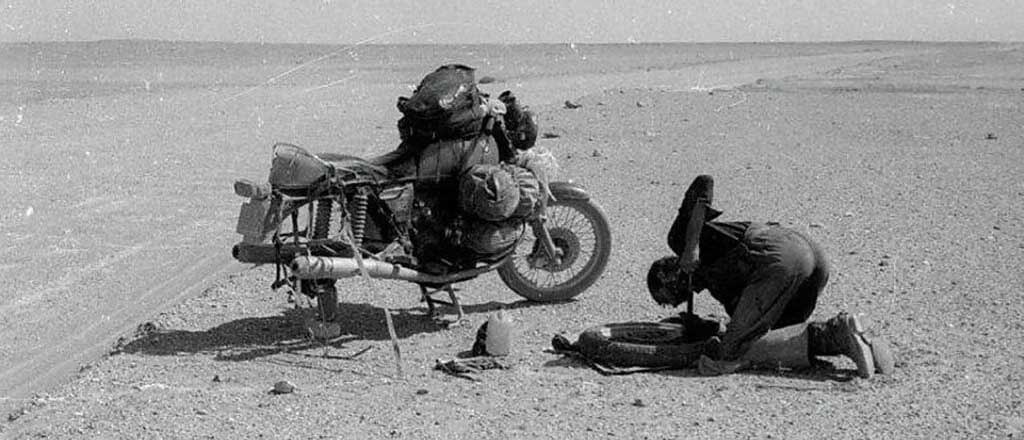
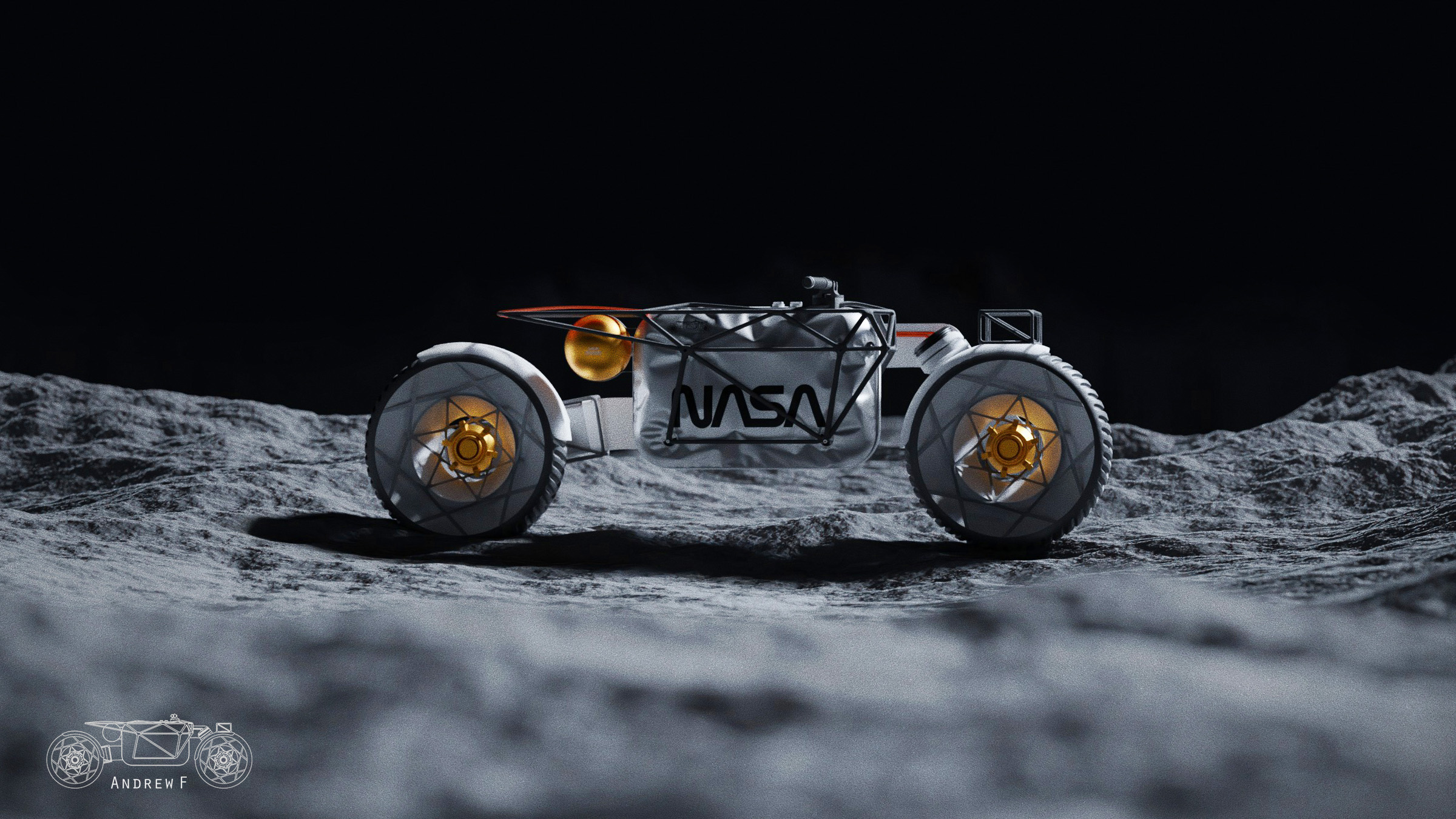
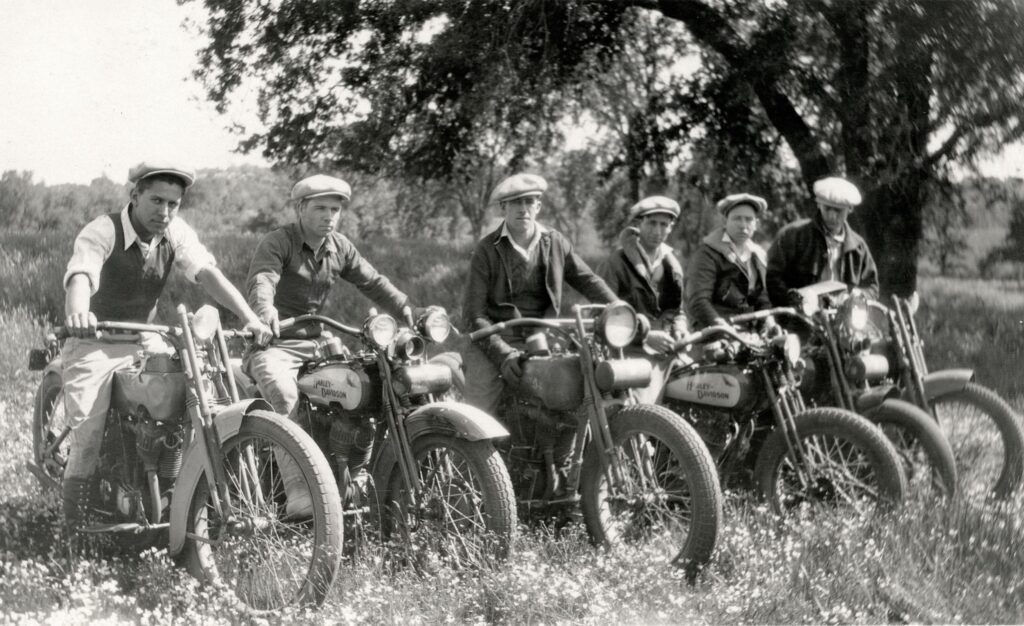
It is said no plans survive first contact with reality, and for me things started to go wrong from day one. It was the 90th birthday of my Brough Superior SS80 and I planned to celebrate with a 2,000 mile trip around Portugal and Italy. I’ve got to know the foibles of this bike after 15 years of ownership and thought I’d been pretty thorough, having rebuilt the mag, replaced tyres and chains, checked and greased suspension, replaced cables, etc. I’d put around 300 miles on her around my home town of Hay in the Welsh borders without a hitch and even the dynamo seemed to be generating a feeble but optimistic glow.
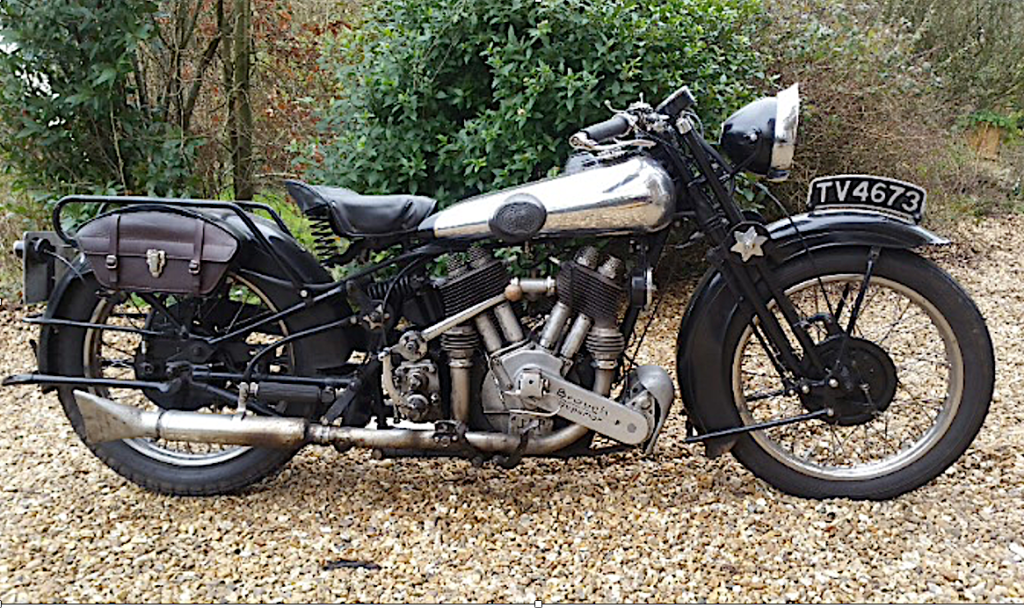
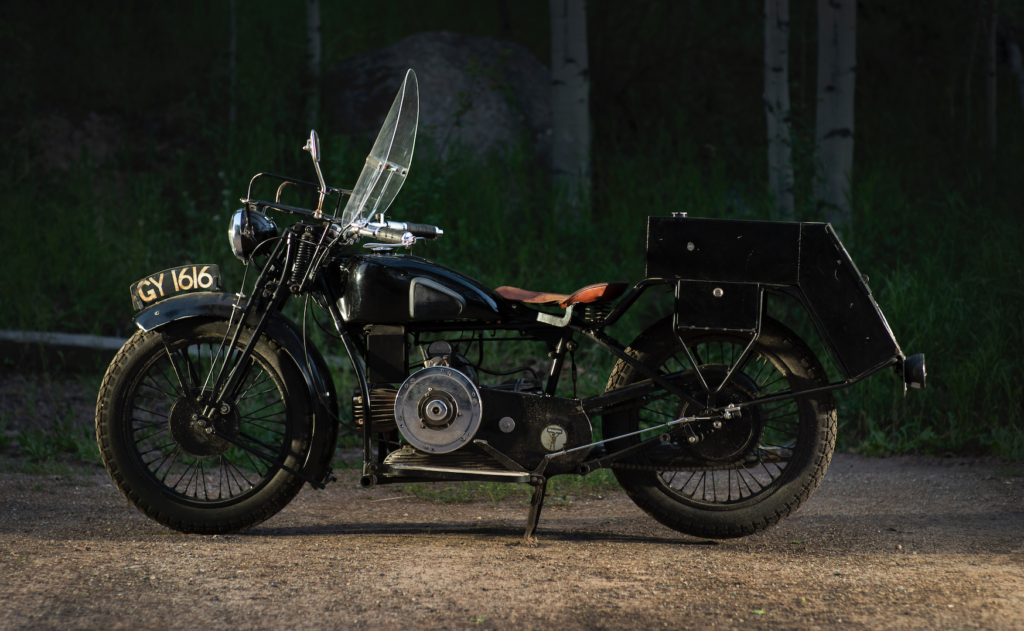
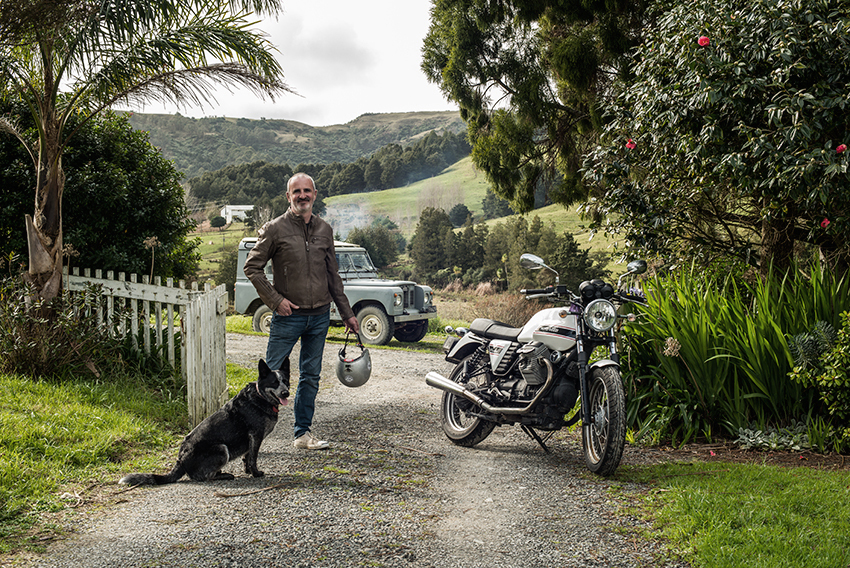
David Jackson's 1931 Brough Superior SS80 is a very hi-spec model, with JAP KTC motor, Bentley&Draper rear suspension and Castle forks - rare options for the SS80 model that provide a very comfortable ride and excellent roadholding, but limited ground clearance. [David Jackson]I was cheating a bit – my friend Russell seems to enjoy driving and had taken the bike, together with 8 others, to Porto in a truck. We only had to jump on an Easyjet and meet him there. What I didn’t know was that Portugal did not accept the NHS Covid certificate and I was turned away at the gate. An uncomfortable night in the van at Bristol Airport followed, after which I got tested, and another flight to Lisbon the following day. I had to try to figure out how I could get to Porto, find my bike and catch up with the rest of the group. It had been left at a farm house just outside the city, so after an anxious journey by taxi, tram, tube and train I finally got started by late afternoon, about 8 hours behind the pack.
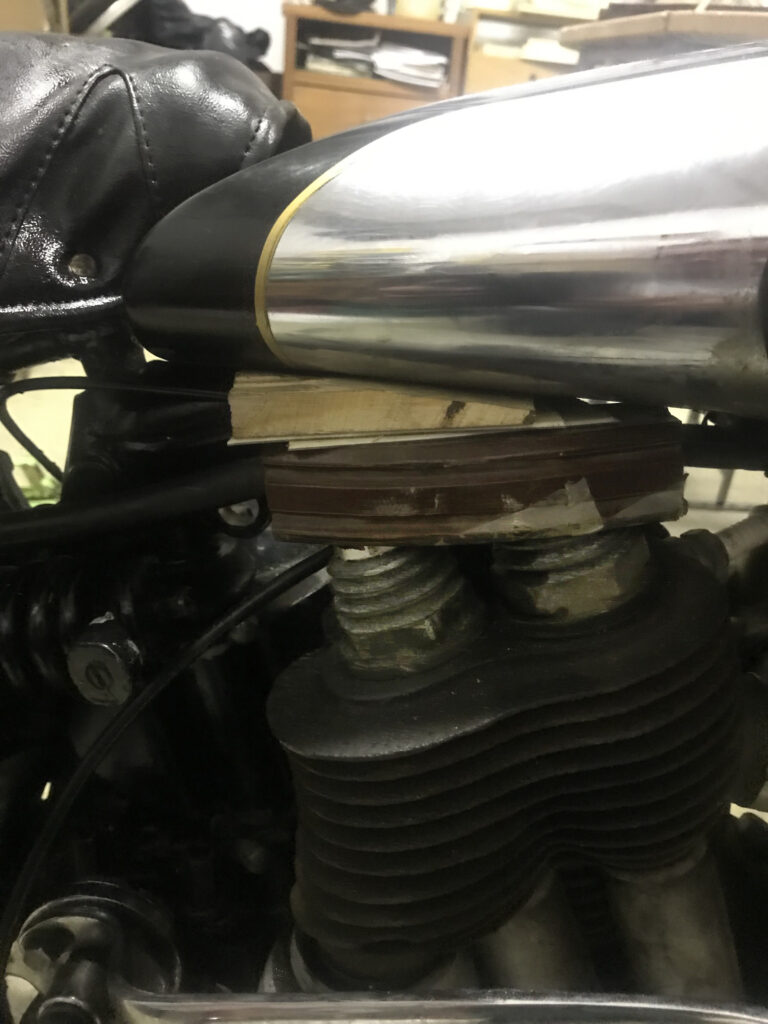
A clever idea that didn't work: wedging the valve cap in place with pieces of wood. Even the low compression of the sidevalve engine was enough to blow them out. [David Jackson]My head was pounding without sleep, but I thought I’d try to get two hours riding in before dark. The other riders I figured were about 150 miles north over the border with Spain. There was no way I’d get there that night, but decided the next day to head 200 miles straight to the north eastern town of Chaves where they were due the following night and I could stage a surprise interception. After all that hassle perhaps I would only lose a day’s riding. I found a hostel and feeling relieved to be finally making progress, crashed into bed. It was so deep a sleep I was oblivious to the pounding of the overnight rain and the next day saw the place enveloped in cloud and drizzle, every bit as cold as home. One of the features of my Lucas mag is a mysterious short to the frame in bad weather, and Vaseline in great dollops around the pickup is the only cure. I'm still nervous about the magneto in the rain, and I must have slathered on half a tub before I set off that morning. Despite all I was feeling rested and very positive, determined to make the hero’s entrance at the hotel that night. All the same, alone and abroad on an old bike in the cold and wet with no phone reception, every squeak and rattle begins to sound ominously threatening.
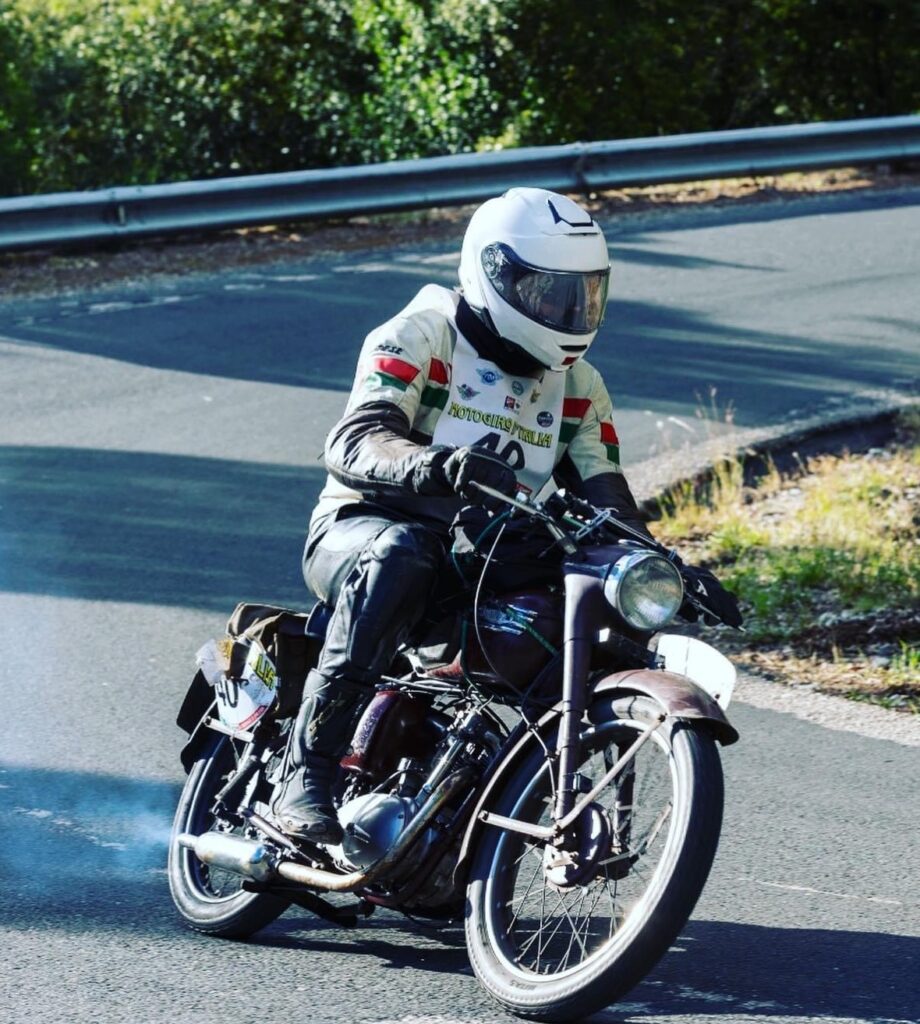
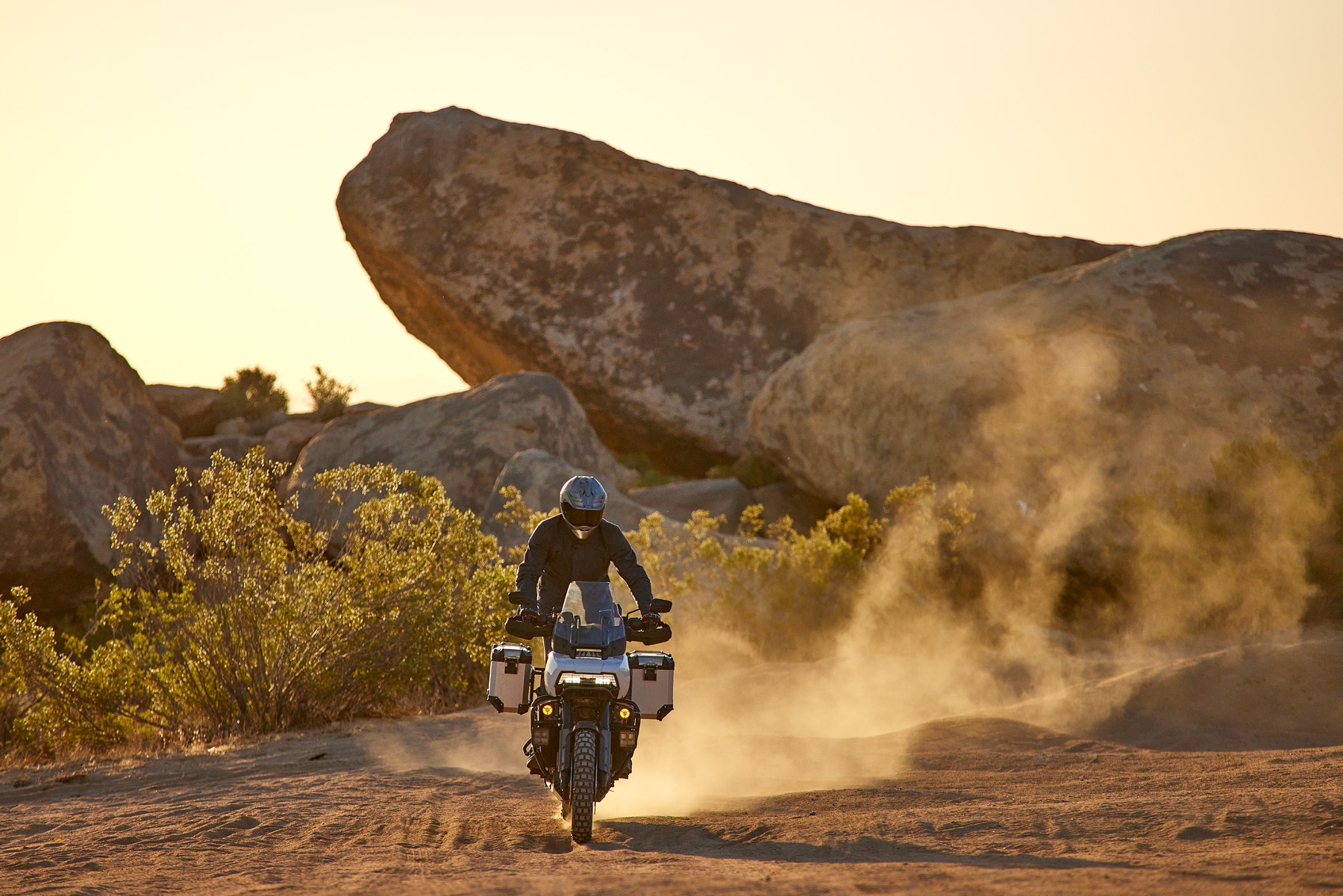
Riding a vintage V-twin through the mountains is an experience one remembers for a lifetime. [David Jackson]The north of Portugal is not the Algarve; it is mountainous, thickly forested with spruce trees and has some excellent motorcycling roads which are largely free from traffic. Roads climb and plunge through steep valleys as high as 1000metres and I could really feel the engine richening up, losing power it really couldn’t afford. Throughout the day the rain continued and at times visibility fell to just a couple of hundred yards, but the Brough plodded along happily and I began to feel like I was on holiday. The JAP SS80 engine was already obsolete by 1931. It is a 1000 cc side valve total loss design generating something like 25hp, which consumes about a pint of oil every 100 miles depending how you set the pilgrim pump. The bike itself is a handsome but long slow steering machine of about 220 kgs, with very poor ground clearance. First to ground is the nut securing the footrest, which I’ve learned to use as a kind of skid providing feedback in a corner. They rarely last longer than a day so I always keep a handful in my pocket. Such an underpowered heavy bike with a hand change Sturmey-Archer three-speed gearbox makes the Brough a handful in mountainous terrain. Steep descents depend heavily on engine braking in second. Regular dabbing of the back brake helps, but over use quickly leads to fade and the effects of the front brake are barely discernible. The only thing to do is to plan far ahead, hope the unexpected doesn’t happen and if things get out of hand look for somewhere soft to bail out.
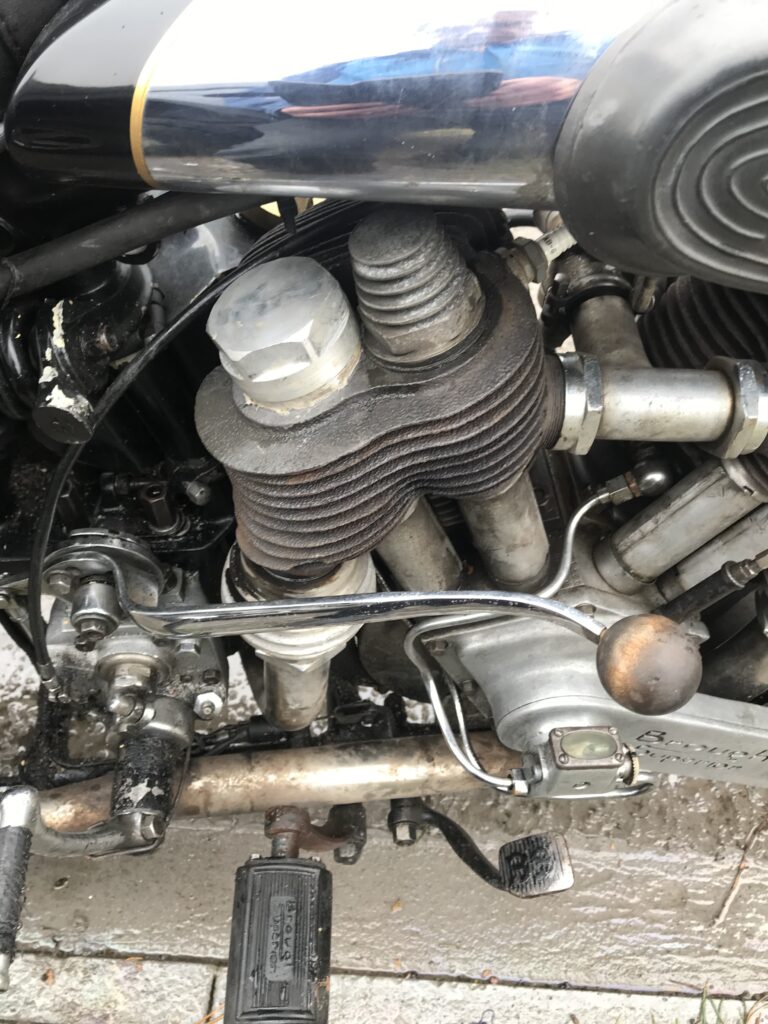
The replacement valve cap in situ, also showing the external shift mechanism of the Sturmey-Archer 3-speed gearbox (an 'ankle shifter'). [David Jackson]The knack of getting the best out of the engine is not to overfeed it with fuel, but to aid its digestion by regular use of the advance retard lever. A hill start for instance means a burst in first at full advance, followed by a panicky hand shift to second, then full retard for a slow pick up gradually advancing the spark as the engine begins to speed up. Missing second is easily done, after which you just grind to a halt and repeat. Uphill switchbacks and hairpins offer a unique challenge; swing it around in second with as much speed as you dare, move to full retard, try to keep momentum and hang off the bike to minimise lean angle whilst trailing a shower of sparks from the unfortunate footrest nut. None of this would have featured in George Brough’s promotional material, but then neither do I ride in with a tie, a Fair Isle sweater and a pipe. With only 20 miles to go, disaster struck. A sharp crack from the engine halfway around a corner and I immediately lost power. Pulling over I noticed a hole in the top of the cylinder - one of the “fir cone” valve coolers had blown off. This was bad news – even if I managed to find the thing it was most likely to have stripped its alloy threads which screw into the harder cast iron head. After a short search by the roadside I found it and sure enough only a couple of threads were intact. I screwed the cooler back in as best I could knowing it wouldn’t last long, and within a mile sure enough it blew again, this time ripping off what remained of the threads. Being so close I was determined to make it to the hotel under my own steam, nursing the bike along at 20-30 mph on one pot. One cylinder pulled okay without it having to fight the compression of the other but with a hole to atmosphere downstream of the carb I was very wary of it offering too weak a mixture and potentially damaging the front pot too.
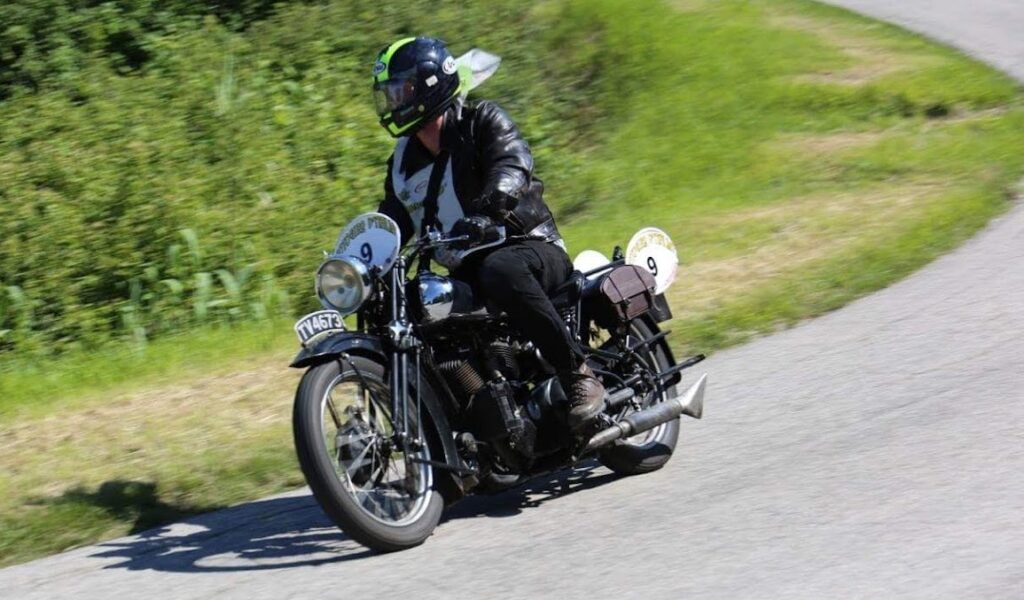
Repaired an under way! Testing the Brough Superior's road-holding around mountain corners on the MotoGiro. [David Jackson]I arrived in a haze of smoke and oil, relieved to be amongst friends and we set about thinking about how to repair the cooler. It’s not a complicated thing – a large 2 inch diameter alloy nut with 16 tpi threads would do the trick – something which could easily be knocked up in 30 minutes on a lathe. The best idea came from Nick, a carpenter by trade, who thought he could hold the old cooler in place with wooden wedges placed between it and the bottom of the tank. The hotel staff kindly obliged and we set to work in their workshop. By 10pm that night Nick had quite skilfully put together a series of interlocking blocks holding the cone in place and I tightened the tank down to increase the pressure on the top of the cone. It was a crackpot idea but the best we had. I took a tentative swing on the kickstart. Suffice to say an explosion at 6 bar of compression smashed the whole lot to pieces and I was lucky not to ruin my fuel tank. It was not to be. Accepting defeat we loaded the broken Brough on the truck and I joined a couple of other casualties in a hired Fiat Panda. Stewart had fried the ignition on his 1960s MV Augusta and Clive had seized the engine on his Triumph Terrier. We had a pleasant couple of days touring the spectacular Douro Valley in our Panda jealously watching the other riders enjoying themselves.
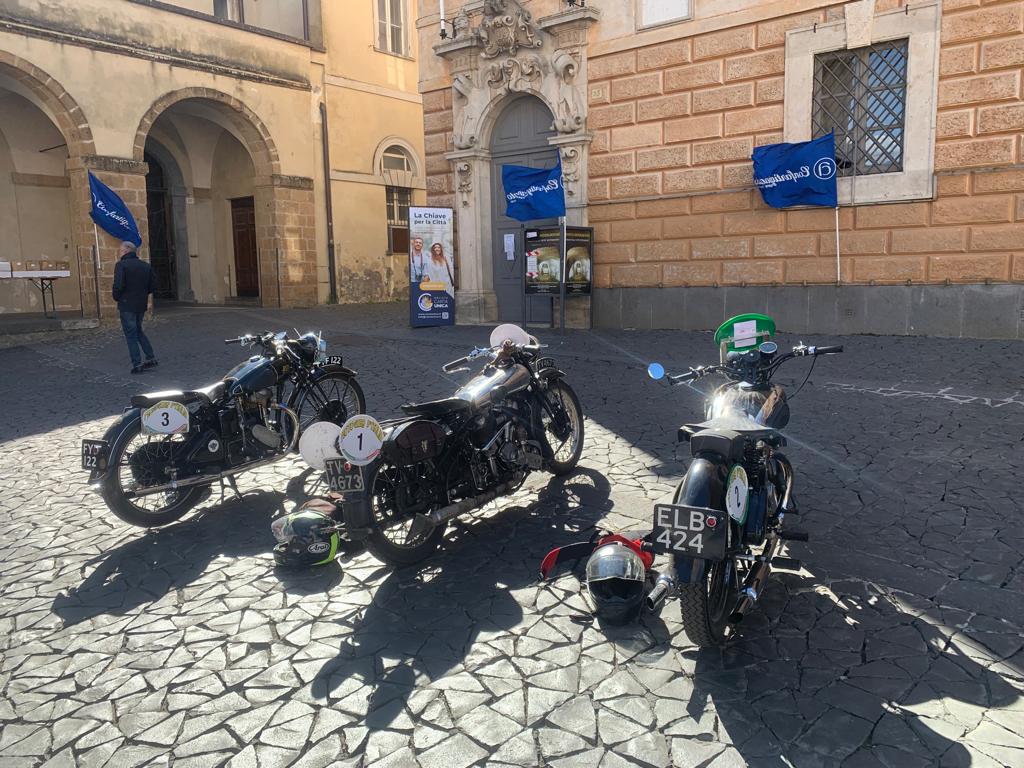
MotoGiro particpants: combined age 260 years for a pair of Rudge Ulsters and the 1931 Brough Superior SS80. Vintage motorcycling at its best. [David Jackson]My thoughts were turning to the next leg: the Motogiro Rally of Italy which was beginning just over a week later. I really wanted to take the Brough – it would be its third completed Motogiro and it had become a bit of a celebrity there. Most Italians have heard of Lawrence of Arabia and it always seems to attract attention. I spoke to Mark Upham in Austria and he agreed to send a couple of fir cones out straight away, but you can never tell with post Brexit customs and I wasn’t sure I’d get them in time. I decided to get one made anyway and I watched fascinated as my local machine shop knocked one up in about 20 minutes. It was big and ugly, but it did the job and a week later, thanks again to Russell and his truck, there I was in Rimini on the Adriatic coast ready to start stage two. The Motogiro d’Italia has been an annual fixture since the 1950s, originally established to race small capacity Italian machines over 1000 miles of the toughest terrain in Italy. It is still a big deal: the organisers select different courses each year and carefully signpost the route ahead. There are stops organised roughly every hour, and local people come out in force to spoil us with pizza, cakes and sandwiches, often in beautiful medieval squares otherwise closed to traffic. Oh and wine, from 10 am throughout the day. A few mounted Carabinieri police accompany us, often shepherding us through traffic with sirens blazing. It all makes you feel very special.
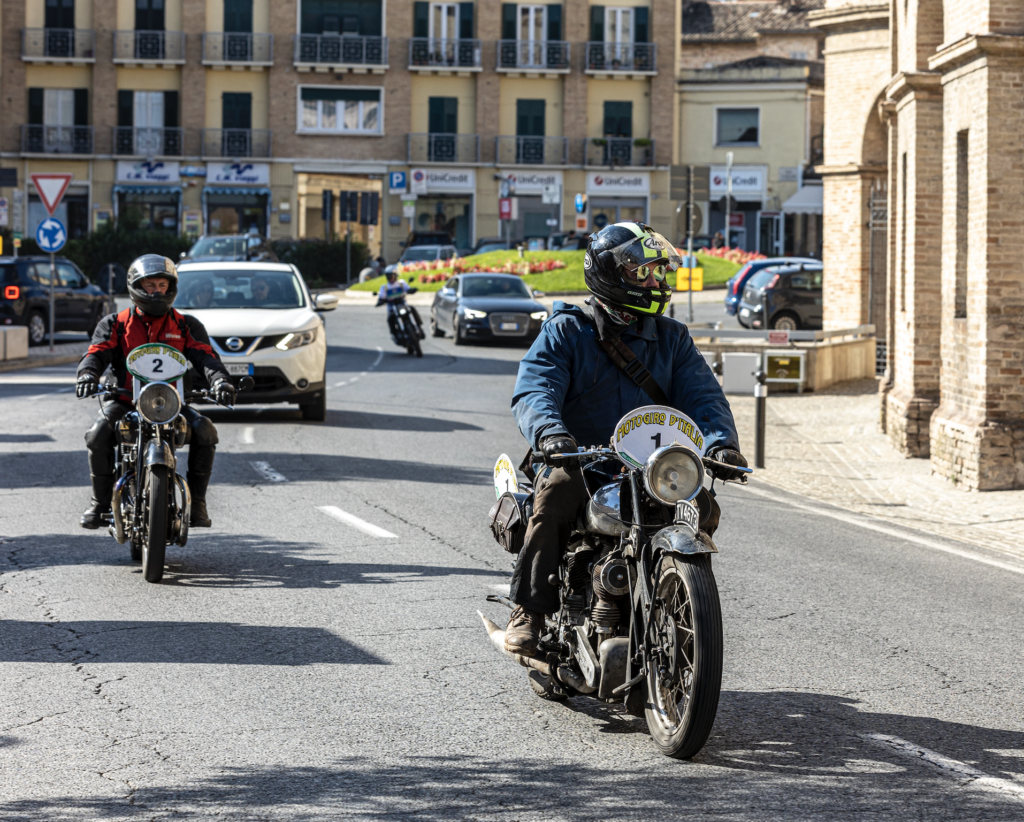
Wild in the streets: the Brough leads a Rudge Ulster through a town on the MotoGiro. [David Jackson]Nowadays bikes of all ages are welcomed but its heart is still old 1950s Italian tiddlers, and the winner must come from a prescribed list of machines. Around 20-30 Brits made it this year out of, I guess, about 120 riders from all over Europe and the US. A special “vintage” pre-war category had been created for me and Jeremy, also from Hay, who rides a 1936 Rudge Ulster. Jeremy and I tend to ride together but are fiercely competitive and up to this year had each won it once. Another Brit joined us in the vintage category also on a Rudge together with a nice old Italian on an a Moto Guzzi Falcone. By the end of the first day the Italian was way ahead of us on points and we guessed this year he was pre-destined to win. It’s a mystery, but it often seems to work that way. With apologies to George again I have to say a 1936 Rudge Ulster is streets ahead of a 1931 Brough Superior both in design and quality. A drip free alloy cast primary drive, four overhead valves, a four speed foot change box, a circulating oil system, interlinked brakes which work, a light short wheelbase flickable frame, about 10hp more from half the capacity and a bike you could buy for a fifth of the price. I could go on. But as Richard Thomson says it doesn’t have the soul of a Brough 31.
A Triumph Terrier under a punishing rally schedule and torturous roads? Only for the brave (ie, Clive). [David Jackson]The first day was a wash out. It rained torrentially and got worse the higher we climbed. Off the main highways the roads were in dreadful condition, with large land slips to the sides, strange undulating ripples and huge nut crunching potholes often lurking around blind bends. Choose your line and speed on the Brough and you must stick to it, whatever lies ahead. A dry afternoon spell brightened things up until - wham! - the front end washed out and I found myself sliding across the oncoming lane at 20 mph towards the Armco. The brunt of the damage was to my dignity and the poor old footrest, but looking at the road, my speed and impact point I can honestly say there seemed no reason why it happened. I don’t mind falling off due to my own idiocy but its unsettling when you suddenly find yourself on your arse and don’t know why. A lorry was labouring uphill and 20 seconds later I would have been under its wheels. On the first day too – but either I was going to spend the next six days worrying myself into a neurotic mess or I was going to pretend it never happened. I banned Jeremy from laughing about it until after the trip and we carried on.
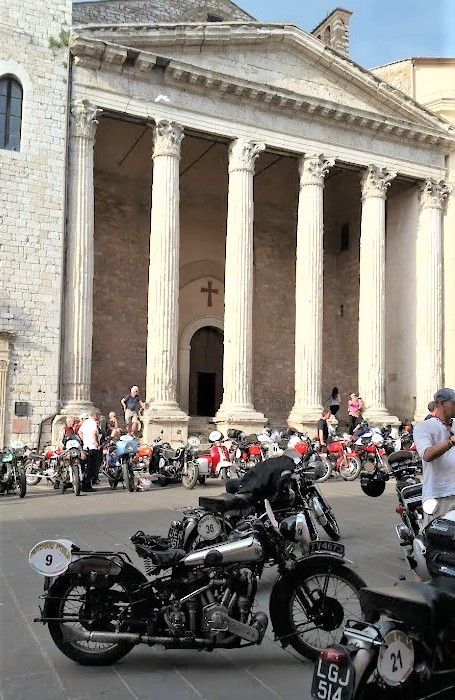
An impressive Doric facade dwarfs a legion of riders, but that's Italy - the architecture is amazing. This is likely a pagan temple converted to a church perhaps 1800 years ago. [David Jackson]Who else should be at the start line by the way but Clive on his Terrier, who had found an equally knackered spare engine on his shed shelf and hastily installed it for Italy. Whatever my woes, I always consoled myself that Clive’s lot was infinitely worse. A big man, he was always to be found in the 121st position of the pack, hunched mournfully over his machine labouring up yet another mountain billowing smoke. Each night found him spannering in the car park, head and piston akimbo and surrounded by helpful advice. A sheared rocker feed and lost cover ended with him directly injecting oil into the exposed valve springs by syringe every ten miles or so. I’m surprised that wasn’t a feature of JAPs. The next six days blended into a whirlwind of magnificent countryside, good weather and ancient but seldom visited Italian towns. Some days were as long as 8-9 hours riding, with little time to grab a sandwich en-route. The condition of the roads, together with the fact that you are always busy on a Brough, left little chance to look up and enjoy the scenery. The relentless pace of the event is perhaps its only drawback, but the compensation is that you don’t have to map read and are led through some marvellous country which few visitors know exist. We criss-crossed the Apennines numerous times, from the Adriatic to the Med, back and forth, up and down, at one time through the snowline with the temperature falling to 3 degrees. Altitude stretched the Brough’s slender reserves of power to its limit, and at one stage it refused to pull in top gear at all.
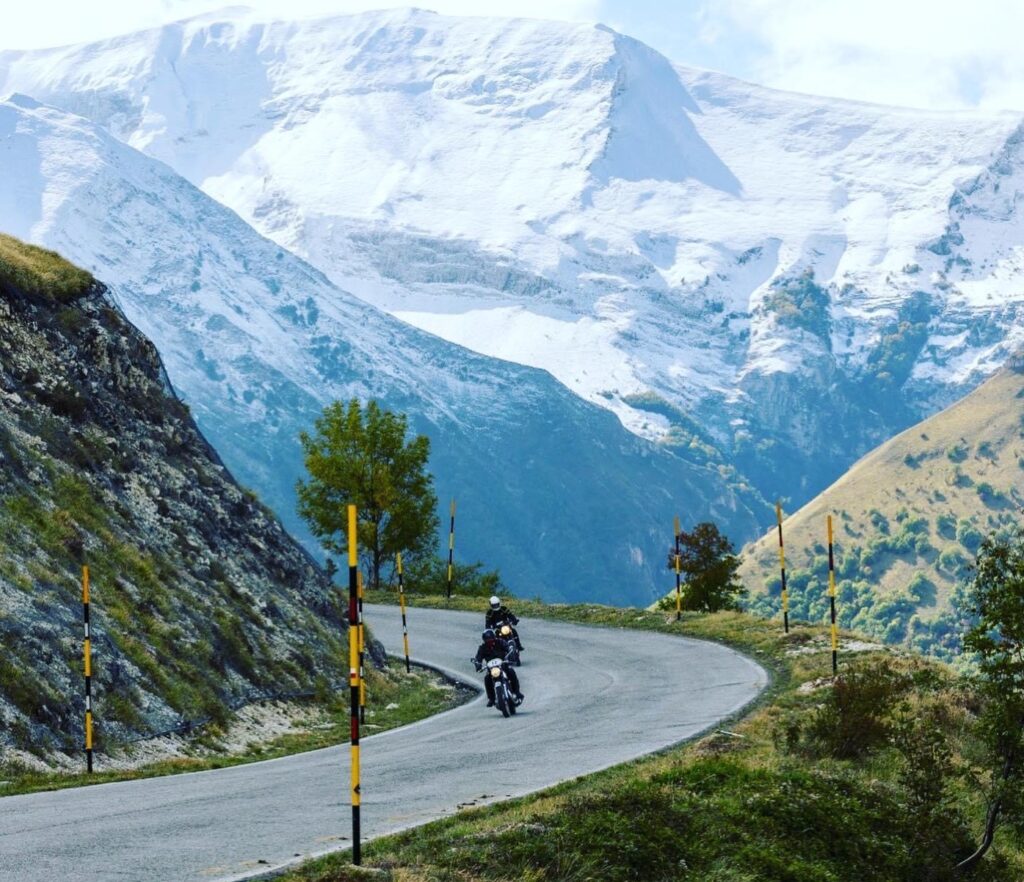
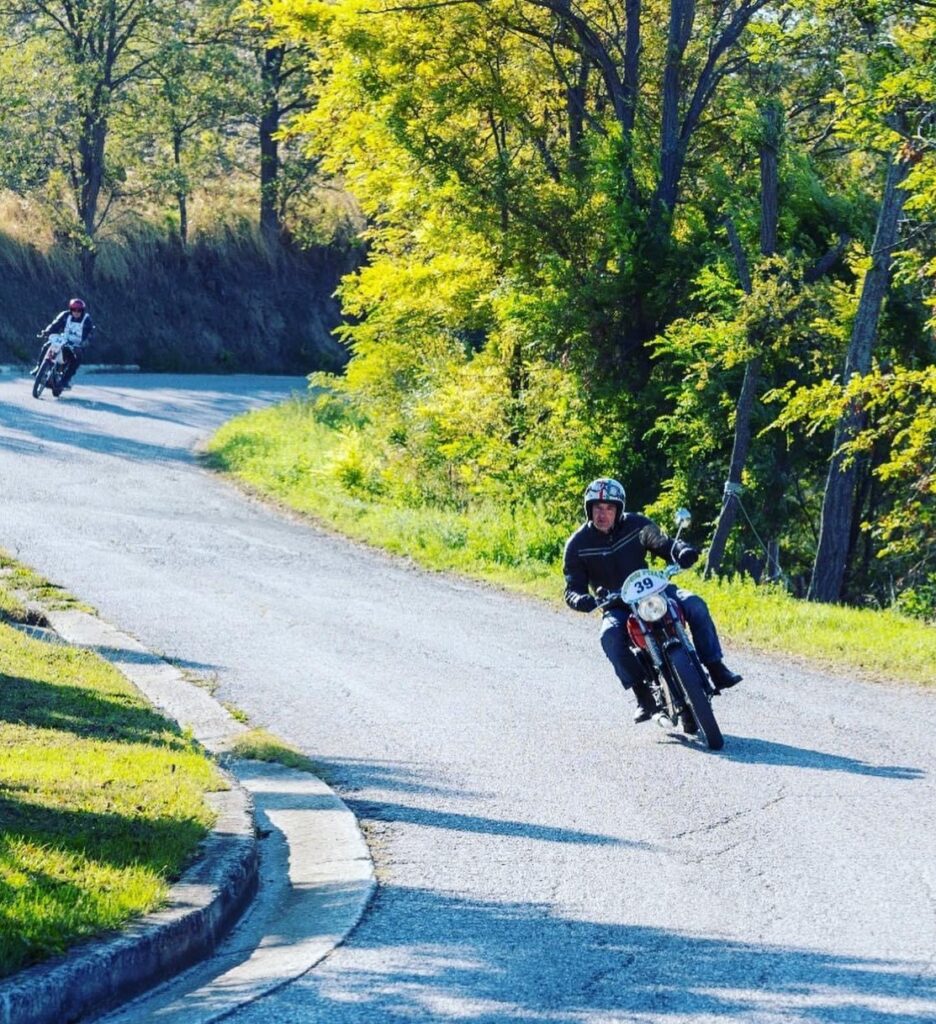
Twisting roads though the Italian hills are the norm on the Motogiro. [David Jackson]No day was entirely incident free. I snapped my rear brake cable twice, one of the things I’d carefully made up in my shed before the trip. The bike is hair raising enough with a rear brake, but losing it adds entirely new layers of excitement. Without brakes you have to time your entry onto an Italian roundabout between vehicles, as if you were shuffling a deck of cards. A mountainous descent felt like a dance with death. I kept thinking about pilots on the western front, fluttering to earth in a spinning string bag and how much worse life was for them. Jeremy and I tried our best to make another cable, only for it to fail again. I don’t know the reason why, the frayed soldered thistle just pulled its way out of the nipple on both occasions. Perhaps I’d been using softer electrical solder, it’s something I will look into. At one stage we were concerned that Nawal, the other guy with a Rudge and aged in his 70s, had failed to appear by 9pm. It had got dark three hours earlier, he had lost the course, fallen off and smashed his helmet visor. His eyes streaming with cold he had navigated home on mountain tracks using the light from his phone. We had to laugh. There is a special bond which develops between people on the Giro and by the end of it you feel you have been in a bubble of kind, funny, adventurous, like-minded people you are sad to see go.
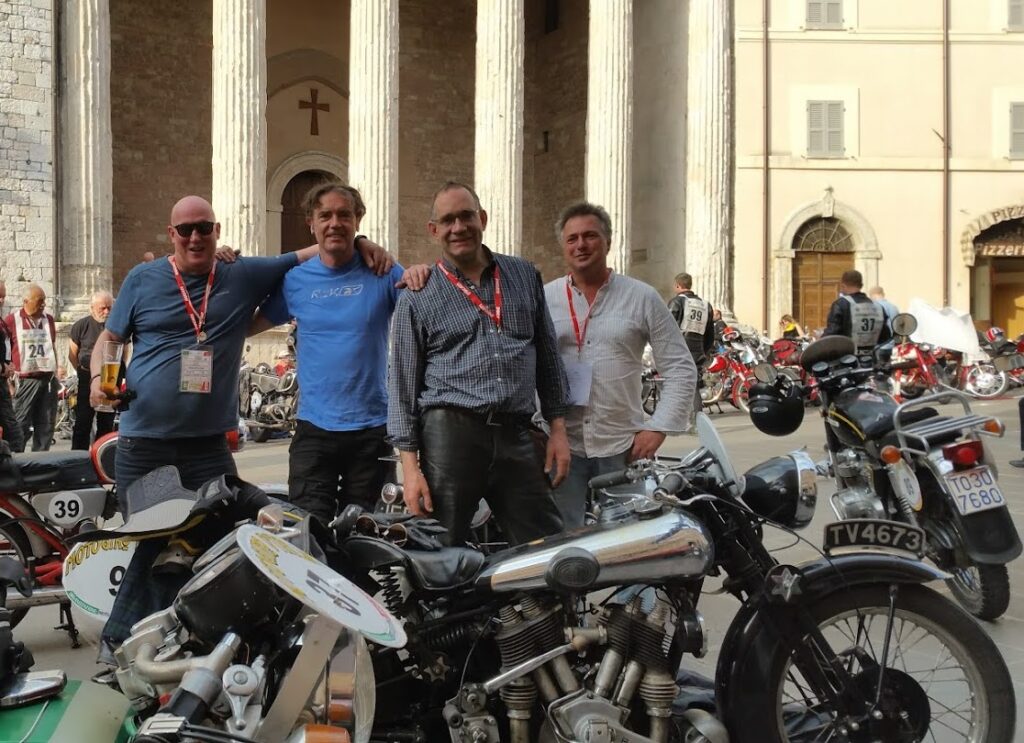
In the end, it's all about the connections you make with people that make international travel rewarding. [David Jackson]Finally the last day came, my rear brake cable snapped once more and it was with relief and exhaustion that the bike and I plodded over the finish line back at Rimini. The poor old girl had completed 1100 miles in 6 days on terrible roads, was starting to oil its plugs and misfire, was burning a lot more oil than usual and was generally ready to give up. It felt like I’d been bullying an elderly dowager through an assault course and she seemed not to appreciate her birthday treat. I myself may never walk normally again. But the prize for sheer British pluck must go to the indefatigable Clive and his Terrier, whose arrival in that tell-tale cloud of blue smoke was heralded by applause and back slapping from all nationalities. He looked ready to throw the bloody thing in a skip. The best bit? I beat Jeremy on points.
What one never wants to see: a relatively new motorcycle museum atop a private mountain in Austria, totally engulfed in flames. Photos of the disaster on January 17, 2021 at the Top Mountain Motorcycle Museum reached me in minutes, so I could watch almost in real time a precious collection of the world's rarest and most interesting motorcycles simply evaporate. Some of those motorcycles had been subject to Road Tests on The Vintagent, and included the ultra-rare sister of the 1925 Sunbeam OHC Grand Prix racer I had ridden only a few months prior at the Auerberg Klassik hillclimb event. It's difficult to convey the utter bewilderment and deep upset these images caused: I did not know exactly what was inside the museum, but knew who had loaned their machines, as well as the owner of the venue, and could only imagine how they felt at the news.
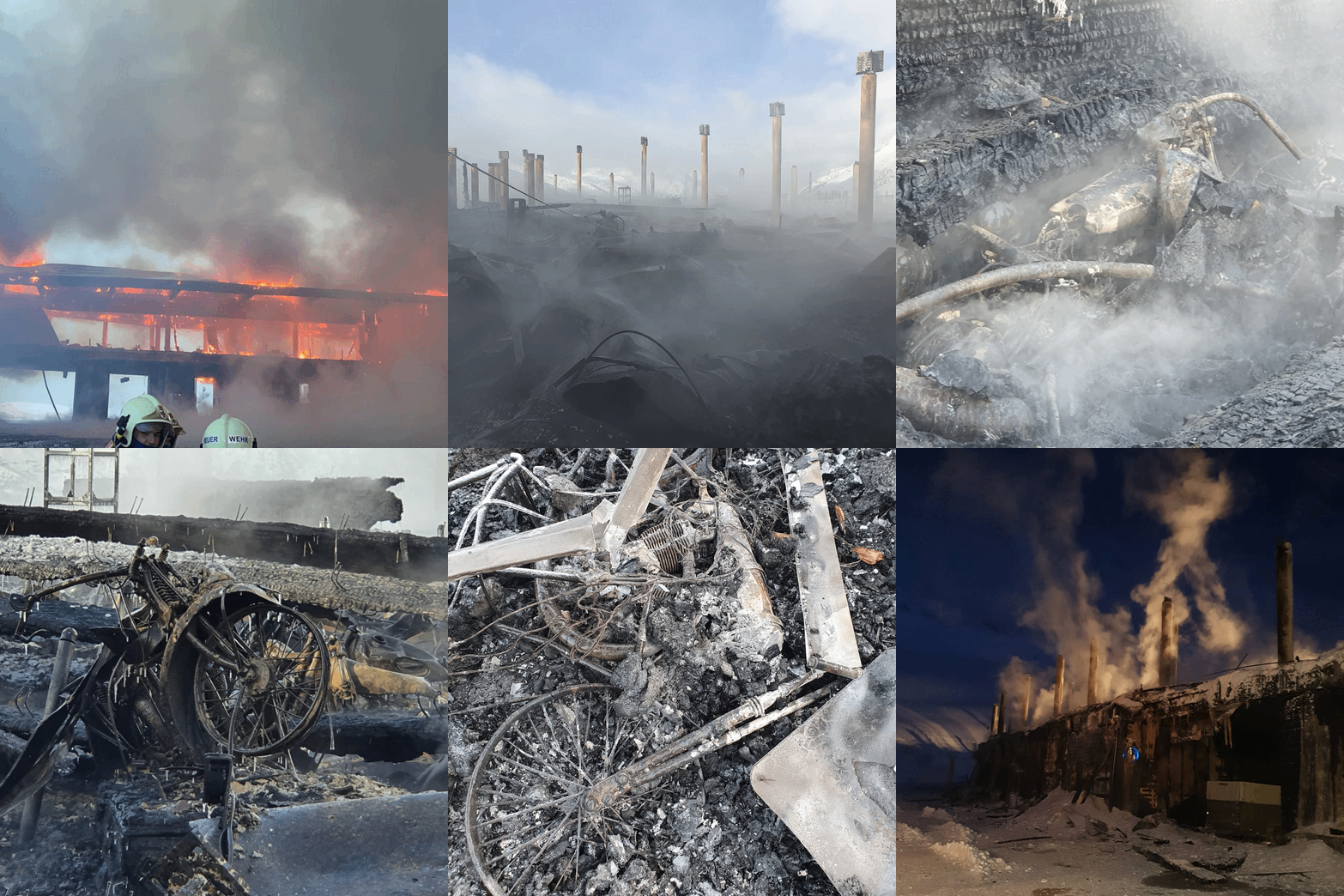
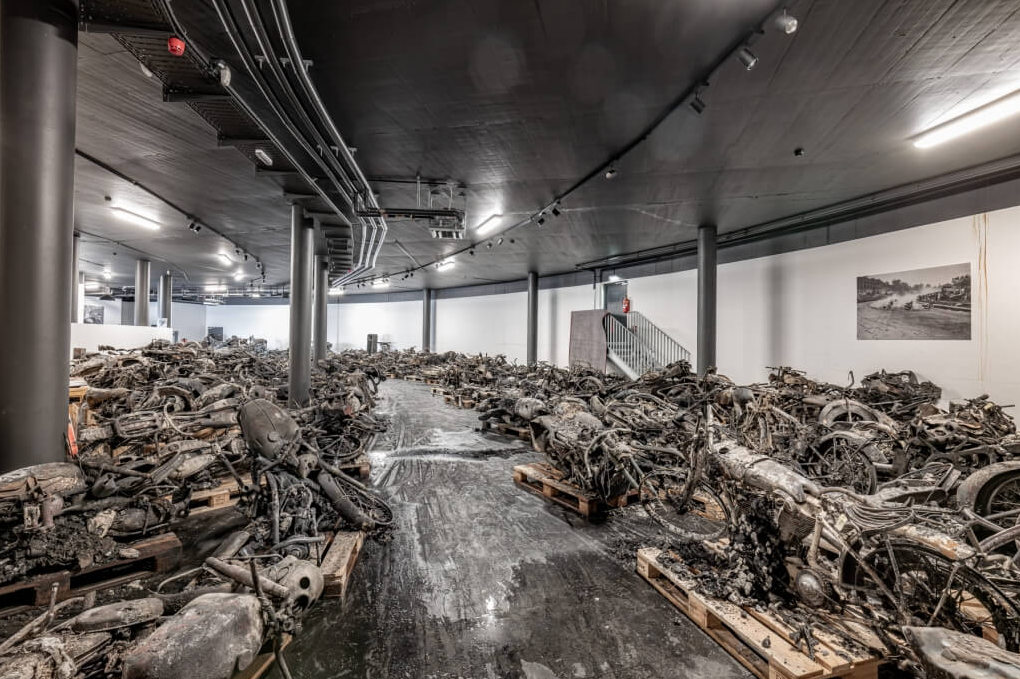
The fire and its aftermath at the Top Mountain Motorcycle Museum on January 7/8th, 2021. [Mark Upham]The devastating fire at the Top Mountain Motorcycle Museum brought back memories of the equally disastrous fire at the National Motorcycle Museum almost twenty years prior (2003). Are motorcycle museums doomed to burn? Why do they build them with wood? How could this have happened? Terrible speculation ran rampant on social media: it must have been incompetence by the architects, or maybe insurance fraud by the owners - the whole gamut of paranoid speculation and rumor-mongering when the inexplicable happens. And none of it was true. It's hard to imagine a stricter permitting, building code and inspection system than in Austria. The Top Mountain Museum was totally up to code and recently inspected, so what went wrong? Simply put, it was an electrical fire from a faulty large-screen TV display that gamed the system. There isn't a fire suppression system anywhere that's 100% foolproof, and sprinklers can be overwhelmed in the wrong situation. The result was catastrophic: a total loss of the mostly wooden upper floor of the museum, while the concrete lower floor and adjacent gondola barn were unscathed.
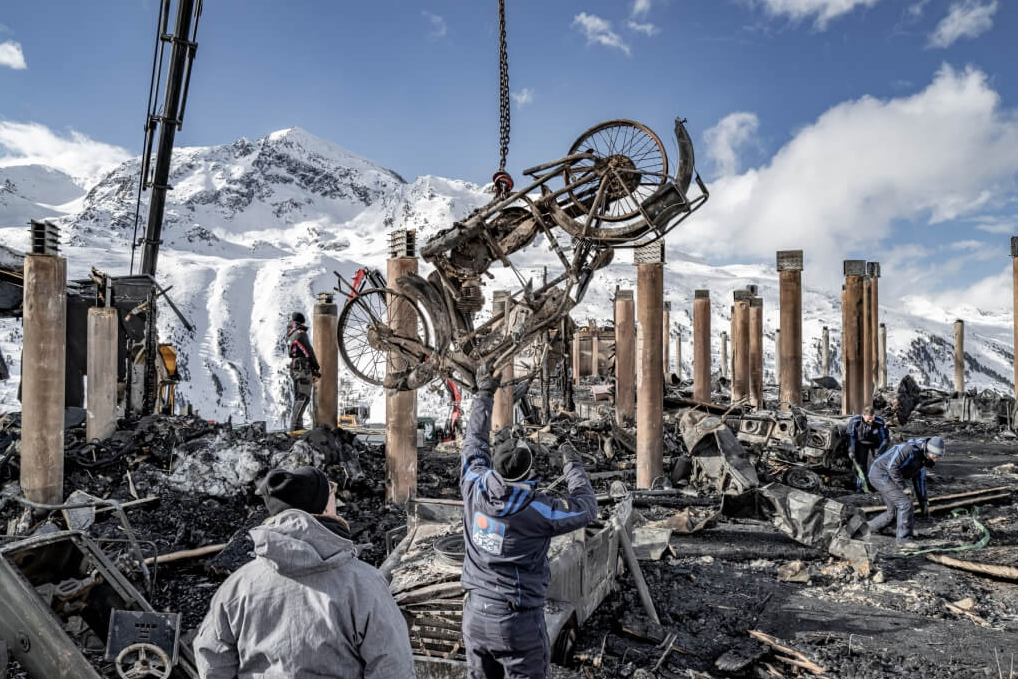
A disheartening scenario: hauling precious history like scrap metal. [Top Mountain Museum]Author Stefan Knittel is a curatorial advisor to the museum (and a Vintagent Contributor), and explains, "Why didn’t the fire stop? Everything was planned, inspected and tested and passed the test for fire safety. The commissioner for fire safety lives ten miles from the museum, and was in charge of the qualifications and tests; he had to report to the police, detectives, insurance, and state attorneys, for technical faults. He said nothing was wrong, that the museum was built to the highest possible standard. The problem is wooden construction takes longer to burn than a steel hall. This is a safety aspect; if the museum would have been open the time for escape is 20 minutes instead of a few minutes. The sprinklers are designed to pour water on particular spots, there is not a sprinkler system that drowns a space in water, but now there are better sprinklers. It was built to the best standards at the time, nothing failed, it was a terrible loss. The only good thing is the fire was during the night and nobody was harmed."
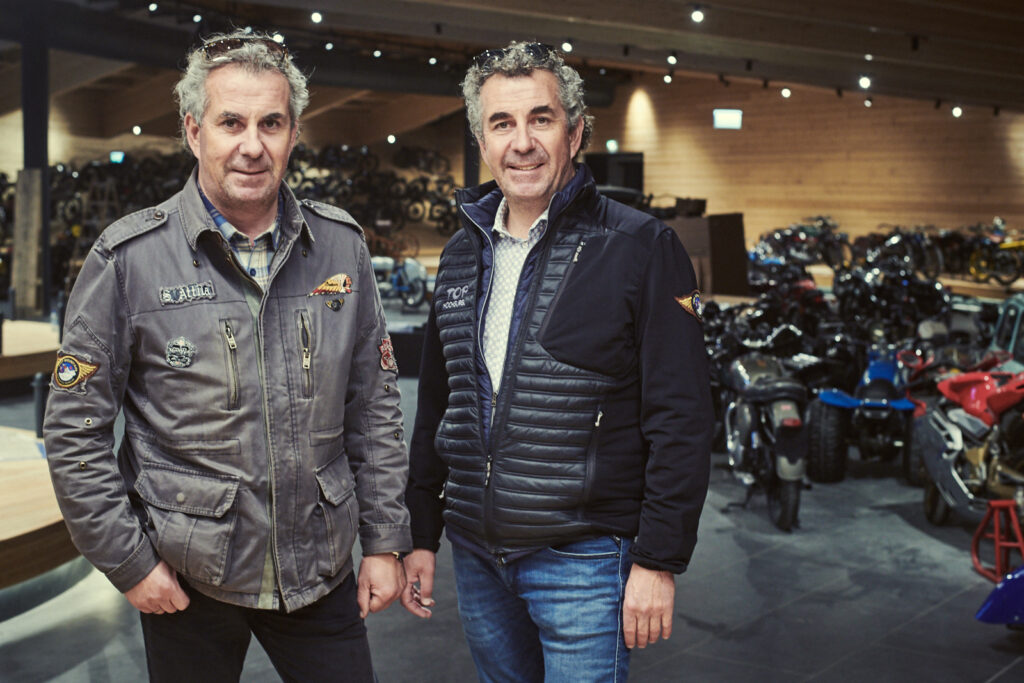
The Scheiber brothers, Attila and Alban, who own the Top Mountain Motorcycle Museum in Austria. [Fabio Affuso]
The Building and the Collections
While the ashes were still smoldering, the co-founder of the museum, Attila Scheiber, said 'we will rebuild immediately.' That seemed ambitious in the middle of a global pandemic, and the middle of Winter. But the Top Mountain Motorcycle Museum is located in the Ötztal valley in the Autrian Tyrol, near the Italian border, and the Scheiber family (the museum is owned by brothers Attila and Alban) have deep family connections in the region. The brothers were planning to build an extension of the museum in 2021, and thus had full plans, the necessary permits, and the construction bids in hand and ready to go before the fire struck: thus one hurdle was already gone, and the rebuilding project was greenlighted immediately. Stefan Knittel noted, "All the contracts were valid to build the extension already, and all the builders - wood, concrete, technical – is contracted to local companies in the valley. The Scheiber family has a 4th generation skiing business, and is the largest employer in the valley, and is more or less a team of family contacts and contractors. To rebuild the museum quickly would have been impossible anywhere else! In Germany, just to get the permissions would take a year."
A nearly inconceivable task: to quickly provide an insurance value for 360 rare motorcycles. [Top Mountain Museum]But first, the site had to be cleaned up, and the bikes sorted out for insurance, with the accompanying triage of which machines might be saved, and which were simply scrap. That job fell to Mark Upham, long time motorcycle dealer through his British Only Austria emporium, and owner of Brough Superior Motorcycles (meaning the 1919-40 originals: he is no longer associated with the current French production model). "I had to do the insurance estimates for all the bikes that burned. It took about 4hrs per bike on average, for 360 bikes, to arrive at the insurance value. Without The Vintagent's 'Top 100 Most Expensive' list this would not have been possible. I can find all sorts of evidence for particular machines, but to have the top prices documented was very helpful. If bikes were under-insured the Scheibers had to pay the margin between the agreed value and the current value; in the case of loaned bikes the Museum had to pay the owners out of pocket."
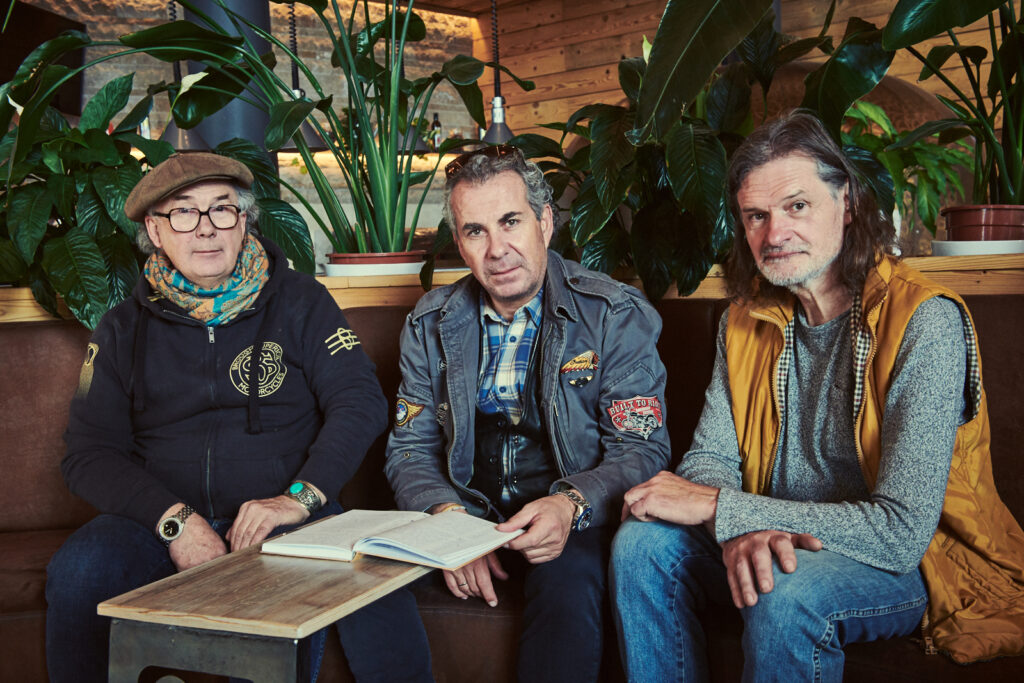
Mark Upham, Attila Scheiber, and Stefan Knittel meeting at the Top Mountain Motorcycle Museum in November 2021 [Fabio Affuso]Who insures such a collection of priceless machines? Upham puts it in context: "Remember the total value of all the bikes in the museum was nothing compared to a ship stuck sideways in the Suez canal! I was dealing with Unica, under Reifeisen Bank, and 10% was offset with a Munich insurance company, and 70% by Lloyds of London. It took some research with these companies to sort the situation." Unlike with the National Motorcycle Museum fire, most of the motorcycles at the Top Mountain museum were on loan from collectors across Europe. It was a very complicated situation, and the valuation process takes considerable time, as 'comparables' of extremely rare machines are hard to find, or simply non-existent in the case of unique motorcycles, so reasonable estimates from similarly unique and historic motorcycles had to be suggested, and justified. "People should insure their bike for market value, that’s all the insurance companies will pay."
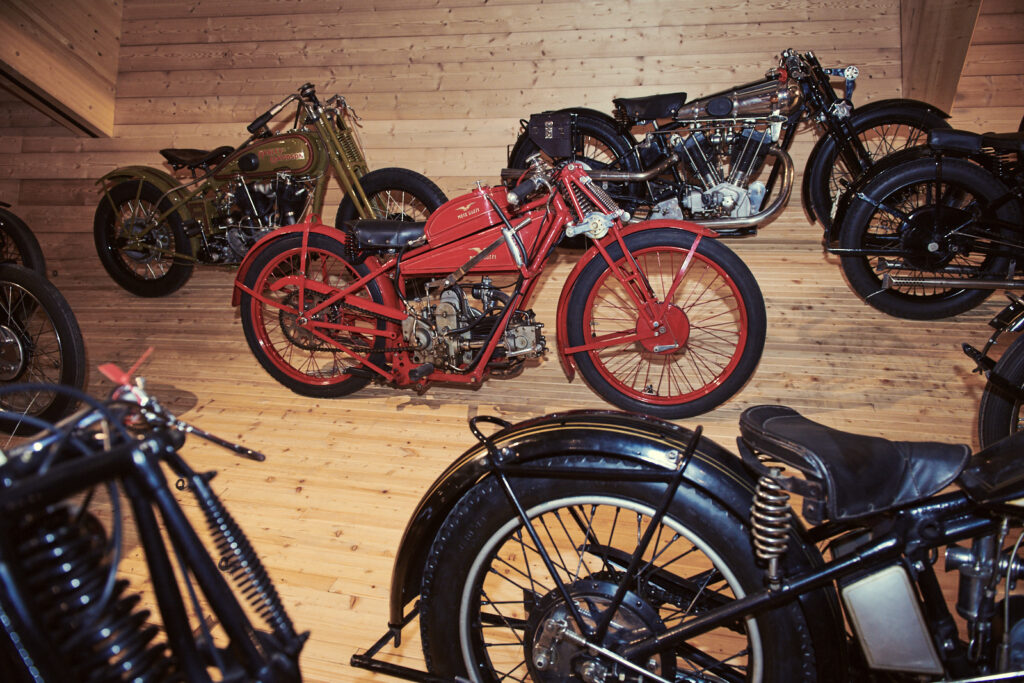
The sweeping banked wooden board track display was a feature of the original Top Mountain Motorcycle Museum, and has returned to the reborn museum. Bikes visible are a Harley-Davidson JDH racer, a Moto Guzzi C4V, and a Brough Superior SS100 Pendine. [Fabio Affuso]Then there is the question of what happens to the remains of motorcycles often worth half a $Million? Any motorcycle can be rebuilt or replicated by skilled craftspeople, and the fact that many of these machines were extremely historic and desirable - Grand Prix winners, Land Speed racers, Brough Superiors of all stripes, etc - drew unwanted attention from speculators. The twisted hulks were still smoldering when the owners of the museum, and the owners of the collections known to be on loan there, were approached about selling the remains of this or that motorcycle. The ambulance-chasers all expressed condolence over the disaster, but their motivation was pure greed, masquerading as a concern for History (read 'Death, Taxes, and Old Bike Fever'). It's a situation seen many times in the old motorcycle scene, as greed is evergreen. But, to answer the question: what happened to the damaged motorcycles?
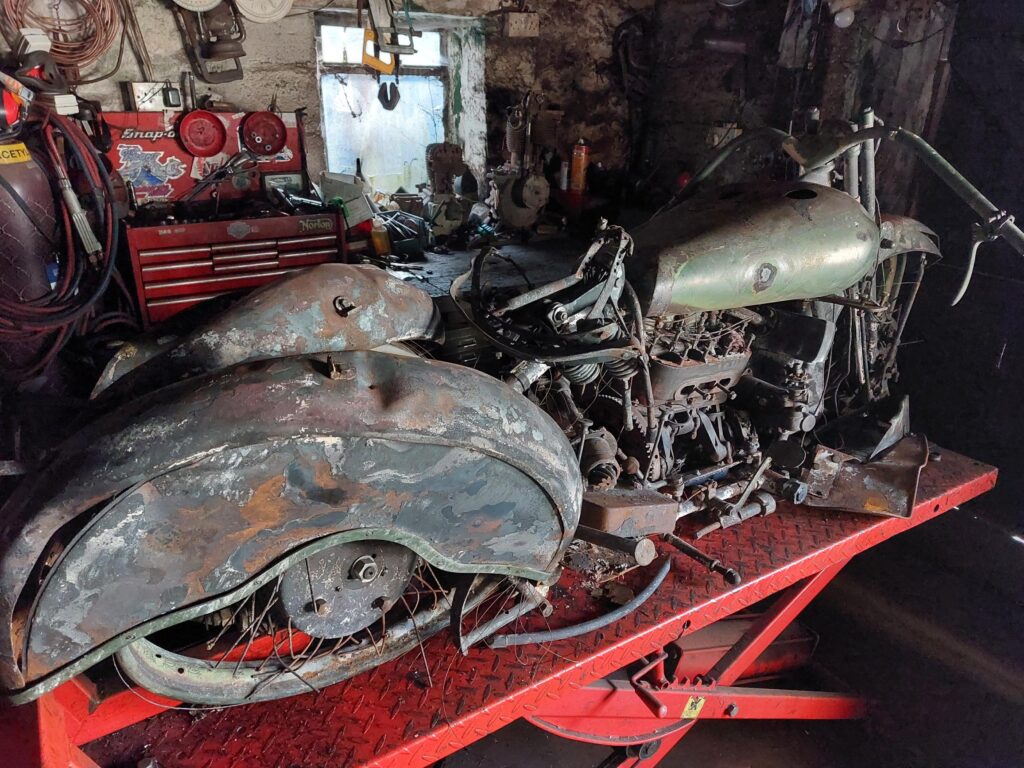
The 1930 Brough Superior-Austin BS4 'three wheeler' that was the subject of a Vintagent Road Test, currently awaiting its Phoenix resurrection at the workshop of Brough expert Sam Lovegrove in England. [Sam Lovegrove]Mark Upham explains, "What are the bodies worth after the fire? That was a big question. We thew away over 250 bikes, all low-value machines, mopeds, etc. For a few bikes there was nothing left, only parts of the frame. Any aluminum, magnesium, plastic, or ceramic was all gone. Once the insurance was paid out, all the motorcycles were sold in one lot to a salvage company, after a bidding process. They own all the bikes now. Let's hope some phoenixes come out of the fire."
A Museum Reborn
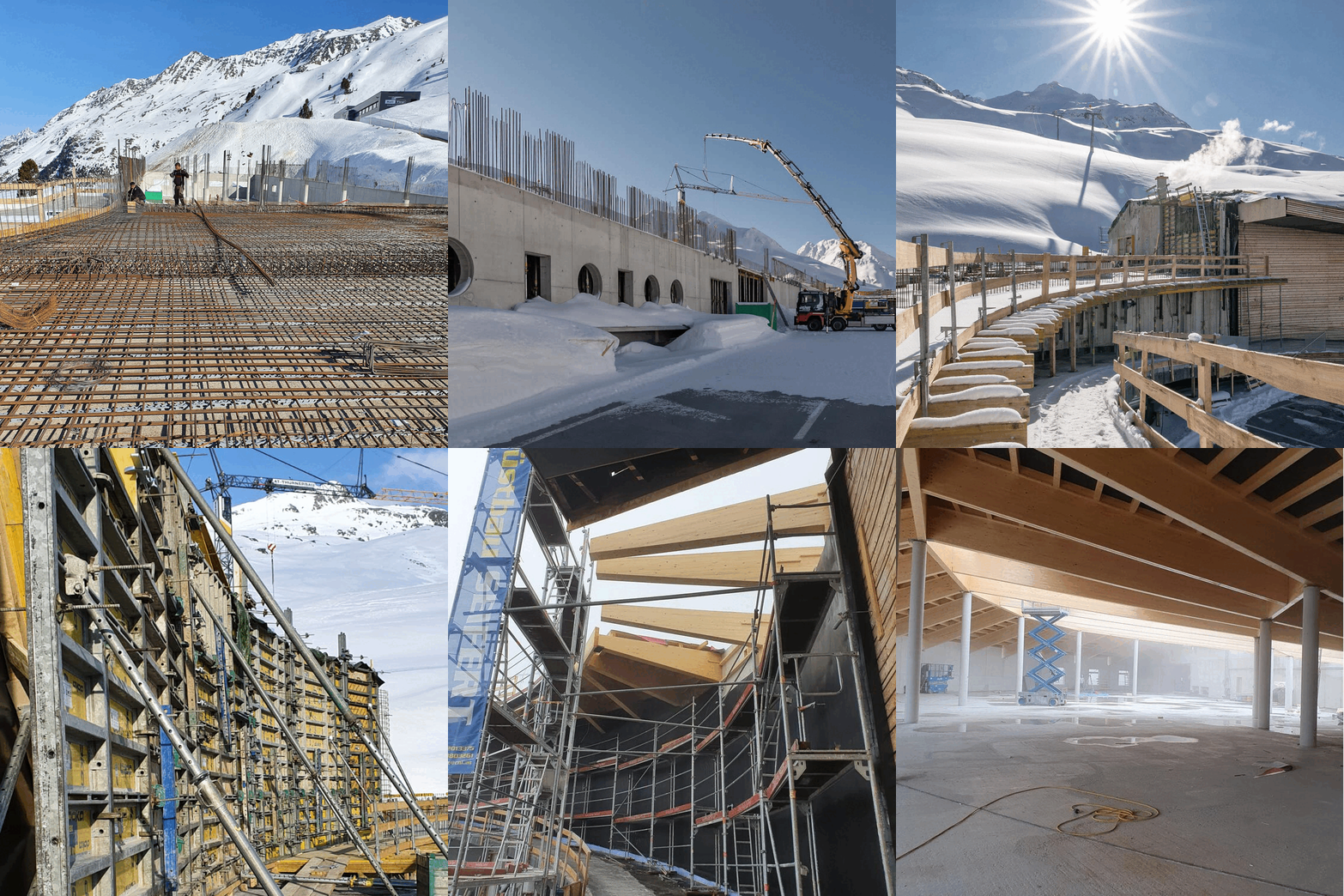
The reconstruction of the Top Mountain Motorcycle Museum seen in moments from February through November of 2021. [Mark Upham]
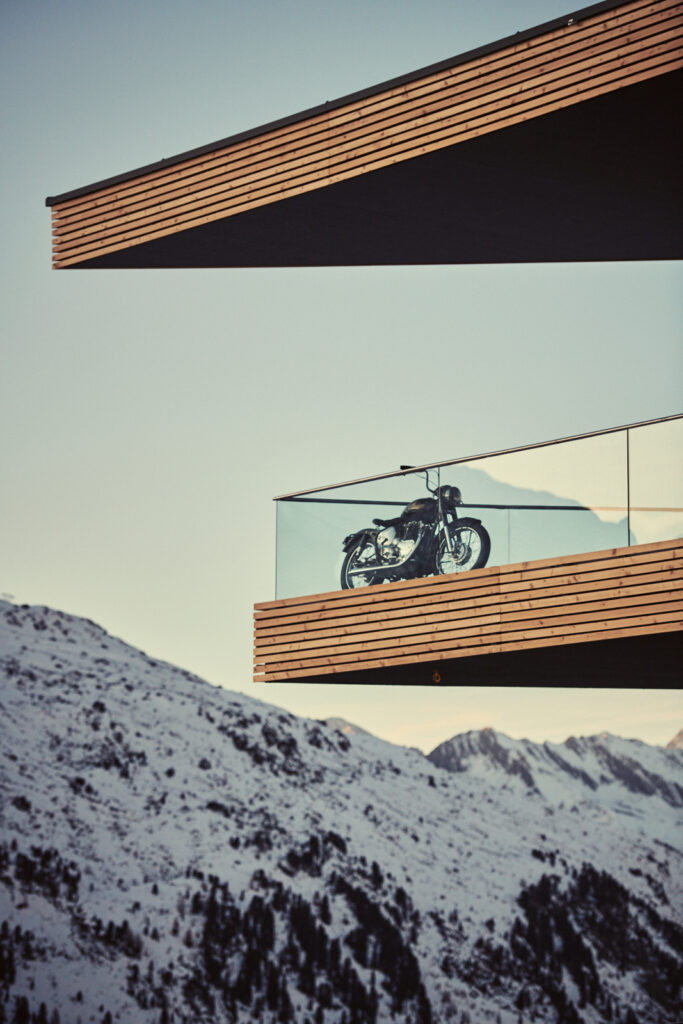
Amazingly, the Top Mountain Motorcycle Museum was completely rebuilt in 10 months. It took the tireless efforts of hundreds of people to achieve the nearly impossible. Mark Upham notes "we got the whole museum together and open, it has been exactly ten months, a major feat! Attila has 250 employees, and I counted 80 people working on the museum before they opened it." Plus, all the local contractors, suppliers, and tradespeople who lent their efforts in the midst of the pandemic, and the midst of winter, working between occasional lockdowns. Stefan Knittel observes, "The rebuilt museum now has an extension, the side hall was ready to build a year ago, and all the concrete was in place before winter. The architecture is the same, by the same architect, of the same manner - adjusted to suit the mountain slopes. From the front the museum looks the same, and you don’t see the extension as it’s off to the side from the entrance. Inside, the board track is the same, with podiums. It's fully wood-paneled inside and out, but now with concrete walls. It was built with absolutely modern standards, up to the minute fire security, specified and tested by the authorities, with fire walls installed. There were some changes beyond the originally planned addition: most significantly, the walls of the museum and now all concrete, with wooden panelling." The wooden paneling lends the same Tyrolean vibe of the original museum, while providing peace of mind after the trauma of the fire. The Scheiber family has built up four generations of goodwill in the area, and the whole region immediately expressed support to rebuild the museum after the fire. Stefan Knittel notes, "The whole area said on the night of the fire, we are ready to build when you are. All the exhibitors and loaners, the owners of KTM, etc, said on the night of the fire, we are ready to rebuild when you are. An interview on the smoldering remains with Attila was broadcast on TV and moved many Tyrol politicians. A major German collector was already planning to send 100 motorcycles from the now-closed Hockenheim Museum, so all those bikes went straight to the Tyrol. Nathalie from Deutsches Zweirad and NSU Museum offered that museum's reserve bikes, so we took 70. Plus KTM offered some contents of their museum, and some simulators, on which your mother-in-law can ride the Timmelsjoch pass in winter! They lean and everything."
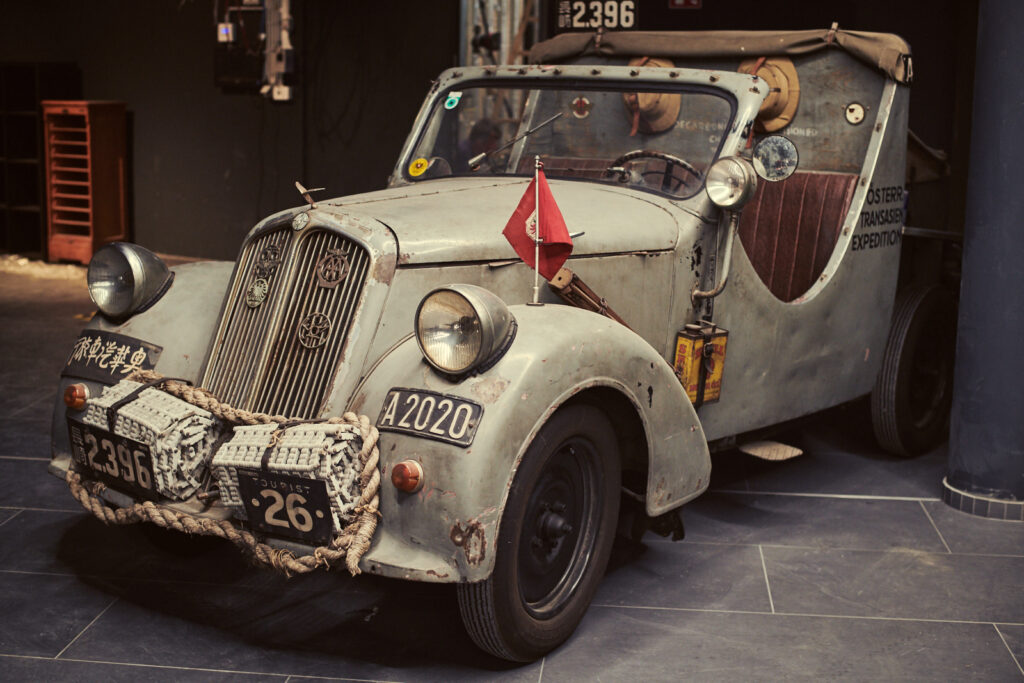
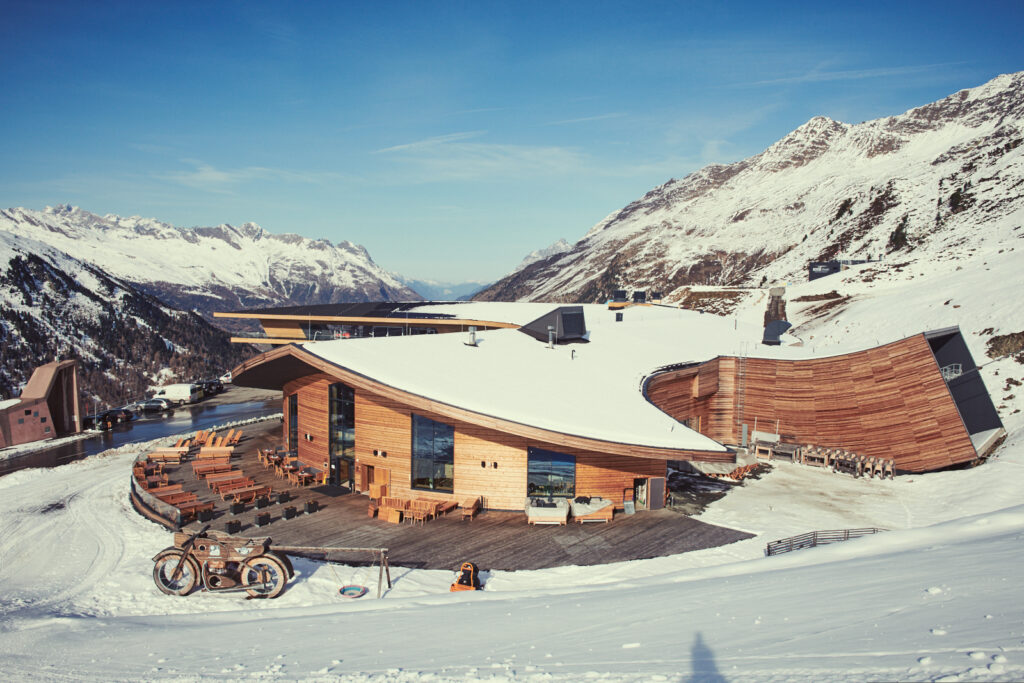
A stunning location at the top of the Austrian Tyrol, now fully functional and open for business. [Fabio Affuso]The opening party for the reborn museum was held on November 21, 2021. A full re-opening party will have to wait until 2022, when restrictions are lifted from the pandemic, but it's currently possible to visit the museum and see the remarkable collections. The grand, sweeping banked board track that was a feature of the original museum is back on display, now with an even more rare collection. Machines include the earliest of banked track racers from the Noughts, like a pair of Alessandro Anzani-designed 3-cylinder W-triples from 1903 and 1905; motorcycles like that can be seen nowhere else. Early racers from Indian, Harley-Davidson, Moto Guzzi, Brough Superior, AJS, Clément, and Magnat Debon are displayed in proximity to contemporary factory KTM racers from MX to MotoGP (the KTM Motohall). A few classic and rally cars are also on display (the Porsche Heritage collection), as is the Rausch Collection of round-the-world Steyr-Puch machines - barring Max Reisch's 1933 Puch 250 'Indian Dream', which is still on display at our ADV:Overland exhibit at the Petersen Museum. The rest of Max Reisch's two- and four-wheeled expedition vehicles are on display, with all their original equipment and traveling gear.
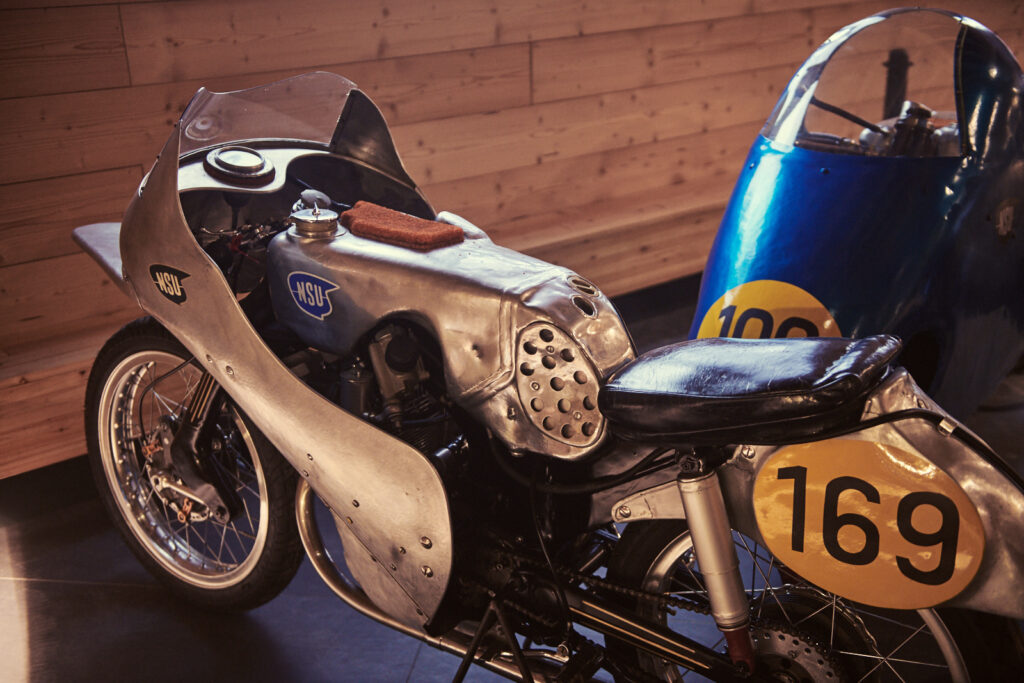
Priceless machines on display include this factory NSU Rennmax DOHC racer, a machine that dominated GP racing in the mid-1950s. [Fabio Affuso]The grand opening is planned for March. What's there now? Stefan Knittel sees "ten cars ten or so, 450 motorcycles, mopeds, scooters. It will be thinned out a little, the expressions of support and the loans were overwhelming. KTM is still bringing MotoGP and other products. The Museum will be open again once the current lockdown is over in Austria, and the official opening is in March, date TBD but in connection with the MotoGP race in Austria. A huge motorcycle festival is planned for the new extension." It's an event to plan for, and The Vintagent will spread the news once the date is fixed. Until then, the local tourist board has great info on how to get there and where to stay: check out their site here.
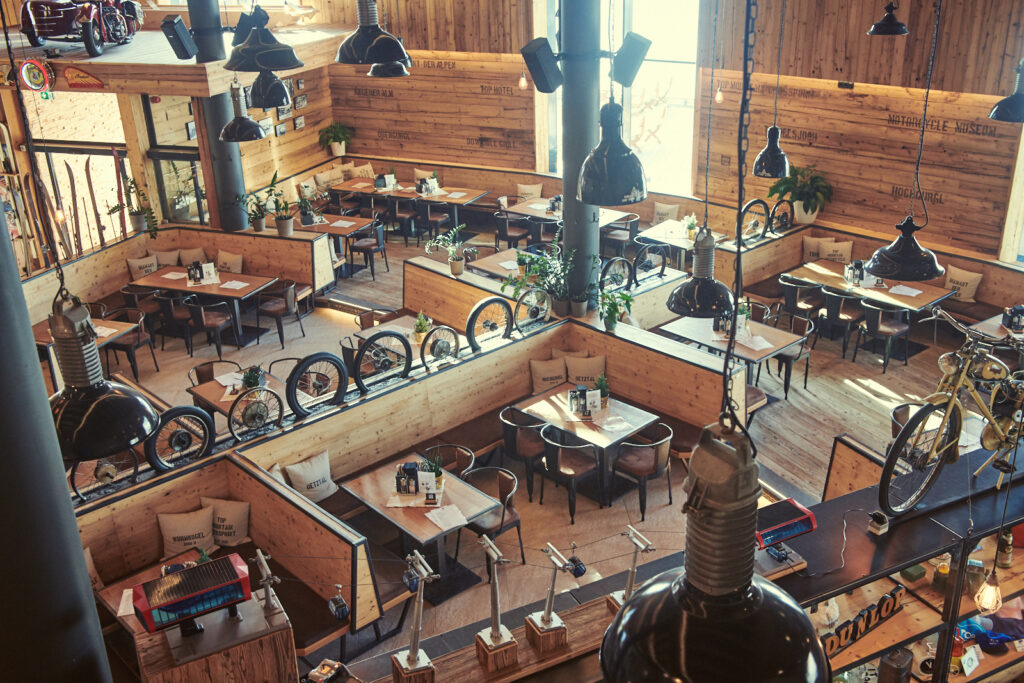
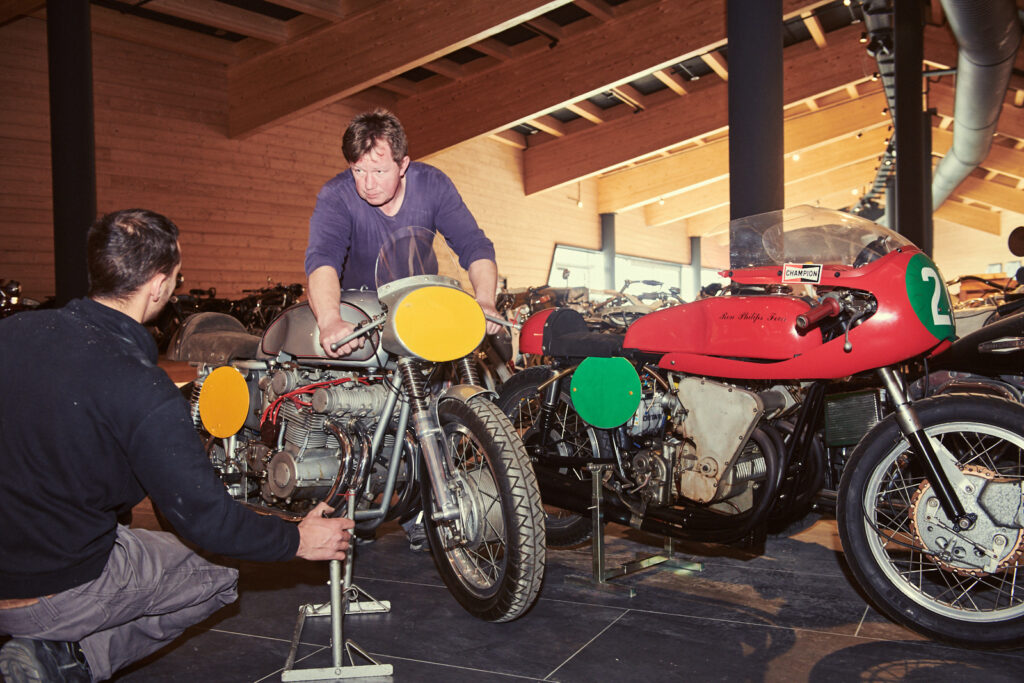
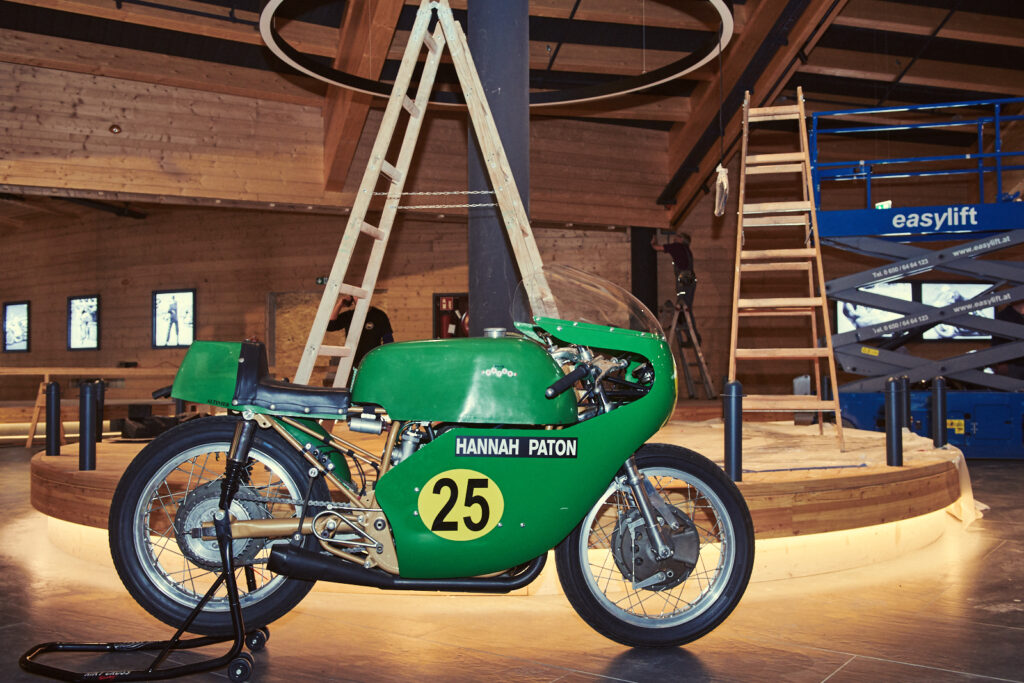
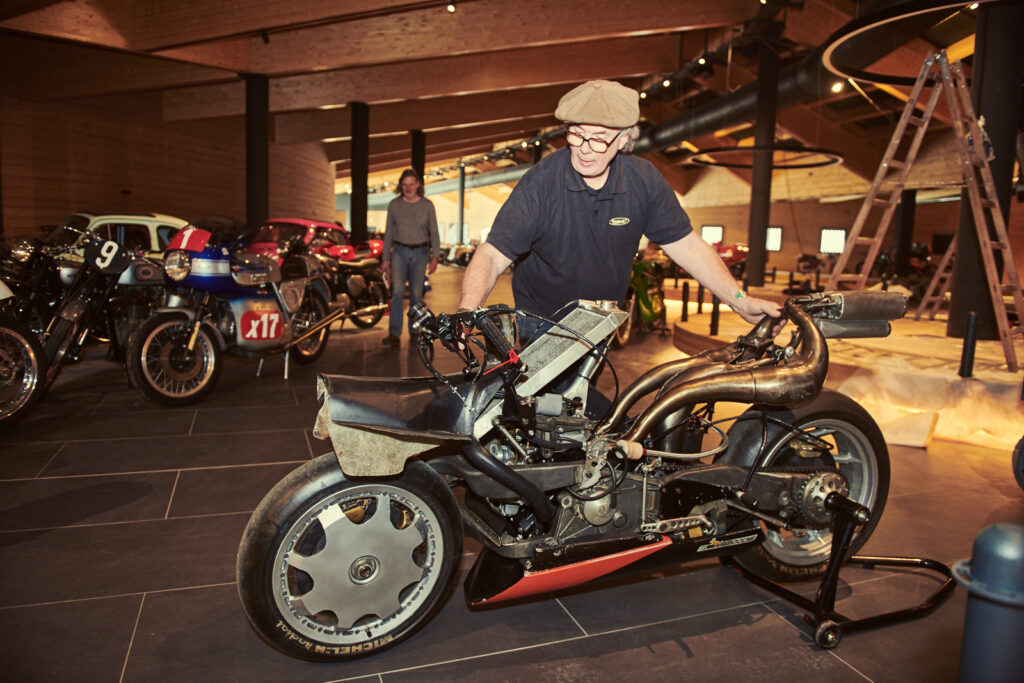
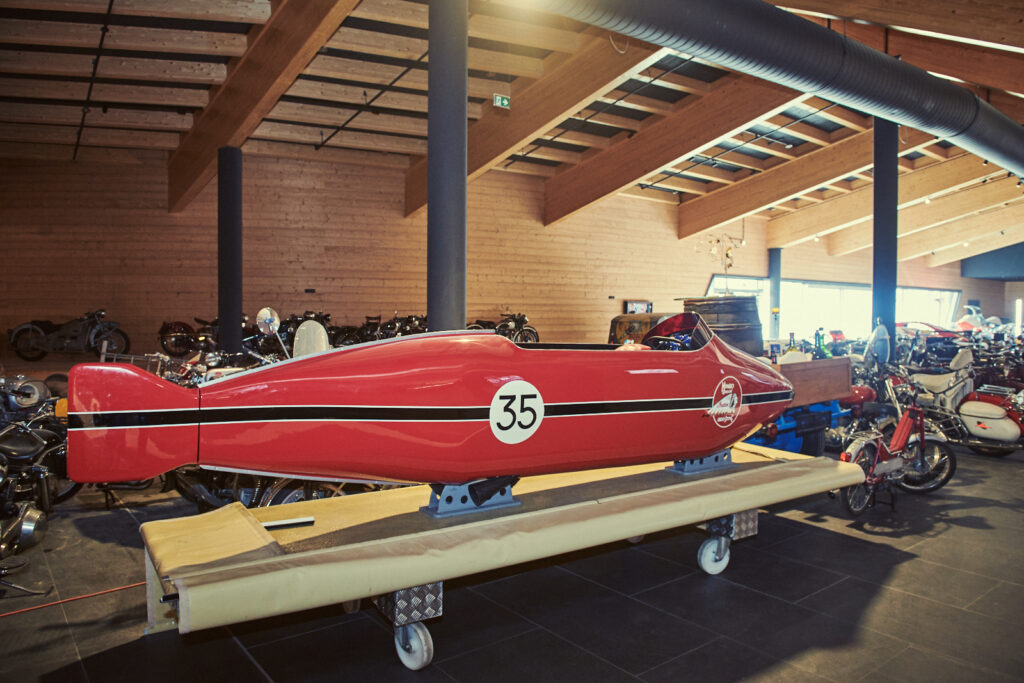
The museum's cafe is adjacent to the exhibition space, so you're never far from amazing motorcycles. [Fabio Affuso]Installing a pair of unique, home-built British four-cylinder DOHC racers: the Jones Four and Ron Philips Four. [Fabio Affuso]A rare Paton twin-cylinder GP racer in the competition hall, during installation. [Fabio Affuso]Mark Upham wheels a a still-radical ELF-Honda two-stroke GP racer with hub-center steering and extravagant exhausts (see our 'Two Wheeled Icons of the 1980s'). [Fabio Affuso]The Max Reisch collection of round-the-world and overland vehicles from the 1920s-40s are all on display: the 1933 Puch currently at our ADV:Overland exhibit in Los Angeles will move directly to the Top Mountain Museum in April 2021. [Fabio Affuso]A Burt Munro streamliner that survived the fire in the concrete basement is now displayed in the main hall. [Fabio Affuso]Attila Scheiber wheels a Max Reisch Puch, the 1929 250cc model he rode to Africa in 1932. [Fabio Affuso]Situated at the top of the Timmelsjoch alpinestrasse, the Top Mountain Motorcycle Museum is simply extraordinary, and deserves a visit by any motoring enthusiast. [Fabio Affuso]
Fabio Affuso is an Italian photographer based in London and his native Naples. He photographs motorsport and fashion around the globe. Find him at his website and Instagram.
Paul d'Orléans is the founder of TheVintagent.com. He is an author, photographer, filmmaker, museum curator, event organizer, and public speaker. Check out his Author Page, Instagram, and Facebook.
As part of the buildup to our Electric Revolution Live event in May 2022 (a follow-up of our Electric Revolution exhibit at the Petersen Museum), we are ramping up reportage on the EV scene via The Current. It’s an ever-evolving, even frantic, landscape of electric vehicles, and it can be tough to keep abreast of all the latest bikes, batteries, and news constantly flooding the market. That’s why we’ve re-launched our weekly EV News Roundup to bring you cherry-picked stories that matter to you.
Hello dear readers and riders! We want to wish you all a very happy holiday season. As folks are settling in and slowing down to enjoy a relaxing holiday with loved ones, the world of EVs is only ramping up. From an electric apparatus that is truly art in motion to Rivian’s expansion into the deep south and a first look at Ducati’s first electric racing motorcycle, here are the EV news stories we think will matter the most to you.
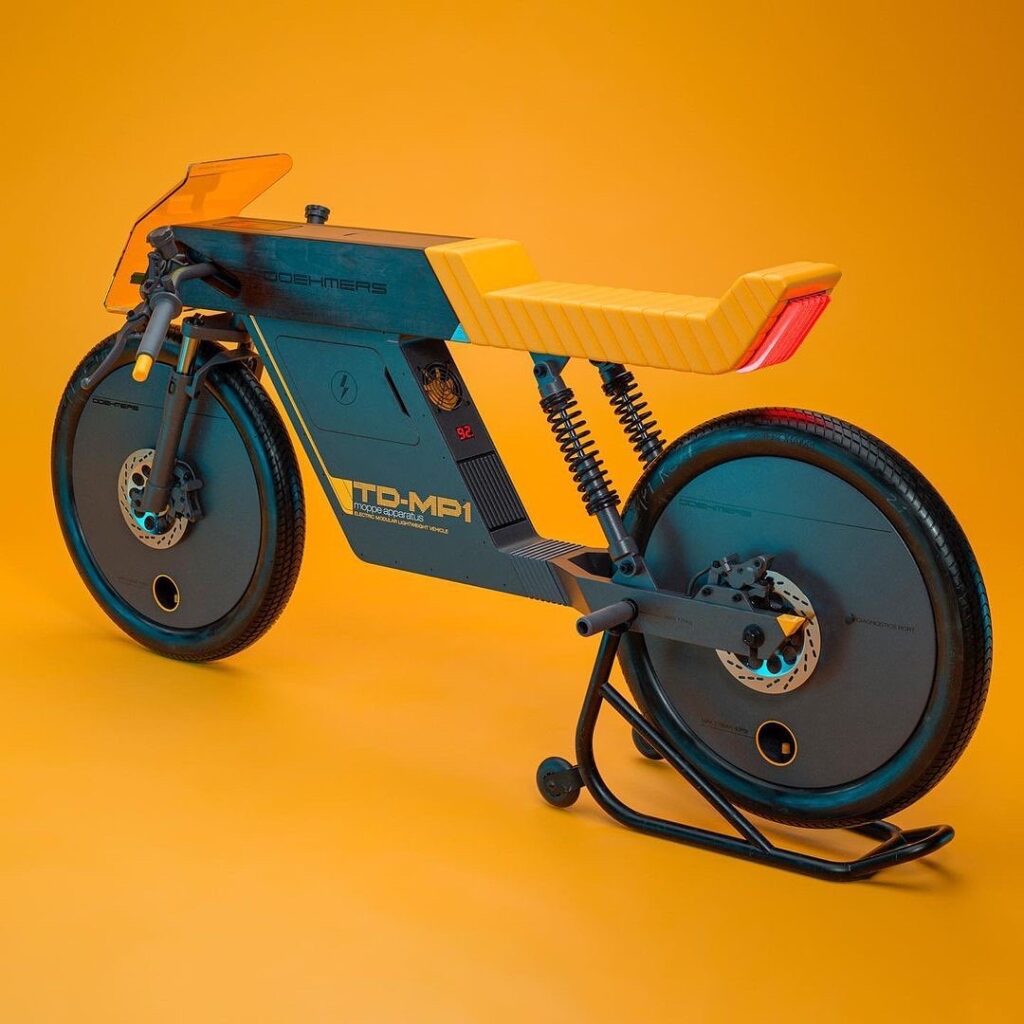
The Doehmers TD-MP1 emoped is a spectacular design concept from the talented hand of Torkel Doehmers, based in Mälmo Sweden. [Doehmers]Art is subjective. So is how much fun you can have on a motorcycle. Remember, a bike’s engine capacity does not dictate how exciting it will be to ride. The Moppe Apparatus TD-MP1, an electric moped concept by Swedish designer Torkel Doehmers, is an embodiment of this testament. Drawing inspiration from the itsy-bitsy Honda SS50, Doehmer’s unique vision fuses together classic café aesthetics with modern moped appeal, including low-mount grips and a skateboard seat with a ducktail flip. But this bike goes way beyond traditional design. It’s literally rideable retro-futuristic art. With a nod to mid-century architecture and innovative, modular elegance, the Moppe Apparatus TD-MP1 breathes new life into micro mobility.
Huge Adventures in a Tiny Package
The latest from august manufacturer Citroén, whose beach buggies of the 1960s defined a particular kind of fun: the My Ami Buggy. [Citrôen]Get ready to hit the pavement, sand, dirt, or wherever you fancy! Citroën’s new electric buggy concept, called My Ami Buggy, caters to your wanderlust by allowing you to travel the beaten path silently and with zero emissions. The buggy boasts bull-bars, an LED light bar, and numerous savvy storage solutions. It's a worthy heir to Citroën's Méhari, the cheap and cheerful Euro version of the Baja buggy.
Prius, Step Aside for Toyota’s New BEV Lineup
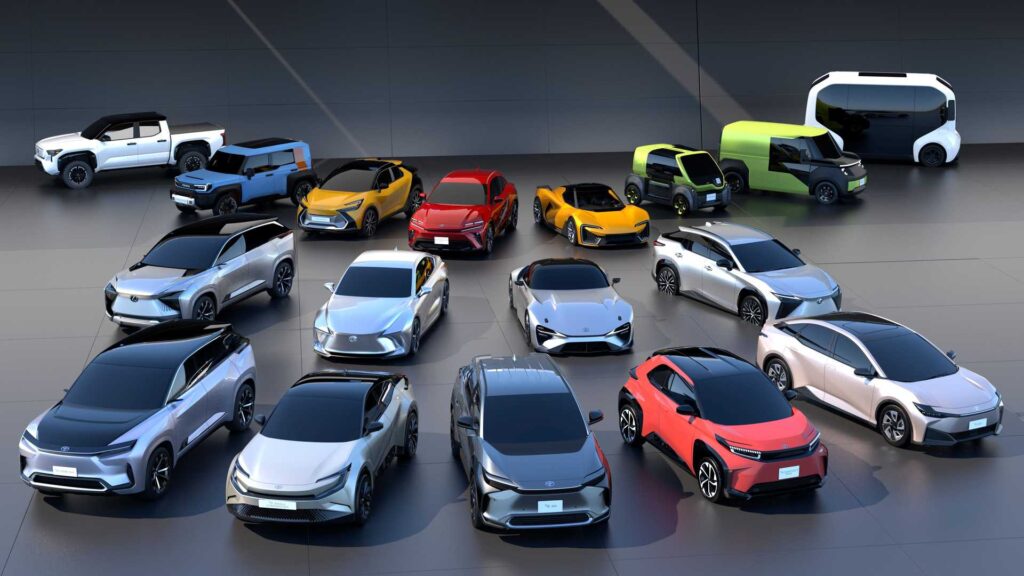
Boom. Suddenly, Toyota throws down a full lineup of new EV models, coming soon to a dealer near you. [Toyota]This week, Toyota Motor Corporation revealed 16 new Toyota and Lexus battery-powered electric vehicles (BEVs), including a pickup. The new models will make up half of the 30 EVs the automaker plans to release by 2030. The lineup included Toyota’s bZ series, which stands for “beyond Zero,” and Lexus’ first EV, dubbed the RZ, a production version of the LF-Z electrified concept. The shining star of the show was Toyota’s EV Tacoma-esque truck. The company also plans to invest $70 billion in EVS globally, with the first $35 billion going toward BEVs.
First Look at Ducati’s e-Racing Motorcycles
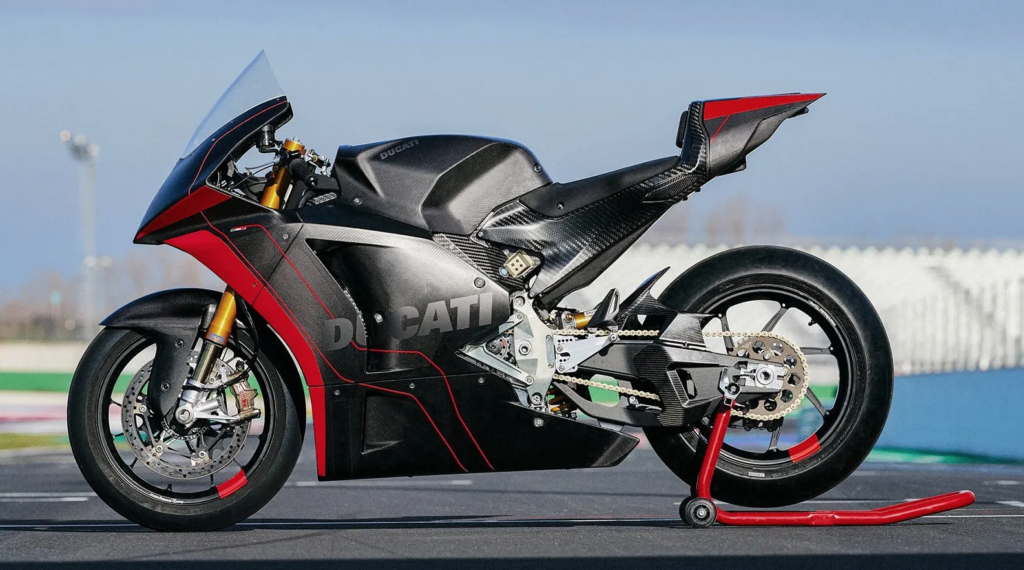
The new Ducati Moto-E racer, the V21L, which will fill the grid of Dorna's new racing series. [Ducati]Ducati finally released its first e-motorcycle prototype this week, giving us an initial peek at the bike that’s slated to take the track at the FIM MotoE electric motorcycle racing series. Called the Ducati V21L, the EV prototype was already put to the test on the Misano World Circuit Marco Simoncelli track, with Michele Pirro in the saddle. “We are experiencing a truly extraordinary moment. I find it hard to believe it is reality and still not a dream! The first electric Ducati on the track is exceptional not only for its uniqueness but also for the type of undertaking: challenging both for its performance objectives and for its extremely short timescales. Precisely for this reason, the work of the whole team dedicated to the project has been incredible and today’s result repays us for the efforts made in recent months. We are certainly not finished yet; indeed, we know that the road ahead is still very long, but in the meantime, we have laid a first important ‘brick,’” Ducati’s e-Mobility Director, Roberto Cane, said. Ducati had announced its commitment just a few weeks ago, with no bike or even concept model to back it up, which seemed a very ballsy move. Apparently they were further along the development track than everyone assumed!
Rivian Expands in Georgia
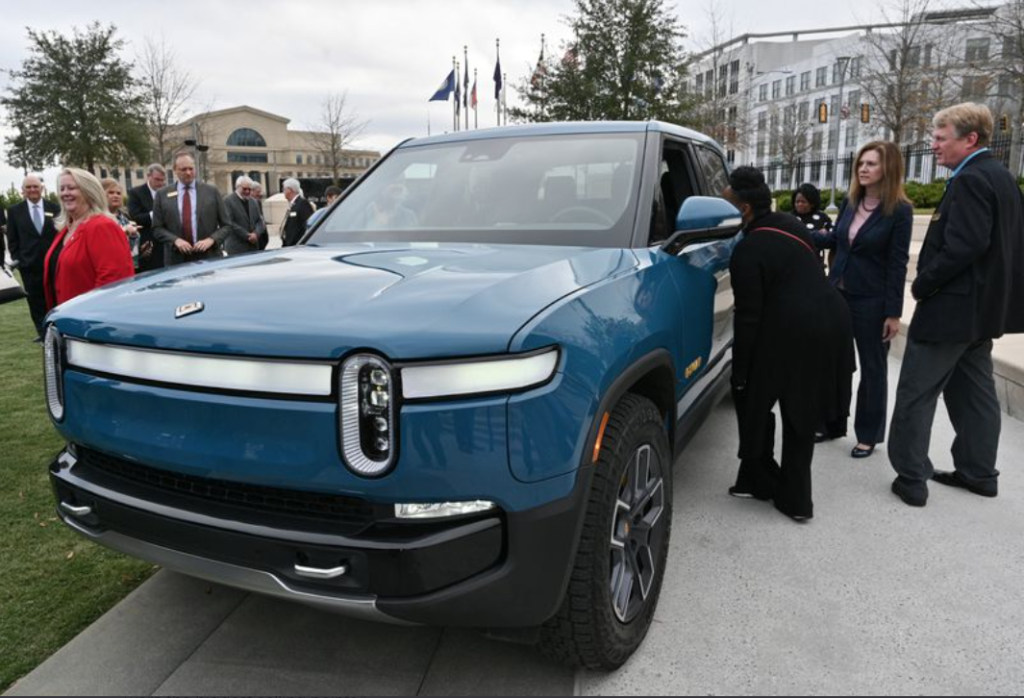
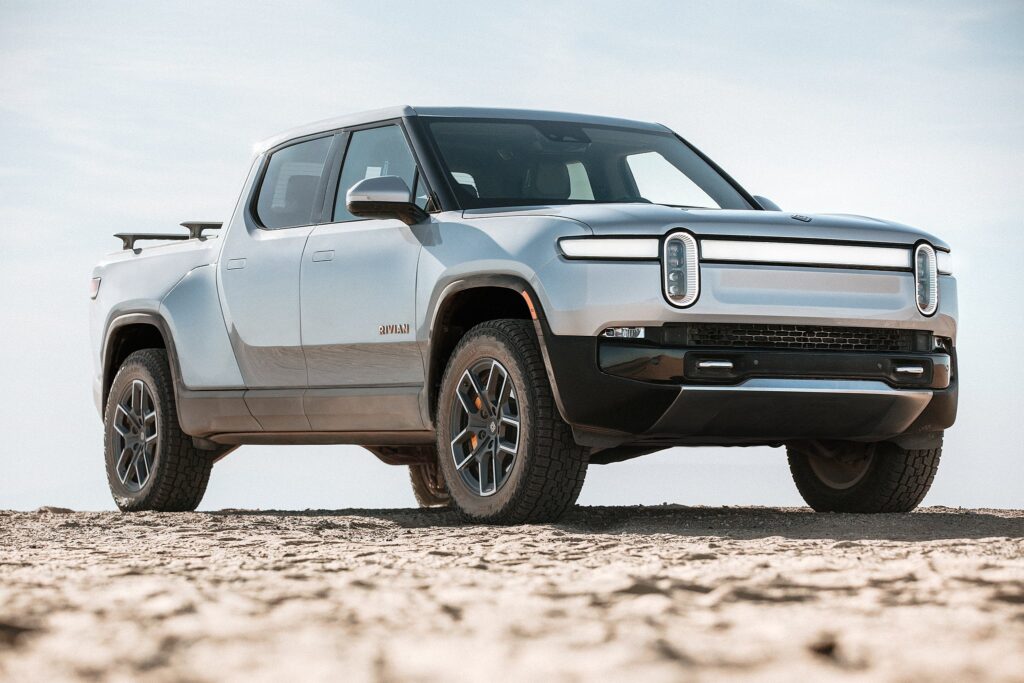
The new Rivian R1T truck at the Georgia statehouse on Dec 16, for the announcement of Rivian's $5Bn auto plant just outside Atlanta. [HYOSUB SHIN / AJC]EV manufacturer Rivian had its first earnings report as a publicly traded company this week. The company is also expanding production capacity of its Illinois factory from 150,000 to 200,000 EVs annually and building an additional factory outside of Atlanta in 2024. The company’s new factory aims to produce 400,000 vehicles per year and will also include a co-located battery cell production facility. The State of Georgia agreed to a massive incentive package of hundreds of $Millions over five years, including tax breaks and abatements, infrastructure improvements to nearby freeways (I-20), and Georgia's cash rebate to large employers of $5250 per job per year, which would total $200M if Rivian employs the 7500 workers it expects to hire and train. That's a big push for a company that's already valued more than Ford and GM, but if it were my business, I'd take it too!
'Electric Revolution' exhibit at the Petersen Museum Garners 6.3Billion Media Impressions
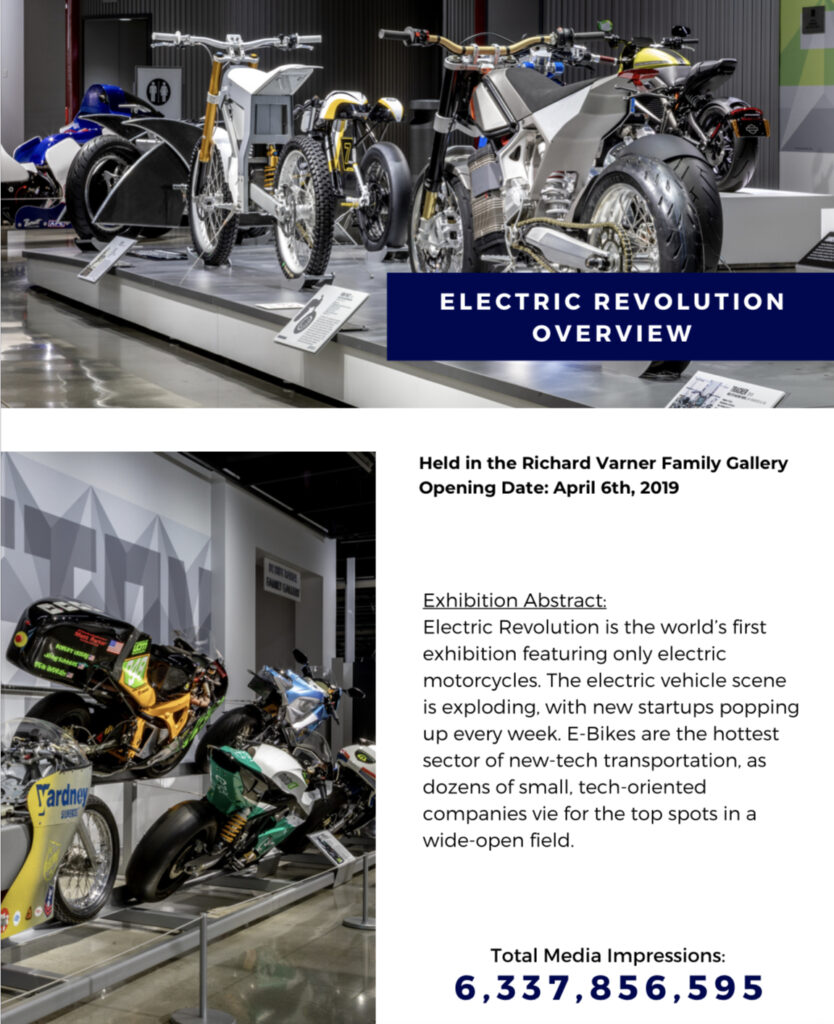
The numbers don't lie: Electric Revolution was huge. [Kahn Media]
The Vintagent team, along with our partners at the Motorcycle Arts Foundation, always knew our first-ever exhibit of electric motorcycles at the Petersen Museum (2019) was big news. We didn't know how big until we asked for an analysis this week from Kahn Media, the PR agency supporting the Petersen Museum. The numbers are staggering: Electric Revolution made 6.3 BILLION media impressions across all mediums, from print to web and TV. We expect our Electric Revolution Live! event next May 2022 will generate even larger numbers, as the first event of its kind in the world: an entertainment event centered around EVs of all kinds, with racing and demonstrations, kids events, test rides, food and wine and music at night. Mark your calendar for Memorial Day weekend in Walla Walla WA!
Stephanie Weaver is the EV Editor at The Vintagent, and a Philadelphia-based freelance writer. When she's not locked to her laptop, she can be found riding horses and motorcycles.
The Motorcycle Portraits is a project by photographer/filmmaker David Goldman, who travels the world making documentaries, and takes time out to interview interesting people in the motorcycle scene, wherever he might be. The result is a single exemplary photo, a geolocation of his subject, and a transcribed interview. The audio of his interviews can be found on The Motorcycle Portraits website.
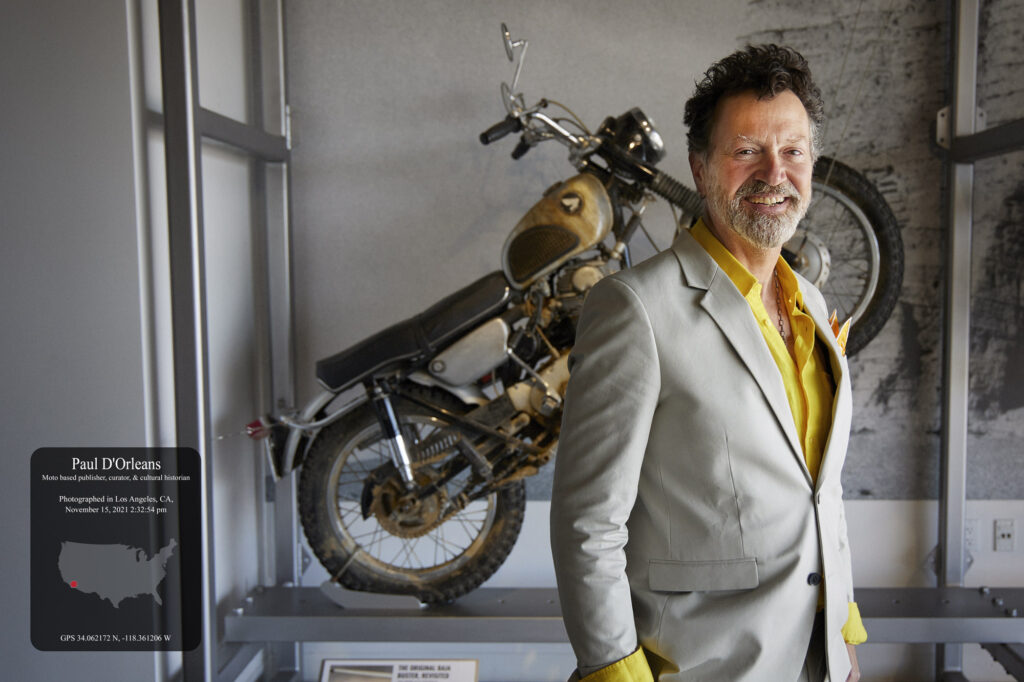
The following portrait session is with Paul d'Orléans, publisher of The Vintagent. David Goldman caught up with Paul in November 2021 at the Petersen Automotive Museum while wearing his Guest Curator hat, and shooting a short film with David Martinez about Paul's current exhibit, ADV:Overland. David Goldman asked Paul a few questions about motorcycling: here are his responses.
Paul d'Orléans captured at his gig as Guest Curator at the Petersen Automotive Museum in Los Angeles, Nov. 15 2021. [David Goldman]"I'm Paul d'Orléans, publisher of The Vintagent since 2006. I'm also a guest curator at the Petersen Automotive Museum, an author, a motorcycle nut, a historian and an event producer and TV presenter/ event host.
"What started me off in motorcycling wasn't really the beginning of my motorcycle career because it was strictly utilitarian: I was 15 years old and wanted to graduate from high school a year early. The only way to do that was to take night classes at the local Community College, so I bought a little Honda 50 to ride at night in Stockton. I did graduate a year early, and was super grateful to the motorcycle, but I didn't ride too much through University - it wasn't till after UCSC. I'd set up a little printing press in my mother's basement in San Francisco and had a partner who was a journeyman printer by the name of Jim Gilman. We published books and printed posters for punk and political events, and Jim rode a 1950 BMW R50 that he'd found under a staircase. Jim had every issue of Classic Bike and The Classic Motorcycle which in 1984 had only been publishing for a couple of years, and one day he gave me 3 milk crates full of the magazines. I just devoured those magazines and it ignited a passion for motorcycle history for me - I became really hungry for learning about motorcycles, and that started me reading books about bike.
That led to owning about 300 motorcycles, and kind of put me on the path to where I am today. I've had so many amazing experiences that I could only have had on motorcycles: I've ridden motorcycles literally all over the world and all across the United States four times on the Motorcycle Cannonball Endurance Rally. One trip in particular that stands out as unique was in 1987 my girlfriend Denise Leitzel and I each bought MZ motorcycles (little 250cc two-strokes from East Germany) in London, and we rode into the Iron Curtain countries - Poland, Czechoslovakia, East Germany etc. We tried to get into the Soviet Union but they wouldn't let us! That trip was amazing because the Berling Wall fell a year later. You know, we would not have seen that other world unless we had those motorcycles. We were able to explore all the nooks and crannies of those countries, off the freeways and outside of towns, where no trains went, no buses went. We saw an amazing and actually beautiful and now vanished world.
What motorcycles mean to me - that is a big and loaded question for a professional in the motorcycle industry! I've carved out a niche in this world without resorting to any sort of professional employment, so obviously motorcycling means a tremendous amount to me. I've just found so much richness in my life: I found personal growth I found a kind of strength and overcame a lot of my own demons and weaknesses just by dedicating so much time to motorcycling; solo long-distance or really really fast. I've made friends all around the world because of motorcycles, and feel like I owe motorcycles a lot. My life is basically dedicated to giving back to something that has given me so much."
David Goldman is photographer and filmmaker who has traveled the world on projects documenting human trafficking, maternal health and marginalized people. He also interviews and photographs motorcyclists in this travels for his series The Motorcycle Portraits. You can follow his website here, his IG here, and his FB here. Explore all his stories for The Vintagent here.
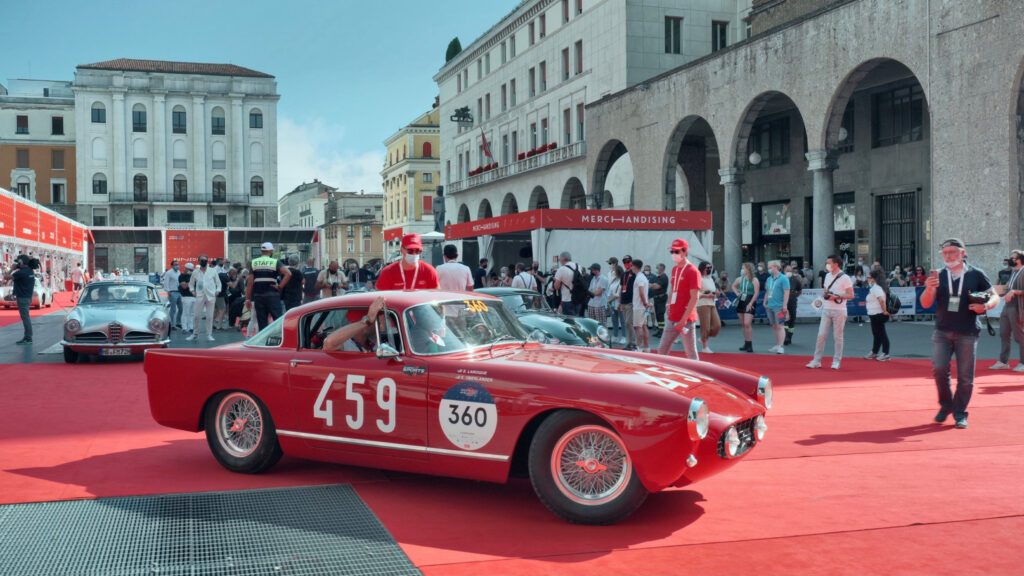
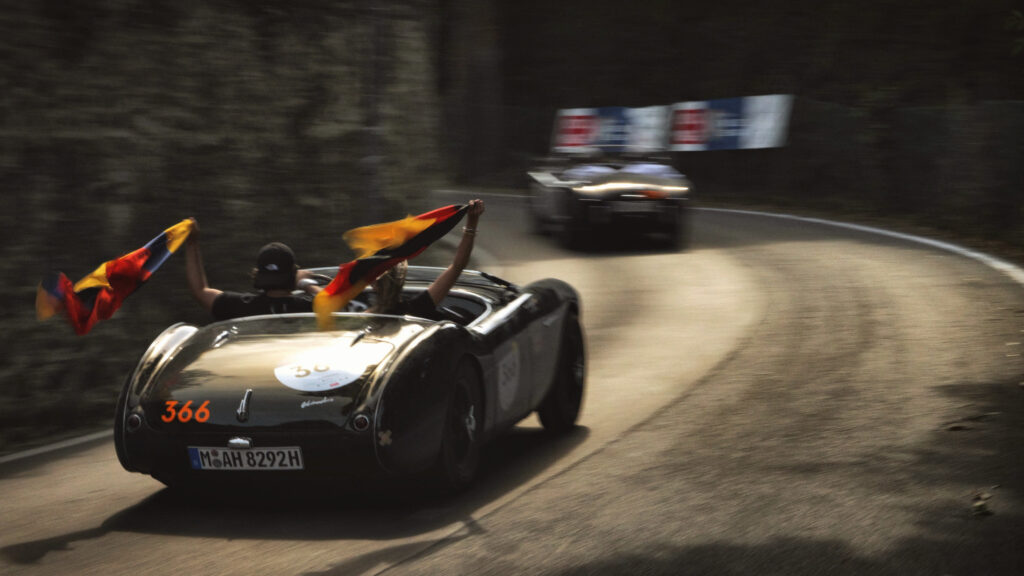
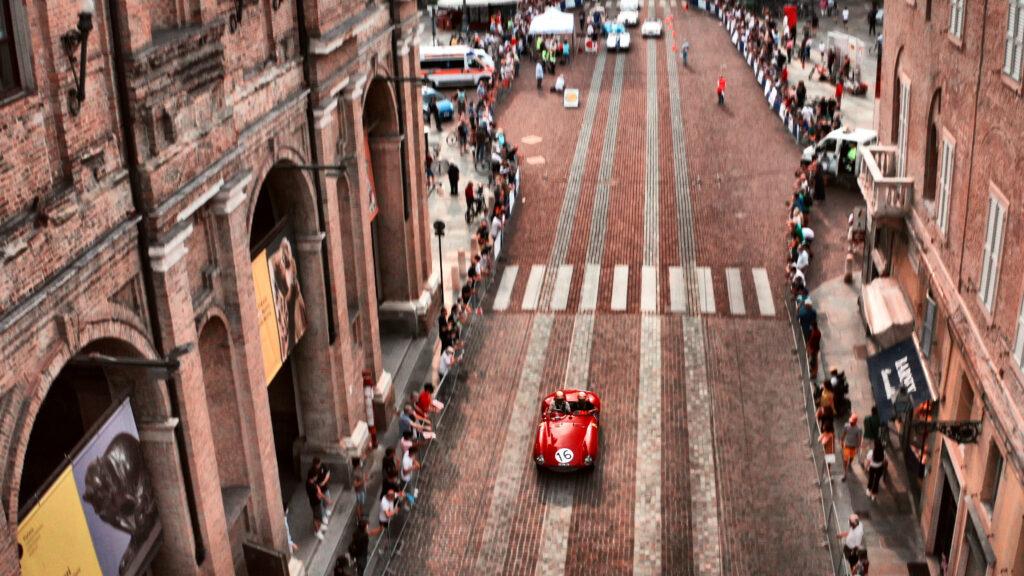
'Four59' follows the story of a spectacular and unique car: a 1955 Ferrari 25oGT Competition Boano (chassis #6) that first raced in the 1956 Mille Miglia. Its current owner dug in on its history, finding several mysteries, but tells the back story and meets the original family that owned and raced 459. He also determined he would drive the car in the Mille Miglia himself after a full restoration. Filmmaker Sean Fannin followed the team from the USA to Italy, and on the Mille Miglia itself. It's a spectacular film that The Vintagent is proud to support!
We have the full film above, and Nadia Amer's interview with Sean Fannin below:
Nadia Amer (NA): Your film about the Mille Miglia and the Ferrari 256 GT Boano (#459) is spectacular. What compelled you to make a film on this particular race and how did the project come about?
Sean Fannin (SF): Thank you! Filming the Mille Miglia has been a bucket list event since I started shooting automotive content. I have shot other races, but the Mille Miglia has always been special because of my family's Italian heritage. My grandmother has always told me stories of where her family is from, but I had never spent any substantial time in Italy to properly take in the culture. As for this opportunity coming about, I was at a dinner with Eric Oberlander and his family the night before a project in Baton Rouge. Eric mentioned that he was going to participate in the Mille Miglia in a couple months, to which I told him that I would love to shoot such a project. To my surprise, Eric invited me to shoot a piece that documented his involvement in the race. We didn’t have much time to fully plan for a project such as the Mille and it’s many moving parts, but we decided that this was an opportunity neither of us wanted to pass on.
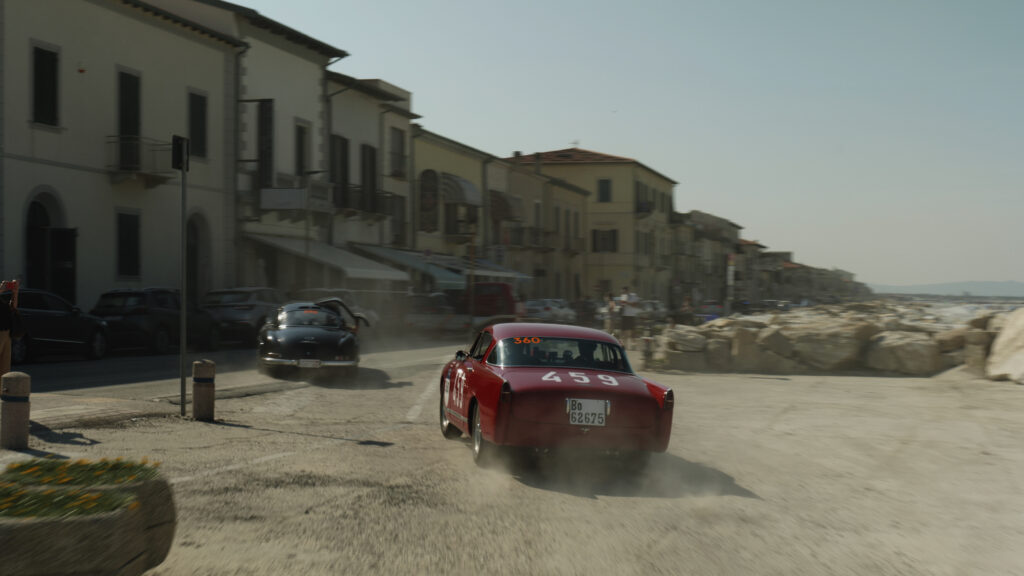
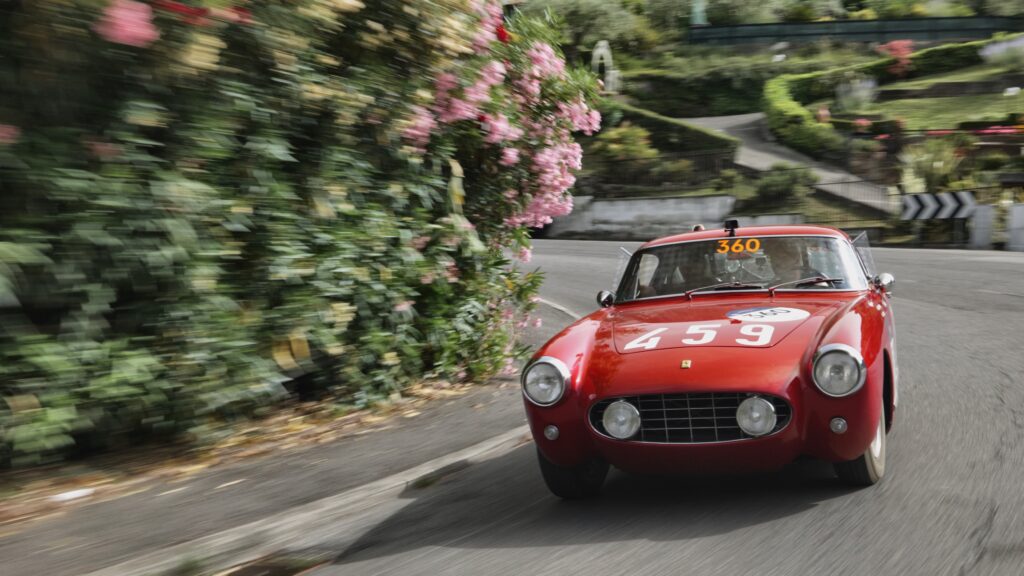
A stunning vehicle from any angle, the 1955 Ferrari 250GT Competition Boano was hand-built with an aluminum body and a racing heart. [Sean Fannin]NA: You seem to have a passion for cars. Have you filmed other races? How does filming the Mille Miglia compare with other projects you have done?
SF: I have filmed La Carrera Panamericana in Mexico, the World Stratos Meeting in Biella, Italy and Peking to Paris, which traverses from Beijing, China to Paris, France. Each of these races has their own trials and tribulations, but the production process is relatively the same. You keep up with the car(s) you are shooting as best as possible and grab footage whenever possible. The Mille differed in the sense that the other races introduce competitive sections where the drivers main goal is to be faster than the rest of the field. The Mille has competitive sections, but they do not rely just on speed. Instead, these regularity sections require the driver and navigator to work in unison to drive over pneumatic tubes at a predetermined interval. This doesn’t mean the Mille is void of speed. Speed in the Mille is introduced when trying to get to your next time stamp. Drivers don’t want to be late, or early, or they will be penalized, so they reduce their chance of missing their checkpoint by arriving as soon as possible. This allows them to drive up and collect their stamp right on time. As you’d imagine, the competitive bug hits pretty quickly and driving from checkpoint to checkpoint becomes very spirited.
NA: How long was the planning process and what kind of crew and equipment did you have with you?
SF: The planning process for this project was shorter than usual because I met Eric only a few months before the race started. Throw in the requirements to travel under a pandemic and logistics became very tight. In terms of filming crew, it consisted of just myself, with my wife Abigail as my assistant. Adam Martin, Eric’s crew chief, doubled as my production driver and occasionally grabbed a shot for me if needed. In all, Eric’s team came together whenever needed to get the job done. They were a great group to work with. As for equipment, I brought all the goodies. Two camera bodies, two GoPros, gimbal, car mounts, drone, external recorder and mics for that lovely engine note. Being a run and gun style project I made sure that everything would fit into two smaller sized cases, which allowed us to stay light on our feet and not have to rule out any locations due to gear restrictions.
The Mille Miglia is a feast for the senses. Especially following a spirited Austin-Healey 100M. [Sean Fannin]NA: What camera systems did you use and at what resolution and frame rate? Was there an artistic or technical requirement that drove the decision making?
SF: I have always used a Panasonic LUMIX system when shooting my own projects. For the Mille Miglia I brought my LUMIX S1 with a LUMIX S 24-70 2.8 Pro lens. This pair handled all handheld shots. For stabilized shots I paired my LUMIX S5 with the 24-70 on a DJI Ronin S. A Sigma 100-400 paired with a 2x converter was used to give us reach on those long shots. This two camera setup allows me to be as quick on my feet as possible when dealing with so many unknown shooting scenarios. We shot 4K UHD ProRes 422 and ProRes RAW at 23.98 FPS by pairing the LUMIX cameras with an Atomos Ninja V recorder. A DJI Mavic 2 Pro handled all aerial shots. The main driving force behind this camera system is the need to be compact as possible when operating in such hectic and unknown situations. You find that there is limited time to set up shots on a project like this because you are constantly on the move, so you only get one chance at a shot for most of the race. So, I wouldn’t say that there was a specific artistic direction that drove the decision making, we were more focused on the ability to keep up with the pace of the competitors. However, we knew that we wanted to pull in the highest data rate possible when recording, so we shot in RAW as much as possible.
NA: You have such a wide range of shots. Were you given an all access pass to shoot or were you required to get permits from each town? Were there any obstacles to shooting in a foreign country? Did you find the production process to be different in Italy vs. other projects you have done?
SF: We were not required to get permits from each individual town, but we were required to get credentials from the Mille Miglia organizers that allowed our production vehicles into the city centers. There is a race route that the race participants follow, but not all vehicles following the race, mechanics and such, are allowed to stay on this route in certain areas. A media pass gave us access to important areas of the route. We are forever grateful to The Vintagent for partnering with us on this project and providing an outlet to gain the credentials needed. The obstacles that you face when shooting in a foreign country are typically the language barrier and not being familiar with the area. These are obstacles that can be easily managed, but every once in a while a communication barrier will turn a simple issue into something much bigger. Bad weather can be another factor that provides a bit of a headache, it rarely brings shooting to a halt, but it does complicate the shooting process when there are many moving cars and people. Luckily, the weather cooperated and we had sunshine for the majority of the race. If you have never participated in a race like this you may not be familiar with the Tulip road books that are used to navigate the race route. A tulip is a pictorial representation of the route. Each junction along the route is drawn as a small diagram which shows the design of the junction, and the route to follow at that point. This can be an issue if the driver and navigator aren’t seasoned at reading these directions. As I mentioned before, Eric’s crew came prepared and Adam Martin was well acquainted with the navigation skills needed. I had previous experience with the Tulip books during the Carrera and P2P, so I shared navigation duties in our car as Adam always got us exactly where we needed to be. You can always plug in a GPS coordinate if you get lost, but you are likely to not take the race route, which is where all of the action takes place.
Blasting through the Italian countryside and numerous small towns and villages, the Mille Miglia is nominally a rally, but inevitably becomes a race. [Sean Fannin]NA: There are some very engaging mounted angles that make the viewer feel like they are part of the race. How did you get these shots? Did you use gimbal heads or some other mount? Can you provide any more detail on the techniques and equipment used in getting the various shots?
SF: The mounted shots were captured using GoPro 9 Black cameras. Once the cameras were mounted in the morning they stayed on until we had an opportunity to meet up with Eric and rearrange or pull the cameras. I prefer to mount my S5 for these shots when I am shooting in a controlled environment, but the nature of the race didn’t allow for this as there would be multiple hour stretches before we could pull the cameras. So, we decided on various mounting points for the GoPros and placed the cameras wherever a mount would stay. Eric and Scott were gracious enough to start and stop the cameras at points of interest, while also handling their driving and navigating duties. With myself being the sole camera operator we knew that simply having coverage of the race was going to provide great leverage in post.
NA: Can you explain a bit about how you chose your shots and how you decided to position yourself to get the best shot and/or capture the “story” or moment? Did you ever feel like you were in danger? Were you as stressed as Eric Oberlander described his state of mind?
SF: When it comes to getting shots for a project like this it is a constant mix of selecting a few points of interest from the route book paired with simply showing up to a location and quickly seeing if anything jumps out to your eye, sometimes within minutes of the subject driving through. With only one camera on the ground I knew that variety was going to be key, so my main goal in each location was to get as many shots from as many different angles as possible. I always go for quality over quantity, but for a shoot like this the extra footage in post really paid off. Danger is inherent in races like this, fast cars on open roads with a lot of moving parts and people, but at no point did we ever feel like we were in harm's way. We probably were in harm's way, it just never feels that way once you slip into the speed of the race. As for Italy itself, we always felt welcomed throughout the entire route. Italy as a whole was a perfect backdrop for such a historic race.
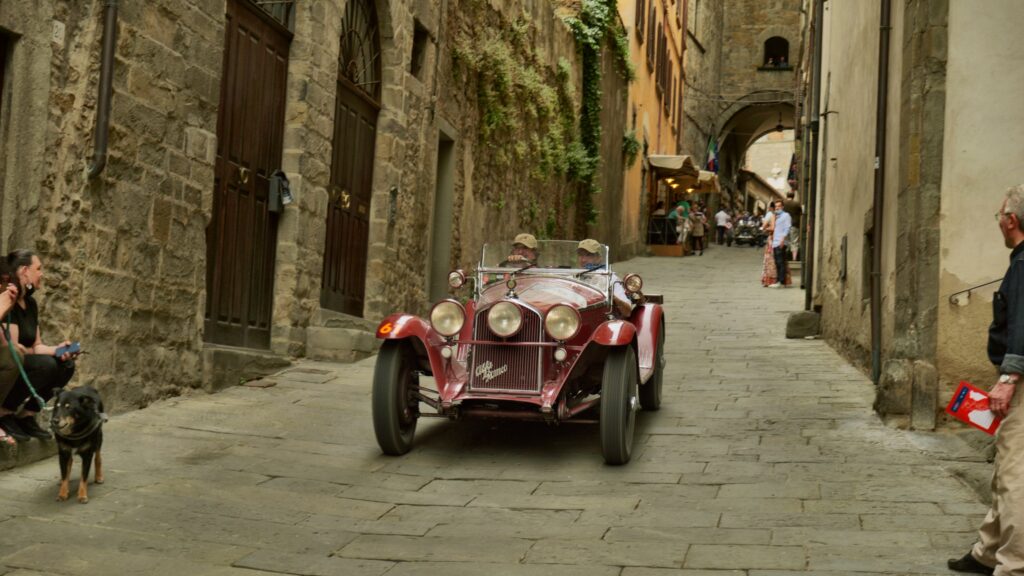
Seeing and hearing historic racing cars on narrow streets, the exhaust note reverberating everywhere, is stirring stuff for spectator and driver alike. [Sean Fannin]NA: What was the most difficult part of shooting and the production process in general? Did you have to make any tough decisions?
SF: The most difficult part of shooting was capturing the higher energy driving while traversing roads that were still open to the public. Now, this is nothing new when it comes to races like the Mille, but you always want to get the best footage possible while staying safe and out of the way of the race car and other drivers. Another tough part about this project was that we only had one person shooting. We captured plenty of footage along the way, but there was the constant struggle of deciding which locations were most important. We had to skip some of the areas that were of interest, but we needed to use that time to get to our next location before Eric and Scott. However, we are very pleased with the results and I would like to believe that these restrictions only made us more creative when making decisions. Overall, this was a difficult project to wrangle with a skeleton crew, but everyone involved came together to pull it off.
NA: The B-roll of the towns and people is breathtaking. What kind of drone did you use? Did you need a permit for that? Did the permitting process differ in Italy vs. your other productions?
SF: The drone used is the DJI Mavic 2 Pro. My kit is based around being light and compact, the Mavic 2 Pro’s form factor fits perfectly into this equation as it travels in my main camera case while producing a great picture. You can have the Mavic 2 Pro out of the case and into the air within a minute or so, making it a significant tool to have in the kit. It was essential to capture the atmosphere of the Mille. There is no better way to do this than by immersing yourself in the crowd and by also showing the point of view that only a drone can capture. The race cars are the star of the Mille, but it’s the supporting cast of people and places that makes the Mille special.
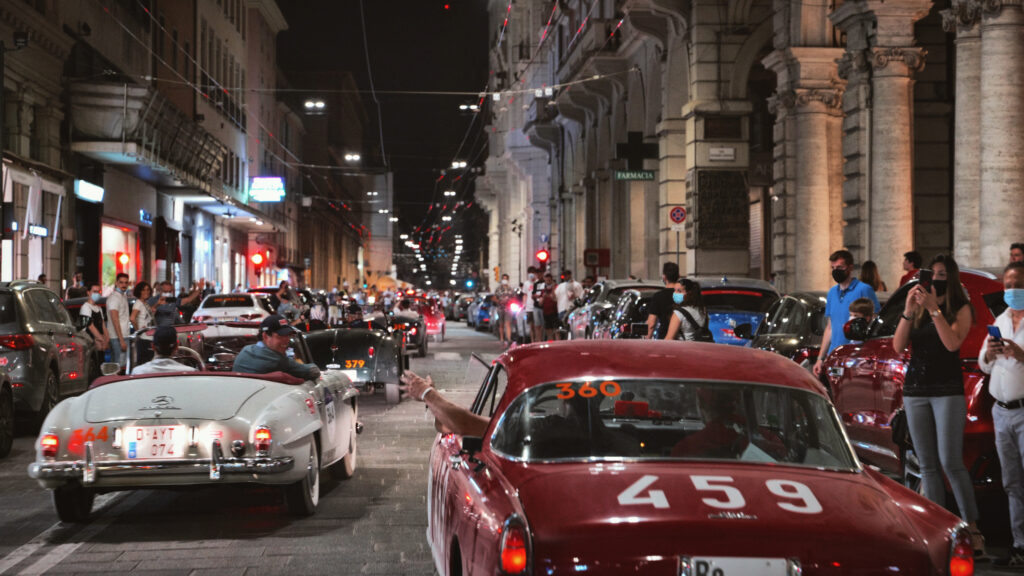
On the way to a fantastic meal and a rest for the evening in a celebratory atmosphere. [Sean Fannin]NA: The archival footage and photos really add depth. Where did they come from? And did you use the parallax technique for animating the photos?
SF: The archival footage was purchased by Eric OBerlander. It is an authentic reel of film that his team found for sale on eBay. We didn’t know if there was any footage of car 459 or Franco Marenghi, but Eric was willing to acquire the footage regardless. After we received the digital conversion we realized that neither made an appearance, but we were thrilled with the footage that was present. It gives a great sense of the atmosphere that surrounded the Mille in that time period. The photos came from Eric’s own dive into the history of car 459, along with the photos that the Marenghi brothers gifted to Eric. I wanted to make the photos more dynamic, so I created a simple parallax effect using Photoshop. Nothing too crazy when it comes to the world of animation, but hopefully it brought the photos somewhat to life.
NA: It was a touching scene where the son of Franco Marenghi, the original owner of the car, got to drive his father’s car that participated in the 1956 Mille Miglia. What was it like to meet Alberto Marenghi and his brother?
SF: We were thrilled when we heard that the Marenghi brothers agreed to be a part of this project. It was special to have such a direct line to car 459 and its original driver, Franco. They were gracious enough to share the photos and stories that they had accumulated over the years, some of which answered unknown questions about the car and its involvement in the 1956 Mille. It was a special moment to ride along with Alberto as he manned the wheel of the car that he had been told so many stories about. Both brothers shared stories of their father that added an extra layer to the story that Eric Oberlander can now add to the history of car 459. Alberto and Vittorio were the key piece of the puzzle that made this story come full circle, showing once again that car culture traverses all boundaries.
It's not all groomed roads and cosseted driving for these precious vehicles...note the Mercedes 300SL with the 'gullwing' open for a bit of air in the notoriously hot cabin. [Sean Fannin]NA: How many hours of footage did you shoot and how long did it take to edit? How many days did you shoot?
SF:I am not sure exactly how many hours of footage we shot, but we shot for nine days. Eric participated with a team called Scuderia Sports. This team spends three days training for the Mille while also enjoying the sights and food of the area. We shot Eric participating in the Scuderia Sports exercises and then in the race. Once the race started our shoot days typically lasted anywhere from 17-19 hours. You wake up early and get the car to the start, this is when I would place the GoPros for the morning session. Eric would set out for the day and we would hang with him for a few hours. Once we captured enough car to car footage we would then jump ahead and look for locations to shoot passing shots and drone footage. We would repeat this process, basically leapfrogging throughout the day. We would then arrive at the final checkpoint at night and head to the hotel. We would then prepare to do it all over again in a few hours.
NA: Eric Oberlander, Scott Laroque and the rest of the team seem like a fun group. How did you meet them? What was your relationship like and do you have any behind the scenes stories you care to share?
SF: I met Adam Martin years before I met everyone else on the team. I filmed his father-in-law’s Paul Newman Datsun 240z in my hometown of Cincinnati. I met Eric and Forrest in Louisiana while shooting Eric’s Baja Bronco for a separate project. Adam is friends with Eric so he showed up to hang out during the shoot. I met Scott during the Mille. The team was a fun bunch, always laughing and making the most of the experience, but also very focused when it came time to compete. For this being their first time competing in the Mille, Eric and his crew hit the ground running and never looked back. They finished as the top American team, which was one of their personal goals. I was proud to cross the finish line with team 459.
As cars go, a 1950s Ferrari competition coupe is about as good as it gets. [Sean Fannin]NA: What was it like for you personally to be part of such an historic race? What is your overall feeling of the experience? Would you care to share your most difficult and joyous moments?
SF: My head is still spinning from taking part in the Mille Miglia. The people, the landscapes, the food, the wine, the cars, the history… with the added layer of being able to capture such a unique story along the way. I can’t think of a better way to see Italy than chasing a vintage Ferrari through the Italian countryside. My most joyous moment of the Mille was definitely crossing the finish. Energy is always extremely high and everyone is celebrating the completion of a common goal. Also, it was special to have my wife along for the ride. She acts as my assistant on bigger projects, but had yet to come along for a race or rally. I’m not going to say that she was a fan of the 19 hour work day, but she loved the experience of the Mille and finally was able to see what a race like the Mille is all about.
NA: The sheer number of unique shots lends itself towards a hectic shooting schedule. Are there any entertaining statistics you would like to share? (ie. how little sleep, how many locations, etc.)
SF: Sleep? What is that? All jokes aside, sleep was one of the aspects of the race that we weren’t too familiar with. Eric and Scott had a later start time due to the Ferrari being a 1955. Because of this, we would typically get to the hotel each night around midnight. Food, showers and a cold beer were a must upon arrival. For myself, this was then followed by two hours of prepping for the next day. Transferring footage, charging batteries, arranging all of the gear and having another look at the schedule for the following day usually allowed for roughly two to three hours of sleep each night. Eating from the hotel vending machines wasn’t out of the question if no surrounding food options were available. Nonetheless, you understand the machine and you roll with it.
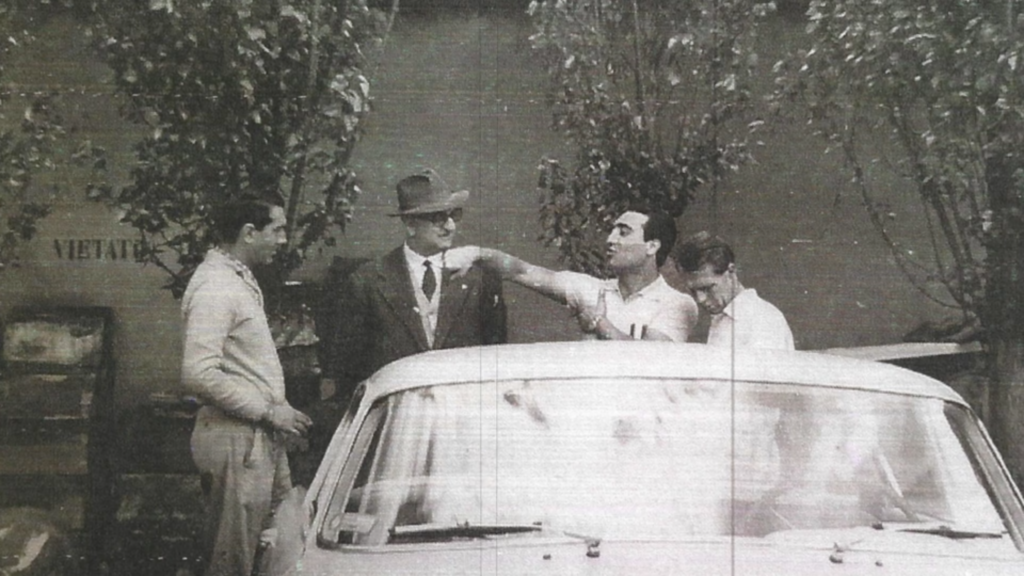
Enzo Ferrari and the three winners of the 1956 Mille Miglia standing behind '459' in an amazing period shot. [Sean Fannin]NA: Thanks for the interview! Would you like to film this race again and what is your next project?
SF: Thank you for your interest in this project. I would love to film the Mille again. You become part of a bigger family when you take part in these types of races. You leave with incredible stories and lifelong friendships. I fully plan to make it back to the Mille, as well as the Carrera and Peking to Paris, to capture the amazing stories of the people who compete in these events. What’s next for me is wherever my camera takes me. I love to shoot, and all the technical aspects that come with it, but what I love most is the adventure of exploring new areas and meeting interesting people. I have no doubts that I will return to the Mille to tell more of the fantastic stories that it has to offer.
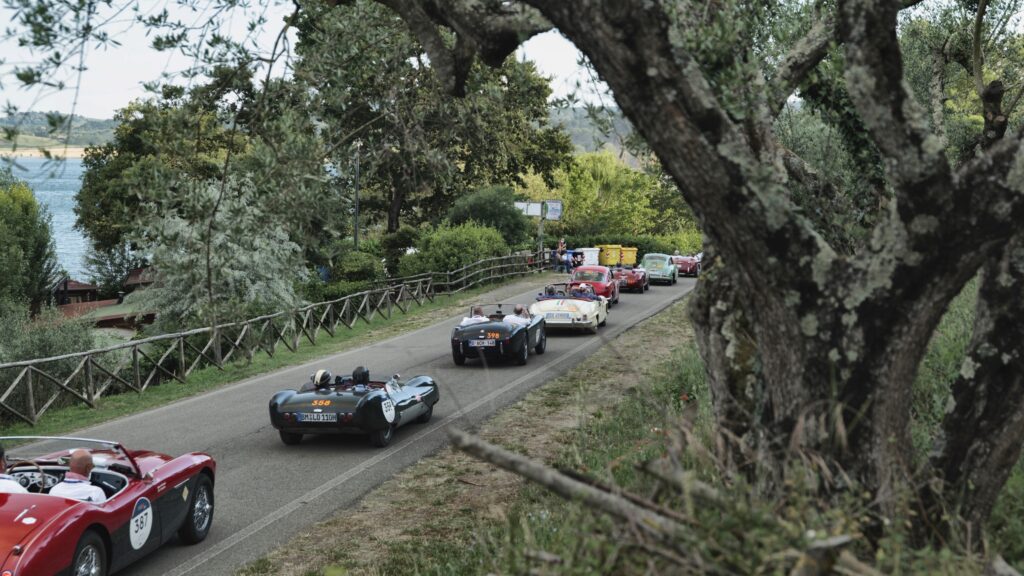
A whole lotta racing history in a line...Austin-Healey, Lotus, AC, Mercedez Benz, Alfa Romeo... [Sean Fannin][Ed: Thanks to Sean Fannin for his special 'Vintagent edit' of Four59, to Nadia Amer for her interview, and Nadia Fugazza for introducing Sean Fannin to The Vintagent]
As part of the buildup to our Electric Revolution Live event in May 2022, as a follow-up of our Electric Revolution exhibit at the Petersen Museum, we are ramping up reportage on the EV scene. It's an ever-evolving, even frantic, landscape of electric vehicles, and it can be tough to keep abreast of all the latest bikes, batteries, and news constantly flooding the market. That’s why we’ve re-launched our weekly EV News Roundup to bring you cherry-picked stories that matter to you.
A warm welcome to all of you readers and riders! If this is your first time checking out The Current, we’re your one-stop-shop for all of the latest EV news that matter to both electroheads and traditionalists. This week, we’re covering some pretty exciting stuff. From President Biden’s recent Social Policy Bill that includes a whopping $4.1 billion tax break for folks buying e-Bikes to North America’s first affordable highway-capable e-Motorcycle, we deliver valuable stories to your inbox each and every week.
Want a Hefty Tax Break? President Biden Has You Covered!
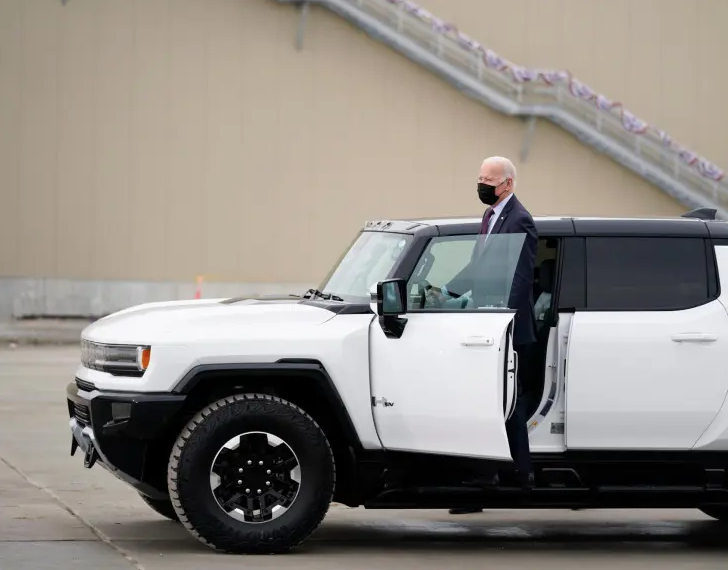
President Joe Biden tried out an EV Hummer this week. [AP Photo Evan Vucci]President Joe Biden’s new Social Policy Bill will include a $4.1 billion tax break for people buying electric bikes. As part of his nationwide White House tour promoting the $1 trillion infrastructure bill that provides $7.5 billion in funding to build out America’s EV charging network, Biden climbed behind the wheel of the electric Hummer SUV yesterday for a test drive. "You know, up until now, China has been leading in this race," the President said when speaking about EV manufacturing. "That's about to change.” We will surely invite POTUS to Electric Revolution Live, maybe he'll dig one of the classic EV conversions on display.
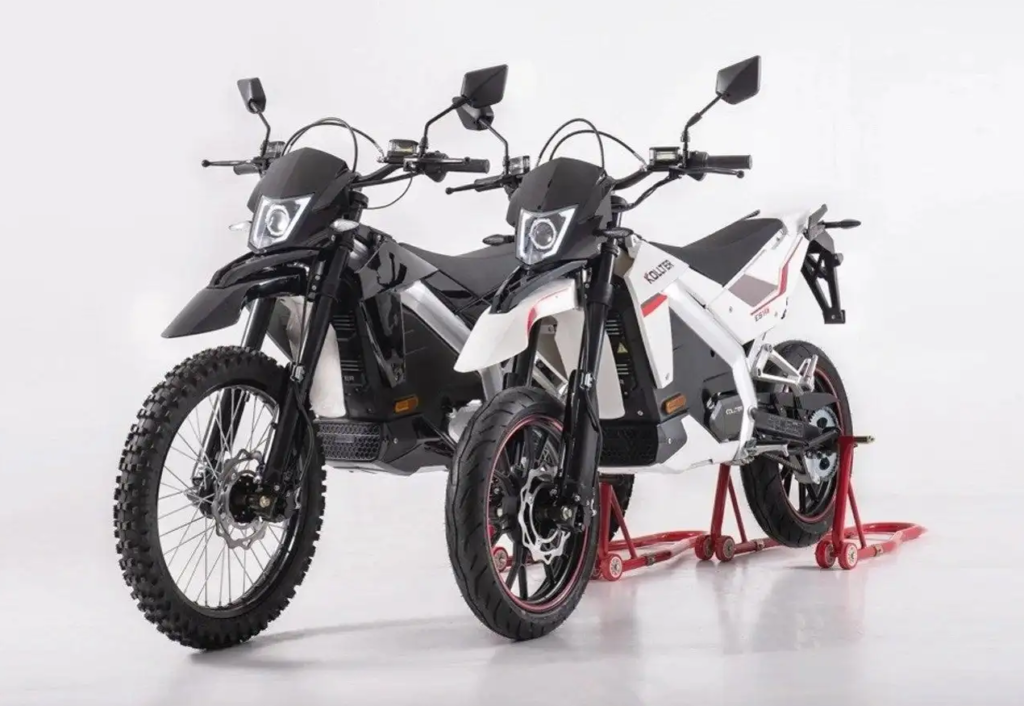
Kollter ES1: North America’s First Cost-Efficient Highway-Capable e-Motorbike
The Kollter ES1 range: Made in Germany, and highway capable. [Kolter]The Germans certainly know something about making high-quality vehicles. And Kollter’s new thrilling and highly affordable ES1 is a testament to the country’s superior craftsmanship. Recently rolled into North America and priced to please at just $5,990, the highway-capable e-Motorcycle boasts 70+ mph speeds, allowing it to seamlessly hang out with the rest of the two-wheeled herd on the highway. The bike also features an 80-mile range, a prompt 4.5-hour charging time, and an 11 kW (15 hp) peak-rated single-stage reduction mid motor.
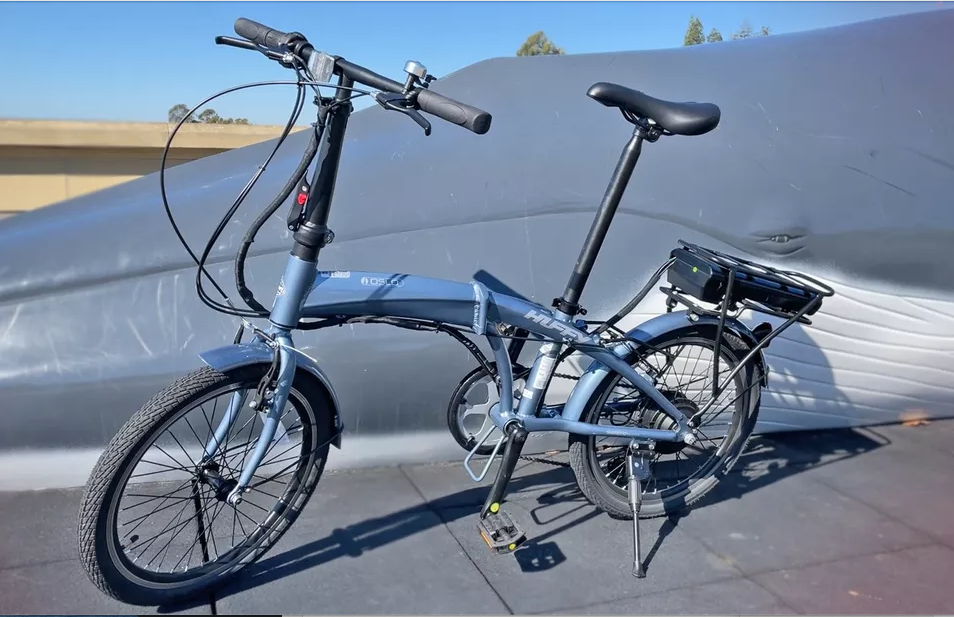
Huffy Releases a Folding e-Bike
Huffy! An old name in a new game, now with a folding ebike. [Huffy]The EV realm isn’t just for motorcycle manufacturers! Huffy is enjoying its slice of the pie with the recent release of its Oslo folding e-bike. The easy-to-fold commuter bike is equipped with a 36-volt battery that powers a 250-watt rear hub motor and collapses in the pedals, middle, and handlebars to be easily tucked away when not in use. Clocking in at just 45 pounds, the Oslo Electric is perfect for people who live in small apartments or who work desk jobs.
BMW Plans to Enter the e-Scooter Market
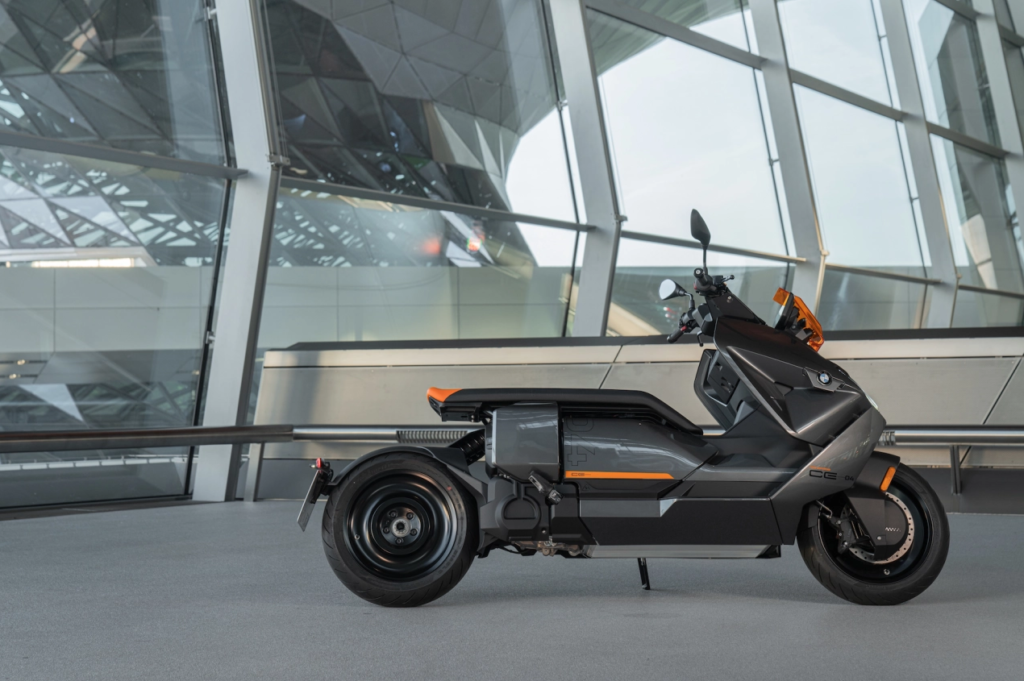
Prototypes, prototypes, prototypes. We featured the BMW Concept Link in our book collaboration with Gestalten - The Current - and saw it on its unveiling at Villa d'Este. BMW says it's now likely to build an escooter, and soon. [BMW]With so many big-name brands entering the EV market, it’s no wonder nobody wants to get left behind, including BMW. The company is hoping the innovative styling and next-gen technology of its new CE 04 e-Scooter will attract new customers to the brand. The retro-futuristic two-wheeled bike was showcased at the Los Angeles Auto Show earlier this week. Slated to arrive in showrooms early next year, the CE 04 will have a starting price tag of $11,795. Able to seat two, the e-Scooter boasts 42 ponies and 45 lb.-ft. of torque, along with an 80-mile range. Do you think this scoot can compete against HD’s Livewire or Zero Motorcycles? Let us know in the comments below!
Hongik University Releases Smart Life Concepts at the 2021 Industrial Design Online Degree Show
Seoul-based Hongik University’s industrial design department recently hosted its 2021 online degree show that showcased the state-of-the-art projects of 95 forward-thinking students. Some of the key pieces included:
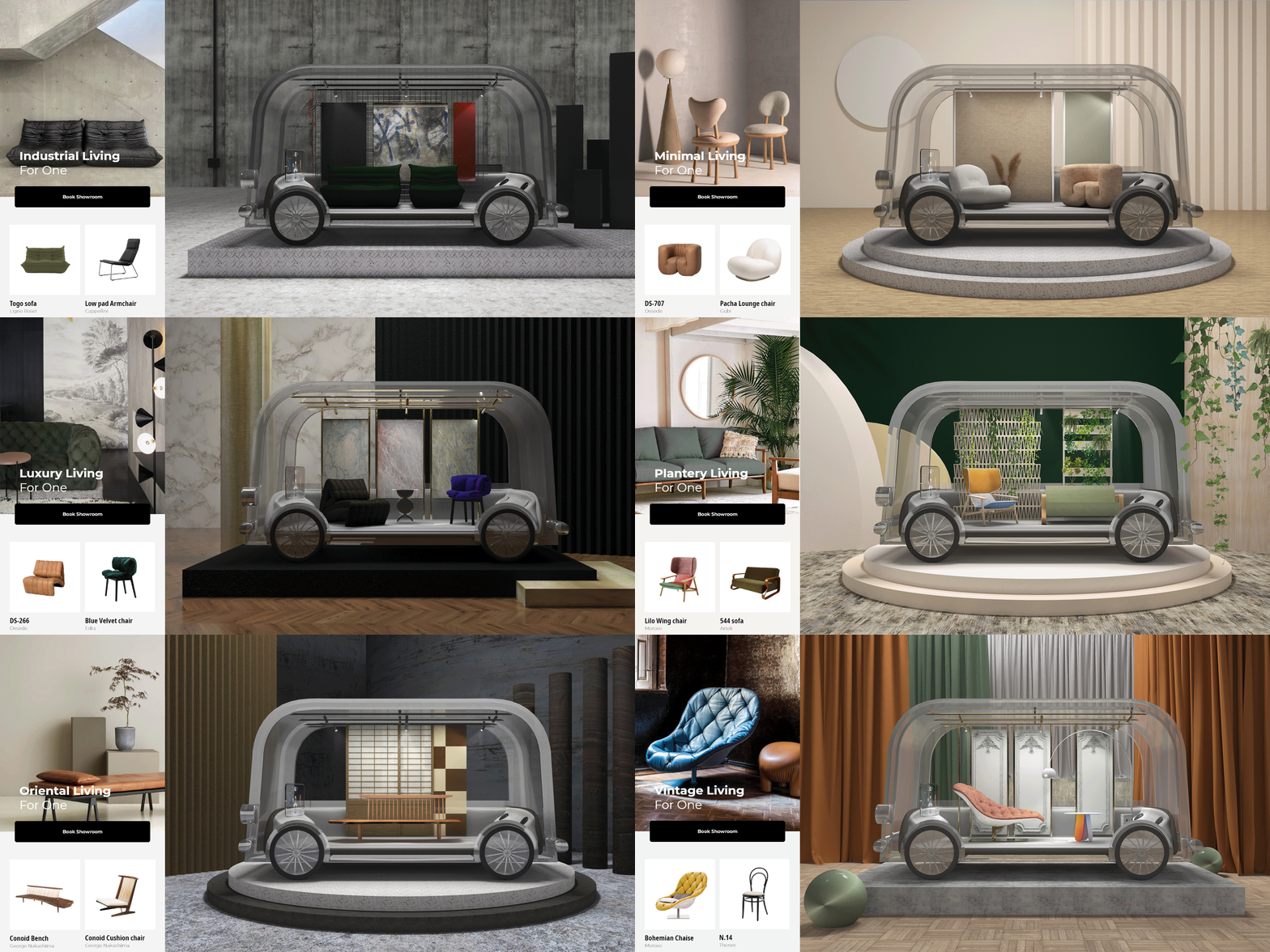
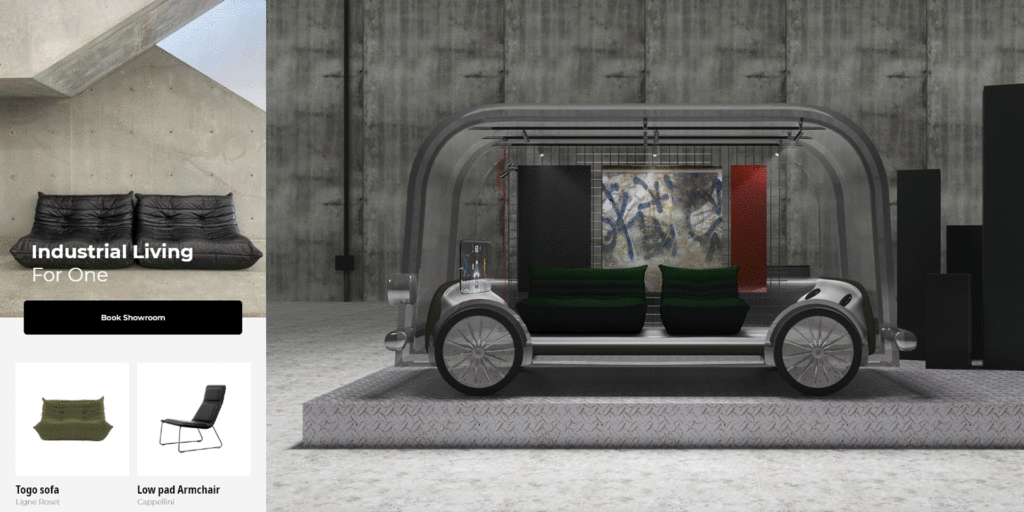
The SITT connected showroom mobile space. [Hee-Soo Kim and Jae-Yeon Kim]
Sitt by Hee-Soo Kim and Jae-Yeon Kim, an autonomous showroom service where users can sit in eight different comfy, interior settings.
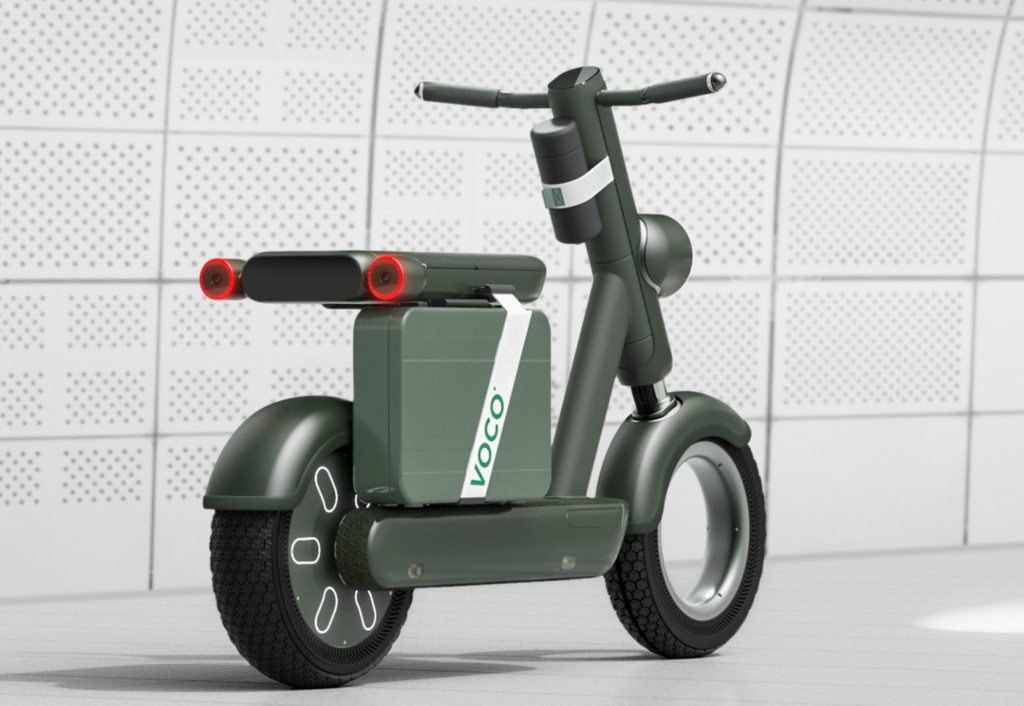
The VOCO is a self-parking ebike concept. [Kwang-Seuk Go and Hye-Won Kim]
VOCO by Kwang-Seuk Go and Hye-Won Kim, a near-future e-Motorcycle that promotes autonomous driving.
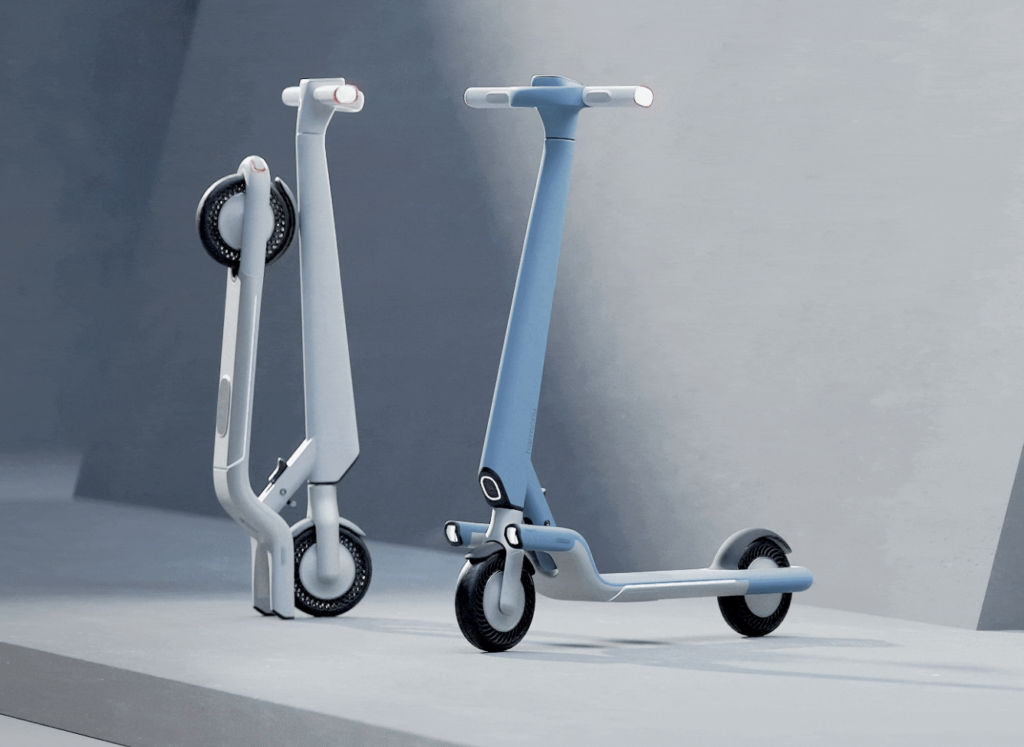
The Harmony eScooter promotes safety and portabiliity with rider warning systems and adaptive road lights. [Min-Ji Park]
Harmony by Min-Ji Park, a pioneering form that aims to provide portability and safety solutions to e-Scooters.
These amazing concepts only go to show that the future is clearly electric.
Breaking Battery News
Lithium polymer batteries from mobile phones ready for recycling...but where?
Elemental Holding, a metals recycling company, is building an EV battery recycling facility in Poland. The facility is slated to start operations in 2023.
Recent research has found that materials recovered from spent lithium-ion batteries actually perform better than the virgin materials found in new ones. All the more reason to recycle, people!
Stephanie Weaver is EV Editor for The Current vertical on TheVintagent.com, and a Philadelphia-based freelance writer. When she's not locked to her laptop, she can be found riding horses and motorcycles.
After 18 months of hibernation, the world is primed for adventure, and the ADV:Overland exhibit at the Petersen Automotive Museum has it in spades. Subtitled ‘off-road to off-world’, ADV:Overland includes round-the-world and long-distance racing machinery from 1903 to the present, plus sci-fi and NASA overland explorers. The real-world adventure machines show dirt and scars from outrageous journeys, some even with their original bags, boxes, and tools in place, 90 years later. ADV:Overland showcases the living, breathing history of overland travel, and its counterparts in outer space, as a welcome breath of freedom after pandemic shutdowns. ADV:Overland is on display through April 2022. See all of our exhibited vehicles here.
Robert Edison Fulton Jr's 'One Man Caravan' round the world 1932 Douglas Mastif as it exists today. [Fulton Family Archives]
Pictures from an exhibition: Robert Edison Fulton Jr.'s 1932 Douglas 750cc H32 Mastif motorcycle. (by Clement Salvadori and Paul d'Orléans)
Back in 1885 the brothers William and Edward Douglas established a foundry in Bristol, England, making bits and pieces for the burgeoning industries cropping up in the region. Eventually that meant cars, tractors, and castings for a local motorcycle start-up in 1907, Joseph Barter's Light Motors Ltd, who designed a neat little flat-twin engine with opposed cylinders sitting fore and aft in the frame, which he called the Fée (fairy). Barter soon ran out of money, and the Douglas Engineering Co. acquired the business, thinking the new business of motorcycles might have a future. The Fée led to other flat-twin designs from Douglas, an engine configuration to which they remained faithful throughout their production, although by the mid-30s they had turned their motor through 90degrees, where it remained until their 1957 demise.
A Douglas won the Isle of Man TT in 1912, and the marque had many successes in worldwide competition, and during WWI they provided many thousands of 600cc sidevalves to the British army. Douglas was among the earliest manufacturers - in 1921 - to adopt overhead-valve cylinder heads and 'hemi' combustion chambers, which made them fearsome competition machines, and the next year an RA model became the first 500cc motorcycle to record 100mph, with Cyril Pullin riding at Brooklands. In the 1920s the company was quite successful financially, with regular race wins at Brooklands and the Isle of Man TT, and also the burgeoning world of Dirt Track racing, in which the low-slung weight and long wheelbase of the hot RA model proved a perfect fit. By the mid-1920s the Douglas DT5 and DT6 (600cc) Dirt Track (later known as Speedway) racers were al-conquering on dirt tracks around the globe, right through 1930, when a combination of the Stock Market crash and the JAP speedway motor dealt the company a mortal blow. In 1932 Douglas was sold to a group of investors headed by Kenton Redgrave, and this is where our story begins.
Robert Edison Fulton Jr on his 1932 Douglas Mastif, modified by the factory for his journey with racks and an extra-large fuel tank over the rear wheel, plus a skid plate, where Fulton hid a revolver. [Fulton Family Archives]A young fellow named Robert Edison Fulton Jr., son of the founder of Mack Trucks, had been studying architecture in Vienna after graduating from Harvard in 1931. After a year abroad, he was headed back to the USA via London, and on an early summer's eve in 1932 he was invited to a posh dinner. As the 24-year old son of a wealthy industrialist, Fulton was the sort to be invited to such parties. When asked at the dinner what he planned to do next, he replied off-handedly that he would not sail back to New York, but would rather ride a motorcycle around the world! Kenton Redgrave happened to be at the table, and immediately offered him a Douglas motorcycle, thinking such a journey would be good publicity.
Fulton had only briefly owned an Indian motorcycle while in college, which he soon crashed and was pressured to sell by his family: that was the extent of his motorcycle experience. To undertake a round-the-world (RTW) journey was an act of youthful hubris: Fulton did not even know if it had been done before (it had – see our 1912 Henderson exhibit). A few weeks after that fateful dinner party, Fulton appeared at the Douglas factory to meet his Mastif: the machine had been specially modified for the journey, and was a very rare 750cc model to boot, with perhaps only 30 ever made. The factory had added an extra gas tank over the rear wheel and bash plate under the motor, where Fulton wedged a revolver ‘just in case’, and which he never removed. The factory also thought it prudent to bolt a Douglas sidecar onto to the ‘continental’ side: left, as most countries he would be riding through drove on the right side of the road. Fulton rode off in July of 1932, heading east back to Vienna, then turning south to the Balkans. By then he had discovered how bad the roads were away from large European cities, and soon decided to get rid of the sidecar. Shortly after, in Turkey, he abandoned much of his cooking gear and other items he realized were non-essential, including the tuxedo he’d packed away ‘in case of an embassy dinner’. What he kept included a cine camera with which he shot 40,000' of film in the course of his journey.
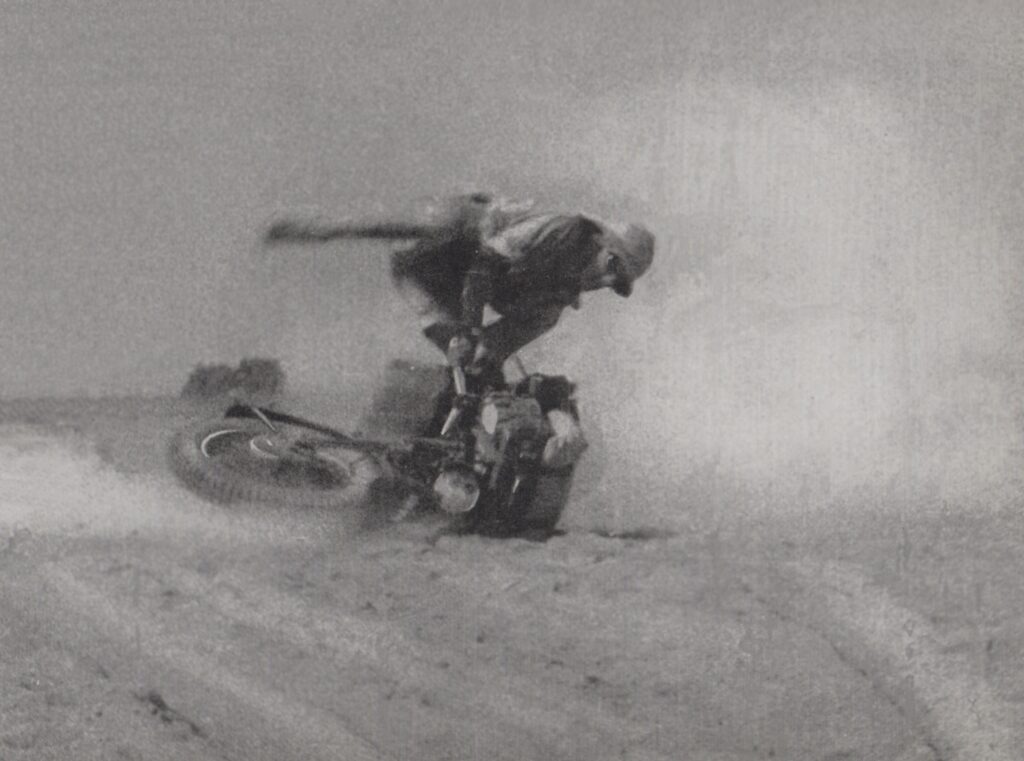
A lot of this! The deep desert sands of the Middle East were without roads or even markers in many areas, with bandit nomads a constant worry. [Fulton Family Archives]Fulton had a positive attitude on his journey, and was fascinated at the differences between the cultures he encountered, as well as their similarities. For example, Fulton famously noted that in small villages all over the world, he was warned against traveling to the neighboring village, which was invariably described as full of thieves and murderers. On arriving there, he found people just as accommodating as the previous town, but was warned against the next spot on his map in the same terms. Concerning the Mastif in our exhibition, few things went mechanically wrong in his 18-month trip, other than half a dozen flat tires. In Waziristan a king-pin in his transmission sheared, but the company had given him a small bag of spare parts, including such a pin, and he fixed it himself, obviously having some mechanical skills. After his successful journey, Fulton wrote a classic account of RTW travel – ‘One Man Caravan’ (Harcourt, Brace - 1937) – which inspired many other would-be travelers to undertake this ultimate adventure on two wheels. 'One Man Caravan' records being shot at by Pashtun tribesmen in the Khyber Pass, running from bandits in the Iraqi desert, spending a night in a Turkish jail, and being lavished with attention by Indian rajahs, although Fulton is modest and discretely charming throughout, and is never self-aggrandizing...which turns out to be a common theme among RTW travel writers to come. Fulton did capitalize on his journey and book with a lecture tour of the United States, where he shared his film footage and tales of his adventures. In 1983, he produced (with his filmmaking sons Rawn and Travis),a 90-minute film compiled from his film footage, 'The One Man Caravan of Robert E. Fulton Jr. An Autofilmography', and later in his life a second film, "Twice Upon A Caravan."
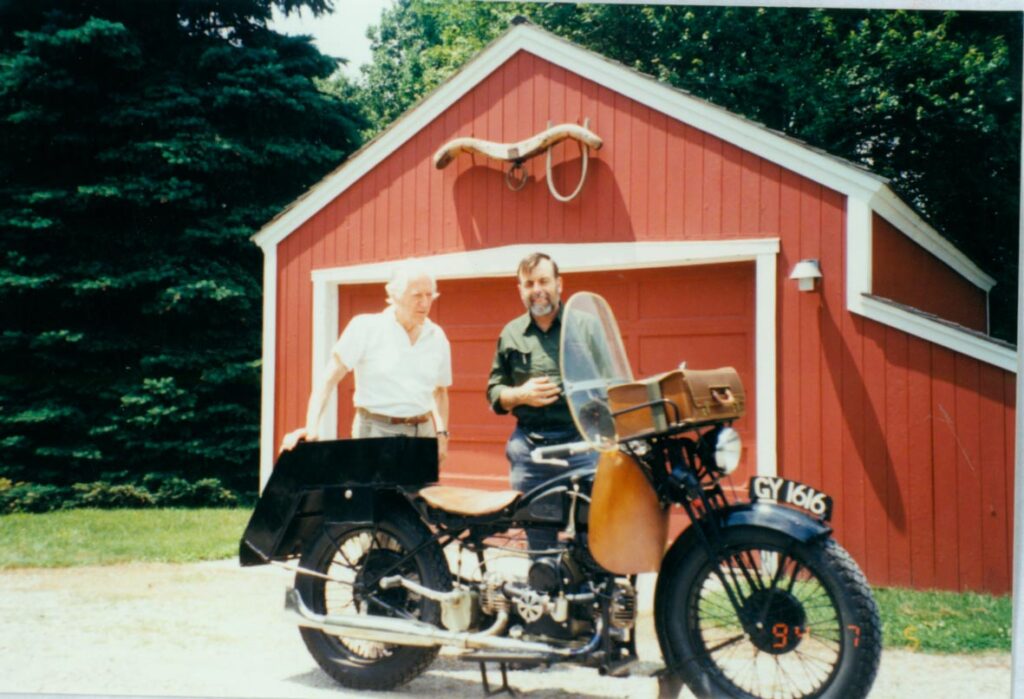
Robert Edison Fulton Jr. went on to become an airplane enthusiast (including a P-51 Mustang for his personal use), and a prolific inventor. He invented the first ground-based flight trainer, the first ground-based air gunner trainer, a functional flying car, and the Skyhook system for pilot rescue or personnel retrieval by an aircraft - without the need to land. He kept his faithful Douglas Mastif close by the rest of his life, but only shared it publicly at local Connecticut motorcycle shows on occasion. ADV:Overland is the first time Fulton’s famous machine has been exhibited in a museum, and his sons have kept it in running condition in homage to their remarkable father.
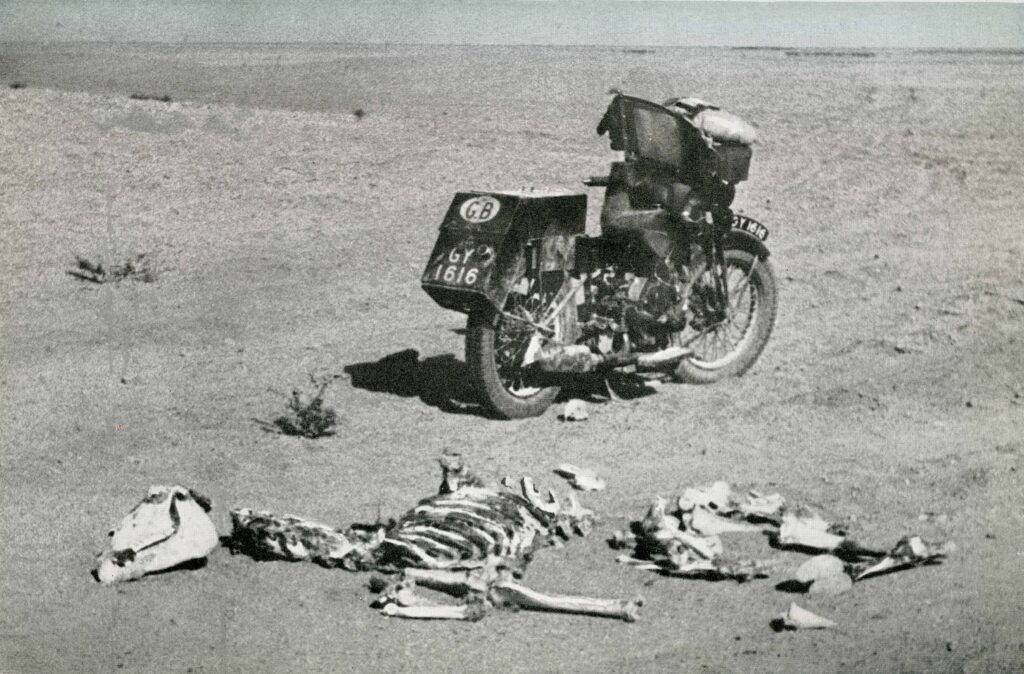
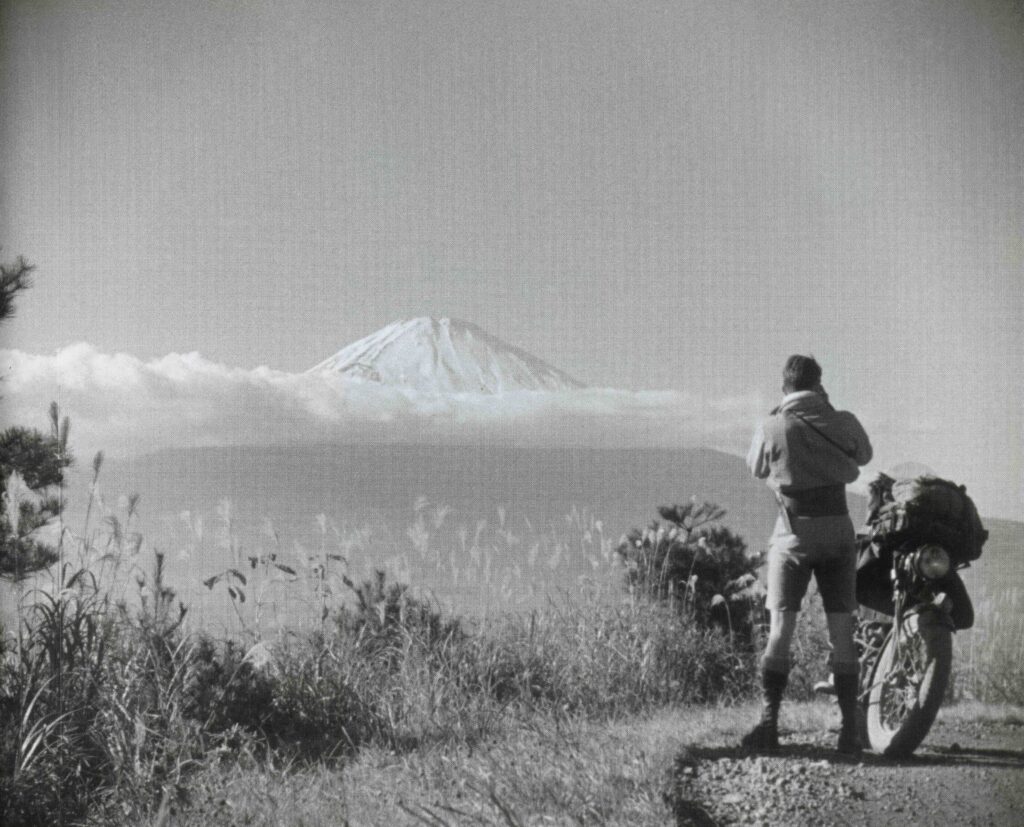
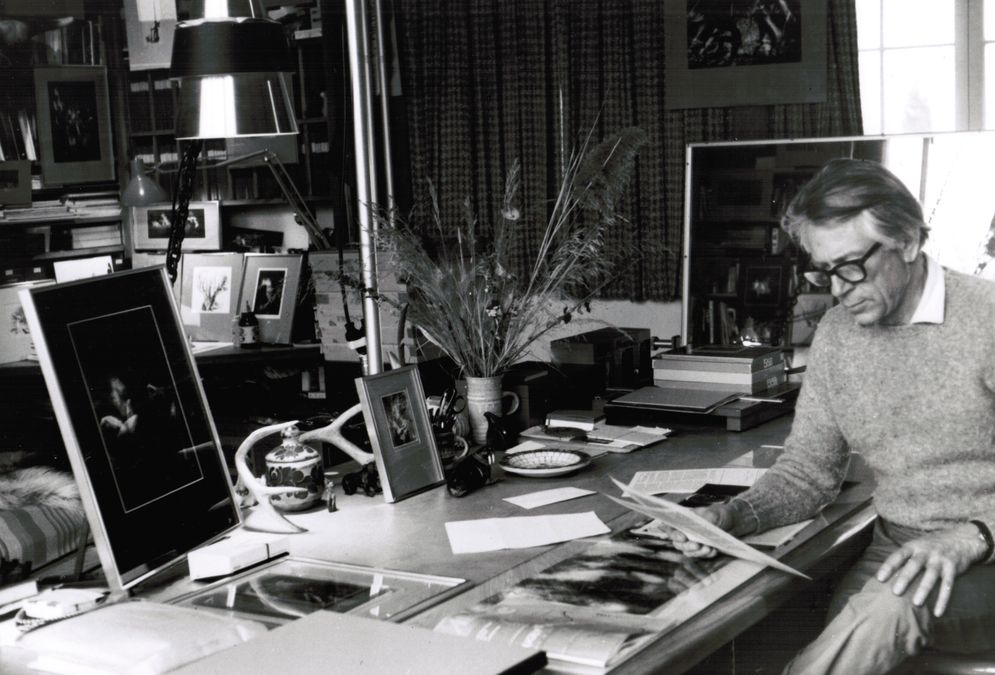
Fulton came across many animal, and the occasional human, that had succumbed to the desert. [Fulton Family Archive]Fulton in Japan photographing Mt Fuji. [Fulton Family Archive]Robert Edison Fulton Jr later in life, at his desk, where the ideas for new inventions poured forth. [Fulton Family Archive]Vintagent Contributor Dennis Quinlan visited RE Fulton Jr in 1994, capturing him with his Douglas at Flying Ridge, Connecticut. Fulton died in 2004: read his NYTimes obituary here. [Dennis Quinlan]
Clement Salvadori is a veteran moto-journalist, world traveler, and author of No Thru Road, 101 RoadTales, several travel guides through California and Baja, and more.
Paul d'Orléans is the founder of TheVintagent.com. He is an author, photographer, filmmaker, museum curator, event organizer, and public speaker. Check out his Author Page, Instagram, and Facebook.
As part of the buildup to our Electric Revolution Live event in May 2022, as a follow-up of our Electric Revolution exhibit at the Petersen Museum, we are ramping up reportage on the EV scene. It's an ever-evolving, even frantic, landscape of electric vehicles, and it can be tough to keep abreast of all the latest bikes, batteries, and news constantly flooding the market. That’s why we’ve re-launched our weekly EV News Roundup to bring you cherry-picked stories that matter to you.
Hello dear readers and riders! Are some of you feeling the frosty bite of winter in the air yet? Have you busted out your winter riding gear? Thankfully, we have some hot EV news this week that is guaranteed to warm things up! From a café racer e-Motorbike and an itty-bitty caravan to a former Tesla employee shattering the Cannonball Run record aboard the manufacturer’s Model S, our weekly EV roundup always brings stories that matter the most to EV enthusiasts and traditionalist riders alike.
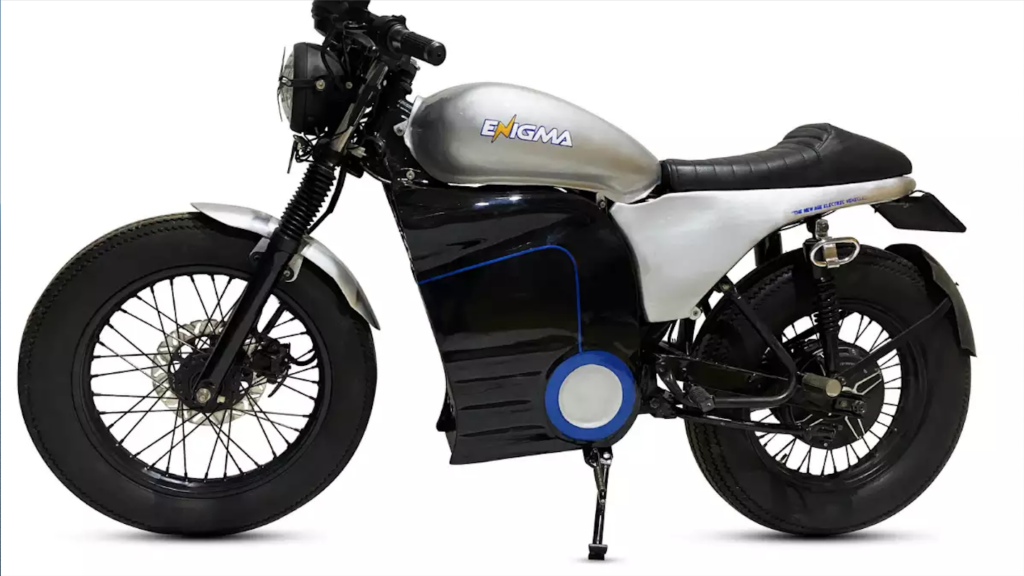
The Enigma eBike is a cafe racer from India with an 85 mile / 85mph spec, and is meant to be affordable. [Enigma]India-based EV manufacturer, Enigma, revealed its EV “café racer” earlier this week. The bike, planned to be manufactured at the company’s plants in Bhopal, Mandideep and Uppal Hyderabad, will feature a 72V, lithium ferro phosphate battery that delivers a 140-km (86.9 miles) range on a single charge. Enigma promises that the bike will reach top speeds of 136 kmph (84 mph) and have a peak power of 5.6 KW. The e-motorcycle will go from 0 to 80% charged in just three hours and will be available in five colors. “When we started designing our motorcycle, our ambition was to create a motorbike that would serve as a powerful exploration tool but also balance the everyday commuting without breaking the bank,” Enigma founder and CEO, Anmol Bohre, said.
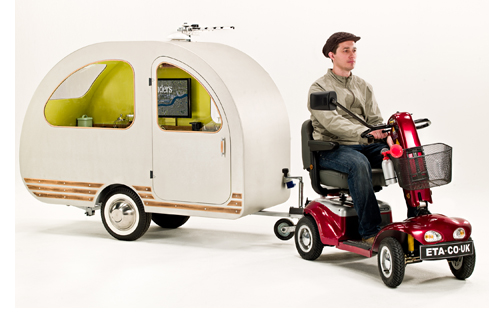
World’s Smallest (and Cutest!) Towable Caravan
Officially the world's smallest caravan, the QTvan is meant to be towed by small EVs, even mobility scooters. Fancy a cross-country trip? [QTVan]Skip those Royal Wedding queues once and for all! Designed by Yannick Read and Britain’s Environmental Transport Association (ETA), the QTvan is the world’s tiniest and most adorable towable caravan. Measuring just 2.39 meters in length and 1.53 meters in height, the QTvan caters to Britain’s three biggest obsessions: tea, queuing, and caravans. Occupants can enjoy watching the next Royal Wedding on the 19-inch TV or make a cup of PG Tips via the caravan’s tea-making facilities. It is effortlessly hooked up to a mobility scooter or other micro EV, and is priced at £5,500 ($7,421).
Meet the Ford F-100 EV Pickup
Retro Ford F-100 Eluminator EV? Yes please! [Ford]We are losing our minds over this retro-inspired electric pickup truck concept recently unveiled by Ford. Harkening back to the aesthetics of the ‘70s, the all-electric F-100 Eluminator is a zero-tailpipe-emissions demonstration truck that features all-wheel drive and two electric traction motors that are capable of producing 480 ponies and 634 lb.-ft. of torque from a 'crate motor' out of the Mach E GT Performance Edition. You can't buy this truck, but you can buy the powerplant from Ford to put into your own vintage F-100 chassis...serious suspension upgrades required.
EV Personal Aerial Vehicle is a Whole Lotta Fun to Fly!
Meet George Jetson! Or at least, the Jetson personal electric aircraft, which requires no pilot's license to tear around the sky. [Jetson]Sweden’s Jetson Aero just announced that it is completely sold out of its 2022 production of the personal eVTOL, a cute little single-seat EV aerial craft. Capable of zooming along at 63 mph, the craft features an aluminum/carbon fiber spaceframe, eight props mounted on four arms that put out 118 horsepower, a throttle/joystick control combo, and a display dash. So, if you want an airplane that you can stash in your garage, now you know where to look!
OTTOEDGE Releases Its First Campaign for AMO Electric Mobility
The OTTEdge AMO escooter in a virtual display setting. [OTTEdge]Listen up all of you marketing gurus out there! OTTOEDGE, a global independent agency, recently deployed a successful marketing campaign for AMO Electric Mobility that really resonated with youths positioned to change the world. Released primarily on digital platforms, the campaign has garnered 2+ million views on YouTube with unique 1.5 million views. The campaign will also appear on National Television and regional news channels. Amongst all the marketing static the EV space has produced, it’s nice to see a campaign that really stands out.
Fresh Funding:
All-singing, all-dancing, but all-performing? The towering valuation of Tesla belies its actual revenue, but that hasn't stopped speculators. [NY Times]
Tesla hit a trillion-dollar market valuation earlier this week when shares increased thanks to Hertz’s announcement of plans to purchase 100,000 of its EVs. With revenues of around $50Billion, this makes Tesla the lowest-revenue company to hit the 10-figure valuation, which worries some economists.
Rad Power gains power through investment: the compact utility eBike maker looks stronger every year. [Rad Power]
Rad Power Bikes, the fat tire EV manufacturer, raised $154 million Series D from existing investors, bringing the startup’s total funding to $329 million.
The Rivian RT-1 [Wikipedia]
EV startup, Rivian, is looking to raise $8.4 billion, which would give it a value equal to Honda. Does this make sense? It seems market valuations have more to do with anticipated value than actual production capacity or products available...then again, Amazon wasn't profitable for many years when it sold primarily books...
Former Tesla Employee Uses a Tesla to Shatter Cannonball Run Records
Ryan Levenson used a Tesla Model S Long Range to knock 2 full hours off the cross-USA 'Cannonball' EV record from a Porsche Taycan. [Ryan Levenson]We’ve all secretly dreamed of getting payback on employers we downright loathe. Well, that’s the story behind Ryan Levenson’s staggering Cannonball Race record. The former Tesla employee and EV enthusiast rented a Tesla Model S and outfitted it with 19-inch-rimmed racing tires to increase its range. Ryan and his team could race 1.5 to two hours between stops, thanks to the Model S’s 405-mile range and Ryan’s minor tweaks. Using the quick-charge capacity of Tesla's coast-to-coast facilities, he set a new record at 42 hours and 52 minutes, of which around 7 hours was spent on charging time. The current IC record for a Cannonball run is 25 hours 39 minutes, by comparison, which included only ten minutes for refueling! Several fuel cells were packed into that car...could a Tesla (or other EV) be packed with batteries for a shorter run?
Stephanie Weaver is a Philadelphia-based freelance writer. When she's not locked to her laptop, she can be found riding horses and motorcycles.
Editor's Note: Fabio Affuso is an Italian photographer covering all types of motorsport and fashion, with a particular interest and gift for motorcycle photography. He has contributed stories about The Great Mile and most recently the all-electric Elektrafuture event in St. Tropez, which gave him the inspiration to try an off-grid off-road journey in his native Italy, between two legendary volcanos. He had generously shared his photographs and travel diary from his journey with The Vintagent: it is a pioneering exploration of what will surely be possible for eBike journeys in the future, completely off-grid using solar energy. A longer version of this story with video clips is coming soon.
From Fabio Affuso: POWERED BY SOLAR
When in the middle of a total world lockdown this bonkers project first came to mind, nobody had any idea if it was gonna work, but that didn’t matter: its true essence was challenging ourselves and tasting freedom once again. For the friends and ballsy brands I approached it was a salivating mix of excitement and perplexity…”It’d be amazing to ride between the volcanoes! How can you do an enduro trip with electric motorcycles?? Nobody’s done it yet with solar, is it even possible? Total Outlaws…I’m in!”
Solitude on a stunning mountain landscape was the reward for making a pioneering eBike ride into the Apenines and volcanos of southern Italy. Jose S picks his way through the rocks for a stunning view. [Fabio Affuso]Truth is, the project was a bet and a challenge, and one we so sorely needed. Being able to rely on our own abilities and resources was what we really wanted, something our modern society has ultimately taken away from us, making everything terribly homogenous, safe and controlled. Motorcycling, and now electric motorcycling cross-country, became our time machine to feel alive again. A risky jump, not for the cautious, but the daring wouldn’t miss it for anything in the world. After all, riding electric motorcycles off-road between the two most dangerous live volcanoes of Europe is not an everyday task, with no guarantee of success. Riding Vesuvius (near Naples) to Etna (on Sicily) while charging the bikes from a self-converted camper van with solar power is even less so…a technological as much as a personal challenge. But isn’t that what the future looks like anyway?! It’s just that we wanted to do it on our terms. In the end, the allure of being totally off-grid, free camping, riding wild across mountains, and even getting stranded in the middle of nowhere was too much to resist for this wild bunch. So we went.
The équipe included a converted ambulance with solar panels to be used for charging the bikes. Off-grid, but still dependent on a petrol vehicle...a compromise for the present. Malaka manhandles the CAKEs for a dawn ride. [Fabio Affuso]Some six months after Powered by Solar first bubbled up, at 6am five of us were up on top of Vesuvius. Equipped with the raddest gear from El Solitario, Sena and Kriega, we were ready to head down south for the next 6 days. With Lesley, Mia the wolfdog and Malaka driving 2 self-made camper vans, with Josè, Adelio and I riding 3 electric off-road motorcycles by CAKE.
Adelo L bushwhacking: riding on seldom-explored or abandoned trails was a big part of the challenge and the fun. [Fabio Affuso]Off-roading in the middle of nowhere with silent motorcycles is a rad and surreal experience, especially while talking to each other via hi-def intercom. All you can hear is the live forest, the sound of the chain, and your pals laughing and crying as you’re powering through thorny woods (that’s if you don’t put your Spotify on). Wild enduro is not for everyone, but if you're into it, you know the true taste of exhilaration. From abandoned hiking paths cut by landslides and dubious homemade bridges, to thick pine forests with fast trails and fallen massive trees, we rode all sorts of terrains like a squad on a mission. Everybody knows Italy has amazing roads to ride, but not everybody knows there are more unpaved than paved roads in this country, so the choice is endless [ed. note: it's the same in the USA!]. The further south in Italy you go, the easier it becomes when you bump into forest rangers, who often wave rather than chase you...like in Sicily, when we rode between wildfires, we stopped to chat with fire brigades and police under the flying water scooper planes. Italian heat in August is serious business that can leave a mark [ed note: especially in 2021, when Sicily hit 120deg F, the highest ever recorded in Europe].
Camping near a wildfire: climate change in Italy looks much like California - drought, heat, and fires appear to be the new normal in late summer. [Fabio Affuso]Because of the heat, most days between 2 and 4pm we either rode like camels in the Sahara, or slept like wolves at the equator. On the first day, when drowsy and tired we found a huge dam to swim in, eat and sleep. We were on a fine enduro adventure, but first and foremost we are a bunch of friends getting lost into nature, because we can and because we need to. Far from actually getting lost, we rode amazing tracks laid out by friend and enduro tour guide Ugo Filosa (www.offroaditalia.it). Weirdly, the Southern Italian mountains are pretty much free of people in the summer, as most prefer the beach to the high altitude. Riding under those tall trees up high on the Apenines, we found respite from the beach bums' mayhem, and only in the evening descended to the coast to have a swim and the occasional shower. After all, it is summer, and we need to sink it in before it’s gone.
Malaka watching fire crews drop water by plane onto an advancing fire. A sadly common sight in California, Greece, and Spain too! [Fabio Affuso]The CAKE Kalk bikes we used are super light and fun, but we had to plan well and monitor battery power all the time if we are to make it to the end. Driving the vans to the best meeting points, Jose, Adelio and I tested the CAKEs’ gazelle capabilities until the last drop of power, like when in Calabria all three of us decided to continue into the mountains with half power, to then descend on the other side with none. Reckless, probably yes, but intoxicatingly beautiful.
The CAKE Kalks proved well able to handle the roughest terrain, but it's still hard work! Lesley B takes a break on the black volcanic soil. [Fabio Affuso]Fully stocked with cold beers and snacks, Lesley and Malaka are always on the ball, criss-crossing the mountains on tarmac to reach our designated meeting points, be it light or dark, or at some emergency rescue points, as it happens twice when we got unrepairable punctures or when we rode the bikes until the last drop of CAKE juice. Yet we have to do it this way, we have to touch the technical limits to know where they are and to finally push them, or else we are only restrained by our own mind’s limits. I know a hippy or two who would ask…what’s the worst that could happen!?
Jose S exploring classic Italian mountain village architecture, with the added bonus of silent exploration, and no harrassment. [Fabio Affuso]Once we learned that running the batteries flat is not good for our charging technique (swapping batteries and charging off solar), we made peace with the fact we needed to hook into the grid for once, with the bonus of a proper shower at the empty camping park by the beach. Flexibility and adaptability is what ultimately takes us all the way to Sicily, through wildfires and then finally atop Etna, where mother earth fulfills our ecstatic ambitions with a mind blowing nightime eruption. ‘Illegally’ free camping on the volcano itself, it’s hard to find a better way to end this crazy trip inspired by nature, technology, and our obstinate aspiration for a world that could be free once again.
Malaka enjoying the cinders! Direct from the volcano, and not on the Speedway track. [Fabio Affuso]Adelio and Jose S find sketchy trails not intended for motorcycles! But all part of the fun. [Fabio Affuso]The heart of fire, but not a fire per se: an eruption on Mt Etna was a reward for a long journey. [Fabio Affuso]Keep an eye out for the full story coming to Thee Vintagent soon…
Fabio Affuso is an Italian photographer based in London and his native Naples. He photographs motorsport and fashion around the globe. Find him at his website and Instagram.
Vintagent Labs is the new content creation arm of The Vintagent. A collaboration between Nadia Fugazza, Mark MacInnis, and Paul d'Orléans, incorporating the skills and contributions of talented friends and collaborators around the world. Nadia Fugazza is a film producer and editor and now Executive Producer for Film at The Vintagent, who spent 8 years creating award-winning video content for Petrolicious. Mark MacInnis is a film producer and now Managing Editor for The Vintagent, whose films have been featured for years on The Vintagent ('Sugar & Spade' and 'Sugar & Spade in Morocco'). Paul d'Orléans is the founder and CEO of The Vintagent. [/one_half]
SUMMARY
A film about adventure travel, in support of the ADV:Overland exhibit at the Petersen Automotive Museum in Los Angeles, July 2021 - April 2022. Subtitled ‘off-road to off-world’, ADV:Overland includes round-the-world and long-distance racing machinery from 1903 to the present, plus sci-fi and NASA overland explorers. The real-world adventure machines show dirt and scars from outrageous journeys, some even with their original bags, boxes, and tools in place, 90 years later. ADV:Overland showcases the living, breathing history of overland travel, and its counterparts in outer space.
In the beginning, every motor trip was an adventure, and every motorist a mechanic. Some heard a different call, seeking adventure in overland travel to far-distant places. In 1903, crossing the USA on wheels had never been done, but that changed when George Wymans rode a California motorcycle for 50 days from San Francisco to New York. In 1912, nobody had circled the globe on a motorcycle, but that changed when Carl Stearns Clancy straddled his Henderson Four and headed east. In the next 100 years, brave men and women struck out to see the world on wheels, making epic journeys recorded in books, films, and television. Folks more technically-oriented imagined travel off-world, on the Moon or Mars or beyond, in science fiction and actual space programs.
Exhibition curator and Motorcycle Arts Foundation co-founder Paul d’Orleans explains: “ADV:Overland celebrates the spirit of adventure. These remarkable machines tell a human story, of dreamers and reckless youth, stubborn visionaries and dogged competitors, all together in one place. It also includes the ultimate overland dream of surface exploration on other worlds, which is happening on Mars right now - and we have some of the NASA/JPL rovers. We told lenders not to wash their overland veterans: we wanted to show good honest dirt as proof of their rough duty.”
The contrast between the extremely simple overland machinery from the early 20th century to Charley Boorman’s electric LiveWire from Long Way Up is great, but the journey still had to be made on wheels. “The genesis of overland travel can be seen in the early bikes, like the 1912 Henderson Four that Carl Clancy rode around the world. These rudimentary machines captured the public’s imagination and fueled overland travel and competition we see today, like the Baja and Dakar rallies, and films like Long Way Up,” added MAF co-Founder Sasha Tcherekoff.
If 100-year old dirt-covered bikes don’t inspire you, then come to ADV: Overland for the far-out space exhibits. Two sci-fi overlanders from the Lost In Space series, including the spectacular 1960s tracked glass house, keep company with a futuristic 3-D printed electric “Lunar motorcycle” from Hookie.co. For an inspiring comparison between real and imaginary off-world overlanding, NASA/JPL loaned two actual Mars rovers - models of Opportunity and Sojourner - that have logged more miles on other worlds than any other vehicle.
Also on display is Charley Boorman’s electric LiveWire customized by Harley-Davidson for the Long Way Up television series. The Motor Company is also a sponsor of ADV: Overland in support of the 2021 launch of the Harley-Davidson Pan America. The Pan America marks Milwaukee’s first-ever adventure-touring motorcycle meant to compete in the growing ADV motorcycle space.
ADV: Overland opens on July 3rd, with an opening reception on July 15th, which will be a drive/ride-in event on the Petersen rooftop. The exhibit is produced by Motorcycle Arts Foundation (MAF) and Sasha Tcherevkoff in partnership with Vintagent Lab, the just-launched content creation arm of The Vintagent.com.
CAST AND CREW
Executive Producers: Nadia Fugazza, Mark MacInnis, Paul d'Orleans Producer: Mark MacInnis Director: Tiziano Niero Director of Photography: David Martinez Editor: Nadia Fugazza Key Cast: Dan Green Videographer and additional photos: Jeremy King Composer: Giacomo Lamparelli Voice Over: Paul d'Orléans VO Engineer: David Darling
Lyndon Poskitt on his RoundTheWorld KTM, struggling in the sand. [Lyndon Poskitt]
Anton Gonnisen in the Peking to Paris Rally on his home-built homage to the original 1906 Contal Mototri that ran the first PtoP race in 1907. [Anton Gonnisen]
RE Fulton Jr in Japan, 1932, from 'One Man Caravan.' [Fulton Family Archives]
After 18 months of hibernation, the world is primed for adventure, and the ADV:Overland exhibit at the Petersen Automotive Museum has it in spades. Subtitled ‘off-road to off-world’, ADV:Overland includes round-the-world and long-distance racing machinery from 1903 to the present, plus sci-fi and NASA overland explorers. The real-world adventure machines show dirt and scars from outrageous journeys, some even with their original bags, boxes, and tools in place, 90 years later. ADV:Overland showcases the living, breathing history of overland travel, and its counterparts in outer space, as a welcome breath of freedom as we emerge from COVID.
In the beginning, every motor trip was an adventure, and every motorist a mechanic. Some heard a different call, seeking adventure in overland travel to far-distant places. In 1903, crossing the USA on wheels had never been done, but that changed when George Wymans rode a California motorcycle for 50 days from San Francisco to New York. In 1912, nobody had circled the globe on a motorcycle, but that changed when Carl Stearns Clancy straddled his Henderson Four and headed east.
In the next 100 years, brave men and women struck out to see the world on wheels, making epic journeys recorded in books, films, and television. Folks more technically-oriented imagined travel off-world, on the Moon or Mars or beyond, in science fiction and actual space programs.
Exhibition curator and Motorcycle Arts Foundation co-founder Paul d’Orleans explains: “ADV:Overland celebrates the spirit of adventure. These remarkable machines tell a human story, of dreamers and reckless youth, stubborn visionaries and dogged competitors, all together in one place.
It also includes the ultimate overland dream of surface exploration on other worlds, which is happening on Mars right now - and we have some of the NASA/JPL rovers. We told lenders not to wash their overland veterans: we wanted to show good honest dirt as proof of their rough duty.”
The contrast between the extremely simple overland machinery from the early 20th century to Charley Boorman’s electric LiveWire from Long Way Up is great, but the journey still had to be made on wheels. “The genesis of overland travel can be seen in the early bikes, like the 1912 Henderson Four that Carl Clancy rode around the world.
These rudimentary machines captured the public’s imagination and fueled overland travel and competition we see today, like the Baja and Dakar rallies, and films like Long Way Up,” added MAF co-Founder Sasha Tcherevkoff.
If 100-year old dirt-covered bikes don’t inspire you, then come to ADV: Overland for the far-out space exhibits. Two sci-fi overlanders from the Lost In Space series, including the spectacular 1960s tracked glasshouse, keep company with a futuristic 3-D printed electric “Lunar motorcycle” from Hookie.co.
For an inspiring comparison between real and imaginary off-world overlanding, NASA/JPL loaned two actual Mars rovers - models of Opportunity and Sojourner - that have logged more miles on other worlds than any other vehicle.
Also on display is Charley Boorman’s electric LiveWire customized by Harley-Davidson for the Long Way Up television series. The Motor Company is also a sponsor of ADV: Overland in support of the 2021 launch of the Harley-Davidson Pan America. The Pan America marks Milwaukee’s first-ever adventure-touring motorcycle meant to compete in the growing ADV motorcycle space.
ADV: Overland opens on July 3rd, with an opening reception on July 15th, which will be a drive/ride-in event on the Petersen rooftop. The exhibit is produced by Motorcycle Arts Foundation (MAF) and Sasha Tcherevkoff in partnership with Vintagent Lab, the just-launched content creation arm of The Vintagent.com.
Music for the July 15th opening reception curated by @RedLightVinyl.
Paladin. If you were part of the nascent Old Motorcycle scene in Berkeley in the late 1970s/80s, you probably encountered him. He was typically seen hanging around T.T. Motors on Ashby Avenue, giving unsolicited advice and a deposition on any subject to anyone nearby. Sometimes that was me, after I'd ridden whatever was running, from San Francisco to the East Bay to check out the bikes for sale at T.T. Motors, visit my friends, and inevitably have a chat with Paladin.
Paladin on a Triumph TR6 sold to him for $45 by John Gallivan of TT Motors in Berkeley [Berkeley USA]He was a devoted Triumph man, and I owned several of his 'hardtail' Triumph conversions over the years, each honed closer to the 'bob-job' ideal than anything made today - they were fast, light, and no-frills. He could appreciate other brands though, and enjoyed discussing their relative merits. His arms were covered with amazing self-applied Triumph tattoos, images from long-ago advertising, logos, and graphic imaginings of motorcycles and women. He applied tattoos on others, occasionally.
John Gallivan in his TT Motors shop in Berkeley. [John Gallivan]John Gallivan, owner of T.T. Motors, said of Paladin, "I liked and respected him a great deal. I sold him that bike [a Triumph TR6] for $49.00, and he stayed. His writing in Iron Horse magazine and others are classics. He coined the word 'unobtanium' referring to rare British parts. His centerfold in Iron Horse with a girl and real rats crawling all over is a classic." As mentioned, Paladin was a regular contributor to Iron Horse, and had a column, 'Paladin's Notebook', with illustrations of his ideas for choppers and cafe racers, some of which were prescient, and predated the third-wave cafe racer scene of the 2010s by 20 years.
'Paladin's Notebook' ran in Iron Horse for many years, and mixed Paladin's illustrations with thoughts on motorcycle design and culture. [Iron Horse]Paladin knew a heck of a lot about motorcycle history, their care and customization, and motorcycle culture in all its diversity. He knew a lot about everything else too, and shared what he knew in a distinctive voice, like a pirate that had swallowed Sylvester the Cat: thufferin' thuccotash, arrr. As he spoke, one eye would squint, then the other, and as he waved his arms he jingled the tools hung on chains from his filthy leather jeans. He carried a sheathed knife he'd made himself, and made them for others too, occasionally. And he was a performance poet, in a now-vanished tradition of Bay Area poets who ranted and broke boundaries, were extremely political and sometimes had the cops intervene in their readings, like Peter Plate, for whom I printed several books. His friend Arnold Snyder recounted one of Paladin's poems from the mid-1970s from memory on his blog:
Every damn body was born to die So while you’re waitin’ you better get high ’Cause the trip is whatever you manage to buy And you pay for it soon as you’re born
Now, me, I get off on women and sin Hard partyin’ Getting’ righteously wasted But mostly a big ol’ Milwaukee V-twin
’Cause there’s nothin’ at all like a righteous machine About dynamite fast and say, medium clean And if you’ve been hangin’ out there You flat know what I mean
Tearin’ up empty streets around dawn Tearin’ down highways out on a run With a few or more bros, out havin’ fun The wind in your armpits, your chrome in the sun
And like the wind, you’re gone On a knucklehead, or a panhead, or a shovelhead ’Cause once you’re gone, you’re gonna stay dead So, meanwhile, Get it on!
Another 'Paladin's Notebook' featuring a design that predates the current Tracker custom style by 30 years. [Iron Horse]Paladin was 5' tall and full of surprises. The first time I rode a Velocette to T.T. Motors in 1985, Paladin brought out a bucket of soapy water and a sponge and washed it! "Such a finely made motorcycle as this should NEVER be dirty!" He, on the other hand, didn't mind being dirty. He was spiritually inclined towards old Norse religion, which was odd for a Jewish guy from New Jersey - his real name was Martin Rosenberg. But, this was Berkeley, so while his chosen religion was remarked on, it was never judged.
Martin Rosenberg aka Paladin, from the book 'Berkeley U.S.A.' [Berkeley USA]Paladin died of heart failure in his sleep in 1988: he was only 45. He had suffered a mighty knock to the head in a motorcycle accident a few years prior, which definitely altered his personality. And, who knows what he put into his body for fun. His wake was amazing, and set the pattern for every wake to follow that I had a hand in: a ram's horn was filled with whisky, and passed from person to person, with each raising a toast in turn, a collective shout 'To Paladin!', and telling a story or remembrance of the man. A proper wake, and how I'd like to be remembered too.
The following is an excerpt of an interview with Paladin, from the book, 'Berkeley U.S.A.' (Anne Moose, Alternative Press, 1981):
"Essentially, everything that I do relates at one level or another to motorcycling. I make my living by writing for motorcycling journals and doing illustrations for them... I'm into motorcycle paint work and uh, you know, it's kind of dull if you ain't into bikes, but I'm into bikes so I find it all quite fascinating....Twenty years ago, it didn't matter if you rode a Harley, or if you rode a Triumph, or if you rode a BSA. If you rode, you rode. You were committed. The other people who rode were your brothers, except you didn't use the word brother because you didn't have to. This was all just, you know, understood at almost a back brain level.
Now then, when the Japanese started bringing their bikes in, what they brought was nothing new in the sense of engineering. What they did was... a publicity campaign. They brought in a form of advertising to make the motorcycle, shall I say, socially acceptable. Well, people that are stone bikers, as opposed to motorcycle operators, don't really care much about social acceptability... But what this did, brought a whole new kind of person into the riding scene, and it brought in a lot of divisionism. In 1963, you break down on your bike on the side of the highway, you know that the next guy who comes by is going to stop and help. And it don't matter what brand of bike you're riding, or if his bike is chopped or not, or who's in a club and who isn't - that's jive. You're a biker or you're not. Since the Japanese bike has become popular...it's brought this new element ...this whole concept of antagonism and divisionism which we've had to deal with for about the past twelve to fifteen years.
The notorious 'rat bike' cover of Iron Horse, with Paladin, a model, and his ratty Harley-Davidson. He later became a cafe racer fan. [Iron Horse]Personally, I can't stand Japanese bikes. I don't care how fast they are, or how many camshafts they have, or if they win races. I just don't like the aesthetics of the damn things. But at the same time, it doesn't matter what kind of sled you've got under your ass - when you're in the wind, it's like, the same wind, and that's the policy we're pushing.
As far as I'm concerned, the only group that really matters in this country, per se, is the bikers. And this may sound like an off-the-wall statement, but I think if you'll check back you'll find that during that whole big so-called cultural revolution of the sixties, language, style, and everything was copied from the bikers. Our influence is a lot more subtle than many people would imagine. We're simply living our own lives, and in living our own lives we're setting such a rare example in modern times...
Some intriguing cafe racer designs from 'Paladin's notebook, including a Morini V-twin. [Iron Horse]The thing is, you're born black, you're born Chicano, you're born Anglo-Saxon, Protestant, Jewish, Polynesian, whatever. Nobody is born a biker. It's something you do by choice. A biker is under a complete psychic necesssity, right, in that he is one half of a symbiotic organism of which the other half is a motorcycle. And if you wish to make any value judgements on that, go ask your mother how she likes her valium.
One of the things that a lot of people that I'm close to are into, is trying to get more women into riding. I guess you could say it's part of our highway beautification project. I personally think that women and men both - and everyone - should know how to handle machines... that, to me, is the only way we're ever going to have what I'd consider to be a sane and healthy culture... If people are going to band together, it must be through recognition and respect of their own strength, and of the strength of those about them. It always starts at the inside and works out."
May you long be remembered, Paladin. [Berkeley USA]
Paul d'Orléans is the founder of TheVintagent.com. He is an author, photographer, museum curator, event organizer, and public speaker. Check out his Author Page, Instagram, and Facebook.
Was the Wall of Death invented in San Francisco in 1914? That's the claim made in several press clippings from the scrapbooks of pioneering board track veteran Erle 'Red' Armstrong. News stories from 1914 and later stake the claim that Armstrong invented the vertical wall of death attraction, after many years of riding on slant-wall motordromes and racing on banked wooden board tracks in the 'Noughts and 'Teens. Photographs of his vaudeville attraction 'Whirl of Death', set up at the Empire Theater in San Francisco, confirm a 1914 date, and make a previously unknown connection with the 'Race for Life', the combined slant-wall/vertical-wall motordrome consctructed at the 1915 Panama Pacific International Exposition. Photographs dug up at the San Francisco Public Library archives reveal details of the Race for Life, and finally we know the story of who set up and rode that motordrome - Erle 'Red' Armstrong and his partner, 'Reckless' Vernon.
The entrance to the Whirl of Death in a carnival tent setting, on tour somewhere in the West in 1914. [A Century of Motorcycling]Erle Armstrong was born in 1888 in Moria, Illinois, but moved to Colorado with his family ten years later, where his father was a mining engineer in Denver. Erle had flaming red hair (hence his lifelong nickname) and a strong physique, and took up bicycle racing in 1904 at age 16: he soon became the Colorado State Champion. By 1905 Erle made his living as a delivery boy for a Denver dry goods store, using an E.R. Thomas motorcycle: he was the sole source of income for his family as his father had died earlier that year. Regardless, Erle doubled down on racing, and shifted to motorcycles, using his own single-cylinder Orient as his mount. With a natural feel for pulling the best from his motorcycles, Armstrong's Orient brought him records for the 5, 10, and 25-mile races in his very first event. He was soon racing in the nearby states of Wyoming and Kansas, and traveling a circuit between those three states and earning a name for himself, and the notice of manufacturers.
Erle 'Red' Armstrong with a factory racing Indian 8-Valve board track machine, the most technically sophisticated American motorcycle when it was introduced in 1911. This example is rare in having front suspension, and as the photo was taken at the Dodge City board track, presumably it was set up for one of the 200-mile races held there. Note also the cushions strapped to the tank, to stop busting the rider's chin over bumps and give some support when in full crouch. [Indian publicity photo]By 1907 Armstrong was working for the Denver Indian dealer, and became the Rocky Mountain State motorcycle champion, a title he retained through 1909. He raced Indian singles and V-twins, and Excelsior singles too, and opened Armstrong Motor Sales in 1910, selling Thor, Wagner, and Minneapolis motorcycles [read our story on the Minneapolis here]. In 1911 he sold his dealership - it took time from his racing - and moved to California, where he raced on board and dirt tracks. He rode mostly Indians and Excelsiors at events as far-flung as Chicago, Dodge City, Oakland, Denver, and Atlanta, as well as at his home Los Angeles turf. In 1913 Armstrong appears racing Excelsior V-twins on the boards, taking wins and being featured in Excelsior advertising, at the moment Ignaz Schwinn pumped money into his recently acquired (1911) motorcycle brand to push sales. After WW1 he joined Indian full-time and moved to Springfield, and managed the factory racing team
A 1914 press publicity photo of the actual Whirl of Death, built of cedar planks and steel bands, with Erle Armstrong and his partner 'Reckless' Vernon. Shown clearly are their specially adapted Excelsior board track racing motorcycles with rigid forks, tiny fuel tanks, and no brakes: the sheen of their satin carnival costumes is clear even in this mediocre reproduction. [Clymer Publications]In 1914 Erle Armstrong supplemented his racing career in the winter months with touring a carnival act of his invention and construction: a vertical-walled motordrome built of wooden slats held in place with steel bands, 19' in diameter and 12' high. The act was called the Whirl of Death, and it toured throughout the West, inside theaters and under canvas tents. According to Armstrong's biographer Butch Baer (a family friend), he built three motorcycles to run on his Wall, and as oil was not allowed in theaters due to fire regulations, he modified his machines to run for 2 minutes each without oil(!). Baer claims there was never a serious accident in any of Armstrong's tours, a remarkable record given the inherent danger of the act.
A view of the Empress Theater on Market St in San Francisco, after it was purchased by the Loews entertainment chain. The building no longer exists. [San Francisco Public Library]According to a later press report on the 'cylinder of death':
"A wooden cylinder with spruce slats three inches apart, 19 feet in diameter, and 12 feet high, two 61 cubic inch 'ported' motorcycles, and two daredevil riders attired in spangled costume, were the ingredients of one of the most hair raising vaudeville acts ever to tour the old time 'three a day' circuit. Conceived in the brain of 'Red' Armstrong who was also one of the performers, this act toured the top billing of the country in company with such greats of the theater as Eddie Cantor, and Weber and Fields."
"The act consisted of riding the inside of the cylinder - with two riders going in opposite directions - blindfolded! Traffic was controlled by a 'ringmaster' who sounded a shrill blast on a whistle if the top man approached the open apex of the cylinder, and two blast if he came too low. This early day 'sonar' system worked out fine until one night in 'Frisco when the whistle failed! Red remembers riding right out of the top of the contrivance, and soaring off into the wings in an unscheduled exit! He was right back in the next performance despite a somewhat damaged big toe - his only souvenir of the accident."
The original Race for Life in 1914: a more solidly constructed motordrome than the presumably earlier Whirl of Death, combining a slant-wall section with a narrow vertical at the top. [A Century of Motorcycling]Armstrong's Whirl of Death took up residence in San Francisco in 1914 at the Empress Theater at 965 Market St. He seems to have liked San Francisco, where he seems to have lived for two years with his wife Maude. He took a day job as service manager for Hap Alzina's Indian dealership, while still hitting the boards in both the racing and vaudeville scenes from 1914 through 1916. It was a golden era for 'Red', and he became one of the winningest board track racers in the country. According to Indian ads, Armstrong held more track records than any other rider, for example at the new Tacoma 2-mile board track (the first of that length - there was a lot of wood in Washington) where he on the inaugural 300-mile race, breaking speed records for 100, 200, and 300 miles. In the winters of 1914 and '15, when racing was dormant, he toured his Whirl of Death.
Construction details of the 1914 version of the Race For Life, with Erle Armstrong's notations ("note steepness" on the banking angles and very narrow 90deg section at the top. This version of the Race For Life appears to be a smaller diameter than the enormous motordrome set up at the Panama Pacific International Exposition in 1915. [A Century of Motorcycling]At some point in 1914, it appears Armstrong changed both the construction and name of his attraction, to the Race For Life, if the date notations from his scrapbooks are accurate. Armstrong's photos suggest he built a far more elaborate motordrome in 1914, with far more robust construction and a mix of banking angles, from 45deg to a fully vertical 90deg section. The large banked sections might seem retrograde after the radical vertical Whirl of Death carnival act, but the Whirl was too fragile to accommodate automobiles, and cars running banked motordromes were very popular since 1909 in Coney Island. The 1914 'taken in the morning' photo above from the Race For Life includes a racing car with a boat-tail rear end, and a ramp for its entry, so clearly Armstrong was expanding his act for a greater draw. Now that we know the Race For Life and Whirl of Death were both touring attractions in 1914, it should be possible to dig deeper on the subject and find period press confirming the dates and locations Armstrong toured - watch this space.
An aerial view of the 1915 Panama Pacific International Exhibition, showing the still-extant Palace of Fine Arts buildings by Bernard Maybeck on the right side. All the other buildings for the PPIE were demolished or moved in 1916, and the neighborhood developed as the Marina District, then as now a haven for young, upscale couples. Not shown in this retouched photo are the Zone and racetracks on the far left of this view. The neighborhood above the PPIE (in gray) is Pacific Heights. [Wikipedia]In 1914, Armstrong applied to install his Race For Life at an upcoming world's fair in San Francisco, which was in the planning stages. San Francisco was in the middle of a building boom at the time, after recovering from the devastating earthquake and fire of 1906. To proclaim to the world that 'San Francisco is back', a consortium of politicians and developers combined civic pride with blatant self-interest, and contrived to convert a large tract of swampy bayside land known as Harbor View into a major development opportunity. Harbor View sat on the north side of town between the Presidio military base and the city's shipping piers (Fort Mason and Fisherman's Wharf), which was then occupied by hundreds of working people displaced by the '06 earthquake, living in shacks and tents on the grazing land of local ranchers. The pretext for developing Harbor View, and ultimately reaping enormous wealth, was the creation a world's fair ostensibly celebrating the 1913 opening of the Panama Canal.
The PPIE was conceived as the Jewel City, illuminated by rainbow-colored searchlights operated by Marines (the Rainbow Scintillator), and lighting through gem-like lenses of Czech glass. This souvenir booklet of the PPIE shows the impact and scale of the exhibition. [San Francisco Public Library]It was called the Panama Pacific International Exhibition (PPIE), a pearl in a long chain of grand industrial expositions originating in 1798 in revolutionary France, that grew in popularity and scale in the 1800s, culminating in the first truly international and expansively conceived Great Exhibition in 1851 of London at Crystal Palace, an enormous steel-and-glass structure built for the occasion. Such fairs are still popular today - the most recent was in Milan in 2015, that focussed on food production.
The Palace of Fine Arts was designed by Bernard Maybeck, and is the only PPIE building still on-site from 1915, although it has been extensively re-engineered, three times, to stabilize what was intended as temporary construction. It was simply too beautiful to destroy! [Wikipedia]Creation of the PPIE was a major undertaking, regardless the grand halls were constructed of temporary materials, mostly wood and plaster. The 635 acres of land were purchased by the City (for a little over $1M), which then had the job of stabilizing the sandy tidal wetlands and beaches. The PPIE was planned like a small city in itself - the Jewel City- as a mix of high-style Beaux Arts architecture for great halls celebrating the arts, sciences, and manufacturing, and a large central fun fair called the Zone. The color palette of plasters used in construction were carefully regulated, and even the sand used on its broad avenues were brought in from Monterey Bay and oven-roasted to the correct shade of tan!
The entrance to the Race For Life attraction at the PPIE: the noise alone must have lured customers! [San Francisco Public Library]The Zone was planned as a mix of food halls and entertainments, enticing entrepreneurial vaudevillians and carnies from across the USA to dream up for-pay spectacles. It was expected the PPIE would be hugely popular, despite the fact that much Europe was at war by the time the fair was open. Regardless, 18 Million people eventually purchased tickets and strolled the grounds. One carnie didn't have to go far to set up his attraction: Erle Armstrong was approved for his exciting, headliner act, and installed the Race For Life at the PPIE. The PPIE version of his motordrome was an even larger and more robustly constructed attraction, with four banked sections allowing for an easy transition for cars and motorcycles entering the 'drome. A wide 78deg banked section was topped by a much taller 90deg section, measuring about 6' high, with a 1' deep lip allowing the audience to literally stand on top of the riders and look directly below. The taller vertical section was wide enough for a car (or two), and Armstrong included a 1914 Stutz GP car in his act, as well as several racing Indians and Excelsiors, one of which was adapted to carry his wife Maude on the handlebars.
Erle 'Red' Armstrong riding his board track Indian on the vertical section of the Race for Life in 1915. [San Francisco Public Library]We documented the Race for Life story here on The Vintagent in 2017, but Erle Armstrong's story was the missing piece of the puzzle. I speculated in the article that the 1915 photos of the Race for Life might be the first properly documented Wall of Death, but a recent purchase of 'A Century of Motorcycling, Vol I and II' (self-published by Butch and Tom Baer in 2006, no ISBN) included the terrific 1914 photos included above, and the news that Erle Armstrong also created the Race for Life, and was considered at the time to be the inventor of the vertical-wall motordrome, now known as the Wall of Death.
'Red' Armstrong and 'Fearless' Vernon 'racing' on the vertical section of the very large Race for Life attraction in 1915. The attraction had a canvas roof that could be closed in case of rain. [A Century of Motorcycling]It makes sense: who but a hardened board track racer would have the experience of banked wall riding, the machinery capable of riding fully vertical, and the bravery required to do it first?
The site plan of The Zone showing the layout of the Race for Life: 40' in diameter with a canvas roof. [San Francisco Public Library]Game for a ride: Maude Armstrong rode on the handlebars of husband Erle's Race for Life board track racer. This photo was her entry pass to the PPIE. [A Century of Motorcycling]There's a very good biography of Erle 'Red' Armstrong here on Archive Moto, and plenty of mentions of his racing in Stephen Wright's American Racer books, as well as in Dom Emde's excellent new book The Speed Kings: the Rise and Fall of Motordrome Racing, as well the aforementioned A Century of Motorcycling, by Butch and Tom Baer, which might prove difficult to find! Other photos and information used in this article are from the San Francisco Public Library.
On the very day the US military occupation of Japan ended following WWII, on April 28th 1952, the Asahi Shimbun newspaper published a critical essay claiming the occupation left Japan’s people “irresponsible, obsequious and listless...unable to perceive issues in a forthright manner, which led to distorted perspectives.”
Honda's very first international race in São Paolo Brazil, 1954, with an R125 racer. Note the girder forks, knobby tires, and tall chassis compared to the Puch racer beside it with road race tires, telescopic forks, full-width aluminum brakes, clip-on handlebars, and rear suspension! [Honda]Less than two years later, in January 1954, Soichiro Honda’s fledgling Honda Motor Company participated in its first overseas motorsports event at the São Paulo City Fourth Centennial Celebration International Motor Race. It took four days for Honda's staff of 3 to travel from Tokyo to Brazil. Racer Mikio Omura, riding a modified Dream E-Type racer, rode hard to finish thirteenth. The performance gap between Honda and the European motorcycles was wide, but Soichiro was undeterred. Two months after Brazil, on March 20, 1954, Honda nonetheless published a “Declaration of Entry” to compete at the ultimate road race, the Isle of Man TT. Setting his company in pursuit of this remarkable man-on-the-moon objective, Soichiro Honda boldly exclaimed, “My childhood dream was to be a motorsport World Champion with a machine built by myself. I have decided to compete in the Isle of Man TT races… This aim is a difficult one, but we have to achieve it to test the viability of Japanese industrial technology, and to demonstrate it to the world… I here avow my definite intention that I will participate in the TT races and I proclaim with my fellow employees that I will pour in all my energy and creative powers to win..." Honda wasn’t simply building engines for cars and motorcycles: they were powering Japan into the modern age.
Distorted perspectives? Perhaps. Irresponsible, obsequious and listless? Hardly.
Honda's first sophisticated racer, the RC71 or C71Z, with their new twin-cylinder OHC motor, seen at the second running of the Mt Asama volacano races in 1957. The first Asama race was 1955, the last in 1959. The track was all cinders, hence the knobby tires. [Honda]At the time, Honda was only beginning to export motorcycles to the “advanced countries”. Racing, however, offered an opportunity to compete with the rest of the world. Never before had there been a Japanese rider competing at the TT with a motorcycle made in Japan. While no Japanese motorcycle had ever raced at the Island, a Japanese rider had, back in 1930 when Kenzo Tada, the Japanese champion and Velocette dealer for Tokyo, was invited by Veloce Ltd to race at the TT. Tada finished a respectable 15th, and brought stories of British and European race teams back to Japan, fueling the dreams of impressionable youth like Honda.
Soichiro Honda supervising his team of racers in 1957 on the Mt Asama track. Note the changes on the racers, from higher pipes and bigger tanks to full-width hubs and lighter bodywork. [Honda]Soichiro Honda knew the winner of the Isle of Man TT would be known across the globe....along with any vehicle that completed the race safely. “I will fabricate a 250cc (medium class) racer for this race, and as the representative of our Honda Motor Co, I will send it out into the spotlight of the world. I am confident that this vehicle can reach speeds exceeding 180 km/h.” In 1955, he embarked on a world tour, making the rounds of British and European manufacturers who would meet with him. Their reception was generally friendly, and in their Colonial mindset, they saw no threat in the courteous Japanese fellow who built inexpensive lightweight motorcycles. It is said that the racing department at NSU were only too happy to show him the blueprints for their all-conquering 125, 175, and 250cc Grand Prix racers, with their sophisticated OHC and DOHC motors, pressed steel frames, and beautifully made castings. NSU made a strong impression, and shared the most information: some say Honda was able to purchase an obsolete NSU Grand Prix racer and bring it to Japan for study.
Mt Asama in the background, and the simple infrastructure of the 1955 races. Competition was fierce as every Japanese manufacturer fielded their prototype racing bikes. [Honda]Within two years Honda had transformed his product line into very sophisticated unit-construction OHC engines with forward canted twin-cylinders, in a simple pressed-steel spine chassis with short leading-link forks. The NSU influence was clear, but Honda did not copy NSU's street bikes for their new lineup, but took the technology of hand-made NSU Rennmax racers into mass production [how this was possible can be studied in another article here]. With this new architecture, Honda competed at the Isle of Man TT for the first time in 1958 on a modified version of their twin-cylinder 250cc design, the RC71Z. NSU had dropped out of racing the previous year, along with BMW, Moto Guzzi, Gilera, etc, as the European motorcycle market hit a rough patch due to the growing popularity of cheap cars, but the Japanese market was booming, as was the American scene. In 1959 Honda established their first dealers in the USA, and just two years later, in 1961, Honda factory rider Mike Hailwood claimed his first of many victories at the TT, winning both the 125cc and 250cc classes, with the factory race team sweeping first through fifth places in both classes overall.
Distorted perspectives - certainly. Listless? Ha!
The 1961 Isle of Man TT, where Honda swept the 125cc and 250cc classes. Tom Philips, Luigi Taveri, and Mike Hailwood, with Mike's father Stan directly behind him. [Honda]Fast forward a generation. By the time most teenagers take the fateful leap from drooling over bike magazines, to actually riding motorbikes, their tastes firmly eschew “classic” or “vintage” as old and uninteresting; much as they saw their parents generation. When that first motorbike is decades old, its hardly by choice; rather, its a compromise driven by budget, hand-me-down or practical happenstance. A rite of passage, a first step on the road toward the ultimate grail: the latest shiny and sparkly machine they (nay, we) could get our hands on. History can wait until later in life.
Takeshi Maejima, or Ted, of Ted's Special Motorcycle Works in Japan. [Larry Morris]An outlier of the old-is-boring, new-is-better view common among his peers 30 years ago, Takeshi “Ted” Maejima had just one occupational goal for his life, one all-consuming passion: to revive, preserve and celebrate Honda’s remarkable legacy of motorcycle racing. To Ted, his first bikes were “too new”- he was determined to travel back in time. Today, his motorcycle shop, Ted’s Special Motorcycle Works in Kanagawa Prefecture is a treasure trove of racing history. Ted is the go-to expert for vintage Honda service, restoration and parts, particularly CB72 Hawks and CB77 Super Hawks, for both track and street.
At Willow Springs Raceway, 2014: Ted is on the left, on the 72x Honda CB160, while Larry is on the right, not that they knew each other at the time. [Philip Graybill]Willow Springs International Raceway, April 2014. This image, shot by my friend, photographer Phillip Graybill, who joined me while I was racing at this AHRMA event, is how I first “met” Ted, who had no clue who I was until years later. The photo ultimately led to a connection on social media and eventually, in-person in Japan where I now live, just 30 minutes away from him.
I asked him a few question for The Vintagent:
Larry Morris (LM): How and where did you get the nickname Ted?
Takeshi Maejima (Ted): 1996, in the USA. Americans had a tough time saying and remembering my name, Takeshi; so they began calling me Ted. I had an opportunity to move to LA for two years to help my friend Ken Awae, who had a workspace inside famed Hollywood stuntman (and top desert racer) Bud Ekins’ legendary repair shop in Los Angeles. Bud was well known as Steve McQueen’s stunt double and close friend. When McQueen wasn’t filming he was usually riding dirt bikes with Bud. By the time I arrived, Bud was retired. His son-in-law ran the shop and rented space to my friend Ken. I helped Ken fix Honda and Kawasaki street bikes.
A Honda CB77 with full factory race kit: curved carb bellmouths, special seat, megaphone exhaust, rearsets, clip-ons, etc. [Larry Morris]LM: Is that where you learned how to take apart and repair motorcycles?
Ted: No, when I was 20 I attended Honda’s International Technical School for two years.
LM: Ahh, this is all starting to make sense to me now. How did that come about?
Ted: Back then there were so many more kids trying to get into university than today in Japan. To be honest I didn’t do very well on my exams, so I was not accepted into university. Thats when I realized my destiny was to learn about and be around motorcycles as much as possible.
A rare CR110 production racer with period patina, sitting in the library of Ted's shop. [Larry Morris]LM: I always think of you as the “Honda Hawk/Superhawk Guy” (CB72/CB77) . When and how did you develop such a particular knowledge about these motorcycles?
Ted: After I finished Honda Technical School I moved to Osaka and spent two years working for a guy who at that time was very well known and trusted for fixing and restoring these bikes.
LM: Tell me why these are such special motorcycles.
Ted: The Honda Hawk was the first “Sport” bike. Everything was designed and built from Honda’s victories in TT racing beginning in 1961. There was nothing better than the Hawk as a street bike. At the time the CB750 came out, it cost about $2500. The Hawk was nearly $8000. These were really the best and most advanced machines. You see this design in your beloved Laverda twins, and elsewhere. Now the world was following Japan, following Honda. This was very special to me.
A Honda CB450 'Black Bomber', the bike that truly put the world on notice that Honda would soon dominate the global motorcycle market, with its DOHC motor with plenty of power, and good handling. [Larry Morris]LM: Lets talk about racing. Every time I turn around it looks like you're racing...or around racing. When was your first race and where?
Ted: I did my first race at Tsukuba on a CB77 when I was 20 years old. I’ve been racing Honda’s ever since. When I went to the States, I was very fortunate because I joined AHRMA (American Historic Race Motorcycle Association). It was there I raced with and learned about racing from some of my heroes, such as Gary Nixon and Dick Mann. I just wanted to be at racetracks and I wanted to be around racing, as much as possible.
LM: You're 46 now. How much racing are you still doing these days?
Ted: About 8 events per year. Four LOC (Legends of Classic vintage racing) and four BOBL (Battle of Bottom Link Supercub amateur vintage racing).
LM: I’m sorry for crashing your BOBL racer. Three times.
Ted's Special Motorcycle Shop, filled with treasure for those with eyes to see. [Larry Morris]Larry Morris is the proprietor of New York City Motorcycles in Venice, California and Chigasaki, Japan. Instagram: @newyorkcitymotorcycles
What was the first four-cylinder racer at the Isle of Man TT? No, it wasn't Japanese, or even Italian ... it was Belgian. In the second Isle of Man TT, held in 1908, Fabrique Nationale de Herstal (or F.N. - still in business, but making only armaments today) sent two of their little inline 4-cylinder shaft-drive Model F machines to the Island, and R.O. Clark managed third place in the multi-cylinder class (which Rem Fowler won on a Norton the previous year), averaging 37.79mph, and 90mpg! The race was held on September 22 over the 'short' St. John's course over 10 laps, giving a race total of 158 1/8th miles. Harry Reed on a 5hp DOT twin was the winner of this class (at 38.57mph), while Jack Marshall won the Single Cylinder class on a 3.5hp Triumph (40.4mph). It was typical in these early days for twin-cylinder machines to lag behind singles.
R.O. Clark speeding to 3rd place in the 1907 Isle of Man TT on his FN Model F four. The St. John's course was almost entirely unpaved. [The Vintagent Archive]The FN had a serious weight handicap compared to its competition, tipping the scales at at well over 300lbs, while the Triumph single weighed in at under 200lbs. the FN was 50% heavier than its competition, but weight in those days was roughly equated with durability, and the FNs ran smoothly and consistently through the race. These early TT races were true tests of endurance for the temperamental motorcycles of the Pioneer days, which had trouble completing a 15o-mile road trip, let alone a race. The TT course was almost totally unpaved, and full of hazards like horseshoe nails and stray dogs or sheep. Flat tires were commonplace, as were get-offs, and the need to open and close gates when passing through farmer's fields.
They're still out there! A 1907 FN Four in original paint condition, coming up for sale at Mecum's delayed 2021 Las Vegas auction. [Mecum]FN returned many times to the TT, with their last foray in 1931, using a single-cylinder purpose-built racer. Their 4-cylinder bikes were soon outclassed in the following years, and by 1913 they could only manage 33rd and 36th place, as by now their role as 'touring' motorcycles, and luxuriously smooth ones at that, made them unsuitable as 'tourist trophy' contenders.
Pioneer motorcycle designer Paul Kelecom, who was hired by FN in 1904 to update their motorcycle line. [The Vintagent Archive]The FN Four was designed by Paul Kelecom in 1904, after he was hired by the armaments/bicycle manufacturer with a brief to design a new motorcycle line. Kelecom had experience designing single-cylinder motorcycle engines for several years, which were used under license by a host of Pioneer manufacturers, including Triumph and Veloce. Kelecom began working for FN in 1903, and after improving their existing line of single-cylinder 300cc sidevalve engines, the management gave him a new brief - to design a four-cylinder motorcycle. All of Kelecom's design work was completed within the year, and the first prototype of this revolutionary machine began testing in 1904. Its maiden voyage was a publicity tour in November and December of that year, in which the FN engineering dep't tester, a Messr Osmont, rode through France, Italy, Switzerland, Germany, and back through Holland and Belgium, in bad weather and worse road conditions. The new 4 performed faultlessly, and debuted at the 1905 Paris Cycle Show. The interest and enthusiasm for this novel motorcycle is hard to describe - Kelecom had created the very first practical four-cylinder motorcycle, which had a smooth and quiet engine, with genteel road manners.
The first, 1905 version of the FN Four with 362cc, slim and minimal, but still 50% heavier than its competition at the Isle of Man. [The Vintagent Archive]This first machine had a capacity of 362cc, using side exhaust valves and 'automatic' inlet valves (ie, weak springs, no pushrod - the engine suction pulls the valve open). It was a 'wet sump' engine, and each connecting rod had a small dipper which flung oil around the crankcase. This was also one of the first motorcycles which used a magneto rather than the horrible battery ignitions of other Pioneer machines.
FN's first motorcycle of 1901, essentially one of their bicycles with a small motor attached. [The Vintagent Archive]The frame was a full cradle, which suspended the motor from twin rails. Most impressively, Kelecom used an enclosed shaft drive, with full ball bearings and enclosed crownwheels, which then as now makes the cleanest and least labor-intensive drive system. The engine was started by bicycle pedals attached to the rear wheel by a chain on the 'other' side of the bike - so the FN had a shaft AND chain... until 1913 in fact, but this held no terrors as the engine would have been very easy to spin, with very low compression and little mechanical drag from encumbrances like strong valve springs, or a gearbox. There were two brakes - a coaster-type (actuated by backpedalling) in a rear drum, and a stirrup on the rear rim, which was hand-lever operated.
A wonderful Beaux-Arts poster introducing the FN Four in 1905. [The Vintagent Archive]The very first four-cylinder TT machine was likely still direct-drive, although aftermarket kits manufactured by Englishman Sydney Horstmann (OBE) provided a two-speed kit with a clutch by 1908 (he also made an overhead-cam kit for the FN, which I'd love to see). The engine capacity in 1907 was increased to 410cc, and it is likely the TT machine was overbored to nearer 500cc. Many of these early FNs are still on the road, including one that was ridden around the world in 2012 by Ron Fellowes, as documented in his book 'No Room for Watermelons.'
Showing off all the goods: automobiles, motorcycles, and guns in this 1906 poster for FN. [The Vintagent Archive]The original four-cylinder motor designed by Paul Kelecom, the first mass-produced four in the motorcycle industry, with separate cylinder castings, automatic inlet valves, no oil pump, direct drive, and a magneto. [The Vintagent Archive]A symphony of levers controlled the magneto spark advance, air mixture, and oil pressure. [Mecum Auctions]
We have all, at some impressionable moment, been moved by a photograph. And sometimes, the energy in the image misaligns with our own so perfectly it changes every molecule in our being. Our expression of that impact might be as simple as a wardrobe change and new music on our playlist, or as profound as a wholly new direction in life. For Wil Thomas, the discovery of a late 1940s image of two Black men on distinctive motorcycles was the inspiration for both study and creation: a close observation of what is shown and implied in that photo, the history suggested, the mood and lifestyle of those riders, their choice of machines. Eventually, the photo inspired a replica of the Harley-Davidson Knucklehead bob-job under one of the riders - the one with the 'thousand-yard stare'.
Lucius P. Dawkins on his Series B Vincent Touring Rapide, and his friend on a Harley-Davidson EL Knucklehead bob-job. [Vintagent Archive]We know the identity of one man in the photo: Lucius P. Dawkins purchased a Vincent Series B Touring Rapide brand new, presumably with pay from the military shortly after WW2. He was not the only Black American motorcyclist to purchase the fastest motorcycle in the world at that date - several others can be seen in rare photographs from the era - but he was distinctive enough that his name is attached to this photo, and a few others with his Vincent. The gentleman on the Knucklehead, though, remains anonymous.
Lucius P. Dawkins was not the only Black American rider with a Vincent: this early 1950s photos of a Columbus, Ohio 'dress club' shows two riders on Vincent Black Shadows. Both have been customized as full-dress machines, with extra lights and chrome, and flank a BSA Golden Flash. The rest of the lineup in this (cropped) photo are on Harley-Davidson Hydra-Glides and Knuckleheads. [Vintagent Archive]The story implied in the picture resonated with Wil. As an ex-Marine, he deduced that given the approximate date (late 1940s), and the oufits of the riders, both were likely recently returned from WW2. While the men wear fashionable turned-up dungarees, Dawkins wears a Navy watch cap, while his friend wears something else - the look of a hardened combat veteran. That thousand-yard stare might or might not have come from military service, of course, as Blacks in the 1940s were restricted from full participation in Jim Crow America, and plenty had traumatic experiences right at home. That would include, dropping the veneer of a writer's objectivity, my own brother-in-law Leon Allen, who left Shreveport Louisiana for good after his best friend was lynched in 1940, and headed to LA, like hundreds of thousands of others fleeing the South for work and an easier life out West in the 1940s.
The inspirations Harley-Davidson EL Knucklehead bob-job of classic proportions and detail, that inspired Wil Thomas to build his own. [Vintagent Archive]As a fan of Harley-Davidsons, Wil was especially intrigued by this very early EL custom, with its chromed springer forks, no front fender, high handlebar risers, bobbed rear fender, and fishtail exhaust. It is the very definition of the postwar bob-job, still full of appeal as a perfected custom style, and still the most popular custom motorcycle trend, with two factories producing 'bobbers' even today. Ultimately, Wil was moved to build a replica of this machine, as Greg Williams documents in his story below. Wil's hommage created a bridge spanning decades of history, binding the past with the present, and adding a chapter to the almost untold story of Black motorcyclists in America. Where no heritage for our story exists or is celebrated, we must create our own from neglected scraps, that shine like diamonds for those with eyes to see them.
Wil with his Knucklehead homage at Perform Under Pressure in 2018. [Wil Thomas]Greg Williams gives this report on Wil Thomas and his back story:
Cresting the gravel drive filled with weeds and ruts, a weatherworn wooden shed with a grimy window appears at the end of the road. A heavy door locked with a rusty padlock yields easily to a pair of bolt cutters. Creaking open on rusty hinges, dim sunlight shines through dust motes to reveal a piece of greasy old chrome. It’s a motorcycle, and not just any machine, but a custom 1947 Harley-Davidson stashed away by its builder, Wil Thomas.
None of the above is true, apart from Wil having built the Knucklehead. Rather, the Los Angeles-based creator says it’s a romantic vision; a possible scenario of what he’d like to see happen to the machine he built. “We all dream about finding an old motorcycle or parts in a shed,” Wil tells me. “That’s romantic, and that’s cool, and that feels real. The bike was here long before me, and it will be here long after I’m gone. Maybe someone with a grander vision will blow it apart and make it better, or maybe someone will think it special enough to preserve it. Somewhere in the middle of that is the truth, but for just this period of its history I’m its custodian.”
Wil Thomas at his Seal Beach garage in 2014, captured on wet plate by the MotoTintype team. [MotoTintype]Long before Wil found his ’47 Knuck, he grew up fascinated by western movies and especially those including John Wayne. His favorite? The Cowboys, a film where Wayne’s rancher character employs a ragtag group of youngsters to help him drive his cattle to market. “Growing up in the ‘70s, there weren’t a lot of images that reflected us,” Wil explains. “But I saw that movie on TV, and in my mind, I wanted to be a cowboy – I never saw it as anybody else’s sport.”
During summers, Wil worked on a horse ranch near Potosi, Missouri, a community 72 miles south of his hometown of St. Louis. For $10 a day, he labored in the barns and looked after tack and equipment. “There’s a culture around horsemanship – and the motorcycle is similar. There’s a command of the horse, and there’s a command of the motorcycle; it’s a perfect analogy.”
Wil Thomas in his Marine Corps days with his coveted Harley-Davidson tee. [Wil Thomas]Wil grew up without a father figure in the house, and didn’t have a mechanical mentor. While his grandfather and his uncle would tinker in a basement workshop, no one gave him hands-on tutelage. He and his friends did wrench on their BMX bikes, and he tells a story about helping his neighbor remove the governor on a riding mower before racing it down the alley. But he didn’t grow up around motorcycles or have much to do with mechanics, either.
After high school, Wil played university-level soccer for a couple of years, but gave up athletics and school when he enlisted in the United States Marines. Aboard the USS Ogden, he saw active duty for four years, and inactive duty for another four. Initially, he was stationed in California and was involved in the first Gulf conflict during 1990 and 1991. “When you’re sitting on a ship, during down time or while cleaning weapons you tend to dream off of the real world and we were always talking about one of three things; food, chicks or motorcycles,” Wil explains. “I was walking around in a Harley-Davidson T-shirt, but felt I was living a lie and said I would never wear another motorcycle shirt until I got a bike.
Wil's first real bike: a Kawasaki Eliminator ZL600 that served him well. [Wil Thomas]“Now, you’d expect the minute I got off the ship I’d get a bike but that still didn’t happen right away,” Wil says. Instead, he moved to Chicago and got a job in the security field. It wasn’t until 1998 when he was back home in St. Louis to visit a girlfriend that a motorcycle materialized. Walking down Forest Park Parkway, Wil saw a Kawasaki Eliminator ZL600 parked outside a motorcycle shop. It was for sale, and exactly what drew Wil to the Kawasaki with its transverse four-cylinder engine and shaft final drive he still doesn’t know. “But, it called to me,” he says, and continues, “with $600 in my pocket, I went into the shop and asked if I could buy the bike on layaway. They took the $600, and the bike stayed in St. Louis. I’d send money to my then girlfriend and she’d go and pay it down – she wasn’t too stoked about this, because I wasn’t focused on the relationship.”
Although the girl didn’t last, Wil says he kept and rode the Kawasaki for quite a few years. And, because he didn’t know all that much about motorcycles, he took a part time job working weekends on the parts counter at Illinois Harley-Davidson in Countryside. That’s when he invested in a Big Dog chopper – a bike he says didn’t end up meaning much to him. “I got a Sportster shortly after that, and once I started tinkering with and modifying the Sportster I never rode the Big Dog again. When I started working on my own bike, and modifying it to my aesthetics, that’s when it really started to evolve for me.”
A selection of Wil's early bikes, including a couple of H-D Panhead customs. [Wil Thomas]To get his fix on the scene, he’d head to the magazine stand at Tower Records and pore over motorcycle and hot rod titles; the hot rod books because there were occasionally bike stories on the pages. One weekend in April 2004, while cruising Chicago on his Sportster, Wil says he pulled up on a show with old cars and motorcycles. He recognized one of the hot rods from a magazine and started talking to the builder, but he drew up sharp at the sight of two custom bikes parked behind the car.
“He told me if I liked the bikes, I had to go to the Flatiron Building at Six Corners (a well-known convergence of three streets in Chicago) and go in the basement,” Wil recalls. “He said there were two guys there who built them. So, one day I found myself on that corner and I walked on down there. I talked to a guy about learning a bit more about the bikes, and he just said, ‘Bring beer.’” Wil spent $44 a week on Bud Light and, while listening to live traditional roots and blues music, learned even more about motorcycles and the custom-building community. Shortly after, he spotted an ad in the Chicago Tribune newspaper.
Wil's garage today, where a Sportster chopper lives with his Knuck in the garage. [Wil Thomas]He says, “In this little classified were the words, ‘1952 Real H-D Chopper’ and a contact number.” Calling the seller, Wil was invited to see the motorcycle. It was, according to Wil, something of a 1980s monstrosity with disc brakes but it was a Harley-Davidson Panhead engine in a rigid frame. Just like he did with the Kawasaki, Wil managed to pay a substantial deposit, telling the seller he’d be back on August 6 with the balance; the day he’d get his bonus check from work. “The beginning of all this for me was that Panhead from northern Illinois,” he adds, “none of the other bikes matter until that one.
“Over that winter, I put my aesthetic on the Panhead, and I drew heavily from images of a green Panhead on the cover and in the pages of DicE Magazine’s issue No. 4,” he says. “It had Z-bars, and I modified mine with a set of those, a Frisco Sporty tank and a Wassell fender. My Panhead granted me entrance to the lifestyle and the people, and I was invited to shows and runs, including my first El Diablo Run in 2006.”
Wil's Panhead as modified to his taste as he joined a new generation of chopper fans in a revival of early-style chopper aesthetics. [Wil Thomas]From that point, Wil essentially built 12 bikes in as many years but one of the most important might be the 1947 Knucklehead alluded to earlier. That all starts with his mom, and it’s a long story. “When I was in college, I picked up an affinity for Asian aesthetics, and I told my mom about it. This was a case of be careful of what you say,” Wil explains, and continues, “my mom is a junker, she loves to go to thrift stores. For a long time, I got every tea set or trinket that looked Chinese or Japanese – she just wouldn’t quit. At some point, I said, ‘Don’t buy another thing.’ But that’s just mom, she was looking out for me. So, instead, I told her, here’s something you cannot find – try locating a 1942 Harley-Davidson Knucklehead.”
Wil chuckles, “From that day on, if someone had a big beard or looked like they knew something about Knuckleheads, my mom would go up to them and ask if they knew of one for sale. She focused her energy on that search.”
And, wouldn’t you know it, Mom came through. Once after visiting Wil, while flying home, she had a copy of a motorcycle magazine in her hands. Sitting next to her was a fellow who asked if she was into motorcycles. Not personally, but she had a son who was, and say, you wouldn’t know anyone with a Knucklehead for sale? “This guy knew a guy who did, though, and I got a contact number,” Wil says. “I called him, and talked to him for a bit. He wasn’t looking to sell it then, but about a year later he phoned me up and said he was moving on, and offered me the Knuck.”
The Knuck transformed. The patina today gives the impression the machine has always been in this configuration, lending a kind of gravitas to its simplicity and lack of flash. [Wil Thomas]A poorly constructed chopper with a butchered neck and 10-inch over front end, Wil says he rode it like that until the frame broke nearly in half between the sidecar loop and the front motor mount. Considering what he’d do next with it, he began to draw inspiration from a photograph of Lucius P. Dawkins astride his Vincent Rapide. Alongside Dawkins is another rider, but instead of a British machine, he’s on a Harley-Davidson Knucklehead bob-job. The front fender is gone, the rear has been shortened at the hinged joint, and Stellings & Hellings bars and risers sit atop the chromed springer fork.
“I have that photograph framed and on the wall in my garage and in my office,” Wil says. “I walk past them every day, and there are not a ton of images of brothers on bikes. I’d always trip off the brother on the Knuck, and wonder about the story. It looks like its 1947 or 1948, and I wonder if they’d just got back from the War and said, let’s buy bikes and ride to New Orleans. I’m making up the story, but they look like military men to me. The guy on the Knuck, he’s so intense, and in his eyes, he looks like he’s seen beyond.”
Wil Thomas today as proprietor of TriCo Store in Los Angeles, among many other projects he pursues in film and advertising. [Wil Thomas]It was the era of narrowed forks and tanks with a whole lot of metal flake paint jobs on the tins when Wil began reconstructing the ’47 Knuck. “I didn’t see a whole lot of originality or honesty in those builds,” Wil says. “It’s in my nature – if everyone’s going one way, I’ll go the other way, and the Knuck in the photo was speaking to me in an honest, different way.”
He started with the frame, getting help to return it as close as possible to stock dimensions. With those repairs completed, he mounted a set of stock gas tanks, a chromed springer fork with Stelling & Helling risers and bars and an abbreviated rear fender. All of the parts were well-used pieces he’d picked up over the years at various meets – none of the bits came from sources such as eBay. The exhaust set up, Wil says, was not his favorite part until he put it on the Knuck to cut it up. “I went from hating it to liking it, and sometimes the piece you don’t like is the thing that ends up making the bike,” he says of the exhaust, and adds, “I let the bike tell me exactly what it wants to be.”
Wil looking vintage himself on his Knucklehead homage, captured in a (solarized) wet plate/collodion by the MotoTintype team.
Wil emphasize that he’s still no mechanic. He relies on others with specialized skills to ensure a motor or transmission is built and set up correctly. When it comes to building a bike, however, Wil’s specialty is his innate sense of line and what looks ‘right’ and his ability to fit the pieces together. Since finishing the ’47 Knuck, it’s essentially not been changed, and the machine truly has an identity of its own. After spending years living in an L.A. loft where he can pull into the garage, load a bike into the freight elevator and bring it up to his living room (he currently has eight bikes up there), Wil is contemplating a change.
“It looks like something out of a dream, but there’s a heavy dose of reality that goes along with living where I do,” Wil says. “It’s a very cool chapter of my life, but I always said I was going to go back to the country and horses. If I do, I’d like to put that Knuck away in a shed, perhaps leaving it there for someone else to find long after I’m gone. Now, that feels real.”
*from Rod Stewart's seminal 1971 song and album of the same name.
Wil Thomas more recently with his Knucklehead. [Tumblr]Greg Williams is a motorcycle writer and publisher based in Calgary who contributes the Pulp Non-Fiction column to The Antique Motorcycle and regular feature stories to Motorcycle Classics. He is proud to reprint the Second and Seventh Editions of J.B. Nicholson’s Modern Motorcycle Mechanics series. Follow him on IG: @modernmotorcyclemechanics
Paul d'Orléans is the founder of TheVintagent.com. He is an author, photographer, filmmaker, museum curator, event organizer, and public speaker. Check out his Author Page, Instagram, and Facebook.
You never know when your work might change the course of a multi-billion dollar industry. The influence of BikeEXIF on motorcycling has been tremendous, spearheading a global custom motorcycle movement that spread all over the 'Net, in print, in garages, and ultimately into the design rooms of the motorcycle industry itself. Arguably, without BikeEXIF there would be no factory Scramblers, Bobbers, Cafe Racers, or Trackers. Another website would have sprung up in its place, such was the energy of the initial wave of the 'alternative custom' scene that began in the 2000s, but BikeEXIF was already there, and pretty soon seemingly everyone into bikes was watching.
The simple, classic BikeEXIF header has been copied a hundred times. [BikeEXIF]Chris Hunter founded his website in 2008, after spotting an interesting trend emerging in Japan and Australia - custom motorcycles that were not based on Harley-Davidson V-twins, and were not the fat-tire choppers currently dominating TV and magazine coverage. In the early 2000s, a custom motorcycle WAS a Harley-Davidson chopper of some sort, or at least it seemed that way. There were always others - 'streetfighters' in the UK, the retro-cafe racer scene, retro Trackers, etc - but it was V-twins that occupied the niche called Custom in the mind of the world. That all changed with BikeEXIF.
It's hard to recall just how moribund motorcycling had become in those days, prompting a NYT article in 2009 to ask, "Is Motorcycling Over?" Well, it WAS over, for the moment. But as riders around the world began focussing on other types of machines to customize - cheap CB Hondas, Yamaha Viragos, etc - the idea that anyone could customize anything to make a cool daily ride caught fire. Small shops cropped up, built bikes, and disappeared, or went professional and rode a wave of popularity not seen since the 1970s. The people wanted something different than what factories were offering, and so began making what they wanted themselves.
Chris Hunter captured at a rare visit to Wheels&Waves in Biarritz. [Paul d'Orléans]The designs were not usually perfect, and certain trends (radically shortened suspension, board-hard seats, ubiquitous pipewrap, vintage Firestone tires, no fenders, etc) were ridiculed even as they emerged, but that's fashion: it changes with the season. What mattered was new life grew in the motorcycle scene, with an explosion of creativity in every related medium. Suddenly, short films about motorcycles became popular, new websites and magazines sprung up to cover the scene, new clothing brands catered to stylish riders, books like The Ride were published, and events like Wheels & Waves and the One Show gave folks a place to gather. It was a motorcycling renaissance.
BikeEXIF republished my column from Classic Bike Guide magazine, 'Instafamous/Instabroke', on the cost of mistaking popularity on social media for the financial requirements of running a business. [BikeEXIF]The OEM factories took note, and began by 2010 offering motorcycle designs that reflected home-grown trends. The Ducati Scrambler, BMW rNineT, and many other designs would not have been made without the popularity of 'alternative customs', and these models based on 'outsourced R&D' have typically proved the most popular in their respective factory lineups. In other words, BikeEXIF changed the industry.
Chris Hunter recently sold BikeEXIF to the Iron&Air team of Adam Fitzgerald and Gregory George Moore. In a press release last week, they stated:
“We’ve long thought that Iron & Air Magazine and Bike EXIF would be the perfect complement to one another. Now that we’re two sides of the same coin, our combined resources will make the two properties even stronger and enable us to provide the most robust view of the custom culture within the motorcycle industry. We’re excited to offer enthusiasts even more premium analog and digital experiences via our magazine, website and social ecosystem.”
Greg and Adam from Iron&Air. [BikeEXIF]By way of a 'BikeEXIT' interview on the passing of his torch, I asked Chris Hunter a few questions so the world might better know whose fault all this might be.
Tell our readers how you came to start a custom motorcycle blog: what were you doing before that? What inspired you to start BikeEXIF? Was there any competition in 2008?
It started as a lunchtime experiment when I was a creative director working at an ad agency in Sydney, Australia. I was scouting around for a bike to buy, and absorbing information on motorcycles in general, and was feeling uninspired by the quality of moto sites at the time. I knew of Deus, which was starting to take off, and I found the Japanese and European custom scenes fascinating. I needed to upskill on the nuts and bolts of digital, so I started BikeEXIF. The idea was to focus on a sweet spot: the best photography of the best custom bikes. I think Return Of The Cafe Racers was going at that point, but I don’t think I was aware of it at the time.
Chris Hunter relaxing after a ride at his home in New Zealand. [Chris Hunter]The custom motorcycle landscape has shifted dramatically in 13 years: tell us what you've seen from your beginnings to today? Where have you seen the greatest improvements?
I’ve enjoyed seeing the move away from chrome and bling, and towards a more ‘industrial design’ vibe. There’s been gradually less emphasis on the ‘retro’ side of design, and more on finding a new aesthetic language. The cafe racer as a genre is no longer dominant—scramblers are everywhere, plus a lot of bikes that are difficult to pigeonhole. Choppers have died a death but the grassroots bobber scene is still going strong.
I think the overall quality of construction has improved a lot too—there are some seriously talented amateurs out there, as well as a handful of pros who can build a bike to OEM factory levels. A few years, dodgy welding and dubious engineering was quite common; nowadays, people seem to take more care and research things a little better. The advent of CAD has helped too, with more and more builders using it to raise quality levels, doing limited runs of parts to recover costs, and making kits.
The overall quality of photography has improved remarkably, too. Most builders understand that effort needs to go into the images as well as the bike itself.
Pipewrap. Firestones. I think the storm has passed now, but there was a long stretch when seemingly every custom motorcycle used them. [Anonymous]Are you willing to take personal responsibility for Firestones & Pipe Wrap?
Please, no! I’ve never really been a fan of pipewrap, but I don’t get my knickers in a twist over it either. And for many custom bikes, classic sawtooth-type tires are fine. When I lived in Sydney, I once rode cross-city with Matt [Machine] Darwon: he was on a classic Guzzi with old school tires, and I was on a modern V7 shod with normal rubber. It was pouring with rain, the streets were twisty, and I was having trouble keeping up with Matt. I don’t think vintage-style tread patterns are a good idea for a 100hp sportbike, but for older or slower machines, they’re just fine. Don’t forget it’s as much about the rubber compound as the tread pattern.
The new media powerhouse, Iron & Air and BikeEXIF. [BikeEXIF]It must have been a hell of a lot of work to put out customs daily. I told you so! Tell us about the work you've put into making BikeExif the heavyweight it is today?
It was indeed a massive amount of work, but over the past couple of years the workload has been manageable. My editor Wes Reyneke has been a great help in that regard.
Running a successful digital business is kinda like making mayonnaise … you have to have all the right ingredients in the right proportions. So the content is obviously the main ingredient, and it needs to be high quality. Then there’s the technical stuff like the coding and server setup, and search engine optimization. Plus social media, and making sure that you’re using it for your own purposes, rather than getting used yourself.
Time management is another critical ingredient; I used to work all hours, but now basically work in blocks of time in the morning and evening. And I’ll still be working on the business for a while with the Iron & Air guys, they’re a great team and I’ve known them for a while, so it was the perfect fit.
In 2014, German publisher Gestalten approached Chris Hunter to put the trend on paper, and 'The Ride' was the result. It was quickly followed by 'The Ride: 2nd Gear', and both sold very well. Paul d'Orléans contributed to both. [BikeEXIF]Finally, I'll toss back your questions from the BikeEXIF questionnaire you sent me in 2010:
What was the first motorcycle you bought with your own money?
A Moto Guzzi V7, about 13 years ago in Sydney. I had a Vespa before that, which was perfect for zooming around the city, but not so good for longer trips. Today I ride a Husqvarna Svartpilen 701.
What do you think is the most beautiful production motorcycle ever built?
The original Brough Superior SS100. More recently, the Ducati SportClassic. Of current production bikes, I love the Kiska-designed ‘Pilens and I think the BMW R nineT has perfect visual balance.
Despise is a strong word … there are some corners of the industry and brands I think are well past their sell-by date. And you’ll never find me posing next to a custom bagger being ‘ridden’ by a pinup girl. But generally, each to his own.
What is your idea of perfect happiness?
A day with with no faffing around on social channels or dealing with email! A week exploring the snow-capped Southern Alps of New Zealand with my wife and three kids. An evening sitting by the fire with a glass of Islay single malt in hand, a magazine on my lap, and the dog asleep at my feet.
Chris Hunter was kind enough to provide the foreward to Paul d'Orléans latest book, 'Ton Up!' (2020 Motorbooks)
Electric motorcycles: Yes or No?
Big yes. I love what brands like Zero, Cake and Ubco are doing. I think it’ll take a while for ICE motorcycles to be phased out, but electric is definitely the future. I’m just waiting for Zero to set up shop in New Zealand!
Which ‘everyday’ modern bikes do you think will become future classics? The equivalent of the Honda CB750 or Moto Guzzi V7 Sport, if you like? Who are your real-life motorcycling heroes?
I think the Ducati SportClassic is a contender, along with the MV Agusta F4, Aprilia RS250 and some of the better Japanese superbikes. Generally speaking, I think it’s going to be the sportier end of the market that appreciates. But really, it’s anyone’s guess.
Are you optimistic for the future of motorcycling?
Yes. I was worried when COVID hit, but sales have been generally unaffected and have risen in some places. The cost and utility aspects of motorcycles will always be positive, and they’re also the ultimate social distancing activity!
What is your current state of mind?
A little besieged at the moment, with handling the transition to Iron & Air, and planning for the future. But thankful and hugely optimistic too.
Thanks Chris! We at The Vintagent wish you all the best for the future.
Hard work yields results. We congratulate Chris Hunter on his success, and wish him well in the future. [BikeEXIF]
In the beginning was the sea…or more accurately, the seaside. A promenade is a public walkway constructed along the strand to keep the sand from our shoes. Promenades attracted droves in the 19th Century - what else was there to do - and soon pleasure piers, amusement parks, and music venues became their principal attraction, compounding the interest of a fun-seeking public. Even in the midst of the Depression, the period examined here, Youth found a way to its opposite sex, and a tourist-laden seaside resort was a happy hunting ground for perambulators of breeding age, whether the hunter was on foot or awheel. To the newly mobile, places like Southend-on-Sea became the hottest pickup spots outside of a London dance hall, and motorcyclists of a certain age and inclination were naturally drawn to them for the same reason: unintended procreation and forced marriage (kidding / not kidding). Thus we have the creation of seaside promenades, upon which one promenades, in a typical Anglophone example of verbing a noun.
Hello, Percy. An unknown but stylish rider aboard a mid-1920s Coventry-Eagle Flying 8 with rakish zeppelin-bodied Mills-Furford sporting sidecar, an apex fairy-catching machine! [The Vintagent Archive]The introduction of any new technology brings unforeseeable cultural consequences, and so it was with the motorcycle: who knew it would become an essential tool for the mating rituals of a certain youth subculture? Beginning in the Twenties, a subset of mostly London-based motorcyclists made their gathering point exactly these seaside promenades. They were noted for riding ‘modern, sporting mounts’ resplendent in extra chrome and straight-through exhausts, dressing snappily, and doing their best to attract the attention of so-called ‘seaside fairies’, or young ladies expecting to be courted by just such fellows. These mostly male riders were disparagingly called the “seaside promenade Percy”, presumably in reference to Percy Shelley, the notorious 19th Century libertine, anarchist, and dandy, who died young and beautiful in 1822. Shelley was scandalous for his Bohemian lifestyle and free love antics, so decamped to Italy to live a hassle-free life with his young genius bride, Mary Shelley, who wrote the first, most profound, and most misinterpreted treatise on the unexpected consequences of technology, called ‘Frankenstein: or, a Modern Prometheus.”
Success! Perhaps a first-generation ca.1925 Brough Superior SS80 with Milford zeppelin sidecar is the ticket. The Stormgarde coat and flat cap help the effect, and the Flapper in her cloche hat seems quite happy with the situation. [The Vintagent Archive]In the typical English gift for abbreviation, our obnoxious inter-war heroes were soon called simply Promenade Percys: a perfect double entendre. Calling a young motorcyclist Percy implied their amorous antics were not the proper focus of a young man’s energies: that would be war, not love. Or at least, a battle substitute like sport. Finger-waggers made their displeasure plain via letters and editorials in the mid-1930s motorcycle press, when Percys were compared unfavorably with ‘real men’ like Jimmie Simpson, the square-jawed hero of the Norton factory racing team, who retired in 1934 with five European Championships under his belt. Real men, it was implied, risked their necks in battlefields and on racetracks, while Promenade Percys (and later cafe racers) merely jousted for the attention of girls. [Sadly, I have yet to discover a similarly derided Promenade Pamela]
The Promenade Percy phenomenon was not limited to England, or even the sea, as this 1930 riding gang from southern Germany attests. Terrific examples of stylish riding gear from leathers to woolens and every type of flying goggle! [The Vintagent Archive]It's been claimed the Promenade Percy was the origin of the species of what became known as cafe racer culture, but it's not so. I argue in my book ‘Ton Up!’ that a subculture attracted to ‘racers on the road’ is evergreen, and simply human nature. Included in the book is an account of the joys of speed on two wheels from 1869, on one of the very first Michaux pedal-velocipedes. While not the first, our Percy is the direct ancestor of the Ace Cafe denizens of the 1950s, and were excoriated in the press in exactly the same manner. From the Western Gazette of Feb 12, 1932: “Pukka riders must not be confused with those ‘bright Percys’, the promenade pests, who float up and down their main streets and sea fronts adorned in spotless suits with carefully oiled hair, looking for some fair damsel to adorn their pillion seat.” A 1934 letter describes Percys “engaged in ‘Simpsoning’ up and down the seafront with their pillions bedecked in beach pyjamas.” From 1932 onwards such letters blossomed in The Motor Cycle every Springtime, but their condemnation sounds more like envy to our modern ears. And frankly, I can’t imagine much better than riding a chromium-plated 1930s sports motorcycle along the seaside, in a fantastic tweed suit, with my fairy damsel on the back.
Fun by the seaside: even motorcycle parts can be leveraged for fun, as demonstrated by Stanley Woods (top) and his pals near the sea wall at Douglas, Isle of Man, in 1928. [The Vintagent Archive]Rakish Promenade Percys with competition from pedestrians! But this is Sao Paolo, Brazil, in 1930, where only the very wealthy could afford a 1928 Moto Guzzi C4V racer to use as a street machine. The whole ensemble here is amazingly attired! [The Vintagent Archive]Not to forget our Australian friends, who have nothing but beach on which to promenade. This 1928 picnic gang includes Phil Irving in regulation University woolens and his then-characteristic beret for rakish effect. [Harry Beanham photo: The Vintagent Archive]Here he is: Percy. Aboard the hot crumpet-catcher of the 1920s, a 1925 Norton 16H Sports with sidecar. His outfit is impeccable, including collarless leather racing jerkin, woolen jodhpurs, white shirt and tie, summer gloves, and woolen fishing socks pulled up high, an affectation adopted by the classic Ace Cafe Rockers of the 1950s, but with engineer's boots, which had yet to be invented in this period. [The Vintagent Archive]By popular demand, here's the North American style of sporting riding gear circa 1929, from my own hometown of Stockton California. A gang of riders on Harley-Davidsons, a a few of which hint at a new style of motorcycle emerging at this time, the 'California Cut-Down', or simply Cut Down as it became known, the first widely copied style of motorcycle customization. The gents are snappily but not too formally - no neckties required in Stockton! [The Vintagent Archive][This essay is adopted from a column originally published in Classic Bike Guide. As CBG no longer includes columns in their pages, we are adding this content into The Vintagent so more readers can enjoy the thoughts of our publisher, Paul d'Orléans. The photographs included here are all original and unpublished photos, included in his book 'Ton Up! A Century of Cafe Racer Speed and Style' (2020, Motorbooks), an exploration of the evergreen love for fast motorcycles since 1869. If you want a signed copy, we'll set you up with one here.]
Paul d'Orléans is the founder of TheVintagent.com. He is an author, photographer, filmmaker, museum curator, event organizer, and public speaker. Check out his Author Page, Instagram, and Facebook.